
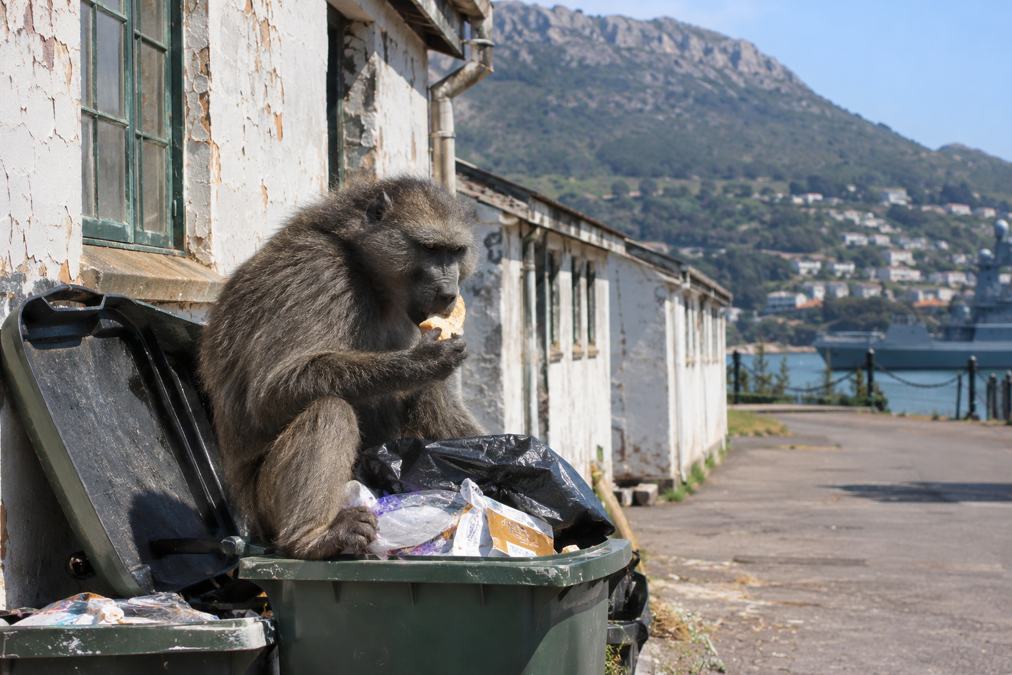
While the underlying causes of human-baboon conflict are evident throughout the Cape Peninsula, Simon’s Town presents a particularly revealing case study. Here, the problem was compounded by the longstanding failure to manage human-derived food waste on South African Navy properties, most notably at Waterfall Barracks.
This is not speculation or an allegation manufactured by conservation organisations. It is documented in the City of Cape Town’s own Urban Baboon Programme reports, stretching back more than a decade, which cite multiple Navy properties as human-derived feeding hubs, enabling the baboons to move between them and further into the urban environment.
The naval barracks
This is arguably the most important Simon’s Town-specific issue.
The Waterfall troop had access to naval properties where food waste was readily available. The management reports describe:
- Inadequate waste disposal at the naval facilities.
- Bins that were not baboon-proof.
- Bin-room doors that were unlocked or could not be secured.
- Food waste left accessible to baboons.
- Buildings and roofs that provided opportunities for the troop to roost.
- Multiple naval properties acting as feeding points throughout the town.
The December 2012 management report from Human Wildlife Solutions is particularly revealing. It records that the bin-room door at Waterfall Barracks was not lockable, the bins were not baboon-proof, and baboons scattered waste after gaining access. The report also stated that management repeatedly asked the warrant officer responsible to address the problem; however, he failed to do so.
Waste management
The COVID-19 lockdown only served to exacerbate an already established problem, with deteriorating waste-management arrangements providing further opportunities for baboons to access human food.
Over time, the troop became habituated to human presence and learned that the naval installations and surrounding urban environment offered readily available food and shelter.
Then there is the litter and waste created by the informal settlements.
Habitat loss
Add to that the ever-increasing fragmentation and loss of normal habitat and feeding ranges. The Cape Peninsula Baboon Strategic Management Plan (2023/24–2033/34) makes an important admission: across the Peninsula, a substantial proportion of naturally available low-lying land has been transformed into residential, commercial, industrial and agricultural landscapes.
The plan explains that baboons generally prefer low-lying areas for foraging and higher ground, including cliffs, caves and tall trees, for sleeping and roosting. It identifies the loss of low-lying habitat as a contributor to human-baboon conflict.
In fact, a July 2023 City Urban Baboon Programme report identified two City-owned properties, ERFs 844 and 825, in Simon’s Town where dense alien vegetation provided refuge for the Waterfall troop. The report said the vegetation made it difficult for rangers to encourage the baboons away from the urban edge and recommended clearing it. I am unable to find evidence that it was ever cleared.
Habituation
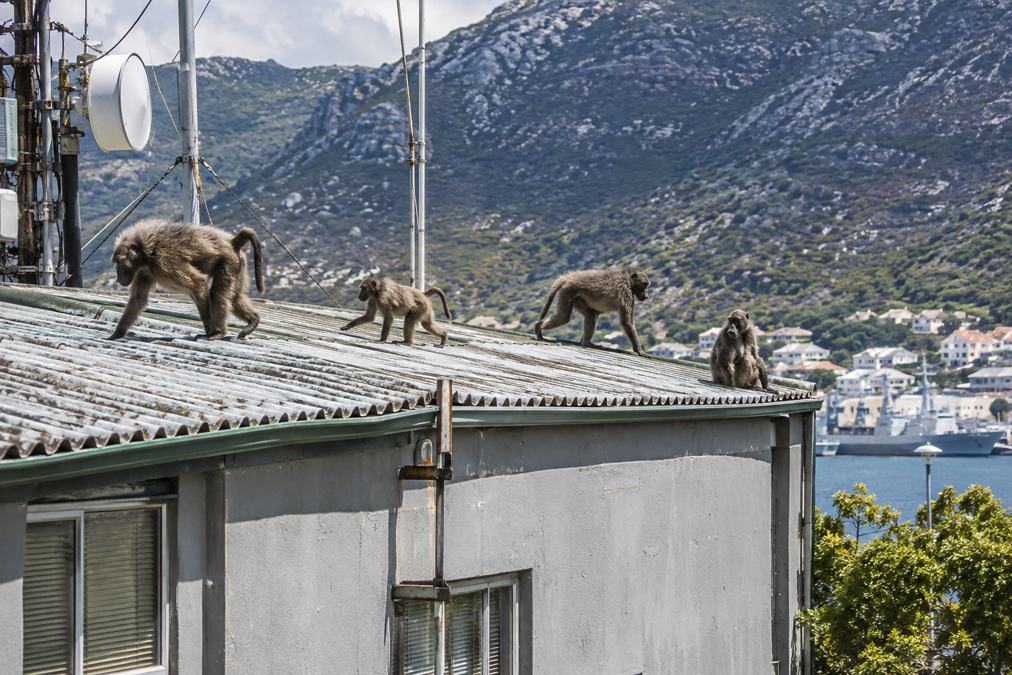
Added to the above, the Waterfall troop had become habituated to human presence through prolonged exposure to urban environments. Research dating back to around 2009, together with the Simon’s Town Civic Association’s Baboon Dialogue Initiative, identified two key drivers of conflict: the loss of natural foraging areas as development expanded, and the baboons’ learned association between human environments and readily accessible food.
As the troop became increasingly accustomed to people and conventional deterrents, traditional herding methods also became less effective. Crucially, habituation is not an inherent behavioural defect. It is an adaptation to an environment, in which human activity has repeatedly provided opportunities for food and shelter.
Solutions
Having established that the human-baboon conflict in Simon’s Town has been driven, in significant part, by human activity and failures in management, we arrive at the question that should be at the centre of this entire debate: Why, after years of documented problems, repeated warnings and recommendations for corrective action, are the baboons now being made to bear the ultimate consequences of human failure? Why are the animals paying the price for a problem we created?
I think I can answer that question.
Because addressing the problem would have required something that appears to have been in desperately short supply: political will, accountability and a willingness to confront another government department.
Take Waterfall Barracks, for example. The City’s own reports repeatedly identified the property as a significant source of human-derived food and shelter for the baboons. The problems were documented as far back as 2021 and continued through 2024, despite repeated engagement with the Navy and recommendations for corrective action.
But why was the discussion apparently confined to securing buildings and waste facilities? Was there ever a serious proposal to assess which parts of the barracks were still operationally necessary, require the Navy to vacate redundant buildings, and have those buildings demolished or repurposed so that they no longer provided attractive sources of food and shelter?
That would have required the City to engage decisively with national government, establish which facilities were genuinely required by the Navy and insist that the remaining property be properly managed. It would have required someone to take responsibility for addressing a problem that had been repeatedly identified but never adequately resolved.
Then there is the question of littering, illegal dumping and unsecured waste.
Cape Town already has legislation providing for substantial fines and imprisonment for illegal dumping. The problem, therefore, is not simply an absence of laws. It is whether those laws are being consistently enforced and whether those responsible for creating or maintaining baboon attractants are being held accountable.
I would go further. There should be a properly enforced system of penalties for anyone who litters, dumps waste or repeatedly fails to secure refuse in designated baboon-management areas. That should include residents, businesses, public facilities and government departments, without exception.
I would propose a minimum R5,000 admission-of-guilt fine for defined waste-management offences, with substantially tougher consequences for repeat offenders. Where an individual repeatedly disregards the law, the courts should have the power to impose meaningful custodial sentences, subject to the usual requirements of due process and proportionality.
And that standard must apply equally to the South African Navy, municipal facilities, private businesses and individual residents.
Habitat loss
If habitat loss and the fragmentation of natural foraging areas were such significant contributors to the conflict in Simon’s Town, why was there not a far more determined effort to address those underlying problems?
There were proposals. As far back as 2022, the City itself raised the possibility of imposing additional development restrictions through an overlay zone in areas bordering baboon habitat.
Conservation biologist Dr David Gaynor proposed a baboon-proof fence along the mountain firebreak, designed to keep the troop out of residential areas while allowing it to remain free-ranging in its natural habitat. Other proposals included restoring traditional sleeping sites and improving the natural routes through which baboons moved around the area.
Yet I have found no evidence of a formal development moratorium for Simon’s Town, nor a dedicated programme to restore and reconnect natural foraging habitat for the Waterfall troop.
Why was the protection of remaining habitat not made a greater priority? Why were development restrictions, ecological restoration, and the preservation of natural movement corridors not pursued with the same determination as the proposals to capture and remove the animals?
Bureaucracy won, while the baboons lost
Again, I think I can answer that question.
Because it would have required political courage, initiative and a willingness to make decisions that might have irritated voters, developers, powerful interest groups and, potentially, other government departments. It would have meant confronting those responsible for poor waste management, challenging development practices, enforcing regulations and demanding accountability from institutions that had allowed the problem to persist.
That takes effort, determination and, above all, a willingness to accept responsibility.
Instead, it was considerably easier, cheaper and more politically convenient to make the baboons pay the price for human failure. The animals had no vote, no political influence, no financial leverage and no ability to hold anyone accountable.
Therein lies what I believe to be the real failure: a bureaucratic culture in which managing a problem becomes more important than solving it, where institutional self-preservation takes precedence over initiative, and where the easiest available solution is often the one that requires the least imagination, the least confrontation and the least accountability.
Contravention of NEMA
Another significant consideration that appears to have been overlooked in this entire debate: the legal obligations imposed on government authorities by the National Environmental Management Act 107 of 1998 (NEMA).
Section 2 of NEMA establishes a set of national environmental management principles that apply to all organs of state whose actions may significantly affect the environment.
These principles require, amongst other things, that the disturbance of ecosystems and loss of biological diversity be avoided, or where this cannot be avoided, minimised and remedied. They also require a risk-averse and cautious approach to decisions where the consequences are uncertain, that environmental impacts be properly assessed, and that authorities pursue the best practicable environmental option.
Furthermore, the National Environmental Management: Biodiversity Act 10 of 2004 (NEMBA), as amended in 2022, expressly incorporates consideration of animal wellbeing into the management, conservation and sustainable use of biodiversity.
These are not simply aspirational statements. They form part of the legislative framework within which environmental authorities are required to exercise their powers.
This raises some serious questions about the decision to remove the Waterfall troop from its natural habitat and place it in what is intended to be permanent captivity.
Where is the comprehensive assessment demonstrating that this was the best practicable environmental option? Where is the evidence that all reasonable alternatives, including habitat restoration, development restrictions, strategic fencing, improved waste management and sustained coexistence measures, were properly investigated and exhausted?
What assessment was undertaken of the long-term ecological, behavioural and welfare consequences of removing an established, free-ranging troop from its natural environment and preventing it from reproducing?
And how were these consequences weighed against the environmental management principles contained in NEMA and the biodiversity and animal-wellbeing objectives of NEMBA?
The fact that CapeNature has issued permits for the capture and transportation of these animals does not answer those questions. Nor does an approved management plan automatically establish that every decision taken under it complies with the broader legislative framework.
The authorities have a responsibility to demonstrate that their decisions are not only administratively authorised, but also consistent with the environmental laws they are entrusted to uphold.
It is not enough to call something conservation because it is being undertaken by a conservation authority. The lawfulness and ecological justification of the intervention must stand up to scrutiny. This is where, I believe, future litigation against the City of Cape Town lies.