Keeping your computer files organized is a nightmare in today’s wired world. Imagine spending hours and hours looking for a file on a messed folder is quite a chore. Maybe you should consider arranging your files appropriately so you can access it easily whenever and wherever you need it. You might want to check these tips to make an organized file from chaos. Here are some ways on how to properly manage your computer files.
Recycle Bin
Many of us computer users save unnecessary files, and we end up having loads of repetitive and nonsense documents. Cleaning up the storage is one way of organizing your computer files since there is no point in saving unwanted files. In doing so, you might discover how many times you add up to your computer’s storage in stowing three copies of the same file under one file name. To give you an idea, here are some great duplicate file finders that may help you to clean up those drives and make space for new needed files. Many individuals try using tools like Tidyup 5, Duplicate Sweeper, Anti-duplicate to locate the same file efficiently. Delete those copies that only consume some space.
Group Your Files
When we do a project or file, what we usually end up doing is saving it wherever the screen tells us to store. We often find piles of different files in one folder like those documents you typed, images you saved, videos, and kinds of music you downloaded that gives such pain in the eyes seeing compilations of different types of data. Consider making a folder for each category, make one for your documents, add another folder for all your downloaded videos, another one for your songs to be streamed, another one for your saved images. In doing so, you can easily navigate and access your files without confusion and hassle.
Use the Right Name
Laziness makes us impulsive in naming the file, and we often save things with names like letter1, asdf, letter2, docs2. It is our common mistake when we store something. Doing this causes such hassle when we need the documents, and we have to open each file to view what’s in it, cut off the laziness and start naming your file according to its description and purpose. For instance, you can use the exact words that describe the file, like bills, and proposals you can scout what you are looking for without having to open each improperly named file. Saves time and gets rid of the mess.
Use Storage Providers
One way to keep access to all your organized files is by using storage providers where you can back up your files and manage it from different devices anytime. Try using OneDrive, Google Drive, iCloud, and the like to sync and backup your files safely and securely. These services provide multiple data storage that can be very efficient for those who keep a stockpile. These services also have a strong search ability that will make your life easier by just typing file type, keywords, and more.
Arranging and cleaning up those computer messes may take some time to do so. However, you will thank yourself in the future for having such a clean pile of records and accessible data that will save time and make your computer look pleasingly organized.
With more than a century under its belt, Rolex has become a staple name in the field of luxury watch manufacturers. The mystique that comes with the name Rolex has only increased people’s interest in the brand. The manufacturer keeps the process of developing this ageless machine behind closed doors.
What makes a Rolex a must-have in your collection is the fact that every single model is hand-assembled and tested. This Swiss masterpiece goes through triple checks in order to deliver a watch that withstands time.
Owning a Rolex watch is considered a luxury, and we understand why. Most Rolex watches will not break your bank, and you can own vintage or new Rolex watches under £6000. It doesn’t take a lot to have this magnificent piece of machinery in your collection.
The Devil in the Details
Tiny details, such as various dials, bezels, and crown guards, vary immensely from model to model. Since not every model from a collection is the same, that adds a lot to the watch’s overall collectability. Features that were available for a short time, like the ‘Bart Simpson’ dial in the ‘60s, contribute to its value. Every avid collector dreams of owning a unique Rolex model.
As we mentioned, all Rolex watches are hand-made. Thus, the professionals creating a sample need a year, or longer, to perfect one Rolex wristwatch, which testifies to the quality of Rolex products. Even so, round 800,000 watches are produced per year.
Value with Time
Unlike many other watches whose value decreases the moment you purchase them, the value of Rolex increases. This might not be true for all Rolex models but certainly is true for vintage models and stainless steel sports watches.
Vintage Rolexes, such as the Daytona and Explorer, are usually in high demand. Of course, it is expected of the watch to be in pristine condition for its value to increase continually. On the other hand, Rolex sports watches are typically sought after as well because most collectors want this unique and limited item, which makes it even more valuable.
Recognition and Versatility
What makes Rolex stand out is its design. It would be difficult to find a watch enthusiast unable to recognise Rolex’s predominant look. Most Rolexes are round-shaped and waterproof. The majority of collectors love the idea of preserving and improving existing collections. Rolex does precisely that while carefully modifying iconic models to remain relevant.
Rolex is a watch that can be worn for any occasion. No matter the situation, you can easily switch from a leather strap to a bracelet. Accessorising a Rolex watch is quite exciting because of the many straps it boasts, like Italian leather, suede, nylon NATO strap, vintage tang buckle, and others.
Quality and Simplicity
Rolex has been present on the market for 115 years, and for a good reason. The quality of the watches persists — they are quite well-grounded and sturdy. For example, Rolex Explorer is made to withstand constant temperature changes. More precisely, it was designed for high-altitude mountain climbers.
The simplicity of the watch is something that remained over time. There are no complicated and flashy features that are unpleasant to the eye. A Rolex was initially made for everyday wear, and it managed to uphold that reputation to this day. The impeccable image of a simple Rolex watch will never go out of style.
Having an online website can help increase your prospective customers greatly than what your physical land-based office can reach. The same is true for your law firm website. Your website does not end its work after it has been established. With the website ranking algorithm of Google changing as time passes and with the ever-changing needs and preferences of internet users, your website needs to keep up with these changes and incorporate on-page SEO enhancements to emerge among the top results and choices of potential clients.
Have a User-Friendly URL Domain Name
One of the most noticeable aspects of your law firm website is its URL domain name. It is the part of your website that can be manually inputted in web searches. Thus, in order to attract many prospective clients, some of the recommended on-page SEO techniques are to make your site’s domain name easy to remember, specific and concise. It is important to include specific keywords associated with your firm’s name and practice. For example, you may have started out making your URL domain name as Chavezlaw.com. In order to establish your website’s niche or location, you can improve your domain name to optimize its location (e.g., ChavezLawDallasTX.com) or specialization (e.g. ChavezLaborLawDallas.com). This way, it is easier to attract the attention of established clients and potential ones by having a specific and powerful URL.
Strengthen Your Title Tags
Title tags are simply the words users see in the clickable link when your site shows up when they search for a particular legal topic. The words in the title are important as they give users an idea of what your business is about before clicking on that link to proceed to your website. The title tag should be created to include keywords and relevant words to your line of business or practice. You are only allocated 61-70 characters for the title, and the first 10-12 words are what can only be seen in the search results, so make the title concise and powerful.
Improve Your Meta Description
The text you see just below the large-font text of the title tag is the meta description or a summary of your website’s content. This area makes good follow-up avenue for you to entice and convince searchers and potential clients to follow your link to know more about your firm. Keep your meta description relevant and embedded with keywords while making the content unique and engaging for users. Start off the description with questions related to the most pressing issues of potential clients. Remember to also keep your description unique and distinctive from other similar webpages.
Optimize Your Header Tags
Also known as paragraph headings, header tags keep your website content organized, well-defined and categorized. H1, H2 up to H4 tags are read by the search engines and alert Google of the topics in the subsequent paragraphs. Thus, specific keywords and law practice-related phrases should be incorporated into these headers.
Redefine Your Page Content
Having high quality and engaging content is one of the most important strategies that apply to basically all types of websites, including law firm websites. You may have initially made general content encompassing various legal topics in the past, but with stiff competition from other law firm websites, it will no longer be effective in attracting an audience. Customize your content by offering useful topics to your audience. A carefully conducted market research and survey must be done first before creating custom content. This way, you are making content that offers legal advice, an answer to the common questions of people outside your client base and a solution to their most pressing legal problems. Make the custom content easy to read for layman readers and engaging enough for them to read on.
Keep Your URL Structure Well-Organized
One of the defining qualities of the modern or new generation of internet users is their inquisitive nature. They are no longer content with staying on a single link on a website, and most of them have multiple tabs open in a single search engine window. This is where keeping an organized URL comes in handy.
Simply defined, the URL structure is how you arrange and name the remaining pages and posts on your website. A well-organized and aptly named URL structure can make it easier for search engines to recognize the links as part of your URL domain, which in turn increases your website’s rate of organic traffic and contributes to your ranking. If your law firm is composed of several lawyers specializing in many legal fields, you can make a URL structure based on legal specializations to help cater to the different legal needs of internet searchers. For example, you can allocate another page dedicated to immigration law and name the subdirectory as ChavezLawDallasTX.com/immigration. Not only are you widening the reach of your website and strengthening its web presence, but you are also giving an avenue for other talented and capable lawyers in your firm to shine, maximize their potential and grow in their careers.
There are actually many ranking factors included in Google’s algorithm, but what is given here are the most important and easiest to apply. Keep in mind to improve the details of your website, especially the ones that are readily seen by internet users. It is in the little and most obvious details that users can get easily get drawn to a certain website. Thus, make it a point to have a user-friendly, relevant and helpful webpage in order to increase its significance, strengthen its presence and improve its ranking.
Australia’s consumer watchdog has recommended major changes to our consumer protection and privacy laws. If these reforms are adopted, consumers will have much more say about how we deal with Google, Facebook, and other businesses.
The proposals include a right to request erasure of our information; choices about whether we are tracked online and offline; potential penalties of A$10 million or more for companies that misuse our information or impose unfair privacy terms; and default settings that favour privacy.
The report from the Australian Competition and Consumer Commission (ACCC) says consumers have growing concerns about the often invisible ways companies track us and disclose our information to third parties. At the same time, many consumers find privacy policies almost impossible to understand and feel they have no choice but to accept.
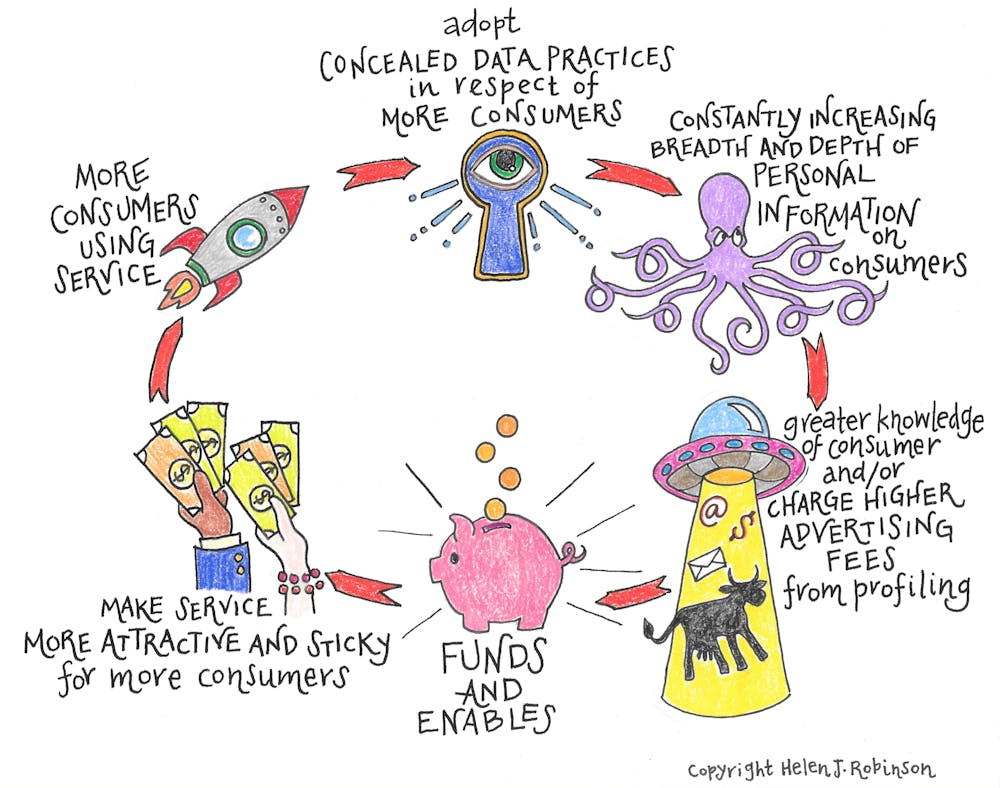
My latest research paper details how companies that trade in our personal data have incentives to conceal their true practices, so they can use vast quantities of data about us for profit without pushback from consumers. This can preserve companies’ market power, cause harm to consumers, and make it harder for other companies to compete on improved privacy.
The vicious cycle of privacy abuse. Helen J. Robinson, Author provided
Privacy policies are broken
The ACCC report points out that privacy policies tend to be long, complex, hard to navigate, and often create obstacles to opting out of intrusive practices. Many of them are not informing consumers about what actually happens to their information or providing real choices.
Many consumers are unaware, for example, that Facebook can track their activity online when they are logged out, or even if they are not a Facebook user.
Some privacy policies are outright misleading. Last month, the US Federal Trade Commission settled with Facebook on a US$5 billion fine as a penalty for repeatedly misleading users about the fact that personal information could be accessed by third-party apps without the user’s consent, if a user’s Facebook “friend” gave consent.
The ACCC is now investigating privacy representations by Google and Facebook under the Australian Consumer Law, and has taken action against the medical appointment booking app Health Engine for allegedly misleading patients while it was selling their information to insurance brokers.
Nothing to hide…?
Consumers generally have very little idea about what information about them is actually collected online or disclosed to other companies, and how that can work to their disadvantage.
A recent report by the Consumer Policy Research Centre explained how companies most of us have never heard of – data aggregators, data brokers, data analysts, and so on – are trading in our personal information. These companies often collect thousands of data points on individuals from various companies we deal with, and use them to provide information about us to companies and political parties.
Data companies have sorted consumers into lists on the basis of sensitive details about their lifestyles, personal politics and even medical conditions, as revealed by reports by the ACCC and the US Federal Trade Commission. Say you’re a keen jogger, worried about your cholesterol, with broadly progressive political views and a particular interest in climate change – data companies know all this about you and much more besides.
So what, you might ask. If you’ve nothing to hide, you’ve nothing to lose, right? Not so. The more our personal information is collected, stored and disclosed to new parties, the more our risk of harm increases.
Potential harms include fraud and identity theft (suffered by 1 in 10 Australians); being charged higher retail prices, insurance premiums or interest rates on the basis of our online behaviour; and having our information combined with information from other sources to reveal intimate details about our health, financial status, relationships, political views, and even sexual activity.
In written testimony to the US House of Representatives, legal scholar Frank Pasquale explained that data brokers have created lists of sexual assault victims, people with sexually transmitted diseases, Alzheimer’s, dementia, AIDS, sexual impotence or depression. There are also lists of “impulse buyers”, and lists of people who are known to be susceptible to particular types of advertising.
Major upgrades to Australian privacy laws
According to the ACCC, Australia’s privacy law is not protecting us from these harms, and falls well behind privacy protections consumers enjoy in comparable countries in the European Union, for example. This is bad for business too, because weak privacy protection undermines consumer trust.
Importantly, the ACCC’s proposed changes wouldn’t just apply to Google and Facebook, but to all companies governed by the Privacy Act, including retail and airline loyalty rewards schemes, media companies, and online marketplaces such as Amazon and eBay.
Australia’s privacy legislation (and most privacy policies) only protect our “personal information”. The ACCC says the definition of “personal information” needs to be clarified to include technical data like our IP addresses and device identifiers, which can be far more accurate in identifying us than our names or contact details.
Whereas some companies currently keep our information for long periods, the ACCC says we should have a right to request erasure to limit the risks of harm, including from major data breaches and reidentification of anonymised data.
Companies should stop pre-ticking boxes in favour of intrusive practices such as location tracking and profiling. Default settings should favour privacy.
Currently, there is no law against “serious invasions of privacy” in Australia, and the Privacy Act gives individuals no direct right of action. According to the ACCC, this should change. It also supports plans to increase maximum corporate penalties under the Privacy Act from A$2.1 million to A$10 million (or 10% of turnover or three times the benefit, whichever is larger).
Increased deterrence from consumer protection laws
Our unfair contract terms law could be used to attack unfair terms imposed by privacy policies. The problem is, currently, this only means we can draw a line through unfair terms. The law should be amended to make unfair terms illegal and impose potential fines of A$10 million or more.
The ACCC also recommends Australia adopt a new law against “unfair trading practices”, similar to those used in other countries to tackle corporate wrongdoing including inadequate data security and exploitative terms of use.
So far, the government has acknowledged that reforms are needed but has not committed to making the recommended changes. The government’s 12-week consultation period on the recommendations ends on October 24, with submissions due by September 12.
Katharine Kemp, Senior Lecturer, Faculty of Law, UNSW, and Co-Leader, ‘Data as a Source of Market Power’ Research Stream of The Allens Hub for Technology, Law and Innovation, UNSW
Apple Inc said on Monday it will issue a software patch later this week for a bug that lets iPhone users hear audio from users who have not yet accepted a video call.
The bug, which Reuters was able to replicate, allows an iPhone user placing a call using Apple’s FaceTime video-calling feature to hear audio from the recipient’s phone even if the recipient has not yet picked up the call. The bug appears to rely on Apple’s group video-calling feature.
In certain situations, the bug also broadcast both video and audio from the recipient’s phone, the technology news website the Verge noted.
“We’re aware of this issue and have identified a fix that will be released in a software update later this week,” an Apple spokesperson said.
Apple’s group FaceTime was temporarily made unavailable due to an ongoing issue, according to Apple’s system status webpage. apple.co/2Sars1k
The Cupertino, California-based company was not immediately available to comment on the update on its system status page.
Users took to Twitter to tweet jokes and comments about the bug affecting Apple’s group FaceTime service.
“Disable FaceTime for now until Apple fixes,” Twitter Inc CEO Jack Dorsey tweeted.
Apple announced the feature last summer, but then removed it from early test versions of its iOS 12 operating system. The company launched the feature in October.
A 10-page memo that went viral inside Google and has been obtained by Gizmodo sees a Google software engineer arguing that women are underrepresented in tech not due to bias, but rather because of inherent psychological differences from men.
The memo has been shared repeatedly on the internal network and Google+. Motherboard first reported that the memo existed, and Gizmodo published it in its entirety.
The memo titled ‘Google’s Ideological Echo Chamber’ is essentially the personal opinion of a male software engineer working for Google.
In the document, the employee argues that he “values diversity and inclusion, am not denying that sexism exists, and don’t endorse using stereotypes.” However, some topics, he adds, now involve “shaming into silence.”
“This silencing has created an ideological echo chamber where some ideas are too sacred to be honestly discussed,” and the lack of discussion brings about “the most extreme and authoritarian elements of this ideology,” the memo says.
The software engineer goes on to claim that the reason why women don’t have a 50-percent representation in tech may be the “differences in distributions of traits between men and women,” and “discrimination to reach equal representation is unfair, divisive, and bad for business.”
The traits in question include “biological differences” that are “universal across human cultures” and are “highly heritable.”
Women in general have more “openness directed towards feelings and aesthetics rather than ideas,”“a stronger interest in people rather than things, relative to men,” so they end up working for front desk rather than coding, the memo’s author argues.
Women also have “extraversion expressed as gregariousness rather than assertiveness,” hence, “higher agreeableness,” and consequently, “women generally have a harder time negotiating salary, asking for raises, speaking up, and leading,” according to the memo.
“We need to stop assuming that gender gaps imply sexism,” the document says.
Feminists on Twitter have reacted with outrage and four-letter expletives.
Another issue the author highlights is that “feminism has made great progress in freeing women from the female gender role, but men are still very much tied to the male gender role.”
“If we, as a society, allow men to be more ‘feminine,’ then the gender gap will shrink, although probably because men will leave tech and leadership for traditionally feminine roles.”
The author concludes that “despite what the public response seems to have been, I’ve gotten many personal messages from fellow Googlers expressing their gratitude for bringing up these very important issues which they agree with but would never have the courage to say or defend because of our shaming culture and the possibility of being fired. This needs to change.”
Following the heated debate that surrounded the memo both inside and outside Google, the company’s new Vice President of Diversity, Integrity & Governance, Danielle Brown, issued a statement saying, “Many of you have read an internal document shared by someone in our engineering organization, expressing views on the natural abilities and characteristics of different genders, as well as whether one can speak freely of these things at Google. And like many of you, I found that it advanced incorrect assumptions about gender. I’m not going to link to it here as it’s not a viewpoint that I or this company endorses, promotes or encourages.”
“The Middle Ages is a space where white supremecy is legitimised. The maintenance of white privilege. The gamer community use ‘historical facts’ to legitimise this kind of literacy,” said British Ph.D. candidate Victoria Cooper recently. Mediaeval representations in video games was the focus of Victoria Cooper’s paper, Playing Politics: Exploring Nationalism and Conservatism in Fantasy Video Games, which was given earlier this month at the International Medieval Congress. Part of the session,The Use and Abuse of the Middle Ages in the Modern World, IV: Nationalism and Identity, it examined the ways in which medieval imagery and history are often hijacked by far-right political groups and nationalist organisations to legitimise their historical narratives.
Victoria Cooper
Cooper, a PhD candidate at the University of Leeds, used player assessments of the Middle Ages, marketing, and player forums as the backbone of her research. Forums, in particular, are good resources for player observation because conversations here spring up organically and aren’t censored. When Cooper was speaking to players, she was careful to never brings up the Middle Ages to see if they brought it up themselves. The result? Most players do.
What did these unchecked conversations reveal? The games don’t inspire a specific kind of nationalism with another country per se, but they do harken to “the mediaeval’ which becomes it’s own space, and has its own nationalistic quality where real heritage is superimposed upon a fictional world.
Cooper notes that the medieval world is often exploited by right wing groups, such as the British National Party (BNP). They used the symbol of Excalibur to promote “Englishness”, since, according to legend, Excalibur is the sword that confers the rightful kingship of England. There is even an online shop profiting from this perceived sense of English nationalism that declares, “Excalibur: the number 1 patriotic goods store”. However, it appears that the BNP is no longer affiliated with the shop and Excalibur has taken great pains to extricate itself from the association by posting a large disclaimer on their front page stating, “Excalibur has no affiliation or ties to any political party. All merchandise sold on Excalibur belongs to Excalibur and any profits made from such merchandise stays with Excalibur.”
Groups like the BNP in England often attempt to tie a mediaeval past to their nationalism by framing it with shirts like, “White and Proud”, or “Anglo Saxon”, as a form of identity politics.
#GamerGate
Cooper recalled the infamous “#GamerGate” – the 2014 scandal that erupted in the gaming world when several prominent women challenged the status quo of the community. The women received rape, violence and death threats. They (and their supporters) were also “doxed”; a tactic whereby private information, like a home address, phone number, place of work and personal details are made public in an effort to silence and publicly shame the person.
Cooper noted that the gaming community has traditionally had horrible reactions towards academic inspection of games because players want to maintain them as apolitical and are resistant to changing the status quo. The predominantly white, male players of Gamergate insisted that representations of the games should be divorced from modern politics.
However forcefully players maintain their arguments, many gamers continue to map their identity, heritage, and ancestry onto these games. They claim to be apolitical, yet in the same breath, refuse to acknowledge the politics behind these games. According to Cooper, they subscribe to the popular idea of the Middle Ages as ‘gritty, white, male, and powerful’. They cling to the notion that women didn’t fight in the Middle Ages, fiercely stating this as ‘as fact’, and steadfastly refusing to allow women agency in warrior roles.
Unfortunately for gamers, the tide is turning and the inspection of their identities is happening whether they like it or not, and will continue to gain momentum. Games like Skyrim, and The Elder Scrolls are only the tip of the iceberg. What Gamergate tried to shut down, instead, opened a Pandora’s Box that can never be closed. Academics, like Cooper, will continue to challenge, examine and illustrate the ways these groups misappropriate mediaeval history. – mediavalists.net
Google Inc said on Thursday it had started testing the latest prototypes of its self-driving cars on Mountain View, California roads, with safety drivers aboard.
The prototypes will join Google’s Lexus cars, which use the same self-driving software, the company said in a blog post on Thursday. Google’s self-driving Lexus RX450h sport utility vehicles have been in operation for several years.
Although the prototypes are designed to work without a steering wheel or pedals, safety drivers will have a removable steering wheel, accelerator pedal and brake pedal during the test phase in case they need to take over driving.
Earlier this month, Google launched a website specifically for the self-driving car. That came after increasing criticism by customers and consumer groups that the search giant was not providing enough information about the project.
Google has so far reported 12 accidents involving the prototypes. Injuries have been minor, the search giant has said, and accidents were mostly a result of human error by the drivers of the other cars involved.
As US mass surveillance continues to make headlines, one man has had enough. Philip Zimmermann, creator of one of the most widely-used encryption systems, has moved his company to Switzerland, claiming societies need to “roll back” surveillance tactics.
Expressing his concerns about mass surveillance, Zimmerman told the Guardian that “every dystopian society has excessive surveillance, but now we see even Western democracies like the US and England moving that way.”
Zimmerman is the inventor of the encryption program Pretty Good Privacy (PGP), as well as the co-founder of three-year-old encryption start-up Silent Circle.
“We have to roll this back. People who are not suspected of committing crimes should not have information collected and stored in a database. We don’t want to become like North Korea,” the Internet Hall of Fame inductee continued.
Silent Circle will now operate from Switzerland – a move prompted by the 2013 Lavabit incident. The founder of Lavabit – which provided email addresses for 410,000 people including NSA whistleblower Edward Snowden – was served with a court order in 2013, requiring him to install surveillance equipment. This prompted him to close the service.
Zimmerman paid close attention to the situation, realizing that Washington could also serve Silent Circle – which offered voice, text, and email services – with the same order. He shut down the email service, wiped its database and never looked back.
Now the company is setting up its headquarters in Switzerland – where, according to Zimmerman, he is “less likely to encounter legal pressures.”
On its blog, Silent Circle credits Switzerland with having the “world’s most robust privacy laws,” adding that the company will continue to grow its Washington and London offices, but that “most of our new growth will take place in our new headquarters.”
While the Snowden revelations have opened the world’s eyes to mass surveillance, Zimmerman knew the possibilities all along.
The user manual for PGP, written in 1991 and updated seven years later, warns: “Today, email can be routinely and automatically scanned for interesting keywords, on a vast scale, without detection. This is like driftnet fishing.”
Perhaps it is this insight that has led to such widespread support for Silent Circle. Earlier this year, the encryption system raised US$50 million in a second round of outside funding.
In addition to Silent Circle and PGP, Zimmerman also played a role in developing Blackphone, the world’s most spy-resistant phone. In addition to its sealed operating system largely preventing data leaks, Silent Circle is used on the phone to encode all calls, texts, and contacts.
The second generation of the phone, costing around $700, is expected to be released this year, and will be followed by an attempt at a tablet device.
An MIT report has found that regular solar panels like the ones used today could supply much of the world with power. They believe terawatts of energy could be produced by 2050 and say that investment, not technology, could be the biggest hurdle.
The world’s population currently consumes 15 terawatts of power from various energy sources, according to the Economist. Despite making up less than 5 percent of the world’s population, Americans use 26 percent of the world’s power.
The publication, by the Massachusetts Institute of Technology, shows that no revolution in solar energy needs to take place, as scientists already have everything they need to harness the energy of the sun and turn it into electricity, though minor tweaks may help to improve efficiency.
The US, for example, generates less than 1 percent of its energy from solar power. This is something the researchers are looking to change.
“Our objective has been to assess solar energy’s current and potential competitive position and to identify changes in US government policies that could more efficiently and effectively support its massive deployment over the long-term, which we view as necessary,” Robert Armstrong, the director of MIT Energy Initiative, said in a statement.
The Topaz solar farm in California went online at the end of 2014. It generates 500 megawatts of energy, which is enough energy to power at least 160,000 homes. A terawatt is 1 million megawatts of energy.
The company behind the project, First Solar, uses 9 million solar panels to generate electricity. Crucially, it also eliminates over 350,000 tons of CO2 every year, Techspot reports.
“Solar electricity generation is one of very few low-carbon energy technologies with the potential to grow to very large scale. As a consequence, massive expansion of global solar generating capacity to multi-terawatt scale is very likely an essential component of a work-able strategy to mitigate climate change risk,” the MIT report said.
The study has emphasized the need for more research at a federal level, as well as more development support to help to advance low cost and large scale electricity storage technologies.
Battery technology is expected to be a crucial part of the future development of solar power energy, as the batteries can be used to store electricity during peak production and then dispense it at times when there is no sunshine.
The CEO of Tesla industries, Elon Musk, has been a big advocate of trying to develop better batteries that could help to store electricity.
“Our goal here is to fundamentally change the way the world uses energy,” Musk said on April 30, Bloomberg reported. “We’re talking at the terawatt scale. The goal is the complete transformation of the entire energy infrastructure of the world.”
The ability to get funding is out there. For example, the International Monetary Fund has calculated that the fossil fuel industries are receiving $5.3 trillion a year in subsidies, which is the equivalent to $10 million every minute. This is a figure that those looking to promote solar power can only dream of.
The authors of the MIT publication believe that the production of solar power will only increase if carbon dioxide emissions become costly. They admit this is unlikely to happen without a drastic rethink in US government policy.
“The main goal of US solar policy should be to build the foundation for a massive scale-up of solar generation over the next few decades,” the report said.
The researchers point to the example of Germany as a standout in pursuing green energy. In 1991, Berlin adopted a Feed-in Tariff scheme which was a rebate scheme to encourage the production of low carbon source energy.
The scheme was so successful that by 2013 Germany was producing 45 percent of solar energy in the EU, and 27 percent of solar energy around the globe, despite the fact that the country is not renowned for having a year-round sunny climate.
The head of the nonprofit group that oversees the world’s Internet addresses expressed confidence Thursday that it would be privatized and out of US government control by year’s end.
Fadi Chehade’s comments came despite criticism in the US Congress, where some lawmakers have resisted the plan to end Washington’s key management role in the Internet Corporation for Assigned Names and Numbers (ICANN).
Chehade said all the necessary components for a new stewardship scheme are accounted for and there will be “major legitimizing endorsements” from several countries in coming weeks.
“It is now up to the community to wrap them up, put them in a nice little box with a bow and ship them to Washington,” Chehade said, of the pieces of a plan to supplant a contract ICANN has with the US Department of Commerce.
The comments come a year after the US government said it would end its technical oversight role for the Internet domain system, with the stipulation that it be managed without direct control by governments or intergovernmental bodies like the United Nations.
The US plan seeks to turn over this function to what Chehade calls a “global multistakeholder community.”
Chehade said a growing number of countries, including China and Brazil, have voiced support for this new system.
“When we started we heard things like the UN would take over or China will fragment the Internet. Everyone was in threat and defense mode,” he said.
View galleryICANN is in charge of assigning Internet domain names …
ICANN is in charge of assigning Internet domain names and the numbering codes that lie behind online …
“Now that China has come to the table, and Brazil has done the same, government after government is showing support.”
Chehade said some 150 countries now support the shift of ICANN oversight away from the US government to a globally representative group of governments, civil society and businesses.
– ‘Neutral, well-governed’ –
ICANN is in charge of assigning Internet domain names and the numbering codes that lie behind online addresses. The California-based nonprofit has been overseen by the US government since its inception in 1998, under a contract that expires on September 30.
“I feel the proposal will lead us to a global, independent, neutral, well-governed organization,” Chehade said.
He was optimistic the shift from US oversight would take place by the end of this year, but cautioned that political timetables tend to be elastic.
Chehade dismissed concerns brought up at a House hearing on Wednesday that ICANN was not transparent or accountable enough, saying the organization is open to anyone with ideas regarding how it could be better.
“I welcome the fact that Congress is constantly scrutinizing us; that everyone in the world is constantly scrutinizing us,” Chehade said. “We should always be on top of our game.”
Representative Bob Goodlatte said there had been “concerns routinely expressed by a wide array of stakeholders about ICANN’s trustworthiness, accountability, execution and transparency of its current and existing duties and initiatives.”
The lawmaker also lamented ICANN’s “refusal to deal responsibly with registries that profit from the trafficking of counterfeit drugs and even controlled substances like heroin.”
Last year, some critics in Congress argued that Washington was “giving away” the Internet, posing long-term threats to online freedom and commerce.
Some in Washington have complained that ICANN has failed to crack down on groups that abuse the system, citing domains such as .sucks, which according to critics encourages celebrities and companies to pay out large sums to keep certain websites from going public.
ICANN says it lacks the authority to look into questions of specific abuses but has passed the matter to government regulators.
Electric car pioneer Tesla unveiled a “home battery” Thursday which its founder Elon Musk said would help change the “entire energy infrastructure of the world”. The Tesla Powerwall can store power from solar panels, from the electricity grid at night when it is typically cheaper, and provide a secure backup in the case of a power outage.
In theory the device, which typically would fit on the wall of a garage or inside a house, could make solar-powered homes completely independent of the traditional energy grid.
“The goal is complete transformation of the entire energy infrastructure of the world, to completely sustainable zero carbon,” Mr Musk told reporters shortly before unveiling the Powerwall in a stylish warehouse space outside Los Angeles.
Examples of the sleek device — available in a range of colours — were lined up along one side of the hall. “It looks like a beautiful sculpture on the wall,” said Mr Musk.
All the power for the evening demonstration, attended by several hundred media as well as tech world participants, came from his new batteries, hooked up to solar panels on the roof, he said.
Initially the device, which will cost $3,500, will go on sale in the United States later this year. But the aim is to roll it out internationally some time next year.
Germany is seen as a key market for the product because it has among the highest take-up of solar energy in the world, Musk said.
But it could also be a huge boon for under-developed regions, where power is often unreliable at best, despite abundant solar energy — and he compared the potential to that of the way cellphone technology has expanded.
“It’s analogous to the way mobile leap-frogged landlines,” Mr Musk said.
“This is going to be really great for the poorest communities in the world,” he said. “This allows you to be completely off grid.” Mr Musk stressed however that moving advanced economies like America away from unsustainable fossil fuels was a key goal. “I think we should collectively do something about this … we have this handy fusion reactor in the sky, called the sun,” he said.
Last year Tesla announced the construction of the world’s largest lithium-ion battery plant in Nevada, a five-billion-dollar “Gigafactory” with Japanese electronics giant Panasonic.
Plenty of people these days are prepared to augment their bodies with face furniture, piercings, rings and tattoos.
But would you implant a chip in your hand to show how easy it is to exploit an Android phone?
That’s what former US navy petty officer Seth Wahle did, in an attempt to demonstrate how business networks could be compromised.
Wahle took an NFC chip, similar to the kind found in many of today’s smartphones, and injected it between the thumb and finger of his left hand. According to Forbes, the injection was something of an eye-watering experience.
But implants aren’t for the squeamish. Wahle says the needle was bigger than he’d expected when he had the chip implanted by an “unlicensed amateur” for $40, enough to make him want to vomit. He says he had to go through a backstreet operation due to Florida’s restrictive body modification laws.
Unfortunately for lovers of Hollywood techno-thrillers, the attack itself is fairly lame.
As the article in Forbes describes, for the exploit to be successful the victim has to click on a link sent to his Android device by the implanted NFC chip:
It has an NFC (Near Field Communications) antenna that pings Android phones, asking them to open a link. Once the user agrees to open that link and install a malicious file, their phone connects to a remote computer, the owner of which can carry out further exploits on that mobile device.
Put simply, that Android device is compromised. In a demo for FORBES, Wahle used the Metasploit penetration testing software on his laptop to force an Android device to take a picture of his cheery visage.
During a time when the gaze of the world’s technology lovers is firmly on technologically developed areas such as North America, East Asia and Europe, the notion that one of the least developed areas on the planet, Africa, could soon be producing some of the hottest upcoming technology and gadgets is a rather strange thought. The fact is, however, that there are a variety of new and upcoming African additions to the technology market that are going to change the face of the continent, and perhaps beyond.
Jumia
On a continent where the vast majority of transactions are completed via cash or mobile phone, the idea of Amazon-like delivery services seems a distant possibility. Despite the lack of credit and debit card capacity in African countries, however, companies are stepping in to the online realm, taking advantage of the current climate. Jumia is akin to Amazon, yet delivers good within the Nigerian cities Lagos and Abuja via motorcycle to customers, payments being made with cash on delivery.
mPawa
There are an estimated 750,000,000 SIM cards in Africa, many African people having their own mobile phones with call and SMS capacity. mPawa takes advantage of the current state of the African telecoms market, matching employers with potential employees that have the correct skill set. The service does work via online, but can also be used via SMS.
Mint Smartphone
South African technology companies Mint and CZ Electronics have teamed together recently, aiming to produce Africa’s first smartphone. The company, once a subsidiary of Alcatel, is aiming to produce an affordable, top-quality smartphone that will contain a dual core processor, camera, HD screen and Wi-Fi/3G/4G connections. Soon, Africans everywhere will be able to watch videos on Youtube, acess and get involved with social networks such as Facebook, and play online games on providers such as Springbokcasino in complete security. It’s likely all of these sites will be poised for a huge amount of growth as the African online market booms.
Kopo Kopo
In countries where the majority of payments are made via mobiles, shop owners everywhere are cottoning on to the trend and the possibilities that go with being able to conduct payments in a mobile manner. Kopo Kopo is a Kenyan start-up that allows consumers to make payments via their mobile phones at any store or merchant who has signed up to the service.
This website uses cookies to improve your experience. We'll assume you're ok with this, but you can opt-out if you wish. Cookie settingsACCEPT
Privacy & Cookies Policy
Privacy Overview
This website uses cookies to improve your experience while you navigate through the website. Out of these cookies, the cookies that are categorized as necessary are stored on your browser as they are essential for the working of basic functionalities of the website. We also use third-party cookies that help us analyze and understand how you use this website. These cookies will be stored in your browser only with your consent. You also have the option to opt-out of these cookies. But opting out of some of these cookies may have an effect on your browsing experience.
Necessary cookies are absolutely essential for the website to function properly. This category only includes cookies that ensures basic functionalities and security features of the website. These cookies do not store any personal information.
Any cookies that may not be particularly necessary for the website to function and is used specifically to collect user personal data via analytics, ads, other embedded contents are termed as non-necessary cookies. It is mandatory to procure user consent prior to running these cookies on your website.