What’s affirmative about affirmative action?

“Cadre employment must stop and an effective civil service must be built up by appointing  competent people. Officials and managers at all three levels of government should possess the correct financial and technical skills for the job.” So declared president Cyril Ramaphosa after a visit to Kimberley recently where the ANC celebrated its 108th birthday. He was “shocked” at the living conditions he found there, he said. “But we know the (country’s) looting and the wholesale state capture shebang took place right under his nose, with his eyes wide open”, said columnist Barney Mthombothi (Sunday Times 12.1.20). So why the president’s shock at the Kimberley situation? Doesn’t he read the newspapers?

He said that if the country’s peoples’ lives must be bettered, then the services delivered by the country’s three levels of government must improve.

How will he better this parlous situation? He declared that attention must now be given to the “thorough training of the state’s civil service corps”. (But they have shown themselves to be untrainable and, more seriously, to have no integrity. They have caused irreparable damage to South Africa’s local government systems and structures over the past 25 years.)  Mr. Ramaphosa is going to restore to “health” the country’s parastatals (such as South African Airways.) “We will get it right by appointing qualified and experienced managers and give them the space to fulfil their mandates,” said the president.

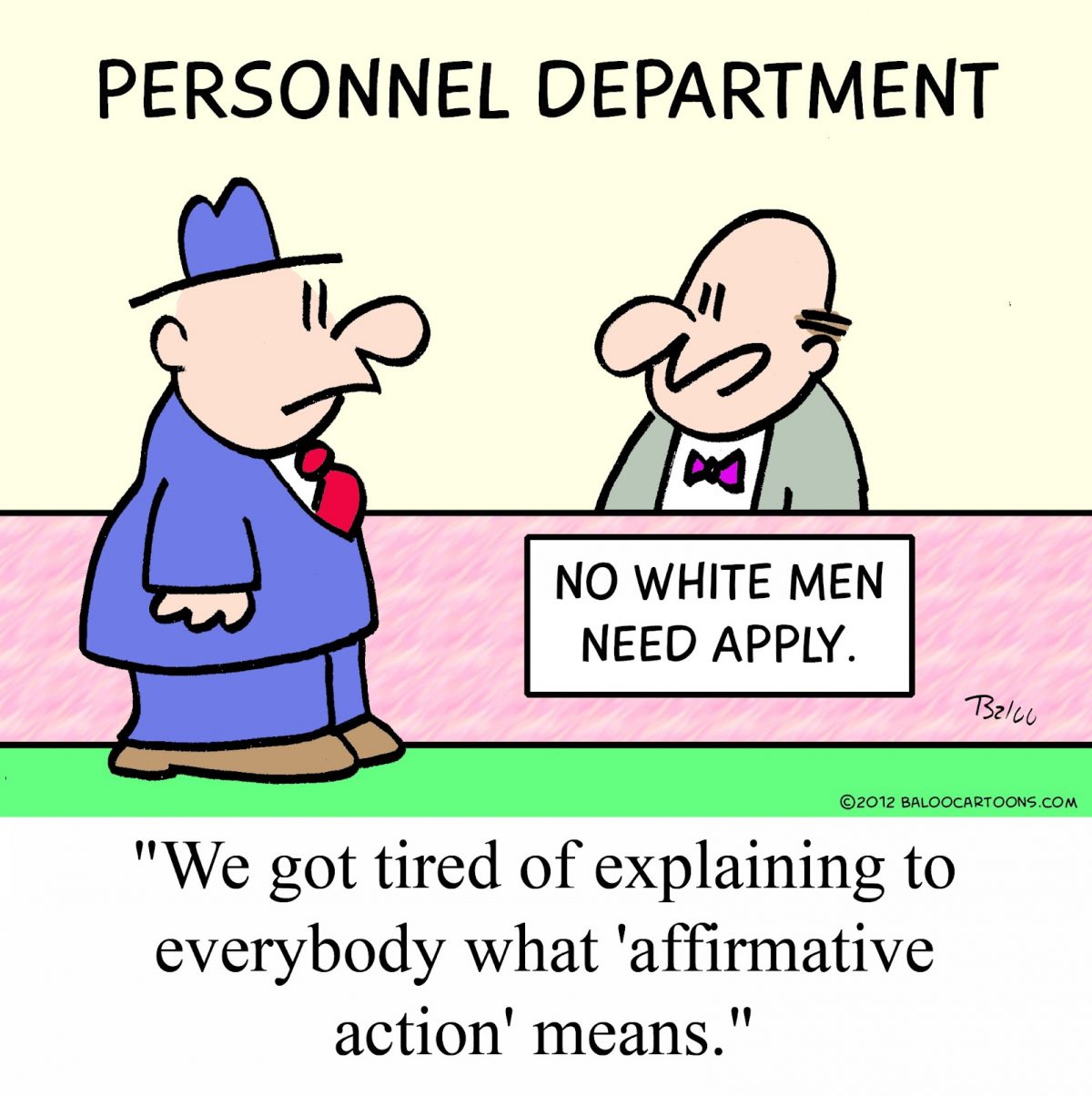
So why didn’t he do this a long time ago? Because he doesn’t intend to change anything, just move cadres around like deckchairs on the Titanic. Proof of this chicanery can be observed by checking out the media advertisements for government jobs, especially for municipalities.  All of these, without exception, state that the municipality (or any other government department), is “an Employment Equity Organisation that subscribes to the principles of affirmative action”. In other words, no whites must apply.

There we have it. Mr. Ramaphosa is a teller of tales which bear no resemblance to the truth. Declares Mr.Mthombothi: “Apart from his well-earned reputation as a coward, Ramaphosa is cultivating another unfortunate trait. He’s telling too many falsehoods. These fibs are not only corroding his credibility, they are a godsend to his ever-expanding bank of enemies”. (Mthombothi was referring to the rafts of lies told and promises made during the president’s tenure, including the whopper in New York in December 2018 about SA farm murders “not existing”.)

Deformative Action

The root cause of South Africa’s descent into third world status is indeed “affirmative action” (AA), a term first used in the United States in Executive Order No. 10925 signed by President John F. Kennedy on 6 March 1961, which included a provision that government contractors “take affirmative action to ensure that applicants are employed, and employees are treated during employment, without regard to their race, creed, colour, or national origin.” This was followed by further legislation in 1965 and in 1967, when gender was added to the anti-discrimination list.

According to Wikipedia, “this action prevented employers from discriminating against members of disadvantaged groups.”  In South Africa’s post-1994 election period, the term “previously disadvantaged” became part of the country’s politically correct lexicon, implying that, in quite explicit terms, whites had historically suppressed the other South African race groups. The corollary of this narrative was a relentless media chronicle (intentional or unintentional, the jury is still out on this!) to heighten white guilt and its spin-off, black entitlement. This has resulted in a policy of reverse discrimination so severe and unyielding that is destroying the South Africa we knew. It is in fact deformative action.

One key to the SA government’s warped version of affirmative action is the word “disadvantaged”. Many argue that this word misrepresents history, and with good reason. Empirically there is no contrary narrative to the fact that when whites arrived in the Cape in 1652 and subsequently moved throughout Southern Africa, there was no evidence of a local civilization other than a basic way of life that did not include the written word, or serious infrastructure or any other sign of natural evolution or development towards a way of life similar to that brought to South Africa by the whites from Europe. This fact has been attested to by writers, travellers and historians who visited Southern Africa over the centuries since 1652 where they chronicled what they saw. Political correctness had not reared its ugly head at that time, so what they saw and what they wrote cannot be challenged because there were no other versions, and their agendas were mostly historical.

Is it any wonder that the descendants of these people who occupied Southern Africa at the time of the arrival of the whites have virtually destroyed South Africa’s functioning infrastructure and the social fabric created and built up over 450 years? They never developed anything remotely resembling the accoutrements of a functioning modern civilization. When the ANC/SACP alliance appointed their political friends and colleagues to posts via the official policy of AA, where not even the vaguest knowledge and skills existed to enable many of these appointees to fulfil their mandates, it can be concluded that the collapse of South Africa was entirely predictable. There could have been no other outcome.

So why the term “disadvantaged”? Many would assert that black South Africans have been advantaged by their co-option into the Western civilization developed by others which gave them the written word, a Western-style education system and all the trappings of a way of life which, alas, is so desperately lacking in most of sub-Saharan Africa. It could be said that the real disadvantaged are the South Africans who pay the bulk of the taxes, who pay for electricity and water when millions use these services and pay nothing, and who see the country’s schools, transport services and other facilities go up in smoke at every protest about “non-delivery” of services for which they have never paid and will never pay! This destruction is wanton and the serious consequences thereof never seem to enter the heads of the perpetrators.

With the exception of only two years – 2011 and 2014 – there has been a steady net growth in the number of SA emigrants. It is estimated that by 2017 more than 820 000 wealthy educated people have left South Africa. The number of SA born emigrants to the Big Five countries (UK, US, Canada, Australia and New Zealand) almost doubled between 2000 and 2017, an average net increase of about 1 500 per month. These people are the cream of South African society, the taxpayers, the job creators, the entrepreneurs. They left because the ANC government has got it all wrong, and there seem to be no remedies in sight.

Nothing is done

The appointment of AA cadres is exacerbated by the inability and/or obstinacy of the SA government to do anything to ameliorate the problems associated with AA: vast and pervasive incompetence, indolence, corruption and a totally unjustified sense of entitlement. Neither the government nor their cadres can introspect. They cannot see what others see – that they are useless. Or maybe they don’t want to see. While the country falls apart around them, they will continue to talk the leg off an iron pot at meetings, summits, lekgotla’s and sundry get-togethers where they endlessly discuss the country’s “challenges” (read failures).  BUT NOTHING GETS DONE.  Businessmen, commentators and a myriad of worriers write endless articles “urging” the government to do something. These pleas fall on deaf ears. The ANC moves at its own pace: its real goal is the retention of power at any price. Such is the ransom we have paid on the altar of African “democracy”.

Relentless

The destruction continues relentlessly. There is no stay of execution. A cursory glance at any daily South African newspaper will confirm the continuity of the ANC government’s stupefying stupidity. One blatant example is president Ramaphosa’s announcements that his government will proceed with legislation enabling the expropriation of private property without compensation. In the next breath he talks about the investment “millions” that will flow into South Africa, as if one circumstance will not influence the other.

Now the ANC proposes that the courts will not be the arbiter of whether or not the state will pay for land it expropriates. This power is given to the relevant minister. This latest rashness reveals a remarkable lack of “cause and effect” thinking, but then this has always been a hallmark of a rudimentary mindset. The example of Zimbabwe’s collapse seems to have either escaped the president, or he believes that things will be different here! Either way, the president is hardly fit to lead South Africa.

Affirmative action in South Africa is a tragic failure. The inevitability of its outcome was pointedly ignored by those who had neither the integrity nor the foresight to know what the future would hold, despite the numerous examples of nepotism, patronage and affirmative action displayed by virtually every African government north of the Limpopo. In South Africa, leaders and influencers were seduced by the world’s approbation of this country’s “transition to democracy”. Warnings were either ignored or dismissed as the rantings of extremist groups.  History will be the judge of who was right. But being right doesn’t necessarily  mean you win!

Opinion: South Africa is sleepwalking into disaster

The worm has turned and virtually every South African political commentator whose legacy was to encourage a one man one vote ANC takeover in South Africa is now tearing into the government and its alliance partners. The country is on its economic knees and those in charge seem blithely unaware of the destruction they have wrought and are still wreaking, or else they couldn’t care less. What is surprising is that people are surprised. Why would ANC cadres not do what they are doing, given who they are and whence they came? A leopard never changes its spots.

In his startling and brutally critical book “How long will South Africa survive? The Looming Crisis”, former ANC supporter and self-described ex Marxist R.W. Johnson explains how effortlessly the ANC government has slipped into the lifestyle of so many other African ruling cliques, but with more to plunder and destroy. He has put to bed any notions that the ANC may still have something up its sleeve and the country will come right after all. The book should be required reading for all thinking South Africans.

TAU SA has watched the slide with the somber knowledge that it was inevitable. Warning after warning has been issued, to little avail. Agriculture was one of the first victims of government’s ludicrous socialistic policies (there are currently 16 pieces of legislation on the table designed to hobble SA’s commercial agriculture) but the country at large appeared disaffected because it wasn’t happening to other segments of society. It was only a matter of time before the other shoe dropped: affirmative action hit all levels of the country’s civil service; Black Economic Empowerment (BEE) has affected virtually all manufacturing and commercial enterprises; attempts to nationalize the mining industry (some of which endeavors became a reality) sent investors running for the hills; and the prohibition on foreign property ownership caused uncertainty across the board and businesses started moving their head offices overseas, while others sent out cash in an upsurge of foreign purchases. This economic shambles has sent even the most optimistic believers into a tailspin.

GWEDE MANTASHE

A particular object of resentment in business and agricultural circles is ANC Secretary General Gwede Mantashe. He is not an elected public representative yet his pronouncements and actions are directed at all and sundry, as if he were president. In a letter to Mantashe (to which there was no reply), TAUSA president Louis Meintjies asked Mantashe what gave him the right to organize a recent conference on Afrikaans and other matters which resulted in a shambles and where not even an agenda had been drawn up? Despite the country’s disarray in virtually every sector, Mantashe chose to emphasize the Freedom Charter over the constitution as the country’s first reference for governing. Meintjies put it to Mantashe that it is the SA Communist Party that is controlling the government, and emphasized that because of TAU SA’s close contact with Georgia in the Caucasus, “that country is presently licking its economic wounds after what it suffered under Soviet Communist rule”. Clearly these comments are like water off a duck’s back as far as Mantashe and others in the ruling clique are concerned.

Mantashe talks with forked tongue. Wrote Meintjies: “On the one hand you mentioned at the conference that you need farmers as agriculture is a key industry. Shortly thereafter you threaten us with land grabs and illegal land occupation. Are you creating a climate for further violence and unrest in the country and is it your hidden agenda that farmers must be driven from their farms? You are busy creating the right climate for this”.

Shortly afterwards, a KwaZulu/Natal farmer and his family were forced to flee for their lives when 400 neighboring squatters invaded his farm and killed his cattle. The farm was conservatively valued at R12 million and the destroyed cattle at R3 million. The farmer declared that if his farm was suitably ploughed and if he were left alone to plant pineapples, the property’s value would increase to R50 million. (Twenty five years ago, Zimbabwe’s land nationalization plan was unveiled where 5 million hectares of land was grabbed by the government and compensated for a fraction of its real value. Now Zimbabwe imports maize while the populace scratches in the dust for food.)

PANIC

Panic is creeping into the writings of commentators and newspaper editors about the country’s economic malaise and the ANC/SACP alliance’s bull-headedness and inability to acknowledge the dire consequences of their policies. A Business Day editorial (29.7.15) declares that the ANC is “sleepwalking into disaster” and points out the damage caused to the mining industry and the economy at large by the government. Strong words unheard of during Mandela’s rule are now being bandied about with impunity: “mulishness” is used to describe the ANC’s mindset over their introduction of travel restrictions now hurting the hospitality industry. They have a “Stalinist worldview” says another editor, while former Business Day editor Peter Bruce uses words like “drivel”, “pseudo Marxist claptrap” and “deranged” to describe various policies of the ruling clique. It’s a bit late for this type of vituperation from people of influence, many of whom lauded the coming to power of the ANC and who initially turned a blind eye to their corruption, incompetence and other sins in order to give the impression that “democracy” was flourishing in South Africa. At the same time, many lambasted those who warned of the perils of an ANC government as dinosaurs, rightwing fanatics and even Nazis!

Huge layoffs and retrenchments are planned by mining companies fed up to the back teeth with destructive government policies, strikes and union demands. Yet government cadres continue to threaten the mining industry. One of the world’s biggest mining groups Glencore has just had its licence suspended, with minister of Mineral Resources Ngoako Ramatlhodi deploring Glencore for creating “inhumane” job losses!

All along those in government have never viewed capitalism as a creator of jobs but rather as a supplier of jobs. Mining, manufacturing, agriculture –all of them are the ANC’s playthings, to be manipulated to fit their socialist agenda. These people have no idea of what drives an economy, and despite the abysmal failure of socialism and communism, they believe that somehow these failures can be turned into successes by declaring this to be so! Rhetoric beats logic every time.

Why this ANC behavior has suddenly shocked people whose forefathers have lived for centuries in Africa is a mystery. A perfect storm is brewing. R.W. Johnson predicts a possible implosion of SA’s economy where the government may have to go cap in hand to the International Monetary Fund (IMF) or the World Bank. But with these two organizations there’s no free lunch. Their funds are not as loose as the SA taxpayers’ money, to be spent willy nilly with no accountability. Foreign loans mean conditions, two of which will surely be a demand to cut the salaries of the bloated SA civil service, and the other will be instructions to prune welfare payments now distributed to more than 15 million recipients. Currently public sector pay is rising 7% translating into an 11,5% increase for the average worker when benefits are included. This three year wage deal will cost an extra R66 bn. Will the economy survive long enough for this increase to be met, or will the IMF pull the plug on it? What then for the ANC?

These recipient groups may turn on the ANC and the organization could disintegrate into infighting between factions trying to retain their places at the trough. Unemployment could soar to Zimbabwean levels , and millions could roam the streets looking for food. It’s not an unrealistic scenario. (In South Africa, the number of workers in agriculture fell 31% to 670 000 in 2014 from 969 000 in 2001. The current unofficial unemployment level is estimated to be 40%.)

SIXPENS

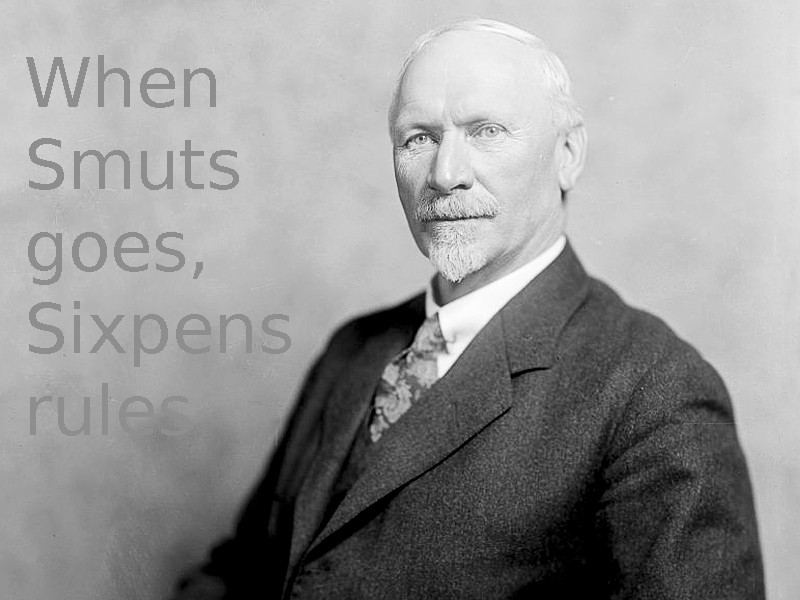
Says R W Johnson in his book: “In his celebrated dystopian novel written in 1947 ‘When Smuts goes: A history of South Africa from 1952 to 2010’, Arthur Keppel-Jones foresaw South Africa meeting its ruin at the hands of a primitive Zulu leader, Sixpens. There are many points of comparison between Zuma and Sixpens. Indeed, in many respects, Zuma has fulfilled the predictive vision of right-wing whites who resisted majority rule on the grounds that it would bring authoritarianism, corruption and incompetence sufficient to ruin the country. The surprise is how quickly the ANC in power regressed to this sort of rule and, even more, how it rallied behind Zuma, defending him against any criticism.”

In light of the country’s parlous situation and the fact that the government neither listens to advice nor acts rationally, the TAU SA president urged farmers to stick to their principles and to unify. A line must now be drawn in the sand. Farmers must declare that they did not steal land from anyone; they will not accept government propaganda without question; they will refuse to be drawn into participating in failed and failing government projects; and they will continue to produce food for South Africa while paying no attention to government’s socialist rhetoric. In a newspaper interview, Mr. Meintjies says that he doesn’t believe the government wants to get rid of commercial farmers. ”They want to control them. They want to control agriculture. If they can do that, they can control the food production, and if they control food, they control the masses”. The TAU SA president has been called a dinosaur by some critics but the dinosaurs knew what was coming.

Edmund Burke (1729 – 1797) said that ”the people never give up their liberties but under some delusion”. Why so many people of influence took so easily to ANC rule may never be explained. But Burke also said that “a state without the means of some change is without the means of its conservation”. Change may be on the way, and not a moment too soon. We must hold on until the ANC destroys itself. Perhaps then, after such trauma, the country can regenerate and realize once again its full potential.

Communists play cat and mouse with South African farmers

Hundreds of South Africa’s commercial farmers have now gone home after TAU SA’s yearly congress in Pretoria. In the north of the country they wait for the summer rain: their soil is prepared, the seeds are planted and the days grow hotter. Eyes look skyward for the first signs: they wait for the whip of the pre-storm wind, for that scent of moisture, for the quick darkening of the sky. Fifty three million South Africans depend on the country’s commercial farmers for their daily bread.

In his keynote Congress speech, TAU SA president Louis Meintjes covered many points – government propaganda on how “the whites” stole black land; farmworkers’ “rights” (but nothing about the rights of those who created the farms); how the country is run from Luthuli House, making the claim that SA is a democracy something of a farce. Then there’s the ubiquitous Freedom Charter, trotted out at every turn by the ANC, an outdated manifesto, written by white communists (notably Rusty Berstein), whose so-called principles are today only supported by countries like North Korea.

Then there’s the government’s 50/50 plan – the “sharing” of private farms with the workers which has elicited guffaws around the world and caused many potential investors to run for the hills. TAU SA says this latest caprice is a bridge too far. It is patently unacceptable, for many reasons but not least that it will cause hardship and hunger.

Then followed the president’s key question: where will it stop? Each demand’s acquiescence is followed by another demand. Despite reams being written about the empirical impracticality of the ANC’s farm policies, it is clear the government takes no notice. Willy nilly it surges ahead with plans and notions and white papers and green papers, each more ludicrous than the last. Communism’s DNA is well entrenched at Luthuli House, despite its spectacular failures in the twentieth century.

It should be therefore no surprise that the government proffered this policy during pre-1994 negotiations for the transfer of power in South Africa. It is a pity that many who negotiated with the ANC did not take cognizance of communism’s awful legacy.

Book

In his book How Communists Negotiate by American Admiral C. Turner Joy (MacMillan & Co, NY 1955), this Commander in Chief (UN Command) of Naval Forces in the Far East and American representative at the South Korean Armistice Conference at the end of the Korean War set out how the North Korean communists meticulously planned to get as much as they could without giving away anything to the other side. Virtually all of the processes he outlined regarding the negotiation process there were repeated by the ANC pre-1994.

His chapters include “Setting the stage”: Turner says the communists carefully consider the physical circumstances of the negotiating venue. (Remember the luxury game farms and the joint fishing trips of the Codesa protagonists. Then there were the well-dressed ANC big wigs in West Africa sporting English tweeds, briar pipes and a good British accent).

Chapter Two of Turner’s book – “The Delegation” – outlines how the very best intellectual minds and people of good appearance headed the communist teams at Korea. In pre-1994 SA, no rabble nor any toyi toyi-ing mobs were anywhere near the discussion venues. Chapter Three discusses the “Loaded Agenda” – “the Korean communists sought an agenda composed of conclusions favorable to their basic objectives, with some allowances for compromises if it suited them”, wrote Turner.

(It is rumoured that the Mozambican president Samora Machel told Nelson Mandela not to frighten SA’s whites because he would need them during the transition period so that the country wouldn’t disintegrate, as did Mozambique after independence. This practical approach to preserve the functional status quo during the early period after 1994 was sold as forgiveness and reconciliation on the ANC’s part, while in reality it was a calculated policy to preserve stability.)

Chapter Four – “Incidents” – refers to the communist policy of creating violent clashes and disturbances during the negotiation process in order to unnerve the other side who long for peace and want to hurry up the peace process to avoid further violence. (Nelson Mandela refused to renounce violence as a condition for his release. In fact after his release in 1990, violence increased exponentially until power was transferred in 1994.)

The Veto

The chapter on “The Veto” illustrates a Machiavellian method used to increase the chances of compromise from the other side. The stubborn recalcitrance of the North Korean side was designed to irritate the Americans into accepting some points in order to move ahead as they were tired of the delaying tactics.

Turner’s assessment of how the communists decide what is the truth and what is not is contained in the fascinating chapter “Truth and Consequence”. He says “the distortion of truth as practiced by the communists is a science”. (Remember Bishop Tutu’s assertion that there were “four kinds of truth” in his Truth and Reconciliation Commission summing up! Then we have the current “truth” about land theft, and a new “truth” about South Africa’s history, designed to engender a feeling of guilt among whites. This is entirely misplaced: without white settlement of Southern Africa, there would have been no present-day South Africa.

Whites found people who had no written language, who created no infrastructure and whose lives were beleaguered by battles with other tribes. They had no land titles and lived in primitive dwellings surrounded by sparse agriculture. Why the guilt among whites?)

Inches and Miles

The chapter most apt in relation to the TAU SA president’s speech is entitled “Inches and Miles”. Here Turner puts the case of “give an inch and they’ll take a mile“ so succinctly. He says:

“Communists regard any concession made by their opponents as a sign of weakness. Many Westerners entertain the notion that to accept some part of a communist negotiating proposal will encourage the communists to respond in kind.

“On the contrary such action is likely to induce an even more adamant attitude on their part. If Western negotiators agree to a communist proposal without insisting on an equal concession on another point, the communists conclude that their opponents are in a weak position and then they demand more.”

Thus the “fundamental techniques” to which Turner refers as part and parcel of communists’ negotiating processes are being used in South Africa 60 years after this Korean episode.

Anybody who cared to read a South African Communist Party directive on Reform and Revolution which was circulating in the mid-eighties would have seen that the doctrine was as sacred then as it was from the early days of communism. In para 13.2.3, it says “at the same time we must not mechanically dig in our heels against any future possibility to negotiate or compromise with other forces. We must remember that virtually all revolutionary struggles in the post-war period (Algeria, Vietnam, Angola, Mozambique) reached their final climax at the negotiating table.”

The TAU SA president asks: Do we know what we are supporting? Where will it stop? My personal opinion is that it is irresponsible to support any policy unless you know where it will end and what will be the final goals. He asks the ANC government: what is your end goal and when will you stop?

Herein lies the rub. Give and give and more will be asked of you until there is nothing more to give. Feed the crocodile and it will turn around and devour you. The ANC government cannot be allowed to usurp the commercial farming sector. It is to no one’s advantage. Indeed, it is a catastrophe waiting in the wings.

Education is about values… not a commodity

Top ten academic performers at Hoërskool Wagpos, an Afrikaans government school in South Africa

by TAU Bulletin

And a school matriculation certificate is not a ticket to the corner office, the VIP lift and the executive washroom.

Education is holistic: it is not a voucher for a comfortable life, nor a ticket to the turnstile of good fortune. The dictionary defines education as “the systematic development and cultivation of the mind and other natural powers. It begins in the nursery, continues through school and also through life. The impartation of knowledge by others is but a part of education.” The dictionary’s synonyms for education include “breeding, cultivation, culture, development, discipline, information, instruction, knowledge, learning, nurture, reading, schooling, study, teaching, training and tuition”.

Education is an intrinsic ingredient of a culture: it is the living embodiment of the passing from generation to generation the means by which the people of that culture conduct their lives.

The exuberance displayed by South Africa’s Minister of Basic Education Ms. Angie Motshekga when she recently announced the matriculation pass rate for South African pupils had jumped to 76.5% (from 60,6% in 2009) was met with scepticism and even derision. According to AfriForum, the actual pass rate was less than 38%, this because only half of the students who enrolled at the beginning of their school careers finished to write Grade 12, the matric year.

Mr. Tinyiko Maluleke, deputy vice chancellor of student affairs at the University of Johannesburg asked in a hard-hitting article (Independent 5.1.14) whether the matric certificate could be trusted. He said the certificate was in danger of “meaninglessness, worthlessness and irrelevance. The country’s entire education system is at issue, and 20 years of democracy have not taught teachers and principals (of mainly black schools) to stop striking during school hours.”

Professor Jonathan Jansen, rector and vice-chancellor of the University of the Free State weighed in, saying SA’s education system is a “fraud”. He concurred with other critics that the results proffered by the Minister were “grossly misleading”. “We know that the top 5% of Grade 6 pupils know more mathematics than the bottom 20% of the maths teachers in the same grade. We know that South Africa was dead last, just above Yemen, at the bottom end of international rankings on science and mathematics.” Mediocrity has been institutionalized, he declared, while “government officials hope we are all ignorant enough to accept the ‘official lies’” because of the way the so-called pass figures were manipulated. Pass rates were “pulled up by white kids” said Graeme Bloch of Wits University. “Sorry to be racial, but if you are born on the right side of the tracks, you have a 100% chance of getting matric”.

(We must pause here to comment on this “if you are born” comment. Who you are when you are born is the result of your genetic background, a consequence of your family’s ancestral lineage. And if that history is replete with achievement, initiative, hard work, the ability to overcome obstacles and a skill and desire to move forward and improve yourself, then comparing those “born on the right side of the tracks” with those ”born into” poverty is fallacious. This delusion infers that there is some sort of pantry in the sky which dishes out ways of life to some, and other less salubrious ways of life to others.

Everyone in South Africa is a genetic descendant of his ancestors. Blaming poor education results on the “privilege” of some is disingenuous. Cultural backgrounds have played a huge role in education result disparities – Africans had no written word, while South Africa’s first-world educational system was brought to this country by European settlers who then superimposed it on Africans. Similar occurrences took place during the colonial times in other new-world lands.

As well, using the term “previously disadvantaged” (liberally utilized to neutralize white academic achievements) is to refute history. Indeed, Africans were actually advantaged by European settlement. From where did they receive everything they have now – their ability to communicate in a world language, their education, health, legal and legislative system, and the country’s first-world infrastructure?)

The laughing stock

Setting a matriculation pass mark of 30% makes South Africa the world’s laughing stock. Average grade three literacy achievements only reached 35%, with numeracy at 28%. In grade six, the language average is 28% and mathematics is 30%. These figures are a reflection of how the government has managed an education system not generic to Africa. Cultural and language problems have been swept under the carpet in the government’s rush to “prove” that education is improving, when the opposite is in fact true.

Education is not just learning – it is how you interpret, utilize and develop that which is taught. In a country where mediocrity is the norm, it is not surprising that many waving their certificates cannot get work. Dumbing down the worth of this certificate has caused heartache to millions. They were led to believe that their 30% pass would get them a job. The government has sacrificed young people as scapegoats to foster the illusion that the state’s education system is delivering.

Quality is the name of the game. Said Anne Oberholzer, Independent Examinations Board’s (IEB) CEO: “If I’m prepared to spend my salary on my child’s education … rather than buying clothes or a fancy car, you can’t stop me from doing that”. The excellent IEB pass rate was the result of “extra hard work” rather than necessarily school resources. “Success at matric starts way back – matric is a combination of all the years of school exposure”, she said.

It is a simple case of values and norms. If black teachers go on strike during class teaching times, if pupils burn down schools, if ministers don’t get school books to pupils in time, and if the government shows by example that one really doesn’t need a good education to get rich as a party hack with a cushy government job (where capacity doesn’t even come into it), why bother to learn? Why have unbelievably bad results in black schools earned the ire of government when at the same time they show by their actions you don’t have to get good marks to join the government jobs gravy train?

And why try to achieve through hard work and sacrifice when government will legally provide you with a goodly share of someone else’s company just because you are black? In both the public and private sector, there are ample opportunities to feed at the trough, so why struggle at school and university? This same hypocrisy extends to government complaining about the quality of teachers, while universities across the board give preference to blacks for academic posts. A University of Johannesburg advertisement for the Deputy Vice Chancellor: Strategic Services (24.1.14) says it is “committed to taking persons with disabilities and the potential of historically disadvantaged individuals into account in making this appointment”. So if merit is not a criteria for university posts, how will government produce good teachers, and how can this in the end provide competent students and graduates for the country’s future?

Entrepreneurship

Entrepreneurship can’t be taught, yet it is the well-spring of all economies. It emanates from within and it is difficult, fraught with risk and sometimes very disappointing. It is easier to leaching on someone else’s success, a path made easier by government policies. While informal entrepreneurship is well entrenched in South Africa – small traders in townships and city streets sell goods someone else has produced – this doesn’t grow the economy.

Where is black entrepreneurial contribution to the formal economy? A weekly Pretoria is enthusiastically supported by locals and the diplomatic community. Selling mostly food, more than seventy stalls are manned by whites, Portuguese, Indians, a Moroccan family, Greeks, some Chinese. There is not one black South African stall. What is the point of an education that cannot extend to doing something for yourself?

Farming

Paging through any SA farm magazine shows the extent to which farmers have themselves developed and streamlined their profession. They haven’t just studied agriculture, they have applied it, improved on it, created new processes, adapted international methods to South African conditions and perfected agriculture to such an extent that 35 000 of them can feed 53 million people. Education was just the beginning. Without application, initiative, resilience, the ability to overcome hardship and plain hard work, where would South Africa be in terms of food security?

Most government officials and politicians see themselves as an intrinsic part of first world South Africa. They wear the clothes and drive the cars, but many do not exhibit the values generic to this first world. Education in this context should mean:

  • solving the problem yourself, not hiring a consultant;
  • making sure the traffic lights work and if they don’t, ensuring that a point officer keeps the traffic flowing until the robot is fixed;
  • making sure our cities are not littered and polluted until they look like Nairobi or Lagos;
  • answering the phone, replying to the e-mail and delivering the service to the people who pay your salaries;
  • owning up, with an apology, to the fact that many in government are incompetent and are unable to run South Africa as it should be run;
  • accepting criticism without retaliation in the form of racism accusations;
  • deciding that police asleep on duty, taking bribes and generally running amok with weapons is not worthy of a law-enforcement body;
  • immediately sacking all persons with criminal records employed in government;
  • not contemptuously ignoring court judgments;
  • ridding yourself of a completely unjustified entitlement syndrome because you didn’t create what you are now enjoying;
  • not wasting taxpayer’s money with impunity, and being contemptuous when confronted with this fact;
  • not handing over productive farms to incompetents and admitting this policy is a failure;
  • trying to emulate those who achieve instead of denigrating them and accusing them of being ”privileged”.

A point to ponder about education: Zimbabwe president Robert Mugabe has three university degrees, but he remains a savage tyrant, contemptuous of his people’s quality of life, of democracy and of what others think of him. Education without values is truly just a piece of paper!

Beware the Stockholm syndrome

Cyril and Roelf, laughing

by TAU Bulletin

“Adjusting” to the ANC and the consequences thereof.

Stockholm Syndrome: This syndrome refers to a group of psychological symptoms that occur in some persons or groups in a captive or hostage situation. It is sometimes referred to as a Survival  Identification Syndrome.

In early June of this year, a meeting was held between Afrikaner groups and the ANC. A former National Party minister Mr. Roelf Meyer facilitated the meeting which was attended, inter alia, by some commercial farmers and was designed to discuss the government’s land reform policy. In press pictures, Mr. Meyer was seen laughing and joking with ANC bigwigs including Mr. Gwede Mantashe, secretary general of the ANC, but it was the ANC which was laughing all the way to the bank. TAU SA’s public statement at the time explained why it would not attend – numerous TAU SA requests to see the country’s president, the Minister of Water Affairs and the Ministers of Transport and the Police were systematically ignored. All efforts to get appointments were fruitless.

So what was to be discussed under the sponsorship of Mr. Meyer? If the government is not prepared to meet representatives of organized agriculture, it can only be assumed the Meyer meeting was a public relations exercise for the ANC, with the hapless attendees along for the ride.

There is a growing trend in South Africa, particularly within the Afrikaans press and other organizations, that reconciliation (from one side only of course), a healthy guilt complex  and “live and let live” with the government is the way forward. Attitudes within the English language press seem to have hardened, although there are still sycophants who urge us not to be pessimistic:  that “false alarmism” is wrong.

But the University of Pretoria’s politics lecturer  Mzukisi Qobo says we must “face the truth”. (Business Day  29.6.2012).  He says “peddlers of good news” are trying to convince us that things are not so bad. “Anyone who dares point to the reality of a creaking public service or worsening leadership is likely to be reminded that there are many good stories happening elsewhere in the country”. They point to Zimbabwe, Nigeria and Iraq as being worse than South Africa.

“There is nothing as dangerous as unguarded optimism” says Qobo. “It is a convenient refuge for those who find reality too discomfiting and want to be left alone to wallow in their apathy. They think that to be discontented is a bad thing when in fact it is the absence of meaning and too much comfort in the face of crisis that gives succor to bad leadership. What our optimists don’t realize is that they are fostering idle indifference.  Action is a progeny of discontent.  It is when we are deeply dissatisfied with a political framework which lowers the benchmark for success and excellence that we are most likely to take action and insist on meaningful change.”

Mr. Qobo’s words should cause those who are succumbing to a group version of the Stockholm Syndrome to take stock of themselves. Now that we are enslaved by the ANC, let’s make the best of it. Let’s sit down and chat and try and get them to be “reasonable”.  After all, it’s all we’ve got left. They run the country, they have the power and if we’re nice to them, maybe they’ll leave us alone! For the sake of peace and quiet, we can overlook the ANC’s bad governance, its corruption, its venal theft and plunder of the country’s assets, its corrosive indifference to the needs of the people, its dismissive contempt of criticism and its wholesale destruction of a country that took 350 years of hard work to build. Let’s all be friends, even if the ANC treats us with disdain. They are our captors, but so what? We can’t do anything about it so let’s just get on with it and stop complaining!

Mr. Qobo quotes US admiral Jim Stockdale who survived torture in captivity during the Vietnam war.  He didn’t try and escape from reality by invoking a false sense of optimism. This “cripples human agency by leaving everything to fate”. Stockdale’s counsel is that “you must never confuse faith that you will prevail in the end… with the discipline to confront the most brutal facts of your current reality”. How many times have we heard that “it has to get worse before it will get better!”  Who says it will get better?

At the same time

At the Meyer group’s convivial get-together, the ANC’s Gwede Mantashe assured the meeting that land reform without compensation wasn’t the policy of the ANC. Soon after, at the ANC Midrand policy conference, delegates passed a motion where the “willing seller, willing buyer” principle regarding agricultural property ownership, was rejected.  In mid April, TAU SA’s legal representatives told the Equality Court in Johannesburg that it is more dangerous being a farmer in South Africa than being a member of the police. This evidence was proffered in the case against the ANC and its Youth League’s Julius Malema on the hate speech issue. The song “Shoot the Farmer” has been widely sung at ANC rallies, with no comment from the ANC’s hierarchy and no strong objections from others in civil society who should have been shouting from the rooftops about this exhortation to kill!

During the ANC’s centenary celebrations in KwaZulu/Natal in April and May of this year, President Jacob Zuma sang (in Zulu)  – “We will kill them with a canon (gun); They will flee, shoot them;  You are a Boer, we will kill you;  You will be killed, you will flee”.

(During this period, blacks occupied a farm in Komatipoort and ordered the farmer to leave. The levels of aggression displayed by the crowd were similar to the same type of behavior exhibited by land invaders in Zimbabwe.)

It was AFTER the President’s outburst that Mr. Meyer organized the meeting with the ANC. Did Mr. Meyer complain to the ANC about these obvious crimes, urging people to kill the farmers? Or is this to be cast aside in order to” get along” with the ANC and the President?

The government’s Green Paper on land reform and its Draft Land Tenure Security Bill have caused shockwaves not only within the farming community but throughout the country. Why bother talking to the ANC when they are at the same time undermining commercial agriculture? (Has Mr. Meyer read through these destructive Bills?)   At virtually the same time as Mr. Meyer’s affable June 6 meeting with the ANC, TAU SA declared in a press release that ANC Youth League threats to occupy farms and put farmers’ safety in jeopardy was being taken very seriously. “Is it meaningful to stay involved with government forums?” asked TAU SA. “We are being deceived and cajoled in official circles while being threatened and intimidated outside these circles.”

State president

The State President continues with his obfuscation about land ownership (the old 13% black/87% white  ownership fiction), and it’s time those who care should take action to counter this propaganda. South Africans who do not want to see their country descend into yet another African abyss should do all in their power to disseminate throughout the world the appalling failures of ANC rule. There are not enough “successes” to counteract the decline.

Are citizens really content to “go along” with the third world “values” of the ruling party? Where our hospitals are death traps, where doctors are raped and where a cake and a bottle of Coke will get the nurse out of her chair to attend to you? Where our municipalities don’t function, yet salary increases and bonuses are lavishly awarded? Where the civil service’s inertia, incompetence and corruption degrades us; where you can buy a passport on the street, forge your matriculation certificate and indeed your Ph.D. documentation;  where the government  cannot keep the country clean, where it pollutes the water and trashes school books? The ANC has turned South Africa into the world’s laughing stock, so why the obsequiousness towards them?

If there is no public discontent  and rebellion against certain media and groups who continue to urge us to reconcile with criminals, incompetents and thieves, then we deserve everything we get.

When farm murders figures cease to shock us so that we consider it “normal” that those who supply South Africa’s food are wiped out;  when we say Thank Heaven we were not killed when thugs rob and assault us, then it’s time to take stock. There was a time when the police WERE dependable, when the hospitals WERE the best in the world, when our fences WEREN’T bedecked with barbed wire, when our transport ran on time, our cities were clean, our civil service functioned efficiently, and our borders repelled transients, criminals and illegal entrants to what used to be a sovereign country.

It’s time to remind the ANC that if they don’t ship up, then they must ship out! It’s our constitutional right to do so.

In defence of pale males

Another pale male: Argentine model and presenter Mario Guerci

by TAU Bulletin

The state of the nation is no more ludicrously evident than Gauteng premier Nomvula Mokonyane’s recent “warning” that “pale males” would return to government in Gauteng if SA’s opposition Democratic Alliance party wins next year’s provincial election.

“It can’t happen, it will not happen” she declared. “Reversals in transformation are unacceptable, and the Gauteng public must be spared the “white gevaar”  (danger).

Where in the world are efficiency, skills, creativity and diligence seen as a danger? Only in South Africa, where so-called liberation credentials, party membership and loyalty trump the need to maintain the first world country and its infrastructure which was handed to the ANC on a plate after the 1994 election.

Ms. Mokonyane’s racial invective and resentment has been received with a muted tolerance. Despite the non-racial assurances in the Founding Provisions of South Africa’s constitution, the governing party’s racial diatribes against, mostly, whites continue apace. Indeed, they seem to have increased. The State President’s YouTube clip where he urges his supporters to “kill the boers” and that his cabinet would “kill with a machine gun” is still running, without any apparent move by YouTube to take it out of circulation. (Yet a YouTube clip made by two white South Africans saying they refuse to apologize for being who they are was taken off within a few days of its appearance on the internet.)

South Africa has two parallel universes – the ANC’s self-delusion and the reality. The fact that the country has dramatically slipped down the world’s various achievement indexes over the past nineteen years has either escaped Ms. Mokonyane’s notice, or she is disingenuous in the extreme. Does the rather corpulent Ms. Mokonyane not realize that 90% of the food she and her countrymen consume is produced by pale males? That virtually everything she takes for granted in this country was created by pale males?

From where did the railways, roads, commercial farms, schools, hospitals, potable water and electricity transmission emanate?  The very language she uses in a legislature which is not part of her cultural heritage is a language of the pale male. The news print that distributes her humbug is not of her culture either. But she is selective in her vitriol.  When this lady shops, she hurries to the pale males’ luxury shopping centers:  she was recently seen at up market Hyde Park “posing proudly with her R10 000 LK Bennet shoes and matching handbag”. (Tony Leon, Business Day 30.7.13).  Pale males are excoriated but they are good enough to produce and supply the luxuries which she and her fellow anti-white friends cannot live without.

There is no empirical evidence to show that without the intervention of others in Africa (including pale males), Ms. Mokonyane’s culture would have evolved any further than that of those “lost” tribes one finds in the Amazon and Papua New Guinea.  She should be grateful that that particular ship sailed around the Cape of Good Hope many years ago and that it decided to stop for victuals. Non-pale male groups who could have manned that ship may not have been so conciliatory to the locals, then and now.

Who created the Sasols, the Iscors, the Eskoms and the country’s nuclear capacity? Who rid the country of the tste tste fly and malaria? Who developed Africa’s premier agricultural and veterinary service, used by the whole continent? Who produces maize and other grain surpluses year after year on the continent that cannot feed itself?

And, conversely, who is busy destroying what used to be the African continent’s pin-up country?

Certainly not pale males. Ms. Mokonyane and her compatriots should look in the mirror. But if one’s modus vivendi  is self delusion, then blame is the name of the game. The world has taken note of the Africa of today. It is not a pretty picture. Zimbabwe went from the continent’s bread basket to a basket case. Few if any of the continent’s governments can feed their people. Corruption, nepotism, inefficiency and venality are the order of the day. South Africa is no exception.  Who is to blame for Liberia’s status as an African cesspool, or for Ethiopia’s failed state ranking? Colonialism? Apartheid? Pale males? Neither of these countries was subjected to colonialism or apartheid. They are travesties because the people who live there are who they are.

South Africa today could certainly do with some pale males to put things right. But this is not the ANC’s priority: a deep racial inferiority complex trumps practicality.

The facts

Pale males around the world are denounced by the non-achievers with relentless regularity. Whites in the United States complain about this as well.  We quote Fred Reed from the US’s Nationalist Times:

“I am weary of the endless denunciation of ‘white privilege’; the calls to abolish all tests in which whites excel, and the need to make universities and police forces and advanced placement classes ‘look like American demographics’.  It might be well to note the utter dependence of the US on white men who have contributed virtually everything that keeps the affirmative action classes from living in mud huts.”

Reed continues with examples of this contribution: “Euclidean geometry, parabolic geometry, hyperbolic geometry and projective geometry.  Physical chemistry, organic chemistry, biochemistry. Classical mechanics. The indeterminacy principle. The wave equation. The Parthenon. Air conditioning. Number theory.  Romanesque architecture. Gothic architecture.  Information theory.  Entropy. Enthalpy. Almost every symphony ever written. Pierre August Renoir. The diatonic scale. The mathematics behind the twelfth root of two and all that. The Bohr-Sommerfeld atom. The purine pyrimidine structure of the DNA ladder. Single sideband radio. All other radio. Dentistry. The internal combustion engine. Turbojets, turbofans, Doppler beam-sharpening. Penicillin. Airplanes. Surgery. The mammogram. The Pill. The condom. Polio vaccine. The integrated circuit.

“The computer, computational fluid dynamics. Euripides, Sophocles, Aristophanes, Homer. Glass. Rubber. Nylon. Roads. Buildings.  Acetyl-cholinesterase inhibitors. Silicone. The automobile. Bug spray. Public cryptography.”

“Like it or not white men can do these things, have done them, and continue to do them. The evidence shows that all groups receiving affirmative action have not done them, and cannot do them, which is why they need affirmative action.

“The pattern of white men doing difficult things continues. Consider the founders of companies in information technologies. Not quite all white, but all men. Anyone who watched the landing of Curiosity on Mars will have noticed that Mission Control consisted overwhelmingly of white men. If I were rude, I would say to those who criticize: invent your own things.”

Reed cites South Africa as an example of a tragedy in the making. “A constantly dwindling number of whites are at the mercy of a predatory welfare class and it’s possible they can’t and won’t carry the rest of the population. If things get worse for them, they will simply flee the country.”

Whether this scenario plays itself out in South Africa is up to the whites. But Ms. Mokonyane mustn’t take too much for granted. Her dislike of pale males borders on the obsessive, to the point where common sense and practical considerations for the benefit of all South Africans are cast aside in an all-consuming and embittered realization that her ANC cannot feed its people, cannot govern, and are no better than what the world has seen emanate from the rest of the continent over the past fifty years. She knows this, the ANC knows this, and the world knows it. Keeping out the pale males won’t improve the ANC. This racial animosity is inimical not only to whites but, eventually, to the future of all South Africans.
The pale male acrimony is however selective. Ex president Nelson Mandela was not interned in an ANC-run hospital. The new ANC elite have quietly bought houses in so-called white areas. They send their children to white schools. They want the pale male’s education system. (Every university in South Africa is a white creation). What is the yardstick against which anything of worth in South Africa is judged if not against a pale male-created yardstick? Are the elite’s suits bought from Nigeria or Italy? Is there such a thing as a Ghanian IPod? Do they fly Air Kenya or British Airways? Do they go to Mali for their holidays or to Paris?

A South African business journalist refers to “the African No” – “a jumbled melee of endless meetings, unreturned phone calls and ignored e-mails”. Compare this approach with the white world. The United States for example accounts for 4,5% of the world’s population but 25% of the world’s GDP. When people flee their terrible countries they try for Europe, Australia and other pale male bastions. They don’t want to emigrate to Zambia or the Sudan.
A cursory trawl through South Africa’s productive sector sees pale males as police divers, as rescue helicopter pilots, as paramedics, as the donors to charities, as the bedrock of the taxpayer base, as the underpinners of the medical profession, the service industry, the banking and the mining sector. The country is divided into the producers and the consumers, and we know on which side of the divide the pale male sits.

Virtually all of the productive farms that were handed over to ANC supporters under the government’s land redistribution policy failed:  a pithy example of pale male producers and ANC-created destruction.

It is a pity that more media space is not given to a frank analysis of who are the drivers of the South African economy, instead of to those who talk about nationalization, about transformation, about white racism and so-called privilege. South Africans might get a clearer picture of who is really important in the grand scheme of things, as opposed to those who can talk the leg off an iron pot, hold press conferences,  fly all over the world first class, endlessly discuss turnaround strategies and blame everyone but themselves for their shortcomings.  Within ten years, South Africa’s social spending (including huge government employee wage bills) will exceed government revenue. Employee compensation as a share of government income went from 31,7% in 2008 to 44,3% in 2012. South Africa’s pale males are a finite group – even they cannot hope to foot the bill for this parasite profligacy forever.

Maybe then South Africa will value its pale males, but it may be too late.

(Extract from Nationalist Times courtesy of Impact magazine)

The drum beat on SA land grab quickens

by TAU Bulletin

During the South African Truth and Reconciliation Commission hearings in the late nineties, the  Commission declared in its findings that there were four different kinds of truth. The Commission “rejected the popular assumption” that there are only two options to be considered when talking about truth – subjective and objective information – but that there were other kinds of truth – “personal or narrative” truth, “social or dialogue” truth and “healing or restorative” truth. We wonder which kind of truth is being published in our media on the history of land ownership in South Africa, and specifically why the reasons for the codification behind the South African 1913 Land Acts are being pointedly ignored.

South African history is arguably one of the world’s most controversial chronicles, but it was chronicled by those who could and did: the first Europeans who landed at the Cape, the subsequent colonial government, the missionaries, and the Europeans who made South Africa their home as did their counterparts who made other new world countries their home. The present government can only refer to the 1913 Land Act as a point of reference because their forefathers did not have the written word. They have no proof of anything other than what someone else wrote about. It is thus ironic that these complainants refer to “historical theft”, “land grabbing”, “stolen dreams”, “structural inequalities” and “infamous laws” as if they had their own factual proof that these circumstances existed.

Facts are ignored in the surfeit of hyperbole and distortions carried by the South African media which is increasingly becoming a mouthpiece of the government’s fraudulent propaganda.

A rooibos tea farm in South Africa

TAU SA’s two previous Bulletins exposed this disinformation about the history of land in South Africa and the land devastation of Zimbabwe.  Nobody in the media published one word of these Bulletins. TAU SA requested the Johannesburg Sunday Times to publish the 1913 Land Act Bulletin as an advertisement. The cost of a half page is around R180 000. TAU SA was completely ignored. The paper was not prepared to publish anything other than the politically correct myths and false dissemination about the history of land in this country.

This should reveal something to readers of this Bulletin. If the facts are ignored, who is kidding whom about press freedom in South Africa?

The media

City Press, a publication within the largest Afrikaans press stable in South Africa, carried a full-page article “A century of stolen dreams” containing the opinions and historical fantasies of one Dr. Ruth Hall from the University of the Western Cape. On the adjoining page was an article by ANC national spokesman Jackson Mthembu entitled “A Call to Accelerate Restitution”.  His article was entirely predictable – land is a “ticking time bomb”.  At the bottom of the double page spread was a large piece  on the now discredited book by three British academics called “Zimbabwe Takes Back its Land” on which we wrote in a previous Bulletin. This double-page centre spread’s ideological humbug is served up as a true picture of the land question in South Africa.

Who is Dr. Ruth Hall and why does she have a say while not one word from commercial agriculture – the people who actually produce South Africa’s food –  is printed anywhere? Hall holds a Ph.D. from OxfordUniversity in the UK and is an Associate Professor at the University of the Western Cape. She joined in 2002 and has continually punted a leftist, ideological viewpoint which is a total disconnect from SA’s agricultural realities. Her SA history in the article was distorted and her sanctimony and bitter criticism of the twin plagues of colonialism and apartheid infect her pronouncements.  The “erasing of history, unjust laws, cheap migrant labour, the legacies of displacement, deprivation, dispossession, inequality and poverty” are alluded to as being the fault of whites. She laments the fact that there was not a Truth and Reconciliation Commission on Land.

South Africa’s largest circulation newspaper the Sunday Times gave prime space to one  Mtobeli Mxotwa , spokesman from the Ministry of Rural Development and Land Reform whose article was entitled ”Radical steps needed to right the 1913 wrong”, while leftist Gareth van Onselen’s article on the same centre page was headlined “Consequences of a cruel act linger on”.

The absolutely useless ANC Youth League was given top space in The Citizen to say that “Land reform is too slow” while a large colour picture of President Jacob Zuma and the Minister of Rural Development shows them at the opening of an exhibition entitled “Reversing the legacy of the Natives Land Act 1913” at the Cape Town Convention Centre. Some newspapers printed critiques of current legislation but not one paper printed theTAU SA bulletin or excerpts thereof containing the historical facts on the history of land in South Africa.

The Land Act bulletin was specifically sent to Business Day, asking that some of it be printed. TAU SA was ignored. To top it all, the Afrikaans Sunday newspaper Rapport(30.6.13)  carried an article by “political analyst” J.P. Landman who sees the government’s land reform program is a “political requirement for community and political stability”. In other words, hand over the farms to appease the (mostly violent) mob demands. Thus we are to continually appease each time there’s a riot, or a threat of violence. Feed the crocodile until it devours you! His Zimbabwe allegory is completely wrong – agriculture was destroyed by Robert Mugabe when he lost the 2000 election and grabbed farms to placate the so-called war veterans who demanded land, not because land was not handed over earlier. is Zimbabwe allegory is completely wrong – the land(Perhaps Mr. Landman would like to hand over some of his property as an appeasement gesture!)

Media

Instead of all of the above, when will the South African media explain the truth about land in South Africa? Whose viewpoints should be exposed to the population – those who produce the food or those who talk about expropriation, who draft parliamentary laws to further curb commercial farming, who are establishing a land valuer’s office to determine the price of land according to themselves, who urge giving in to the violence of the mobs, or the British university zealots with leftist agendas?

Getting the facts to the South African public is becoming as difficult as the course taken by samizdat activists during the worst years of the old Soviet Union.  From the Russian sam “self”, and izdatelstvo “publishing”, these activists’ literature was secretly written, copied and distributed  during the periods of Soviet repression. We haven’t reached this point yet, but when a national newspaper refuses to print undisputable facts about land in South Africa, and even refuses a paid advertisement containing these facts, then we can’t be too far behind. TAU SA’s bulletin and other news is disseminated via the internet, but the masses who vote for the ANC only read the inflammatory nonsense propagated by government-supporting academics and ANC spokesmen. These masses clamor for land based on this disinformation. They believe Jackson Mthembu’s ticking time bomb warning, and his statement that Africans can only build from the “ruins of the past” if they have a piece of land on which to do so. This is dangerous nonsense. Forty million black people each with a piece of land?

TAU SA tries to maintain the very best relationships with the media: there is also much appreciation of how the media has handled TAU SA’s viewpoints and how they have been presented in the media.  In this light it is thus strange that this important topic is met with almost absolute silence. It doesn’t make sense. TAU SA is of the opinion that the land question is of crucial importance, given the implications for food security in South Africaand the emotional way it is presented to the voting public. The other side of the story should be heard – especially when this “other side” consists of the very people who produce South Africa’s food. For the sake of justice we would like to see this happen.

What are the facts?

  • All the undisputable facts on the history of land in South Africa can be found in the book “Disputed Land” by Louis Changuion and Bertus Steenkamp. Almost a third of the book contains historical documentation to back up the contents of the book. (It can be bought at Kalahari.com). As far as we know, not one South African publication has reviewed this book.
  • Only 35 000 commercial farmers provide food for South Africa’s nearly 53 million people. If the emotive recommendations of Dr. Hall, and the ignorant demands of the ANC ever become realities, will Dr. Hall and the ANC suggest suitable food supply replacements for SA’s commercial farming sector’s production?  In a 25 June press release, TAU SA asks that the government “take active steps to prevent more farmers leaving the industry to avoid South Africa relying on unsustainable food imports”. The World Bank recently warned that food demand is growing, and that “disruptive weather events are increasing in frequency and amplitude. The variables that surround agriculture are increasingly volatile. Countries will not export food if they are themselves vulnerable.” The World Bank continues:  “About 50% of global grain supplies are in India and Chinaand they are not exporting them. Countries from India to Egypt to Vietnam to Indonesia banned exports of rice during the 2008 crisis, while sudden changes in trade policy also affect exports.”  Will the ANC turn South Africa into a country dependent on others for food?
  • The government’s land restitution policy is an abject failure. Hundreds of farms have been lost to production.
  • Black Economic Empowerment has not left agriculture alone. The current Broad-based Black Economic Empowerment Bill is due for amendment, and comment has been called for. It is a fact that profit after tax on average assets of a working farm in South Africa is 1,7%.  Farming enterprises are running on thin margins – 85% of livestock producers show a profit per annum of less than R40 000 per month, while 27% of general farmers run at a loss and 58% make a profit of between zero and R500 000. Most farmers cannot afford BEE. BEE scorecards have been presented to agriculture on which little research has been conducted. If this legislation is thrust upon commercial farmers, many will go out of business, further impinging upon food security in South Africa.
  • Agriculture throughout the world is increasingly less labour intensive. The US farm population today is only 1,5% of the total. Yet American farmers feed 320 million people and they export massive quantities of food around the world. Thus this “hunger for land” and “everyone must have a piece of land” punted by the ANC is clearly a sop to their electorate but a danger to food security. South Africa will simply relapse into one huge squatter camp if commercial farms are broken up and redistributed.

Indeed the agricultural warning drum has been beating but who is listening? The “free” press should ask itself whether honest information or politically correct propaganda is its mission, and whether it should be held responsible for a collapse of food security in South Africa.

Whose land is it anyway?

by TAU Bulletin

On 19 June 1913, the Native Land Act of 1913 became law in the recently-created Union of South Africa. The legislation was the culmination of centuries of land occupations, divisions and invasions; of treaties, conventions and agreements signed, and sometimes ignored; of squatting, a population explosion on a finite land area, tribal alliances and tribal wars; of British imperialism, Boer endeavors at independence from Britain and the British repudiation thereof; of the influence of missionaries, of huge culture chasms; of Zulu hegemony and destruction (the Deficane); of the declaration and dissolution of Boer republics, British arbitrary annexations throughout the country, and the haphazard movement of people who never knew a border in contrast with those who saw borders as the very linchpin of their future in South Africa.

Common currency has it that whites “stole” land from indigenous blacks and that this theft was legally ratified by the 1913 and 1936 Land Acts which divided up the land and codified these divisions. Some international observers have defined this “theft” as akin to the German invasion of Paris, or the Russian annexation of its Soviet Republics. They have conveniently ignored the turbulent chronicle of a country unique in its history, in its human diversity and the real reasons for the unremitting conflict over land. Whites who came to South Africa in 1652 and thereafter found a land devoid of basic development and infrastructure, sparsely populated by meandering tribes who had no written word and whose way of life was the absolute antithesis of Western mores.

Who arrived where first has always been a bone of contention. It is now acknowledged that the Khoi-San groups, and their sub-groups, are the indigenous peoples of South Africa. The United Nations Economic and Social Council declared on 15 December 2005 this to be a fact. Whites and black African groups arrived in various parts of the country around the same time. They met at the Fish River in the Eastern Cape, and wars followed. These hugely disparate nations believed they had legitimate claims to land, based on contrasting ethnic assumptions.

Given that only 35 000 commercial farmers are currently the bedrock of 95% of food production for South Africa’s population, the history behind the 1913 and 1936 Land Acts should be academic. But land in South Africa is a political tool. It is wielded without thought for the morrow. It is proffered within the context of a cultural more that has no place in today’s practical world. The division of land under the 1913 Land Act is a blunt weapon used to garner votes by the present SA government to seduce naïve and mostly uneducated followers who cannot feed themselves but who are asked to look upon those who can feed them as ogres who stole their land.

WHAT ARE THE FACTS?

*  No one less than the President of South Africa Jacob Zuma still punts the discredited tale that 87% of South Africa’s land belongs to Whites, with only 13% for blacks. This is simply not true. In a Research and Policy Brief on Land Ownership and Land Reform in South Africa (27.2.2012), the SA Institute of Race Relations declared that “as of March 2011, 25% of SA’s total surface area of 122 million hectares was in the hands of the State. The remaining 75% is privately owned. (In the great expanses of the Free State and the Northern Cape, private owners held 89% and 91% of the surface area respectively, while in the Western Cape and Gauteng, only 55% was held by the State.)  So State land can now be regarded as black owned, which means at least a quarter of the country’s surface is in black hands.

(In Gauteng, this 55% represents 910 000 hectares, which is slightly larger than Cyprus and nearly the size of Lebanon.  The problem is that national, provincial and local governments have little idea of what they own and how to make the best of it.) (Jack Bloom, MPL and DA leader in the Gauteng Provincial Legislature – The Citizen 27 May, 2013)

“Since 1995, 2.6 m hectares or the equivalent of 2,1% of all land has been handed to blacks via land restitution programs. This pushes the amount of land in black hands to 27,1%.  In addition more than R5 billion was paid out to restitution claimants who accepted cash instead of having land returned to them.  That money was sufficient to purchase an additional 2,6 million hectares which would have pushed the amount of land in black hands to just on 30%.

“The land redistribution program had by 2010 handed a further 3,1 million hectares, or 2,5% of the surface area, to black South Africans pushing up the share of black-owned land to at least 32,5%. This figure is more than double that of the 13% often cited by government officials (including the President).

“These calculations have not taken into account land traded between private owners. There is sufficient anecdotal evidence that such trading between white and new black owners has taken place. Whether the amounts traded are equivalent to 10% or 15% or 20% is unknown. Any of these figures would however push the figure for black land ownership to between 40% and 50% of South Africa’s surface area.”

*  The bulk of the land attributed to white ownership is in fact owned by little more than 35 000 commercial farmers. They produce 95% of South Africa’s food, this in a country recently described by the executive vice president of global chemical company DuPont as “largely unsuitable for crop growing, with only 12% of its land mass considered arable”, and only 3% “truly fertile”. Only 1.5% of SA farmland is irrigated.

*  In addition, commercial farmers are ever more vulnerable, both physically and economically.  As a group they are murdered at an inordinately high rate, and farm attacks have not abated since the ANC came into power. Input costs are high: fuel has increased 219% over the past six years and fertilizer has increased 145%. Municipal rates and taxes (for which the farmer receives little or no value) cost farmers $475 m per year. The country’s infrastructure doesn’t serve commercial farming well, in some cases not at all. Farmers must repair local roads, while the country’s telecommunication service neglects rural areas. Stolen infrastructure is not replaced. The list of weak support goes on – electricity load shedding, labor cost increases of 300% (which costs are not matched by concomitant productivity);  the high price of agri-chemicals and the reported annual loss of R2,1 billion of stock, crops and equipment theft, calculated in 2005.

*  The existence of hundreds of small towns throughout South Africa depends on the surrounding commercial farms. Hundreds of thousands of workers who would otherwise be unemployable are employed on farms.( In 2010 there were 886 417 agricultural workers, a decrease of 20,7% since 1993). Thousands of ancillary enterprises depend on the food production business including wholesale and retail industries, transport, refrigeration and agri-chemical concerns; veterinary practices and businesses, seed and equipment technology and irrigation supply groups, and many more. The total contribution towards GDP which includes industries dependent on agriculture is in the order of 23%.

*  Recent statistics published by the SA Institute of Race Relations state there were 1 337 400 units of food production in South Africa.  Of these, 1 256 000 are subsistence farmers; 35 000 communal area farmers have turnovers of less than R300 000 per year; 24 000 small commercial units have turnovers of less than R300 000 per year, and only 22 400 commercial units have turnovers of more than R300 000 per year. THIS MEANS THAT ONLY 6% OF FARMERS IN SOUTH AFRICA PRODUCE 95% OF THE FOOD FOR 53 MILLION PEOPLE.

*  The single biggest threat to SA agriculture is clean water. Productive agricultural land is being degraded by the mining industry. There is no control over the pollution of the country’s water resources.

These are the very basic facts of the situation in commercial agriculture today. Food production rests on a very tenuous foundation.

THE CURRENT SITUATION AND THE REASONS FOR THE 1913 LAND ACTS

The self-sufficient production levels of South Africa’s current commercial farming sector did not simply emanate from thin air. There is every reason to believe that WITHOUT the Land Act of 1913, South Africa would not be in such a fortunate, if fragile, position with regard to food security.

Government (and many organizations with strange agendas) continues to harp on the perceived unfairness and injustice of the divisions of land set out in the 1913 Land Act without taking into account South Africa’s pre-1913 recorded history and, importantly, THE POPULATIONOF THE COUNTRY AT THE TIME. Political points are continually scored by creating antagonism towards the commercial farming sector, thus garnering support for even more punitive legislation aimed at, eventually, taking more and more land purportedly for the voters. Government is however disingenuous. In reality title is not being given to land recipients. The Democratic Alliance’s Jack Bloom tells of a 1998 farmer settlement scheme in Randfontein where in 2002 title still hadn’t been transferred to the recipients.(Citizen 27.5.13)  There are thousands of examples like this throughout the country.

WHAT ARE THE PRE-1913 FACTS ON LAND IN SOUTH AFRICA?

*  Man in his primitive state did not know the concept of “land tenure”.  When hunter/gatherer groups formed, the first land tenure (if it can be called that) was by nature communal. Before the arrival of the European in South Africa with his tradition of individual land ownership, communal tenure in Africa was the norm. The territory inhabited and/or cultivated by a particular ethnic group was owned and/or utilized by the tribe in the name of their king or chief. Because there was no written word among these peoples, Christian missionaries took it upon themselves to learn and then write and codify the languages of the black people to whom they were ministering.  They then taught these people to read and write their own language.

*  It is known that a great migration of black people took place from the Great Lakes region southwards, eventually reaching Southern Africa. Numerous reports exist as to which tribe went where. But these reports are not the historical property of the black peoples. Thus their claims to land in South Africa have no empirical foundation. They are based on oral history and folklore, and what was observed by early European travellers and missionaries, by the British colonial presence in the country, by Boer trekkers and administrators.  If your history is written by others, with what can you contest this history? However, the early settled areas of the black people were later generally recognized as their core areas.

*  The agricultural potential of the southern African soil, as well as its attractiveness for permanent residence lies in its climate and nature.  This became obvious to the first Europeans who arrived at the Cape in 1652 to establish a settlement for the Dutch East India Company in order to provide fresh produce for passing ships.  In 1657 some of these officials were permitted to farm on their own. This resulted in individuals, FOR THE FIRST TIME IN WHAT IS NOW SOUTH AFRICA, “owning” land in the European sense of the word. This of course led to clashes between these Europeans and the indigenous peoples, the Khoi and the San. The Khoi/San did not “own” land in the European sense – it was not part of their communal culture of simply “occupying” land and they therefore didn’t recognize or respect this European custom.  However, they felt entitled to the land they traversed and on which they hunted.

*  With the raising of the British flag in 1806 in the Cape, the British assumed power in the newly acquired Colony of the Crown. British hegemony and the British imperialistic stance gave rise to the trekking north by the Boers who established Republics in the Transvaal and the Orange Free State in 1844 and 1852. After the discovery of gold and diamonds in the late nineteenth century, the British simply annexed these republics for the British Crown! On 16 December 1880, the first struggle by the Boers in a war of independence from the British started.

*  From the very beginning of settlement, black and white were segregated. South African history is replete with clashes over land “ownership”. There were no title deeds, no courts to decide who owned what. Proclamations and annexations were followed by wars, clashes,  agreements and disagreements, theft of livestock, sloppy boundaries and arguments over the measurement and surveying of land; borders were drawn and re-drawn; people moved all over the place and a completely differing approach to farming by both groups existed.  In the black community, land was communal and the product of their agricultural activities was mainly for their own consumption. This was subsistence farming, and it persists in today’s South Africa. Segregation was such an integral part of South African life that it existed as well among the different tribes and within tribes.  For instance, the Xhosa nation was divided into at least seven tribes and the Sotho into three separate groups.

*  Smaller tribes appealed to both Boer and the British to save them from other marauding tribes. They moved onto farms to survive and were given work. The Zulu Deficane (the marauding slaughter) caused enormous disruption within the black tribes and caused thousands of blacks to flee to other areas of South Africa.

*  It was the Cape government, under British control, that kept the white farmers and the Xhosas of the Eastern Cape separate. There never was any true integration of the two vastly differing cultures, even to this day.

*  As whites moved further into the interior, land was exchanged by barter, sometimes by conquest, in other instances by agreement. (It is interesting that “occupation by war” was recognized throughout the world at that time. This principle was also recognized and applied in Africa where indigenous black nations fought against each other.)

*  Agreements about land entered into by black tribes and white farmers were fraught with ambiguity. Whites believed they now owned the land but the black tribal chief believed he had “lent” the land for a period and in some instances wanted it back. This reneging on agreements caused endless insecurity within the white farming community.

*  Soon after the formation of the Union of South Africa in 1910, it was deemed imperative to settle the land question once and for all. The government (still under the British Crown) believed that if land could not be partitioned and allocated within the ambit of a Western title deed system, the very future of South Africa would be put at risk.

*  The most immediate problem was food production for a burgeoning population. (It was obvious to the British then that blacks could not produce food for surplus, and to this day this is still the case). The core reason for the 1913 Land Act’s passing was the security of the whites, and particularly the farmers, to give them the necessary security of tenure on their farms to produce the food for what was still a country under the British flag, controlled essentially from London. Gold and diamonds had been discovered, and Britain was not going to give up this new jewel in the Crown.

*  Antagonists of the 1913 Act and indeed the 1936 Act should look to Britain for redress. These pieces of legislation were not apartheid Acts – they were devised in South Africa under a government controlled by Britain.

POINTS TO CONSIDER


*  The current population of South Africa according to Stats SA is 52,98 million. As quoted by the SA Institute of Race Relations’ Yearbook 2012, the population of the country in 1911 was blacks: 4,018 million, whites: 1,276 million; coloureds: 525,466 and Indians: 152,094. The percentages were white:  21% and black: 67%. One hundred years later, the percentage population increase of blacks was 920% while for whites it was only 259%. If life were fair, each population group should be responsible for providing food for its own people. But in present-day South Africa, a handful of white commercial farmers is responsible for 95% of the food supply for 53 million people.

*  According to a recent index compiled by Accenture, 12 sub-Saharan African countries are severely affected by food security problems. Only four countries in the region have high food security – one of these is South Africa. Yet sub-Saharan Africa has 60% of the world’s uncultivated arable land, and it imports an average of $50 billion of food annually. Grain yields in this area are 40% lower than those in the rest of the developing world.

*  Other new world countries which were colonies of European powers also faced the same problems as South Africa. They met with primitive undeveloped indigenous people. In Australia, New Zealand, Canada and the United States of America, these sectors remained outside the Western economy, and are in many cases still marginalized. In South America, the Spanish decimated three civilizations – the Aztecs, the Mayans and the Incas. The remains of these civilizations never recovered and exist today on the margins of society. In South Africa, the black peoples grew out of all proportion to their contribution to the economy. Today they are consumers, not producers. (South Africa’s public sector wage bill ranks among the highest compared with countries at a similar level of development. There are about 1,3 million funded posts in the public sector and the rise in their wages over the past few years has not been matched by productivity increases.) (Business Day  28.5.13)


*  Virtually all the productive farms which were handed over to black beneficiaries under the government’s land restitution program have failed, mostly due to government’s lack of financial support, training and of course the lack of a will to farm by the beneficiaries. Some farms turned into squatter camps. This land has been lost to South Africa’s overall farm production. Despite this bleak record, farms are still being handed over. A once-thriving KwaZulu/Natal farm which produced more than 400 tons of bananas a year is in ruins. (Sunday Times 12.5.13). Although R3,2 million was paid for this farm, the government is planning to sink more money into it in the form of “recapitalization”.

*  The population of the Netherlands per square kilometre is 380. In Japan, it is 320, in Germany 230, Italy  is 180, the USA is around 35 and South Africa is approximately 45. There is no need for more land to be handed over to anyone if it interferes with food production. If the densely populated Netherlands and Japan can feed themselves with the land they have, why must South Africa’s land be given to people who cannot feed themselves and have already proved this?

*  Land is political for South Africa’s State President. He says it is a “sensitive issue” which people must “leave alone”.  But if his government cannot feed its people, this issue ceases to be sensitive and becomes a life and death matter. The State President is truly fortunate that South Africa’s commercial farming sector is arguably one of the best in the world.

*  If the South African government is seeking redress and, more importantly, blame for the Land Acts of 1913 and 1936, it should seek reasons from the British government. The Cape was a British Colony from 1806, and the British slowly and inexorably annexed the rest of the country over the next century. How a government can complain about land divisions 100 years ago when its people’s population increased by 920% since then is strange. Clearly the political agenda is all that matters. Notwithstanding this, if they feel they have a case, they must put it to British government.


SUGGESTED READING AND BIBLIOGRAPHY


*  DISPUTED LAND by Louis Changuion and Bertus Steenkamp. (2012) (In Afrikaans OMSTREDE LAND). Available from www.kalahari.com . Arguably the most informative book written about the history of land in South Africa.)

*  SOUTH AFRICA: 21st CENTURY LAND ISSUES – A HISTO-GEOPOLITICAL INVESTIGATION by Dr. C.J. Kruger (2002)

*  ANDREW SMITH’S JOURNAL OF HIS EXPEDITION INTO THE INTERIOR OF SOUTH AFRICA – 1834/36 published by the South African Museum, 1975.

*  AN HISTORICAL SURVEY OF NATIVE LAND SETTLEMENT IN SOUTH AFRICA FROM 1902 TO THE PASSING OF THE NATIVES’ TRUST AND LAND ACT OF 1936 by Simon  McDover Mohau Lekhela, submitted in compliance for the requirements for an MA Degree to the Department of History, University of South Africa, 1955.

*  THE CONQUISTADORS by Hammond Innes. (1969)

*  DIE RUILKONTRAKTE IN 1833-34 AANGEGAAN TUSSEN MOSJESJ EN DIE WESLEYANE by I.S.J. Venter University of South Africa Communications, Pretoria. 1960.

*  HISTORY OF THE PRESBYTERIAN MISSIONARIES DURING THE NINETEENTH CENTURY IN KAFFRARIA. Merle Friedman, 1960

*  ZULU THOUGHT PATTERNS AND SYMBOLISM by Axel-Ivar Berglund, Swedish Institute of Missionary Research, Uppsala, Sweden. 1976.

*  THE WHITE TRIBE OF AFRICA by David Harrison. 1981.

*  TOWNSMEN OR TRIBESMEN by Philip Mayer and Iona Mayer, Oxford University Press. 1961.

Max du Preez’s fantasies on Zimbabwe

'Fast-track land reform' of the Zimbabwean style, as sought by Max du Preez

by TAU Bulletin

Anti-apartheid journalist and apologist for South Africa’s democratic dispensation Max du Preez has been caught short with his latest efforts to justify the unjustifiable. In a Natal Mercury piece (30.4.13), Du Preez tells us we can “learn from Zimbabwe’s flourishing farms”, and goes on to laud a new book by three London (where else?) left wingers: London School of Economics’ Joseph Hanlon, an anti-apartheid and commonwealth sanctions activist in the 1980’s; Jeanette Manjengwa, Deputy Director, Institute for Environmental Studies, University of Zimbabwe; and Teresa Smart, visiting fellow at the University of London.

Du Preez says the book “Zimbabwe Takes Back its Land” shows that Zimbabwe’s radical land grab “has worked” and that “agricultural production is on levels comparable to the time before the process started.”  What is meaningful, says Du Preez, is that these production levels were achieved by 245,000 black farmers on land previously worked by some 6 000 white farmers. He clearly does not see the irony in this – does it take 245 000 Africans to produce the same as 6 000 white farmers?

(It is interesting that euphemisms such as “the process”, “land redistribution” and “fast track land reform” are used in the book and by Mr. Du Preez to describe one of Africa’s most haunting and terrifying attacks on any country’s productive agricultural sector. Who can forget the horrifying television footage of mobs of so-called war veterans storming white farms, destroying farm animals, beating to death family dogs trying to defend their owners’ properties, while farm families who couldn’t flee fast enough met sometimes gruesome fates at the hands of these thugs, all in the name of land reform. Ironically, these destructive mobs received few farms at all – the choicer properties were taken by Mugabe’s cronies for, in some cases, weekend parties.)

From the book, Du Preez says lessons South Africans can learn is that new black farmers can actually farm successfully and commercially if given enough time and help, and that an “ambitious land redistribution programme (in South Africa) can play a role in alleviating poverty and providing employment and dignity to large numbers or marginalized people”.  (It is reported that the London team spent one month in Zimbabwe before writing the book, and that they used a simplistic method based on a very small section of agriculture – they used three farms that were “taken back” while more than five thousand farms were stolen by the Mugabe government.)

It is further common cause that many “flourishing” farms are owned by the Chinese, and that the few still owned by white farmers operate at the grace and favor of President Mugabe.(He, his courtiers and his army have to be fed after all!).  We are also told that when certain farms are targeted by the ubiquitous war veterans, all the owner has to do is phone the Chinese Embassy and nothing more is heard from the mob. Sizeable tobacco contracts have been signed with the Chinese government.

 What is to be gleaned from this puff piece by someone who clearly feels the need to continue defending South Africa’s current dispensation?

Millennia

Black South Africans have existed in Africa for millennia. They never developed anything better than subsistence farming – maybe  food for today but little for tomorrow. They had no written language, and it was left to early Christian missionaries to formalize and put into script African languages which had been solely an oral tradition. Thus there was no recorded title to land – it is a non-African concept – so to entitle a book “Zimbabwe Takes its Land Back” is disingenuous. One commentator declared: Zimbabwe takes back its land from whom? It was taken back from Zimbabweans, seventy percent of whom had bought their farms after President Mugabe came to power and whose agricultural skills were the bedrock of a country that had been a savannah until they came.

Yes, in another way, land in Zimbabwe was “taken back” – it was plundered and stolen from white productive farmers whose accomplishments showed up the incompetence and inability of others to produce a surplus, let alone enough to eat for themselves. This highway robbery was based on racial resentment, fuelled by a tyrant afraid of losing an election and who used white achievement as a scapegoat to foster black pique.

The United Nations

Before Mr. Du Preez decided to wax unctuous about Zimbabwe’s “flourishing farms”, he could have visited the websites of the United Nations World Food Programme (WFP), the Food and Agricultural Organization (FAO) in Rome, the World Bank and a few other organizations trying to keep Zimbabwe afloat. According to WFP director Felix Bamezon (14.3.13), Zimbabwe’s current food insecurity levels are “the worst in four years.” The WFP is presently providing food aid to 1,58 million people in 37 districts of the country. In March this year, the WFP said approximately 19% of the population of Zimbabwe was estimated to be in need of food assistance.

If a government cannot even feed its people, let alone have surplus production, this can hardly be termed “flourishing”. The Japanese government recently provided nearly $6 million for flood, drought and food relief to Zimbabwe. This contribution allowed the WFP to purchase maize for 215,000 people and pulses for 835 000 people for two months. During the last decade, Japanhas provided more than $29 million to the WFP’s operations in Zimbabwe.

In January of this year, the Zimbabwean finance minister admitted to journalists the country only had $217 in its bank account!  David Smith of the London Guardian wrote on 30 January of this year that “from 2000 the seizure of white-owned farms led to chaos in the agriculture sector and the economy shrank by half. In 2008 hyperinflation of 231,000,000% broke the national currency and left millions of people hungry.” (Emphasis ours)

Where did the money go? The opposition Movement for Democratic Change (MDC) says that income from diamond sales is being stolen by President Mugabe’s Zanu/PF party to finance the forthcoming election. The watchdog “Partnership Africa Canada” said last November that at least $2 billion of diamonds form the Marange fields has been stolen by Mugabe’s ruling elite.

What flourishing really means!

In the October 2009 edition of THE ROSARIAN, a publication distributed by the Flame Lily Foundation (created to secure the interests of former residents of Rhodesia/Zimbabwe), Dr. Mick Gammon writes a lengthy piece on the destruction of Zimbabwe under President Robert Mugabe, with particular emphasis on agriculture. (Dr. D.M. Gammon was a former specialist in the Department of Conservation and Extension in the Rhodesian Ministry of Agriculture.)

“The first white traders and missionaries who came to the region in the 19th century found a land devoid of infrastructure. The wheel was not yet in use. Travelers went for days without seeing any human habitation. With a population of around 250 00 at the time, most of the land was not occupied. Commercial farming started in the 1890s on what was for the most part, virgin land. There were no roads or railways, no electricity or telephones, no fences, boreholes, pumps, windmills, dams, irrigation schemes; no cattle dips, barns or any other farm buildings.

“These first farmers had to discover how to contend with predators that killed their livestock and other animals that consumed their crops; how to control diseases, pests and parasites of livestock and crops that were foreign to them. Knowledge and experience built up over generations in the developed world had limited application, since the local climate, oil and vegetation was vastly different.

“From this starting point, agriculture developed faster than it had anywhere else in the world. Soon the country became self-sufficient in most agricultural products. In many cases yields per hectare and quality equalled and bettered those in the developed world.

“The United Nations Food and Agriculture Year Book 1975 ranked the then Rhodesia second in the world in terms of yields of maize, wheat, soya beans and ground nuts, and third for cotton. In the combined ranking for all these crops, Rhodesia ranked first in the world.

Rhodesia’s Virginia tobacco was rated the best in the world in yield and quality, while maize entries in world championships were consistently placed in the first three places.

“The world’s largest single citrus producer was developed early in the country’s history. The indigenous cattle were developed through breeding and selection to highly productive breeds. Wild life was incorporated into farming systems to develop a highly successful eco-tourism industry, and endangered species found their most secure havens on farm conservancies.

“Zimbabwe was the world’s second largest exporter of flue-cured tobacco. This together with exports of maize, soya beans, cotton, sugar, coffee, tea, fruit, vegetables, flowers and beef, made agriculture the major source of foreign currency. It was the largest employer of labor, providing employment for about a third of the country’s work force.

“The country’s state departments of veterinary services, tobacco research, plant and seed research, livestock and crop management were world class.  Each farm was, to a large extent, an outpost of civilization and many farms established schools for the children of their workers. Every farm was a clinic and dispensary and ambulance service for the surrounding areas.”

What happened to these farmers has been splashed around the world. It is a tragic history. From prosperity to a government balance sheet of just $217; to perennial food aid, to a tyrannical dictatorship, corruption and government theft; to poverty and large-scale emigration. From a  bread basket to a basket case. The only thing flourishing in this scenario is the scary imagination of Mr. Du Preez.