Video: Blacks beating up white woman with baby

A video is currently going viral on the internet, showing three blacks approaching a white woman with a baby on her lap. Initially they ask her to put down the baby but when she fails to react, they simply start assaulting her. The video has been removed from some social media for “violating community standards”. It seems that real-life episodes of the current violence perpetrated all over the world by groups who deem themselves to be victims “violate community standards”.

In the interests of freedom of expression and the pursuit of truth, we are publishing the short (46 seconds) video here. Please also subscribe to the Free West Media YouTube channel!

South Africa’s land expropriation will be aimed at ‘whites only’ – minister

The land expropriation policy of South Africa’s ruling party, the ANC, will specifically target white people, according to Zweli Mkhize, the minister of cooperative governance and traditional affairs. Neither the property of black citizens nor land controlled by traditional (black) leaders “would be targeted”, he said.

The ANC, which has a long-standing and close relationship to the South African Communist Party, is an Afro-Marxist party that has long threatened to nationalise all farmland in South Africa. Last year the party adopted a policy of “land expropriation without compensation”, which was also adopted by the South African parliament in February this year (2018).

The party also wants to change the South African constitution to allow it to confiscated land at will from white citizens.

The government met with representatives of the National House of Traditional Leaders over that body’s worries about the planned redistribution process, Mkhize’s ministry said in an emailed statement on Friday.

“A wrong impression has been created that the discussion on land expropriation includes land in the hands of traditional leaders,” Mkhize stated.

Jan Smuts: The white man’s task

It is interesting that Jan Smuts has not been vilified to the same extent as other Afrikaner leaders of the twentieth century, even though his ideas on “native policy” did not differ substantially from theirs. That was probably because he was pro-British and therefore his views on South Africa’s racial problems were “excused” by subsequent historians and politicians alike. Except for the Johannesburg airport, his name was not removed from streets or buildings. At the extremist left-wing campus of the University of the Witwatersrand, there is still a “Jan Smuts House”. However, Smuts was under no illusions about the the capacity of Africans for government, as subsequently demonstrated by post-colonial African states, as well as the formerly white-ruled countries of Rhodesia and South Africa.

In Smuts’s speech delivered on 22 May 1917, he bluntly states that “Natives have the simplest minds, understand only the simplest ideas or ideals, and are almost animal-like in the simplicity of their minds and ways”. He also says that it is “probably true that earlier civilisations have largely failed [in Africa] because that principle was never recognised, civilising races being rapidly submerged in the quicksands of the African blood. It has now become an accepted axiom in our dealings with the natives that it is dishonourable to mix white and black blood.”

In today’s politically correct climate, even just one of those statements would be enough to terminate his public career as a politician, yet in 1917 they hardly raised an eyelid.

Here is the full speech:

The White man’s task by Jan Smuts, 22 May 1917

Before the country had time to settle down under Union, South Africa was fighting in the Great War. After the conquest of both German South West and East Africa, General Smuts proceeded to London to join the Empire War Cabinet and to render brilliant services to the Allies. One of his most notable and prophetic speeches on African problems was delivered at a dinner given in his honour under the chairmanship of Lord Selborne at the Savoy Hotel on May 22, 1917. In it he gives some of the guiding principles of our native policy.

GENERAL SMUTS said:

I am deeply grateful to you for the reception you have given me here tonight. I am thankful to you, Lord Selborne, for what you have said. Your words tonight carry me back to that period in our history when I was serving under you and was a fellow-labourer with you in what will probably remain the greatest creative epoch in the history of South Africa.

Jan Smuts House on the campus of the University of the Witwatersrand

The various South African societies, together with the Imperial Institute, have combined in order to do me this honour, and I am very glad to have you all together on this occasion. I know that there are many here tonight who have, at one time or another, differed from me. Sometimes the differences have been very acute, but tonight all these differences have been swallowed up and forgotten in the great constructive tasks in which we are all engaged. It is a matter of great gratification to me to think that after all, notwithstanding all those differences in the past, you can say tonight to me: “You have not done so badly after all,”

This function, of all the various functions I have so far attended, appeals most to me, because it is really not in honour of me, but in honour of that far-away, dear land, which most of us have served and with which most of us have been associated in the past. Tonight we are really met together here as members of the South African family; some born into it, some married into it, some old servants who have grown grey in her hard service and who have given the best years of their lives to that service here we can all sit together, forgetting Europe, forgetting the storms raging outside, and our minds can travel back to the sun-filled spaces of Southern Africa, to its amazing history, and its immense tasks. A great historian has said:

“On those whom the gods love they lavish infinite joys and infinite sorrows.” On that principle surely South Africa must be a special favourite of the gods. She has known joys and sorrows; she has known the deepest abasement and she has known the highest exaltation. The history of South Africa is in many respects one of the true and great romances in modern history.

When I look around tonight and I see all who are sitting here at this table, I feel, and you all feel, that we are lifted out of the world of commonplace into a strange world. We feel that whatever the past has been, whatever mistakes we have made and we have all made mistakes whatever services we have been able to render to our South Africa, a kind Providence has intervened and has woven all those mistakes and all those services into a strange and wonderful texture which we call the history of South Africa and of which we are very proud. When we look at that wonderful history we are all cheered and encouraged to move forward in the hope that as our task has not been too difficult for us in the past it may not prove entirely beyond us in the future.

There are very grave questions before South Africa, and these questions will probably increase in magnitude after this war. Now the Ten Plagues are being poured over Europe in this war, and they will be followed by the Exodus in due course. You will see very large numbers of people, after this war, sick of the Old World and looking to the young countries for a new home where they may find peace. I am sure that many of you will find in our large country, our wide spaces, just that repose for body and soul that you desire. We look forward to great times, to great developments in South Africa, and it will be the task of our Governments in South Africa to make the best use of the unique opportunities for a forward move that will be presented by the times that will follow the war.

But in South Africa we always feel that there is something more. With us it is never a question of merely material progress and of prosperity, although we are always very eager to have those good things too; we always feel that under our peculiar historical and racial conditions there are very large political problems in the background which always press for solution. And that is what gives profound interest to life in South Africa. We have made very great progress in recent years. If you remember that it was within seven years of the Boer War that we had all the British Colonies of South Africa united in one great Union you will see how great and rapid that progress has been. But although we have achieved political union, our aim has always been far greater; we have aimed not only at political union, but also at national unity; and when you have to deal with very hard-headed races, such as our people in South Africa, both English and Dutch, you can well understand that it takes more than seven years to bring about that consummation. We have grave difficulties in this respect. We have different racial strains, different political tendencies.

We have people in South Africa who prefer isolation, who prefer to stand aside from the great currents that are carrying South Africa to her new and greater destiny. These are not merely Dutch, many of them are English. We have English fellow-citizens who will always remain English; to whom even the sunshine and the wide spaces of South Africa are not sufficient to bring about the great transformation of soul. We look forward patiently in such cases to the next generation. We have also a large section of my own people, the Dutch people in South Africa, who think that the best policy is for them to stand aside and to remain, in isolation. They think that in that way they will be better able to preserve their language, their traditions, and their national type, and that they will in that way not be swallowed up and be submerged by the new currents. They point to the precedent of Canada, where French-Canadians are also standing aside from the general current of Canadian life and national development for the same reasons. Now, you know, that is the issue which is being fought out now in South Africa, and has been fought out in recent years more acutely than ever before.

The policy General Botha and his associates have stood for is that we must have national unity in South Africa as the one true basis of future stability and strength – and that national unity is entirely consistent with the preservation of our language, our traditions, our cultural interests, and all that is dear to us in our past. The view we have taken is this that the different elements in our white populations ought really to be used to build up a stronger and more powerful nation than would have been possible if we had consisted of purely one particular strain. All great Imperial peoples really are a mixture of various stocks. Your own history is one of the completes proofs of that doctrine, and it is only in recent years that this remarkable doctrine of the pure race has come into vogue, and largely in Germany. The man who has preached the doctrine most eloquently is a Germanised English man, Houston Chamberlain. The doctrine is to the ef f ect that the governing races of the world are pure races, and that they simply debase themselves and become degenerate if mixed with alien blood. They must remain pure, and in so far as they do so they will play a great part in the world. It is more than hinted at that the German race must guide the world because it is one of these pure races. What arrant nonsense!

We do not pretend in South Africa to listen to these siren voices. We want to create a blend out of the various nationalities and to create a new South African nation out of our allied racial stock, and if we succeed in doing that we shall achieve a new nationality embracing and harmonising our various traits and blending them all into a richer national type than could otherwise have been achieved. The ideal of national unity means a continuous effort towards better relations, towards mutual respect and forbearance, towards co-operation, and that breadth of view and character, which will be the most potent instrument for dealing with our other problems. Although in South Africa our national progress is marked by the ox-waggon and not by the train or aeroplane, I am sure in the end we shall achieve success and a new nationhood.

And this is more important because in South Africa we are not merely a white man’s country. Our problem of white racial unity is being solved in the midst of the black environment in South Africa. Whether we shall succeed in solving that other larger question of the black man’s future depends on many factors on which no one could feel very much assurance at present. We know that on the African Continent at various times there have been attempts at civilisation. We read of a great Saracen civilisation in Central Africa, and of the University of Timbuctoo, to which students came from other parts of the world. Rhodesia also shows signs of former civilisation.

Where are those civilisations now? They have all disappeared, and barbarism once more rules over the land and makes the thoughtful man nervous about the white man’s future in Southern Africa. There are many people in South Africa – and not very foolish people either – who do not feel certain that our white experiment will be a permanent success, or that we shall ever succeed in making a white man’s land of Southern Africa; but, at any rate, we mean to press on with the experiment. It has now been in progress for some two hundred and fifty years, as you know, and perhaps the way we have set about it may be the right way. Former civilisations in Africa have existed mostly for the purpose of exploiting the native populations, and in that way, and probably also through inter-mixture of blood, carried in them the seeds of decay.

We have started by creating a new white base in South Africa and today we are in a position to move forward towards the North and the civilisation of the African Continent. Our problem is a very difficult one, however; quite unique in its way. In the United States there is a similar problem of black and white with the negro population. But there you have had an overwhelming white population with a smaller negro element in the midst of it. In South Africa the situation is reversed. There you have an overwhelming black population with a small white population which has got a footing there and which has been trying to make that footing secure for more than two centuries.

You will therefore understand that a problem like that is not only uncertain in its ultimate prospects, but is most difficult in the manner that it should be dealt with. Much experience has been gained, and there are indications that we have come to some certain results. You remember how some Christian missionaries, who went to South Africa in the first half of the Nineteenth Century in their full belief in human brotherhood, proceeded to marry native wives to prove the faith that was in them. We have gained sufficient experience since then to smile at that point of view. With us there are certain axioms now in regard to the relations of white and black; and the principal one is ” no intermixture of blood between the two colours.” It is probably true that earlier civilisations have largely failed because that principle was never recognised, civilising races being rapidly submerged in the quicksands of the African blood. It has now become an accepted axiom in our dealings with the natives that it is dishonourable to mix white and black blood.

We have settled another axiom, and that is that in all our dealings with the natives we must build our practice on what I believe Lord Cromer has called the granite bedrock of the Christian moral code. Honesty, fair-play, justice, and the ordinary Christian virtues must be the basis of all our relations with the natives. We don’t always practice them. We don’t always practice that exalted doctrine, but the vast bulk of the white population in South Africa believe sincerely in that doctrine as correct and true; they are convinced that they must stick to the fundamental Christian morality if they want to do their duty to the natives and make a success of their great country. Of course, this doctrine applies to other countries besides South Africa.

If you ask me what is wrong with Europe – although no wise man would express an opinion on such a great matter – I should say the moral basis in Europe, the bedrock of the Christian moral code, has become undermined and can no longer support all that super-structure of economic and industrial prosperity which the last century has built up on it, and the vast whole is now sagging. The same argument applies much more to the natives of Africa. Natives have the simplest minds, understand only the simplest ideas or ideals, and are almost animal-like in the simplicity of their minds and ways. If we want to make a success of our native policy in South Africa we shall have to proceed on the simplest moral lines and on that basis of the Christian moral code. I think we are all agreed on those two points on what I have called the racial and moral axioms.

I wish we had made more progress and also discovered some political axiom and knowledge how to deal politically with our immense native problem. But although in this regard nothing can be taken as axiomatic, we have gained a great deal of experience in our history, and there is now shaping in South Africa a policy which is becoming expressed in our institutions which may have very far-reaching effects in the future civilisation of the African Continent. We have realised that political ideas, which apply to our white civilisation largely, do not apply to the administration of native affairs. To apply the same institutions on an equal basis to white and black alike does not lead to the best results, and so a practice has grown up in South Africa of creating parallel institutions – giving the natives their own separate institutions on parallel lines with institutions for whites. It may be that on those parallel lines we may yet be able to solve a problem, which may otherwise be insoluble.

More than twenty years ago, as many of you re­member, an experiment in native self-government was begun by Cecil Rhodes in the old Cape Colony which gave local institutions to the natives in Glen Grey reserve. That principle has been extended over a large part of the old Transkeian territories, and so successful has it been that when we came to framing the Act of Union an Appendix was added about the future administration of the Protectorates when they should become incorporated into the Union. This Appendix was largely the work of our chairman. Lord Selborne. He fought with extraordinary tenacity for that Appendix, and I am not sure, although I did not see the importance of the matter in those days, whether in the distant future the South Africa Act will not be remembered as much for its Appendix as for its principal contents. This Appendix laid down that the native territories in South Africa should be governed apart from the Parliamentary institutions of the Union and on different lines which would achieve the principle of native self-government. Subsequently Commissions have been appointed in South Africa to inquire into native questions, and more and more the trend of opinion has hardened in the same direction. We have felt more and more that if we are to solve our native question it is useless to try to govern black and white in the same system, to subject them to the same institutions of government and legislation. They are dif­ferent not only in colour but in minds and in political capacity, and their political institutions should be different, while always proceeding on the basis of self-government. One very important Commission had, I believe . Sir Godfrey Lagden as chairman, and as a result of that and other Commissions we have now legislation before the Parliament of the Union in which an attempt is made to put into shape these ideas I am talking of, and to create all over South Africa, wherever there are any considerable native communities, independent self-governing institutions for them.

Instead of mixing up black and white in the old hap­hazard way, which instead of lifting up the black degraded the white, we are now trying to lay down a policy of keeping them apart as much as possible in our institutions. In land ownership, settlement and forms of government we are trying to keep them apart, and in that way laying down in outline a general policy which it may take a hundred years to work out, but which in the end may be the solution of our native problem. Thus in South Africa you will have in the long run large areas cultivated by blacks and governed by blacks, where they will look after themselves in all their forms of living and development, while in the rest of the country you will have your white communities, which will govern themselves separately according to the accepted European principles. The natives will, of course, be free to go and to work in the white areas, but as far as possible the adminis­tration of white and black areas will be separated, and such that each will be satisfied and developed accord­ing to its own proper lines. This is the attempt which we are making now in South Africa to solve the juxtaposition of white and black in the same country, and although the principles underlying our legislation could not be considered in any way axiomatic, I am sure that we are groping towards the right lines, which may in the end tend to be the solution of the most difficult problem confronting us.

As I have already said, we have started in previous times to civilise Africa from the North. All these attempts at civilisation from the North have failed. We now try to proceed from the other end from South Africa. We have built up a stable white community in the south of the Continent and given them a training for two hundred years, and they have learned the ways of Africa, which are not the ways of other parts of the world. And now we are ready to go for­ward, and, as you know, in the last few decades enormous progress has already been made in this expansion towards the North. All our people in South Africa, English as well as Dutch, have taken part in this great movement towards the North, which is proceeding ever farther, and the time is coming when it will be almost a misnomer to speak of ” South ” Africa, because the northern limits of our civilisation will have gone so far that it will be almost impossible to use the word ” South ” any more except in reminder of our original starting-point.

Great developments have taken place not only in Southern Africa, but in Central Africa in our day. You will remember that only fifty or sixty years ago Central Africa was a place for the explorer and discoverer, a land of mystery, of pigmies and other wonders of which we read in the books of Stanley and others. In a couple of decades Central Africa has marched right into the centre of world politics, and tonight in this great assembly we are not only interested in Southern Africa, but also those other enormous territories farther north, which our troops from South Africa and other parts of the Empire have conquered and occupied. What the future of that country will be no one knows.

I must say that my experience in East Africa has opened my eyes to many very serious dangers that threaten the future, not only of Southern Africa, but also of Europe. We have seen, what we have never known before, what enormously valuable military material lay in the Black Continent. You are aware of the great German scheme which existed before the war, and which no doubt is still in the background of many minds in Germany, of creating a great Central African Empire which would embrace not only Cameroon and East Africa, but also the Portuguese Colonies and the Congo – an extensive area which would have a very large population and would not only be one of the most valuable tropical parts of the world, but in which it would be possible to train one of the most powerful black armies of the world.

We were not aware of the great military value of the natives until this war. This war has been an eye-opener in many new directions. It will be a serious question for the statesmen of the Empire and Europe whether they are going to allow a state of affairs like that to be possible, and to become a menace not only to Africa, but perhaps to Europe itself. I hope that one of the results of this war will be some arrangement or convention among the nations interested in Central Africa by which the military training of natives in that area will be prevented, as we have prevented it in South Africa. It can well be foreseen that armies may yet be trained there, which under proper leading might prove a danger to civilisation itself. I hope that will be borne in mind when the day for the settlement in Africa comes up for consideration.

You will have further questions in regard to the territorial settlement of Central Africa, which will follow the war. We are now, after the conquest of the Ger­man Colonies, in the happy position of having a through land route from Egypt to the Cape. We are in the secure position of having no danger on the Atlantic seaboard or on the Indian seaboard to our very essential sea communications as an Empire. What will happen to these communications after the settlement will depend on that settlement itself, but I hope it will be borne in mind that East Africa gives us not only this through land communication from one end of the Continent to the other, but that East Africa also ensures to us the safety of the sea route round the Cape and the sea route through the Red Sea to the East. It is a matter of gratification to us South Africans here tonight that South African troops have taken such a large and leading share in securing these extremely valuable results. I sincerely hope that, whatever settlement is come to, these larger considerations which I have referred to will be borne in mind.

We shall always have a difficult question not only in Central but in Southern Africa. Unlike other British Dominions, our future as a white civilisation is not assured for the reasons, which I have given. Many thoughtful people are in doubt about our future, and in any case no cheap and easy victory will be scored in South Africa.

We know we have tremendous problems to contend with. We know we have tremendous tasks before us, and in dealing with these problems and in trying to fulfil these tasks one generation of South Africans after another will brace its nerves and strengthen its intellect and broaden its mind and character. Although these difficulties may seem to us, and indeed are, grave perils to our future, I trust that in the long run these difficulties may prove a blessing in disguise and may prove to have afforded the training school for a large-minded, broad-minded, magnanimous race, capable not only of welding together different racial elements into a new and richer national type, but capable of dealing as no other white race in history has ever dealt with the question of the relations between black and white. . . .

References:
• Smuts, J.C. (1942). Plans For A Better World: Speeches of Field-Marshal the Right Honourable J.C. Smuts, P.C., C.H., K.C., D.T.D. , London: Hodder & Stoughton.

Ilana Mercer: ‘Gun Violence’? No! Goon Violence

For a short while, the thing called “gun violence” was uppermost in the minds of the blabbering class. Two lovely young people, Alison Parker (news reporter) and Adam Ward (photojournalist), of Roanoke, Virginia, were gunned-down on live TV, is a scene reminiscent of the film “15 Minutes,” in which an anchor’s drive for ratings and a murderer’s quest for his 15 Minutes of Fame result in … gun, fist, and other gratuitous, on-air violence.

A week on, CNN’s Poppy Harlow was using the language of George Orwell’s Oceania to describe the entity, “gun violence,” that “took” the life of poor Deputy Darren Goforth, of Harris County, TX. Shortly thereafter, the same inchoate culprit claimed Lt. Joe Gliniewicz of Fox Lake, Illinois.

Ambush assaults on police are, indubitably, up. And so is Orwellian newsspeak.

In Roanoke and Harris County, black men were implicated in directing the guns at Parker, Ward and Goforth. The killers acted on a tip from their mentors in media. That’s right: Do not be so hard on the “Black Lives Matter” movement. The movement is in its infancy. Most people are unfamiliar with it. “Black Lives Matter,” moreover, is not nearly as innervating and enervating as the meme disseminated, year-in and year-out, by media, academia, by the pedagogy and the politicians; over the airwaves, on the teli, in classrooms, in the halls of power; in textbooks, film, music and in every other cultural outlet and product.

For decades has this “Racial-Industrial Complex” been schooling Americans in the fiction of systemic black oppression by white America. The threshold for oppression is remarkably low. To be white is to oppress The Other; to be black is to be oppressed.

Concomitantly, there has been an epidemic of citizen fatalities at the hands of police officers. Combine the latter with the ritualistic, imbecilic, systemic and baseless drumbeat about oppression of blacks by whites—and you have your catalysts (not causes) for why so many blacks imagine they’ve been wronged, and how some individuals are encouraged, inadvertently, to act on their anger.

As to the former catalyst: In 2014 alone, attests activist William B. Scott, police “gun-violence” dispatched 1,100 people, an average of three every day of the year. Scott’s son, Erik, a decorated ex-Army officer, West-Point graduate, and Duke Univ. MBA, was shot to death by a slob of a cop in Las Vegas. Erik’s BlackBerry was mistaken for a firearm. (Excellence runs in this family. Senior is a graduate of the U.S. Air Force Test Pilot School.)

One can’t help but wonder at the incongruous specter of black leaders and advocates (media, pols, pedagogues) complaining when those they consider incorrigibly racist—cops—make themselves scarce in black neighborhoods. The “Racial Industrial Complex” conflates higher arrest and incarceration rates among blacks (rather than lawbreaking and too many laws), with “scientific” proof of systemic racism. Surely, then, police presence in black communities will only increase arrests and bolster these “racist” statistics. Surely a lack of police presence in black communities is to be celebrated.

Go figure!

As kids, we knew our local policeman by name. He patrolled our neighborhoods regularly and joshed around with us. He lived among us. Community policing, however, is a thing of the past. Former Ferguson Police Officer Darren Wilson—notorious for shooting Michael Brown—gave a clue as to why. Wilson told The New Yorker that while he didn’t want to work in a white area, liked the black community and had fun there—he had experienced “culture shock.” Wilson described venturing into a “different culture”: a “pre-gang culture where you’re just running in the streets, not worried about working in the morning, just worried about your immediate gratification.” For his candor about an alien culture, Wilson was called racist by CNN’s Boris Sanchez and Kate Bolduan.

“To make us love our country, our country ought to be lovely,” said Edmund Burke, in his “Reflections on the Revolution in France.” Darren Wilson’s words suggest a variation on Burke’s theme: To make cops love the communities they police, the communities they police ought to be lovely.

Burke further reminded us in 1790 that, “To love the little platoon we belong to is the first principle (the germ as it were) of public affections.” But what happens when those little platoons are not so little and not so lovely?

A country that is without a modicum of cultural cohesion and is, by D.C. design, comprised of ever-accreting, competing factions—this kind of country cannot be lovely in the Burkean sense. In fairness to law-enforcement, communities in America must be damn difficult to police.

Ultimately, thinking logically about crime and the criminals who commit it is likelier to lead to solutions than irrational thinking.

Repeat after me: It was not an inanimate object or an abstraction—“gun violence”—that murdered innocent cops and cub reporters, but malevolent men with murder on their minds and weapons in their hands.

Columnist Jack Kerwick’s reductio ad absurdum illustrates the absurdity of “gun violence” speak:

Imagine if, while discussing the Holocaust, we spoke about ‘gas chamber violence,’ or while discussing Islamic State mass beheadings, we talked instead of ‘machete violence.’ Or suppose that discussions of the lynching of blacks were peppered with references to ‘rope violence.’ None of this would sit well with decent human beings, for it is clear, or at least it is thought that it should be clear, that such descriptions miss entirely that which is fundamental to the phenomena being described—the perpetrators responsible for these wicked deeds.

Let us speak, then, of “goon violence.” For to grasp the distinction between goons with moral agency, on the one hand, and inanimate guns with no such thing, on the other, is to come to grips with reality. (Of course, it would help a lot if stupid liberals quit their litany of lies about eternal, never-ending black oppression.)

We’ve covered the catalysts. Let us address the causes:

Guns are not the root cause of man’s evil actions. Neither are the multiplying categories of the psychiatric Diagnostic and Statistical Manual of Mental Disorders. Evil is part of the human condition, always has been, always will be. Evil can’t be wished away, treated away, medicated away or legislated away. Evil is here to stay.

Bad people do bad things. Deal, as they say in the hood.

**
Ilana Mercer is a paleolibertarian writer, based in the U.S. She is a fellow at the Jerusalem Institute for Market Studies. Her latest book is “Into the Cannibal’s Pot: Lessons For America From Post-Apartheid South Africa.” Her website is www.IlanaMercer.com. Follow her on Twitter. “Friend” her on Facebook.

US Report warns of backlash against whites

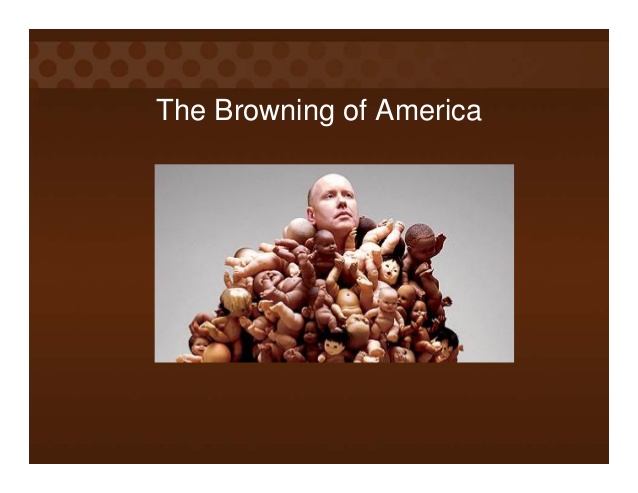
A study of the growing Hispanic immigrant population declares that the country is on the verge of the “Latinization of the United States,” a “browning of America” that by 2050 will be 29 percent Latino — and politically influential.

Published in the authoritative journal “Ethnicities,” the immigration analysis by two California experts noted that while big states such as California and Florida are home to most Hispanics, there has been a recent growth surge exceeding 300 percent of mostly Mexicans to Georgia, Kentucky, South Carolina, North Carolina and Arkansas.

The analysis is focused on how to economically handle the surge so that Latinos do not get left behind — or out of the middle class. The numbers and characterization of the new immigrants spells out the influence of the Hispanics.

In “Latina/o Formations in the United States,” Loyola Marymount University’s Antonia Darder and University of California’s Rodolfo D. Torres write that already 20 percent of the 30 million youths aged 18-24 in America are Latino and are poised to influence American politics and policy.

“By the sheer force of numbers, the kinds of adults that Latino students become will dramatically shape the future history of this country, as the former white majority becomes a minority population, at least in terms of number,” said the study provided to Secrets. It sits behind a paywall.

“Latinos have become more than an electoral voting bloc, emerging as strategic actors in major processes of democratic social transformation,” they added.

And they warned that there could be a backlash as whites try to hang on to power.

“In fact, the current struggle that persists in Arizona may well be a bellwether for the potential backlash that is bound to ensue in others parts of the nation, as the White Anglo-Saxon Protestant population no longer enjoys the political security associated with their past majority status,” said the authors.

“Over the past four decades, Latinos in the United States have emerged as strategic actors in this process of socio economic transformation. This so-called Latinization of the United States comes at a time of increasing social polarization and class inequalities. These forces assert themselves economically, demographically, culturally and politically in the workplaces and in Latino everyday life,” added their analysis.

Source: Washington Examiner

Rachel Dolezal is right: White self-hate is only logical, says US ‘academic’

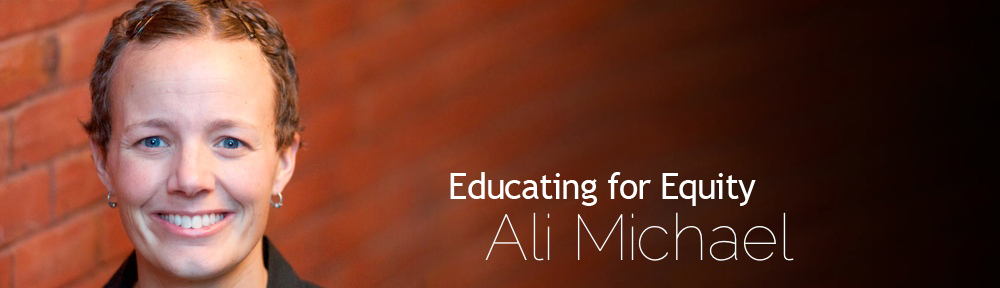
Writing in the Huffington Post, a US author and “Director of P-12 Consulting and Professional Development at the Center for the Study of Race Equity in Education at the University of Pennsylvania”, Ali Michael, argues that she dan identify with Rachel Dolezal’s attempt to disguise herself as a black and renounce her white identity. Below, Michael says:

“I definitely experienced this. There was a time in my 20s when everything I learned about the history of racism made me hate myself, my Whiteness, my ancestors… and my descendants. I remember deciding that I couldn’t have biological children because I didn’t want to propagate my privilege biologically.”

Here is a slightly shortened version of Ali Michael’s column, originally entitled, I sometimes don’t want to be white either.

Rachel Dolezal is a fascinating case study in White racial identity development.* She is stuck in the immersion/emersion stage, in which White people, having learned extensively about the realities of racism, and the ugly history of White supremacy in the U.S., “immerse” themselves in trying to figure out how to be White in our society, and “emerge” with a new relationship to Whiteness. Only in the case of Dolezal, her way of dealing with the pain of the reality of racism, was to deny her own Whiteness and to become Black.

She is an extreme example of a common phenomenon. The “immersion” stage is typified by White people taking more responsibility for racism and privilege and often experiencing high levels of anger and embarrassment for racism and privilege, which they sometimes direct towards other Whites. They sometimes try to immerse themselves in communities of color, as Dolezal did. She’s not alone.

I definitely experienced this. There was a time in my 20s when everything I learned about the history of racism made me hate myself, my Whiteness, my ancestors… and my descendants. I remember deciding that I couldn’t have biological children because I didn’t want to propagate my privilege biologically.

If I was going to pass on my privilege, I wanted to pass it on to someone who doesn’t have racial privilege; so I planned to adopt. I disliked my Whiteness, but I disliked the Whiteness of other White people more. I felt like the way to really end racism was to feel guilty for it, and to make other White people feel guilty for it too. And then, like Dolezal, I wanted to take on Africanness. Living in South Africa during my junior year abroad, I lived with a Black family, wore my hair in head wraps, shaved my head. I didn’t want to be White, but if I had to be, I wanted to be White in a way that was different from other White people I knew. I wanted to be a special, different White person. The one and only. How very White of me…

Beverly Daniel Tatum has written that White people don’t choose to identify as White because the categories to choose from are loaded from the start. Traditionally, one can identify as a colorblind White person, a racist White person or an ignorant White person: those are the three ways White people get talked about as White. If those are the options, who would choose to identify as White? And so White people identify as “normal” and “Irish” and “just American” and do not self-identify racially. And that leaves us with a society in which only people of color have a race, where only people of color seem to be responsible for racialized problems. It makes it hard for all of us to know and tell our racial stories — because White people think we don’t have any. And it makes it hard for us to own our history, because we don’t see it as ours.

Many White people also feel like we don’t have culture, and this isn’t a coincidence.

Throughout the 20th century, countless immigrant groups abandoned the artifacts of cultures that racialized them as immigrants (language, religion, food, styles of speaking, gesticulations, family structures, traditions, etc.) in order to become White. And this was not just a matter of fitting in; it was about accessing rights that were reserved for White people: citizenship, land ownership, police protection, legal rights, etc.

The more one could cast off the markers of otherness, the more likely it was that one could become White. And so while the desire to become White is really the opposite of what Rachel Dolezal had, the process of becoming White that her ancestors undoubtedly went through in the great American star-off machine, may be connected to her desire to un-become White, to lose that feeling of being cultureless, of being part of an unidentified group, and to leave behind that identity that has no positive way to be. And lots of White people — myself included — do this in thousands of tiny ways as we appropriate the cultures of others (from Africa, India, Compton, Guatemala, Harlem, Mexico…) to fill in the blanks in our own.

Daniel Tatum said we need to change this. We need to give White people new ways to identify as White. Because at the end of the day, we need White people to see that we are White. When we recognize and own our Whiteness, we can account for our own portion, our one 1/billionth of responsibility for what White people have done throughout history. We can work with other White people to begin to challenge bias, ignorance and colorblindness. We can use our privilege to confront the sources of that unfair favoring.

I was lucky. The Black family I embedded myself in during my “Rachel Dolezal phase” insisted on my inherent goodness, and that of my family and even — I thought this was a stretch — of my ancestors. They helped me focus on my capacity to make change as a White person. They appreciated my desire to be Black, they teased me, they let me know in no uncertain terms that I would never be Black. I read James Baldwin, Toni Morrison, Steve Biko. I swore off White authors. But the Black authors I read saw the immersion stage coming, and they reminded me that Black people don’t need White people to help them pursue liberation, that the job of White people lies with teaching other White people, seeing ourselves clearly, owning our role in oppression.

I’m not sure what happened with Rachel Dolezal. Maybe it was mental illness. Maybe it was a desire to connect to her adopted brothers. Maybe she felt safer and more loved in Black communities. Maybe it felt good to distance herself from the overwhelming oppressiveness of Whiteness — her own and that of her country and of her ancestors. But the lesson for me is remembering how deep the pain is, the pain of realizing I’m White, and that I and my ancestors are responsible for the incredible racialized mess we find ourselves in today. The pain of facing that honestly is blinding. It’s not worse than being on the receiving end of that oppression. – Ali Michael


*White racial identity development was first theorized and written about by Dr. Janet Helms.


Letter: Why call me a ‘white bitch’ when I also love Mandela?

I am a white born-free. I was born in the year 1995 into a post-apartheid, democratic South Africa – the “Rainbow Nation” as Archbishop Tutu affectionately named us.

I am a “Millennial” or “Generation Y” as Time magazine likes to call me – free from the categorical narrow-minded stereotype my parents (“Generation X”) and their parents are neatly packed into.

A millennial is ideally a free- thinker, an open-minded spirit ready to take risks, as well as accepting of all races, and religions however diverse they are from their own. This is me.

This, supposedly, is also the girl who infringed my human right to dignity, as well as my right to feel safe in any given situation.

The boy and girl in the car that practised racism, violence, hate speech and assault against my friend and me in Stamford Hill Road outside Live – The Venue on a Saturday night in January could not have been older than 22.

While technically they may not be “born-frees” strictly speaking, these two people were born long after the apartheid regime had come to an end and democracy was a leading force in South Africa.

They have no excuse to harbour hate, vengeance, bitterness or any other negative feelings towards white people. The “race card” is being pulled out far too often in this country when nine times out of 10 race has absolutely nothing to do with the situation at hand.

All my friend did was cry out “a*******!” in frustration at the occupants of a speeding car that nearly ran us over as we crossed the road to get to our own car that night. But things escalated quickly.

Before I knew it, the speeding car had stopped and a drunk couple alighted, tumblers in hand, cussing at us.

The phrase “white bitches” were among others thrown at us as the girl screamed in my friend’s face, threatening to assault her.

We removed ourselves from the situation and as we walked away, we felt liquid on our backs as a glass sailed past, narrowly missing my head and shattering on the pavement in front of us.

One of the main things which set our Generation Y apart is that we are classified as “tolerant”.

Our generation is supposedly tolerant of other races, cultures, points of view, political standpoints.

I could fill this letter with a long list of examples of our tolerance, but the fact is many of us in South Africa are not tolerant and it sends a surging pang of guilt to my very core when I think of what dear Madiba would say of these attitudes.

This is the country he spent his entire life moulding into something he could finally be proud of.

But I do not think Madiba would be proud. He would look down on these backward, destructive, unproductive, entitled Millennials.

You don’t even deserve to be associated with the term since Millennials are meant to be forward-thinking go-getters. We are supposed to be a generation that makes its own future. But you sit back and wait for your futures to make you.

Well, guess what? You’re going to be waiting a long time and your frustration will cause you to riot and fight and scream and tear down statues unnecessarily.

You are your worst enemies and that will eventually destroy you. I can wash off the alcohol you throw at me, but you cannot wash away the hate that is inside of you.

All Millennials need to read this and consider which category they fall into for the good of their future – and more importantly, the good of our beautiful country’s future.

– Meghan Deonn Oberholzer, Vredehoek

Asians in USA are punished for having better test scores than blacks and Latinos

Sarah was at a college prep seminar when she was told she’d have to be better than everyone else.

Sarah was shown a prominent study that correlated race and SAT scores in college admissions, which found that Asian-Americans were at a stark statistical disadvantage, losing the equivalent of 50 points off their SATs by virtue of their race. Black and Latino applicants, in contrast, gained the equivalent of 230 and 150 points, respectively, the study claimed.

“I just thought it was really unfair,” Sarah, a 15 year-old student at a public high school outside San Francisco, told BuzzFeed News. “And I thought it was a little bit racist, a little bit prejudiced.” (Sarah asked that only her first name be used in order not to jeopardize her college applications.)

Above all, Sarah concluded that the unfair statistical disadvantage translated to more pressure and more work. Sarah, who immigrated to the U.S. from China with her parents when she was 5 years old, would have to spend the next three years trying even harder to distinguish herself in a highly competitive majority-Asian school. “I’m not even in my sophomore year, and it’s already hitting me,” she said.

Last month, a coalition of Asian-American groups filed a federal complaint alleging that Harvard University applied discriminatory quotas against Asians in its admissions process. In response, an even larger Asian-American coalition published an open letter rebuking the complaint and affirming its support for affirmative action policies that consider applicants’ race. The reaction to the Harvard complaint revealed fault lines in the Asian-American community around the often highly sensitive and personal issues of college admissions and race.

The debate has also underscored differences of opinion between recent immigrants and American-born people of Asian descent, particularly among Chinese-Americans. While many of the former see affirmative action as part of a long legacy of anti-Asian discrimination in the United States, many of the latter accept affirmative action as a necessary corrective to America’s history of racism, particularly against blacks.

“A lot of recent immigrants have the mentality that if you work hard enough, and prove yourself with high GPA and SAT scores, then that should be all you need” to get into a top college, said C.N. Le, a professor at the University of Massachusetts, Amherst. Whereas Chinese-Americans who have assimilated over generations to life in the United States, Le said, are more likely to appreciate “the structural factors that led to the formation of affirmative action” in the first place.

Such is the case with David Fong, who has a 15-year-old son in public high school in Redondo Beach, California. “I don’t agree with the people bringing the [complaint against Harvard], but I understand their thinking,” Fong told BuzzFeed News. “I just think their thinking is wrong.” Fong grew up in the tenements of New York City’s Chinatown, the son of working-class Chinese immigrants. His mother worked in a garment sweatshop, and his father was a waiter at a Chinese restaurant, until he and a group of fellow waiters pooled enough money to buy the place.

From that point on, Fong’s parents struggled to elevate the family to a solid middle-class existence. Fong was a latchkey kid who barely saw his constantly working mother and father. “The restaurant was open seven days a week,” he said. “The only times it closed were Christmas, Easter, and Thanksgiving was a half day.”

Fong’s parents placed a huge premium on his education. Fong listened, eventually getting undergraduate and law degrees from NYU. But he also came to deeply value diversity. Growing up, Fong went outside the Chinese community to make friends of different races and backgrounds, trying to combat the “informal social segregation” that he saw among his peers. “I think the next generation, when we’ve been here longer and gotten the chance to interact with other people and immerse ourselves in American society, realize that we need to be more open-minded,” Fong said.

Fong inculcated this perspective in his son, Jason Fong, a budding writer and committed wrestler who just finished his sophomore year at Redondo Union High School. Jason has seen the statistical evidence suggesting that he, as an Asian-American college applicant, may face higher hurdles than some of his peers. But if he were rejected from a school in favor of an underrepresented minority, he says, “I would accept that. It’s for the greater good of the country, because the diversity level in America is what makes it different from anywhere else in the world.”

Many recent Chinese immigrants think this mentality ignores the decades of very real discrimination that Chinese people have suffered in American history. American-born Chinese — or ABCs, as some immigrants call them — can lose sight of this discrimination, said Sean, the stepfather of Sarah, the high school student outside San Francisco. (Sean also asked to withhold his last name to protect Sarah’s identity.) He sees the effects of affirmative action on Asians as part of a lineage that includes the Chinese Exclusion Act and laws preventing Chinese people from working in government or marrying Americans.

“People who move here, I think, are more aware of the discrimination, because we’re sensitive,” Sean told BuzzFeed News. “We came from another country, and we always look around to see, am I doing well? What else do I need to do? So we force ourselves, and also our children, to work harder just to get recognition.”

When he looks ahead to Sarah’s future navigating high school and the college application process, Sean worries mostly about the pressure that the system places on his stepdaughter — pressure to do everything possible to obtain higher test scores to overcome the bias against her. That pressure, he said, can be harmful to the well-being of a generation of young Asians striving to succeed academically while also cultivating meaningful social lives. “When you’re 15 or 16, any pressure on you, when you feel it and assess it, it can be exaggerated fivefold,” Sean said. “The pressure, in my opinion, is unfair pressure.”

And it is a pressure that Sarah says she definitely feels. “Coming from a high school that has really high test scores and a really high population of Asians, everyone is fighting to be seen,” she said. She plays volleyball and pursues extracurricular activities in an effort, she said, to “beat the stereotype” that Asians are narrowly test-focused and excessively studious. “But it’s hard to maintain that when we also know that we’re at a disadvantage, and we have to study even harder to get even better SAT scores,” she said. “It’s hard to balance that.”

“Oftentimes I think it would be a lot easier if I wasn’t Asian,” Sarah added. “I think I could enjoy my high school experience more.”

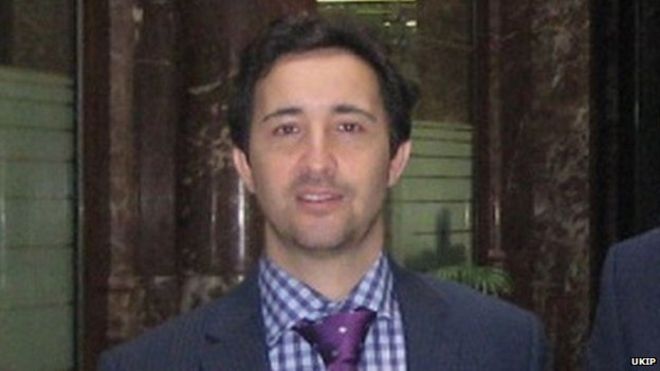
‘Cultural Marxism has ruined the UK and South Africa’ (Part 2): interview with Jack Sen, suspended UKIP candidate

What is the real reason you were suddenly suspended from UKIP?

I was suspended from UKIP simply because I refused to toe the party line when it came to discussing the genocide of the Western European people and minority South Africans, and the Marxist imposed double standards Westerners face on a daily basis.

The moment one has the audacity to discuss the deliberate displacement of indigenous people in Western Europe, or murder of Western White people in general, the epithet “racist” is shouted.

Considering I myself have some non-white ancestry (I have an Indian grandparent), I found the “white supremacist” tag used to describe me a tad ironic. I say this as I myself have been abused on occasion for being “swarthy”.

For me the criticism had less to do with race and more to do with the divide-and-conquer ideology being used to tear our societies apart – something you see quite a bit of in South Africa.

Still, I felt something needed to be said.

My wife, English mum, and most importantly my 100% phenotypically white daughter, need someone to stand up for their interests and well-being, and I’ve believed for some time now that I should be that person. That’s what dads are for after all.

The white Western male is quite sadly apathetic – one can say they’ve been emasculated beyond belief by Cultural Marxism, evidenced by the tens of thousands of grooming gang rapes and not one instance of revenge. They don’t have the same fighting spirit one sees in South Africa, or in non-white nations.

After what transpired in Rotherham, where white children were singled out for rape, and the white Leftist establishment did nothing to prevent it, I felt I needed to take a stand, not against the perpetrators of the rape, but the Leftist fiends facilitating it.

If I am the only man in Britain that does so, I’ve done my part.

What was specifically said?

A few weeks before I was suspended I gave an interview to the European Knights Project.

The interviewer asked me about commonalities that existed between the Marxists that wrecked your homeland, and the ones currently destroying mine.

So I rattled off a few names: Ed Miliband, Joe Slovo, Nadine Gordimer and Barbara Spectre. These names are all quite conspicuously Jewish, so I decided to throw a few gentiles in the mix so I wouldn’t appear anti-Semitic, as that was not the plan.

It didn’t work.

Although I never actually came out and said that in places like in South Africa, Sweden and England, where the displacement is at its most intense, Marxist Ashkenazi-Jewish radicals from former Eastern bloc nations are overrepresented in a movement calling for our annihilation, the implication was there, and I was doomed.

Within days of giving the interview – and I still don’t know who reported me – I was being disciplined. Not for anti-Semitism – as there was nothing overly anti-Semitic about my statements – but because I’d dared call the deity, Madiba, a terrorist. Thankfully, the chaps at UKIP HQ had no idea who Slovo and Gordimer were so I was safe… for the moment.

Then, this amateur junior reporter at the Mail on Sunday, named Alisha Rouse, sent me an email asking to urgently speak to me, due to the fact that I had given an interview to a “white supremacist site”. That’s how she worded the email, as well.

Me, someone with an Indian granddad who on occasion had been verbally abused in Britain because of his ethnicity, being accused of white supremacism! The idiotic woman really had no clue what she was talking about, however I entertained her out of fear she would misreport my beliefs.

Rouse then proceeded to waste my time over the phone grilling me about my beliefs that there’s an effort to destroy our culture and her belief that I was again; anti-Semitic. She asked me if I was a racist, I said no, and that was that. The story, although UKIP were petrified of its release, never even made the paper. The reporter was really just trying to make a name for herself by having a go at a well-known UKIP parliamentary candidate. She failed, and I moved on.

Once UKIP heard I’d spoken to her, I was shouted at, threatened and told that I’d better distance myself from all things South African, due to the fact that fact that South Africans were blind to just how racist they were.

Believe it or not, that’s what our Head of Candidates wrote me.

The man didn’t give a damn about the murders, racism and hatred, nor that a few hundred thousand Saffas live in Britain! One would think a party looking for votes would care about the single most important issue Saffa expats care about.

They just told me to keep my mouth shut and never ever speak to a national reporter again.

I agreed and moved on.

Although I understood why I’d gotten in trouble, I was still under the misguided impression that UKIP prided itself on encouraging people to speak their minds, as long as their opinions weren’t based on hatred – which mine were certainly not.

I didn’t see what was wrong with discussing what amounted to ethnic genocide and naming the people behind it. Nor was there anything wrong in giving my opinion to a very widely read website, especially as the initial conversation took place well before my campaigning had started.

I can understand if I’d said that there was war between Jews and gentiles (that’s not my opinion), why that might have been seen as offensive, but simply to point out that what amounts to genocide was taking place in SA and Europe? It made no sense.

In fact, tell an objective Black or Asian who’s not attended a Marxist indoctrination camp, also known as a university, that this is happening, and provide them with a little evidence that Europeans are being replaced. Then go through the names of the people behind the move to displace us, telling them that most of these people are progeny of Eastern European immigrants with Marxist backgrounds. I can almost guarantee that he won’t see racism at all. He reflects, and either agrees or disagrees.

Most of the Asian people I know – especially members of Britain’s Hindu and Sikh communities – actually agree with me. Muslims themselves recognize that one of the most efficient ways to spread and increase the percentage of people subscribing to Islam is through mass immigration and outbreeding. I mean it doesn’t take a genius to recognize what’s happening, nor should we be prevented from discussing it nor be prevented from naming the people behind it.

Then there were the aforementioned tweets sent to Luciana Berger, accusing her of being more concerned with Israel than she was with her constituency in Liverpool. Berger, who just prior to being parachuted into Liverpool from London, chaired the Labour Friends Of Israel organisation, has been criticised by a lot of people for her foreign allegiance and dodgy dealing – so again there wasn’t really anything that controversial in my words.

In fact a Wikipedia article was quoted in the criticism.

Still, Berger, who has made a bit of a career out of feigning moral outrage when confronted with her treachery, and crying anti-Semitism whenever she is criticized for her shoddy politics, phony Labour credentials, and dual allegiance, saw an opportunity… and jumped.

I say this as this is not the first time the repugnant Berger has gotten people into problem over their opinions.

Not being able to openly criticise politicians that have sold our local people out for their internationalist interests is one of the worst things about this nation.

And the woman knows why I called her a traitor. She was angered that I just had the balls to do so, right before an election and in a party that is well-known for pandering to special-interest groups.

How do you respond to charges that your tweet to Luciana Berger was anti-Semitic?

Disseminating truth, when one’s intention was to expose injustice, has nothing to do with racism. Her being Jewish is of no concern of mine. Her being a traitor to this country is.

The right to point out that a morally bankrupt politician with a dual allegiance, who’s paid to serve us, has been corrupted, has to be protected. It’s far less incendiary than drawing a cartoon of Mohammed, something I am certain this vile Berger woman would don a Je Suis Hebdo T-shirt for, yet it was deemed anti-Semitic by the press, and most distressingly the party I’d dedicated the last 6 months of my life to.

In the first tweet I sent Berger, where I claimed she had dual allegiance (she actually has a single allegiance if I am being perfectly honest), and would prefer to send child benefit ear-marked for the poor to Israel and Poland, the evidence is there to back up the allegation.

If she’d been a white gentile and a member of a neo-Nazi organisation that she’d lobbied on behalf of, I would have been equally aggressive. If Berger was Muslim, and say in some sort of Pakistani friends association as its leader, I would have made the same allegation.

That’s what honest men and good public servants do.

With that said, in neither case I doubt anyone would have taken any notice. Although Muslims are protected in Britain, we are still allowed to criticise them. It’s only Jews that are totally off-limits, and this is why anti-Semitism is on the rise again. Knowing you can’t criticise someone breeds resentment.

If I wasn’t anti-Semitic before this event, can you imagine how I feel now?

It’s actions like these that make people angry. I’m smart enough to know there are distinct differences between Jewish people, but knowing that the only reporter at the local Liverpool Echo I ever had a problem with was Jewish, and this politician was, as well, will make some appreciate why people think as they do.

I would like to add my interpretation of UKIP’s actions and mind-set if possible.

Although I first thought UKIP rushed to judgment due to the fact that they were petrified of being branded racist, I am now starting to think that it goes much deeper. The Daily Express just gave more than one million pounds to Mr Farage, leader of UKIP. Knowing what I know about politics and Richard Desmond’s motivation for backing UKIP, I’m no longer certain that what happened wasn’t orchestrated and I was made an example of. I mean Nigel Farage taking time out of his busy schedule to call me an embarrassment on national television? Shameful.

Prior to this incident, many people saw UKIP as a conservative, pro-British and pro-Western party. Do we have reason to doubt that?

I thought so myself when I first joined as the vast majority of the people that are on the ground – the members, volunteers, council and parliamentary candidates – are all very pro-British, Western, and as patriotic as you could envision.

Sadly, the suits at the top prey upon the genuine love of country we grunts at the bottom of the totem pole feel. The fact that UKIP supports fracking Britain to death, cares little for the environment and would allow millions of third-world immigrants in to replace the migrant workers from Eastern Europe, not simply shit the borders most UKIP supporters would prefer, is cause for concern.

Although there’s merit to the idea of civic nationalism, I have a funny feeling that the longer UKIP stays relevant, the more it will gravitate towards the sort of pseudo-nationalism we see in groups like the EDL and Britain First. To be honest, UKIP is starting to remind me a lot of the American Republican Party, and that is certainly grounds for worry as well. I wonder if we’ll be importing Ari Fleischer to run our MI5 next.

What attracted you to the plight of white South Africans, an unpopular cause in Britain if ever there was one?

My Afrikaner grandmother, my love for justice, and the fact that it pains me to see good people dying while the world and people like Ms Berger watch in amusement. I’d have loved to move to South Africa with my family at some point, but it’s simply not possible under the current government. Knowing I can’t even bring my daughter to see where her grandma was born because people are being killed, made me take a step back and think, hold on, you’re unable to move back to SA, but these people are literally trapped and have to live in fear for their lives? I just wanted to make a difference and am happy I have been given the chance.

You say you read some Afrikaans? Did you just pick it up or do you know another Germanic language such as German or Dutch?

I only do as my grandma would sing a few songs to us as children in her native tongue and put Malva puddings on our table at Christmas time. My knowledge of the South African people is more cultural than linguistic, but basically I enjoy the language and want to see it live on in perpetuity. I’d love to see South Africa return to its former greatness. Although change was necessary, what we’ve witnessed is the wholesale destruction of a nation. Handing over the nation to people that don’t have the capacity to run it, is a recipe for disaster.

The poverty, Aids, murder, rapes and societal degradation are evidence that majority rule in Africa doesn’t and can’t work.

Do you consider yourself to be a victim of political correctness?

Yes, definitely but in a slightly different manner than the sort of political correctness we typically see infecting our society. UKIP gave me a lot of rope to criticise grooming gangs on my site, as well as attacking paedophiles, forced sexual education programmes, gay lifestyle indoctrination, but when I directed my fighting spirit at Berger and the people behind South Africa’s demise, I was done. That’s what’s so disturbing about this whole incident. It reeks of being conspiratorial.

UKIP reps have made some truly racist statements over the past few months. From candidates threatening to shoot “peasants”, calling gays “disgusting” and “pooftahs”, to Farage himself making some pretty racially charged statements about Muslims, we’ve seen our fair share of scandals. One common denominator in the abuses was the fact no-one ever criticised Jews or mentioned the word white. Until now that is…

It appears that if you mention Jews – even if it’s fair criticism, or talk about white genocide and Ashkenazi involvement in Marxism, you’re done.

I spent a fortune on my campaign, could have secured 20% of the vote and a possible second place if it weren’t for UKIP damaging me on the telly, as they did, so I am angry and at this point feel I have an obligation to myself, my family and the victims of genocide to speak openly.

What saddens me most is how political correctness has ruined some of the friendships I forged in UKIP.

The fact that not a solitary soul at head office would even speak to me after my suspension tells me all I need to know about how they see candidates that dare tell the truth.

I would like to add that although I was made to feel quite unwelcome by top officials in UKIP, many of my fellow UKIP parliamentary candidates, also perturbed by the direction the party has headed, did in fact reach out. The support from people on the ground in my constituency was overwhelming.

Also, several members of the British National Party (BNP) contacted me via Twitter since the suspension, commending me for my decision to say and do the right thing. One of them put me in touch with BNP party Chairman Adam Walker, who’d heard about how I had been treated by UKIP, and wanted to show support. After speaking to Adam a fair bit this past week I can say without any reservation that I’m genuinely impressed with the manner in which he wants to take the BNP forward and was pleased to see that all our ideals and vision of a better Britain lined up. It’s nice to know authentic nationalism is alive and well!

How did being suspended so close to the election impact you on a personal and professional level?

Imagine seeing your idol, Nigel Farage, calling you an embarrassment, seeing the people that you dined with, who held your daughter in their arms, men that you shared pints of ale with betraying you, as they did me.

Then imagine watching your chances slip away over a few innocuous Tweets, it was quite painful.

Being done with the frauds has taken a great weight off my shoulders. Although they were better than the Lib/Lab/Con regime, they are still a part of the establishment and, in my estimation, controlled opposition that puts up with a bit of abuse as long as they can continue to play the game. The fact that media mogul, Richard Desmond, handed UKIP over a million quid only a week before they suspended me for anti-Semitism tells me that UKIP is done and are no longer worth supporting.

In a way – and although I do feel guilty for feeling this way – I’m glad UKIP had a shambolic result at the election. Hopefully, my ability to demonstrate to the world that UKIP are not part of the solution, with the help of people like you, made some sort of impact. The impact my words have had on the tens of thousands of South African expats that decided to make their voices heard on election day, also makes me quite proud.

How does one fight against political correctness if it so well-entrenched in the mainstream media, universities and parliaments throughout the Western world?

In a perfect world we’d be able to deal with contemporary adherents of the Frankfurt school, as other nations have, but that’s not going to happen in my lifetime.

So one has to use the best weapon we have today – the internet. People have to speak up, defend the right to free speech, accept they will be vilified, but push on as we do. Problem is, not adhering to political correctness can have catastrophic impact on a person’s career as I discovered. It’s a tough call, but all I can say is I can sleep at night because I know I did the right thing.

I have not won the election as Berger did, and might never be as well-off as she is, due to the fact that I am honest, but I can at least live with myself knowing I have done a small part to expose vermin like her and make a difference.

People can also join true natioanlsit parties like the BNP – not to be confused with racist parties.

Other people are going to need to start thinking in the same way, otherwise our civilisation will truly be lost.

Although this all ended quite tragically for me, I think I brought a little exposure to the worst genocide of the 21st century and I am quite proud of that: that of white South Africans. If I can now continue this moving forward, I am satisfied. Thanks for giving me an opportunity to speak.

English-speaker wants an Afrikaner volkstaat too

Dear Dan Roodt,

I am a Canadian who married a Boere Meisie. I have three Afrikaans-speaking children. I read your Volkstaat article from 2010: “Volkstaat is inevitable (sorry to the naysayers)”.

The gap that the White South Africans live in where they can still live a decent life and get employment and enjoy their culture and walk safely down the road is narrowing every year. I was working at a company that employed nearly 1000 staff and I was in HR department when we received a notification of the new increased BEE quotas. The new quota meant we would have to lay off a couple of hundred white workers. A great way to go out of business – get rid of your loyal and experienced staff members (and yes – we went out of business a year later). I did a stint at Eskom and that was BEE+++++. You felt like an alien working there if you are White. They were not allowed to give me a full-time job due to the colour of my skin even though my managers endorsed me highly! So where do all these laid-off whites go?

Then the government tries to step by step erode the Afrikaans culture. I will never forget Thabo Mbeki’s speech a few years ago where he said the Afrikaner White is no different to an English White. As if a culture of 350 years had no significance. Increasingly there is more pressure for Afrikaans schools to move to English.

Place names change, statues removed, disarming decent citizens, increasingly racist politicians and openly racist Black citizens, massive crime, etc. I am a foreigner who had nothing to do with Apartheid and yet when I shop, or eat at my canteen I see Black workers being friendly to Black customers and then they serve a White and then become unfriendly. At my work canteen I often get given a small serving and see all the Blacks in the same line getting large servings. I get treated poorly by most Black service industry workers. My municipality charged me R120,000 for one month’s electricity and I was told by the meter reader that my municipality will never fix a White man’s account.

When the gap gets too narrow then the Whites will have to form a Volkstaat. The sad thing is that this may end up happening amid total chaos and civil war. Five million persecuted people can do a lot of damage. I remember the World War II footage where they noted how the Europeans pulled together in times of extreme hardship. We don’t just die or jump into the ocean as seems to be the expectation.

It was interesting to see the amount of support that Steve Hofmeyr received recently. Couple of hundred thousand supporters. Its not 5 million supporters yet for White figureheads. But the 200 thousand will grow as things get worse. Obviously it’s easy to pretend there isn’t a problem while you have your decent house, drive down your safe highway to your reasonable job. Its easy to criticise people like Steve and yourself while people still live in the gap. In the last 2 years, I have had two attempted car jackings, my brother-in-law and his wife and toddler were tied up and were lucky not to be shot by military-weapon=toting criminals (got interrupted when about to shoot), my wife was robbed at an ATM, our Church Pastor’s son was stabbed, etc.

Slow erosion of culture is a clever tactic. Let the old school ex-army/police die of old age. Change things slowly so the change creeps up on people. But I am seeing new Black political and union forces getting impatient. Afrikaner culture just won’t die quick enough for them. It must really upset them to see the growth of the Afrikaans music culture and the persistence of the White-dominated Springbok rugby team and the support structures amongst families and friends that prevent Whites from sinking into poverty when BEE’ed out of the employment market and the large number of Whites returning from overseas now that the global economy is in trouble, etc. Malema’s call for taking all White-owned farms just won’t go away. They seem to be more and more in a rush to grab their share regardless of the cost to the economy.

I can’t wait to see the change in the Whites’ attitude when one of these big changes hits them hard and fast. When the gap gets too narrow too quick.

I agree with you that a Volkstaat should be centered on an Afrikaner culture. I would gladly shift to your language. I have travelled the world and have a love for the Afrikaner culture since for me it stood out as being vibrant and strong and non-Americanised.

See you at the border of the Volkstaat.

Regards,

Tim Edmundson

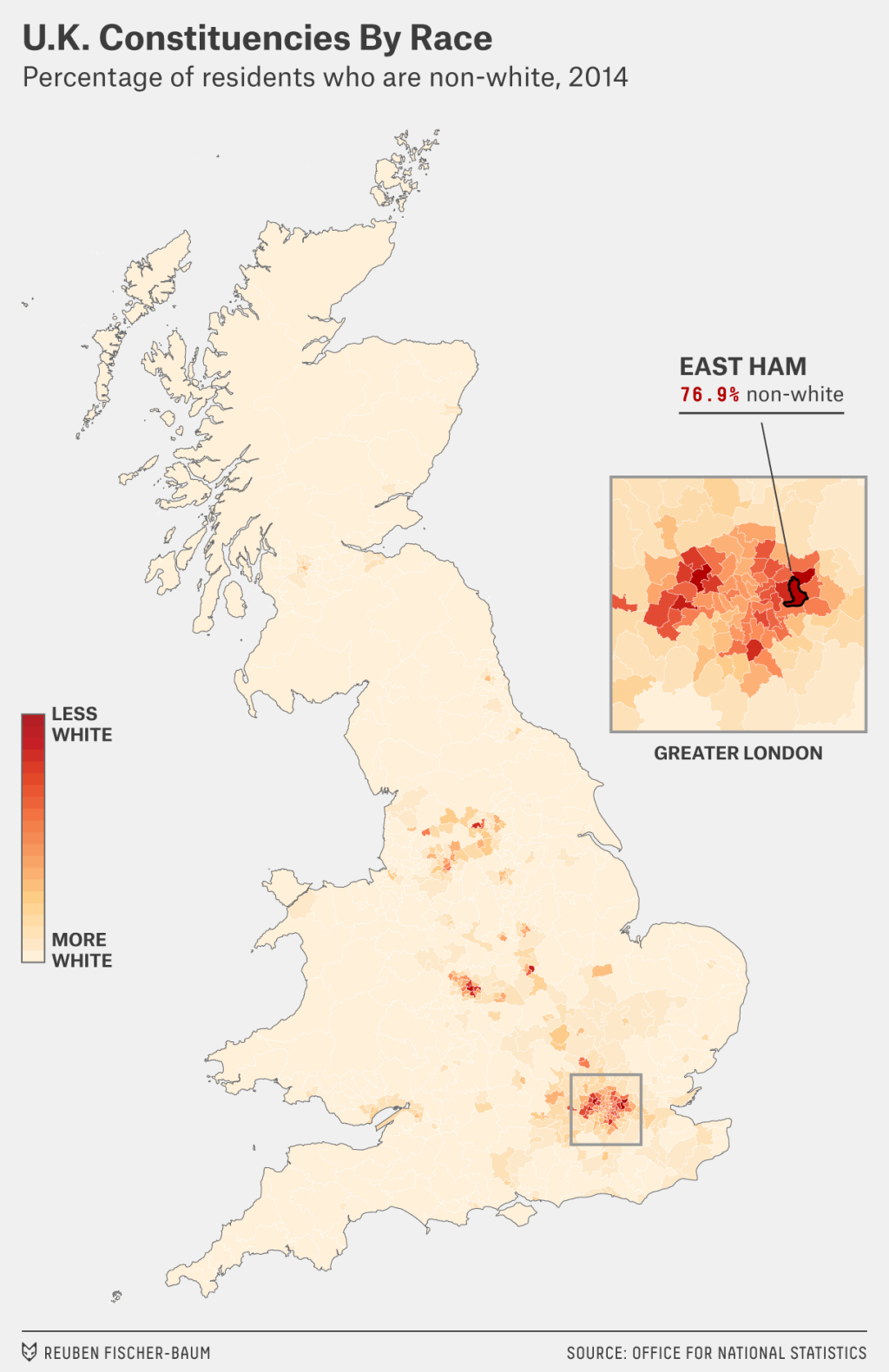
87% of British blacks vote Labour and other ethnic facts

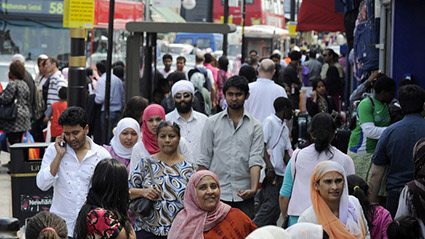
One of the safest Labour seats in Britain is its most non-white one, East Ham. It has been in Labour hands since it was formed in 1997 and will vote Labour again tomorrow in Britain’s general election. Its MP, Stephen Timms, was once stabbed by one of his constituents, Roshonara Choudhry, a 21-year-old student, who “was inspired by an al-Qaida cleric and wanted to punish Timms for voting in favor of the Iraq War”. The Labour MP downplays the incident and simply wants to represent his “diverse” ward.

Mona Chalabi writes:

There are two mosques on Church Road. I arrive at one of them just after prayers have finished one afternoon in early April, and as I peer my head around the entrance, I see a man hopping on one leg dressed in a black parking inspector’s uniform. He slips his foot into a black regulation shoe that he left on the grid of shelves that line the lobby when he went in to pray.

“Do you have time to talk to me about the election?”

“Nah, sorry,” he replies. “I’m still on my shift.”

I step back outside so that I’m not in the way of the men silently filing out of the mosque. One tall man with a round stomach slowly passes me in a beige salwar kameez, his sandals flapping behind him as he talks quietly into a cell phone. I don’t recognize the language, but I’m hardly surprised — I am, after all, in East Ham. Only 58.6 percent of people in Newham, the local authority where East Ham is found, reported English as their main language in the 2011 census, the lowest share of anywhere in England and Wales.

I’m here because the residents of this East London constituency make this place an outlier in a number of ways. This is the U.K.’s most ethnically diverse constituency and one of its most religious areas. It has the highest number of residents who were born abroad — 83,223, according to the 2011 census. And, according to the Office for National Statistics (ONS), 77 percent of the population here is non-white, the highest share of anywhere in the country. The median across the U.K.’s 650 constituencies is just 5.2 percent non-white.

In other words, this place sticks out statistically.

east-ham-uk-diversity3

Understanding those numbers is important in explaining why this is one of the safest Labour seats in the country. East Ham has been represented by a Labour member of Parliament (MP) since the seat was formed in 1997. In the 2010 general election, Labour won 70 percent of the vote here and is projected to win 69 percent on May 7.

But while residents here are a key part of this political continuity, they’re also in some ways the focus of calls for political change. Race and religion are rarely explicit talking points in U.K. politics, but they’re often implicit when the topic of immigration comes up — as it now so often does.

That evening, the first of two debates is aired on national television. Leaders of the seven largest political parties take to podiums to present their visions for the country, debate them and take a handful of questions from members of the audience. Race doesn’t come up once, but immigration features heavily. The politicians exchange insults about inaction and make promises about immigration policies. If those policies were different — and most of the party leaders say they should be — maybe East Ham wouldn’t look the way it does now.

In 1999, my mum started working in East Ham as a general practitioner in a National Health Service medical practice that was made up of two small terraced houses with one wall between the two knocked down. Each summer, after a few weeks of holidays had passed and the boredom had become unbearable, my best friend and I would go to the surgery to help out. We would prepare new files for new patients in a waiting area that had once been a living room. There were always new files to make because there were always new patients. Six years ago, the surgery moved to a much larger multi-story, multi-practice building half a mile away to cope with increasing demand.

Between the 1991 and 2011 censuses, the population of Newham grew 42 percent. That growth has been almost exclusively non-white, as the Centre on Dynamics of Ethnicity at the University of Manchester shows below.

eastham-chart

Newham’s largest non-white groups reported in the 2011 census were Indian (13.8 percent of people), African (12.3 percent) and Bangladeshi (12.1 percent) — but it’s a long list.3

There’s no data on race and voting patterns at the constituency level, but it’s safe to say that the high share of ethnic minorities here has driven Labour’s success in East Ham. Between May and August 2010, the Ethnic Minority British Election Study asked almost 4,000 voters nationally who they had chosen in the general election that May. Of Brits who were ethnic minorities, 68 percent supported Labour; that compares with 31 percent of whites.

RACE LABOUR CONSERVATIVE LIBERAL DEMOCRAT
African 87% 6% 6%
Caribbean 78 9 12
Bangladeshi 72 18 9
Indian 61 24 13
Pakistani 60 13 25
White 31 37 22

And religiosity in the area has probably played a role, too. Newham is the least irreligious place in the country: Only 9.5 percent of residents say they have no religion, compared with 24.7 percent in England. That’s partly because the share of the population that is Hindu is six times larger in Newham than it is at the national level — the same is true of the Muslim population.

Between February and March of last year, the British Election Study conducted a national survey on the attitudes of religious groups. Among those who said their religion was Islam, 73 percent said they would vote Labour. It’s a strikingly high figure — only 40 percent of those with no religion and 32 percent of Anglicans said they would vote Labour (the largest and second-largest groups of respondents, respectively).

FAITH LABOUR CONSERVATIVE LIBERAL DEMOCRAT UKIP
Islam 73% 15% 7% 1%
Sikhism 64 15 6 6
Hinduism 58 31 3 6
Roman Catholic 45 30 5 13
None 40 27 11 12
Buddhism 38 25 7 14
Baptist 37 32 10 16
Presbyterian 35 25 5 8
Methodist 35 41 11 10
Anglican 32 39 8 18
Judaism 30 46 5 12

Stephen Timms, who has represented East Ham in Parliament since 1994,4 is well aware that he represents an incredibly diverse constituency. He’s also probably well aware that the racial and religious makeup of his constituency has helped secure his seat as a Labour MP. But it’s not just political demographics — Timms is also well-liked by his constituents. Several people I spoke to gave examples of how he had helped them personally. He votes strongly in favor of raising welfare benefits and against reducing housing benefits, issues that are especially important in this area where 42 percent of children live in poverty.

After a string of high-profile roles, most recently as shadow employment minister, Timms, 59, is now the Labour party’s “Faith Envoy” (he took up Christianity in his teens).

But this long political career, one built on a very solid electoral majority, has not been without incident.

Just a week after re-winning his seat in the last election, Timms was stabbed twice in the stomach by a constituent at an advice surgery — a regular session for MPs to hear the concerns of the people they represent. His attacker, Roshonara Choudhry, a 21-year-old student, said she was inspired by an al-Qaida cleric and wanted to punish Timms for voting in favor of the Iraq War. Aside from giving a few interviews about it, Timms finished his most recent political term without emphasizing the attempted murder.

When I call him, hours before the first leaders debate is due to air, I ask Timms, who is seeking re-election, about race in East Ham. Timms, who is white, speaks about it comfortably.

“You’d think that a very diverse place like this was kind of, by definition, a pretty fragmented community — I actually don’t think that’s the case,” he said. “I think this is actually a quite cohesive community, and I think the reason for that is the great majority of people in this area belong to something. They belong to a church or a mosque or a temple or a gurdwara.”

A thriving religious community and a high vote share for Labour don’t mean there isn’t political debate in East Ham. The U.K. Independence Party (UKIP) has a candidate standing in East Ham who is expected to get 5 percent of the vote in this election (nowhere near enough to unseat Timms, and lower than the 11 percent median vote share that UKIP is projected to get across the U.K.). Britain’s newest political force, UKIP has the strongest stance of any party on immigration — it wants the country to get out of the EU because it believes immigration is unsustainably high.

In 2010, UKIP was politically irrelevant. But the party came in first in the 2014 European Parliament elections, which was followed by two wins in U.K. by-elections. Now, UKIP is shaping the debate on immigration — and by extension, the stakes of this election. Nationally, 27 percent of voters say immigration is the most important issue facing Britain, more than any other single issue. I told Timms that even some of the immigrants I’d spoken to in East Ham were worried that immigration was too high.

“I’m not surprised you came across that,” he said. “It is sometimes a little bit surprising to listen to someone who is clearly an immigrant complaining about immigration, but people do feel quite strongly about that. … Quite a lot of Labour supporters think this is an important issue, and they need to feel that the system is properly managed and fairly.”

The Church in East Ham is now a community centre where they play disco music, unlike in the mosques in the area that are very much used for religious purposes

From the outside, Trinity Community Centre looks like a church so typical that it could be part of a toy train set, made of plastic and placed next to the pretend railway station. I’m greeted in the hallway by a suited Sikh man in a turban holding a clipboard. I tell him that I’m looking for the advice surgery. Only the staff is here today — with the election just five weeks away, Timms is busy with “other commitments.”

Someone somewhere is playing the 1994 disco hit “U Sure Do” by Strike very, very loudly. Over the man’s shoulder, I can see through a glass window — streamers hang from the ceiling, and balloons float between adults and children. I ask if it’s a birthday party, and he tells me that it’s a therapy group for children with disabilities.

A lot of community support groups meet here. If I had arrived at another time or on another day, I might have bumped into Dost, a service for refugee, asylum-seeking, trafficked, undocumented or new migrants between the ages of 11 and 25. Or I might have seen one of the adult education classes or stumbled across Bayaan, a support group that encourages young Asian girls to get into higher education.

The man with the clipboard points above his head: “The advice surgery is upstairs.”

About a dozen constituents sit on pews, waiting to speak to a member of Timms’s staff. I’m keen to hear what they think about UKIP. People here don’t all agree about UKIP; some say the party is racist, some say the party has a point on immigration, but most of these constituents tell me they will vote Labour.

There’s no data on support for UKIP by race either nationally or at the constituency level, but there is evidence that many voters are concerned about the party’s racial politics. In a survey last May, 41 percent of people said they believed UKIP was a racist party and 46 percent said they believed UKIP was “deliberately trying to attract support from racist voters.” The Guardian recently reported that “Are UKIP racist?” was the most common Google search about the party in March.

UKIP’s public policies don’t use xenophobic language, but the party’s general position on immigration and a string of racist incidents involving UKIP members can leave British voters straining for subtext.

Given all that, it seems unlikely that UKIP will be able to win over ethnic minorities in East Ham or elsewhere in Britain. But that doesn’t mean Labour can be complacent about these voters. Britain’s political landscape has changed quite rapidly — established parties now have a smaller share of the vote, and new parties like UKIP are no longer irrelevant players.

If another party emerges that can successfully disentangle race and immigration, presenting itself as neither xenophobic nor lax on border control, Labour could be in real trouble. In 2010, the party won 79 seats with a margin of victory of less than 5 percentage points. In 19 of those seats, over a quarter of the population was non-white.5 Those seats matter; they could make the difference between being in government and being out of it. Parties that want power would do well to not neglect the voters who live in places like East Ham. – Mona Chalabi for fivethirtyeight.com

ANC proposes Jurassic Park of white symbols and statues

The ANC government’s proposed plan to rid the country of white statues and symbols includes the appointment of a task team to ensure the acceleration of the process of identification‚ consultation and relocation of statues for a period of between a minimum of three years and a maximum of not more than five years.

Above all‚ the plan includes a special programme to be established to celebrate African history “on the continental scale” to affirm black identity‚ as an antidote for white South African “exceptionalism”.

The term “exceptionalism” alludes to a recently coined phrase depicting Neocons in the US, and has little to do with South Africa or the besieged white minority in the country. The use of the term nevertheless indicates the regime’s level of confusion.

An audit of existing names‚ symbols and sites will be made “to identify those that are considered offensive”, meaning white. These will need to be changed within a specified period, the regime says.

In the instances where there may be “a need for disposal of some of the symbols and statues‚ proper disposal processes and guideline policies will be designed”.

An anti-white racial campaign will thus be launched together with a series of vigorous public re-education sessions.

The establishment of a historical theme park, a kind of Jurassic Park, giving a detailed history and narrative of the evolution of the South African society is part of the scheme.

Transformation of the heritage landscape will be informed and replaced by black and gay symbols or themes that focus on unity, the ANC says.

US Police kill more whites than blacks

The black Nobel Prize-winning novelist Toni Morrison says she wants to see an officer shoot an unarmed white teenager in the back before agreeing that the “conversation about race” is over, but she almost certainly already has received her wish.

An analysis released last week shows that more white people died at the hands of law enforcement than those of any other race in the last two years, even as the Justice Department, social-justice groups and media coverage focus on black victims of police force.

“People keep saying, ‘We need to have a conversation about race,’” Ms. Morrison told the (U.K.) Telegraph in an April 19 interview.

“This is the conversation. I want to see a cop shoot a white unarmed teenager in the back,” said Ms. Morrison, who also has won the Pulitzer Prize for her work, which includes the bestsellers “Beloved” and “Song of Solomon.” “And I want to see a white man convicted for raping a black woman. Then when you ask me, ‘Is it over?’, I will say yes.”

Her comments reflect a widespread view that blacks are routinely targeted by law enforcement while whites shot by police are a rarity. Outrage has surged in recent weeks over the high-profile deaths of black men at the hands of police, notably 50-year-old Walter Scott of South Carolina, who was shot in the back and killed April 4 as he tried to run away from an officer after a traffic stop.

The officer who shot him, Michael Slager, has been charged with murder, and the Justice Department is investigating the case for civil rights violations. Department officials announced Tuesday that they have opened a federal probe into the death of Freddie Gray, 25, who died Sunday from injuries sustained while in Baltimore police custody.

Meanwhile, the deaths of whites at the hands of law enforcement typically receive less attention, even when the case is shrouded in controversy. For example, Gilbert Collar, an 18-year-old white student at the University of South Alabama, was shot and killed while naked, unarmed and under the influence of drugs by a black police officer.

The officer, Trevis Austin, was cleared of wrongdoing in 2013 by a Mobile County grand jury in a case that received little media coverage outside Alabama. Mr. Collar’s parents filed a federal lawsuit last year against the officer.

As researchers are quick to point out, FBI data on police shootings by race is notoriously incomplete, which may explain why Peter Moskos, assistant professor at the John Jay College of Criminal Justice at the City University of New York, decided to use figures from the website Killed by Police.

Based on that data, Mr. Moskos reported that roughly 49 percent of those killed by officers from May 2013 to April 2015 were white, while 30 percent were black. He also found that 19 percent were Hispanic and 2 percent were Asian and other races.

His results, posted last week on his blog Cop in the Hood, arrived with several caveats, notably that 25 percent of the website’s data, which is drawn largely from news reports, failed to show the race of the person killed.

Killed by Police lists every death, justified or not, including those in which the officer had been wounded or acted in self-defense.

“The data doesn’t indicate which shootings are justified (the vast majority) and which are cold-blooded murder (not many, but some). And maybe that would vary by race. I don’t know, but I doubt it,” Mr. Moskos said on his blog.

Adjusted to take into account the racial breakdown of the U.S. population, he said black men are 3.5 times more likely to be killed by police than white men. But also adjusted to take into account the racial breakdown in violent crime, the data actually show that police are less likely to kill black suspects than white ones.

“If one adjusts for the racial disparity in the homicide rate or the rate at which police are feloniously killed, whites are actually more likely to be killed by police than blacks,” said Mr. Moskos, a former Baltimore cop and author of the book “Cop in the Hood.”

“Adjusted for the homicide rate, whites are 1.7 times more likely than blacks die at the hands of police,” he said.

“Adjusted for the racial disparity at which police are feloniously killed, whites are 1.3 times more likely than blacks to die at the hands of police.”

Mr. Moskos listed two possible reasons for the racial disparity. The first is that police assigned to largely black neighborhoods face “more political fallout when they shoot, and thus receive better training and are less inclined to shoot.”

The second is that police assigned to black communities with high crime rates are more accustomed to dangerous situations and thus are more likely to be able to resolve them without resort to lethal force.

Figures on police shootings by race are thin on the ground, but Mr. Moskos’s results have some support: The investigative journalism website ProPublica came up with a similar percentage in an Oct. 10 article, reporting that 44 percent of all those killed by police were white, using FBI data from 1980 to 2012.

The fact-checking website PolitiFact concluded in August 2014 that police kill more whites than blacks after the claim was made by conservative commentator Michael Medved. PolitiFact cited data from the Centers for Disease Control on fatal injuries by “legal intervention” from 1999 to 2011.

“Over the span of more than a decade, 2,151 whites died by being shot by police compared to 1,130 blacks. In that respect, Medved is correct,” said PolitiFact.

But PolitiFact gave his assertion a “half true” rating because whites make up 63 percent of the population, while blacks make up just 12 percent.

“Yes, more whites than blacks die as a result of an encounter with police, but whites also represent a much bigger chunk of the total population,” PolitiFact said in its Aug. 21 post.

But PolitiFact did not take into account the percentage of those by race involved in violent crime or shootings of police, as Mr. Moskos did.

Despite the recent flood of media coverage involving police shootings, Mr. Moskos advised his readers to “keep all this morbidity in perspective,” reminding them that very few people, white or black, will ever be shot or killed by police.

“The odds that any given black man will shoot and kill a police officer in any given year is slim to none, about one in a million. The odds for any given white man? One in four million,” he said. “The odds that a black man will be shot and killed by a police officer is about 1 in 60,000. For a white man those odds are 1 in 200,000.”

Source: The Washington Times

Communist education minister rails against ‘old white professors’

South African professors are too old and too white, and the vandalism of colonial-era statues highlighted the need for a frank conversation on race and transformation.

This is according to Higher Education Minister and Communist Party leader Blade Nzimande , who described the continuing uproar over the statues as a “proxy” protest.

The statue of Cecil John Rhodes at the University of Cape Town, which sparked the protests, is finally on its way out. The decision was taken last night at a meeting of the UCT council that was disrupted by protesters. The statue will be moved temporarily, pending a final decision on its fate.

“The statue struggle is a proxy struggle. It’s time we confront the real issues of national reconciliation, transformation and economic empowerment because that is what lies at the heart of this. This is a deeper issue.”

Nzimande touched on the racial transformation of the academic profession, saying academics were too old and too white.

“We are concerned that our academics are ageing. We estimate that the average age of an academic is 55 years. If we don’t do anything about this, in 10 years’ time we will be in serious trouble. We want the majority [of recipients of the bursaries and posts] to be black and women, so that we are also able to confront this challenge that our professoriate is too white for a country like South Africa,” he said.

His department launched the “Staffing South Africa’s Universities Framework” earlier this year, which was aimed at funding junior academic posts and offering bursaries for students to study master’s and PhD courses, including overseas studies.

Yesterday, UKZN vice-chancellor Albert van Jaarsveld agreed that professorships needed to be transformed.

“I believe we need more African and more so African female academics. We need to ask ourselves as universities what we are doing to lubricate the process of transformation and more active transformation, to make sure it happens,” said Van Jaarsveld.

However, like Arts and Culture Minister Nathi Mthethwa, Nzimande criticised the vandalism of the statues.

“We can’t destroy our history. Let’s remove them and take them to museums,” Nzimande said.

The call comes as Afrikaner groups yesterday petitioned the king of the Netherlands to step in and save the Jan van Riebeeck statue in Cape Town.

This followed an announcement that the Economic Freedom Fighters party was planning a march where it would call for its removal.

This prompted Action Forum’s Johan Willemse to chain himself to the statue.

“The EFF are hoodlums,” Willemse said.

Provincial co-ordinator for the party Front Nasionaal, Daniel Lotter, said the vandalism of the statues was an attack against the nation, which was brought on by earlier comments by President Jacob Zuma.

“He claimed all SA’s problems started with the arrival of Van Riebeeck,” he said.

Controversial Afrikaans singers Sunette Bridges and Steve Hofmeyr, along with about 100 others, rallied around the Paul Kruger statue in Pretoria yesterday.

Bridges said she was shocked at the inaction of the government in dealing with the illegal defacing of monuments across the country, but the vandalism of Kruger’s statue was the last straw.

Tshwane spokesman Lebogang Matji said: “We will not bow to the EFF nor to Sunette Bridges.” – Times Live