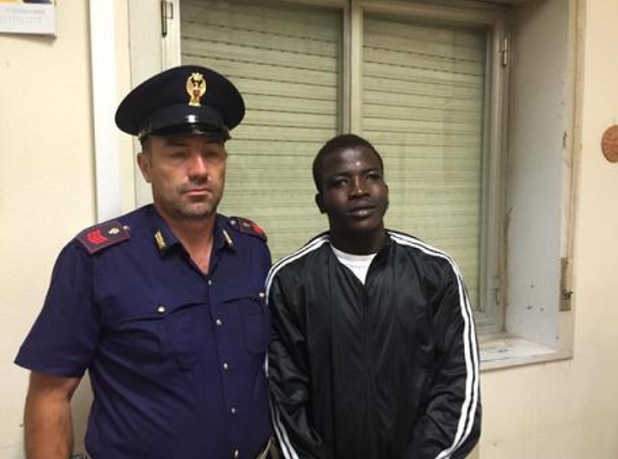
Italy’s simmering anti-immigrant sentiment has been stoked by the murder of an elderly couple in their home in Sicily, allegedly by an African asylum seeker.
Mamadou Kamara, an 18-year-old from the Ivory Coast, allegedly slit the throat of Vincenzo Solano, 68, and then attacked his Spanish-born wife, Mercedes Ibanez, 70.
Ms Ibanez fell to her death from a second-floor balcony, during a robbery that turned violent.
Mr Kamara is one of thousands of migrants and refugees living at a vast reception centre at nearby Mineo, in south-eastern Sicily.
They are accommodated there after arriving by boat from Libya, and wait sometimes for months to have their asylum applications assessed.
The migrants are allowed to come and go freely from the facility, a former US military base where prostitution, links with organised crime and the trade in illicit goods is said to be rife.
Mr Kamara, who was rescued in the Mediterranean on June 8 and brought with other migrants to the port of Catania in Sicily, allegedly broke into the pensioners’ flat in the village of Palagonia, six miles away, and slit the throat of Mr Solano.
The elderly man’s wife was found dead in the courtyard of their three-storey apartment block. Investigators believe she may have fallen over the balcony in panic after trying to flee the attacker.
Mr Kamara was arrested after police searched his bag on Sunday as he returned to the migrant centre.
Inside they found a mobile telephone, a laptop computer, a video camera and a pair of trousers, allegedly belonging to Mr Solano, that were covered in blood.
The young African man claimed to have “found” the items, but police arrested him and are expected to charge him with two counts of murder.
Sebastian Maccarrone, the director of the Mineo migrant centre, said: “If it was him, it is a tragedy within a tragedy – for the people killed, and for integration. We are all shocked… For each small step we have taken forward in terms of integration, this has put us 10 steps backwards.”
More than 100,000 refugees have arrived by boat in Italy this year, making the crossing from Libya in overcrowded rubber dinghies and leaky fishing boats. Last year, a record 170,000 arrived on Italian shores.
“Italians fear for their lives inside their own homes,” said Gianluca Buonanno, an MEP with the Northern League, a staunchly anti-immigrant party of the Right.
“This is Renzi’s national security strategy. What kind of country are we living in?”
Giorgia Meloni, another centre-Right politician and a close ally of Silvio Berlusconi, the former prime minister, said: “The instigator of the murder of these two innocents is the Italian state, which is responsible for having kept open a facility … which we said should be closed down.”
“The murdered couple had returned from living in Germany to enjoy their retirement in Sicily,” a relative told La Stampa newspaper. “They shouldn’t have died like this, slaughtered like goats.” – London Daily Telegraph
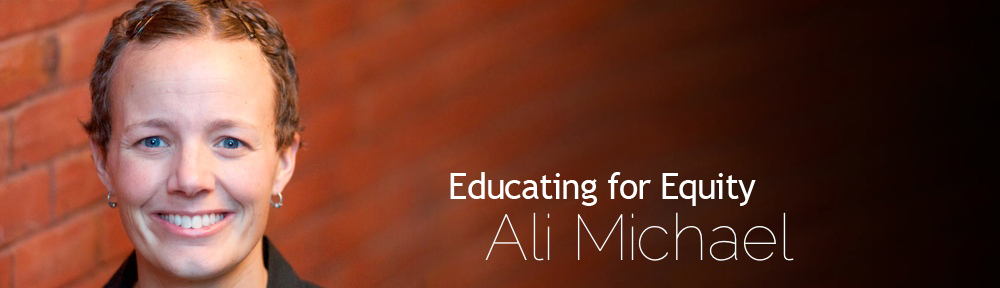
Writing in the Huffington Post, a US author and “Director of P-12 Consulting and Professional Development at the Center for the Study of Race Equity in Education at the University of Pennsylvania”, Ali Michael, argues that she dan identify with Rachel Dolezal’s attempt to disguise herself as a black and renounce her white identity. Below, Michael says:
“I definitely experienced this. There was a time in my 20s when everything I learned about the history of racism made me hate myself, my Whiteness, my ancestors… and my descendants. I remember deciding that I couldn’t have biological children because I didn’t want to propagate my privilege biologically.”
Here is a slightly shortened version of Ali Michael’s column, originally entitled, I sometimes don’t want to be white either.
Rachel Dolezal is a fascinating case study in White racial identity development.* She is stuck in the immersion/emersion stage, in which White people, having learned extensively about the realities of racism, and the ugly history of White supremacy in the U.S., “immerse” themselves in trying to figure out how to be White in our society, and “emerge” with a new relationship to Whiteness. Only in the case of Dolezal, her way of dealing with the pain of the reality of racism, was to deny her own Whiteness and to become Black.
She is an extreme example of a common phenomenon. The “immersion” stage is typified by White people taking more responsibility for racism and privilege and often experiencing high levels of anger and embarrassment for racism and privilege, which they sometimes direct towards other Whites. They sometimes try to immerse themselves in communities of color, as Dolezal did. She’s not alone.
I definitely experienced this. There was a time in my 20s when everything I learned about the history of racism made me hate myself, my Whiteness, my ancestors… and my descendants. I remember deciding that I couldn’t have biological children because I didn’t want to propagate my privilege biologically.
If I was going to pass on my privilege, I wanted to pass it on to someone who doesn’t have racial privilege; so I planned to adopt. I disliked my Whiteness, but I disliked the Whiteness of other White people more. I felt like the way to really end racism was to feel guilty for it, and to make other White people feel guilty for it too. And then, like Dolezal, I wanted to take on Africanness. Living in South Africa during my junior year abroad, I lived with a Black family, wore my hair in head wraps, shaved my head. I didn’t want to be White, but if I had to be, I wanted to be White in a way that was different from other White people I knew. I wanted to be a special, different White person. The one and only. How very White of me…
Beverly Daniel Tatum has written that White people don’t choose to identify as White because the categories to choose from are loaded from the start. Traditionally, one can identify as a colorblind White person, a racist White person or an ignorant White person: those are the three ways White people get talked about as White. If those are the options, who would choose to identify as White? And so White people identify as “normal” and “Irish” and “just American” and do not self-identify racially. And that leaves us with a society in which only people of color have a race, where only people of color seem to be responsible for racialized problems. It makes it hard for all of us to know and tell our racial stories — because White people think we don’t have any. And it makes it hard for us to own our history, because we don’t see it as ours.
Many White people also feel like we don’t have culture, and this isn’t a coincidence.
Throughout the 20th century, countless immigrant groups abandoned the artifacts of cultures that racialized them as immigrants (language, religion, food, styles of speaking, gesticulations, family structures, traditions, etc.) in order to become White. And this was not just a matter of fitting in; it was about accessing rights that were reserved for White people: citizenship, land ownership, police protection, legal rights, etc.
The more one could cast off the markers of otherness, the more likely it was that one could become White. And so while the desire to become White is really the opposite of what Rachel Dolezal had, the process of becoming White that her ancestors undoubtedly went through in the great American star-off machine, may be connected to her desire to un-become White, to lose that feeling of being cultureless, of being part of an unidentified group, and to leave behind that identity that has no positive way to be. And lots of White people — myself included — do this in thousands of tiny ways as we appropriate the cultures of others (from Africa, India, Compton, Guatemala, Harlem, Mexico…) to fill in the blanks in our own.
Daniel Tatum said we need to change this. We need to give White people new ways to identify as White. Because at the end of the day, we need White people to see that we are White. When we recognize and own our Whiteness, we can account for our own portion, our one 1/billionth of responsibility for what White people have done throughout history. We can work with other White people to begin to challenge bias, ignorance and colorblindness. We can use our privilege to confront the sources of that unfair favoring.
I was lucky. The Black family I embedded myself in during my “Rachel Dolezal phase” insisted on my inherent goodness, and that of my family and even — I thought this was a stretch — of my ancestors. They helped me focus on my capacity to make change as a White person. They appreciated my desire to be Black, they teased me, they let me know in no uncertain terms that I would never be Black. I read James Baldwin, Toni Morrison, Steve Biko. I swore off White authors. But the Black authors I read saw the immersion stage coming, and they reminded me that Black people don’t need White people to help them pursue liberation, that the job of White people lies with teaching other White people, seeing ourselves clearly, owning our role in oppression.
I’m not sure what happened with Rachel Dolezal. Maybe it was mental illness. Maybe it was a desire to connect to her adopted brothers. Maybe she felt safer and more loved in Black communities. Maybe it felt good to distance herself from the overwhelming oppressiveness of Whiteness — her own and that of her country and of her ancestors. But the lesson for me is remembering how deep the pain is, the pain of realizing I’m White, and that I and my ancestors are responsible for the incredible racialized mess we find ourselves in today. The pain of facing that honestly is blinding. It’s not worse than being on the receiving end of that oppression. – Ali Michael
*White racial identity development was first theorized and written about by Dr. Janet Helms.
Everyone sometimes feels the urge to reinvent themselves — to start again afresh in a new place, free from the assumptions others have made about them.
Even so, after Rachel Dolezal moved from their family home in Montana to the city of Spokane in Washington State, her adopted brother was stunned to learn just how thoroughly she had transformed herself.
The blonde-haired, blue-eyed daughter of missionaries was passing herself off as black, and had even befriended an African-American man she was pretending was her father. She begged her brother Ezra not to rock the boat by revealing the truth about her past.
Dolezal as an ‘oppressed black woman’
Rachel told Ezra that, as one of four African-American infants her parents had adopted, he was welcome to visit her, not least because he obviously fitted in with her new persona. Much to his dismay, she wanted him to go along with the lie that he was her brother by blood.
‘She told me not to blow her cover,’ Ezra said yesterday. ‘She told me not to tell anybody about Montana or her family over there. She said she was starting a new life.’
Ezra was both baffled and angered by her imposture, which he considered tantamount to ‘blackface’, the deeply controversial tradition of white entertainers blacking up their faces. And it was, to be brutally frank, little different: she started to darken her skin colour, frizz up her straight hair into dark curls, and affect an African-American accent.
Ezra’s anger turned to fury when he and his family discovered that, not content simply pretending to be black, 37-year-old Miss Dolezal had even invented a whole history of suffering at the hands of white oppression, to help her climb the ladder in the civil rights world.
She told those she encountered in her new incarnation how her white mother and white step-father (in truth, her real father) had punished their mixed-race children with a kind of whip that had once been used on slaves.
Miss Dolezal also complained to the police of being the victim of hate crimes by white racists, who she said had even left a noose in her garage.
All this posturing appeared to do the trick, helping to establish Miss Dolezal as a leading light of the black rights movement in America’s Pacific Northwest. She is the president of the National Association for the Advancement of Colored People (NAACP) in Spokane, Washington state’s second- biggest city. She also runs the city’s police oversight committee and is an African Studies professor at the local university, where she gives impassioned classes on The Black Woman’s Struggle.
Now, however, after her horribly misrepresented parents decided it was time to reveal the truth about their daughter, her astonishing, decade-long deception has come spectacularly tumbling down. When a TV news crew finally confronted her, and asked if she was African-American, she eventually stammered that she ‘didn’t understand the question’ and ran off to hide in a dress shop.
Officials are now investigating whether she should be prosecuted for lying about her racial background in her application for the police ombudsman’s job. She might yet also face trouble from police, who have dropped investigations into all nine of the alleged race hate crimes she suffered amid allegations she invented them.
This outlandish case could have been dismissed as an example of someone merely seeking to get a leg up in their career by posing as someone they are not. But this is America, with its bitter legacy of slavery and segregation.
Black or mixed-race Americans have for centuries been passing themselves off as white in order to better their lives, but you can probably count on one hand the number of people who have tried to go in the opposite direction. So what are we to think of a talented young white woman who has spent the past decade pretending to be black?
Miss Dolezal is bound to fuel the growing furore when she addresses the media tonight at a meeting of her NAACP group. Deeply embarrassed to have been hoodwinked so easily, the national organisation has nevertheless supported her, praising her record and insisting that one’s racial identity is irrelevant in leading the group.
However, most people don’t believe for a second that she would have risen so far in the civil rights industry if she had been recognised as a white middle-class woman from a conservative family.
Unlike in many areas of life in America, being black is an obvious advantage in the civil rights industry where — to quote one commentator — it is seen as more ‘authentic’.
What’s peculiar about Rachel Dolezal, however, is that she is still insisting, even after her public exposure, that she really is black.
Whether this is a case of serious delusion or a brazen attempt to bluff it out is hard to tell. Although her parents, Larry and Ruthanne Dolezal, say they each have a grandparent who had some Native American blood, neither has any black lineage.
Miss Dolezal claims her parents timed their revelations to discredit her in an upcoming trial concerning sex abuse allegations relating to her brother, Joshua, 39, in which he will appear as a witness. They say they only spoke out after being approached by the media.
Their family background is a mix of German, Czech and Swedish. Nevertheless, Rachel was ‘always interested in ethnicity and diversity’ growing up, says her mother. That accelerated when her parents adopted four black infants in the Nineties.
Ironically, it appears that racism from black people may have spurred her to want to become one of them.
Members of her family believe that the turning point came when she won a scholarship to take a master’s degree in fine art at the largely black Howard University in Washington DC. They recall how she had submitted a portfolio of portraits of African-Americans, and people at the university — especially staff — were resentful when they discovered she wasn’t black as they had assumed.
Her brother Ezra says Miss Dolezal — still with a pale complexion and straight blonde hair — complained to her family of suffering racism.
She developed a ‘dislike for being white, and for white people’ that boiled down to ‘self-hatred’, he believes.
After university, she had a short-lived marriage to an African-American man which produced a son but ended, she claims, because her husband became violent to her and to the child.
In around 2006 or 2007, she started to ‘disguise’ herself as black, says her mother. It started with her hair — she had enjoyed arranging the hair of her adopted black sister, Esther — and Miss Dolezal was soon braiding her own in the same ethnic style, often covering it in an African headwrap.
By 2011, say family members, she was applying make-up to her face to appear ‘darker and darker’. A new look needed a new back story, and hers was elaborate — born in a tepee and brought up in South Africa, she said she had had to hunt with a bow and arrows for food.
None of it, say her family, is remotely true — she hasn’t even set foot in Africa.
It’s easy to scoff now at the many times this firebrand has eloquently spoken out about the difficulties of living as a black woman in a largely white part of the States. Even going to the cinema to watch 12 Years A Slave was an ordeal, she said, as she felt the eyes of her white neighbours turn to watch her reaction.
In 2010, she told the New York Times that she could ‘not imagine showing her face’ at an event held by the Tea Party, the ultra-conservative faction in the Republican Party, because of the preponderance of white faces. ‘It would make me nervous to be there unless I went with a big group,’ she said. Only last December, she wrote a column about the ‘asphyxiation we are experiencing as black people in America’.
Certainly, it would have been pretty much impossible to take some of her radical stances if she had been white.
A video clip, entitled Black Is Beautiful, shot in one of the classes she gives at Eastern Washington University, shows her railing against how black women’s hairstyles have been dictated by ‘white supremacy and racism’.
Talking about one particular style of African-American hair, she tugs at her own tight curls and says: ‘Like this.’
Thanks to her pretence, Miss Dolezal got away with a lot of arguably racist behaviour of her own. She once refused to allow a light-skinned Hispanic student to participate in a class exercise about white oppression because ‘she didn’t look Hispanic’.
Her tweets included one in which she lambasted the Oscar-winning film The Help, which examines the nature of social segregation between black and white, sniffing how it had ‘put $206mil in a white woman’s pocket’.
In another tweet, she praised a video entitled ‘S**t White Girls Say … to Black Girls’, claiming it was ‘true2life’.
It would be easy simply to goggle in astonishment — and many have. Critics of overweening political correctness are having a field day over the lengths one liberal white woman has gone to identify with black oppression. Dolezal may even remind British TV viewers of the ludicrous Ali G, the white rapper persona created by the comic Sacha Baron Cohen, who liked to complain at every perceived slight: ‘Is it because I is black?’
Conservatives have also highlighted what they see as the hypocrisy of liberals who have condemned Miss Dolezal’s claims to be black, yet applauded the recent announcement by former Olympic decathlon champion Bruce Jenner that he is now a woman calling herself Caitlyn.
Why can Jenner — who hasn’t even had gender-altering surgery — say he’s a woman if she can’t say she’s black?
But those on the Left, and many black commentators, say the comparison is unfair. Not only is ‘blacking up’ deeply racially offensive, they say, but there is the whole history of America’s unhappy race relations to take into account.
For years, under the so-called Jim Crow laws which preserved racial segregation in the South — even deep into the 20th century — a ‘one drop of blood’ rule meant that people with even the smallest trace of black ancestry were legally considered black.
For many, this was catastrophic. But according to academics, this has also established a tradition whereby pretty much any American can say they are black and not be challenged.
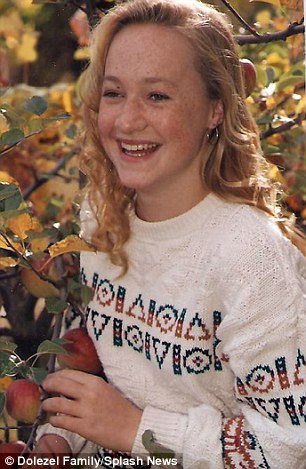
Indeed, those who have leapt to Rachel Dolezal’s defence say that if she wants to say she is black, why should anyone deny her that? The problem is that one click of the mouse in the internet age provides pictures of her as a young freckle-faced blonde girl, making a mockery of it all.
‘I wonder what race Rachel would become if she got stopped by the police?’ the — genuinely — black woman author Terry McMillan mused waspishly on Twitter. Unfortunately, one suspects, Miss Dolezal would seize on any mistreatment by the police as further proof of her noble struggle as an oppressed black woman. – DailyMail.co.uk (shortened)
Rapidly growing numbers of black immigrants have reshaped the overall black population in the United States in recent decades, particularly in Washington and other cities with large U.S.-born African American communities, a new report says.
A record 3.8 million foreign-born blacks now live in the United States, the Pew Research Center reported Thursday. The influx means that the share of foreign-born blacks, largely from Africa and the Caribbean, has grown from 3.1 percent of the black population in 1980 to 8.7 percent in 2013. By 2060, 16.5 percent of the U.S. black population will be foreign-born, the report says.
The report highlights the degree to which America’s black population is less homogenous than in previous generations, experts said.
“I think when you’re talking about the black population, it’s increasingly important to be able to pull apart the distinctions between U.S.-born blacks of several generations compared to the new immigrants,” said William H. Frey, a demographer and senior fellow with the Metropolitan Policy Program at the Brookings Institution.
“Just because they’re new immigrants,” Frey added, “they have different needs and patterns, probably in terms of language in many cases, in terms of assimilation. And so they probably shouldn’t be confused with native-born blacks in lots of ways, who have their own needs to be addressed.”
Frey, in his 2014 book “Diversity Explosion,” estimated that black immigrants made up about 10 percent of all blacks and differed from U.S.-born blacks in important socioeconomic respects. That was also reflected in the Pew report, which said black immigrants tend to be older, more likely to have a higher education and a higher income, and less likely to live in poverty.
The impact of black immigration has been particularly strong in cities that already had some of the nation’s largest black populations. For instance, in the District, 15 percent of the black population was born outside the United States. In Miami, 34 percent of the black community was born elsewhere. In New York’s metro area, that figure is 28 percent. Nearly half of the influx has occurred since 2000, the report says.
Most of the nation’s 40 million U.S.-born blacks trace their heritage to African ancestors who were brought here as slaves. The report also notes that blacks accounted for nearly one-fifth of the U.S. population at the end of the 18th century.
The most recent wave of black immigration began in the 1960s after U.S. immigration laws were changed. In recent years, the pace has increased. The most recent Census Bureau estimates show that immigration accounted for 25 percent of the growth in the U.S. black population between 2010 and July 2013, Frey said.
Half of the black immigrants arrived from the Caribbean, the Pew report says. The largest source is Jamaica, with 682,000, followed by Haiti, with 586,000. Jamaican immigrants make up 18 percent of the black population in the United States; those from Haiti represent about 15 percent of the U.S. black population.
But a rapidly growing proportion of foreign-born blacks who arrived in the United States in recent years came from Africa, led almost entirely by immigrants from sub-Saharan Africa, the report says. Nigeria and Ethiopia rank first and second, respectively, in the number of African immigrants in the United States. Many sub-Saharan immigrants — 28 percent — were refugees or others seeking asylum.
Two enterprising white entrepreneurs just made yet another app for avoiding non-white areas of your town, and it’s really taking off!
SketchFactor is here, an app made for avoiding “sketchy” neighborhoods, which is the term young white people use to describe places where they don’t feel safe.
The app is the brainchild of co-founders Allison McGuire and Daniel Herrington, is a Manhattan-based navigation app that crowdsources user experiences along with publicly available data to rate the relative “sketchiness” of certain areas in major cities.
The app will launch on the iTunes on Friday, capping off a big week for the startup, which was named as a finalist in the NYC BigApps competition.
According to Ms. McGuire, a Los Angeles native who lives in the West Village, the impetus behind SketchFactor was her experience as a young woman navigating the streets of Washington, D.C., where she worked at a nonprofit.
After meeting Mr. Herrington, an electrical engineer who was taken with the SketchFactor idea, the two quit their Washington D.C.-based jobs and decamped to New York City with funding from family and friends.
As one of the finalists in the BigApps competition, SketchFactor is poised to receive more attention when it launches.
CCTV footage of two blacks walking out of a pharmacy with white twins in a trolley – when their mother had turned her back on them for just a few seconds – has gone viral.
The attempted kidnapping of the 4-year-old brother and sister took place on Monday afternoon at the Zambezi Junction mall in Pretoria.
Crime-fighting organisation eBlockwatch posted the footage of the blacks walking off with the children on its Facebook page.
Founder Andre Snyman said they have had complaints from the public in the past about people trying to snatch small white children while the adults were shopping.
He had always thought they were hoax, he said.
But, this time the video footage showed this did, in fact, happen.
The twins’ father, Dale Ribbink, posted two CCTV videos on his Facebook page.
They seem to show that four blacks, two men and two women, were working together.
In the first video, a man and woman are seen harassing a mother at the till.
The mother is holding her 2-year-old son on the counter.
They get into an argument and the pair leave the store, only to come back in and grab the trolley with the children in it.
The mother said she fetched her son from school and went to the pharmacy because he was sick.
At the till, she noticed two people standing near her, she said.
“I felt a hand in my pocket and my cellphone and wallet were in there, so I asked the woman what she thought she was doing,” she said.
At first the woman didn’t answer her, but when the mother asked again, the tall black woman started shouting at her in a confrontational manner, asking: “What are you to do?”
The mother pointed to the camera, saying she would report her as a pickpocket.
She said the pair left the store, only to come back a few minutes later.
“I think they wanted to distract me, to get me into an argument so that they could grab my son,” she said.
Ribbink said his wife was looking for nasal spray.
She bent down to fetch the medicine and when she looked up, a black woman had walked out of the shop with their children.
There are currently eight million non-white people – 14% of the total – across England and Wales, according to the study by the Tory think tank Policy Exchange
Up to a third of the population will be black or from another ethnic minority by 2050, new research forecasts today.
There are currently eight million non-white people – 14% of the total – across England and Wales, according to the study by the Tory think tank Policy Exchange.
But the so-called BME (black and minority ethnic) population has doubled in the past decade and now accounts for 80% of growth while the white population has remained constant.
While ethnic minorities make up just 5% of the over-60s, they account for a quarter of under fives.
That means between 20% and 30% of people will be black or ethnic minority by the middle of the century.
And it is a time bomb for the Tories who struggle to win votes from BME communities which overwhelmingly back Labour.
The findings should act as a wake-up call for politicians to stop treating people from non-white backgrounds as one, single group, the think tank said.
Since the Second World War immigration from the Caribbean , the Indian subcontinent and Africa has produced in diverse groups with widely differing opinions, experiences and traditions, it said.
There are “clear and meaningful differences between each of these communities which need to be fully understood” but politicians are not doing that, the report says.
Author Rishi Sunak said: “These communities will continue to become an ever more significant part of Britain, especially in future elections.
“However, as our research demonstrates ethnic minorities are not one homogeneous political group.
“From education to employment, housing to trust in the police, politicians from all parties must understand the different issues affecting individual communities.”
The research draws on survey, census, academic and polling data to build up a detailed picture of the five largest minority groups in the UK – Indian, Pakistani, Bangladeshi, Black African and Black Caribbean.
With the exception of those from an African background a majority of non-white Britons describe themselves as “British-only”, the report said.
BME communities also overwhelmingly support the Labour Party “regardless of class or association with Conservative policies”.
Some 68% voted for Gordon Brown’s party at the 21010 General Election, compared with 16% for the Conservatives and 14% for the Liberal Democrats.
Last month Adam Afriyie, the first black Tory MP and once touted as a future party leader, said the Conservatives will not be able to completely detoxify its brand in the eyes of ethnic minority voters in time for next year’s general election.
He admitted that even if Prime Minister David Cameron “does everything perfectly” in the run up to the 2015 General Election, the party’s lack of support among minorities will persist.
But Mr Afriyie said the party would be making a mistake if it changed its policies to suit individual groups in a “political gamble” for more popularity.
A new report on New York City public charter schools faults them for being too segregated. But what’s more important, the racial composition of a school’s student body or whether children in the school are learning?
According to UCLA’s Civil Rights Project, which produced the study, just 8 percent of New York City charter schools are considered multiracial, versus a New York City average of 14.5 percent. The authors, John Kucsera and Gary Orfield, conclude that some 73 percent of the city’s charters are “apartheid schools” where fewer than 1 percent of students are white. “Charter schools take the metro’s segregation to an extreme,” they write.
Charter critics pretend that something invidious is going on, but the reality is that charter operators consciously locate in slums and ghettoes to offer poor minorities better school choices. The racial makeup reflects the neighborhood, not some racist conspiracy. Moreover, public charter schools in New York City (and elsewhere) typically outperform the surrounding traditional public schools, and some are among the highest-performing schools in the state. This belies the notion that black children must be sitting next to white children in order to learn.
The political left has a longstanding obsession with the racial makeup of schools. The Supreme Court’s 1954 Brown decision introduced the notion that “separate” was inherently “unequal.” Ever since, and despite the fact that high-quality all-black schools have proliferated, the liberals have placed racial parity above all other concerns. The Obama Justice Department is currently trying to shut down a voucher program in Louisiana by arguing that it will harm desegregation efforts.
In other words, liberal policy makers would relegate disadvantaged black kids to inferior schools for esthetic reasons. Of course, polls over the decades have consistently shown that black parents care most about having access to a quality school in their neighborhood. The racial composition of that school is a secondary concern at best.
Most of us are aware of the ongoing saga of the Waterkloof 4 (Tiedt, van Schalkwyk, Becker & Du Preez), four underage white boys convicted of having assaulted and killed a homeless black man. Apart from the Oscar Pistorius murder, the trial has elicited more publicity than any other in recent South African history and has led to endless denunciations of “white racism” and psycho-babble about “Afrikaner brutality”.
I have been lucky enough to read through the witness and accuseds’ testimonies, crime-scene photos and specialist statements and found all of the evidence to be extremely interesting. Unlike the Oscar Pistorius case, where many details were disclosed in the media, journalists never gave much away when reporting on the Waterkloof 4 case. Maybe it was because it appeared to be open and shut, especially judging by the public and the mainstream media who presumed them guilty before proven innocent. Nevertheless, a guilty verdict was handed down to four of the boys. I’ve decided to lay out the facts about this case by sharing my findings, which come directly from court evidence.
The so-called ‘Waterkloof 4’, from L to R: Gert van Schalkwyk, Christoff Becker, Reinach Tiedt and Frikkie du Preez
Background
August 2003: three boys who had knowledge of the crime decided to come clean regarding the incidents which took place in December 2001. These three identify the “Waterkloof 4”, aged 15 and 16 at the time of the crime, who are subsequently arrested.
July 2004: they plead not guilty
June 2005: they are found guilty
January 2007: they are sentenced to 12 years imprisonment each
April 2008: they appeal to the High Court
May 2008: their appeal is denied
June 2008: they take their case to the Supreme Court of Appeal
August 2008: their application to the Supreme Court of Appeal is turned down and they start their 12 year sentences
December 2011: two of the four have their sentences converted to correctional supervision after a successful parole hearing
June 2013: the two return to jail after their parole is appealed by Correctional Services
February 2014: the four are released on parole but two are rearrested days later after a video shows them violating prison regulations a day before their release.
The trial
In summary, the State’s case was based mostly on witness testimony that the Waterkloof 4 had assaulted an unknown black man in Constantia Park and later that night brutally assaulted and killed another unknown black man in Moreleta Park. The Waterkloof 4 denied the first assault but admitted to the second assault, with exception that they killed the man or intended to kill him. The only evidence other than witness testimony was the second victim’s body.
Constantia Park assault (alleged first assault according to witness testimony)
The accused vehemently denied this assault took place and thus the State had to prove this event occurred. As mentioned, the only evidence was that of the State’s witnesses as there was no case of assault reported to police and the unknown man was never seen or heard from again.
The Defence accused the witnesses of fabricating the story and this accusation is given some credibility when the State’s witnesses left gaps in their testimony. The judge dismissed these gaps and other anomalies due to “traumatic memory issues on behalf of the witnesses” and accepted their testimony as fact. The defence also brought up the possibility of collusion which the judge dismissed, even though the State’s witnesses had more than a year to collude.
Nevertheless, the Defence had to counter the State’s witnesses’ testimony and did so by looking at phone calls which were used to identify a time line and locations of individuals, with the help of cellular phone towers. Although the calls placed the accused in the vicinity of the second assault (Moreleta Park), they placed significant doubt on whether the Constantia Park assault was possible as it gave the accused (and witnesses which drove with the accused) a maximum of 14 minutes to drive in a fully loaded small Toyota Tazz from Hatfield, look for a shop to buy milk, assault the unknown man in Constantia, wait “5 minutes” for the other accused to meet up with them and then get to Moreleta Park. To make the State’s case worse, the State’s witnesses testified that they were not speeding but the judge corrected this and stated that they were probably speeding, overriding State’s witness testimony and again raising doubts over the credibility of their testimony. The Defence also questioned why the accused had driven through Constantia Park, as this was a longer route to where they were heading.
Although the accuseds’ testimony represented a more reasonable and logical explanation of events as it more reasonably fits the timing of the calls and the logical route to their destination, their testimony was dismissed as lies as it contradicted the testimony of the State’s witnesses. In the end there was no reliable evidence to put the accused at this crime scene other than the State’s witnesses’ testimony which was accepted as reliable.
Near the end of the examination of the Constantia Park assault, the State prosecutor went on to say that the witnesses might have mistaken this event with something that happened on another day:
“Edelagbare, oor hulle getuienis daar op kan hulle verwar het met ‘n ander dag. Dit is hoekom ek nie hard wil betoog oor hierdie klagte nie”
This was ignored by the judge.
Moreleta Park assault
The accused admitted to brutally assaulting an unknown man in Moreleta Park, who they claim was a burglar who had just robbed a residence. This was backed up by the State’s main witness. The Defence however questioned whether the man found in the park was actually the man they assaulted, an outrageous claim, but appears to be supported by the physical evidence (see below). Again the State relied heavily on the State’s witness testimony that the man found in the park was the man the accused assaulted as the man was found in “exactly” the same place the next day after the assault. It must be noted that the main State’s witness, who is not one of the Waterkloof 4, was also involved in the assault but was given immunity for turning State’s witness.
One of the State’s witnesses had disclosed to a teacher that the motive for the attack was purely racial while the accused say that they had gone after a man who had run across the road with a television. They suspected the man of being involved in a burglary. On the day of discovering the victim in the park, a car radio was found next to the victim and this was later found to be stolen as a case of robbery had been reported to the SAPS. The victim was also found with a wallet (money inside), watch, and a ring and was well dressed with new shoes, smart cap and had four tattoos, which appears contrary to the claims that this man was homeless. The State’s witness confession to the teacher prior to the arrests was that the accused never knew of the stolen goods during the attack and only used this as an excuse to do commit their foul deed. Contradicting stories meant that it was up to the State to prove murder.
Besides the State’s witness testimony, the State had very little evidence:
No physical evidence linking the accused to the victim (no DNA, no trace evidence)
No murder weapon (no knives, no hammer)
No time of death (due to “refrigeration”)
By all accounts the assault was described as brutal. Besides the melee of punching and kicking, one of the accused had demonstrated his “Naas Botha” kicks on the victim. A State’s witness testified that this accused had kicked the victim twice in the face with steel tipped shoes, one of which was later found to be dented in. This was confirmed by the aforementioned accused. The entire group had jumped with full weight on the victim like in a “loose rugby scrum”. Another of the accused had hit the victim twice on the crane of the head with a hammer, the first blow bringing the victim to his knees while the second blow floored the victim completely. All of this was admitted by the accused and agrees with State witness testimony. The State’s witness also testified that the accused had made stabbing motions towards the victim (admitted by the accused) but cannot confirm whether the accused had stabbed the victim.
The post mortem indicated that the unknown man had died of severe blood loss cause by one deep cut in his thigh. Besides this cut, the medical experts made the following findings:
There were no bruises or fractures to the skull
There was minor subdural hematoma but no swelling on the brain or any other change to structure of the brain. The fact of whether the hematoma was caused by the assault could not be determined.
Three small scars on the head, two of which had scabbed before the assault, the other one showed no signs of significant bleeding
Face, nose, tongue, throat showed no bruising, discolouration, bleeding, lacerations or scarring
There were no broken teeth
There was no bruising or trauma to the neck
There was no bruising or trauma to the chest and diaphragm
There was no bruising or trauma to the abdomen
Internal organs showed no trauma but some were bleak due to blood loss
No bruises or fracturing on the back
No noticeable bruising, fractures or trauma to the rest of the body
With regards to the cut in the thigh (cause of death), the medical experts made the following conclusions:
The victim had lost between 4 – 5 litres of blood, which meant he would have bled to death over a 24 – 48 hour period as no major arteries were penetrated.
With regards to the object that made the stab wound, the medical specialist found that: “Hierdie gat kon nie veroorsaak gewees het deur ‘n mes, of selfs ‘n dun yesterstaaf nie” or in English, this could not have been made by a knife or even a thin iron rod. The object appeared similar to a spike on a palisade fence which backs up the Defence’s claims that the victim had cut himself on a palisade fence while fleeing from a residence he had burgled.
As you can see this posed serious questions against the State’s argument that the victim found in the park was the man that the accused claim they assaulted. Some of these questions raised by the Defence were:
Physical evidence on the victim shows no correlation to the assault as described by the accused and the witnesses. There is no evidence that suggests a knife or hammer was used in the attack even though a State’s witness had testified that he had seen blood on the hammer after the attack. There was also no evidence that the boys had jumped on the victim or kicked the victim in the face. When the pathologist was asked by the Defence whether it was obvious that the body brought before her was not the body of the man as described in the assault, she answered: “Yes that is correct.” A second pathologist replied with the same answer.
The crime scene inspector found no evidence of blood on the ground near or beneath the victim, or anywhere else in the park for that matter. Where did 4 – 5 litres of blood go? The State contested that the light rain that night may have washed away any evidence of blood or that the victim’s clothing had absorbed all of the blood but this was disputed by the Defence.
The flow of blood on the victim suggests the possibility the body was moved after death and moved to the spot where the body was eventually found.
If the only injury the victim sustained was the cut to the thigh and the victim took between 24 and 48 hours to bleed to death, why did the man remain in the same spot for this lengthy period of time? Why didn’t he seek medical treatment or at least crawl/limp away from the scene?
The victim’s shoes were removed while there had been no mention of this by the accused or State’s witnesses.
In the end however the judge ruled, after quoting a previous case “the State vs. Bernardus 1965”, that the body is full of anomalies and that sometimes death can be caused by the slightest of assaults. Although this judgement contradicts all witness accounts and the physical evidence, this ultimately leads to the guilty verdict for the Waterkloof 4.
Sentencing
The Waterkloof 4 were sentenced to 12 years imprisonment each, five years after the crime was committed (13 years ago). Because of the extreme brutality of the assault, there was much public and media outcry for a harsh sentence. However the law differentiates between adults and minors for sentencing purposes. Taking into account that the perpetrators were juvenile (also first-time offenders), different sentencing laws had to be followed.
Quoting an article by Zita Hansungule, who works at UP’s Centre for Child Law: “In 2009 the Centre for Child Law had challenged the constitutionality of the Criminal Law (Sentencing) Amendment Act which provided that minimum sentences should apply to 16 and 17 year-old offenders.
The High Court found that applying minimum sentences to these offenders was not in line with the Constitution which provides that children have the right not to be detained except as a measure of last resort, and then, if detention is unavoidable, only for the shortest appropriate period of time. The High Court held that in cases pertaining to minors, the courts must consider all available sentencing options, especially non-custodial sentences, before considering detention.
The Constitutional Court was approached to confirm the decision of the High Court. It confirmed the decision and held that the Constitution envisages that detention of young offenders may be possible, but it mitigates the circumstances of detention. It confirmed that for minors, detention is not a first or intermediate resort but a last resort. The Court held that each individual case needs to be examined on an individualised basis so that an appropriate sentence can be found. It stated that ‘legislation cannot take away the right of 16 and 17–year olds to be detained only as a last resort, and for the shortest appropriate period of time, without reasons being provided that specifically relate to this group and explain the need to change the constitutional disposition applying to them’.
These judgements confirmed that children should be treated differently to adults in sentencing, no matter how old they are. Both courts were of the view that children are less physically and psychologically mature than adults, more susceptible to pressure from others and more receptive to rehabilitation than adults.”
Taking this into account the Waterkloof 4 appeared to be sentenced fairly as this is about the maximum that a juvenile will face for a single murder charge.
Parole
As with the case of sentencing, parole is also a thorny issue. In accordance with the law, the Waterkloof 4 were released on parole last week. The law allows for this if the offenders have served 50% of their sentences and have completed internal correctional programmes and have been well-behaved. According to parole documents the four were all but exemplary during their stay. I’ve looked through parole documents and found that they interacted well with other inmates and also took part in social activities. Study courses were also completed during this time. It is thus reasonable to concede that their release on parole is in accordance with the law. Subsequently however, two members of the Waterkloof 4 have been ordered to return to prison after a video showed them “living it up” in their cell a day before release.
Conclusion
It has been more than 10 years of trials, appeals, paroles and controversy, a kind of soap opera that will be remembered by most of us for many decades to come. As I’ve described, there are many questions left unanswered regarding the crimes committed in 2001, those which surfaced during trial. There are also questions we need to ask regarding our criminal justice system. I’d like others’ thoughts on this matter…
Kevin King is a professional DJ and freelance columnist
President Barack Obama said that racial tensions may have softened his popularity among white voters within the last two years, according to a story posted on the New Yorker magazine’s website today.
“There’s no doubt that there’s some folks who just really dislike me because they don’t like the idea of a black president,” Obama said in the article by David Remnick.
Obama said this in his most direct comment on how race has affected his political standing since he’s been in office. His wife Michelle has spoken openly about race before.
Obama’s second term has been marked by controversies including a partial government shutdown in October, revelations that the National Security Agency has gathered personal mobile phone data and the troubled rollout of health-insurance expansion.
Obama’s approval rating among all voters is 39 percent and his disapproval rating is 53 percent, according to a Gallup Poll conducted Jan. 14-16. In the 2012 presidential election, Republican candidate Mitt Romney won 59 percent of the white vote, compared with Obama’s 39 percent, according to exit polling by a consortium of major news outlets. Obama won 43 percent of the white vote in 2008 against 55 percent for opponent John McCain, a Republican senator from Arizona.
A white Republican unseated a 24-year African-American incumbent from office in a surprise election victory that some are saying was racially tinged and deceptive.
Still, he figured he’d have fun running, because he was fed up with what he called “all the shenanigans” at the Houston Community College System. As a conservative white Republican running in a district whose voters are overwhelmingly black Democrats, the odds seemed overwhelmingly against him.
Dave Wilson, who KHOU reports is an “anti-gay activist and former fringe candidate for mayor,” is being criticized by his opposition for his campaign that reportedly lead the overwhelmingly African-American, Democratic district to believe he was black.
Wilson said he came up with the strategy because he knew his chances of winning the election against 24-year Democratic incumbent Bruce Austin were quite thin.
“I’d always said it was a long shot,” Wilson told Houston’s KHOU. “No, I didn’t expect to win.”
Austin described Wilson’s campaign as “disgusting,” referring to Wilson’s use of fliers showing African-American faces and a caption of: “Please vote for our friend and neighbor Dave Wilson.”
Wilson admitted simply using images found on the Internet.
One of the mailers used said that Dave Wilson was “Endorsed by Ron Wilson – a longtime African-American, Democratic state legislator. However, the fine print below the slogan states, “Ron Wilson and Dave Wilson are cousins,” a reference to Wilson’s non-politically affiliated cousin who lives in Iowa.
“He’s a nice cousin,” Wilson told KHOU, suppressing a laugh. “We played baseball in high school together. And he’s endorsed me.”
In response to losing the election by 26 votes, Austin said he was seeking a recount.
“I don’t think it’s good,” he said. “I don’t think it’s good for both democracy and the whole concept of fair play. But that was not his intent, apparently.” – CBS Local
A white Obama and black McCain, not the right recipe
Neo-Conservative warmongers must be feeling rather frustrated by the most recent turn of events regarding Syria.
Will the Neo-cons, AIPAC (American Israeli Public Affairs Committee), the powerful Israeli lobby, the McCain/Graham/Rice hawks lay the whole thing to rest, or will they just wait for a better opportunity to ignite in the already volatile Middle East?
Actually, they might fabricate just such an opportunity, seeing that their current fabrication is being exposed.
They may very well have no other choice. Failing to act “decisively” the US and UK will have lost some sizable measure of global credibility, tantamount to defeat in their estimation, whilst Russia and China are the moderate powers in the eyes of the world.
To have to admit to that would be too costly for Washington.
The hysteria about Iraq’s WMD back in 2003, is proving harder to stir a decade later in Syria.
Unless of course something really big, dramatic, fear-inducing and unprecedented takes place. Perhaps in South Carolina
Yes, South Carolina: Senator Lindsey Graham’s home state. Together with John McCain, Graham has been a key war-monger against Syria in Congress. He sits on the Senate Armed Services Committee.
Interestingly, on Tuesday, 3 September the local CBS Network outlet in his home State reported some odd remarks the senator made on Syria, stressing that “if there is no US response, Iran will not believe America’s resolve to block Iran from developing nuclear weapons…. those nuclear weapons in the hands of terrorists could result in a bomb coming to Charleston Harbor.”
That same 3 September, some alarming news was reported by an independent journalist on Storyleak.com, referring to an alleged “high level source inside the military confirming that Dyess Air Force base in Texas was actively moving nuclear warheads to the East Coast of the United States”.
It was apparently South Carolina. Normally, such extreme reports would be dismissed outright, were it not for uneasy precedents like the “Bent Spear” incident of the 29th August 2007 which occurred at Minot and Barksdale Air Force bases in the US, after six AGM-129 ACM cruise missiles loaded with W80-1 variable yield nuclear warheads went missing for 36 hours, “by mistake” of course.
Many observers believe that it was in fact a foiled attempt by the Neo-cons to get hold of some nukes for “special use” that was fortunately thwarted when whistleblowers leaked the secret to the press…
A terror attack on the US mainland could provide the “ample proof” that it was perpetrated by those “evil” Iranians in connivance with the Syrians, backed by the Russians (and China), and so the “War on Terror” would then escalate to “DefCom 1 Mode”.
They could then blow Syria to smithereens, erase Iran off the map, deal with the Awakened Bear, and order FEMA to deal with any wayward patriot.
Naturally this would all be carefully staged by the “PsyOps Dept.” generating news flashes, teary-eyed reporting, and “news analysis” on CNN, FoxNews, ABC-CBS-NBC, BBC, NYT, Telegraph, TV5 France.
The concept of False Flag attacks is being increasingly debated and understood throughout the world. When addressed with historical perspective regarding key events over the past century, they shed totally new light on how “behind the curtains” misdeeds may have actually triggered major world events.
See prof Daniele Ganser’s questions that still haunt 9/11.
This increased awareness is fast eroding the effectiveness of False Flags. Today’s warmongers have a small advantage in that a Democrat sits in the White House who obviously does not fit the Neo-con profile: clearly he’s not a WASP (White, Anglo-Saxon, Protestant). In fact, he’s a “liberal”, he’s black, he doesn’t come from an establishment family, he’s a Nobel Peace Prize laureate… and he’s rooting for war on Syria and Iran.
It’s a question I get asked a lot, ever since I set out five years ago to find out why I, your typical middle-class white person, had no black friends at all.
I do have black friends now, actually. Several. But I rarely offer that information when asked, because to ask white people how many black friends they have is to pose the wrong question.
Recently, a Reuters poll came out showing that 40% of white Americans have zero nonwhite friends, and only 20% of white Americans have five or more nonwhite friends. People seemed shocked that the numbers were so bad.
Personally, I was surprised that they were so good. America remains a deeply segregated and divided country. Even accounting for institutional and socioeconomic barriers, in the places we have the opportunity to integrate—the high school cafeteria, for instance—we largely don’t.
The Reuters survey itself is misleading, lumping all minorities together under the vague heading of “nonwhite.” Depending on what part of the country you live in (e.g, anywhere but Minnesota or Wyoming), it’s not uncommon to have Asian or Hispanic friends.
But the social divide between whites and those groups is more a function of the slow-rolling, generational process of immigrant assimilation. That is a wholly different phenomenon from the social divide between whites and blacks, which is the product of 400 years of slavery and segregation. That’s the social divide we should worry about, and if the poll had focused on that, the numbers would surely have been much worse.
The reason why “How many black friends do you have?” is such a terrible question is because it shows how we typically talk when we talk about race. Even when we try to talk about race in a constructive way, we usually make black people the object of the sentence, rarely the subject.
Black friends are the things to be acquired to prove one is not racist. The way the question is asked accords black people no agency, nor does it reveal anything about the real character of the white person being queried.
What you really want to know is not “How many black friends do I have?” but rather, “Have I become the type of individual that a black person might choose to be friends with?” That’s a real question. Poll a couple thousand white people with that and you might start to get some interesting answers, or at least some confused and befuddled looks.
White people are products of their own whitewashed, sanitized environment. Black people have been systematically excluded from white neighborhoods. Black stories rarely surface in popular culture. The history of race in high school textbooks has been boiled down to a handful of bedtime stories about Jackie Robinson and Rosa Parks. Try to tap into the average white person’s feelings on race and you won’t necessarily find feelings of hate and antipathy. You just won’t find much of anything, no fully formed or well-considered thoughts about race of any kind. There’s nothing really there. Even white people who want black friends don’t know where to start.
America’s lack of integration wouldn’t be such a big deal except for the fact that relationships and social networks are vital to economic advancement.
Even when programs like school busing and affirmative action give black people access to white spaces, when those people go to climb the social ladder there’s nothing there for them to grab onto, because there’s very little reciprocal effort coming from the other direction. It’s high effort and low reward.
The result is that black people end up with integration fatigue. Many black writers responded to the Reuters poll with essays on why they didn’t want white friends, and didn’t need them. White friends weren’t worth the bother.
This is their prerogative, but ultimately, it’s to society’s disadvantage because white people control the access to, well, just about everything. If you don’t have white friends, you might have a decent job and a comfortable life, but all the doors of opportunity in this country are not open to you. “I may do well in a desegregated society,” the Rev. Martin Luther King Jr. said, “but I can never know what my total capacity is until I live in an integrated society.”
Interracial friendships, social bonds across the color line, are a key factor in putting the sins of America’s past behind us. But it’s not something that’s accomplished by white people knowing lots of black people. It helps if white people know how to be better white people. – CNN.COM
A councillor belonging to Italy’s anti-immigrant Northern League party called Thursday for the country’s first black minister to be raped, sparking an outcry and her expulsion from the party.
“Won’t someone rape her, just to make her understand what victims of this terrible crime feel? For shame!” Dolores Valandro, a councillor in Padua in Northern Italy, wrote on Facebook alongside a photograph of African-Italian Immigration Minister Cecile Kyenge.
Valandro was apparently reacting to an article on a website called “all immigrant crimes” which detailed an alleged attempt by a Somali in Genoa to rape two Romanian girls, Italian media reports said.
Kyenge said “everyone should feel offended” by the comments, and said she had long battled against violent language and behaviour.
Her reaction was supported by Prime Minister Enrico Letta, who said: “Cecile Kyenge is right, each one of us should feel offended, I feel offended.”
“The words do not deserve any comment, just disdain. Cecile deserves solidarity from me, the government and the country,” he said.
Valandro later apologised, saying: “It was a something I said in a moment of anger. When I’m angry I vent that way.”
Kyenge, an eye doctor and Italian citizen originally from Democratic Republic of Congo (DRC), has been subjected to a barrage of racist attacks since being appointed minister in February.
She has drawn heated criticism from the League over plans to push for legislation that would allow children born in Italy to immigrant parents to get automatic citizenship instead of waiting until 18 to apply. – AFP
This website uses cookies to improve your experience. We'll assume you're ok with this, but you can opt-out if you wish. Cookie settingsACCEPT
Privacy & Cookies Policy
Privacy Overview
This website uses cookies to improve your experience while you navigate through the website. Out of these cookies, the cookies that are categorized as necessary are stored on your browser as they are essential for the working of basic functionalities of the website. We also use third-party cookies that help us analyze and understand how you use this website. These cookies will be stored in your browser only with your consent. You also have the option to opt-out of these cookies. But opting out of some of these cookies may have an effect on your browsing experience.
Necessary cookies are absolutely essential for the website to function properly. This category only includes cookies that ensures basic functionalities and security features of the website. These cookies do not store any personal information.
Any cookies that may not be particularly necessary for the website to function and is used specifically to collect user personal data via analytics, ads, other embedded contents are termed as non-necessary cookies. It is mandatory to procure user consent prior to running these cookies on your website.