EU official denies reponsibility in migrant crisis

The crisis of mass migration of refugees from Africa was not caused by European countries, but by autocratic leaders, a European official said on Tuesday.

Roeland van de Geer, European Union ambassador to South Africa, said the cause of the crisis in North Africa “lies squarely with its own leaders”.

Speaking after a meeting between President Jacob Zuma and the diplomatic corps, he told reporters he believed that this lack of democratic values was driving the multitudes to risk life an limb and life to reach Europe.

“So we lay the responsibility for what is happening in the countries of the Maghreb clearly in the hands of the leaders who were dictators and did not respect democracy,” said Van der Geer.

Earlier on Tuesday, President Jacob Zuma blamed European countries for the Libyan refugee crisis.

Addressing numerous ambassadors and high commissioners in Pretoria, Zuma said European countries had ignored the African Union’s proposal for peaceful intervention in Libya, destabilising the country, and should therefore welcome refugees from the north African country.

“What has happened? The consistent, systematic bombing by NATO forces undermined the security and caused conflicts that are continuing in Libya and neighbouring countries. That is why we have this problem (of refugees). It has not just popped up from nowhere,” Zuma said at the Sefako Makgatho Presidential Guesthouse in Pretoria.

Zuma said African countries were ignored when they repeatedly proposed an alternative road map to the “destabilisation” of Libya.

“Today, those who were part of destabilising that part of the world don’t want to accept the refugees. It is their responsibility. They caused it and they must now address it. That is of absolute importance. It is the painful truth,” said Zuma.

He said South Africa was ready to assist Libya in post-conflict reconstruction and development projects. The southern African economic powerhouse also offered to help Libya with reconciliation efforts, and to formulate a Constitution for Libya.

Libya’s long time leader Muammar Gaddafi died in October 2011 during the Battle of Sirte. He was captured by National Transitional Council forces after he had been hiding in a culvert. He was killed shortly after his capture.

On Tuesday, Zuma claimed that before the 2011 Arab Spring, and the killing of Gaddafi, there were no refugees in the northern part of Africa.

“It was all quiet. Things were normal in the north of Africa. It was the action taken, the bombarding of Libya, and the killing of its leader, that opened the floodgates, firstly for serious tensions within Libya.

“The beginning of the refugee (crisis), at least from the African side, was triggered by that undermining of the security situation. As people grapple with the problem of refugees, we forget easily, we might think Africa suddenly has a problem where refugees are flooding Europe,” said Zuma.

Commenting on the Syrian crisis, Zuma said European countries should not shut down their doors to the multitudes of refugees.

“It took the painful drowning of a four-year-old Syrian child to shake the world into action. Attempts to shut the borders by some European countries will not assist the situation,” said Zuma.

He said the international community must not support external military interference “or any action in Syria” that is not in line with United Nations’ charters.

“As immediate relief for the refugees, we call on our European Union partners as well as Syria’s regional neighbours to assist the Syrian refugees, in full accordance and compliance with all Human Rights and Humanitarian laws,” said Zuma.

“We pledge our support to the EU as it grapples with this challenging situation.”

Source: ANA

Italy’s taste of violence: black migrant murders 2, causing public outrage

Italy’s simmering anti-immigrant sentiment has been stoked by the murder of an elderly couple in their home in Sicily, allegedly by an African asylum seeker.

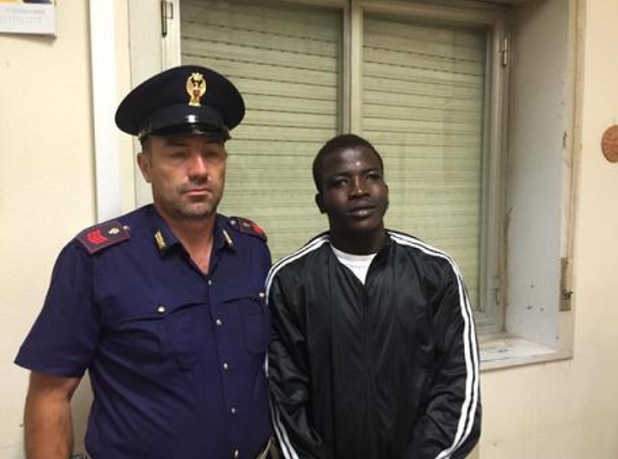
Mamadou Kamara, an 18-year-old from the Ivory Coast, allegedly slit the throat of Vincenzo Solano, 68, and then attacked his Spanish-born wife, Mercedes Ibanez, 70.

Ms Ibanez fell to her death from a second-floor balcony, during a robbery that turned violent.

Mr Kamara is one of thousands of migrants and refugees living at a vast reception centre at nearby Mineo, in south-eastern Sicily.

They are accommodated there after arriving by boat from Libya, and wait sometimes for months to have their asylum applications assessed.

The migrants are allowed to come and go freely from the facility, a former US military base where prostitution, links with organised crime and the trade in illicit goods is said to be rife.

Mr Kamara, who was rescued in the Mediterranean on June 8 and brought with other migrants to the port of Catania in Sicily, allegedly broke into the pensioners’ flat in the village of Palagonia, six miles away, and slit the throat of Mr Solano.

The elderly man’s wife was found dead in the courtyard of their three-storey apartment block. Investigators believe she may have fallen over the balcony in panic after trying to flee the attacker.

Mr Kamara was arrested after police searched his bag on Sunday as he returned to the migrant centre.
Inside they found a mobile telephone, a laptop computer, a video camera and a pair of trousers, allegedly belonging to Mr Solano, that were covered in blood.

The young African man claimed to have “found” the items, but police arrested him and are expected to charge him with two counts of murder.

Sebastian Maccarrone, the director of the Mineo migrant centre, said: “If it was him, it is a tragedy within a tragedy – for the people killed, and for integration. We are all shocked… For each small step we have taken forward in terms of integration, this has put us 10 steps backwards.”

More than 100,000 refugees have arrived by boat in Italy this year, making the crossing from Libya in overcrowded rubber dinghies and leaky fishing boats. Last year, a record 170,000 arrived on Italian shores.

“Italians fear for their lives inside their own homes,” said Gianluca Buonanno, an MEP with the Northern League, a staunchly anti-immigrant party of the Right.

“This is Renzi’s national security strategy. What kind of country are we living in?”

Giorgia Meloni, another centre-Right politician and a close ally of Silvio Berlusconi, the former prime minister, said: “The instigator of the murder of these two innocents is the Italian state, which is responsible for having kept open a facility … which we said should be closed down.”

“The murdered couple had returned from living in Germany to enjoy their retirement in Sicily,” a relative told La Stampa newspaper. “They shouldn’t have died like this, slaughtered like goats.” – London Daily Telegraph

Italy saves 3000 migrants

Italy’s coastguard on Saturday successfully coordinated the rescue of around 3000 migrants in the Mediterranean after receiving distress calls from more than 20 overcrowded vessels drifting in waters off Libya.

One of the biggest single-day rescue operations to date appeared to have been concluded without any reports of casualties.

Two navy ships, the Cigala Fulgosi and the Vega, picked up, respectively, 507 and 432 migrants from two wooden boats in danger of sinking just off Libya, the navy said.

The coastguard said its patrol boats had boarded a total of just under 1,000 people from various unseaworthy fishing boats and inflatables that had left Libya overnight Friday-Saturday.

At least another 1,000 rescued migrants and refugees were reported to be headed for Italian ports on other boats as the wave of new arrivals triggered increasingly virulent attacks on centre-left Prime Minister Matteo Renzi’s handling of the migration crisis.

“This must a joke. We are using our own forces to do the people smugglers’ business for them and ensure we are invaded,” said Maurizio Gasparri, a senator for Silvio Berlusconi’s centre-right Forza Italia party.

“Help them, rescue them and take care of them: but don’t let them land here,” the populist leader of the anti-immigration Northern League wrote on his Facebook page.

The rescued migrants included a batch of 311, including a new-born baby, who were on a boat belonging to humanitarian group Doctors without Borders (MSF) which is expected to dock on Monday in Vibo Valentia in Calabria, according to port authorities there.

A further 370 had been picked up by the Italian customs police and were headed for Messina in Sicily and the Norwegian boat Siem Pilot was also carrying hundreds of people to port.

Just over 170,000 migrants and refugees from Africa, the Middle East and South Asia landed at Italy’s southern ports in 2014 after being rescued in the Mediterranean, while the total for 2015 has already topped 104,000.

A further 135,000-plus have landed in Greece since January and more than 2,300 people have died at sea while trying to make it to Europe with the help of traffickers.

Source: AFP

Pressure builds on Hillary to explain emails

As pressure builds on Hillary Clinton to explain her official use of personal email while serving as secretary of state, she faced new complications Tuesday. It was disclosed her top aides are being drawn into a burgeoning federal inquiry and that two emails on her private account have been classified as “Top Secret.”

The inspector general for the Intelligence Community notified senior members of Congress that two of four classified emails discovered on the server Clinton maintained at her New York home contained material deemed to be in one of the highest security classifications – more sensitive than previously known.

The notice came as the State Department inspector general’s office acknowledged that it is reviewing the use of “personal communications hardware and software” by Clinton’s former top aides after requests from Congress.

“We will follow the facts wherever they lead, to include former aides and associates, as appropriate,” said Douglas Welty, a spokesman for the State Department’s inspector general.

The expanding inquiry threatens to further erode Clinton’s standing as the front-runner for the Democratic presidential nomination. Since her reliance on private email was revealed in March, polls in crucial swing states show that increasing numbers of voters say Clinton is not honest and trustworthy, in part, because of her use of private emails.

Revelations that dozens of Clinton’s emails now include classified information has prompted an FBI inquiry into whether classified information was improperly stored on her private server and a thumb drive held by her attorney. The news has sparked fear among national security experts that the federal government’s secrets may have been exposed or even hacked.

Source: McClatchy

NATO is the root cause of EU migrant crisis

The scale of the migrant crisis Europe is facing today cannot be understated. It is truly unprecedented. What is habitually understated, however — and in fact almost completely ignored by mainstream media — are the real roots of the crisis, says Danielle Ryan.

The debate around migration into the EU is happening nearly entirely without reference to the causes of the recent influx of migrants from North Africa and the Middle East. The elephant in the room is NATO and nobody really wants to talk about it.

Hundreds of articles, laden down with numbers and proposals and predictions fail to make any direct link between cause and effect. News anchors sit seemingly baffled, mouths agape, at the apocalyptic-like pictures they are seeing land on their desks, and yet few are willing to draw the appropriate conclusions. But it is such a basic and logical connection that it’s hard to believe it is not being made very loudly and very persistently.

Maybe it’s just that these journalists are so conditioned to framing U.S. and NATO policy in a positive light that the links don’t even really occur to them. Or maybe they’re simply embarrassed and trying to shift focus from their long-recorded support for various military interventions in these countries.

Either way, the result is that the story is framed in such a way that it makes the timing of the crisis sound almost random. We’re witnessing a conversation about how to ‘deal’ with boats full of Libyans making their way across the Mediterranean — as if Libya was a country that had just self-imploded yesterday, and for no discernible reason.

A fierce debate is raging over ‘what to do’ about these migrants — and in a way that’s understandable because that is the more immediate problem — but the debate we really need to be having is about the policies, NATO’s policies, which were the catalyst.

Even if Europe unites in formulating a ‘solution’ to the problem, it will be nothing more than a bandaid fix because it will only deal with symptom. After all, what’s the point in covering your open wound with a bandaid when the guy who cut you is still wielding a knife in the same room? It doesn’t take a genius to work out how that story ends.

Whenever the cause is grudgingly mentioned by the media, it is mentioned briefly and abstractly where the author or anchor might refer to “conflict” or make mention of how violence has “reignited” in these countries in recent years and months.

The editors at the New York Times in particular, are big fans of loading all the blame squarely onto Europe’s shoulders. Here a Times piece argues that the migrant crisis “puts Europe’s policy missteps into focus”. Another piece, from the editorial board, lectures Europe on how to handle the situation.

In April, NATO head Jens Stoltenberg called for a “comprehensive response” to the crisis and promised that NATO would help to stabilize the situation. The alliance’s role in “stabilizing” Afghanistan was part of its broader approach to the refugee crisis in the Mediterranean, he said.

That is rich coming from the head of a ‘security’ and ‘defensive’ alliance which for years has pursued a policy of offensive destabilization in the very regions which people are fleeing from in their hundreds of thousands. But Stoltenberg’s comments and NATO’s actions are easily decoded by the employment of some basic common sense.

The NATO modus operandi is clear. The pattern, repeated over and over, involves the complete destabilization of a region, to be swiftly followed up with another NATO-led ‘solution’ to the problem. When you couple that with the use of spokespeople who are unashamed to feign ignorance and lie blatantly (Jen Psaki, Marie Harf etc.), and a compliant media that will regurgitate the line without question, this is what you get.

The 2011 NATO intervention in Libya was authorized by the United Nations on “humanitarian” grounds and resulted in the deaths of between 50,000 and 100,000 people and the displacement of 2 million. Very humanitarian.

Similarly, after the U.S.-led campaign to destabilize Syria in an effort to topple Bashar al-Assad, facilitating (and even supporting) the rise of ISIS in the region, a staggering 10 million have been displaced (according to Amnesty International) and European countries are left to help pick up the pieces. Germany, for example, has pledged to resettle 30,000 Syrian refugees. Sweden, a non-NATO nation, has taken in similar numbers.

It should be made clear however, that the numbers European countries have taken or pledged to take pale in comparison to the numbers being hosted in other Middle Eastern countries. Lebanon, for example, is hosting 1.1 million Syrian refugees. Jordan is hosting more than 600,000. Iraq hosts nearly a quarter of a million. Turkey hosts 1.6 million.

There is one country that’s getting off scot-free in all of this — at least on the Syrian front. That country is the United States. The U.S. has taken in less than 900 Syrian refugees after four years of war. American officials have cited “national security” in their explanations for not yet taking more, although they have said they would like to see the number increase.

Maybe this has something to do with it?
Debate not allowed

There is a second media crime flying under the radar here and it is this: In European countries where the massive influx of migrants from the Middle East and North Africa have caused serious societal divisions, where migrants have failed to assimilate (for a variety of reasons, including both government policies and often radical religious beliefs), Western media will allow no one to talk about it honestly — and woe betide the person who tries.

Take Sweden, where the disease of political correctness is at an even more advanced stage than it is in the rest of Europe. There, any attempt to debate the coherence of a ‘doors wide open’ immigration policy is branded as “racist”. A further irony in the Swedish context, is that the country is facing a housing crisis and has nowhere to put most of the people they are pledging to resettle. There’s some real forward-thinking, common sense policy for you.

This is a dangerous combination for Europe: An unsustainable influx of migrants, foreign policy which ensures its continuation, a docile media, and an epidemic of political correctness which has infected the entire continent.

Media 101 on the migrant crisis: Talk a lot about migrants, don’t mention why they fled and then call anyone who has a problem with it a “racist” — success! Oh, and you get an added bonus if you can somehow link it all to ‘Russian aggression’, Vladimir Putin and NATO as a ‘defensive’ alliance.

Some European countries are taking a more hardline approach and are getting slammed for it. Hungary, for example, is looking at building a barrier wall along its border with Serbia, similar to barriers along the Greek-Turkish and Bulgarian-Turkish borders. Again, this has sparked accusations of xenophobia and racism from media and political quarters.

But that’s part of the game, isn’t it? If NATO’s war supporters can focus the debate around the idea that anyone who wants to address or critically assess immigration policy is “racist” then we won’t have to talk about why the migrants are here in the first place or why they are facing such dire circumstances at home.

Russia Today’s Oksana Boyko tried recently, to broach this topic with Peter Sutherland, the UN’s special representative on international migration and development, but she got nowhere. She argued that the debate around migration into the EU can’t really be had without addressing the essence and heart of the problem, but found that NATO policy is apparently a topic not up for discussion.

Debating Europe’s migrant crisis without acknowledging the context in which it has been created it useless. It would be like asking Americans to debate police brutality without talking about race. The two are inescapably interlinked and any ‘solutions’ that come from an incomplete debate will ultimately fail.

For now though, it seems Europe will continue to debate this humanitarian crisis in terms of ‘what to do’ without addressing the ‘how to stop’ and we’ll keep running around in a vicious circle.

An easier solution, of course, would be for NATO to put an end to its campaign of destabilization in the Middle East and North Africa, but that would require the acceptance and acknowledgement of some very hard truths.

Danielle is an Irish journalist and blogger. She has a degree in Business and German from Trinity College Dublin and studied political reporting at the Washington Center for Politics and Journalism in Washington, DC. Special interests: American politics and foreign policy, US-Russia relations and media bias. Her blog can be found at journalitico.com.

Destroying Libya for profit

While advising Mrs. Clinton on Libya, Mr. Sydney Blumenthal, who had been barred from a State Department job by aides to President Obama, was employed by her family’s philanthropy, the Clinton Foundation, to help with research, “message guidance” and the planning of commemorative events, according to foundation officials.

During the same period, he also worked on and off as a paid consultant to Media Matters and American Bridge, organizations that helped lay the groundwork for Mrs. Clinton’s 2016 campaign.

Much of the Libya “intelligence” that Mr. Blumenthal passed on to Mrs. Clinton appears to have come from a group of business associates he was advising as they sought to win contracts from the Libyan transitional government.

The venture, which was ultimately unsuccessful, involved other Clinton friends, a private military contractor and one former C.I.A. spy seeking to get in on the “ground floor” of the new Libyan economy.

The projects — creating floating hospitals to treat Libya’s war wounded and temporary housing for displaced people, and building schools — would have required State Department permits, but foundered before the business partners could seek official approval.

It is not clear whether Mrs. Clinton or the State Department knew of Mr. Blumenthal’s interest in pursuing business in Libya; a State Department spokesman declined to say. Many aspects of Mr. Blumenthal’s involvement in the planned Libyan venture remain unclear. He declined repeated requests to discuss it.

But interviews with his associates and a review of previously unreported correspondence suggest that — once again — it may be difficult to determine where one of Mr. Blumenthal’s jobs ended and another began.

A series of memos from Mr. Blumenthal — who was not an employee of the State Department — to Mrs. Clinton about events unfolding in Libya before and after the death of Col. Muammar el-Qaddafi, have been obtained by The New York Times.

Mrs. Clinton, who was secretary of state at the time, took Mr. Blumenthal’s advice seriously, forwarding his memos to senior diplomatic officials in Libya and Washington and at times asking them to respond. Mrs. Clinton continued to pass around his memos even after other senior diplomats concluded that Mr. Blumenthal’s assessments were often unreliable.

Source: NYT

EU wants military intervention to curb migration

The European Union’s (EU) Chief Diplomat, Frederica Mogherini briefed the United Nations Security Council on migrants.

The EU is considering a draft resolution that would authorise EU military intervention to curb the illicit trafficking of persons that has already cost almost 2000 lives lost at sea this year alone.

The EU indicated its first priority was to prevent further loss of lives as sea.

As the Security Council mulls the parameters of military intervention off the coast of Libya in the Mediterranean, concerns about what will happen to migrants found in illegal boats.

Chaos in Libya, which has two opposing governments and various armed militias in the country, has allowed organised networks a foothold to traffic persons off its coast.

The country’s internationally recognised government has objected to the EU proposals which include ‘the use of all necessary means to seize and dispose’ of vessels used in trafficking.

Russia has also said such proposals might go too far as the shape the military action might take remains unclear.

Ilana Mercer: The curse of Colonel Gadhafi

When they destabilized Libya and overthrew strongman Muammar Gadhafi in 2011 the U.S. and its Canadian and European allies unleashed a series of events that accounts for the steady flood into Europe of migrants from North Africa. There are, purportedly, “up to 1 million” poor, uneducated, possibly illiterate, predominantly male, and by necessity violence-prone individuals, poised to board rickety freighters in the Libyan ports of Tripoli and Zuwarah, and make the perilous journey across the Mediterranean, to southern Italy. The 900 migrants who perished off the coast of Libya when their vessel capsized embarked in Zuwara.

ilana_nuut2Zuwara has always been “famous for people smuggling,” notes Richard Spencer, Middle East editor of The Telegraph. “The modern story of Zuwara and its trade in people,” says Spencer, whose newspaper has documented the genesis of the exodus well before the U.S. press awoke to it, “was a key part of the late Col. Muammar Gadhafi’s relationship with the European Union.”

The “indigenous, pre-Arab inhabitants of North Africa,” Berbers, as they are known in the West, have long since had a hand in human trafficking. As part of an agreement he made with Silvio Berlusconi’s government, “Col. Gaddafi had agreed to crack down on the trade in people.” For prior to the dissolution of Libya at the behest of Barack Obama’s Amazon women warriors—Hillary Clinton, Susan Rice and Samantha Power—Libya had a navy. Under the same accord with the Berlusconi government (and for a pretty penny), Gadhafi’s admiralty stemmed the tide of migrants into Europe.

Here’s an interesting aside: Because he cracked down on their customary trade, the Zuwarans of Libya rose up against Gadhafi; the reason for this faction’s uprising, in 2011, was not the hunger for democracy, as John McCain and his BFF Lindsey Graham would have it.

Back in 2007, Labor Prime Minister Tony Blair also shook on an accord with Gadhafi. Diplomacy averse neoconservatives—they think diplomacy should be practiced only with allies—condemned the agreement. The “Deal in the Desert,” as it came to be known derisively, was about bringing Libya in from the cold and into the 21st century. In return, and among other obligations, Gadhafi agreed to curtail people smuggling.

Ever ask yourself why so many northern and sub-Saharan Africans flocked to Libya? As bad as it was before the West targeted it for “reform”—and thus paved the way for the daily privations of the Islamic State—Libya was still one of the mercantile meccas in this blighted and benighted region.

As dumb as “W” was in unseating Iraq’s dictator, Saddam Hussein, he acted wisely with Gadhafi. Both George Bush and Bill Clinton, before him, saw to it that, in exchange for a diplomatic relationship with the U.S., Gadhafi abandoned terrorism and weapons of mass destruction.

Africa has always provided what the cognoscenti term “push factors” for migration: “Poverty, political instability and civil war … are such powerful factors,” laments Flavio Di Giacomo, a spokesman for the International Organization of Migration in Italy. More recently, the Middle East has been the source of the flight. The chaos and carnage in Iraq is ongoing—has been since the American invasion of 2003. Of late, the civil war in Syria, in which the U.S. has sought to topple another strongman who held it all together, has displaced 4 million people. Jordan, Lebanon and Turkey have absorbed hundreds of thousands of these refugees, as they should. But there are at least 500,000 more war-worn Syrians ready to be put to sea.

Programmed from on high, Europeans, like Americans, are bound by the suicide pact of political correctness to open their borders to the huddled mass of Third World people, no matter the consequences to their societies. Gadhafi was without such compunction. In 2010, he openly vowed to “turn Europe black,” unless the neutered Europeans rewarded him handsomely for doing the work they refused to do: patrol and protect their coastline.

“Tomorrow Europe might no longer be European, and even black,” roared Gadhafi, “as there are millions who want to come in. We don’t know if Europe will remain an advanced and united continent, or if it will be destroyed, as happened with the barbarian invasions.”

Presidential candidate Hillary Clinton cackled barbarically when she learned of the demise of Col. Gadhafi, but the colonel is having the last laugh.

Ilana Mercer is a paleolibertarian writer, based in the U.S. She is a contributor to Junge Freiheit, Germany’s finest weekly, and is a fellow at the Jerusalem Institute for Market Studies. Her latest book is “Into the Cannibal’s Pot: Lessons For America From Post-Apartheid South Africa.” Her website is www.IlanaMercer.com. Follow her on Twitter. “Friend” her on Facebook.

Some 400 migrants drown in shipwreck off Libya

About 400 migrants died in an attempt to reach Italy from Libya when their boat capsized. This is the latest tragedy in the Mediterranean where the death toll from shipwrecks has surged this year.

The boat, carrying about 550 migrants in total, flipped about 24 hours after leaving the Libyan coast, according to some of the 150
survivors who were rescued and brought to a southern Italian port on Tuesday morning, Save the Children reported.

Before this incident there had already been more than 500 deaths of migrants crossing the Mediterranean from Africa this year, up sharply from 47 in the same period of 2014, says the Geneva-based International Organisation for Migration (IOM).

The survivors of the latest shipwreck were mostly sub-Saharan Africans, but no further details were available, a Save the Children spokesperson tells Reuters. It is not clear exactly when the boat had capsized.

The number of boats carrying migrants aiming to reach the EU from Africa has picked up in recent weeks as fine spring weather makes the passage safer.

In February, more than 300 drowned when attempting the crossing in cold weather and rough seas. Save the Children, the IOM and other humanitarian organisations have called for the European Union to bolster its sea rescue operations before the migrant flows soar as they usually do in the summer months.

On Monday, 2 851 migrants were saved in rescue operations in the Mediterranean, the Italian coast guard said, adding to at least nine who died and 5 629 who were saved over the weekend. Italy, which handled the largest number of migrant arrivals in the EU, has become increasingly alarmed about the breakdown of law and order in Libya, which has greatly exacerbated the task of tackling the migrant flows.

Source: Reuters

Canada knew NATO would be aiding extremists in Libya

Canadian military intelligence knew that NATO’s March 2011 intervention in Libya would aid militant theocratic Islamists aligned with al-Qaeda and could create long-term chaos in the country, according to David Pugliese, a reporter with The Ottawa Citizen, who obtained Canadian intelligence documents.

At the time, NATO military leader, U.S. Admiral James Stavridis, denied that opposition to the secular leftist Libyan leader Muamar Gaddafi was dominated by fundamentalist Islamist theocrats, calling the bulk of the opposition forces “responsible men and women.”

But Canadian intelligence was clear-eyed about the nature of the Libyan opposition.

Pugliese revealed that “A Canadian intelligence report written in late 2009 described the anti-Gadhafi stronghold of eastern Libya,” from which the uprising against Gaddafi erupted, “as an epicentre of Islamist extremism.”

And Canadian pilots joked privately that they were part of al-Qaeda’s air force, “since their bombing runs helped to pave the way for rebels aligned with the terrorist group.”

Pugliese reports that just days before NATO’s intervention in Libya,

Canadian intelligence specialists sent a briefing report shared with senior officers. ‘There is the increasing possibility that the situation in Libya will transform into a long-term tribal/civil war,’ they wrote in their March 15, 2011 assessment. ‘This is particularly probable if opposition forces receive military assistance from foreign militaries.’

Canada’s Prime Minister Stephen Harper later denied that NATO’s intervention created the chaos that has paralyzed Libya, despite his own military’s warning that there was a good chance it would.

This reveals a dishonest attempt to manipulate public opinion through outright deception.

British naval base in Bahrain a disaster waiting to happen

The British decision to establish a naval base at Mina Salman Port in Bahrain as an old colonial power strongly supporting the Sunni monarchy, is a questionable move.

Bahrain has been criticized by international organizations for human rights abuses, however, as the home of the US Fifth Fleet, it has faced little criticism from Western governments.

The monarchy mercilessly crushed demands for democracy and civil rights from the island’s Shia majority during the Arab Spring in 2011.

Their repression was excessive. Shia mosques and holy places were bulldozed. Doctors at the main hospital in Bahrain that treated injured protesters were tortured by being forced to stand without sleep for days on end. Other prisoners were told that unless they sang the praises of the king their interrogators would urinate into their mouths.

The hypocrisy in the claims of the US and Britain to support secular democracy and civil rights in countries such as Libya and Syria, are therefore outrageous.

They do so in alliance with Sunni theocratic repressive monarchies which understandably have no interest in spreading secular democracy anywhere.

In 2011, UAE said it would refuse to join the coalition against the Libyan leader Muammar Gaddafi if there was any criticism of Bahraini repression.

At the heart of the crisis convulsing this part of the Middle East is a struggle between Sunni and Shia, and Britain has openly taken the side of the former.

It may not necessarily be a good long-term investment, but the British are good at switching sides as Gaddafi found out too late.

The total population of states bordering on the Gulf is about 145 million of whom at least 110 million are Shia.

Nabeel Rajab, one of Bahrain’s leading human rights activists, was arrested on 1 October because he “offended national institutions” by his comments on social media. Rajab had criticised the government for using counterterrorism laws to prosecute human rights defenders.

He also pointed out that a former Bahraini interior ministry officer, Mohamed Isa al-Binali, had joined ISIS and was calling on other interior ministry employees to do likewise.

The opening of a large UK naval base in Bahrain is a reward to London for not speaking out against the royal family’s abuses against dissenters, human rights activist Nabeel Rajab said.

Hundreds of Bahrainis protested the announcement.

It is not at all clear why Britain needs to establish its first permanent naval base in the Middle East since 1970 in Bahrain.

The base in Bahrain will be used to support RAF operations against the Islamic State in Iraq, but these are on such a small scale that they will not do much to affect the outcome of the war with ISIS.

Most British disasters in the Middle East over the past century have stemmed from wishing to be a major player in the region, while underestimating the resources necessary to do so.

Bahrain will pay for the naval base, however.

The Paltrow of politics (minus looks & ethics)

Hillary Rodham Clinton has done some “conscious uncoupling” from reality. The term was disgorged by a celebrity, Gwyneth Paltrow, to announce a separation from her spouse. In the same breath, the actress bemoaned her gilded, glamorous life, and offended America’s military sacred cow by comparing the cyber-attacks she endures to the experience of war.

Hillary Rodham Clinton has done some “conscious uncoupling” from reality. The term was disgorged by a celebrity, Gwyneth Paltrow, to announce a separation from her spouse. In the same breath, the actress bemoaned her gilded, glamorous life, and offended America’s military sacred cow by comparing the cyber-attacks she endures to the experience of war.

As heir to a political dynasty founded by a powerful man, Hillary has received millions of dollars to write books. Over the years, she and husband Bill Clinton have made hundreds of millions from both book deals and speaking engagements. Yet in a recent ABC interview, the former “First Housewife” complained about emerging from the White House not only “dead broke, but in debt”: “We had no money when we got there and we struggled to … piece together the resources for mortgages, for houses, for Chelsea’s education. You know, it was not easy.”

Another reality Hillary has worked to deconstruct is Benghazi. Hillary dare not admit that, by leveling Libya, Americans invited into that country the very lynch-mob that took their lives. The Americans targeted at the U.S. mission in Benghazi had become an irritant to the long-suffering Libyans, who will use any U.S. provocation, real or imagined, to expel those who “came, saw, and conquered.” Still less is the former secretary of state willing to cop to having left the post undefended. This scribe has long subscribed to the view that, at bottom, the woman who cracked the whip at Foggy Bottom had imagined she would run the Benghazi compound like a community center. How better to signal that the war on Libya, Hillary’s special project, was a smashing success?

In a fit of “estrogen-driven paternalism on steroids,” Hillary and two sisters in the Obama administration—“humanitarian hawks” Samantha Power, then a member of the president’s National Security Council, and National Security Advisor Susan Rice, then Ambassador to the United Nations—launched a “war of the womb” that left Libya in shambles.

All along, our globetrotting hegemon evinced little respect for regional powers and their right to handle their own affairs, in-house, so to speak. On behalf of the African Union, South African President Jacob Zuma had brokered a deal with Libya. By the Telegraph’s telling, the AU had “outlined a political solution to end the fighting in Libya based on an immediate end to attacks on civilians and a ceasefire which would be monitored by a credible international organization. The ceasefire would lead to a transitional period and culminate in elections.” Col. Muammar Gadhafi agreed. Judging from what befell Libya, Hillary and her harridans would have none of it. They refused to give peace a chance. War it was. The rest is history, as is Libya.

Into the Cannibal's Pot

Who can forget Hillary Clinton’s blood-curdling cackle, “We came, we saw, he died!”, when tidings arrived of the actions of her thugs of choice in that country? Backed by American drones and French fighter jets above, the Libyan rebels to whom the U.S. had taken a shine intercepted Col. Gadhafi as he fled his hometown of Sirte, dragged him from his vehicle, and lynched him then and there. Hillary’s ululations were a perfect complement to the rebels’ harangues of “Allahu Akbar.”

The focus of Hillary’s next blood-inspired hoedown was to be Syria. She had wanted to arm rebel forces there. Obama objected. Or so she tells readers of her latest, I-did-it-my-way memoire. A story broken by Frankfurter Allgemeine Zeitung (FAZ), almost 2 years back, implicated Hillary’s Syrian soul-mates in the massacre of over 90 Alawi and Shia villagers, “predominantly women and children.” “Rebel atrocities,” relayed National Review’s foreign correspondent, were “being repackaged in both Arab and Western media accounts as regime atrocities.” As president, count on Hillary to devise a creative casus belli for the “humanitarian” invasion she hankers for in Syria. For if she has learned anything from Benghazi, it is not that America ought to divest from democratizing the word, but that our country needs more Green-Zone fortresses everywhere.

Whether this strong-as-a-horse politician was concussed or cowering, in the waning days of 2012, we will never know. Mrs. Clinton was scheduled to testify in December “before the House of Representatives and Senate foreign affairs committees on a report on the deadly attack on the U.S. diplomatic post in Benghazi, Libya, that killed the U.S. ambassador and three other Americans.” She was a no-show.

But on CNN, love is in the air. Viewers have expressed a belief that Hillary would restore the country to the Clinton years of peace and prosperity. Bill Clinton bombed Iraq in 1998, as well as a Sudanese pharmaceutical company that turned out to be the main manufacturer of medicines and vaccinations in Sudan. And he strafed the Serbs in 1999. Stateside, Bill butchered 76 men, women and children in Texas. Alas, so long as Hillary steers clear of another Waco, and confines her murderous sprees to killing far-away people from high above—few boots on the ground—her countrymen will consider her a peacemaker.

While prosperity during the Clinton years was due less to Clinton-economics than to Reaganomics and a Republican Congress not yet completely comatose—in fairness, Bill does grasp something about prosperity. “This is good work,” he famously said about Mitt Romney’s much-maligned work at Bain Capital. Hillary, conversely, has no economic acumen. “There are rich people everywhere, and yet they do not contribute to the growth of their own countries,” she grumbled at the Clinton Global Initiative, in 2012. According to economist George Reisman’s cogent analysis—and contra Mrs. Clinton’s crushing ignorance—“a highly productive and provident 1 percent provides the standard of living of a largely ignorant and ungrateful ninety-nine percent.” As for Obama’s putsch for a North-Korean style health care: Instead of aborting it, Hillary will guarantee that Obamacare reaches full-term gestation.

Another wily fox called Bill (O’Reilly) has defended Mrs. Clinton’s riches as capitalism’s reward for hard work. Not quite. Hillary has accrued wealth by using the predatory political process to wield power over others. Although she has pudding for brains, Gwyneth Paltrow, on the other hand, has made a living in the honest, productive, non-predatory and salutary ways of the free market. Paltrow’s affluence, unlike Hillary’s, is a reward for assets she peddles to people who choose to purchase them.

© 2014 by Ilana Mercer

[followbutton username=’IlanaMercer’ count=’true’ lang=’en’ theme=’light’]

Like Ilana Mercer’s Facebook page

Where’s America’s right to referendum, secession?

mercer_ilanaby Ilana Mercer

[followbutton username=’IlanaMercer’ count=’true’ lang=’en’ theme=’light’]

Like Ilana Mercer’s Facebook page

From a node in the neoconservative network, a Fox News studio, Charles Krauthammer has complained about the eviction of the Ukrainian Navy from the city of Sevastopol, where it was headquartered. Not a word did the commentator say about the city’s location: Sevastopol is on the Crimean Peninsula. It would appear that the city now falls within Crimean jurisdiction – starting March 16, the day the people of Crimea voted to secede from Ukraine.

By most estimates, between 97 and 93 percent of Crimean voters said yes to a reunion with Russia. High too was voter turnout. McClatchy pegs it at 83 percent of registered voters in Crimea. BBC News was agreed, also reporting a ballot of “more than 80 percent.” Zerohedge.com counted a “paltry” 73 percent turnout, still “higher than every U.S. presidential election since 1900.”

As rocker Ted Nugent might say, the Russians and Crimeans are blood brothers. Nugent got into trouble for using this perfectly proper appellation to describe his affinity for a politician, of all people: Texas Republican gubernatorial hopeful Greg Abbott. Notwithstanding that in the land of the terminally stupid, linguistic flourish can land one in hot water – blood brother is a good, if colorful, turn of phrase that denotes fealty between like-minded people. Steeped in state-enforced multiculturalism, America’s deracinated, self-anointed cognoscenti have a hard time grasping the blood-brother connections between the people of Russia and Crimea.

For no apparent reason other than that it is pro-Russian, Americans have reflexively aligned themselves against the swell for secession in southern Ukraine. Separatist referenda in Kosovo, Catalonia, South Sudan and Scotland have been accepted without demur by a political and media establishment unprepared to countenance a similar referendum in Crimea.

Guided by the pack animals of politics and punditry who seldom fail to shed darkness on whatever topic they tackle, a nation that struggles to locate the disputed territories on the map has been convinced of the menace posed by Russia. According to a CNN poll, 69 percent of Americans say they see Russia as a threat. A Rasmussen Report poll indicated that “52 percent support U.S. diplomatic action against Russia over Crimea.”

Helping to drive American Russophobia is the implacable logic exemplified by Bill O’Reilly of “The Factor,” yet another node in the network mentioned. At the suggestion that there are similarities between Russian and American military bellicosity, the TV host foams at the mouth. Fulmination is followed not by argument, but by a form of ad hominem or psychologizing.

Into the Cannibal's Pot

It is absolutely verboten on this popular and powerful show to compare Russia’s “excursion” into Ukraine to America’s naturally illicit and illegal occupations of Iraq, Afghanistan and Libya. In defense of their reflexive rejection of the reasonable, if inaccurate, comparison – for decades the U.S. has been far more aggressive than Russia in its forays abroad – Bill and his gang “argued” (on March 3) as follows:

President Vladimir Putin is a thug. That’s why his actions can’t be contrasted with the actions of “a good country” like the U.S. By “logical” extension, George Bush and Barack Obama are never to be fingered as thugs.

Why, Billy, some of you will inquire? Is it because these thugs are American? Precisely.

Next, Bill O’Reilly’s mind-reading gifts were galvanized to negate the juxtaposition of the actions on the ground of the Russian and American governments. Putin, it would appear, seeks the recrudescence of the Russian empire. On the other hand, the U.S., with a military presence in 148 countries and 900 bases worldwide, has neither sought nor achieved empire status.

Why, Billy, some of you will ask? Is it because the U.S. is a good country? You got it!

Be it in Belgium, Germany, Italy, Spain, Turkey, the United Kingdom, Japan, Bahrain, Djibouti, South Korea, Iraq, Kyrgyzstan, Afghanistan and Kuwait – even Aruba, Iceland, Indonesia, Kenya, Norway and Peru – wherever it plants its military boot, a “good country” is never an empire, only a force for good.

Me, O’Reilly would dismiss as “anti-American.” But what of former secretary of state Henry Kissinger? While Kissinger has condemned Russia’s annexation of Crimea, he excoriated “the demonization of Vladimir Putin.” This antipathy “is not a policy; it is an alibi for the absence of one.” “The United States needs to avoid treating Russia as an aberrant to be patiently taught rules of conduct established by Washington,” wrote the statesman in the Washington Post.

Is Henry Kissinger anti-American or simply smarter than some Americans?

At least Secretary of State John Kerry hung on to his sense of humor. “Unless you are the United States of America, you just don’t invade another country on phony pretext in order to assert your interests,” Kerry lectured the congenitally incurious David Gregory, of “Meet the Press.”

I ad-libbed. Except for the first eight words in quotation marks, Secretary Kerry did indeed say the foregoing. Given America’s military record, the missing words are implied.

The O’Reilly school of “thought” could – and does – counteract that Crimea’s vote to join Russia was tainted by fraud. This is certainly possible. Nevertheless, it is none of our business. Americans have their own tyrants to dethrone.

We’re supposed to be the freest people in the world, aren’t we? Is this claim not the moral basis for America’s we-know-best global meddling? But if we Americans are the freest people in the world, where’s our right to a referendum on, say, that “little” legislative “blip” called Obamacare? And if we’re so bleeding free, where’s our right to secede from D.C.?

© 2014 by Ilana Mercer

[followbutton username=’IlanaMercer’ count=’true’ lang=’en’ theme=’light’]

Like Ilana Mercer’s Facebook page

Libya now primary source of illegal arms trade

libyarmsLibya has been named as the primary source of the illegal weapons trade that is fueling conflicts in at least 14 countries around the world, a final report from the UN’s independent panel on Libya’s sanctions announced.

In a briefing to the United Nations Security Council (UNSC) on Monday, the Libya sanctions committee chair, Rwandan Ambassador Eugene Gasana, noted that the post-Gaddafi government is struggling to secure the country in which a number of armed tribal militias denounce Tripoli’s authority.

“The panel noted that the control of non-state armed actors over the majority of stockpiles in Libya as well as ineffective border control systems remained primary obstacles to countering proliferation and that Libya had become a primary source of illicit weapons, including MANPADs [portable air defense systems],” Gasana told the Council, as quoted by Reuters.

Unable to secure its borders, Libya has let weapons fall into the hands of radical elements on several continents, Gasana said.

“Transfers to 14 countries reflected a highly diversified range of trafficking dynamics; and that trafficking from Libya was fueling conflict and insecurity – including terrorism – on several continents,” he said.

As of now, three ports in the country are under full control of rebel groups. A special force has been ordered by the country’s parliament to be sent next week to “liberate” all rebel-held ports, which is crucial to sustaining Libya’s oil-rich export economy that has been struggling to survive after the NATO invasion and regime change.

The UN arms embargo was enacted on Libya at the start of the unrest which eventually ousted former leader Muammar Gaddafi. Last year, non-lethal equipment was allowed to enter Libya when the UNSC eased its sanctions as the UN cautioned Tripoli against the spread of weapons to nearby states.

The UNSC insisted that Libyan authorities improve their monitoring record of arms supplied, sold, or transferred to the government with the approval of the UN sanctions committee. The panel found a number of violations of the arms embargo, such as “non-notified” transfers of arms to government security forces and transfers of weapons to the private market, Gasana said.

Gasana also pointed out that UN experts discovered that some countries need better legislative capacity to induce sanctions and implement asset freezes of the UNSC-generated list of individuals.“One instance resulted in the dissipation of almost $2 million in funds that should have been frozen,” Gasana said.

Meanwhile, Libya’s UN envoy noted that exporting parties should bear responsibility when supplying Libyan authorities with arms.

“Any request for approval for exporting weapons to Libya that is not done via the Libyan mission at the UN or with the knowledge of this mission would be considered a request from a party that does not belong to the Libyan government,” Ambassador Ibrahim Dabbashi told the Security Council.

“The exporting party shall bear the responsibility for that before the Security Council,” he added.

In the meantime, the head of the UN Support Mission in Libya (UNSMIL) warned the 15-member body that Libya faces increased violence.

“Libya faces the risk of embarking on a new trajectory of unprecedented violence,” as security and political divisions deteriorate, Tarek Mitri told the UNSC.

Mitri pointed to the surge of attacks in Sabha, located in the south of the country, which resulted in over 100 civilian deaths – including children – and the displacement of hundreds of families as well as shortages of food, fuel, and medical supplies. In the east, targeted assassinations, bombings, and kidnappings around Benghazi have reached “intolerable” levels.

“Intense efforts to resolve differences and negotiate an agreement on the management of the transitional period, including the future of the General National Congress and the Government, have not succeeded in bringing an end to the divisions that have paralyzed the political process,” noted Mitri.

An “alarming” rise in attacks on journalists has also been witnessed in recent months, Mitri told the Council, with TV stations in Tripoli and Benghazi vandalized and a number of journalists abducted.

Source: RT
