The “R” in evolution.

The world has had its fair share of revolutions in the past few centuries, most notably the French, the Russian and perhaps slightly less so the South African “transformation”.

The narrative abounds that life has become either too complicated or daunting to continue on its path and therefore is in need of change. The desire for wanton destruction then becomes the norm. No stone is left unturned and people are killed in droves, their demise often being met with mirth and mockery.

While the images of the French and Bolshevik Revolutions are well documented and the savagery well-known, it appears that the dynamism behind them has itself undergone an evolution. No longer do we see a uniform ideology to abide by, but a caricature of one’s own culture is used. The motor behind revolution has gone global and uses different means depending on the local circumstances.

Actually, a global revolution is taking place at present, and has been doing so for decades. We feel the tremors but the epicentre is hidden. We have seen South Africa fall, and are watching how the United States is following suit, yet nations that are rising from the ashes, like Russia for instance, has become the new thorn in the side of the world’s shadow elite. No doubt, a firm nationalist and religious identity works wonders to abate any such dangerous revolutionary takeovers. In that sense Russia has a lot to teach us because they have been there.

In the news today, we see the following “random” events taking place:
Back in 2010 the journalist and Bilderberg Group investigator Daniel Estulin mentioned that thirteen US military bases were being built in Afghanistan with the intention of threatening Russia. Need we not forget that the eastern block has done away with the Warsaw Pact decades ago, but NATO – its military contender in the West – is still rattling its sabre. Otherwise, various fringe groups such as pop stars and gay rights activists have been implemented to stem the tide of Russian nationalism. Not to mention the State Department’s Victoria Nuland’s leaked phone call wherein the political dislodging of Ukraine from its powerful neighbour was discussed. And yet they still want us to believe that Putin is the bogeyman.

Elsewhere, the United States is still reeling from the various racially related riots that have taken place at home. Arguably, it started off when George Soros’ puppet president Barack Obama commented on the Trayvon Martin/George Zimmerman case in 2012. In contrast to the ruling of the court, the president defended the African American teenager, effectively criminalising the defendant further and undermining the rule of law; a dictator in the making. Setting such precedents are not productive when it comes to quelling race relations, not to mention how the defendant, who had previously referred to himself as Hispanic all of a sudden became “white” in the eyes of the public. This hand-picked incident of violence (one out of 8,855 hand gun related homicides that year) had to have a white man killing a black youngster in order to pass muster, otherwise it would have disappeared down the memory hole and would have been seen as no more than an everyday act of violence. The ensuing race related incidents in Ferguson, New York and Baltimore demonstrated how violence with indirect approval from the Commander in Chief begets further violence. The Washington Post has mentioned how, once again, George Soros bankrolled $33 mln to Ferguson to fan the flames of racial tensions. Apparently – and to no surprise one might add – even the race-baiting reverend Jeremiah Wright is on Soros’ dime.

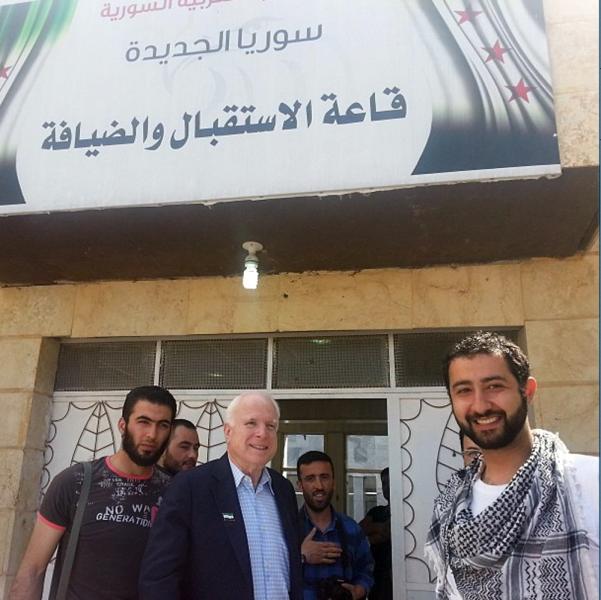
In other parts of the world, especially the Middle-East, we are witnessing the rise of Islamic State, a new type of extremist militia group with lofty ambitions of establishing a global caliphate. Interestingly, where the US had helped to topple local dictators and warlords, IS is taking over with unseen ferocity. First there was Saddam who had to be ousted, and a few years later Khaddafi followed him into the grave. In both instances and beyond, IS rose out of the chaos, beheading people and destroying ancient statues wherever they went. The destructive allure of IS has transcended national borders not only in the Middle-East but even Muslims in Europe are enticed by their boldness and are risking life and limb to fight and die for them. And then we have to hear how none other than puppet master Henry Kissinger mentioned that IS is fighting with weapons manufactured in the United States, while Republican senator John McCain was seen holding a meeting with the IS ringleaders.

Do we see a pattern emerge?

In Russia, the Western elite wants to destroy their sense of nationhood using religion as an important target. In the US they are using trumped up charges of racism to destroy the White Anglo Saxon Protestant character, and in the Middle-East uncompromising savagery is used to kill and intimidate minorities in the name of Islam, all happening at the same time.

In all these cases, religion is used either as a lance or as a target, depending on the local circumstances.

One of the ideals of Communism, as explained in Marx and Engels’ manifesto is to destroy religion. In the case of IS, religion is used as a means to traumatise the various populations in order to ultimately convert the masses to atheism, as religion is perceived as a source of violence. Apparently a new force of atheism is emerging within the spindle of the Islamic world, namely Saudi Arabia. Even though statistics are hard to come by in this reclusive state, the general opinion seems to be that the veils and religious garb are rather concealing unbelief than immorality nowadays.

As Lenin once wrote, the best revolutionary is a youth devoid of morals. From this point of view, it appears as if IS has taken a leaf from the book of global revolution and are using the most severe forms of barbarism to put Lenin’s credo to the test. Any successful megalomaniac could attest to the joys of a traumatised and docile populace, as they often make the best slaves.

Whereas in the United States and South Africa, the destruction of the middle class is taking place, with white Americans and South Africans slowly becoming the nouveau pauvre, the Russian Bear is on the rise, and Putin has achieved everything the globalists had hoped would not happen. The entire revolutionary character and spirit of Russia has been disbanded and the rumors are circulating that the czar is to be restored as a final triumph of nationalism over internationalism.

To create a world of poverty and unbelief appears to be one of the means the elite is using to encapsulate the world by locking its people up in an unbreakable caste.

In our modern times people are once again searching for a sense of being authentic. Realising that the general narrative that has been told to us does not reflect people’s true feelings, the search for a more authentic identity then comes to the fore.

This would explain the primary reason why revolutions, which cost billions in modern day cash, cannot hold up against nationalist sentiments. Just as historian Oswald Spengler wrote about a hundred years ago a sense of one’s own culture and way of life cannot be crushed, simply because self-reflection is free and more captivating than the primitive one-dimensional ideologies proposed by revolutionary ideologues. Conversely, the revolutionary thinkers have to pressure themselves into preventing this return to nationalist based thoughts, ultimately fighting a losing battle.

Regardless of the fact that revolutions have evolved, once the tricks that are being used are exposed, people will naturally return to their own sense of authenticity, causing revolutionary thoughts to dissolve and go gently into that good night.

Let’s hope it’s not too late for that.

Nelson Mandela welcomed Bantustans

The NP under FW de Klerk started the negotiations with Nelson Mandela “well”, but abandoned most white demands in September 1992, leading to the current growing assault on property rights, says Hermann Giliomee. He recently gave a lecture in honour of Richard Elphick at Wesleyan University, Middletown, Conn, USA.

In 1960 Mandela along with mostly white communists decided to form an armed body, later called Umkhonto we Sizwe, to embark on a campaign of sabotage and terror against whites and black moderates, now euphemistically called the “armed struggle”.

Albert Luthuli, the incumbent ANC president was firmly opposed the ANC embarking on a terror campaign.

Two Russian historians, Irina Filatova and Apollon Davidson, in The Hidden Thread; Russia and South Africa in the Soviet Era (Jonathan Ball), write that Mandela was present as a member of the SACP’s central committee:

Using the ANC’s distinction between members of the SACP, i.e. communists, and members of the ANC proper, or nationalists, the two [Russian] historians conclude there was no nationalist present when the SACP decided to embark on an armed struggle.

The controversy intensified when the Mandela Foundation released the 627 page original manuscript of Mandela’s account of his life, which was smuggled out of jail. It now appears that some very interesting passages was expurgated from the prison manuscript in producing the printed version of Mandela’s autobiography A Long Walk to Freedom (1994).

The unexpurgated prison manuscript include detail particularly on how Mandela wanted to deal with the Bantustans.

From the mid-1970s the tide turned against the white regimes in Southern Africa. The economy became bogged down by the sudden jump in oil prices together with a slump in commodity prices and growing demands from a much more assertive black work force.

The collapse of the dictatorship of Portugal in 1974 was the start of rapid withdrawal of Portugal from its Southern African colonies. Soviet-aligned regimes came to power in Mozambique and Angola. A South African attempt to intervene in Angola misfired badly. The Soviet government airlifted some 30 000 Cuban troops to the country. Secretary of State Henry Kissinger warned Vorster that due to opposition in the American Congress the Ford administration would not be able to counter further Soviet intervention in southern Africa.

In June 1976 a major uprising erupted in Soweto, near Johannesburg, and quickly spread to townships across the country. The political isolation of the white community was starkly exposed. The situation was so serious that on 8 August 1976 the Vorster cabinet had on its agenda the issue of the release of Nelson Mandela, which was by then twelve years in jail. There is no record of the decision.

What would have happened if Mandela were indeed released in 1976? Neville Alexander records that in 1971 he and Mandela debated using the apartheid channels, flawed as they were. Two years earlier, in 1974, Mandela had written a secret memorandum, entitled “Clear the obstacles and confront the enemy”, that was smuggled out.

In this document Mandela confronted the fact that the government of the Transkei, which was the putative homeland of most Xhosa, had opted to take the apartheid style independence in 1976. In terms of a 1971 law, Mandela who was born in the Transkei, would lose his South African citizenship.

Undeterred, Mandela wrote in his 1974 memorandum that the ANC faced an entirely new development: the independence of the Transkei, which was sure to be followed by other Bantustans. Mandela wrote: “The Transkei will have an independent legislature, judiciary and executive and may control its foreign relations” and then added:
“For the first time since conquest the people will run their own affairs. Now Africans will be able to be judges, magistrates, attorneys-general, inspectors of education, postmasters, army and police officers, and they will occupy other top positions in the civil service. Would it not be far better to consider independence as an accomplished fact and then call upon the people in these so-called free territories to help in the fight for a democratic South Africa?”

If a free Mandela had pushed for this policy of recognising the Transkei’s independence the strains in the ANC may well have become too great to contain. A major split may well have occurred in the movement, putting South Africa on a quite different course than one it took between 1976 and 1990.

Where’s America’s right to referendum, secession?

mercer_ilanaby Ilana Mercer

[followbutton username=’IlanaMercer’ count=’true’ lang=’en’ theme=’light’]

Like Ilana Mercer’s Facebook page

From a node in the neoconservative network, a Fox News studio, Charles Krauthammer has complained about the eviction of the Ukrainian Navy from the city of Sevastopol, where it was headquartered. Not a word did the commentator say about the city’s location: Sevastopol is on the Crimean Peninsula. It would appear that the city now falls within Crimean jurisdiction – starting March 16, the day the people of Crimea voted to secede from Ukraine.

By most estimates, between 97 and 93 percent of Crimean voters said yes to a reunion with Russia. High too was voter turnout. McClatchy pegs it at 83 percent of registered voters in Crimea. BBC News was agreed, also reporting a ballot of “more than 80 percent.” Zerohedge.com counted a “paltry” 73 percent turnout, still “higher than every U.S. presidential election since 1900.”

As rocker Ted Nugent might say, the Russians and Crimeans are blood brothers. Nugent got into trouble for using this perfectly proper appellation to describe his affinity for a politician, of all people: Texas Republican gubernatorial hopeful Greg Abbott. Notwithstanding that in the land of the terminally stupid, linguistic flourish can land one in hot water – blood brother is a good, if colorful, turn of phrase that denotes fealty between like-minded people. Steeped in state-enforced multiculturalism, America’s deracinated, self-anointed cognoscenti have a hard time grasping the blood-brother connections between the people of Russia and Crimea.

For no apparent reason other than that it is pro-Russian, Americans have reflexively aligned themselves against the swell for secession in southern Ukraine. Separatist referenda in Kosovo, Catalonia, South Sudan and Scotland have been accepted without demur by a political and media establishment unprepared to countenance a similar referendum in Crimea.

Guided by the pack animals of politics and punditry who seldom fail to shed darkness on whatever topic they tackle, a nation that struggles to locate the disputed territories on the map has been convinced of the menace posed by Russia. According to a CNN poll, 69 percent of Americans say they see Russia as a threat. A Rasmussen Report poll indicated that “52 percent support U.S. diplomatic action against Russia over Crimea.”

Helping to drive American Russophobia is the implacable logic exemplified by Bill O’Reilly of “The Factor,” yet another node in the network mentioned. At the suggestion that there are similarities between Russian and American military bellicosity, the TV host foams at the mouth. Fulmination is followed not by argument, but by a form of ad hominem or psychologizing.

Into the Cannibal's Pot

It is absolutely verboten on this popular and powerful show to compare Russia’s “excursion” into Ukraine to America’s naturally illicit and illegal occupations of Iraq, Afghanistan and Libya. In defense of their reflexive rejection of the reasonable, if inaccurate, comparison – for decades the U.S. has been far more aggressive than Russia in its forays abroad – Bill and his gang “argued” (on March 3) as follows:

President Vladimir Putin is a thug. That’s why his actions can’t be contrasted with the actions of “a good country” like the U.S. By “logical” extension, George Bush and Barack Obama are never to be fingered as thugs.

Why, Billy, some of you will inquire? Is it because these thugs are American? Precisely.

Next, Bill O’Reilly’s mind-reading gifts were galvanized to negate the juxtaposition of the actions on the ground of the Russian and American governments. Putin, it would appear, seeks the recrudescence of the Russian empire. On the other hand, the U.S., with a military presence in 148 countries and 900 bases worldwide, has neither sought nor achieved empire status.

Why, Billy, some of you will ask? Is it because the U.S. is a good country? You got it!

Be it in Belgium, Germany, Italy, Spain, Turkey, the United Kingdom, Japan, Bahrain, Djibouti, South Korea, Iraq, Kyrgyzstan, Afghanistan and Kuwait – even Aruba, Iceland, Indonesia, Kenya, Norway and Peru – wherever it plants its military boot, a “good country” is never an empire, only a force for good.

Me, O’Reilly would dismiss as “anti-American.” But what of former secretary of state Henry Kissinger? While Kissinger has condemned Russia’s annexation of Crimea, he excoriated “the demonization of Vladimir Putin.” This antipathy “is not a policy; it is an alibi for the absence of one.” “The United States needs to avoid treating Russia as an aberrant to be patiently taught rules of conduct established by Washington,” wrote the statesman in the Washington Post.

Is Henry Kissinger anti-American or simply smarter than some Americans?

At least Secretary of State John Kerry hung on to his sense of humor. “Unless you are the United States of America, you just don’t invade another country on phony pretext in order to assert your interests,” Kerry lectured the congenitally incurious David Gregory, of “Meet the Press.”

I ad-libbed. Except for the first eight words in quotation marks, Secretary Kerry did indeed say the foregoing. Given America’s military record, the missing words are implied.

The O’Reilly school of “thought” could – and does – counteract that Crimea’s vote to join Russia was tainted by fraud. This is certainly possible. Nevertheless, it is none of our business. Americans have their own tyrants to dethrone.

We’re supposed to be the freest people in the world, aren’t we? Is this claim not the moral basis for America’s we-know-best global meddling? But if we Americans are the freest people in the world, where’s our right to a referendum on, say, that “little” legislative “blip” called Obamacare? And if we’re so bleeding free, where’s our right to secede from D.C.?

© 2014 by Ilana Mercer

[followbutton username=’IlanaMercer’ count=’true’ lang=’en’ theme=’light’]

Like Ilana Mercer’s Facebook page