The “R” in evolution.

The world has had its fair share of revolutions in the past few centuries, most notably the French, the Russian and perhaps slightly less so the South African “transformation”.

The narrative abounds that life has become either too complicated or daunting to continue on its path and therefore is in need of change. The desire for wanton destruction then becomes the norm. No stone is left unturned and people are killed in droves, their demise often being met with mirth and mockery.

While the images of the French and Bolshevik Revolutions are well documented and the savagery well-known, it appears that the dynamism behind them has itself undergone an evolution. No longer do we see a uniform ideology to abide by, but a caricature of one’s own culture is used. The motor behind revolution has gone global and uses different means depending on the local circumstances.

Actually, a global revolution is taking place at present, and has been doing so for decades. We feel the tremors but the epicentre is hidden. We have seen South Africa fall, and are watching how the United States is following suit, yet nations that are rising from the ashes, like Russia for instance, has become the new thorn in the side of the world’s shadow elite. No doubt, a firm nationalist and religious identity works wonders to abate any such dangerous revolutionary takeovers. In that sense Russia has a lot to teach us because they have been there.

In the news today, we see the following “random” events taking place:
Back in 2010 the journalist and Bilderberg Group investigator Daniel Estulin mentioned that thirteen US military bases were being built in Afghanistan with the intention of threatening Russia. Need we not forget that the eastern block has done away with the Warsaw Pact decades ago, but NATO – its military contender in the West – is still rattling its sabre. Otherwise, various fringe groups such as pop stars and gay rights activists have been implemented to stem the tide of Russian nationalism. Not to mention the State Department’s Victoria Nuland’s leaked phone call wherein the political dislodging of Ukraine from its powerful neighbour was discussed. And yet they still want us to believe that Putin is the bogeyman.

Elsewhere, the United States is still reeling from the various racially related riots that have taken place at home. Arguably, it started off when George Soros’ puppet president Barack Obama commented on the Trayvon Martin/George Zimmerman case in 2012. In contrast to the ruling of the court, the president defended the African American teenager, effectively criminalising the defendant further and undermining the rule of law; a dictator in the making. Setting such precedents are not productive when it comes to quelling race relations, not to mention how the defendant, who had previously referred to himself as Hispanic all of a sudden became “white” in the eyes of the public. This hand-picked incident of violence (one out of 8,855 hand gun related homicides that year) had to have a white man killing a black youngster in order to pass muster, otherwise it would have disappeared down the memory hole and would have been seen as no more than an everyday act of violence. The ensuing race related incidents in Ferguson, New York and Baltimore demonstrated how violence with indirect approval from the Commander in Chief begets further violence. The Washington Post has mentioned how, once again, George Soros bankrolled $33 mln to Ferguson to fan the flames of racial tensions. Apparently – and to no surprise one might add – even the race-baiting reverend Jeremiah Wright is on Soros’ dime.

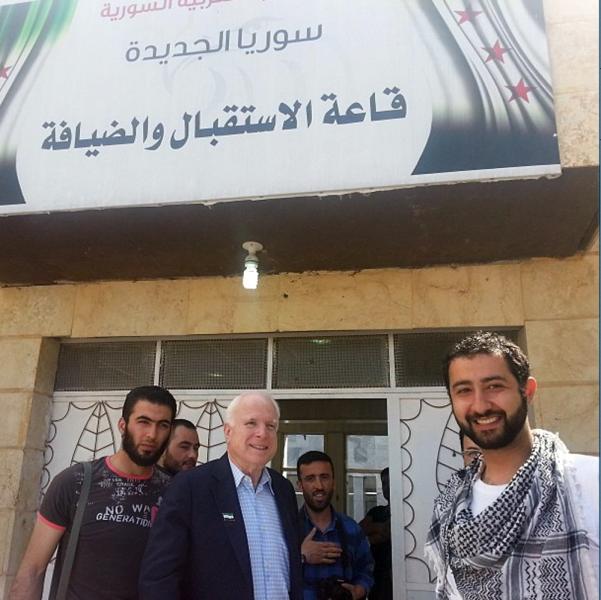
In other parts of the world, especially the Middle-East, we are witnessing the rise of Islamic State, a new type of extremist militia group with lofty ambitions of establishing a global caliphate. Interestingly, where the US had helped to topple local dictators and warlords, IS is taking over with unseen ferocity. First there was Saddam who had to be ousted, and a few years later Khaddafi followed him into the grave. In both instances and beyond, IS rose out of the chaos, beheading people and destroying ancient statues wherever they went. The destructive allure of IS has transcended national borders not only in the Middle-East but even Muslims in Europe are enticed by their boldness and are risking life and limb to fight and die for them. And then we have to hear how none other than puppet master Henry Kissinger mentioned that IS is fighting with weapons manufactured in the United States, while Republican senator John McCain was seen holding a meeting with the IS ringleaders.

Do we see a pattern emerge?

In Russia, the Western elite wants to destroy their sense of nationhood using religion as an important target. In the US they are using trumped up charges of racism to destroy the White Anglo Saxon Protestant character, and in the Middle-East uncompromising savagery is used to kill and intimidate minorities in the name of Islam, all happening at the same time.

In all these cases, religion is used either as a lance or as a target, depending on the local circumstances.

One of the ideals of Communism, as explained in Marx and Engels’ manifesto is to destroy religion. In the case of IS, religion is used as a means to traumatise the various populations in order to ultimately convert the masses to atheism, as religion is perceived as a source of violence. Apparently a new force of atheism is emerging within the spindle of the Islamic world, namely Saudi Arabia. Even though statistics are hard to come by in this reclusive state, the general opinion seems to be that the veils and religious garb are rather concealing unbelief than immorality nowadays.

As Lenin once wrote, the best revolutionary is a youth devoid of morals. From this point of view, it appears as if IS has taken a leaf from the book of global revolution and are using the most severe forms of barbarism to put Lenin’s credo to the test. Any successful megalomaniac could attest to the joys of a traumatised and docile populace, as they often make the best slaves.

Whereas in the United States and South Africa, the destruction of the middle class is taking place, with white Americans and South Africans slowly becoming the nouveau pauvre, the Russian Bear is on the rise, and Putin has achieved everything the globalists had hoped would not happen. The entire revolutionary character and spirit of Russia has been disbanded and the rumors are circulating that the czar is to be restored as a final triumph of nationalism over internationalism.

To create a world of poverty and unbelief appears to be one of the means the elite is using to encapsulate the world by locking its people up in an unbreakable caste.

In our modern times people are once again searching for a sense of being authentic. Realising that the general narrative that has been told to us does not reflect people’s true feelings, the search for a more authentic identity then comes to the fore.

This would explain the primary reason why revolutions, which cost billions in modern day cash, cannot hold up against nationalist sentiments. Just as historian Oswald Spengler wrote about a hundred years ago a sense of one’s own culture and way of life cannot be crushed, simply because self-reflection is free and more captivating than the primitive one-dimensional ideologies proposed by revolutionary ideologues. Conversely, the revolutionary thinkers have to pressure themselves into preventing this return to nationalist based thoughts, ultimately fighting a losing battle.

Regardless of the fact that revolutions have evolved, once the tricks that are being used are exposed, people will naturally return to their own sense of authenticity, causing revolutionary thoughts to dissolve and go gently into that good night.

Let’s hope it’s not too late for that.

Where is the United States of Pindostan?

If you talk to a Russian about the international political situation, sooner or later you will be informed that there is a country in North America that you’ve never heard of. Its name is ‘Pindosia,’ ‘Pindostan’ or, more officially, ‘United States of Pindostan,’ and you will be told that one part of it, called Alaska, used to belong to Russia. Part of the word—‘stan’—stands for underdeveloped state, as in ‘ Pakistan,’ ‘Kazakhstan,’ or ‘Uzbekistan.’ The citizens of this country in plural form are called ‘pindoses,’ in singular—‘pindos.’

There are more than 316 million ‘pindoses’ in ‘Pindostan.’

Today, this country has a black President, and the Russians have a nickname for him too. He is called Maximka—after a character from a popular Soviet movie, made in 1952, which told the story of a black boy saved by the Russian sailors from the cruelty of the vicious American slave-traders who were terribly abusing him and calling him just that—“Boy.” In the film, the saved boy was fed well by the Russian crew, given the name Maximka, and became one of their own in the end.

But by the modern-day Russian legend, Maximka, unfortunately, has grown up into an ungrateful Russophobe.

One can assume that the reader by now has a clue what this country is.

The word ‘pindos’ in Russian is highly offensive, and defines a helpless creature that is a product of a very bad educational system, one who can survive in this world only with the help of various gadgets. The origin of the word is unknown, and the philologists are fighting to establish it. The most popular explanation states that this word was invented by Russian peacekeepers in Serbia with the purpose of describing a NATO soldier, who was seen by them as a strange, clumsy figure with his 90 lbs. of bulletproof vest, weapons, radios, flashlights and so on.

From afar, he looked very strange to the Russian eye—like a penguin.

The Russians have had their favorite, most-hated pindoses. One of them, the constant laughingstock in the media, used to be the US Ambassador to Moscow, Michael McFaul. He was a huge fan of Twitter and if judged by the number of his tweets, spent more time on his gadget than actually doing his job. After more than two years of service there, upon his departure, he received only two words in Russian—via Twitter—from the Russian Ministry for Foreign Affairs: “Goodbye Mikhail.”

Today his place has been taken by the spokesperson for the US Department of State, Jen Psaki. She has an anti-fan club of haters who consider her not to be very bright—they even invented their own anti-IQ unit called 1 Psaki. One who has 3 Psakis has a brain of a clam. The term ‘psaking’ in Russian political newspeak means to know nothing about the subject while saying something banal and politically correct. She is so popular that when she injured her foot and came in front of the cameras with the cast on, all major Russian TV channels and newspapers reported the event.

Another hated ‘pindos’ is Senator John McCain (R-Ariz.), famous in Russia for his periodic tweets to ‘Dear Vlad.’ In 2011, for example, Mr. McCain tweeted Putin, “Dear Vlad, The #ArabSpring is coming to a neighborhood near you.” Usually reserved and purposefully polite while talking about his ‘partners from over the Big Pool’ (Big Pool being the Atlantic Ocean ), this time Mr. Putin shot back, saying that Mr. McCain “has a lot of blood of peaceful civilians on his hands. He must relish and can’t live without the disgusting, repulsive scenes of the killing of Gadhafi.” “Mr. McCain was captured in Vietnam and they kept him not just in prison, but in a pit for several years,” Mr. Putin added. “Anyone [in his place] would have had his roof moved over.” The last three words in Russian slang mean “suddenly to become insane.”

Today, according to the respected Moscow ‘Levada Center,’ which measures political sentiment in Russian society, 74% of Russians have negative feelings towards the USA. It hasn’t always been like this; in the 1990s, 80% had positive attitude toward America.

Currently, 76% of Russians hate Obama personally and only a meager 2% like him. In 2009 only 12% of Russians had extremely negative feelings towards Obama.

These are the maximum peaks of anti-American feelings in Russia in years but the sociologists believe they could go even higher in the near future.

Anti-American sentiment has been growing slowly in Russia since the war in former Yugoslavia. But the sharp recent increase happened as a result of the US-led sanctions that were imposed on Russia after the ‘Russian annexation of Crimea.’ For example, just last week Visa and MasterCard completely stopped their operations in Crimea, leaving more than 2 million people there without access to their money. 75% of Russians do not believe that their country is responsible for the events in Ukraine. On the contrary, they blame the US.

When the sanctions began, many Russian businesses responded by putting up ‘Obama Is Sanctioned Here’ signs on their doors and windows.

However today they went much farther.

The owners of the Moscow supermarket “Electronics on Presnya” are using American flag doormats so the customers could wipe their dirty feet off, according to the British tabloid Daily Mail. “Customers have been filmed wiping their feet on the fabled stars and stripes as they enter and exit stores across Moscow, as struggling retailers take a hopeless swipe at their Cold War adversaries,” reports the newspaper. According to the Moskovky Komsomolets Moscow newspaper, the nation’s business owners decided to put the US flag under the Russians’ feet because of the strained relations between the two countries. “New doormats with the American flag were put at every exit so that America would not think that she is allowed to everything,” they say. “From one perspective, of course it is a flag, but from the other, because of this entire situation in the world, regular folks are suffering. All the electronics we import, mostly from China and buy for dollars. We have to work directly so the US would have no chance to manipulate the prices.” (The Russian ruble lost about 50% of its value because of the economic sanctions by the western countries and a fall in the oil price.)

By the words of the shopping center’s attorney Konstantin Trapaidze, the doormats with the American flag do not break any Russian law. “It is very probable that the doormats have a decorative character. Yes, people are walking on them but nobody prohibited this. They produce not only doormats with the flag on them but also furniture upholstery. The breaking of the law would be when someone would start burning such a doormat or real flag demonstratively, or tear it up.”

Major Russian TV channel Vesti eagerly reported that fact. They also added that some Moscow stores were selling the toilet paper with American flag imprinted on it. The pricetag was $1 per roll.

A number of Russian politicians have been working very hard to keep the flames of rage burning. Last week, the Speaker of the Russian Parliament, Sergei Naryshkin, raised the issue of starting an international investigation of the Hiroshima and Nagasaki bombings by the US in 1945, as a ‘crime against humanity’ has no time limit. He wanted nothing less than a new Nuremberg trial with the US at the criminal’s bench.

Vladimir Putin, from his side, during his most recent press conference, used the occasion to show his negative attitude toward one of America ’s most popular products. Answering a question about Russian drink Kvass, he said, “I don’t know how harmful Coca-Cola is, but a lot of specialists say that it is, especially for children. I don’t want to offend Coca-Cola, but we have our own national non-alcoholic beverages, and we shall help them to win our stores’ shelves.”

He could have chosen another brand as an example of an unhealthy soda, since there is no shortage of different drinks in Russia’s stores. But to no one’s surprise, the Russian President chose for his attack the very symbol of Pindostan.

Source: New York Observer