Edward Snowden joins Twitter

Fugitive US intelligence contractor Edward Snowden has opened an account on the social network website Twitter.

His opening tweet was: “Can you hear me now?”

In his profile, Mr Snowden says he “used to work for the government. Now I work for the public”. He quickly gathered thousands of followers.

So far, Mr Snowden, who is wanted in the US for leaking secrets, only follows one other Twitter user – the US National Security Agency (NSA).

He is believed to be living in Moscow where he is sheltering from US prosecutors.

In his second tweet – a reply to US astrophysicist Neil deGrasse Tyson – Mr Snowden joked: “Now we’ve got water on Mars! Do you think they check passports at the border? Asking for a friend.”

And in another tweet he said: “Hero, traitor – I’m just a citizen with a voice.”

The @Snowden account was verified by Twitter and within nine hours of joining, Mr Snowden had accumulated more than 710,000 followers.

Source: BBC

No Brains In Washington

Washington’s IQ follows the Fed’s interest rate — it is negative. Washington is a black hole into which all sanity is sucked out of government deliberations.

Washington’s failures are everywhere visible. We can see the failures in Washington’s wars and in Washington’s approach to China and Russia.

The visit of Chinese President Xi Jinping, was scheduled for the week-end following the Pope’s visit to Washington. Was this Washington’s way of demoting China’s status by having its president play second fiddle to the Pope? The President of China is here for week-end news coverage? Why didn’t Obama just tell him to go to hell?

Washington’s cyber incompetence and inability to maintain cyber security is being blamed on China. The day before Xi Jinping’s arrival in Washington, the White House press secretary warmed up President Jinping’s visit by announcing that Obama might threaten China with financial sanctions.

And not to miss an opportunity to threaten or insult the President of China, the US Secretary of Commerce fired off a warning that the Obama regime was too unhappy with China’s business practices for the Chinese president to expect a smooth meeting in Washington.

In contrast, when Obama visited China, the Chinese government treated him with politeness and respect.

China is America’s largest creditor after the Federal Reserve. If the Chinese government were so inclined, China could cause Washington many serious economic, financial, and military problems. Yet China pursues peace while Washington issues threats.

Like China, Russia, too, has a foreign policy independent of Washington’s, and it is the independence of their foreign policies that puts China and Russia on the outs with Washington.

Washington considers countries with independent foreign policies to be threats. Libya, Iraq, and Syria had independent foreign policies. Washington has destroyed two of the three and is working on the third. Iran, Russia, and China have independent foreign policies. Consequently, Washington sees these countries as threats and portrays them to the American people as such.

Russia’s President Vladimir Putin will meet with Obama next week at the UN meeting in New York. It is a meeting that seems destined to go nowhere. Putin wants to offer Obama Russian help in defeating ISIS, but Obama wants to use ISIS to overthrow Syrian President Assad, install a puppet government, and throw Russia out of its only Mediterranean seaport at Tartus, Syria. Obama wants to press Putin to hand over Russian Crimea and the break-away republics that refuse to submit to the Russophobic government that Washington has installed in Kiev.

Despite Washington’s hostility, Xi Jinping and Putin continue to try to work with Washington even at the risk of being humiliated in the eyes of their peoples. How many slights, accusations, and names (such as “the new Hitler”) can Putin and Xi Jinping accept before losing face at home? How can they lead if their peoples feel the shame inflicted on their leaders by Washington?

Xi Jinping and Putin are clearly men of peace. Are they deluded or are they making every effort to save the world from the final war?

One has to assume that Putin and Xi Jinping are aware of the Wolfowitz Doctrine, the basis of US foreign and military policies, but perhaps they cannot believe that anything so audaciously absurd can be real. In brief, the Wolfowitz Doctrine states that Washington’s principal objective is to prevent the rise of countries that could be sufficiently powerful to resist American hegemony. Thus, Washington’s attack on Russia via Ukraine and Washington’s re-militarization of Japan as an instrument against China, despite the strong opposition of 80 percent of the Japanese population.

“Democracy?” “Washington’s hegemony don’t need no stinkin’ democracy,” declares Washington’s puppet ruler of Japan as he, as Washington’s faithful servant, over-rides the vast majority of the Japanese population.

Meanwhile, the real basis of US power—its economy—continues to crumble. Middle class jobs have disappeared by the millions. US infrastructure is crumbling. Young American women, overwhelmed with student debts, rent, and transportation costs, and nothing but lowly-paid part-time jobs, post on Internet sites their pleas to be made mistresses of men with sufficient means to help them with their bills. This is the image of a Third World country.

In 2004 I predicted in a nationally televised conference in Washington, DC, that the US would be a Third World country in 20 years. Noam Chomsky says we are already there now in 2015. Here is a recent quote from Chomsky:

“Look around the country. This country is falling apart. Even when you come back from Argentina to the United States it looks like a third world country, and when you come back from Europe even more so. The infrastructure is collapsing. Nothing works. The transportation system doesn’t work. The health system is a total scandal–twice the per capita cost of other countries and not very good outcomes. Point by point. The schools are declining . . .”

Another indication of a third world country is large inequality in the distribution of income and wealth. According to the CIA itself, the United States now has one of the worst distributions of income of all countries in the world. The distribution of income in the US is worse than in Afghanistan, Albania, Algeria, Armenia, Australia, Austria, Azerbaijan, Bangladesh, Belarus, Belgium, Benin, Bosnia/Herzegovina, Burkina Faso, Burundi, Cambodia, Cameroon, Canada, Cote d’Ivoire, Croatia, Cyprus, Czech Republic, Denmark, Egypt, Estonia, Ethiopia, Finland, France, Germany, Ghana, Greece, Guinea, Guyana, Hungary, Iceland, India, Indonesia, Iran, Ireland, Israel, Italy, Japan, Jordan, Kazakhstan, Kenya, South Korea, Kyrgyzstan, Laos, Latvia, Liberia, Lithuania, Luxembourg, Macedonia, Malawi, Mali, Malta, Mauritania, Mauritius, Moldova, Mongolia, Montenegro, Morocco, Nepal, Netherlands, New Zealand, Nicaragua, Niger, Nigeria, Norway, Pakistan, Philippines, Poland, Portugal, Romania, Russia, Senegal, Serbia, Slovakia, Slovenia, Spain, Sweden, Switzerland, Taiwan, Tajikistan, Tanzania, Timor-Leste, Tunisia, Turkey, Turkmenistan, Uganda, Ukraine, UK, Uzbekistan, Venezuela, Vietnam, and Yemen.

The concentration of US income and wealth in the hands of the very rich is a new development in my lifetime. I ascribe it to two things. One is the offshoring of American jobs. Offshoring moved high productivity, high-value-added American jobs to countries where the excess supply of labor results in wages well below labor’s contribution to the value of output. The lower labor costs abroad transform what had been higher American wages and salaries and, thereby, US household incomes, into corporate profits, bonuses for corporate executives, and capital gains for shareholders, and in the dismantling of the ladders of upward mobility that had made the US an “opportunity society.”

The other cause of the extreme inequality that now prevails in the US is what Michael Hudson calls the financialization of the economy that permits banks to redirect income away from driving the economy to the payment of interest in service of debt issued by the banks.

Both of these developments maximize income and wealth for the One Percent at the expense of the population and economy.

As Michael Hudson and I have discovered, neoliberal economics is blind to reality and serves to justify the destruction of the economic prospects of the Western World. It remains to be seen if Russia and China can develop a different economics or whether these rising superpowers will fall victim to the “junk economics” that has destroyed the West. With so many Chinese and Russian economists educated in the US tradition, the prospects of Russia and China might not be any better than ours.

The entire world could go down the tubes together.

Dr. Paul Craig Roberts was Assistant Secretary of the Treasury for Economic Policy and associate editor of the Wall Street Journal. He was columnist for Business Week, Scripps Howard News Service, and Creators Syndicate. He has had many university appointments. His internet columns have attracted a worldwide following. Roberts’ latest books are The Failure of Laissez Faire Capitalism and Economic Dissolution of the West and How America Was Lost.

Democratic revolutions have sown violence, social disaster says Putin

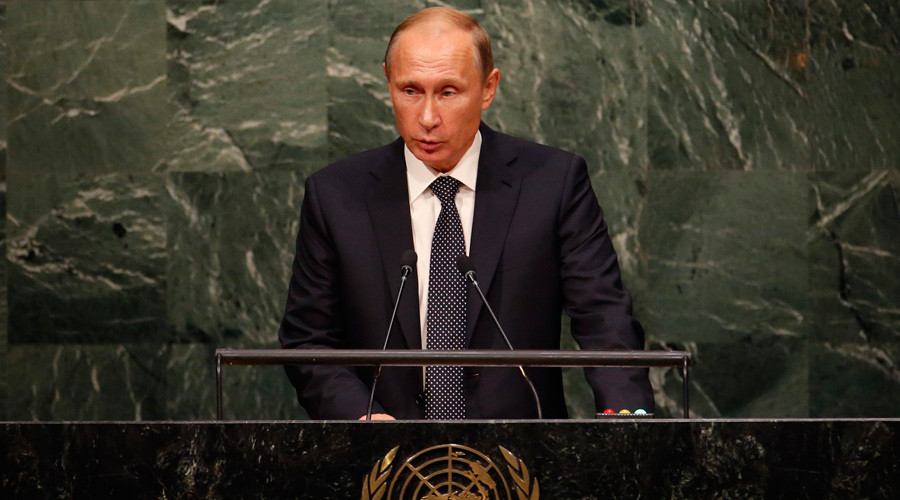
The export of the so-called democratic revolutions continues, as the international community fails to learn from mistakes, which have already been made, Russian President Vladimir Putin said addressing the UNGA.

He cited the example of the revolutions in the Middle East, when people wished for change, “but how did that turn out?”

He said that instead of triumph of democracy “we have violence and social disaster,” where no one cares about human rights, including the right to life.

Actions carried out without a UN mandate could destroy the system of international relations, Putin said in his address.

“Russia is ready to work on the basis of broad consensus on the further development of the United Nations with all partners. But we believe that attempts to undermine the authority and legitimacy of the United Nations are extremely dangerous. This can lead to the collapse of the entire architecture of international relations,” Putin said.

In this case there would be no other rules left “but the rule of force,” he warned. The world would be dominated by “selfishness rather than collective work” and characterized by “dictate rather than equality.”

Putin said that the power vacuums in the Middle East and North Africa regions have led to the emergence of extremists. The Islamic State militants (IS, formerly ISIS/ISIL), who gained foothold in Iraq and Syria, are now seeking to dominate in the whole Islamic world, he said. Some of them have defected from the ‘moderate’ opposition in Syria, who has been supported by some Western states, he stressed.

ISIS trains militants from many nations, including Europe, and Russia is not an exception, he said. Putin urged to cooperate with the Syrian government forces fighting terrorists on the ground.

“We think it is an enormous mistake to refuse to cooperate with the Syrian government and its armed forces who are valiantly fighting terrorism face to face,” he said.

“We should finally acknowledge that no one but President Assad’s armed forces and [Kurdish] militia are truly fighting Islamic State and other terrorist organizations in Syria,” he added.

Source: RT

Berlusconi visits Putin in Crimea

Former Italian prime minister Silvio Berlusconi became the most prominent Western politician to visit Russian-annexed Crimea when he strolled beside the Black Sea on Friday with Russian President Vladimir Putin.

Western visitors have been rare since Russia seized Crimea from Ukraine in March 2014. The takeover drove relations between Moscow and the West to their lowest point since the Cold War era, and prompted the United States and European Union to slap economic sanctions on Russia.

Putin and Berlusconi, known for their warm rapport going back more than a decade, laid flowers at a monument commemorating soldiers who fell in a 19th century war over Crimea. They included troops of the Kingdom of Sardinia, part of modern-day Italy.

Short footage run by Russia’s state TV broadcaster showed Putin telling Berlusconi he wanted to find out the names of the Italian soldiers and imprint them on the memorial.

As part of a joint two-day tour of Crimea, the two men then sat down in an open-air restaurant for a meeting with local residents of Italian origin.

A crowd of several hundred along the way cheered Berlusconi and Putin, who at one point took a small girl in his arms. Both took pictures with residents.

Source: Reuters

Poland slams new Russian-German pipeline

Poland’s conservative president on Tuesday slammed a deal between Russia’s Gazprom energy giant and several leading Western firms to build a second gas pipeline under the Baltic Sea, saying it ignores Polish interests.

“Considering that an agreement was concluded on building Nord Stream-2, which completely ignores Polish interests, one must seriously question unity” in the 28-member European Union, President Andrzej Duda told delegates to an economic forum in the southern Polish mountain resort of Krynica, dubbed Central Europe’s “Davos”.

In June, Gazprom agreed with Anglo-Dutch Shell, Germany’s E.ON and Austria’s OMV to build the new gas pipeline – dubbed Nord Stream-2 – to Germany, bypassing conflict-torn Ukraine but also EU neighbour Poland.

The route under the Baltic Sea from Russia would have a capacity of 55 billion cubic metres per year and would double the flow of the existing Nord Stream pipeline currently linking the two countries.

No timeframe was given for the deal that will boost Germany as a distribution hub for Russian gas in Western Europe but undermines Poland’s role as a transit state.

Polish politicians from across the political spectrum have long opposed Nord Stream, claiming it undermines Poland’s energy security stemming from its role as a transit country for Russian gas via the Yamal-Europe pipeline.

The Nord Stream-2 announcement comes as Moscow seeks more gas delivery routes to the EU that bypass Ukraine, despite the EU’s insistence that it wants to cut its dependence on Russia.

Russia and the West are locked in a bitter standoff over the Kremlin’s role in Ukraine and a gas dispute between Kiev and Moscow has threatened energy supplies to the EU.

Source: AFP

Is Europe doomed as Gadaffi promised?

As Europe’s migrant crisis grows far and wide, many Russian media are recalling the late Libyan leader Muamar Gaddafi’s gloom prophecy made several months before his violent death. “Now listen you, people of NATO. You’re bombing a wall which stood in the way of African migration to Europe, and in the way of Al-Qaeda terrorists. This wall was Libya. You‘re breaking it. You’re idiots, and you will burn in Hell for thousands of migrants from Africa and for supporting Al-Qaeda. It will be so. I never lie. And I do not lie now,” said Gaddafi in an open letter obtained by the Russian daily Zavtra and published in May 2011 several months before the Lybian leader was killed.

Since the beginning of the year 500,000 refugees have arrived in Europe. The migrant crisis has become number one priority for the EU countries, European Commission President Jean-Claude Juncker told the European Parliament in his annual message regarding the state of affairs in the European Union.

“It is Europe today that represents a beacon of hope, a haven of stability in the eyes of women and men in the Middle East and in Africa. That is something to be proud of and not something to fear,” said Juncker.

The question what caused the migrant crisis in Europe has evoked a deluge of comments from the expert community and Russian society in general. Europe is about to lose its reputation of the most stable place in the world, largely because the leading European countries and the United States have been shaking loose the regimes precisely in those countries whose people are now storming railway stations in the EU, experts say.

“That the refugee crisis is an outcome of US-European policies is clear to the naked eye,” says senior research fellow Boris Dolgov, of the Oriental Studies Institute under the Russian Academy of Sciences. “The destruction of Iraq, the destruction of Libya and attempts to topple Bashar Assad in Syria with the hands of Islamic radicals — that’s what EU and US policies are all about, and the hundreds of refugees are a result of that policy,” he told TASS.

“It’s a very serious and multi-faceted problem,” Professor Irina Zvyagelskaya, of the oriental studies department at the Moscow state institute of international relations MGIMO, told TASS. “The civil war in Syria and tensions in Iraq and Libya keep fueling the flow of migrants, but that is not the only cause. I agree with those who see the current events as a trend towards another mass resettlement of peoples, which leave the weaker countries with ineffective economies. There are systemic problems that cause people to abandon their homes and take to the road. And the liberal European legislation allows many of them to not only stay in Europe, but also to live there on social benefits without seeking employment.”

“These people are exhausted, angry and humiliated. They have no idea of European values, lifestyles and traditions, multi-culturalism or tolerance. They will never agree to abide by European laws,” says Russian author, playwright and stage director Yevgeny Grishkovets in his blog. “They will never feel grateful to the people whose countries they have managed to get into with such problems, because the very same states first turned their own home countries into a bloodbath.”

“Angela Merkel vows modern German society and Europe are prepared for problems… That’s a lie and nonsense! I am certain that many of those in France, Italy and Germany, who are pretending compassion and shaking their heads in bewilderment at the news more migrants have drowned or died of suffocation or fatigue on the way, in reality are saying to themselves something like this: ‘This serves them right! That will teach others a lesson!” says Grishkovets.

Columnist and blogger Vitaly Tretyakov wonders why the European Union has walked into this trap which it will never be able to get out of.

“The reasons are many, but all of them are confined to arrogance and exaggerated self-confidence. In most cases this high-handedness is never expressed aloud, but the ‘Europeans’ always feel superiority over everybody else in this world.”

“It remains to be seen whether the European Union succumbed to Washington’s pressures or preferred to manifest solidarity with the United States when it decided to speed up the so-called ‘process of democratization’ in North Africa and the Middle East. Whatever the case, by doing so it helped thrust open Pandora’s Box. Now a vast territory has plunged into civil wars and armed chaos and millions of refugees were forced to flee for life,” Tretyakov said.

Source: TASS

Russia to redouble efforts to honor victims of Stalinism

The government of Russia has announced a sweeping new policy commemorating the victims of past repressions during the era of the Soviet Union.

Not that you’ll hear about in the Western press which will continue to insist Putin sees Stalin as a role model and would like to rehabilitate Stalinism.

The ‘State Policy on Commemorating the Memory of Victims of Political Repression’ was signed by Prime Minister Dmitry Medvedev on August 15 and published on the government’s website on August 18. The announcement by the Ministry of Justice of the Russian Federation is here in English and is reproduced below.

The policy was developed by order of President Vladimir Putin, the presidential administration and the Human Rights Council. The HRC requested its formulation in a meeting with the president last October.

The Russian news agency TASS publishes a commentary on the policy on August 19 by Lyudmila Alexandrova.

The writer cites the government document: “Russia cannot become a full-fledged state ruled by law or occupy a leading position in the world community unless it memorializes the millions of its citizens who perished during the years of political repressions.”

Alexandrova continues:

The document sets out the task of laying down the conditions for free access to archival materials and for educational and informative programmes related to repressions and their inclusion in TV and radio schedules as well as in the curricula of secondary schools.

The document envisions a network of museums and memorial sites, creation of an all-Russia Memory Book and identification of mass burials of those purged in the epoch of political repressions.

In addition to it, results of a competition for the best conception of an all-Russia monument to the victims of repressions will be summed up on October 30 when the nation marks the Day of Memory of Political Repression Victims, which will also be erected at the President’s instruction.

Publication of this concept crowns four years of efforts on the part of the Presidential Council for Human Rights and the Kremlin Administration, Rossiyskaya Gazeta daily quotes Sergei Krivenko, a members of the board of the Memorial International Society.

Source: newcoldwar.org

Lavrov calls Saudi diplomat imbecile

Russia’s Foreign Minister Sergei Lavrov prompted a wave of social media buzz this week after being filmed swearing under his breath during a press conference in Moscow with his Saudi counterpart.

Lavrov and Foreign Minister Adel al-Jubier met Tuesday to discuss how to resolve the worsening Syrian civil war, and the fate of President Bashar al-Assad.

The two men disagreed how to deal with the embattled president, as Russia believes Assad, an ally of President Vladimir Putin, should be involved in a coalition against the Islamic State, but Saudi Arabia wants him removed from power.

While the Saudi top diplomat spoke, Lavrov was seen shaking his head, adjusting his glasses, and muttering to himself, “[expletive] imbeciles,” according to translators.

Lavrov said the two top diplomats agreed on steps to help the Syrian government and opposition groups discuss the future of the country.

Russian and Iranian officials are persuading Saudi Arabia and the United States to realize that fighting terrorism in the region is more important than ousting Assad, The New York Times reported this week.

Jubeir insisted after his meeting with Lavrov that “there is no place for Assad in the future of Syria.”

According to United Nations estimates, the Syrian civil war has killed over 200,000 people since it began over four years ago.

The former U.S. Ambassador to Russia Michael McFaul tweeted Wednesday: “Really? And he used to accuse me of undiplomatic language.”

Source: UPI

Report suggests Russia and NATO are preparing for war

Russia and NATO are actively preparing for war with one another amid the greatest build up of military tension in Europe since the end of the Cold War, a new report says.

Rival exercises by the Russian armed forces and Nato have led to several near-miss incidents that could result in confrontation between the two sides, and leaders need to consider a new arms control treaty to avert the possibility of heightened tensions spilling into war.

The report by the European Leadership Network, a think tank, comes amid the most intense fighting for six months in eastern Ukraine and as Michael Fallon, the defence minister, pledged to expand a British army training mission to Ukraine.

“We do not suggest that the leadership of either side has made a decision to go to war or that a military conflict between the two is inevitable, but that the changed profile of exercises is a fact and it does play a role in sustaining the current climate of tensions in Europe,” the authors write.

The report outlines how both Nato and Russia have primed their forces to respond to an escalation since the Ukraine crisis erupted in early 2014.

The preparations include major military exercises by both Russia and Nato that appear designed exclusively to respond to one another’s capabilities and potential war plans.

”Whilst spokespeople may maintain that these operations are targeted against only hypothetical opponents, the nature and scale of the operations indicate otherwise,” the report writers say.

In March 2015, Russian conducted “snap exercises” that saw 80,000 troops engaged in long-range deployments and simulate combat on a scale that made the United States or Nato the only possibly adversary.

Nato’s exercise “Allied Shield,” in June this year, saw 15,000 allied troops engaged in a series of mock operations including response to a Crimea-style infiltration of irregular forces.

In both cases, the report writers find, the exercises focused on what the two sides perceive to be their most vulnerable areas, with and Nato moving to defend the Baltic States and Russia rushing reinforcements to the Arctic, its Baltic enclave of Kaliningrad, occupied Crimea, and Sakhalin island in the far east.

Allied Shield also included the first deployment of the Very High Readiness Taskforce, a rapid-reaction unit established at the Nato summit in Wales in 2014 in response to the annexation of Crimea.

The exercise, called ‘Noble Jump’, deployed 2,100 troops in a simulated a response to ‘unattibutable infiltration by an ally by irregular or special forces’ – essentially the scenario seen in Crimea and Eastern Ukraine since Early 2014.

The report recommends improvements in Nato-Russian communication to avert near misses and suggests working on a new arms treaty to restrict the use of conventional forces in Europe.

“If Russia or NATO decides at some point that they want to reduce tensions, showing restraint in terms of size or scenarios used for the exercises might be a good place to start,” the report writers conclude.

Source: The Telegraph

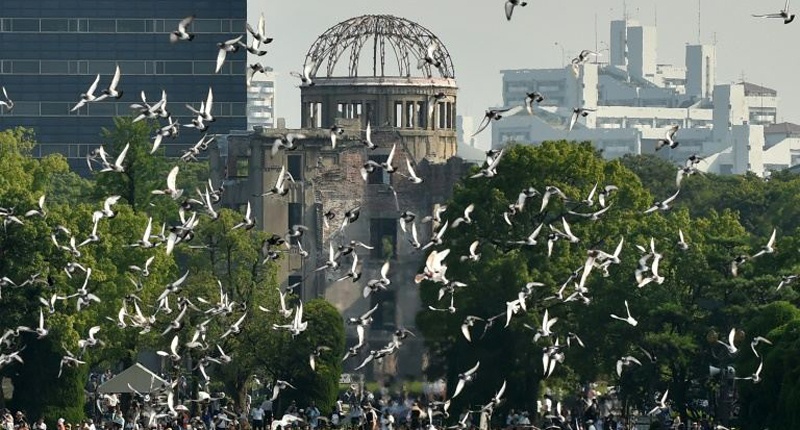
Hiroshima: Killing on an industrial scale

It has been 70 years since the United States became the only nation in history that deployed two nuclear weapons against civilian populations.

On August 6, 1945, a B-29 known as the Enola Gay took off from Tinian island, north of Guam. After flying six hours to the main Japanese island of Honshu, pilot Paul Tibbets flew his aircraft over the city of Hiroshima released «Little Boy», an atomic bomb with the explosive power of 16 kilotons of TNT.

Together two bombs eventually killed an estimated 200,000 Japanese civilians.

Little already remained of Tokyo long before the attacks on Hiroshima and Nagasaki. Hiroshima was one of the largest military centers provisioning the Japanese army and navy.

Originally the chosen targets for the attack were Niigata (a military base and industrial center), Yokohama (an industrial center), Kokura (which held the largest arsenal and warehouse), and Kyoto (also an industrial center).

Nagasaki was a haphazard target. The plane originally flew to Kokura, but because of cloud cover it was unable to release its payload and it turned toward Nagasaki instead.

Within a week of each nuclear attack, thousands who had escaped death began to experience inexplicable combinations of symptoms: high fever, dizziness, nausea, headaches, diarrhea, bloody stools, nosebleeds and whole-body weakness. Their hair fell out in large clumps, their wounds secreted extreme amounts of pus, and their gums swelled and bled.

Purple spots appeared on their bodies, signs of hemorrhaging beneath the skin. Infections ravaged their internal organs. Within a few days of the onset of symptoms, many people lost consciousness, mumbled deliriously and died in extreme pain; others languished for weeks before either dying or slowly recovering.

Even those who had suffered no external injuries fell sick and died. In the ruins of his small tuberculosis hospital in Nagasaki, Dr. Tatsuichiro Akizuki likened the situation to the Black Death pandemic that ravaged Europe in the 1300s.

A second wave of radiation illnesses and deaths swept through Nagasaki in late August through early October. From Akizuki’s perspective on top of Motohara Hill, the illness carved a clear geographical path: From the bottom of the hill upward, people died in order of their distance from the bomb’s hypocenter. Akizuki called this phenomenon the “concentric circles of death.”

By February 1945, Russia and Japan were on the same page and proposed a Far East peace conference that would include Russia, China, Great Britain, the United States, France, and Japan. Japan wrongly believed that Russia would not enter the Pacific war on the side of the Allies.

The USSR’s entry into the war against Japan on Aug. 9, 1945 had a decisive impact on Japan’s decision to capitulate. When the fate of the Kwantung command was almost a foregone conclusion, Emperor Hirohito decided to surrender after panicked reports from his military commanders in Manchuria.

Immediately after the bombings, high-level U.S. officials publicly — and adamantly — rebuffed news reports about the bombs’ horrific aftereffects. Gen. Leslie Groves, director of the Manhattan Project, which developed the atomic bombs, dismissed these reports as propaganda.

Later that year, Groves testified before the U.S. Senate that death from high-dose radiation exposure is “without undue suffering” and “a very pleasant way to die.”

Killing had become possible on an industrial scale by WWII with rifles and machine guns mass-produced in factories, as well as a wide range of products needed to support multimillion-man armies.

Destroying cities was thus the key to winning wars and an integral part of Allied strategy against Germany and in Japan. For Japan the aftermath of bombing Hiroshima and Nagasaki was as calamitous as the fate of Dresden and Hamburg.

Another wall goes up in Europe

Nearly three decades after US President Ronald Reagan issued his much-celebrated challenge to Soviet leader Mikhail Gorbachev to tear down the Berlin Wall, some Eastern European countries have once again begun floating the idea of building up walls in Europe, this time to keep people out. Latvia is the latest country to jump on the bandwagon.

Speaking to Latvian television on Monday, Latvian Internal Affairs Minister Rihards Kozlovskis noted that Latvia would need “four years and 17 million euros in order to fence itself off from Russia via a wall.”

Kozlovskis emphasized that the wall has been made a necessity by the growing influx of illegal immigrants from Central Asia and the Far East who are using Russia as a transfer point on their way to Scandinavia. According to Radio Poland, 239 illegal immigrants have been detained by Latvian border services since the beginning of 2015, 160 of them from Vietnam, and 20 from Afghanistan.

The minister noted that the proposed wall’s price tag should be taken into account by the country’s government in planning for the country’s next budget.

Latvia far from being alone among European nations in its plans to build security walls to keep illegal immigrants out, even if its location next to the Russian border might seem like an odd choice, to say the least.

The Bulgarian government has recently extended its advanced network of border fencing with Turkey, aimed at completely sealing off the border with the Middle Eastern country.

Hungary has also received a lot of flak for passing a law enabling the construction of a metal fence along its border with Serbia, critics dubbing the project a new ‘iron curtain’.

Source: Sputniknews

Russians hack US Joint Chiefs of Staff

Investigators say they believe the same Russian hackers that carried out attacks on the White House and State Department last year and the attempted penetration of the Pentagon last month were responsible for a major cyberattack that shut down the Joint Chiefs of Staff email for the past 11 days, The Daily Beast has learned.

In all of the attacks, hackers broke into unclassified email networks by sending legitimate-looking emails than turned out to be malware or “spear phishing” attempts. In April, President Obama’s unclassified emails were among those compromised, along with the State Department.

Ten days before the July 27 hacking of the Joint Staff system, the Pentagon sent an email warning “at least five” DOD computer users had been targeted, which was first reported by The Daily Beast. The notice linked those attacks to penetrations of unclassified networks at the White House and State Department that began last year.

The Joint Chiefs then suffered what one defense official called the “most sophisticated” attack on its unclassified network, one that has shut down communications ever since for the 4,000 employees on the Joint Staff unclassified server.

Source: Daily Beast

SA swimmer breaks world record

South Africa’s Cameron van der Burgh set a world record for the men’s 50 metres breaststroke in the qualifying heats at the world swimming championships in Kazan, Russia on Tuesday.

The defending champion’s time of 26.62 seconds broke his previous mark of 26.67 seconds, set at the world championships in Rome in 2009.

Source: Reuters

‘Crimea was annexed’ narrative falls apart

A group of Italian MPs announced plans to travel to Crimea less than a week after a delegation of French lawmakers visited the Black Sea peninsula late last week.

When will we see a delegation of US lawmakers take a trip to Crimea?

We guess never, as that would totally torpedo the entire US government, military, NATO and media narrative for Ukraine, and reveal yet another US failed regime change operation where Putin outplayed Obama to secure the prize that is Crimea.

Now America is stuck paying for a colony that is of no value to its military imperial needs.

Via Sputnik News Agency:

The eight- to ten-strong Italian delegation will be led by a member of the parliament’s Foreign Relations committee Alessandro di Battista, Kommersant newspaper reported, citing one of the visit’s organizers, Manlio Di Stefano who represents the Five Stars movement in the Italian legislature.

Senator Sergio Divina of the anti-EU Northern League party also plans to make the trip, scheduled for early October.

Márton Gyöngyösi, the deputy leader of the nationalist Jobbik party’s Parliamentary Group and Vice-Chairman of the Foreign Affairs Committee of the Hungarian National Assembly also intends to visit Crimea. He expects the exact date of the visit to be confirmed “in the coming weeks.”

A delegation of ten French parliamentarians visited Crimea last week holding a series of meetings with local residents and officials in Simferopol, Sevastopol and Yalta.

The Ukrainian Foreign Ministry slammed the visit as a “show of disrespect for Ukraine’s sovereignty and a blatant violation of Ukrainian law.”

The French Foreign Ministry described the MPs’ trip to the peninsula as a violation of international law.

Source: redpilltimes.com