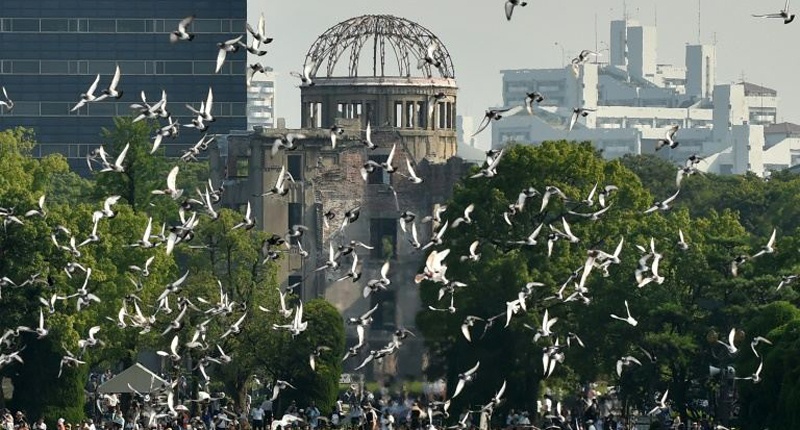
Hiroshima: Killing on an industrial scale

It has been 70 years since the United States became the only nation in history that deployed two nuclear weapons against civilian populations.

On August 6, 1945, a B-29 known as the Enola Gay took off from Tinian island, north of Guam. After flying six hours to the main Japanese island of Honshu, pilot Paul Tibbets flew his aircraft over the city of Hiroshima released «Little Boy», an atomic bomb with the explosive power of 16 kilotons of TNT.

Together two bombs eventually killed an estimated 200,000 Japanese civilians.

Little already remained of Tokyo long before the attacks on Hiroshima and Nagasaki. Hiroshima was one of the largest military centers provisioning the Japanese army and navy.

Originally the chosen targets for the attack were Niigata (a military base and industrial center), Yokohama (an industrial center), Kokura (which held the largest arsenal and warehouse), and Kyoto (also an industrial center).

Nagasaki was a haphazard target. The plane originally flew to Kokura, but because of cloud cover it was unable to release its payload and it turned toward Nagasaki instead.

Within a week of each nuclear attack, thousands who had escaped death began to experience inexplicable combinations of symptoms: high fever, dizziness, nausea, headaches, diarrhea, bloody stools, nosebleeds and whole-body weakness. Their hair fell out in large clumps, their wounds secreted extreme amounts of pus, and their gums swelled and bled.

Purple spots appeared on their bodies, signs of hemorrhaging beneath the skin. Infections ravaged their internal organs. Within a few days of the onset of symptoms, many people lost consciousness, mumbled deliriously and died in extreme pain; others languished for weeks before either dying or slowly recovering.

Even those who had suffered no external injuries fell sick and died. In the ruins of his small tuberculosis hospital in Nagasaki, Dr. Tatsuichiro Akizuki likened the situation to the Black Death pandemic that ravaged Europe in the 1300s.

A second wave of radiation illnesses and deaths swept through Nagasaki in late August through early October. From Akizuki’s perspective on top of Motohara Hill, the illness carved a clear geographical path: From the bottom of the hill upward, people died in order of their distance from the bomb’s hypocenter. Akizuki called this phenomenon the “concentric circles of death.”

By February 1945, Russia and Japan were on the same page and proposed a Far East peace conference that would include Russia, China, Great Britain, the United States, France, and Japan. Japan wrongly believed that Russia would not enter the Pacific war on the side of the Allies.

The USSR’s entry into the war against Japan on Aug. 9, 1945 had a decisive impact on Japan’s decision to capitulate. When the fate of the Kwantung command was almost a foregone conclusion, Emperor Hirohito decided to surrender after panicked reports from his military commanders in Manchuria.

Immediately after the bombings, high-level U.S. officials publicly — and adamantly — rebuffed news reports about the bombs’ horrific aftereffects. Gen. Leslie Groves, director of the Manhattan Project, which developed the atomic bombs, dismissed these reports as propaganda.

Later that year, Groves testified before the U.S. Senate that death from high-dose radiation exposure is “without undue suffering” and “a very pleasant way to die.”

Killing had become possible on an industrial scale by WWII with rifles and machine guns mass-produced in factories, as well as a wide range of products needed to support multimillion-man armies.

Destroying cities was thus the key to winning wars and an integral part of Allied strategy against Germany and in Japan. For Japan the aftermath of bombing Hiroshima and Nagasaki was as calamitous as the fate of Dresden and Hamburg.
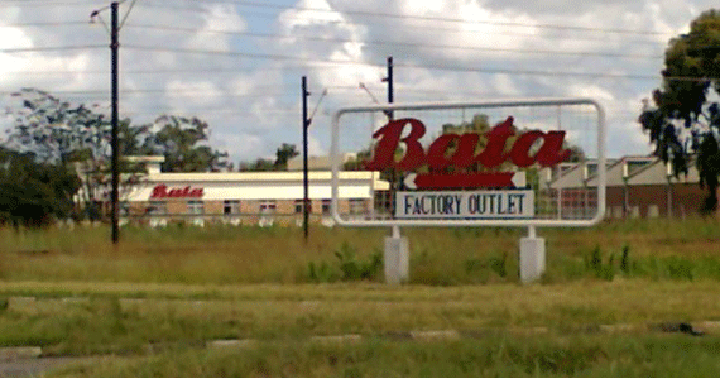
Zimbabwe’s factories grinding to a halt due to mandatory black ownership

The Bata shoe factory in Gweru, Zimbabwe

by Chris Chinaka

Across Zimbabwe, dozens of factories lie idle with peeling paint, rusting machines and broken roofs in once bustling industrial districts, symbols of the huge economic challenge facing President Robert Mugabe and his ZANU-PF party.

On the surface, things look rosy after Mugabe’s landslide election victory in July: growth forecasts are looking more positive as agriculture recovers, inflation has been tamed and the stock market is starting to buzz again after some listless post-election trading.

But look behind the headlines and the landlocked southern African nation’s manufacturing heartlands, which accounted for a quarter of the economy a generation ago, are now wastelands – and some fear the decay is permanent.

From Harare in the north to the second city of Bulawayo in the south, companies are working at a third of capacity, down from 55 percent a year ago, according to the Confederation of Zimbabwe Industries (CZI).

“Businesses are collapsing, and the economy will need a real big push-start to get going again,” said an accountant winding down tube-making firm BMA Fasteners and Tube and Pipe in Harare. He declined to be named for professional reasons.

“At this rate, it’s frightening to think what the future holds,” the 42-year-old said, scratching his head. “I don’t think it is an exaggeration to say it might just be hell.”

Although they are careful not to blame politics, industry bosses say business confidence has fallen since the 89-year-old Mugabe was declared the overwhelming victor in the July 31 election, which the opposition MDC rejected as rigged.

New finance minister Patrick Chinamasa expects the economy to grow 6.1 percent in 2014 from 3.4 percent this year but that will make no dent in unemployment estimated at over 80 percent.

Zimbabwe’s economy shrank by 45 percent during a decade-long crisis blamed on ZANU-PF, but bounced back in 2009 after Mugabe was forced to share power with arch rival Morgan Tsvangirai after violent and disputed elections the previous year.

The July election put paid to that coalition, and with it what some critics saw as the MDC’s moderating influence on Mugabe and ZANU-PF nationalism.

FOREIGN INVESTMENT

In its most blatant form, that nationalism was manifest in Mugabe’s “indigenisation” push, under which foreign-owned firms have been forced to sell majority stakes to local blacks.

However, with the economy so desperate for capital – some estimates put domestic credit demand at $12 billion, more than double total bank deposits – Mugabe may be forced to soften his anti-foreigner stance.

“We are likely to see a more pragmatic approach by the politicians,” said Grant Flanagan of Amigo Partners, which manages a Zimbabwe-focused investment fund, noting some faint signs of a softening of policy.

Most notably, in his new cabinet, Mugabe swapped combative indigenisation minister Saviour Kasukuwere for a mild-mannered technocrat who has already suggested the government is open to discussion about the extent and timing of black ownership.

However, there are no details and when asked by Reuters about indigenisation, another member of the government, Industry and Commerce minister Mike Bimha, declined to discuss something he said was outside his remit.

Without a decent period of clarity and consistency, investors are unlikely to be writing any cheques.

“ZANU-PF must realise they are in trouble over the economy,” independent economic commentator John Robertson said. “Investors, particularly in mining, where they have an opportunity, will want to see whether there really is any softening. If there is, then definitely the economy stands some chance.”

DAUNTING CHALLENGE

Even then, turning the ship round will be difficult.

The African Development Bank estimates that fixing the infrastructure needs $14 billion, a sum that in reality can only be met by the World Bank and IMF, which stopped lending to Harare in 1999 because of unpaid debts.

Private investors will then have to address a manufacturing vacuum filled by cheap imports, mostly from China.

Nowhere is the evidence more glaring than at David Whitehead, a large textile firm that used to employ 2,500 people in Chegutu, 100 km (60 miles) southwest of Harare, but which collapsed two years ago and stands empty today.

A handful of people are contracted to maintain machinery. Most of the time, only a couple of guards are on patrol.

Elsewhere, the factory sector built during the years of isolation imposed on white-minority Rhodesia has lost makers of everything from shoes to medicines, carpets to building materials and chemicals to food.

In 1986 manufacturing contributed 26 percent of GDP. Today it is just over 2 percent.

The industrial graveyard includes Ziscosteel, once the largest integrated steel works in the region, which shut in 2008 due to what analysts said was gross mismanagement and a failure by the state-owned firm to upgrade its equipment.

The government has been struggling to revive it with a number of foreign firms, including lately Essar from India.

“There is a long way to go and the starting point for our companies is retooling. There is no other way. There is idealism, and then there is reality,” says economist Prosper Chitambara, a leading private economic consultant.

WAIT AND SEE

The Harare tube firm, which used to employ 300 people, says it was a victim of a range of factors – price controls, foreign currency problems, power cuts, and then cheaper imports from India and China.

“Everything that could go wrong went wrong,” said the accountant in charge of its burial rites.

For ZANU-PF, the absence of the MDC as a coalition partner means it has no-one to blame and nowhere to hide.

Robert Mugabe taking a nap

After the July election, it launched a Zimbabwe Agenda for Sustainable Social Economic Transformation, although the document was culled from the black empowerment parts of its manifesto, leading many to see it as more of the same from a party well-known for its empty economic blueprints.

However, aides say Mugabe himself is taking greater interest in the economy in a bid to rebuild a legacy tarnished by the hardships and hyperinflation of the last 13 years.

A glimmer of hope lies in tobacco farming, where state and private support for small-scale farmers is expected to push production to 200,000 tonnes from 45,000 in 2008, the pit of a slump blamed on Mugabe’s seizures of white commercial farms.

Many also see huge potential in mining and diamonds if the government can assuage concerns over forced sales of stakes to locals.

“We have to wait and see,” said the security guard manning the entrance to the David Whitehead factory in Chegutu, echoing a refrain heard in boardrooms from Harare to Johannesburg, London and New York. – Reuters

(Additional reporting by Pascal Fletcher in Johannesburg; Editing by Ed Cropley and Giles Elgood)