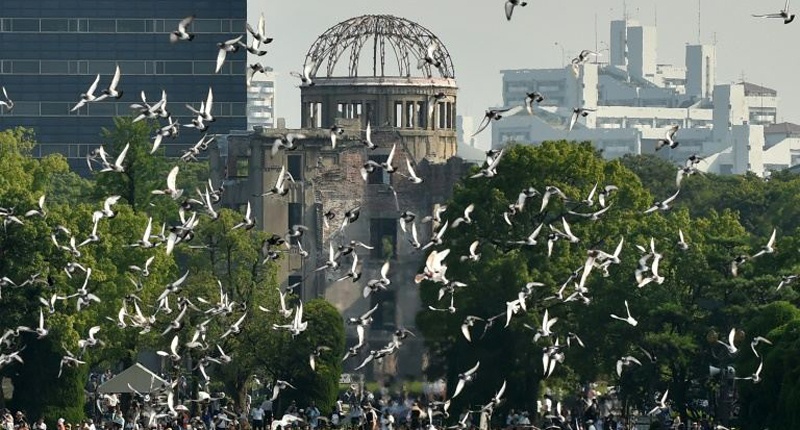
Hiroshima: Killing on an industrial scale

It has been 70 years since the United States became the only nation in history that deployed two nuclear weapons against civilian populations.

On August 6, 1945, a B-29 known as the Enola Gay took off from Tinian island, north of Guam. After flying six hours to the main Japanese island of Honshu, pilot Paul Tibbets flew his aircraft over the city of Hiroshima released «Little Boy», an atomic bomb with the explosive power of 16 kilotons of TNT.

Together two bombs eventually killed an estimated 200,000 Japanese civilians.

Little already remained of Tokyo long before the attacks on Hiroshima and Nagasaki. Hiroshima was one of the largest military centers provisioning the Japanese army and navy.

Originally the chosen targets for the attack were Niigata (a military base and industrial center), Yokohama (an industrial center), Kokura (which held the largest arsenal and warehouse), and Kyoto (also an industrial center).

Nagasaki was a haphazard target. The plane originally flew to Kokura, but because of cloud cover it was unable to release its payload and it turned toward Nagasaki instead.

Within a week of each nuclear attack, thousands who had escaped death began to experience inexplicable combinations of symptoms: high fever, dizziness, nausea, headaches, diarrhea, bloody stools, nosebleeds and whole-body weakness. Their hair fell out in large clumps, their wounds secreted extreme amounts of pus, and their gums swelled and bled.

Purple spots appeared on their bodies, signs of hemorrhaging beneath the skin. Infections ravaged their internal organs. Within a few days of the onset of symptoms, many people lost consciousness, mumbled deliriously and died in extreme pain; others languished for weeks before either dying or slowly recovering.

Even those who had suffered no external injuries fell sick and died. In the ruins of his small tuberculosis hospital in Nagasaki, Dr. Tatsuichiro Akizuki likened the situation to the Black Death pandemic that ravaged Europe in the 1300s.

A second wave of radiation illnesses and deaths swept through Nagasaki in late August through early October. From Akizuki’s perspective on top of Motohara Hill, the illness carved a clear geographical path: From the bottom of the hill upward, people died in order of their distance from the bomb’s hypocenter. Akizuki called this phenomenon the “concentric circles of death.”

By February 1945, Russia and Japan were on the same page and proposed a Far East peace conference that would include Russia, China, Great Britain, the United States, France, and Japan. Japan wrongly believed that Russia would not enter the Pacific war on the side of the Allies.

The USSR’s entry into the war against Japan on Aug. 9, 1945 had a decisive impact on Japan’s decision to capitulate. When the fate of the Kwantung command was almost a foregone conclusion, Emperor Hirohito decided to surrender after panicked reports from his military commanders in Manchuria.

Immediately after the bombings, high-level U.S. officials publicly — and adamantly — rebuffed news reports about the bombs’ horrific aftereffects. Gen. Leslie Groves, director of the Manhattan Project, which developed the atomic bombs, dismissed these reports as propaganda.

Later that year, Groves testified before the U.S. Senate that death from high-dose radiation exposure is “without undue suffering” and “a very pleasant way to die.”

Killing had become possible on an industrial scale by WWII with rifles and machine guns mass-produced in factories, as well as a wide range of products needed to support multimillion-man armies.

Destroying cities was thus the key to winning wars and an integral part of Allied strategy against Germany and in Japan. For Japan the aftermath of bombing Hiroshima and Nagasaki was as calamitous as the fate of Dresden and Hamburg.

Iran urges Israel to give up nuclear weapons

Iran has demanded that Israel give up its nuclear weapons, as it spoke on behalf of the 120-nation Non-Aligned Movement. Iran’s Foreign Minister, Mohammad Javad Zarif said the bloc also wants a nuclear free-zone in the Middle East.

Mohammad Javad Zarif was speaking at the United Nations for the non-aligned group of countries. Israel has never admitted or denied the widespread assumption it has nuclear weapons. However, Zarif says Israel’s assumed nuclear arsenal was a threat to regional security.

The Iranian Foreign Minister said the non-aligned movement regards Israel’s nuclear program as, “a serious and continuing threat to the security of neighboring and other states, and condemned Israel for continuing to develop and stockpile nuclear arsenals,” according to Reuters.

Israel has not signed up to the nuclear Non-Proliferation Treaty (NPT), though it has sent an observer to the month long conference for the first time in 20 years.

Zarif added that the non-aligned bloc are looking to create a nuclear free-zone in the Middle East “as a matter of high priority,” which will only be possible, if Israel abandons its nuclear stockpile.

“Israel, [is] the only one in the region that has neither joined the NPT nor declared its intention to do so, (…) renounce possession of nuclear weapons,” AFP cited Zarif as saying.

‘Israel should nuke Germany and Iran’

An Israeli newspaper, Israel National News, published an opinion piece on Tuesday in which it called for Israel to attack Germany and Iran with nuclear bombs. The article claims that only through the nuclear annihilation of Germany and Iran, with 20 or 30 nuclear bombs, can Israelis prevent destruction of the state.

„If Israel does not follow the way of the Torah, it will be almost completely destroyed by a severe punishment and only a few will survive“ writes Chen Ben-Eliyahu, the author of the piece, in Hebrew.

Israel must respond in kind in order to prevent this. “We must answer an existential threat with an existential threat”; he writes, “not with speeches to the US-Congress. We must make it clear to the Iranians that Israel will wipe out their nuclear program and Teheran and Isfahan as well.

“If an enemy sets out to destroy you, then you must destroy him first. Twenty or thirty nuclear bombs will get the job done”, he explains.

He reminds the Israelis of their near destruction at the hands of the Nazis and calls for revenge on Germany, although the German government is now, next to the US, Israel’s biggest supporter.

Ben-Eliyahu demands a turnaround of the „Final Solution“ and writes „twenty to thirty nuclear bombs on Berlin, Munich, Nuremberg, Cologne, Frankfurt, Stuttgart, Dresden, Dortmund and so on will ensure obliteration.” And in allusion to the “Thousand Year Reich” he continues, “afterwards the country will be quiet for a thousand years“.

The editors of the newspaper „Israel National News“ refused to react to queries about why this opinion had been published in the first place. For it is a racist’s expression of pure hate and it incites genocide.

His reasons are anyway based on the lie that Iran has a nuclear weapons program. Such a person should be accused, convicted and imprisoned for sedition and sanctioning nuclear war.

What Chen Ben-Eliyahu admits with his demand for an attack on Iran and Germany with „twenty or thirty nuclear bombs“ is that Israel possesses a nuclear arsenal, a fact which Israeli government has hitherto vehemently denied.

Translated from German

Source: Alles Schall und Rauch

War does not love British PM back

UK Prime Minister David Cameron certainly loves war.

But events in Iran, Libya, Syria and now Ukraine, show that war does not love Cameron back, making him look rather like a dull schoolyard bully, oblivious to how he has actively contributed to global chaos.

Cameron actively supported the 2011 military operation in Libya. Back in 2011, Cameron visited Tripoli with France’s then-President Nicolas Sarkozy to declare victory over Muammar Gaddafi’s regime in what turned out to be premature celebrations with the “rebels”, now known as ISIS.

In a recent interview however, he declared that Libya shouldn’t become a “safe haven for terrorists”, something that Libya clearly has now achieved with Britain’s meddling.

Cameron was left rather red-faced after ISIS attacks killed Coptic Christians in Libya last week.

In Syria, Cameron also supported arming “rebels” in order to attempt to oust President Bashar Assad.

Cameron, while advocating British attacks against the Syrian government, admitted he was not “100 percent certain” that Assad was behind a recent chemical attack, but that it was “highly likely.”

“This is not like Iraq, what we are seeing in Syria is fundamentally different … We are not invading a country,” he insisted. No weapons of mass destruction were ever found in Iraq.

Cameron had been calling for an international rubberstamp from the UN to aid the Syrian “rebels” – aka ISIS – from the early stages of the conflict.

“Every effort should be made to secure a [UN] Security Council Resolution backing military action before any such action is taken,” Cameron said in the speech to the House of Commons in 2013.

But his attempts proved futile, as British MPs effectively ruled out direct involvement in a military campaign in Syria. The Libyan fiasco was apparently still fresh in everyone’s mind.

“Throughout this coalition government, the Conservatives have adopted a less forthright approach to the Middle East conflict, in a way which I believe risks decreasing British influence in the region,” Liberal-Dem coalition partner Nick Clegg then lamented.

Back in 2010, Cameron stated that Iran has a “nuclear weapon,” when asked about why he was backing Turkey’s bid to join the EU. The Mossad, no less, has publicly denied intelligence proving the existence of such a weapon.

Cameron then attempted to pressure the American Congress over sanctions on Iran right ahead of his visit to the US, but Republicans called it an unproductive move.

He responded that Turkey’s accession could “help solve the world’s problems, like the Middle East peace process, like the fact that Iran has got a nuclear weapon.” Perhaps no one had sent him the memo.

With an ugly conflict brewing in Ukraine, Cameron has announced that UK troops will support Kiev with tactical intelligence, training and logistics. The UK will also “be developing infantry program with Ukraine to improve the pure ability of the forces.”

The PM’s most recent warmongering comments come after the Minsk peace talks, in which a ceasefire was agreed upon by the leaders of France, Germany, Russia and Ukraine.

On top of that, Cameron hawkishly called for more sanctions against Russia, in addition to those implemented during the past year.

He is said to be upset by French and German leaders Francois Hollande and Angela Merkel, who are trying to push for a peaceful and diplomatic solution to the conflict.

“We should keep up the pressure [on Russia],” Cameron said, noting that “in this respect the interests of the United Kingdom and democracy do go together.” Vladimir Putin, the most popular president Russia has had in more than a century, was democratically elected, but perhaps Cameron believes “democracy” has several meanings not included in most dictionaries.

Kiev pondering a nuclear option against Russia

Kiev wants to restart its nuclear weapons program if it doesn’t get enough support from the West.

“If we cannot protect Ukraine today, if the world doesn’t help us, we will have to go back to the development of nuclear weapons, which will protect us from Russia,” Ukrainian Defense Minister Valery Geletey said in an interview with Ukrainian TV, also claiming that NATO members have already started supplying Kiev with other weapons.

In the same briefing Geletey mentioned that arms were starting to come in from the NATO alliance. It could add to the fragility of a recent truce.

Slovakia, to some extent the Czech Republic, and Hungary, are said to be worried about these latest remarks.

The American political establishment wants to use Kiev as a spearhead against Russia, and the Atlanticist alliance has not condemned this statement.

Meanwhile Finland will not give up the construction of a nuclear power plant (NPP) in conjunction with Rosatom (Russia’s Federal Agency for Nuclear Power) because of sanctions; there are no differences in the Finnish government over the matter, Finland Prime Minister Alexander Strubb told Radio Suomi in an interview, ItarTASS has reported.

Strubb also emphasized that cooperation between Finland’s power company Fennovoima and Rosatom “will not shake Finland’s reputation”. He said the project for the construction of the NPP is significant to such an extent that “it should not be mixed with politics”.

The Rusatom Overseas Company (a subsidiary of Rosatom) and Fennovoima signed a contracts for the construction of a Hanhikivi-1 NPP at the end of December 2013. A license for building it had been obtained by Fennovoima way back in summer 2010. During the obtaining of the license, the Russian company had not been mentioned as a supplier of reactor. Therefore the Finnish side considered it necessary for the parliament to approve the construction once again a decision to refer the project to the members of parliament is to be made by the government. Besides, simultaneously, Finland’s Ministry of Employment and the Economy and the Radiological Safety Centre are now busy estimating environmental and nuclear safety of the project.

Fennovoima expects that Finnish authorities, upon studying the new elements that appeared in the project, will reaffirm that it fully meets the country’s interests.

US violates Nuclear Nonproliferation Treaty

peacenuclearU.S. military spending is not actually being cut at all, but increasing. Also going up: U.S. nuclear weapons spending. Some of the new nukes will violate treaties, but the entire program violates the Nuclear Nonproliferation Treaty, which requires disarmament, not increased armament. The U.S. policy of first-strike and the U.S. practice of informing other nations that “all options are on the table” also violate the U.N. Charter’s ban on threatening force.

But do nuclear weapons, by the nature of their technology, violate the U.S. Constitution? Do they violate the basic social contract and all possibility of self-governance? Thus argues a new book called Thermonuclear Monarchy: Choosing Between Democracy and Doom by Elaine Scarry. It’s not unheard of for people to see out-of-control nuclear spending as a symptom of out-of-control military spending, itself a symptom of government corruption, legalized bribery, and a militaristic culture. Scarry’s argument suggests a reversal: the root of all this evil is not the almighty dollar but the almighty bomb.

The argument runs something like this. The primary purpose of the social contract is to create peace and prevent war and other injury. The U.S. Constitution (Article I, Section 8, clause 11) bans the making of war without the approval of both houses of Congress. This approval was to be required not just for an existing military to attack another country, but for a military to be raised at all — standing armies not being anticipated. And it was understood that an army would not be raised and deployed into war unless the citizen-soldiers went willingly, their ability to dissent by desertion not needing to be spelled out (or, let us say, their ability to dissent by mass-desertion, as desertion in the war that led to the Constitution was punished by death).

And yet, because this point was so crucial to the entire governmental project, Scarry argues, it was in fact spelled out — in the Second Amendment. Arms — that is 18th century muskets — were to be freely distributed among the people, not concentrated in the hands of a king. “Civilian” control over the military meant popular control, not presidential. The decision to go to war would have to pass through the people’s representatives in Congress, and through the people as a whole in the form of soldiers who might refuse to fight. By this thinking, had the Ludlow Amendment, to create a public referendum before any war, passed in the 1930s, it would have been redundant.

Before the 1940s were over, in Scarry’s view, a Ludlow Amendment wouldn’t have been worth the paper it was written on, as the existence of nuclear weapons erases Constitutional checks on war. With nuclear weapons, a tiny number of people in a government — be it 1 or 3 or 20 or 500 — hold the power to very quickly and easily kill millions or billions of human beings, and other species, and very likely themselves in the process. “We may have democracy, or we may have wealth concentrated in the hands of a few, but we can’t have both,” said Louis Brandeis. We may have democracy, or we may have thermonuclear bombs, but we can’t have both, says Elaine Scarry.

Source: Global Resource

Obama talks to Rouhani

Pres. Rouhani
Pres. Rouhani

President Obama announced today that he talked on the phone with Iranian president Rouhani: “Just now I spoke on the phone with President Rouhani of the Islamic Republic of Iran,” he said. “The two of us discussed our ongoing efforts to reach an agreement over Iran’s nuclear program.”

This is the first time leaders from America and Iran have spoken since 1979.

“I reiterated to President Rouhani what I said in New York. While there will surely be important obstacles to moving forward and success is by no means guaranteed, I believe we can reach a comprehensive solution.

“I’ve directed Secretary Kerry to continue pursuing this diplomatic effort with the Iranian government. We had constructive discussions yesterday in New York with our partners, the European Union, the United Kingdom, France, Germany, Russia, and China, together with the Iranian foreign minister, and going forward, President Rouhani and I have directed our teams to continue working expeditiously in corporation with the P-5 plus one to pursue an agreement. And throughout this process we will stay in close touch with our friends and allies in the region, including Israel.

“Now we are mindful of all the challenges ahead. The very fact that this was the first communication between an American and Iranian president since 1979 underscores the deep mistrust between our countries.”

Obama said that “Iran’s supreme leader has issued a fatwa against the development of nuclear weapons, President Rouhani has indicated that Iran will never develop nuclear weapons.”

“I have made clear that we respect the right of the Iranian people to access peaceful nuclear energy in the context of Iran meeting its obligations. So the test will be meaningful, transparent, and verifiable actions,” said Obama, which could lead to a relaxation of sanctions.

Obama talked of a new relationship between the U.S. and Iran, if his diplomatic efforts succeed. – TWS

Israel owns 80 nukes, can triple number

Dimona
Dimona

Israel has never confirmed or denied possession of nuclear weapons, but according to new report by US experts it has at least 80 operative warheads and has enough material to produce up to 190 more.

In a report published in the Bulletin of the Atomic Scientists, nuclear weapon proliferation experts Robert S. Norris and Hans M. Kristensen assess that Israel stopped producing nuclear warheads back in 2004 once it reached around 80 munitions.

However, the country can easily double its arsenal since it has enough fissile material to build at least another 115 bombs, experts say.

“There are rumors that Israel is equipping some of its submarines with nuclear-capable cruise missiles,” the report says, echoing the 2013 Stockholm International Peace Research Institute yearbook on armament and international security which also suggested Israel could have nuclear-capable submarine-launched cruise missiles and reported the same assessment of nuke stockpiles.

The suspicions were fueled by the fact that Germany supplied Israel with five Dolphin-class submarines, allegedly capable of launching nuclear missiles, and signed a contract to build a sixth.

It remains unknown how many nuclear warheads of the total inventory could already be deployed, as Israel continues to maintain its long-standing policy of nuclear opacity. In December 2012, Israel once again dismissed the latest demand from the members of the Treaty on the Non-Proliferation of Nuclear Weapons to join the accord.

Israeli stockpiles of weapons of mass destruction have come under unusual scrutiny following the US-Russian roadmap for the destruction of Syrian chemical weapons, which is seen as a significant step towards a WMD-free region.

Recently declassified CIA documents suggest that Israel secretly built up its own stockpile of chemical and biological weapons decades ago. This has added more fuel to the lingering complaint of Arab states, who constantly accuse Israel of possessing nuclear weapons. Israel remains one of just seven countries which has never ratified the Chemical Weapons Convention as well.

In his speech on Sunday before talks with US Secretary of State John Kerry, Israeli prime minister, Benjamin Netanyahu said that “in any case, Israel must be poised and ready to defend itself, by itself, against any threat – and this capability and readiness are more important now than ever.” – RT