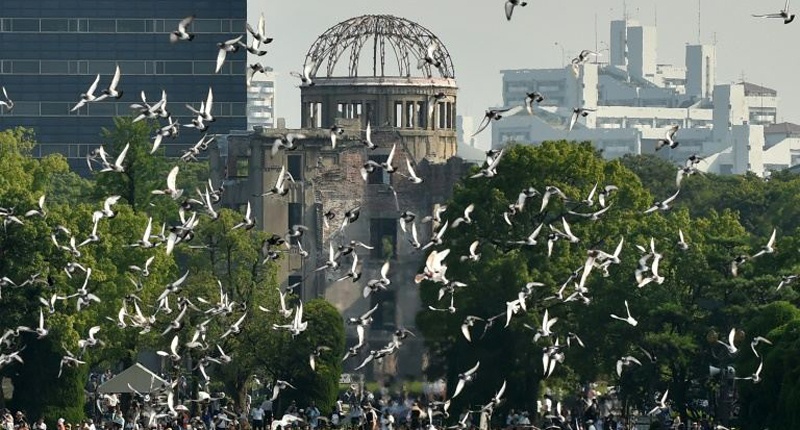
Hiroshima: Killing on an industrial scale

It has been 70 years since the United States became the only nation in history that deployed two nuclear weapons against civilian populations.

On August 6, 1945, a B-29 known as the Enola Gay took off from Tinian island, north of Guam. After flying six hours to the main Japanese island of Honshu, pilot Paul Tibbets flew his aircraft over the city of Hiroshima released «Little Boy», an atomic bomb with the explosive power of 16 kilotons of TNT.

Together two bombs eventually killed an estimated 200,000 Japanese civilians.

Little already remained of Tokyo long before the attacks on Hiroshima and Nagasaki. Hiroshima was one of the largest military centers provisioning the Japanese army and navy.

Originally the chosen targets for the attack were Niigata (a military base and industrial center), Yokohama (an industrial center), Kokura (which held the largest arsenal and warehouse), and Kyoto (also an industrial center).

Nagasaki was a haphazard target. The plane originally flew to Kokura, but because of cloud cover it was unable to release its payload and it turned toward Nagasaki instead.

Within a week of each nuclear attack, thousands who had escaped death began to experience inexplicable combinations of symptoms: high fever, dizziness, nausea, headaches, diarrhea, bloody stools, nosebleeds and whole-body weakness. Their hair fell out in large clumps, their wounds secreted extreme amounts of pus, and their gums swelled and bled.

Purple spots appeared on their bodies, signs of hemorrhaging beneath the skin. Infections ravaged their internal organs. Within a few days of the onset of symptoms, many people lost consciousness, mumbled deliriously and died in extreme pain; others languished for weeks before either dying or slowly recovering.

Even those who had suffered no external injuries fell sick and died. In the ruins of his small tuberculosis hospital in Nagasaki, Dr. Tatsuichiro Akizuki likened the situation to the Black Death pandemic that ravaged Europe in the 1300s.

A second wave of radiation illnesses and deaths swept through Nagasaki in late August through early October. From Akizuki’s perspective on top of Motohara Hill, the illness carved a clear geographical path: From the bottom of the hill upward, people died in order of their distance from the bomb’s hypocenter. Akizuki called this phenomenon the “concentric circles of death.”

By February 1945, Russia and Japan were on the same page and proposed a Far East peace conference that would include Russia, China, Great Britain, the United States, France, and Japan. Japan wrongly believed that Russia would not enter the Pacific war on the side of the Allies.

The USSR’s entry into the war against Japan on Aug. 9, 1945 had a decisive impact on Japan’s decision to capitulate. When the fate of the Kwantung command was almost a foregone conclusion, Emperor Hirohito decided to surrender after panicked reports from his military commanders in Manchuria.

Immediately after the bombings, high-level U.S. officials publicly — and adamantly — rebuffed news reports about the bombs’ horrific aftereffects. Gen. Leslie Groves, director of the Manhattan Project, which developed the atomic bombs, dismissed these reports as propaganda.

Later that year, Groves testified before the U.S. Senate that death from high-dose radiation exposure is “without undue suffering” and “a very pleasant way to die.”

Killing had become possible on an industrial scale by WWII with rifles and machine guns mass-produced in factories, as well as a wide range of products needed to support multimillion-man armies.

Destroying cities was thus the key to winning wars and an integral part of Allied strategy against Germany and in Japan. For Japan the aftermath of bombing Hiroshima and Nagasaki was as calamitous as the fate of Dresden and Hamburg.

Merkel to throw more money at immigrants

On May 8, German leaders will hold their own talks in Berlin to channel money and assistance to mayors in carrying out the federal mandate for each of Germany’s 16 states to take their share of migrants, and figure out how to make room for them.

“Wealthy Germany can afford to help,” said Volker Herzog, the mayor of Vorra. The local pastor, the Rev. Björn Schukat, said that instead, there was a tendency among the authorities higher up the chain to simply announce that, for example, a dozen refugees are arriving — “and now you get on with it.”

Behind the worries is a government policy that calls on the 82 million people of Europe’s biggest economy to be generous. The federal and state authorities apportion the quotas and, increasingly, pay to renovate or rent apartments before sending the people to localities.

Some maintain that Germany’s current wealth and Nazi past impose an obligation to accommodate immigrants. But the costs are being felt as social workers grapple with overcrowded reception centers and officials scramble to house asylum seekers.

In the region, known as central Franconia, there are three social workers for a current allocation of 1,000 migrants. It could use 10, said Pastor Schukat in Vorra.

It was only last December that the federal authorities allocated an extra billion euros to the states and smaller communities to care for refugees this year and next. Just three weeks ago, Berlin was rebuffing calls for more. Now, more money is expected to flow from federal coffers after Ms. Merkel gathers with officials and politicians on May 8.

In 2014, some 627,000 people applied for asylum in a European Union country, including 203,000 in Germany. That was more than anywhere else in the bloc, but proportionally, Germany ranked No. 8, with 2.5 asylum applicants per 1,000 inhabitants, compared with 8.4 per thousand in Sweden.

In a recent German poll, more than half the respondents said they thought there was strong hostility to foreigners in the country.

The concern that Germany is inhospitable was also expressed this winter in pro-immigration demonstrations held nationwide to counter swelling anti-immigration marches, above all in Dresden.

With the federal authorities expecting a flood of newcomers — an estimated 300,000 will apply for asylum in Germany this year, after 200,000 in 2014 — places like Vorra, population 1,000, are struggling to make room.

The mayor of Tröglitz, Markus Nierth, quit after marchers opposed to the housing of migrants demonstrated outside his house. At least half a dozen politicians, from big city districts to tiny towns, subsequently told the German news media of harassment and even death threats.

In a telephone interview on Wednesday, Mr. Nierth said he was glad the federal authorities now seemed willing to do more, particularly financially. “It is really hard to make clear to some people that there is no money for a kindergarten or a swimming pool, but there is money to put up refugees,” he said. If the state or federal government absorbed the cost, hostility to refugees would diminish, he said.

Source: NYT

Wilders rallies thousands of PEGIDA followers

Dutch lawmaker Geert Wilders rallied thousands of PEGIDA followers in eastern Germany Monday to counter society’s “Islamisation”.

The “Patriotic Europeans Against the Islamisation of the Occident”, founded half a year ago in the city of Dresden, had aimed to top their previous record from January of 25,000 people joining a rally.

Many were waving Germany’s red-black-gold national flag and yelling their standard chant of “we are the people”.

“Dresden is showing how it’s done,” said the flamboyant Dutch politician with the trademark peroxide blond hair, who has called Islam a fascist religion and compared the Koran to Hitler’s “Mein Kampf”.

“We have had enough of the Islamisation of society,” he said, speaking in German to loud cheers from the crowd.

“Immigrants have to adopt our values, not the other way around.”

He also insisted that “we don’t hate Muslims, but they have to integrate” and demanded the reintroduction of border controls within the European Union.

More than 2,000 anti-fascist counter-demonstrators had rallied in the afternoon, away from the PEGIDA protest site which was blocked off by police.

PEGIDA marches, which have also targeted “criminal asylum seekers”, mainstream political parties and the media — began with several hundred supporters last October and peaked in January, just after the deadly Islamist attacks in Paris.

Wilders, 51, who heads the Party for Freedom, was again accused of inciting racial hatred after pledging last year to ensure there will be “fewer Moroccans” in the Netherlands.

The German integration commissioner, Aydan Ozoguz, had warned citizens against attending the PEGIDA event, saying that by inviting Wilders the group had shown its true extremist colours.

“Anyone who still marches behind their flag is joining an openly far-right movement,” Ozoguz told the Welt daily.

Saxony state Interior Minister Markus Ulbig said: “This is not a good day for Saxony. With Geert Wilders they have invited a person who has hate inside him, who is divisive”.

Dresden police declined to provide a crowd estimate for the PEGIDA event.

Source: AFP

Hitler photo delivers blow to Pegida

In Pegida’s first ever press conference in Dresden on Monday, Lutz Bachmann insisted that the group was not racist, and distanced themselves from footage during a lively television debate showing Pegida demonstrators delivering racist remarks.

Bachmann has been most keen to stress his Muslim credentials, showing photographs on his Facebook site of his Turkish best man.

Meanwhile a Catholic priest who took part in a demonstration organised by the Pegida-offshoot group Dügida in the western city of Duisburg in Germany on Monday has been banned from preaching by his religious elders, after he compared the movement to the Crusades.

The head of the German anti-Islamisation has stepped down after a picture of him jokingly posing as Adolf Hitler was unearthed. Bachmann, 41, is a butcher’s son from Dresden.

Bachmann’s Facebook page, was accompanied by the line: “He’s Back,” after Timur Vermes’ best-selling 2012 satirical novel of the same name about Hitler.

The Dresden Morgenpost somehow got hold of a private Facebook conversation between Bachmann and one of his Facebook contacts, in which he described immigrants as “cattle”, “scumbags” and “trash”. The comments were posted on 19 September.

Pegida spokeswoman Kathrin Oertel, told Spiegel Online Bachmann’s resignation was the “only possibilty for the movement”.

A spokesman for Bernd Lucke, the head of the political party Alternative für Deutschland, an anti-euro party which has publicly expressed an allegiance with the aims of Pegida, said that with his “sad utterings and disgusting jokes”, Bachmann had “embarrassed the people of Pegida who have been compelled by honest concerns to take to the streets”.

Responding to the picture, Bachmann told Wednesday’s Bild: “I took the photo at the hairdresser’s, for the publication of the audiobook of the satire He’s Back … you need to be able to joke about yourself now and then”. Asked about the derogatory comments he allegedly made about immigrants, Bachmann replied: “We don’t comment about private matters.”

Bachmann, who has multiple convictions for burglary, assault and drug possession, was said by German intelligence services to be a target for Islamist terrorists who said on social media sites they intended to kill him.

German PEGIDA cancels rally over death threats

German PEGIDA movement, which stands against ‘the Islamization of the West’ has canceled next week’s rally in the city of Dresden after threats were issued against one of its top organizers.

The Patriotic Europeans against the Islamization of the West (PEGIDA) movement has been holding protests every Monday in the eastern German city of Dresden since October.

The rallies, which initially gathered no more than 500 people, hit a record attendance of 25,000 last week.

PEGIDA announced on its Facebook page that the rally planned for January 19 has been called off after the police said “there is a specific threat against a member of the organization team.”

According to DPA news agency, the threats were filed by Islamic radicals against the movement’s co-leader, Lutz Bachmann.

The German police were informed of the threats against Bachman by foreign secret services, the agency added.

A spokesman for the Dresden police said that they had placed a “general ban” on all public gatherings on Monday, Reuters reported.

“The police in Dresden have received information of a concrete threat against the weekly PEGIDA rally,” a statement by Dresden police said. “Assassins have been called up to mingle among the PEGIDA protestors and murder one of the individuals leading the rally.”

Instead of taking to the streets, PEGIDA called on all Europeans who oppose “religious bigotry any kind” to hang the national flag of their country out of their windows and light a candle on Monday.

PEGIDA is currently the most supported anti-immigration movement in Germany as rallies by similar organizations in other cities have so far been unable to draw anywhere near as much people.

The Dresden group was criticized by many German politicians, with Chancellor Angela Merkel calling PEGIDA “racists full of hatred.”

Arson attack on German newspaper

A Hamburg daily that reprinted satirical cartoons from French newspaper Charlie Hebdo was hit by arsonists at the weekend, raising security concerns in Germany on the eve of a planned mass rally against Islam in the city of Dresden.

Islamist militant attacks on Charlie Hebdo and a kosher deli in Paris this week that killed 17 people have fuelled fears of similar assaults in other European countries and prompted a warning from German Interior Minister Thomas de Maiziere.

“I am very concerned about well-prepared perpetrators like those in Paris, Brussels, Australia or Canada,” he told the newspaper Bild am Sonntag. There were about 260 people in Germany regarded as dangerous Islamists, he said.

Bild am Sonntag said US intelligence agencies had tapped conversations of senior Islamic State (IS) members in which they said the Paris attacks were the start of a series in Europe.

In Hamburg, two people were arrested after an incendiary device was thrown into a building of the Hamburger Morgenpost daily, setting some documents on fire, police said.

Source: Reuters

Thousands rally in Dresden against criminal immigrants

On Monday night, an estimated 15,000 people joined Pegida, or Patriotic Europeans Against Islamisation of the West, in a march through Dresden, Germany, carrying banners bearing slogans such as “Zero tolerance towards criminal asylum seekers”, “Protect our homeland” and “Stop the Islamisation”.

The Anglo-Saxon presstitutes were unsurprisingly wild-eyed with indignation about the “extremists”, but could find no Nazi’s at the rally.

Lutz Bachmann, the head of Pegida, a nascent anti-immigration campaign group, led the crowds, either waving or draped in German flags, in peacefully chanting “Wir sind das Volk”, or “We are the people”.

The slogan was adopted by protesters in the historic “Monday demonstrations” against the East German government in the runup to the fall of the Berlin Wall.

According to the British Guardian “unnamed sources” in the rally said Muslims were “plotting to infect German food chain with their excrement”, but the “sources” were probably from the Guardian itself.

It was the ninth week in a row that Pegida had taken its protest to the city’s streets in the eastern German state of Saxony, but nobody looked worried about tainted food. Rather they decried the recent decision by local politicians to increase the number of homes for asylum seekers, inviting more in.

Its first march, advertised on Facebook and other social media, attracted just 200 supporters. By last week the figure had risen to 10,000. By Monday night it had grown to an estimated 15,000.

A middle-aged woman in a red leather jacket, said she was shocked that “asylum seekers in Germany have expensive mobile phones, while I cannot afford such luxury and others still cannot afford to eat properly”.

There were no racist slogans and marchers spoke of the “demise of the West” due to the rise of Islam, salafism, sexual abandon and licentiousness.

Old and young men and women, including families with children in pushchairs, many of whom said they had no political affiliation, joined the march.

Almost two-thirds of Germans, according to a poll for news magazine Spiegel by the TNS institute, believe that Angela Merkel’s government is not doing enough to address concerns about immigration and asylum seekers, and 34% think Germany is enduring a process of “Islamisation”.

According to the Anglo-Saxon press, these citizens should all qualify as Nazi’s while the foreigners and immigrants are “open-minded” folks who refuse to speak German.

The Guardian went beyond the farcical in denouncing the rally, claiming that Germans “bark” when they speak.

Led by Bachmann, a 41-year-old butcher’s son who runs a PR agency, Pegida has many clones across Germany. Legida is the name of the Leipzig branch, Bogida the Bonn branch, while in Darmstadt it is known as Dagida.

At a recent rally in Dresden, Bachmann’s hometown, he explained that while asylum seekers enjoyed luxury accommodation, many impoverished German pensioners were “unable to even afford a single slice of Stollen” (German Christmas cake).

Bachmann maintains that he plays a small part of the movement. “I’m just a small cog in a much bigger wheel,” he told the Süddeutsche Zeitung in a rare interview.

German resentment over a sharp rise in the number of refugees seeking political asylum in Germany, many from war-torn countries including Syria, Somalia, Afghanistan and Iraq, has grown in recent months.

All these countries have been ravaged by Anglo-Saxon meddling and expansionist imperial policies.

Last Friday, a newly refurbished home for asylum seekers in Nuremberg in southern Germany was badly damaged in an arson attack. Anti-foreigner slogans and swastikas were found daubed on the walls.

The attack may have come from worried security agents desperate to smear Pegida.

Germans take to the streets against Islam

Anti-immigration protest is sweeping across Germany, as thousands take to the streets against what they say is the growing “Islamisation” of the country.

Demonstrators have adopted the old rallying call of the protests against the East German communist regime that brought down the Berlin Wall 25 years ago, “Wir sind das Volk”. They say they want to preserve Western culture.

The protests come as Bavaria’s ruling Christian Social Union (CSU) is seeking to distance itself from a draft proposal for its party conference which said that immigrants should speak German not only in public, but at home as well.

Germany is now the second most popular destination in the world for migrants, after the US, and the country is struggling to cope with an unprecedented influx of asylum-seekers.

Thousands have defied sub-zero temperatures to join weekly marches each Monday in Dresden under the banner of Patriotic Europeans against the Islamisation of Europe, or Pegida.

The protests were started by a local man, Lutz Bachmann, with no background in politics. When he called his first demonstration in October, only a few hundred turned up, but the movement has snowballed, and last week 7,500 came.

Pegida has inspired similar movements across Germany. Though the numbers have not been as high as in Dresden so far, marches have been called in cities from Düsseldorf to Munich.

Bachmann has been at pains to stress that he is not opposed to genuine political refugees, only to economic migrants who “take advantage” of the German system, and has no problem with Islam but is worried about erosion of German culture.

Concerns for the German culture plunged Bavaria’s ruling CSU into its own controversy, after a draft proposal for the opening motion at the party conference called for immigrants to speak German at home.

“Whoever wants to live here permanently should be encouraged to speak German in public and within the family,” the draft said.

After a storm of criticism, including the Twitter hashtag YallaCSU, Arabic for “Let’s go, CSU”, and questions over how such a policy could possibly be enforced, Andreas Scheuer, the party’s general secretary, sought to limit the damage.