No sooner do terrorists attack, than those who monopolize the conversation revert to abstractions: “terrorism returned,” “terror struck,” when, of course, not terrorism, but terrorists struck Barcelona, Spain, on August 17. Terrorists did the same days later, in Newcastle, England and in Turku, Finland.
The men who murdered 14 in Spain, maiming and injuring over 100, 15 of them critically, are flesh-and-blood. Young, Muslim, Moroccan men with murder on their minds. It is the duty of governments to bar such men from civilized society, or keep such barbarians at bay.
So, drop the Orwellian bafflegab when describing what elites have wrought through their policies. The Maghrebi Muhammadans—aged, 17, 18, 22 and 24—had been given free range and limitless access to their victims, in the name of those victims’ freedoms. The only lucky sorts living safely are the elites who grant the barbarians license to kill.
Thus were Theresa May, the Spanish royals and other leaders—well-protected courtesy of their taxpayers—able to flout the reality faced by the ordinary fellow and utter fatuities like, “These assassins, these criminals won’t terrorize us.” The truth is that these darling buds of May and Merkel do and will continue to terrorize ordinary men and women, but will spare invulnerable elites for reasons obvious.
Of Spain’s many millions, “only” 14 lives were lost in one day, in Barcelona. Similar numbers obtain in London, Manchester, Melbourne, Paris, Nice, Normandy, Stockholm, Saint Petersburg, Berlin, Hamburg, Columbus (Ohio): Only a few people were picked off in each attack, this year.
In the grand scheme of things, the numbers are relatively small. Or, so we’re lectured by the contemptible aggregators who decide who will reside among us.
On TV, June 1, 2017, Alex Nowrasteh, immigration expert at the libertarian Cato Institute, argued that “foreign-born terrorism is a hazard,” but a “manageable” one, “given the huge economic benefits of immigration and the small costs of terrorism.”
Spoken like a collectivist, central planner and utilitarian rolled into one.
This is the Benthamite “utilitarian calculus” at its cruelest. It requires, first, for someone to play God. Whether she sits in Downing Street, D.C., Brussels, or Barcelona; the Godhead has determined that Muslims in our midst are a must in bringing “the greatest good to the greatest number of citizens.” Along the way, a few people will die. For the greater good. In the words of “Stalin’s apologist” Walter Duranty, ”You can’t make an omelet without breaking eggs.”
However, a natural-rights libertarian values the life of the innocent individual. Only by protecting each individual’s rights—life, liberty and property—can the government legitimately enhance the wealth of the collective. Only through fulfilling its night watchman role can government legitimately safeguard the wealth of the nation. For each individual, secure in his person and property, is then free to pursue economic prosperity, which redounds to the rest.
See, statistics are silly unless given context. If you have one foot in fire, the other in ice, can we legitimately say that, on average, you’re warm? Hardly.
Probabilities, in this case the chance that any one of us will die-by-Muslim, are statistically insignificant—unless this happens to you or to yours, to me or mine.
It is this crude calculus that politicians and policy wonks like the Catoite mentioned peddle.
Were it possible to arrange for wonks, pols and their beloved to pay for the policies they promulgate—were these ugly aggregators told, “Yes, we like your idea of flooding western societies with Muslims at the price of a few lives—provided that those lives lost belong to you and yours. The John McCains and Jeff Flakes of the world would quickly retract their policy follies.
Marine Le Pen, the leader of France’s popular National Front, has been ordered to stand trial in October on charges of inciting racial hatred after comparing Muslim street prayers to the Nazi occupation, legal sources said Tuesday.
Le Pen was campaigning to take over leadership of the FN from her father in December 2010 when she made the comparison, complaining that there were “10 to 15” places in France where Muslims worshipped in the streets outside mosques when they were full.
“I’m sorry, but for those who like talking a lot about World War II, if it comes to talking about the occupation, we can talk about it, because that (Muslims praying on the street) is the occupation of territory,” she told a crowd in the southeastern city of Lyon.
“It is an occupation of part of the territory, suburbs where religious law is applied. Sure, there are no armoured vehicles, no soldiers, but it is an occupation nonetheless and it weighs on residents.”
After the comments, which provoked outrage in France, Le Pen was investigated for inciting racial hatred but the probe was later closed with no result.
But a complaint by an association led to a judicial enquiry which was opened in January 2012.
Le Pen was charged in July 2014 after her immunity as a member of the European Parliament was lifted following a vote requested by French authorities.
– ‘I’ll be at trial’ –
Le Pen told AFP she intended to attend the trial.
“Yes, of course. I wouldn’t miss such an occasion,” she said.
The party remains staunchly anti-EU and anti-immigration and Le Pen has seized upon Europe’s migrant crisis to win votes ahead of regional elections in December.
The FN is already leading opinion polls in several regions.
Le Pen has leaned on traditional party arguments, calling for an end to Europe’s borderless Schengen zone as well as actions seen as enticing migrants to France.
However she also stepped up the rhetoric, comparing the flood of migrants on Europe’s doorstep to the “barbarian invasions” of the fourth century.
Speaking to Paris-based foreign journalists on Monday, Le Pen said of migrants: “We should warm them up, feed them and then send them back where they came from.”
In September 2014 the Muslim Party in Denmark announced that Denmark would be the first Muslim country in Europe.
Now, a year later, they are demanding to be part of the Caliphate, but one in two Danish citizens favor a cap on the number of Muslims permitted to live in Denmark, a YouGov poll indicates.
The poll, which was conducted for the Danish publication Metroxpress, specifically targeted immigration from non-Western countries and also found one in four Danes do not want the country’s population to be more than 5 percent Muslim.
A video posted this weekend shows Muslims with police escort marching in Denmark screaming and demanding a caliphate.
The anti-immigration Danish People’s Party called for a national programme that would help Muslims leave Islam in March this year.
Danish People’s Party (DF) spokesman Martin Henriksen wants to see the Danish state step in and offer help to Muslims who want to leave the religion but feel bullied into staying.
“We unfortunately have seen many examples of someone wanting to leave Islam but having a hard time doing it or not daring to do it because they fear reprisals from certain groups within the Muslim communities of Denmark. This is a way in which we can begin doing something about it,” Henriksen told Politiken.
Henriksen stressed that the programme would not be proactive but would rather only help those who reached out for assistance.
“People shouldn’t directly be offered an exit. One should make the decision oneself. And if one decides that they no longer want to be there, there should be a place to go to get support and back-up,” he told Politiken.
Henriksen added that the programme would help those who “live a double life because they don’t dare to leave the religion”.
Scorn is not illegal
There are around 250,000 Muslims in Denmark and religious scholar Mogens Mogensen said that Henriksen is right that some Muslims face heavy resistance when they want to leave the faith.
But he stressed that the state should not get involved.
“If the consequences for those who want to leave Islam are within the law, then this is not an area where society should get involved. Scorn, mockery and ridicule is legal in our society. However, if one uses violence against someone who wants to leave Islam, that is illegal. But the only place where we can document that that happens is in the asylum centres,” Mogensen told Politiken.
“Grotesque” and “un-Danish”
Judging by the political reactions to Henriksen’s suggestions, an Islam exit programme seems unlikely to see the light of day anytime soon.
Representatives from government coalition parties Social Democrats and Social Liberals (Radikale) called Henriksen’s idea “grotesque” and “un-Danish”.
“We have freedom of religion in this country. And that means that politicians should not declare one religion better or worse than another. To make special initiatives aimed at particular religions is very un-Danish,” Social Democrats spokeswoman Trine Bramsen told Politiken.
Primary opposition party Venstre, however, was more open to the idea – if Henriksen can “find some money for it”.
“We should help the young people who are repressively forced to remain in an environment they don’t want to be a part of. It is precisely in these kinds of situations that the power of the state can go in and help,” Venstre spokesman Martin Geertsen told Politiken.
A top Iman has told Muslims to use the migrant crisis to breed with European citizens and ‘conquer their countries’.
Sheikh Muhammad Ayed gave the speech at the Al-Aqsa Mosque in Jerusalem claiming Europe was only welcoming refugees as a new source of labour.
He said Europe was facing a demographic disaster and urged Muslims to have children with westerners so they could ‘trample them underfoot, Allah willing.’
‘Throughout Europe, all the hearts are enthused with hatred toward Muslims. They wish that we were dead, but they have lost their fertility, so they look for fertility in our midst,’ Infowars reports.
‘We will give them fertility. We will breed children with them, because we shall conquer their countries.’
Birth rates are far higher in the Middle East and Sub-Saharan Africa, which is where most migrants are coming from.
The notion of using mass migration as a form of stealth jihad is outlined in the Koran, which states, ‘And whoever emigrates for the cause of Allah will find on the earth many locations and abundance.’
To move to a new land in order to bring Islam is considered a meritorious act.
Saudi Arabia is offering to pay for the construction of enough mosques in Germany to facilitate the needs of every 100 refugees that enter the country. The offer comes as Europe has been flooded with hundreds of thousands of illegal immigrants and asylum seekers from Syria and Iraq.
Fanning out across Europe, seeking refuge, some 4 million refugees are looking for a place to settle down as war ravages Syria. In Syria itself, another 6.5 million are displaced. There are only 10.6 million Syrians, just half of the nation’s total population, still living in their homes. Syrians now make up 20 percent of the planet’s refugees.
These people have needs, including food, shelter and other basics. They also want their spiritual needs met and since nearly all of them are Muslim, that means they want mosques. To meet that demand, Saudi Arabia is offering to build a mosque for every 100 refugees accepted by Germany. Similar offers may be extended to other nations.
The refugees are streaming into Europe instead of into Islamic countries. Saudi Arabia has welcomed some of the refugees, but other Arab states are denying entry to most of these people. These nations have incredible wealth, mostly because of their oil industries, but they would rather build mosques abroad than welcome these refugees into their territory.
A furore has erupted at Virgin Active’s Old Edwardians gym in Houghton.
Muhammed Desai, a gym member, was asked to leave the gym after arriving for a session in a t-shirt presenting a political message.
Desai, the coordinator of pro-Palestine organisation BDS and an ANC Youth League branch president, was wearing a t-shirt calling for “solidarity with Palestinians against Israeli Apartheid”.
Desai said, “I was told that I am not allowed to wear my YCL BDS t-shirt because it’s pro-Palestinian, and so they’ve called police to arrest me.
“My point is quite clear. I’m a paid-up member of this club and I have the right to be here.”
Desai said the manager of the club had refused to put his objections on paper.
Before being escorted from the gym, Desai said, “Those that are offended at human rights… those are the ones that are a problem.”
The front of Desai’s t-shirt displays an image of Chris Hani and a Boycott, Divestment and Sanctions (BDS) logo.
BDS is an international coalition of Palestinian organisations, trade unions, and aligned networks calling for a boycott of all ties with the Israeli state, and for sanctions to be imposed on trade with Israel.
BDS has recently been active in South Africa in calling for a boycott of Woolworth stores until they remove Israeli products from their shelves.
More explicitly, the back of Desai’s t-shirt presented the following message: “From the coast of Cape Town to the coast of Gaza in solidarity with Palestinians against Israeli apartheid.”
The Old Edwardian gym has a very large number of Jewish members.
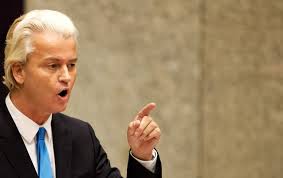
Dutch anti-Islam lawmaker Geert Wilders said Wednesday he plans to show cartoons of the Prophet Muhammad on Dutch television after Parliament refused to display them.
Wilders said he would show the cartoons during television airtime reserved for political parties, in a move likely to offend Muslims since Islamic tradition holds that any physical depiction of the Prophet Muhammad is blasphemous.
Political parties in the Netherlands get a small amount of airtime each year and broadcasting authorities have no say in what the parties show. Wilders said the broadcast would likely take place in the next few weeks, but an exact date has yet to be determined.
The announcement came a month after Wilders gave a speech at a contest in Garland, Texas, for cartoon depictions of Muhammad. Shortly after Wilders left the event, it was targeted by two men with pistols and assault rifles. Security guards shot and killed the attackers.
Wilders, whose Freedom Party holds 12 of the 150 seats in Parliament’s lower house, told The Associated Press he wants to air cartoons from the Texas competition to support people “who use the pen and not the sword.”
Wilders is no stranger to pushing the boundaries of free speech and targeting Islam. He has lived under round-the-clock protection since 2004 because of death threats.
He was acquitted in 2011 of hate speech as judges said that his anti-Islam rhetoric came in the context of a fierce national debate about immigration and multiculturalism.
Wilders is again facing prosecution for hate speech over a chant last year in which he asked his supporters whether they wanted more or fewer Moroccans in the Netherlands and they shouted back “Fewer! Fewer! Fewer!”
A growing number of extremist groups from Africa to southeast Asia are shifting their allegiance to the Islamic State group, leading to greater risks for “cross-pollination” among conflicts beyond Syria and Iraq, the head of Interpol said Friday.
Juergen Stock cited this shift as an emerging trend at a UN Security Council meeting along with changing travel methods being used by foreign fighters seeking to join groups like the Islamic State and al-Qaeda.
Stock was a keynote speaker at a meeting attended by half a dozen ministers including US Secretary of Homeland Security Jeh Johnson to assess progress in implementing a US-sponsored resolution adopted last September requiring all countries to prevent the recruitment and transport of would-be foreign fighters preparing to join extremist groups.
On Friday, the Security Council adopted a presidential statement calling for a significant increase in border controls, improved cooperation at all levels “including preventing terrorists from exploiting technology, communications and resources.”
Johnson said the United States will be developing a new passenger data-screening and analysis system within the next 12 months which will be made available to the international community at no cost for both commercial and government organizations to use.
In a report obtained by The Associated Press on April 1, the panel of experts monitoring UN sanctions against al-Qaeda said the number of fighters leaving home to join al-Qaeda and the Islamic State group in Iraq, Syria and other countries has spiked to more than 25,000 from over 100 nations. The panel said its analysis indicated the number of “foreign terrorist fighters” worldwide increased by 71 percent between mid-2014 and March 2015.
In a recent survey conducted by AlJazeera.net, the website for the Al Jazeera Arabic television channel, respondents overwhelmingly support the Islamic State, with 81% voting “YES” on whether they approved of ISIS’s conquests in the region.
The poll, which asked in Arabic, “Do you support the organizing victories of the Islamic State in Iraq and Syria (ISIS)?” has generated over 38,000 responses thus far, with only 19% of respondents voting “NO” to supporting ISIS.
ISIS pose a direct threat to the “entire civilised world”, the Queen of Jordan has declared, as she urged Muslims around the world to rise up against the group.
She urged people to ignore the “clash of civilizations”. Queen Rania said the war against ISIS must happen with the support of Britain and other allies in the Western world.
She spoke to leftist journalists earlier and said that ISIS threatened the One World ideology because it was “medieval”. She said all “modern” people should unite against the scourge.
Even as Jordan launched intense airstrikes against the Islamic State to avenge the extremist group for burning to death a captured Jordanian fighter pilot, the militants enjoy large support in the kingdom.
Islamic extremists in Belgium have publicly threatened to kill the mayor of the Belgian city of Antwerp, Bart De Wever, if he does not convert to Islam, local media reported Monday.
A sign written in French stating threats against de Wever, who is also the head of the nationalist political party the New Flemish Alliance, was placed on one of the main squares of Antwerp. Experts are currently assessing the seriousness of the action and the message.
“I always warned that we will not get rid of the threat from Islamic extremists in the near future. This was ignored for years. This wound became apparent now with [the current developments in] Syria and will fester for a long time before we will get rid of it,” de Wever said.
Throughout his political career, De Wever has repeatedly received threats. The Belgian government has provided him with security guards at state expense.
In the light of advance of the Islamic State (ISIL) terrorist group in the Middle East and a number of ISIL-inspired terrorist attacks in Europe, the European Union has currently seeing a surge in anti-Islamization sentiment.
According to September 2014 statistics from Belgium’s Ministry of Interior, between 300 and 350 Belgians have gone to fight alongside the ISIL in Iraq and Syria since 2012.
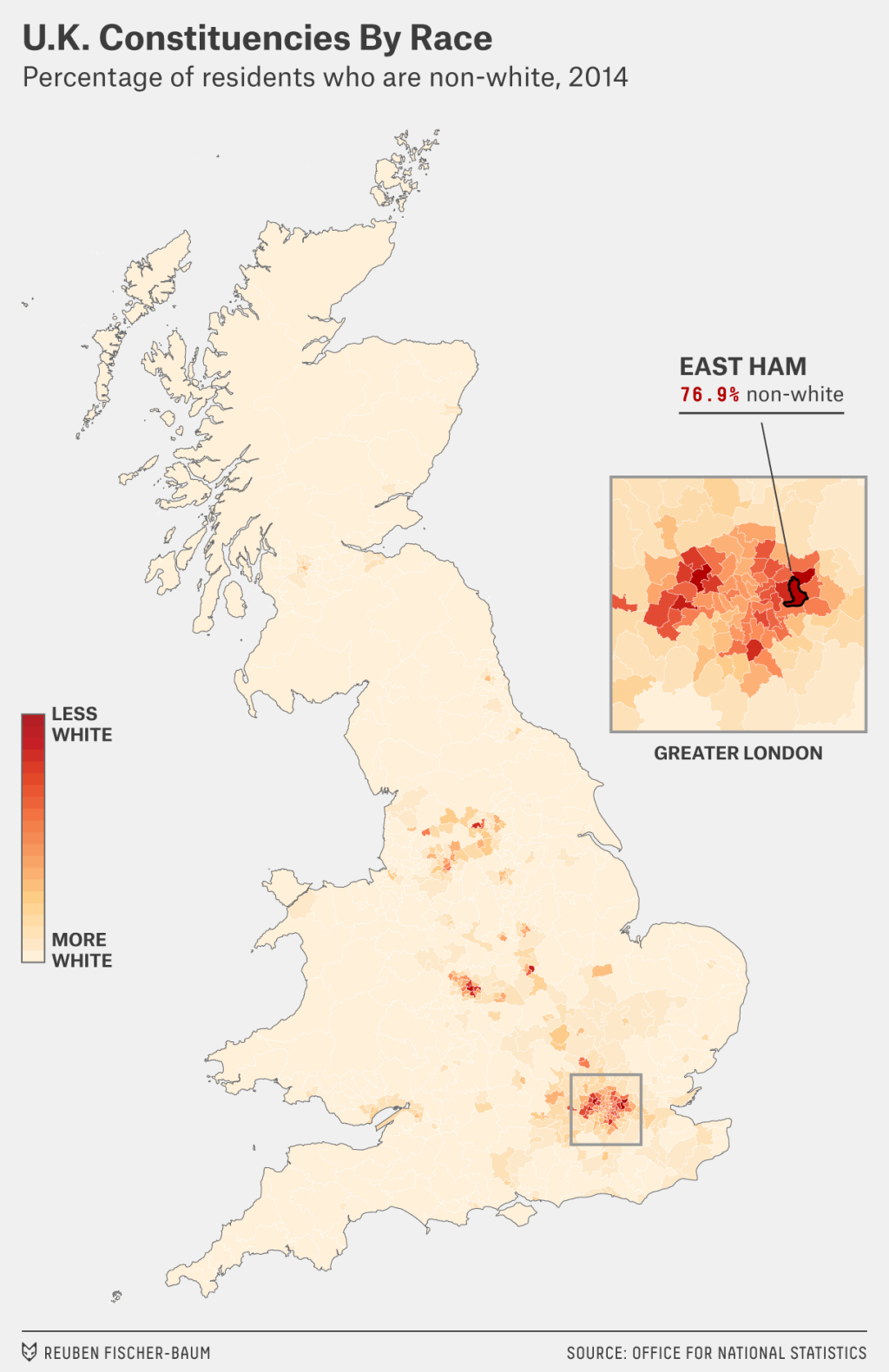
One of the safest Labour seats in Britain is its most non-white one, East Ham. It has been in Labour hands since it was formed in 1997 and will vote Labour again tomorrow in Britain’s general election. Its MP, Stephen Timms, was once stabbed by one of his constituents, Roshonara Choudhry, a 21-year-old student, who “was inspired by an al-Qaida cleric and wanted to punish Timms for voting in favor of the Iraq War”. The Labour MP downplays the incident and simply wants to represent his “diverse” ward.
Mona Chalabi writes:
There are two mosques on Church Road. I arrive at one of them just after prayers have finished one afternoon in early April, and as I peer my head around the entrance, I see a man hopping on one leg dressed in a black parking inspector’s uniform. He slips his foot into a black regulation shoe that he left on the grid of shelves that line the lobby when he went in to pray.
“Do you have time to talk to me about the election?”
“Nah, sorry,” he replies. “I’m still on my shift.”
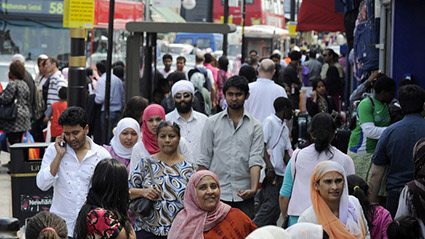
I step back outside so that I’m not in the way of the men silently filing out of the mosque. One tall man with a round stomach slowly passes me in a beige salwar kameez, his sandals flapping behind him as he talks quietly into a cell phone. I don’t recognize the language, but I’m hardly surprised — I am, after all, in East Ham. Only 58.6 percent of people in Newham, the local authority where East Ham is found, reported English as their main language in the 2011 census, the lowest share of anywhere in England and Wales.
I’m here because the residents of this East London constituency make this place an outlier in a number of ways. This is the U.K.’s most ethnically diverse constituency and one of its most religious areas. It has the highest number of residents who were born abroad — 83,223, according to the 2011 census. And, according to the Office for National Statistics (ONS), 77 percent of the population here is non-white, the highest share of anywhere in the country. The median across the U.K.’s 650 constituencies is just 5.2 percent non-white.
In other words, this place sticks out statistically.
Understanding those numbers is important in explaining why this is one of the safest Labour seats in the country. East Ham has been represented by a Labour member of Parliament (MP) since the seat was formed in 1997. In the 2010 general election, Labour won 70 percent of the vote here and is projected to win 69 percent on May 7.
But while residents here are a key part of this political continuity, they’re also in some ways the focus of calls for political change. Race and religion are rarely explicit talking points in U.K. politics, but they’re often implicit when the topic of immigration comes up — as it now so often does.
That evening, the first of two debates is aired on national television. Leaders of the seven largest political parties take to podiums to present their visions for the country, debate them and take a handful of questions from members of the audience. Race doesn’t come up once, but immigration features heavily. The politicians exchange insults about inaction and make promises about immigration policies. If those policies were different — and most of the party leaders say they should be — maybe East Ham wouldn’t look the way it does now.
In 1999, my mum started working in East Ham as a general practitioner in a National Health Service medical practice that was made up of two small terraced houses with one wall between the two knocked down. Each summer, after a few weeks of holidays had passed and the boredom had become unbearable, my best friend and I would go to the surgery to help out. We would prepare new files for new patients in a waiting area that had once been a living room. There were always new files to make because there were always new patients. Six years ago, the surgery moved to a much larger multi-story, multi-practice building half a mile away to cope with increasing demand.
Between the 1991 and 2011 censuses, the population of Newham grew 42 percent. That growth has been almost exclusively non-white, as the Centre on Dynamics of Ethnicity at the University of Manchester shows below.
Newham’s largest non-white groups reported in the 2011 census were Indian (13.8 percent of people), African (12.3 percent) and Bangladeshi (12.1 percent) — but it’s a long list.3
There’s no data on race and voting patterns at the constituency level, but it’s safe to say that the high share of ethnic minorities here has driven Labour’s success in East Ham. Between May and August 2010, the Ethnic Minority British Election Study asked almost 4,000 voters nationally who they had chosen in the general election that May. Of Brits who were ethnic minorities, 68 percent supported Labour; that compares with 31 percent of whites.
RACE
LABOUR
CONSERVATIVE
LIBERAL DEMOCRAT
African
87%
6%
6%
Caribbean
78
9
12
Bangladeshi
72
18
9
Indian
61
24
13
Pakistani
60
13
25
White
31
37
22
And religiosity in the area has probably played a role, too. Newham is the least irreligious place in the country: Only 9.5 percent of residents say they have no religion, compared with 24.7 percent in England. That’s partly because the share of the population that is Hindu is six times larger in Newham than it is at the national level — the same is true of the Muslim population.
Between February and March of last year, the British Election Study conducted a national survey on the attitudes of religious groups. Among those who said their religion was Islam, 73 percent said they would vote Labour. It’s a strikingly high figure — only 40 percent of those with no religion and 32 percent of Anglicans said they would vote Labour (the largest and second-largest groups of respondents, respectively).
FAITH
LABOUR
CONSERVATIVE
LIBERAL DEMOCRAT
UKIP
Islam
73%
15%
7%
1%
Sikhism
64
15
6
6
Hinduism
58
31
3
6
Roman Catholic
45
30
5
13
None
40
27
11
12
Buddhism
38
25
7
14
Baptist
37
32
10
16
Presbyterian
35
25
5
8
Methodist
35
41
11
10
Anglican
32
39
8
18
Judaism
30
46
5
12
Stephen Timms, who has represented East Ham in Parliament since 1994,4 is well aware that he represents an incredibly diverse constituency. He’s also probably well aware that the racial and religious makeup of his constituency has helped secure his seat as a Labour MP. But it’s not just political demographics — Timms is also well-liked by his constituents. Several people I spoke to gave examples of how he had helped them personally. He votes strongly in favor of raising welfare benefits and against reducing housing benefits, issues that are especially important in this area where 42 percent of children live in poverty.
After a string of high-profile roles, most recently as shadow employment minister, Timms, 59, is now the Labour party’s “Faith Envoy” (he took up Christianity in his teens).
But this long political career, one built on a very solid electoral majority, has not been without incident.
Just a week after re-winning his seat in the last election, Timms was stabbed twice in the stomach by a constituent at an advice surgery — a regular session for MPs to hear the concerns of the people they represent. His attacker, Roshonara Choudhry, a 21-year-old student, said she was inspired by an al-Qaida cleric and wanted to punish Timms for voting in favor of the Iraq War. Aside from giving a few interviews about it, Timms finished his most recent political term without emphasizing the attempted murder.
When I call him, hours before the first leaders debate is due to air, I ask Timms, who is seeking re-election, about race in East Ham. Timms, who is white, speaks about it comfortably.
“You’d think that a very diverse place like this was kind of, by definition, a pretty fragmented community — I actually don’t think that’s the case,” he said. “I think this is actually a quite cohesive community, and I think the reason for that is the great majority of people in this area belong to something. They belong to a church or a mosque or a temple or a gurdwara.”
A thriving religious community and a high vote share for Labour don’t mean there isn’t political debate in East Ham. The U.K. Independence Party (UKIP) has a candidate standing in East Ham who is expected to get 5 percent of the vote in this election (nowhere near enough to unseat Timms, and lower than the 11 percent median vote share that UKIP is projected to get across the U.K.). Britain’s newest political force, UKIP has the strongest stance of any party on immigration — it wants the country to get out of the EU because it believes immigration is unsustainably high.
In 2010, UKIP was politically irrelevant. But the party came in first in the 2014 European Parliament elections, which was followed by two wins in U.K. by-elections. Now, UKIP is shaping the debate on immigration — and by extension, the stakes of this election. Nationally, 27 percent of voters say immigration is the most important issue facing Britain, more than any other single issue. I told Timms that even some of the immigrants I’d spoken to in East Ham were worried that immigration was too high.
“I’m not surprised you came across that,” he said. “It is sometimes a little bit surprising to listen to someone who is clearly an immigrant complaining about immigration, but people do feel quite strongly about that. … Quite a lot of Labour supporters think this is an important issue, and they need to feel that the system is properly managed and fairly.”
The Church in East Ham is now a community centre where they play disco music, unlike in the mosques in the area that are very much used for religious purposes
From the outside, Trinity Community Centre looks like a church so typical that it could be part of a toy train set, made of plastic and placed next to the pretend railway station. I’m greeted in the hallway by a suited Sikh man in a turban holding a clipboard. I tell him that I’m looking for the advice surgery. Only the staff is here today — with the election just five weeks away, Timms is busy with “other commitments.”
Someone somewhere is playing the 1994 disco hit “U Sure Do” by Strike very, very loudly. Over the man’s shoulder, I can see through a glass window — streamers hang from the ceiling, and balloons float between adults and children. I ask if it’s a birthday party, and he tells me that it’s a therapy group for children with disabilities.
A lot of community support groups meet here. If I had arrived at another time or on another day, I might have bumped into Dost, a service for refugee, asylum-seeking, trafficked, undocumented or new migrants between the ages of 11 and 25. Or I might have seen one of the adult education classes or stumbled across Bayaan, a support group that encourages young Asian girls to get into higher education.
The man with the clipboard points above his head: “The advice surgery is upstairs.”
About a dozen constituents sit on pews, waiting to speak to a member of Timms’s staff. I’m keen to hear what they think about UKIP. People here don’t all agree about UKIP; some say the party is racist, some say the party has a point on immigration, but most of these constituents tell me they will vote Labour.
There’s no data on support for UKIP by race either nationally or at the constituency level, but there is evidence that many voters are concerned about the party’s racial politics. In a survey last May, 41 percent of people said they believed UKIP was a racist party and 46 percent said they believed UKIP was “deliberately trying to attract support from racist voters.” The Guardian recently reported that “Are UKIP racist?” was the most common Google search about the party in March.
UKIP’s public policies don’t use xenophobic language, but the party’s general position on immigration and a string of racist incidents involving UKIP members can leave British voters straining for subtext.
Given all that, it seems unlikely that UKIP will be able to win over ethnic minorities in East Ham or elsewhere in Britain. But that doesn’t mean Labour can be complacent about these voters. Britain’s political landscape has changed quite rapidly — established parties now have a smaller share of the vote, and new parties like UKIP are no longer irrelevant players.
If another party emerges that can successfully disentangle race and immigration, presenting itself as neither xenophobic nor lax on border control, Labour could be in real trouble. In 2010, the party won 79 seats with a margin of victory of less than 5 percentage points. In 19 of those seats, over a quarter of the population was non-white.5 Those seats matter; they could make the difference between being in government and being out of it. Parties that want power would do well to not neglect the voters who live in places like East Ham. – Mona Chalabi for fivethirtyeight.com
The terrorist group ISIS says they will murder Pamela Geller and kill anyone who shields her.
The terrorists also say they have 71 fighters in 15 different states and they 23 have signed up already for missions like the failed Sunday attack in Garland, Texas.
The attack by the Islamic State in America is only the beginning of our efforts to establish a wiliyah in the heart of our enemy. Our aim was the khanzeer Pamela Geller and to show her that we don’t care what land she hides in or what sky shields her; we will send all our Lions to achieve her slaughter. This will heal the hearts of our brothers and disperse the ones behind her. To those who protect her: this will be your only warning of housing this woman and her circus show. Everyone who houses her events, gives her a platform to spill her filth are legitimate targets. We have been watching closely who was present at this event and the shooter of our brothers. We knew that the target was protected. Our intention was to show how easy we give our lives for the Sake of Allah.
We have 71 trained soldiers in 15 different states ready at our word to attack any target we desire. Out of the 71 trained soldiers 23 have signed up for missions like Sunday, We are increasing in number bithnillah. Of the 15 states, 5 we will name… Virginia, Maryland, Illinois, California, and Michigan. The disbelievers who shot our brothers think that you killed someone untrained, nay, they gave you their bodies in plain view because we were watching.
The next six months will be interesting, To our Amir Al Mu’mineen make dua for us and continue your reign, May Allah enoble your face.
A former employee of Al Jazeera America is suing the network for $15 million, alleging that a manager with close ties to top executives discriminated against female employees and made disparaging remarks about Jews and Israel.
Matthew Luke, who started with the network in 2013 ahead of its launch as supervisor of media and archive management, filed the lawsuit in New York Supreme Court on Tuesday. In it, he alleges that Osman Mahmud, who rose through the ranks to become Luke’s supervisor as senior vice president of broadcast operations and technology, removed female employees from projects, excluded women from emails and meetings and made discriminatory, anti-Semitic and anti-American remarks such as “whoever supports Israel should die a fiery death in hell.”
Not long after Luke went to human resources to report on the behavior, he alleges he was told he did not fit into the company’s culture and was fired.
In an interview with The Washington Post’s Erik Wemple, Mahmud denied the charges, calling them a “pack of lies” and if he had said such remarks more people would’ve reported them.
The network, the American arm of the popular and widespread Al Jazeera network, was launched with big budgets and great fanfare last year after buying Current TV. But the network has struggled mightily in ratings and, according to the New York Post, is starting to lay off staffers and substitute more programming from Al Jazeera English.
The ‘Reclaim Australia’ protests on Saturday were held in 16 cities and towns nationwide, attracting hundreds of demonstrators, who said they are against the imposition of Sharia law, and the wave of multiculturalism that has swept the country.
Muslim community leaders expressed fear and bewilderment after protesters gathered in over a dozen Australian cities at the weekend to express their opposition to minority groups, who want to ‘change the cultural identity of the country.’
Randa Kattan, CEO of Arab Council Australia, warned such racist type of events could quickly spiral out of control.
“In terms of numbers they might be insignificant, but in terms of damage, it is significant,” she told the Guardian.
She called the protesters “squeaky wheels grabbing attention,” but was careful not to underestimate such groups for attracting interest to their cause.
“It only takes one incident,” she warned.
However, the anti-Islam protesters met stiff opposition from the left-wing umbrella group ‘No Room for Racism.’ Tensions peaked in central Melbourne, where police struggled to keep anti-Islam and anti-racism protesters separated. Medical officials said four people were treated for minor injuries, while police spokeswoman Belinda Betty said two men and a woman were arrested following the violence.
More than 100 police were deployed, with almost a dozen mounted police also helping to keep the situation under control.
This website uses cookies to improve your experience. We'll assume you're ok with this, but you can opt-out if you wish. Cookie settingsACCEPT
Privacy & Cookies Policy
Privacy Overview
This website uses cookies to improve your experience while you navigate through the website. Out of these cookies, the cookies that are categorized as necessary are stored on your browser as they are essential for the working of basic functionalities of the website. We also use third-party cookies that help us analyze and understand how you use this website. These cookies will be stored in your browser only with your consent. You also have the option to opt-out of these cookies. But opting out of some of these cookies may have an effect on your browsing experience.
Necessary cookies are absolutely essential for the website to function properly. This category only includes cookies that ensures basic functionalities and security features of the website. These cookies do not store any personal information.
Any cookies that may not be particularly necessary for the website to function and is used specifically to collect user personal data via analytics, ads, other embedded contents are termed as non-necessary cookies. It is mandatory to procure user consent prior to running these cookies on your website.