‘Reclaim Australia’ attracts large crowds

The ‘Reclaim Australia’ protests on Saturday were held in 16 cities and towns nationwide, attracting hundreds of demonstrators, who said they are against the imposition of Sharia law, and the wave of multiculturalism that has swept the country.

Muslim community leaders expressed fear and bewilderment after protesters gathered in over a dozen Australian cities at the weekend to express their opposition to minority groups, who want to ‘change the cultural identity of the country.’

Randa Kattan, CEO of Arab Council Australia, warned such racist type of events could quickly spiral out of control.

“In terms of numbers they might be insignificant, but in terms of damage, it is significant,” she told the Guardian.

She called the protesters “squeaky wheels grabbing attention,” but was careful not to underestimate such groups for attracting interest to their cause.

“It only takes one incident,” she warned.

However, the anti-Islam protesters met stiff opposition from the left-wing umbrella group ‘No Room for Racism.’ Tensions peaked in central Melbourne, where police struggled to keep anti-Islam and anti-racism protesters separated. Medical officials said four people were treated for minor injuries, while police spokeswoman Belinda Betty said two men and a woman were arrested following the violence.

More than 100 police were deployed, with almost a dozen mounted police also helping to keep the situation under control.
US a dangerous ally says former Oz premier

In his new book titled “Dangerous Allies,” Malcolm Fraser, the former prime minister of Australia worries that the Canberra’s dependence on the United States will eventually bring the nation into a direct conflict with China. His words echo those of Georgetown University professor Amitai Etzioni in and article he wrote for the Diplomat on Jan. 20.

Australia has always been strategically dependent on other great powers since gaining independence in 1901. It relied on the United Kingdom until World War II and then transfered that dependence to the United States afterwards. The relationship grew stronger with the signing of the Australia, New Zealand, United States Security Treaty in 1951. Fraser said that the treaty does not require the US to defend Australia, only needing to “consult” it in case of an attack.

In Fraser’s book, he describes how Australia’s blind faith in the UK before World War II left the country unprepared for war. He then goes on to say that currently many feel more vulnerable because of the country’s dependence on the United States. What Fraser and many Australian leaders fears most is that the United States will get Australia involved in a conflict not of its own making. “Australia effectively ceded to America the ability to decide when Australia goes to war,” said Fraser.

Fraser labelled the United States a “dangerous ally” as Australia has become progressively more enmeshed in American strategic and military affairs since the end of Cold War.

Just as with the armed conflicts in the Middle East, Fraser said that the conflict in Ukraine took place partially due to Washington’s attempt to include Ukraine in NATO. He went on to blame the United States lack of historical understanding towards Russia on the matter.

Washington’s policy to “contain” China can eventually lead to trouble for Australia. Believing that the United States will eventually use Australia as a base to attack China, Fraser suggested the removal of all American military facilities from Darwin in the north and Pine Gap in the center of the country as soon as possible. The former Australian leader added that the country should be more independent of the United States in both defense and foreign affairs. While recommending that Australia shore up its diplomatic activities throughout Asia and at the UN, he also suggested an increase in defense spending to 3% of the country’s GDP.

Source: China Times

Not white enough for Oz

Australian Prime Minister Kevin Rudd on Sunday said he made “absolutely no apology” for his hardline new policy on asylum-seekers under which they are sent to Papua New Guinea.

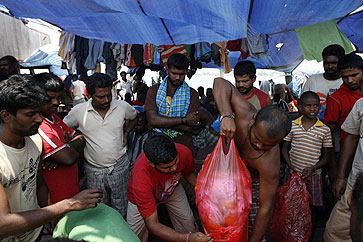
Rudd quickly moved to announce a radically reshaped immigration plan under which boatpeople could be resettled in PNG, sent home, or to a third country but not Australia. His new stance reinforces the notion that Australia wants to remain a white country.

Not white enough for Oz

Under the directive, those who pay people-smugglers to arrive on unauthorised boats will be sent to the poor Pacific nation for processing and resettled there even if found to be genuine refugees.

“On the question of asylum-seekers… we’ve had to adjust our policy over time and I make absolutely no apology whatsoever for our current policy settings because the world around us has changed,” Rudd told Channel Ten.

Rudd, who was last month reinstalled as prime minister by his Labour colleagues to help turn around dire polls in an election year, had previously softened some of the former conservative government’s policies.

The plan has worried the United Nations refugee agency which said on Friday that conditions at Papua New Guinea’s Manus Island facility currently failed to adequately protect refugees.

“UNHCR is troubled by the current absence of adequate protection standards and safeguards for asylum-seekers and refugees in Papua New Guinea,” it said in its first assessment of the policy.

Australia resumed sending asylum-seekers to Manus Island and the Pacific state of Nauru in 2012 in a bid to deter record numbers of migrants arriving by boat, hundreds of whom drowned en route.

Rudd has said the new PNG policy will take some time to deter asylum-seekers, but since he announced the change just over a week ago more than 1 300 have arrived on boats.

‘You will not be settled in Australia’

“It is the implementation of that policy direction over time, resolutely, which will yield results,” he told Network Ten’s Bolt Report.

“In the interim, people smugglers will test your resolve.”

Asylum-seekers are a sensitive issue in Australia, and one set to feature prominently in the election due this year.

Rudd said while people-smugglers, who make thousands of dollars bringing asylum-seekers to Australia, would test the government’s resolve “we are not for turning”.

“Our policy is very clear… you will not be settled in Australia,” Rudd said. AFP

Oz lauds ‘Asian Century’

Julia Gillard has committed to 25 far-reaching goals over the next 13 years designed to tighten links with Asia and ensure that Australians are able to exploit the region’s “staggering” growth.

The measures, outlined in a report by a government-appointed taskforce, include offering thousands of scholarships to Asian students, new diplomatic posts across the region and requiring that a third of all company directors and senior civil servants have a “deep knowledge” of Asia. In addition, every schoolchild will be able to learn one of four “priority” languages: Chinese, Hindi, Japanese and Indonesian.

Ms Gillard said the “unstoppable” rise of Asia and its massive new urban middle class was “a transformation as profound as any that have defined Australia throughout our history”.

“This is good news for Australia and it should drive a profound change in our thinking about our economic relationship with Asia,” she said.

Under the long-awaited plan all schools will be partnered with schools in Asia and television stations will be encouraged to present more Asian news and programs. “Children in kindergarten now will graduate from high school with a sound working knowledge of Asia,” Ms Gillard said.

Australia has greatly benefited from the past decade of growth across Asia, which has triggered a mining boom and helped to shield the nation from the impact of the global financial crisis.

But there are growing concerns that the mining boom may have peaked and that Australia needs to find other ways to benefit from Asia’s rising prosperity.

Ms Gillard said Australia should not seek to lower wages or working conditions to try to compete with the Asian workforce but instead should boost the country’s skills and promote tourism, education and agriculture to the growing middle class, particularly in China.

“Think of it this way: back in the 80s Fosters beer tried to get into China,” Ms Gillard said. “Today it is Grange [one of Australia’s most expensive wines] carrying the flag.”

Critics largely welcomed the push for closer links with Asia but said it came too late. “The Asian century is already well underway – shouldn’t we have been planning for that quite a while ago?” Adrian Vickers, Asian Studies director at the University of Sydney, told ABC Radio.

“I think we’ve got a lot of catching up to do… The rapid advances in technology, in social change, in political change in Asia are things that we are struggling to keep up with as a nation.”

Professor Andrew MacIntyre, from the Australian National University, said the plan was visionary and would help Australia to adjust to a “new phase we are going into”.

“The scale of the change and the momentum of the change now is so huge,” he told the Daily Telegraph. “Australia has to adapt. We need to lift because the pace of change is not slowing down.”