An estimated 35 million migrants heading for Europe

Shock estimates predict up to 35 million refugees could head for Europe due to hugely unstable situations across the world.

The huge figure was revealed today by Hungary’s minister for foreign affairs and trade Peter Szijjártó.

Speaking as the country begins work on its second fence to stop migrants heading across its border he predicted the current crisis will continue for years.

Mr Szijjártó told the Hungarian Times: “The name of the fence is ‘Temporary Security Border Fence’ but I think there is no question that in this case temporary means years.

“It’s a self delusion to call this situation a migration crisis; it is a massive migration of nations, with inexhaustible reserves.

“I don’t think that the analysis results, stating that 30-35 million people out there could possibly become migrants, would be an exaggeration.

“Libya, Yemen, Syria, Iraq and Afghanistan are all countries with a huge population and an extremely unstable situation.”

The Hungarian government also defended itself from criticism over its fences.

The first barrier was put up at its border with Serbia but, after migrants changed their route, they have now begun erecting a 41 kilometre fence at Croatia.

Migrants look to break through to Hungary as that sees them enter the European Union’s Schengen Zone which offers free movement between member countries.

He said: “The recent international political decisions created an unstable situation around Europe that makes sure that the amount of people won’t decrease.

“This is why it’s extremely important to protect our borders.

“This issue wasn’t this important until now, so the European Union neglected it a little bit.

“It became clear that – though its the border of Schengen – Greece couldn’t protect the border of the European Union.

“The Hungarian/Serbian border is another border of Schengen. If we want to follow the orders of Schengen, we have to build a physical obstruction, because this 175 km long area is quite easy to cross.

“The European Union just realised what the Schengen border means.

“If we want to keep the freedom of movement in the European Union, we have to protect the outer borders.”

Source: Express
Japan allows eleven asylum seekers

Last year Japan granted nearly twice as many people asylum as in 2013. The increase was not by any means spectacular.

In 2013 the country approved six applications for asylum, and in 2014 the number rose to eleven.

Japan, the third largest economy in the world, has long been known for its strict asylum policy.

But the country is becoming more popular. Early last year, a record number of 5,000 people applied for asylum. Only eleven applications, about 0.2 percent, were approved.

Worldwide, an average of 32 percent is accepted as asylum seekers.

Lawyers and activists complain about the low numbers in Japan. The country does not do enough to protect them as refugees. There are hardly any facilities for housing and the system for applying for a residence permit is no good, they say.

A spokesman for the Japanese authorities that many asylum seekers are not political, but economic refugees. “In countries such as Nepal and Sri Lanka, many people think they can find a job in Japan.”

One dead after migrants storm Eurotunnel

At least 1,500 migrants desperate to reach England made new attempts to enter the Eurotunnel terminal overnight in the French port town of Calais, a police source said Wednesday, adding that one person was found dead.

“Our team found a corpse this morning and the firefighters have confirmed the death of this person,” added a spokesman for Eurotunnel.

The migrant, a man of Sudanese origin believed to be aged between 25 and 30, was hit by a truck that was leaving a cross-Channel ferry, the police source said.

The latest fatality brings the number of migrants who died near the Channel Tunnel terminal site to nine since June. It comes a day after some 2,000 migrants were pushed back near the terminal entrance, in the largest single attempt to enter the tunnel linking France to Britain.

Calais, where the French end of the Channel Tunnel is located, has seen an explosion in recent years in the number of migrants, who live mainly in makeshift camps in the port city after fleeing war and poverty from countries including Eritrea, Libya and Syria.

The situation in Calais has been exacerbated by strikes by workers and farmers in the region, causing further disruption at the key port.

British police last week raised their estimate of the number of migrants in Calais to 5,000 from 3,000, with thousands of attempts made each day to board lorries and trains headed to the UK.

Authorities stopped more than 8,000 attempts at crossing the Channel over a six-week period in June and July, according to the British interior ministry.

British Prime Minister David Cameron on Wednesday expressed concern over the worsening crisis.

“This is very concerning,” he told reporters during a visit in Singapore, adding that “we are working very closely” with French authorities to address the situation.

Increasing Paris-London tension

The Calais encampments have soured relations between Britain and France, which blame each other for failing to cope with the crisis.

The mayor of Calais, Natacha Bouchart, has threatened to shut down the port if Britain does not do more to tackle the crisis. A report by the French interior ministry released earlier this month criticised a lack of cooperation between the UK and France on sharing information and resources.

Another Eurotunnel spokesman said later on Tuesday: “This is an issue that is a really for the government to sort out. We need them to stop the migrant flow from Calais but it appears to be too much for them to handle.”

Last week Eurotunnel said it would demand nearly €10 million from the French and British governments to help cover the extra security costs involved in combatting the flow of migrants.

French Interior Minister Bernard Cazeneuve and British Home Secretary Theresa May held a UK-France summit Tuesday in London to discuss the ongoing crisis.

“The French and UK governments are working in close collaboration on this issue which affects us both,” said May following the talks with Cazeneuve.

The UK minister said that intelligence and law enforcement specialists will be posted to combat the “terrible” gangs of people smugglers “making a profit out of human misery”.

France and Britain also vowed to work together to return migrants, mainly to West Africa, “to ensure that people see that making this journey does not lead to them coming to Europe and being able to settle”, May added.

The Conservative government minister also announced an extra £7 million ((€10.8 million) for security at Coquelles, the French suburb which is home to the Eurotunnel terminal, which is in addition to the £15 million already pledged.

Source: France24/AFP/Reuters

German cop probed for ‘immigrant abuse’

German prosecutors are investigating a police officer who allegedly abused two immigrants, strangling an Afghan man and forcing a Moroccan to eat pork off the floor.

The police officer has been accused of bragging about the brutal assaults in text messages and photos he sent via instant messaging service WhatsApp to his colleagues in the western city of Hanover.

Human rights group Pro Asyl condemned the alleged incidents, first reported by public broadcaster NDR, for their “appalling level of racism and inhumanity” and demanded a probe into how many “accomplices in police uniform” knew of the violence.

Prosecutors are investigating the officer, who has been suspended, on charges of physical assault and illegal weapons possession and have searched his home and work place.

In the first alleged case, in March last year, the officer had bragged in a text message about beating, strangling and sticking his fingers up the nose of a 29-year-old Afghan man whose feet were cuffed after he was detained for not carrying ID papers.

“It was funny … squealed like a pig,” the officer allegedly wrote on WhatsApp. “It was a present from Allah.”

In the second case, months later, the officer allegedly targeted a 19-year-old Moroccan man, who had been detained for travelling on a train without a ticket, carrying a small amount of marijuana.

NDR reported that the policeman bragged about how he assaulted and then humiliated the young man by forcing him to eat minced pork off the floor.

A photo allegedly sent by the officer shows a handcuffed man lying on the floor, wincing in pain, and apparently restrained by at least two officers.

Germany has become Europe’s top destination for people fleeing war and poverty. Last year, asylum requests rose 60 percent to more than 200,000, and the government expects that number to more than double this year.

Source: AFP

‘SA clogged by economic migrants’

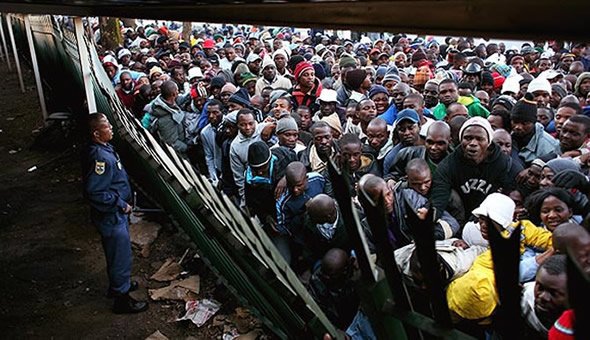
Only 12% of the more than 75,000 asylum seekers who applied for refugee status in SA last year were successful, a sign that the system was being clogged up by economic migrants without a political claim to stay in the country.

Deputy director-general of home affairs Thulani Mavuso told Parliament’s portfolio committee on home affairs on Tuesday that the department would this year seek to amend the Refugee Act of 1998 to speed up the processing of asylum applications.

Recurring violence against foreigners has placed policy makers under pressure to address the presence of large numbers of migrants competing with locals in low-skill jobs and small-scale business enterprises.

The Refugee Act, which is based on the Geneva Conventions, gives every individual from no matter where an opportunity to present their case for asylum. Large numbers of applicants and cumbersome appeal processes have meant that asylum seekers without a legitimate claim can legally live and work in SA for many years while their applications are adjudicated.

Last year the highest number of those granted refugee status came from Ethiopia, (3,041), Somalia (2,903) and the Democratic Republic of the Congo (2,321).

“(Most) asylum seekers fell outside of the definition of a refugee. These are instances of economic migrants with low-end skills (seeking livelihoods),” said Mr Mavuso.

According to the BBC: “Official data suggests there are about two million foreign nationals in South Africa” but that “some estimates put the number of immigrants at five million”.

Source: Business Day

Man arrested for human trafficking

A man was arrested in Mentz village near Mankweng in Polokwane on Monday for alleged human trafficking, Limpopo police said.

The man, 27, who was not from South Africa, allegedly brought 19 men, all foreign nationals, across the border into South Africa and locked them in a storeroom in Mentz village, spokesperson Lieutenant Colonel Malesela Ledwaba said.

“The police swiftly went to the spaza shop store room, acting on a tip off and managed to find the 19 foreigners, who were locked in,” he said.

“The country of origin of the suspect together with that of the 19 men is still to be confirmed.”

The 27-year-old was expected to appear in the Mankweng Magistrates Court soon.

In April, at least seven people, including three South Africans, were killed in xenophobic violence that occurred in parts of KwaZulu-Natal and Gauteng.

Biggest political upset in the Netherlands after asylum announcement

The political upset this week does not come from France, where Marine Le Pen came out stronger in local elections, but from the Netherlands.

The largest party, the liberal VVD has announced that it wants to abolish asylum completely for non-Europeans, meaning black Africans.

The VVD wants to convince other European parties in Europe to adopt a new ‘Fortress Europe’ policy.

This is the first time that a European mainstream party is adopting an openly anti-immigration stance. The proposal is that African countries should rather receive asylum seekers.

Ostensibly the party is worried about “drownings” when tens of thousands of Africans perish at sea in the hazardous journey to Europe.

Last year some 3000 drowned and the VVD says it wants to put an end to this. The real reason is that vast majority of people making it to Europe won’t get asylum, but as illegals they soon join the crime circuit.

During the recent Staten elections, the main voice for immigration and a multicultural hodge-podge, the PvdA, lost the election decisively.

The idea to “shelter refugees in their own region” actually calls the bluff of the European asylum-industry.

Not a single economic refugee will travel to Morocco, Ethiopia, Tanzania and other “designated safe countries”, for the simple reason that hand-outs don’t exist in these countries.

The VVD for the first time is siding with parties like the Front National and the PVV.

Sweden offers to question Assange in London

Swedish prosecutors have asked for WikiLeaks founder Julian Assange’s approval to question him in London where he is currently holed up in the Ecuadorian embassy, the prosecutors said on Friday.

The prosecutor is also asking to conduct a DNA test.

Assange has been stuck inside the South American country’s London embassy since June 2012 to avoid a British extradition to Sweden. Sweden wants to question him on allegations of sexual assault and rape, which he denies.

The Australian says he fears that if Britain extradited him to Sweden he would then be extradited to the United States where he could be tried for one of the largest information leaks in U.S. history.

Source: The Globe and Mail

Snowden wants asylum in Switzerland

US National Security Agency (NSA) leaker Edward Snowden, who has been living in Russia since mid-2013, on Friday made a public appeal for asylum in Switzerland, where he said he once worked under diplomatic cover for the Central Intelligence Agency (CIA).

“I would love to return to Switzerland, some of my favourite memories are from Geneva. It’s a wonderful place,” he told a Moscow-Geneva videoconference. “I do think Switzerland would be a sort of great political option because it has a history of neutrality.”

US prosecutors accuse Snowden of leaking information on US National Security Agency (NSA) secret surveillance programs to mainstream media.

In 2013, he was granted a temporary asylum in Russia after spending more than a month in the transit zone of Moscow’s Sheremetyevo airport.

In August 2014, as the asylum expired, Snowden received a three-year residency permit.

Canada approves asylum bid after ‘Shoot the Boer’

President Jacob Zuma’s singing of the refrain ”shoot the Boer” at an ANC event was among the reasons for the Canadian Federal Court ruling that a white South African couple could continue with their bid for asylum.

Though Charl and Naira Nel have not directly been victims of crime in this country, they say they fear genocide and rape here.

Aggravating their anxiety was Zuma’s performance of a struggle song two years ago and Julius Malema’s rendition of Dubul’Ibhunu (Shoot the Boer). The song Malema sang was declared hate speech by the Equality Court in 2011. Malema was president of the ANC Youth League at the time.

The Zuma song, at the ANC centenary celebrations in 2012, was Dubula ngembayimbayi(Shoot with a machine gun). The president sang the refrain ”shoot the Boer” several times during his rendition.

The Nels left South Africa in 2010 and applied for refugee status in Canada. They sought the assistance of Russell Kaplan, a South African expatriate lawyer who had helped white Capetonian Brandon Huntley in his fight for asylum.

In June, the federal court upheld the board’s decision to deny Huntley refugee status. He had sought asylum in 2008, claiming that he had been assaulted by black South Africans.

The board granted him refugee status in 2009 but the decision was found to be “unreasonable” on judicial review.

In their application, the Nels said ”crimes against white people frequently involved mutilation and brutality, even when nothing was stolen; they observed that political leaders had sung songs about killing white people even after a South African court had declared the song racist. They submitted expert evidence by a reporter, Adriana Stuijt, and the president of Genocide Watch, Dr Gregory Stanton, indicating these crimes were racially motivated.”

But the board refused the couple’s application, saying that although they expressed fear of persecution because they were white, it found “nothing had happened to them personally” and they were not in need of protection.

The Nels then approached the federal court.

On September 4, Judge John O’Keefe set aside the board’s decision and referred their case to another panel for reconsideration.

It is not known when this will be done.

Judge O’Keefe said: “… the board’s assessment of [ Nel’s] updated narrative is puzzling. In it, [he] said that he had become fearful of returning to South Africa because [Malema] had since sung an anti-apartheid song called Kill the Farmer, Shoot the Boer .

”Even after a South African court ruled that the song was hate speech, Malema continued to sing it and Zuma also sang it at the 100th anniversary of the ANC.

“Genocide Watch also updated the situation to stage six of the eight stages of genocide because of political shifts and warned white Afrikaners to leave South Africa,” the judge said.

”The board dismissed the updated narrative on the basis that these were not significant changes and concluded that it was only done with the intent of amplifying a situation of fear.

“However, it never explained why it felt the singing of this song by political leaders or the Genocide Watch opinion could not have legitimately inspired a further subjective fear of political persecution in the applicants.”

Kaplan told the Canadian Post: ”This is the first time the Federal Court of Canada has awarded a white South African with a favourable decision – a big step.”

From 2006 to June 2014, 151 South Africans applied for asylum. Only 23 applications were accepted.

Source: Timeslive

Swiss could grant Snowden asylum

Switzerland has reportedly decided it will not extradite National Security Agency whistleblower Edward Snowden to the US if he comes to testify against the NSA’s spying activities, Swiss media said.

It has been revealed that trade secrets from other nations are not safe with the NSA. Snowden suggested earlier that the United States conducted espionage to prevent losing its economic prowess to other countries.

In the document, titled “What rules are to be followed if Edward Snowden is brought to Switzerland and then the United States makes an extradition request,” Switzerland’s Attorney General stated that Snowden should be guaranteed safety if he arrives to the country to testify, Sonntags Zeitung reported.

In particular, the report proposes to ensure the whistleblower’s safety by inviting him as a witness to a parliamentary hearing focusing on the NSA’s surveillance practices.

In the document, the authority said that Switzerland does not extradite a US citizen, if the individual’s “actions constitute a political offense, or if the request has been politically motivated,” Swiss ATS news agency reported.

Snowden’s safety can thus be guaranteed if it is ruled that the charges against him have a “predominantly political character,” the document concluded.

The only obstacle for that could be “higher-level government commitments,” the Office of the Attorney General said, adding that it must be verified if such obligations do, in fact, exist.

The document was reportedly requested last November.

Snowden’s Swiss lawyer, Marcel Bosonnet, said he is pleased with the Attorney General’s conclusions.

“The legal requirements for safety are met,” he assured, adding that Snowden has already showed interest in testifying.

Immigration rights activist Sarah Progin-Theuerkauf hinted that Snowden might even have a shot at Swiss asylum following the proposed testimony.

“There is evidence that Edward Snowden meets the criteria of refugee status under the Geneva Convention and therefore should be granted asylum,” she told Sonntags Zeitung.

Swiss politicians meanwhile are calling to welcome Snowden to Switzerland as soon as possible.

“We must now move forward, so that Snowden can travel to Switzerland as a witness as soon as possible,” SVP National Luzi Stamm said, adding that the Swiss people have the right to know the truth behind the extent of US spying activities.

Over the past year, Snowden has been the recipient of the German ‘Whistleblower Prize,’ the Sam Adams Award which was presented to him in Moscow, the German ‘positive’ Big Brother Award, the Ridenhour Truth-Telling Prize, and the Fritz Bauer Prize.

He also joined the board of directors of the Freedom of the Press Foundation, co-founded by Daniel Ellsberg, and was elected in absentia as rector of the University of Glasgow.

Source: RT

Snowden granted 3-yr residence permit in Russia – lawyer

Edward Snowden has received a residence permit in Russia, which is valid for three years, starting on August 1, the former NSA contractor’s lawyer announced.

Snowden’s life in Russia: ‘Much happier than be unfairly tried in US’

“On the first of August he received a three-year residence permit,” lawyer Anatoly Kucherena told reporters.

He added that Snowden had not asked for political asylum.

“He will be able to travel freely within the country and go abroad. He’ll be able to stay abroad for not longer than three months,” Kucherena said.

The former NSA contractor will be able to apply for the Russian citizenship in five years.

“A foreign citizen, who got a residence permit, will certainly be able to apply for citizenship,” Kucherena said.

Edward Snowden has not yet made up his mind whether he wants Russian citizenship.

“By all means he is homesick,” his lawyer said. “It was hard for him to find himself far from home, especially for the first time. Of course, in the future Edward will make up his mind on whether to stay in Russia and apply for citizenship or to leave for the US. He hasn’t done this yet.”

Edward Snowden was granted temporary asylum in Russia a year ago. It expired July 31.

He left the US and went to Hong Kong in May 2013, from where he leaked confidential files to mass media concerning the NSA’s overwhelming surveillance.

Snowden then planned to seek refuge in Cuba, but found himself stranded at Moscow’s Sheremetyevo airport, after his American passport was annulled by US authorities.

Kucherena dismissed a letter from the US Prosecutor General’s office to the Russian Ministry of Justice as insufficient grounds for handing Snowden over to the US.

“There has been no request which complies with international law,” the lawyer said.

If Edward Snowden does one day travel back to the US, it’s not going to be extradition, his lawyer assured.

“No extradition is possible under Russian law,” he said. “He has not committed any crime. He faces no charges in Russia.”

Snowden’s security in Russia is being ensured by a private firm, Kucherena said.

“He’s without state protection and he can’t possibly have it. To arrange state protection you have to go through many bureaucratic procedures.”

Kucherena also told reporters that Snowden was satisfied with his job in Russia, as he was able to continue his profession and work in the sphere of computer technology. The former NSA contractor’s Russian salary is adequate, the lawyer added.

The lawyer said Snowden will hold a press conference in Russia as soon as it will be possible. – RT.COM

US-Russia ties damaged, not wrecked by Snowden row

Putin and Obama
Putin and Obama

by Olga Nedbaeva, Victoria Loguinova-Yakovleva

Russia’s awarding of asylum to US leaker Edward Snowden dealt a new blow to already bruised relations between Moscow and Washington but it remains in their interest to prevent the row from erupting into a Cold-War style crisis, analysts said.

Washington immediately rebuked Moscow for granting one year asylum to a man the United States wants to put on trial for leaking details of a vast US intelligence programme.

The White House said it was “extremely disappointed” and, perhaps more significantly, said the decision had called into question the need for a planned bilateral summit between Vladimir Putin and Barack Obama in September.

The dispute could barely come at a worse time in Russia-US relations with Washington deeply critical of rights violations under Putin’s rule and the two sides at odds over the conflict in Syria.

Yet in over two decades since the collapse of the Soviet Union, Russia and the United States already have a chequered history of cyclical ups and downs in relations and the blow of the Snowden row may not be terminal, analysts said.

“A cancellation of the meeting between Obama and Putin would be evidence of a serious complication in relations,” said Maria Lipman of the Carnegie Centre in Moscow.

“But it would be wrong to say that relations are collapsing,” she added, noting that one of Obama’s priorities remained agreeing more arms cuts with Russia.

“There is a risk that Obama could lose interest in relations with Russia but even in this case it is not fatal,” she told AFP.

Putin has tried to distance himself from the entire Snowden affair, declaring on July 17 that “relations between states are much more important than squabbles surrounding the work of security services.”

Minutes after the asylum decision was made public on Thursday, Putin’s foreign policy advisor Yury Ushakov rushed to describe the Snowden issue as “rather insignificant” and arguing it should not affect relations.

The Kremlin had repeatedly argued that it did not invite Snowden to come to Russia and his arrival on June 23 at Moscow’s Sheremetyevo airport from Hong Kong was completely unexpected.

“Russia did not need the Snowden problem but it happened,” said Valery Garbuzov of the US-Canada Institute in Moscow.

“The Russian leadership had to react — it would have been inhumane to hand him over but giving asylum also complicates relations,” he said.

In a strong sign that contacts have not been ruptured, US ambassador to Moscow Michael McFaul met Ushakov Friday for talks on issues including the “new status” of Snowden as well as Syria and missile defence, the American embassy said.

Obama is due to visit Russia in any case in early September to attend the G20 summit in Saint Petersburg.

But he had been expected to come to Moscow for a separate one-on-one meeting with Putin which would be the first bilateral summit between the two men since the Russian strongman returned to the Kremlin for a third term in May 2012.

Until now, they have only held brief meetings on the sidelines of international summits.

Fyodor Lukyanov, editor of the journal Russia in Global Affairs, said it was still possible that Obama could undertake the Moscow visit although he would risk domestic criticism.

“Putin has tried to distance himself from the Snowden affair and has always emphasised that Russia is a victim of circumstances,” he said.

He said that any “retaliation from the United States will only have symbolic character”.

Republican US Senator John McCain had said after the granting of asylum to Snowden that it was time to “fundamentally rethink our relationship” and take tough action against Moscow.

But Lipman said that Putin’s statements on the Snowden affair had shown that the Kremlin chief still had an interest in preserving relations with Russia.

“Other solutions were sought, including sending him to another country. Putin did not strive for Snowden to come to Russia,” she added. – AFP

Snowden has found a place to stay in Russia

Edward Snowden
Edward Snowden

The Russian lawyer for Edward Snowden says the National Security Agency leaker has determined where he will live, but is still figuring out what he will do during his stay in Russia.

Russia granted Snowden temporary asylum on Thursday, allowing him to leave the Moscow airport where he had been holed up for almost six weeks. He can now remain in Russia for at least a year as he evades charges of espionage in the United States.

His lawyer, Anatoly Kucherena, told Russian news agencies on Friday that Snowden “is in a safe place,” but the location will remain secret out of concerns for his security. Kucherena says as soon as Snowden decides what he will do in Russia, he will announce his decision himself. – AP