We have ‘higher cultural standard’: Japanese FM on coronavirus outcome

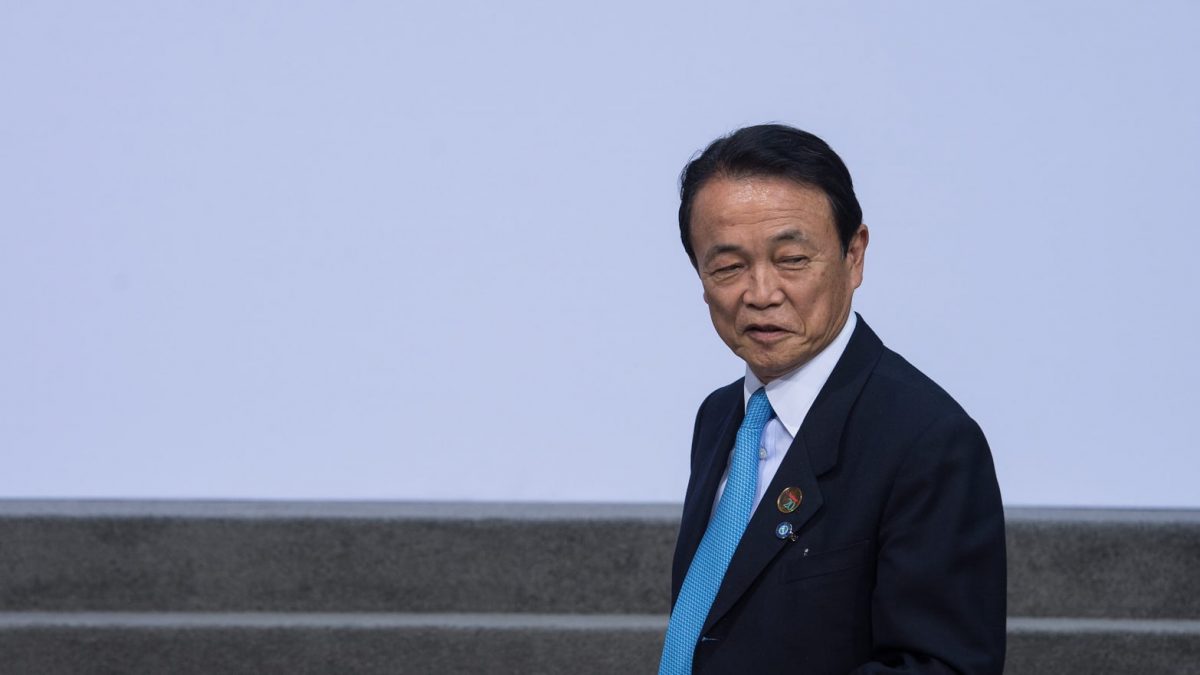
Japan’s success against the coronavirus without enforcing a strict lockdown is due to the citizens’ “cultural standard” that is different from other nations, Finance Minister Taro Aso said, drawing criticism from the public that the comments were inappropriate.

“Other countries have called me up and asked me if we’re the only ones with some drug against the virus or something,” Aso said on Thursday in response to a question from a lawmaker on Japan’s reputation of successfully containing the pandemic. “When I tell them ‘our country’s cultural standard levels are different to yours,’ they’re left speechless. That’s the simplest way to put an end to the questions.”

Despite the lack of harsh measures, Japan suffered far fewer coronavirus infections than any of its Group of Seven peers, with about 7 deaths per million, a track record that Aso noted in his comments. Japan isn’t an exception though in Asia, with Taiwan and South Korea reporting lower mortality rates. —Bloomberg

Read the full article here.

Hitachi case exposes fronting by ANC

South Africa has been fingered in the alleged “improper payments” originating from contracts that the ANC’s investment arm, Chancellor House, for work at the Medupi and Kusile power stations.

As a signatory of the OECD Convention which is aimed at combatting fraud in international business transactions by foreign officials [OECD Convention on Combating Bribery of Foreign Public Officials in International Business Transactions], South Africa’s failure to do so, has been exposed at the highest levels.

It appears however that the ANC has also transgressed their own Broad Based Black Economic Empowerment Act by making use of “fronting” to take money for awarding lucrative contracts to Hitachi.

These observations have been made by the American investment watchdog, the Securities and Exchange Commission (SEC) which described Chancellor House Holdings as a “front” through which the ANC could make money from the contracts with the Japanese group Hitachi in South Africa.

The OECD meanwhile released a damming report at the end of last year about South Africa’s unwillingness to act against international bribery and corruption and the finger is pointed directly at the ANC government.

The title of the report is: ‘Phase 3 Report on Implementing the OECD Anti-Bribery Convention in South-Africa’. The subheading reads: ‘Lack of enforcement jeopardises South Africa’s fight against foreign bribery; OECD concerned that political an economic considerations may be an influence’.

On page 9 of the report of 87 pages, it is stated, amongst others, (under the caption of Bribery of Foreign Public Officials):

‘Corruption remains a serious problem in South Africa. The country has experienced a number of high profile domestic corruption scandals, and corruption allegations have been linked to the highest levels in government.’

Also: ‘Corruption in public procurement tenders has been a particularly serious problem…’. It mentions that the Head of the Special Investigative Unit (SIU) had already reported to Parliament in 2011 about the fact that between R25 and R30 billion – approximately 20% of the country’s total annual procurement budget had been lost due to ‘corruption, incompetence and negligence’.

Japan allows eleven asylum seekers

Last year Japan granted nearly twice as many people asylum as in 2013. The increase was not by any means spectacular.

In 2013 the country approved six applications for asylum, and in 2014 the number rose to eleven.

Japan, the third largest economy in the world, has long been known for its strict asylum policy.

But the country is becoming more popular. Early last year, a record number of 5,000 people applied for asylum. Only eleven applications, about 0.2 percent, were approved.

Worldwide, an average of 32 percent is accepted as asylum seekers.

Lawyers and activists complain about the low numbers in Japan. The country does not do enough to protect them as refugees. There are hardly any facilities for housing and the system for applying for a residence permit is no good, they say.

A spokesman for the Japanese authorities that many asylum seekers are not political, but economic refugees. “In countries such as Nepal and Sri Lanka, many people think they can find a job in Japan.”

French media call G7 ‘idiots’

Nicolas Bonnal of Boulevard Voltaire believes Russia is lucky that it wasn’t invited to the G7 summit this year, comparing the group to the company of hypocritical “idiots.”

As the West is reaching new heights of absurdity, Russia should be happy that it didn’t end up in the company of “idiots,” Nicolas Bonnal said in Boulevard Voltaire.

Russia certainly shouldn’t be ashamed of not being invited to the G7 summit this year. The group of the richest Western nations gathered in Germany, without Russia and China, but with “Italy and its crowds of Libyan refugees,” Bonnal said, comparing the summit akin to being in a luxurious hotel up in mountains, but with non-alcoholic beer.

Even Ethiopia was invited to attend the summit, but not Russia. Russia was punished for not dancing to Washington’s tune.

Moscow was put in a corner for the alleged aggression against Ukraine and the lack of respect for human rights, the author said.

Meanwhile, the United States has 2.2 million prisoners, Guantanamo Bay and the Patriot Act, 1,200 victims of police brutality and over a million people killed because of drug-related gang wars.

American neoconservatives started a series of atrocious wars in Libya, Iraq, and Syria in their “irrational and even frightening desire to harm,” Bonnal said.

The contemporary G7, which was originally seen as the collection of the world’s largest economies, lacks not only Russia, but also China, India and Brazil. Currently, the group consists of the United States, Germany, Britain, France, Japan, Canada and Italy. And almost no economic growth.

Source: Sputnik News

Yuan inclusion in SDR basket inevitable

An integrated Eurasian block will dominate the world. The Chinese are acting upon that insight.

The IMF is due to re-examine the composition of its currency basket for Special Drawing Rights, a foreign-exchange reserve asset for fund members, later this year says Zhao Yongsheng.

“Our assessment now is that the substantial real effective appreciation [of the yuan] over the past year has brought the exchange rate to a level that is no longer undervalued,” the IMF said last week after it concluded its 2015 Article IV Consultation Mission to China.

Does this mean that the yuan is about to be included in the SDR currency basket? We can consider a “signal” sent by IMF Managing Director Christine Lagarde during a speech at Fudan University in Shanghai in March: “It’s not a question of if, it’s a question of when.”

Her speech, and the IMF’s announcement, indicate that the yuan is quite likely to be included in the SDR basket when it is reviewed this year.

But merely joining the SDR basket is not the only important step for the yuan, even if it is already a significant development in the currency’s internationalization.

Actually, the inclusion of the yuan in the SDR basket is not just a question of “if” or “when,” but a question of “how much.”

Let’s look first at the composition of the SDR basket, which now includes the four strongest currencies in the world: the dollar, euro, yen and British pound.

When the SDR was launched in 1981, the shares for the five currencies in the basket were 42 percent, 19 percent, 13 percent, 13 percent and 13 percent for the dollar, Deutsche mark, French franc, yen and pound, respectively. The basket is adjusted every five years.

Looking at this original composition, we can divide the basket’s basic structure into two blocks: the “Deutsche mark-French franc block” (or the “euro block” after the adoption of the European single currency in 2001) and the “dollar-pound-yen block.”

This division is based on differences in culture, historical links and even military relationships.

It is true that Germany and France are not the same, as one is a Germanic culture and the other is a French or half-Latin culture.

Nevertheless, these countries had no choice but to work together to establish and expand the European Union. Especially since the birth of the euro, monetary and financial relations between Germany and France have become closer. They are both countries of Europe’s continental culture.

For their part, the UK and US share an “Anglo-Saxon” culture, and their relationship is that of siblings. With regard to Japan, it has close links to the US due to its post-WWII occupation and rebuilding by the US. That’s why we put these three countries and their currencies together.

Originally, the combined share of the mark and franc was 32 percent.

Even if we assume this European continental culture block increased to 37.4 percent for 2011-15, it would still lag far behind the dollar-pound-yen block, which stands at 62.6 percent for the same period.

How can we maintain balance in the SDR basket?

Balance is essential for any game with multiple players, and that is also true of currency baskets.

In the case of the above division, obviously the gap of 25.2 percentage points between two blocks is too huge to be good for stability.

If we assume a share of 10 percent for the yuan in the SDR basket, the euro plus the yuan will make up 47.4 percent of the basket, against a new share for the dollar-pound-yen block of 52.6 percent. Now, the gap is not so large.

Why do we put the euro and yuan together? This implies the necessity for Europe to find another force to implicitly provide balance against the “American hegemony.”

The increasing closeness of Europe and China will be gradually reinforced with the adoption of China’s “One Belt, One Road” initiative and the operation of the China-initiated Asian Infrastructure Investment Bank.

This solution can also be a moderate and acceptable reform for the current players in the SDR basket, whatever their position, because even with the new composition, the dollar-pound-yen block will retain a dominant position with 5.2 percentage points more than the euro-yuan block.

Finally, in China’s pursuit of inclusion, France will play a major role – and not only because the IMF’s president is usually a French national.

It is also because France needs China, probably much more than do other countries, to recover from the lingering effects of the financial crisis and keep its economy growing.

Source:Global Times

The author is a Paris-based economist and vice-president of the Paris-based China-France Association of Lawyers and Economists. bizopinion@globaltimes.com.cn

Thousands march against US military presence in Japan

Thousands have been marching in Okinawa and across Japan in protest against the planned relocation of a US military base in Okinawa. The protesters criticized the Japanese government, who appear to be turning a deaf ear to the locals.

The protests began on Friday with about 1,200 people in Okinawa, as the island marked the 43rd anniversary of its reversion to Japanese sovereignty, and continued into Sunday gathering thousands of people.

“Even after our reversion, the problems of the bases remain unchanged,” Okinawa Governor Takeshi Onaga said at the protest, adding reversion of sovereignty had failed to bring Okinawans what they wanted.

“We’ve long suffered from the bases, and I’m angered by the outrageousness of both the US and Japanese governments in insisting a new base be built in Henoko,” Fujiko Matsuda, who heads a local citizens’ group, told the Japan Times.

“It is wrong to proceed with the Henoko relocation without listening to the voices of the Okinawans,” said another Okinawa resident, Atsuko Ikeda. “If we don’t prevent it, there is no future for Japan as a democratic nation.”

On Saturday, protestors marched around the US Futenma airbase in Ginowan city in Okinawa. About 2,600 people across Japan from Hokkaido to Nagasaki also took to the streets to voice their disapproval.

The activists shouted slogans, such as: “Oppose enhanced Japan-US defense ties”, “Bring back an Okinawa without US bases”, “The United States has to respect Okinawa people’s will”.

In the northeastern town of Henoko, hundreds of protesters scuffled with police outside new ‘Camp Schwab’. Several demonstrators were detained following the clashes.

On Sunday, about 35,000 people turned out to protest in the prefecture.

“No matter how long it might take, we will never give up our fight until the government gives it up,” said Keiichi Takara, director of the Confederation of Trade Unions Okinawa. “Through the rally, we will reaffirm our resolved commitment.”

According to mayor of Nago, Susumu Inamine, who opposes US military bases in Okinawa, “the government is thrusting their responsibility on us.”

“The government says we are to blame that the issue has stalled for 19 years and they tell us to find an alternative place (for the base). That’s outrageous,” he shouted into the crowd of protesters.

Marine biologist Katherine Musik said the rally “is absolutely tremendous.”

“Tens of thousands of voices, right now, shouting together, ‘NO’, in perfect harmony! ‘NO’ to the US military presence, how powerful! Let’s all shout, ‘Yes’ to the blue corals, red sea fans, orange clownfish, ‘Yes’ to the endangered dugongs in the sea, the endangered birds in the forest!”

There is a long history of incidents and alleged crimes committed by US soldiers in Okinawa. The current wave of anti-base sentiment on the island was sparked by a 1995 case, when three US marines were reported to have kidnapped and brutally raped a 12-year-old schoolgirl.

There were also less-publicized sex crime cases involving underage victims reported in 2001 and 2005, the fatal running over of a female high school student by a drunken US marine in 1998, and other crimes.

Japan invesigates drone ‘containing radiation’

Japanese authorities have launched an investigation after a small drone reportedly containing traces of radiation was found on the roof of the prime minister’s office, sparking concerns about drones and their possible use for terrorist attacks.

No injuries or damage was reported from the incident on Wednesday. The prime minister, Shinzo Abe, who is at present in Indonesia, works at the building during the day and commutes from his own private home roughly 15 minutes away.

Police said it was not immediately known who was responsible for the drone.

The significance was not immediately clear, but a Japanese court on Wednesday approved the restart of a nuclear power station, rejecting nuclear power safety worries in the wake of the 2011 Fukushima radiation disaster.

The chief cabinet secretary, Yoshihide Suga, said the incident was a wakeup call to the potential dangers of drones, including possible terror attacks when Japan hosts the 2020 Olympic Games in Tokyo.

It was not clear when the drone landed. It was found on Wednesday by an official who was reportedly taking new employees on a tour of the prime minister’s office in central Tokyo.

Source: The Guardian

Ministerial visits to Japanese nationalist shrine provoke Chinese ire

Three nationalist ministers in Japan’s cabinet paid homage at a war shrine hated by China Saturday, despite tentative signs of a thaw in Tokyo’s long-frozen relationship with Beijing.

The visits to Yasukuni by three of the five women in Prime Minister Shinzo Abe’s cabinet came as a fourth — the moderate daughter of a former premier — reportedly mulled resignation over a cash scandal.

They also come after what appeared to be a breakthrough in Sino-Japanese ties, with a handshake between Abe and Chinese Prime Minister Li Keqiang on the sidelines of an international gathering in Italy.

Abe has set his sights on a summit with Chinese President Xi Jinping — his first — when Beijing hosts a meeting of the Asia Pacific Economic Cooperation bloc (APEC) next month, and had been talking up the head-to-head in the hope of bouncing China into the meeting.

But a mass visit to Yasukuni on Friday by 110 lawmakers provoked a rebuke from Beijing.

Then in what has become a standard way for China to signal its annoyance with Japan, official Chinese ships were Saturday sent into waters around islands at the centre of a long-running territorial dispute between the two.

The pilgrimage to Yasukuni by three of Abe’s ministers — all well-known for their strident nationalist views — will likely do little to curry favour abroad, including in key ally the United States, but will play well with a core group of right wing supporters at home.

Internal Affairs and Communications Minister Sanae Takaichi, who was first to the shrine on Saturday morning, made international headlines last month when a picture emerged of her standing alongside the leader of a domestic neo-Nazi party.

National Public Safety Commission chief Eriko Yamatani, who has also been pictured with fringe right-wingers, and Haruko Arimura, the state minister in charge of female empowerment, also paid homage.

The 145-year-old Shinto shrine is the supposed repository of the souls of some 2.5 million citizens and soldiers who died in World War II and other conflicts.

It is controversial because they include senior figures in the WWII administration, such as General Hideki Tojo, who ordered the attack on Pearl Harbor.

It is seen as a symbol of Japan’s militarist past, and the continued observance of festivals there by public officials is taken as proof in neighbouring countries of Japan’s lack of repentance for its warring.

China lashed out Friday after the mass lawmakers’ visit, saying it was “gravely concerned” by the activity.

“China would like to reiterate that Sino-Japan relations can only realise healthy and stable development when Japan seriously faces up to and repents of its aggressive past and disassociates itself with militarism,” a statement said.

While China gets publicly annoyed by politicians’ visits to the shrine, it would likely react very strongly to the prime minister going to Yasukuni.

Since a trip in December 2013, Abe has stayed away, although he made offerings for the spring festival, on the war anniversary on August 15 and again on Friday.

He is thought unlikely to visit the shrine after he returns home Saturday from Italy.

Instead, he is likely to turn his attention to damage limitation in the wake of the cash-scandal that has erupted around one of his most popular ministers.

The loss of Yuko Obuchi, a telegenic mother-of-two who is in charge of Japan’s energy sector, would be a blow to his bid to convince Fukushima-scarred voters the country’s shuttered nuclear reactors are safe to turn back on.

Obuchi has told sources close to Abe that she intends to resign when the prime minister gets home, the Nikkei business daily reported.

That follows reports that her political funds have been misspent, including on make-up, theatre tickets for supporters and accessories.

However, after a feverish morning of speculation and rumour in Tokyo’s political world, Obuchi appeared to be rowing away from an immediate resignation.

“What I must do now is thoroughly investigate my own political fund,” she told reporters.

“I have no plans” to meet Abe, she said.

Washington is destroying the world

The aggressive and mindless stance that Washington’s warmongers have taken toward Russia and China have shattered the accomplishment of Reagan and Gorbachev.

Reagan and Gorbachev ended the cold war and removed the threat of nuclear armageddon. Now the neocons, the US budget-dependent (taxpayer dependent) US military/security complex, and the US politicians dependent on campaign funds from the military/security complex have resurrected the nuclear threat.

The corrupt and duplicitous Clinton regime broke the agreement that the George H.W. Bush administration gave Moscow in 1990. In exchange for Moscow permitting a reunified Germany to be a NATO member, Washington agreed that there would be no expansion of NATO to the east. Gorbachev, US Secretary of State James Baker, US ambassador to Moscow Jack Matlock, and declassified documents all testify to the fact that Moscow was assured that there would be no expansion of NATO into Eastern Europe.

In 1999 President Bill Clinton made a liar of the administration of President George H.W. Bush. The corrupt Clinton brought Poland, Hungary, and the newly formed Czech Republic into NATO.

President George W. Bush also made a liar out of his father, George H.W. Bush, and his father’s trusted Secretary of State, James Baker. “Dubya,” as the fool and drunkard is known, brought Estonia, Latvia, Lithuania, Slovenia, Slovakia, Bulgaria, and Romania into NATO in 2004. The corrupt and hopeless Obama regime added Albania and Croatia in 2009.

In other words, over the past 21 years three two-term US presidents have taught Moscow that the word of the US government is worthless.

Today Russia is surrounded by US and NATO military bases, with more to come in Ukraine (part of Russia for centuries), Georgia (part of Russia for centuries and the birthplace of Joseph Stalin), Montenegro, Macedonia, Bosnia-Herzegovina, and perhaps also Azerbaijan.

A large land expanse that was formerly part of the Soviet Empire is now part of Washington’s Empire. The “coming of democracy” simply meant the changing of masters.

Washington always picks the puppet who serves as Secretary General of NATO. The latest is a former Norwegian politician and prime minister, Jens Stoltenberg. On Washington’s orders, the puppet quickly antagonized Moscow with the statement that NATO has a powerful army that has a global policing role and can be deployed wherever Washington wishes. This claim is a total contradiction of NATO’s purpose and charter.

Igor Korochenko, a member of the Russian Defense Ministry Public Council replied to Washington’s puppet Stoltenberg: “Such statements run counter to the system of international security, as the NATO alliance poses a threat to Russia. Therefore, it will cause responsive measures.”

The responsive measures are what you would expect: enough nuclear capability to wipe out the United States and Europe many times over.

The arrogant fools in Washington, wallowing in their hubris as “the indispensable nation,” have provoked Moscow to the point that Russia now has more deployed nuclear weapons than the US. As a result of Washington breaking its word and putting ABM missile bases on Russia’s border, Russia has developed supersonic ICBMs that can rapidly change their trajectory and cannot be shot down by any missile defense system. Of course, the US corporations making billions of dollars selling Washington a useless ABM system will deny this.

Moreover, those countries, such as Poland, whose governments are sufficiently stupid to accept US ABM bases, would be obliterated before the bases could function. The utter stupidity of Eastern Europe’s bought-and-paid-for governments to put trust in Washington is likely to be the main cause of WW III.

The happy participant in the new Armageddon is the American military/security complex. These greedy bastards–”private corporations” whose revenues are entirely public funds– are guaranteed more money regardless of the potential cost in human life. Their US Senate spokesperson, Jim Inhofe, a member of the Senate Armed Services Subcommittee on Strategic Forces, has resurrected the argument from 60 years ago that America is falling behind in the arms race. Restarting the arms race is essential to the profits of the US military/security complex and to the campaign contributions of senators.

It is not only Russia’s strategic nuclear forces that the fools in Washington have revived and activated, but China’s as well. Last year China released a pictorial description of how China’s nuclear forces could destroy the US. This was China’s response to Washington’s insane plan of building new air and naval bases from the Philippines to Vietnam in order to control the flow of resources in the South China Sea. What kind of idiotic government does America have that thinks China is going to put up with this kind of interference in China’s sphere of influence?

China has now added to its nuclear arsenal a new variant of one of its mobile ICBMs. Washington does not know much about this new missile, because the CIA is too busy arranging protests in Hong Kong.

Both Russia and China were content to be part of the world economy and to improve the economic situation of their citizens by developing their economies. But along comes the neocon Unipower, a collection of arrogant psychopaths who declare that Washington will not permit any other country, not even Russia and China, to rise to a capability of exercising a foreign policy independent of Washington’s purposes.

Nuclear war is back into the picture. First Washington threatens those it perceives as rivals. When the perceived rivals don’t submit, Washington demonizes them.

In the histories written by Washington’s court historians, the greatest demons of modern times are the WW II governments of Japan and Germany along with the post-WW II Soviet government of Joseph Stalin. These American court historians ignore the facts.

Japan was forced into war by Washington, which cut off Japan’s access to resources. Japan was then nuked twice while the Japanese government was trying to surrender.

All of US president Woodrow Wilson’s promises made to Germany in order to end WW I, such as no territorial loses and no reparations, were broken. Germany was torn apart and German territory was handed over to Poland, France, and Czechoslovakia. Despite US president Woodrow Wilson’s promise to the contrary, impossible reparations were imposed on Germany by the Treaty of Versailles. The prescient John Maynard Keynes declared that the reparations would result in a second world war. If memory serves, portions of Germany were also given to Belgium, Lithuania, and Denmark.

This humiliation of an industrious and powerful people, whose armies occupied foreign territories when WW I ended, demonstrated the mendacity of the so-called “Western powers.” The French, British, and Americans paved the way for Adolph Hitler. By 1935 Hitler was sufficiently ensconced to denounce the Versailles Treaty. If Hitler had not succumbed to hubris and sent the German armies marching off into Russia where they were destroyed, he, or his successors, would still be ruling Europe today.

The true history is so different from what Washington pretends and Americans are taught. The majority of Americans are blind enablers of Washington’s war on the world. If ebola and global warming don’t destroy humanity, the ignorance of the American people and Washington’s war for world hegemony surely will.

Black fashion fades in Tokyo

A shrinking group of Japanese teens who want to be black are still changing how they look. B-Stylers wear hip-hop-inspired clothing like loose sweatpants and backwards caps and use words like motherf***er and man often, while braiding their hair.

It’s a very tiny subculture, one of many weird fads in Japan, like Lolitas and Dekotora. One does not really see it on the streets any longer.

According to Hina, a boutique owner who sells the look, it was bigger a couple of years ago, but is fading fast. There are only a few die-hards left in each city. It’s definitely not mainstream, and maybe still too small to even call it a subculture.

What do B-stylers like Hina mainly do?

Hina, for example, visits a tanning salon every week to darken her skin. Most would be surprised to learn that these tanning salons even exist, because in Japan it is a classic beauty ideal to let your skin be as pale as possible.

B-stylers also listen to hip-hop, and visit special African hair salons to get braids or curly hair. These salons are usually found in Tokyo’s ghettos and are run by small African communities.

Is World War III coming?

Nouriel Roubini, Kyle Bass, Hugo Salinas Price, Charles Nenner, James Dines, Jim Rogers, David Stockman, Marc Faber, Jim Rickards, Paul Craig Roberts, Martin Armstrong, Larry Edelson, Gerald Celente and others warn of wider war

Paul Craig Roberts – former Assistant Secretary of the Treasury under President Reagan, former editor of the Wall Street Journal, listed by Who’s Who in America as one of the 1,000 most influential political thinkers in the world, PhD economist – wrote an article yesterday about the build up of hostilities between the U.S. and Russia titled, simply: “War Is Coming”. In the article, Roberts notes:

As reported by Tyler Durden of Zero Hedge, the Russian response to the extra-legal ruling of a corrupt court in the Netherlands, which had no jurisdiction over the case on which it ruled, awarding $50 billion dollars from the Russian government to shareholders of Yukos, a corrupt entity that was looting Russia and evading taxes, is telling. Asked what Russia would do about the ruling, an advisor to President Putin replied, “There is a war coming in Europe.” Do you really think this ruling matters?”

In January, well-known economist Nouriel Roubini tweeted from the gathering of the rich and powerful at the World Economic Forum in Davos:

Many speakers compare 2014 to 1914 when WWI broke out & no one expected it. A black swan in the form of a war between China & Japan?

And:

Both Abe and an influential Chinese analyst don’t rule out a military confrontation between China and Japan. Memories of 1914?

Billionaire hedge fund manager Kyle Bass writes:

Trillions of dollars of debts will be restructured and millions of financially prudent savers will lose large percentages of their real purchasing power at exactly the wrong time in their lives. Again, the world will not end, but the social fabric of the profligate nations will be stretched and in some cases torn. Sadly, looking back through economic history, all too often war is the manifestation of simple economic entropy played to its logical conclusion. We believe that war is an inevitable consequence of the current global economic situation.

Reagan’s head of the Office of Management and Budget – David Stockman – is posting pieces warning of the dispute between the U.S. and Russia leading to World War 3.

Investment adviser Larry Edelson wrote an email to subscribers entitled “What the “Cycles of War” are saying for 2013″, which states:

Since the 1980s, I’ve been studying the so-called “cycles of war” — the natural rhythms that predispose societies to descend into chaos, into hatred, into civil and even international war.

I’m certainly not the first person to examine these very distinctive patterns in history. There have been many before me, notably, Raymond Wheeler, who published the most authoritative chronicle of war ever, covering a period of 2,600 years of data.

However, there are very few people who are willing to even discuss the issue right now. And based on what I’m seeing, the implications could be absolutely huge ….

Former Goldman Sachs technical analyst Charles Nenner – who has made some big accurate calls, and counts major hedge funds, banks, brokerage houses, and high net worth individuals as clients – says there will be “a major war”, which will drive the Dow to 5,000.

Veteran investor adviser James Dines forecast a war is epochal as World Wars I and II, starting in the Middle East.

Economist and investment manager Marc Faber says that the American government will start new wars in response to the economic crisis:

“The next thing the government will do to distract the attention of the people on bad economic conditions is they’ll start a war somewhere.”

Martin Armstrong – who has managed multi-billion dollar sovereign investment funds – wrote in August:

Our greatest problem is the bureaucracy wants a war. This will distract everyone from the NSA and justify what they have been doing. They need a distraction for the economic decline that is coming.

Source: Washington’s Blog

Bank Of England leads drive for deposit confiscation

Talks under the auspices of the global Financial Stability Board (FSB) over the summer are approaching a key stage as officials aim to clinch an agreement on bail-ins and the bailing in of creditors including depositors of banks.

Finance officials are hoping to pave the way for proposals to be tabled at the G20 leaders meeting at the Brisbane summit in November.

The issue is of major consequence to globally systemic lenders such as Citigroup, Barclays and BNP Paribas, as some will have to issue billions of dollars of fresh bonds earmarked to carry losses.

The issue is of major consequence also to depositors who could see their savings confiscated as happened in Cyprus.

The complexity of the topic and differences between countries’ legal regimes and corporate structures are raising questions over how detailed any framework will be.

Bank of England officials led by Mark Carney, the Bank of England governor, are attempting to bridge sharp differences among leading G20 countries as they prepare a landmark set of proposals aimed at tackling the problem of “too big to fail” banks according to the Financial Times today.

Japan is one of the countries with problems with bail-in plans amid concerns that they are not easily compatible with the structure of its banking system. Its banks are heavily deposit-funded, and officials are uncomfortable about the idea of bail-ins.

Japanese banks are already vulnerable and bail-ins could hurt consumer sentiment in the already struggling Japanese economy. Concerns in Tokyo are said to be sufficiently profound for it to push its case right up to the summit itself.

China is also sceptical about the notion of private sector bail-ins given its banks are state-owned. “There are some very entrenched positions,” one official told the FT.

Russia is likely to oppose the coming bail-in regime as well as many other large creditor nations.

Mr Carney, who also chairs the FSB, said in March he wanted to “break the back” of the too big to fail issue this year. He said regulators sought by Brisbane to have cracked two major issues – on the loss absorbing capacity that big banks have to hold and on contractual provisions in derivatives contracts.

Bail-ins are coming to banks in the western world with consequences for depositors.

Source: CoreGold

Hundreds of Japanese hold silent protest on Gaza

Hundreds staged a silent protest in Tokyo against the bloodshed in Gaza on Monday, the biggest such gathering in the Japanese capital since the violence began early this month, organizers said.

As night fell demonstrators holding candles formed huge letters spelling “Gaza” in a city park, and offered a one-minute prayer for victims of the violence in the Palestinian territory.

Some waved Palestinian flags while others carried signs reading: “Stop the killing in Gaza. Japan cares.”

“We want people in Gaza to know that they are not isolated from the world,” said Sonoko Kawakami, one of the organizers.

“Gaza is far from Japan, but we are going to continue to do whatever we can do here.”

Leading members of the Muslim, Christian, Buddhist and Jewish faiths delivered brief messages calling for an end to the violence.

The Palestinian death toll in Gaza has now topped 500, the overwhelming majority of them civilians. Israel said 18 of its soldiers had been killed, its heaviest losses in eight years, along with two civilians.

Pro-Palestinian demonstrations have been held in recent weeks in cities across Europe, along with smaller protests in Asia.

In France they have spiraled into violent clashes with riot police, leading to dozens of arrests.

Japan wants Russia in G8

 Akira Amari
Akira Amari

Japan’s Minister in charge of Economic Revitalization, Akira Amari, has spoken in favor of restoration of Russia’s involvement in the Group of Eight after the resolution of current problems around Ukraine.

He said it Tuesday at a news conference in Tokyo.

Russia is an important international actor related to the maintenance of global order and it would be desirable for Moscow to regain its position in the G8 after the solution of the problems the world community has pointed out, Amari said.

He said that the sanctions imposed by the US, the EU and Japan on Russia do not affect the Japanese economy considerably but an escalation of tensions around Ukraine may exert impact on bilateral trade.

Monday night, Britain, Canada, France, Germany, Italy, Japan, and the U.S. issued a statement, which said among other things they were leaving the G8.

The G7 leaders claimed that “this Group came together because of share beliefs and shared responsibilities” but “Russia’s actions in recent weeks” (support for the Crimeans’ referendum on self-determination and reunification with Russia) allegedly were not consistent with them.

“We will suspend our participation in the G-8 until Russia changes course and the environment comes back to where the G-8 is able to have a meaningful discussion and will meet again in G-7 format at the same time as planned, in June 2014, in Brussels, to discuss the broad agenda we have together,” the statement said.

“We have also advised our Foreign Ministers not to attend the April meeting in Moscow. In addition, we have decided that G-7 Energy Ministers will meet to discuss ways to strengthen our collective energy security,” it said.

Source: Voice of Russia, TASS