French media call G7 ‘idiots’

Nicolas Bonnal of Boulevard Voltaire believes Russia is lucky that it wasn’t invited to the G7 summit this year, comparing the group to the company of hypocritical “idiots.”

As the West is reaching new heights of absurdity, Russia should be happy that it didn’t end up in the company of “idiots,” Nicolas Bonnal said in Boulevard Voltaire.

Russia certainly shouldn’t be ashamed of not being invited to the G7 summit this year. The group of the richest Western nations gathered in Germany, without Russia and China, but with “Italy and its crowds of Libyan refugees,” Bonnal said, comparing the summit akin to being in a luxurious hotel up in mountains, but with non-alcoholic beer.

Even Ethiopia was invited to attend the summit, but not Russia. Russia was punished for not dancing to Washington’s tune.

Moscow was put in a corner for the alleged aggression against Ukraine and the lack of respect for human rights, the author said.

Meanwhile, the United States has 2.2 million prisoners, Guantanamo Bay and the Patriot Act, 1,200 victims of police brutality and over a million people killed because of drug-related gang wars.

American neoconservatives started a series of atrocious wars in Libya, Iraq, and Syria in their “irrational and even frightening desire to harm,” Bonnal said.

The contemporary G7, which was originally seen as the collection of the world’s largest economies, lacks not only Russia, but also China, India and Brazil. Currently, the group consists of the United States, Germany, Britain, France, Japan, Canada and Italy. And almost no economic growth.

Source: Sputnik News

BRICS face huge security issues says Putin

Security issues are an important sphere in the activity of BRICS member states (Brazil, Russia, India, China and South Africa) and they are related to the challenges the world community is currently facing, Russian President Vladimir Putin said on Tuesday at a meeting with the Security Council secretaries of the BRICS countries.

“Obviously, for our organization, for BRICS, it’s an important sphere of activity, considering the challenges the entire international community and our countries have to face at present. It’s obvious that the fight against organized crime, terrorism, financial crime is certainly on the agenda of the international community,” Putin said.

According to the president, it is also obvious that BRICS member countries are facing major threats. “It is also clear that our countries are facing considerable threats in connection with violation of international law norms, in connection with violation of sovereignty of different states, their activity spheres,” Putin said.

Source: Itar-TASS

Russia ratifies $100 billion BRICS development bank

The Russian State Duma has ratified the $100 billion BRICS bank that’ll serve as a pool of money for infrastructure projects in Russia, Brazil, India, China and South Africa, and challenge the dominance of the Western-led World Bank and the IMF.

The New Development Bank is expected to start fully functioning by the end of 2015, according to the Russian Finance Ministry.

Russia has agreed to provide $2 billion dollars from the federal budget for the bank over the next seven years.

It will have three-tiers of corporate governance, with a Board of Governors, Board of Directors and a President.

The bank’s board of directors will hold its first meeting in Ufa in Russia in April. Russian Finance Minister Anton Siluanov is likely to become the bank’s first Chairman of the Board of Governors, according to Deputy Finance Minister Sergei Storchak talking on the Russia 24 TV channel.

The decision to establish the BRICS bank, along with a $100 billion reserve currency pool, was made in July 2014. Each of the five member countries is expected to allocate an equal share of the $50 billion startup capital that will be expanded to $100 billion.

The bank will be headquartered in Shanghai, India will serve as the first five-year rotating president, and the first Chairman of the Board of Directors will come from Brazil.

Source: RT

Brazil and Russia may exit BRICS warns phrasemaker

Brazil and Russia’s membership of the BRICs may expire by the end of this decade if they fail to revive their flagging economies, according to Jim O’Neill, the former Goldman Sachs Group Inc. chief economist who coined the acronym.

Asked if he would still group Brazil, Russia, India and China together as emerging market powerhouses as he did in 2001, O’Neill said in an e-mail “I might be tempted to call it just ’IC’ or if the next three years are the same as the last for Brazil and Russia I might in 2019!!”

The BRIC grouping will be dragged down by a 1.8 percent contraction in Russia and less than 1 percent expansion in Brazil, according to the median estimate of economists surveyed by Bloomberg News. China is seen growing 7 percent and India 5.5 percent.

The BRICs were still booming as recently as 2007 with Russia expanding 8.5 percent and Brazil in excess of 6 percent that year. The bull market in commodities that helped propel growth in those nations has since ended, while Russia has been battered by sanctions linked to the crisis in Ukraine and Brazil has grappled with an unprecedented corruption scandal involving its state-owned oil company.

“It is tough for the BRIC countries to all repeat their remarkable growth rates” of the first decade of this century, said O’Neill, a Bloomberg View columnist and former chairman of Goldman Sachs Asset Management International. (GSGEPPA) “There was a lot of very powerful and fortuitous forces taking place, some of which have now gone.”

The growth slump this year isn’t a new normal though and O’Neill sees expansion in Brazil and Russia partially recovering, helping the BRICs average about 6 percent growth per annum this decade — still more than double the average for the Group of Seven nations.

Their share of global gross domestic product will “rise sharply,” he said.

O’Neill had previously estimated average annual growth of 6.6 percent for the BRICs this decade, a pace it was close to achieving through last year mainly because China exceeded the 7.5 percent annual average growth he estimated for the first three years, he said.

Unlike Brazil and Russia, China is embracing economic change while India, after the election of Narendra Modi as prime minister and benefiting from low oil prices and a young labor pool, may have brighter prospects this decade than last, O’Neill said.

With China and India spurring growth, the BRICs will remain the most dominant and positive force in the world economy “easily,” said O’Neill.

China growing at 7 percent will add about $1 trillion nominally to global output every year, O’Neill said. When measured by purchasing power parity, China’s growth adds twice as much as the U.S.’s, he said. India expanding at 6 percent will add twice as much as the U.K. in those terms, he said.

Source: Bloomberg

Russia, Brazil, SA discuss possible joint military products

Russia, Brazil and South Africa are considering a possibility of joint development of military purpose products, deputy director of the Russian Federal Service for Military-Technical Cooperation Anatoly Punchuk said on Monday.

He is leader of the Russian delegation at Euronaval 2014 (International Naval Defence and Maritime Exhibition and Conference) ItarTASS reported.

“In terms of BRICS [Brazil, Russia, India, China and South Africa] a series of major projects with India is being implemented now. South Africa shows more interest in cooperation with Russia in the joint development and production of military weaponry,” Punchuk said.

Earlier, Russia’s state corporation, Rosoboronexport, director-general Anatoly Isaikin told TASS that Russia, Brazil and South Africa were planning to hold talks within BRICS before the yearend.

According to earlier reports, Russia is planning to sign a contract on the Pantsir air defense missile and artillery systems before the end of the year. Russia proposes Brazil to improve technological cooperation on supplies of the Pantsir-S1 air defence and artillery systems, Punchuk said.

After the demonstration tests for the Brazilian delegation in September “active talks are continuing”, he said.

Brazil’s president wins re-election

Brazil’s President Dilma Rousseff narrowly won re-election on Sunday after convincing voters of her party’s strong record of reducing poverty over the last 12 years.

Rousseff won 51.6 percent of votes in a runoff against centrist opposition leader Aecio Neves, who won 48.4 percent support.

The campaign was one of the most dramatic in Brazil since direct elections were restored in 1989. One candidate was killed in a plane crash in August, and his replacement then soared into the lead in opinion polls, only to fade in the final days before the first round of voting October 5.

The vote split Latin America’s biggest country almost evenly in two along lines of both social class and geography. Neves prevailed in Brazil’s richer south, southeast and centre-west, while Rousseff took the Amazon north and impoverished north-east.

Voting was peaceful.

The result means another four years in power for the Workers’ Party, which since 2003 has virtually transformed Brazil – lifting 40 million from poverty, reducing unemployment to record lows and making big inroads against hunger in what remains one of the world’s most unequal countries.

With 200 million people and a gross domestic product of $2-trillion, Brazil is Latin America’s largest economy and its most populous country.

Rousseff owed her victory to overwhelming support from the roughly 40 percent of Brazilians who live in households earning less than $700 a month.

They have benefited from the Workers’ Party’s rollout of a programme that pays a small monthly stipend to one in four Brazilian families, as well as federal housing programs, government-sponsored vocational schools and an expansion of credit to the working class.

Rousseff, 66, is unlikely to enjoy much, if any, of a honeymoon when her second term starts on New Year’s Day.

Marco Aurelio Garcia, a top Rousseff adviser on foreign affairs, sounded a defiant note shortly after the results were published. Asked what the government’s message to financial markets was, he replied: “Take tranquillisers.”

During the runoff, senior leaders from both parties compared their rivals to Nazis.

Rousseff, who was jailed and tortured in the early 1970s for opposing that era’s military dictatorship, is the country’s first woman president. The daughter of a Bulgarian aristocrat who emigrated to Brazil during World War 2, she was a relatively obscure government technocrat until her predecessor Luiz Inacio Lula da Silva hand-picked her as his successor.

Many in the Workers’ Party are already thinking ahead to the next election in 2018, when Lula, who governed from 2003 to 2010, has said he may run again. Brazil’s constitution doesn’t allow presidents to seek a third consecutive term.

Rousseff repeatedly thanked Lula for his support on Sunday night, and gave him a big hug onstage.

Neves’ PSDB, meanwhile, faces an uncertain future after falling short in three straight presidential contests due in part to its image as the party of Brazil’s wealthy minority.


Why the world needs a new reserve currency

It is symbolic that the recent BRICS summit in Fortaleza, Brazil, took place exactly seven decades after the Bretton Woods Conference that created the International Monetary Fund and the World Bank. The upshot of the BRICS meeting was the announcement of the New Development Bank, which will mobilize resources for infrastructure and sustainable development projects, and a Contingent Reserve Arrangement to provide liquidity through currency swaps.

The Bretton Woods Conference marked one of history’s greatest examples of international economic cooperation. And while no one can say yet whether the BRICS’ initiatives will succeed, they represent a major challenge to the Bretton Woods institutions, which should respond. Rethinking the role of the US dollar in the international monetary system is a case in point.

One key feature of the Bretton Woods system was that countries would tie their exchange rates to the US dollar. While the system was effectively eliminated in 1971, the US dollar’s central role in the international monetary system has remained intact – a reality that many countries are increasingly unwilling to accept.

Dissatisfaction with the dollar’s role as the dominant global reserve currency is not new. In the 1960s, French Finance Minister Valéry Giscard d’Estaing famously condemned the “exorbitant privilege” that the dollar’s status bestowed upon the United States.

The issue is not merely one of fairness. According to the Belgian economist Robert Triffin, an international monetary system based on a national currency is inherently unstable, owing to the resulting tensions among the inevitably divergent interests of the issuing country and the international system as a whole.

Triffin issued his warning more than 50 years ago, but it has recently gained traction, as China’s rise has made the world increasingly disinclined to tolerate the instability caused by a dollar-denominated system. The solution, however, lies not in replacing the dollar with the renminbi, but in strengthening the role of the world’s only truly global currency: the IMF’s Special Drawing Rights.

Following the creation of SDRs in 1969, IMF members committed to make them “the principle reserve asset in the international monetary system,” as stated in the Articles of Agreement. But the peculiar way in which SDRs were adopted limited their usefulness.

For starters, the separation of the IMF’s SDR account from its general account made it impossible to use SDRs to finance IMF lending. Furthermore, though countries accrue interest on their holdings of SDRs, they have to pay interest on the allocations they receive. In other words, SDRs are both an asset and a liability, functioning like a guaranteed credit line for the holder – a sort of unconditional overdraft facility.

Nonetheless, SDRs have proved to be useful. After initial allocations in 1970-1972, more were issued to increase global liquidity during major international crises: in 1979-1981, in 1997, and, in particular, in 2009, when the largest issue – the equivalent of $250 billion – was made.

While developed countries, including the US and the United Kingdom, have drawn on their allocations, the major users have been developing and, in particular, low-income countries. In fact, this is the only way in which developing countries (China aside) share in the creation of international money.

Several estimates indicate that, given the additional demand for reserves, the world could absorb annual allocations of $200-300 billion or even more. This has prompted many – including People’s Bank of China Governor Zhou Xiaochuan; the United Nations-backed Stiglitz Commission; the Palais-Royal Initiative, led by former IMF Managing Director Michel Camdessus; and the Triffin International Foundation – to call for changes to the international monetary system.

In 1979, the IMF economist Jacques Polak, who had been part of the Dutch delegation at the Bretton Woods conference, outlined a plan for doing just that. His recommendations include, first and foremost, making all of the IMF’s operations in SDRs, which would require ending the separation of the IMF’s SDR and general accounts.

The simplest way to fulfill this vision would be to allocate SDRs as a full reserve asset, which countries could either use or deposit in their IMF accounts. The IMF would use those deposits to finance its lending operations, rather than having to rely on quota allocations or “arrangements to borrow” from members.

Other provisions could be added. To address developing countries’ high currency demands, while enhancing their role in the creation of international money, a formula could be created to give them a larger share in SDR allocations than they now receive.

The private use of SDRs could also be encouraged, though that would likely be met with strong opposition from countries currently issuing international reserve currencies, especially the US. Keeping SDRs as pure “central bank money” would eliminate such opposition, enabling them to complement and stabilize the current system, rather than upend it.

Just as the Bretton Woods framework restored order to the global economy after WWII, a new monetary framework, underpinned by a truly international currency, could strengthen much-needed economic and financial stability. Everyone – even the US – would benefit from that.

By José Antonio Ocampo, former United Nations Under-Secretary-General for Economic and Social Affairs and former Finance Minister of Colombia, is Professor and Member of the Committee on Global Thought at Columbia University.


Brazilian presidential candidate Eduardo Campos dies in plane crash

A private jet reportedly carrying Brazilian presidential candidate Eduardo Campos crashed Wednesday in the city of Santos, a member of Campos’ political party said.

Brazil’s Globo News has reported Campos has died, though the site did not say how the information was obtained. Friends and colleagues told the BBC they are “very worried” as they have not made contact with Campos since the crash. The Jornal de Hoje reported bad weather in the region, and that the plane also carried Campos’ wife and son.

Witnesses said smoke is billowing from the crash site in a residential area of Santos. A police spokeswoman told the Agence France Presse there were “fatalities but we still do not have a number confirmed.” Firefighters told the BBC there were 10 “victims” but have not determined whether they’re injured or dead.

Guilherme Zeinum, a resident near Santos, told Brazilian news site G1 what he saw of the crash. “I heard a loud noise, followed by an explosion. I went to the window and I could just see black smoke,” he said. “I heard a noise like a turbine. It took a little while, about 10 minutes before I heard sirens heading towards the site.”

According to an Air Force statement, the plane lost contact with air traffic control while preparing to land. The Cessna 560XL plane had taken off from Rio de Janeiro’s domestic airport and was heading to the city of Guaruja, near Santos.

Campos’ running mate, Marina Silva, was not on board the plane, a source inside the political party told Reuters.

Campos had been running for president for the Brazilian Socialist Party, with the election due to take place in October.

He was competing for president against Aécio Neves and against Dilma Rousseff. Most of his electors were against Dilma so they more than probably will vote for Aécio, probably finishing the 10 years government of the communist party known as “Workers Party”.

The 49-year-old Campos had been a former ally to Rousseff before gunning for the presidency himself.

Israel apologises for insulting Brazil

Israeli President Reuven Rivlin had to apologise on Monday to his Brazilian counterpart for a remark by a foreign ministry spokesperson calling the Latin American powerhouse a “diplomatic dwarf”.

The comment in July was made by spokesperson Yigal Palmor after Brazil criticised Israel’s military campaign in Gaza as excessive and recalled its envoy in Tel Aviv.

In a phone call Monday, Rivlin assured Brazil President Dilma Rousseff that Palmor’s comments “do not correspond to the sentiments of the population” of Israel, Rousseff’s office said in a statement.

Rousseff had criticised Palmor’s remarks, saying “Words, including the spokesperson’s, sometimes create a very bad climate. In this case, we have to be very careful.”

Israel and Hamas Monday started a new 72-hour ceasefire, as negotiators in Egypt worked to seek a permanent end to hostilities.

Rousseff “expressed hope for the continuation of the ceasefire and the current negotiations,” the statement said.

Source: AFP

Five Latin American countries recall ambassadors form Israel

El Salvador has joined four Latin American countries in recalling its Israel ambassador from Tel Aviv in protest at the military’s ground and air offensive in the Gaza Strip.

Brazil, Chile, Ecuador and Peru have all recalled their diplomatic representatives to Israel.

The Chilean foreign ministry in Santiago said its ambassador was being brought back to the country because of “the escalation of Israeli military operations in Gaza”.

“Chile notes with great concern and dismay that such military operations, which at this stage of development are subject to a collective punishment against the Palestinian civilian population in Gaza, do not respect fundamental rules of international humanitarian law.”

Brazil had earlier denounced the “disproportionate use of force by Israel” before recalling the Ambassador of Brazil in Tel Aviv to Brasilia.

The United Nations Human Rights Council, consisting of 46 members, also voted unanimously to investigate potential Israeli ‘war crimes’ in the territory. The only member to vote against the resolution was the United States while many European Union nations abstained.

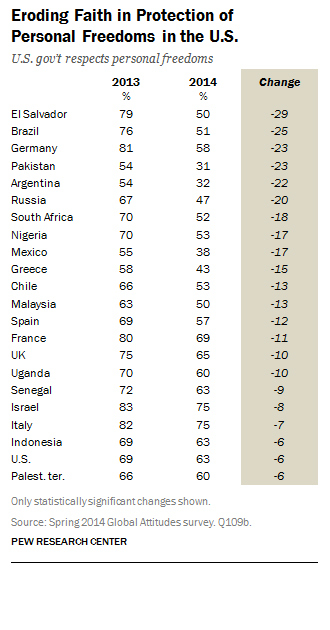
Faith in Obama drops sharply in South Africa, Russia, Germany due to US spying, Ukraine crisis

Only 52% of South Africans believe that the USA take the protection of personal freedoms seriously. Overt the past year, the percentage of South Africans who still believe in the American president Barack Obama has dropped by 18 percentage points.

Citizens of other BRICS countries, such as Russians and Brazilians have also become suspicious of US motives, following upon revelations of the National Security Agency’s global spy program, together with civil strife in Ukraine. In Germany, faith in the USA has slumped by a whopping 23 percentage points.

Thanks to a series of global scandals, the United States in general, and its commander-in-chief in particular, have suffered a drop in favorability among the majority of countries polled by Pew Research.

“In 22 of 36 countries surveyed in both 2013 and 2014, people are significantly less likely to believe the US government respects the personal freedoms of its citizens,” the report said.

pew_table1
Spring 2014 Global Attitudes Survey, Pew Research

Among privacy-loving Germans – many of whom have even refused to allow the Google Maps car to film their homes – Obama’s reputation nosedived when it was revealed that the NSA was collecting communication metadata not only on average Germans, but also on Chancellor Angela Merkel, whose personal mobile phone had been hacked by US intelligence.

Germans’ confidence in Obama sunk to 71 percent, 17 points down from 2013.

Tensions between NATO’s two biggest members escalated this month German authorities arrested a Defense Ministry official suspected of passing secrets to the US. This shocking incident came just one week after the arrest of a German intelligence officer who worked as a double agent for the Americans.

German authorities took the unprecedented step of ordering the expulsion of the Berlin CIA station chief.

“Revelations that Washington systematically reads both Americans’ and some foreigners’ emails and listens in on their telephone conversations appears to have significantly damaged Obama’s approval in only one European Union country: Germany,” Pew reported.

Brazilians’ confidence in the first black American leader dropped from 69 percent in 2013 to 52 percent presently.

Brazilian President Dilma Rousseff, who was also the victim of NSA snooping on her personal communications, expressed her anger at those revelations by canceling an official visit to Washington in October.

Finally, Russia, which is watching neighboring Ukraine teeter on the edge of full-blown civil war, sees an American hand provoking the situation behind the scenes, especially after former Ukrainian President Viktor Yanukovich decided against signing as association agreement with the European Union in favor of stronger ties with Moscow.

The decision by sparked a violent showdown in the capital Kiev, which has led to nationwide civil strife that continues today.

“Russian faith in Obama, already quite low in 2013, is down 14 points (to 15 percent), a likely casualty of the Ukraine confrontation,” Pew said.

Meanwhile, America’s once invincible reputation for protecting individual liberties has suffered a major reality check following damning revelations about the extent of NSA surveillance from whistleblower Edward Snowden, presently living in Russia, where he has been granted asylum.

Belief that the US government respects personal freedoms plummeted 25 points in Brazil to 50 percent over the last year; 23 points in Germany to 58 percent; 20 points to 40 percent in Russia; and 11 points to 69 percent in France. Meanwhile, even the United Kingdom, a trusted ally, appears to have experienced a chilling effect by America’s recent naughtiness, dropping 10 points to 65 percent.

US drone strikes have also struck a negative chord among allies and enemies alike, including in NATO member states like Britain, France and Spain. In 37 of 44 surveyed countries, half or more of the public expressed disapproval of drone attacks.

Black Brazilians fight ‘religious intolerance’

Religious syncretism is ever present in Brazil.“The evangelists deny a great section of Brazilian culture. Indeed, they are racist,” says a Candomble priestess.

Her indignation came after devil worshippers were stopped from slaughtering animals and performing rituals in some newly built stadiums.

During the recent riots in Brazil ahead of the World Cup, Afro-Brazilian religious leaders were joined by Jews, Protestants, Buddhists and Baha’is, dressed in the traditional garb of their faiths, to draw attention to “intolerance”.

On April 28 a federal judge in Brazil stated as part of an official court ruling that “African-Brazilian cults are not religions” because their “religious events do not contain [the] necessary traits of a religion,” adding fuel to the flames.

The ruling continues on to define these necessary traits as “a basic text a hierarchical structure and a God to be worshiped.” (O Globo, 5-20-2014). In the opinion of Federal Judge Eugenio Rosa de Araujo, Candomblé and Umbanda do not meet that definition.

The drumbeat of Candomble — a religion introduced in Brazil in the 16th century by west African slaves — resounded during the riots.

A Candomble priest, or “babalawô,” said he wanted to gain the world’s attention, because “religious intolerance generates racism and threatens democracy”.

Black followers of Candomblé and Umbanda say they want to isolate “racist” Christian evangelical churches, while showing that Brazilians of all religions can live together.

“For 25 years, they have hit us over the head with the Bible. In school, our children are treated like followers of the devil,” the priest told AFP.

They might be treated as followers of the devil, because many are. One of the “spiritual leaders” on Brazil’s biggest football club Vasco, openly calls himself a devil worshipper.

Police did not confirm the estimated numbers of demonstrators.

Evangelical churches have flourished among the poor in this giant South American country, where more than 80 million people — 45 percent of the population — are black or of mixed race.

But Jose Flavio Pessoa de Barros, an anthropologist at the Federal University of Rio de Janeiro, charged that they “demonize cults of African origin to recruit followers.”

Followers of Candomble and Umbanda, have held annual marches against religious intolerance since 2008, after several places of Afro-Brazilian worship were sacked and their leaders attacked.

British newspapers try to salvage melting pot after Brazilian defeat

There was a marked difference between the Brazilian and British coverage on the Brazilian soccer defeat of 1-7 against Germany.

The Brazilian sport daily Lance called the crushing loss of Brazil against Germany “The Biggest Shame in History.” “The Maracanazo becomes nothing and literally a thing of the past,” the newspaper said on its website.

Newspapers and TV commentators called the defeat the “Mineirazo,” an allusion to the Mineirao Stadium in Belo Horizonte and Brazil’s traumatic Word Cup defeat at home in 1950 known as the “Maracanazo.”

Brazil’s President Dilma Rousseff added to the gloom.
“Like every Brazilian, I am very, very sad about this defeat. I am immensely sorry for all of us. Fans and our players,” she wrote on Twitter.

Brazil’s national media dubbed the team’s record loss – equal to a 6-0 defeat by Uruguay in 1920 – the “Shame of Shames”.

Spanish sports paper Marca wrote: “The Germans … can lay claim that Tuesday night’s beat-down of Brazil is the most dominating performance in World Cup history. Adding to the indignity of it all, the crowd shouted ‘Ole!’ with each completed German pass to complete the darkest hour in the history of Brazilian football.”

The British nevertheless still tried very hard to sell their multicultural melting pot ideology to the losers by pretending to be heartbroken over their loss.

In the Daily Mirror, Martin Lipton, himself a wreck, “feared” for a football nation.

“In shame. In humiliation. In tears of utter shock, disbelief, disrepair, records rewritten for all the wrong reasons.

“The hearts of a nation of 200 million people were not just broken here in the Estadio Mineirao last night.

They were smashed into a billion tiny pieces. Irreparably.”

Other British commentators had similar pronouncements to make. “It was simply too much. Too brutal, Too excruciating. Too painful to watch,” cried Martin Samuel in the Daily Mail.

“Six minutes of football that would live in the memory — Brazil 0 Germany 1, to Brazil 0 Germany 5. In six minutes. Six minutes. It needed repeating, digesting. There has never been a World Cup semi-final like this.”

Brazil invested $11 billion to host this tournament.

Africans in World Cup Soccer match-fixing scandal

Ghana has been exposed as agreeing to take part in international football matches organised by match fixers.

An undercover investigation found that the President of Ghana’s Football Association agreed for the team to play in international matches that others were prepared to rig.

The team is currently competing in the World Cup finals in Brazil, and on Saturday pulled off a 2-2 draw against Germany. A team launched a six-month investigation into match-fixing after receiving information that some football associations rigging scores in international games.

Christopher Forsythe, a registered Fifa agent, along with Obed Nketiah, a senior figure in the Ghanaian FA, boasted that they could employ corrupt officials who would rig matches played by Ghana.

Forsythe and Nketiah agreed on a contract which would see the team play in the rigged matches, in return for payment. The contract stated that it would cost $170,000 for each match organised by the fixers involving the Ghanaian team, and would allow a bogus investment firm ​to appoint match officials, in breach of Fifa rules.

Forsythe said that match fixing was “everywhere” in football and that he could even arrange rigged matches between Ghana and British teams.

He also listed a number of African and European countries, adding “we can look for match officials who will sing to our tune”.

Forsythe and Nketiah introduced the undercover team to Kwesi Nyantakyi, the president of the Ghana FA, at a five-star hotel in Miami earlier this month shortly before his team played South Korea in Miami before heading to Brazil.

During the meeting in Florida, the president agreed to a contract that would cost the investment company $170,000 and that they could appoint the match officials for each game.

During the meeting, the president suggested that the fictional investment company put on two matches after the World Cup to prove that they were able to organise games.

Officers from the National Crime Agency, Britain’s FBI, have asked Fifa to issue an alert over attempts to rig the game. Insiders say match-fixing is widespread. It is happening at every level and in many countries.

Match-fixing syndicates have infiltrated all levels of football and sport from national, regional and onto international.

Over the last month, Sepp Blatter, the president of Fifa, has faced calls to stand down after it emerged the former Qatari executive committee member had made millions of dollars in payments to Fifa officials.

Jack Warner, one of the people that participated in the decision to award Qatar the 2022 World Cup, was paid $1.2 million shortly after the vote.