British spies allowed warrantless access to US data

Newly released documents from the British government reveal a lack of judicial oversight for how it sifts through communications data collected by the NSA and other foreign governments

British authorities are capable of tapping into bulk communications data collected by other countries’ intelligence services—including the National Security Agency—without a warrant, according to secret government documents released Tuesday.

The agreement between the NSA and Britain’s spy agency, known as Government Communications Headquarters or GCHQ, potentially puts the Internet and phone data of Americans in the hands of another country without legal oversight when obtaining a warrant is “not technically feasible.”

The data, once obtained, can be kept for up to two years, according to internal policies disclosed by the British government. GCHQ was forced to reveal that it can request and receive vast quantities of raw, unanalyzed data collected from foreign governments it partners with during legal proceedings in a closed court hearing in a case brought by various international human-rights organizations, including Privacy International, Liberty U.K., and Amnesty International. The suit challenges certain aspects of GCHQ’s surveillance practices.

It is well known that the NSA and GCHQ closely share intelligence data with one another, as part of a long-standing surveillance partnership. Some details of the agencies’ spy pact were exposed by former NSA contractor Edward Snowden last year, including the existence of GCHQ’s Tempora program, which taps into fiber-optic cables to scoop up online and telephone traffic across the Web for up to 30 days.

But this is the first time the British government has disclosed that it does not require a warrant to access data collected and maintained by its American counterparts. The revelation appears to counter statements made by an oversight committee of the British Parliament in July of last year that “in each case where GCHQ sought information from the U.S., a warrant for interception, signed by a minister, was already in place.”

Source: National Journal

Faith in Obama drops sharply in South Africa, Russia, Germany due to US spying, Ukraine crisis

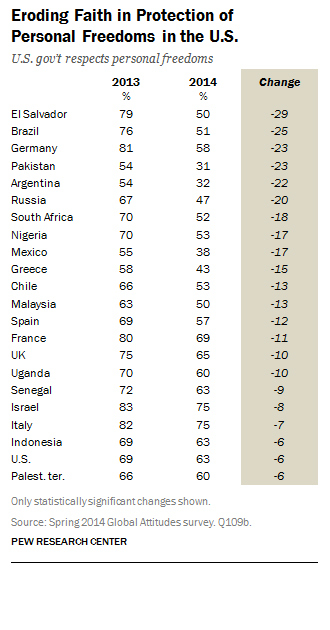
Only 52% of South Africans believe that the USA take the protection of personal freedoms seriously. Overt the past year, the percentage of South Africans who still believe in the American president Barack Obama has dropped by 18 percentage points.

Citizens of other BRICS countries, such as Russians and Brazilians have also become suspicious of US motives, following upon revelations of the National Security Agency’s global spy program, together with civil strife in Ukraine. In Germany, faith in the USA has slumped by a whopping 23 percentage points.

Thanks to a series of global scandals, the United States in general, and its commander-in-chief in particular, have suffered a drop in favorability among the majority of countries polled by Pew Research.

“In 22 of 36 countries surveyed in both 2013 and 2014, people are significantly less likely to believe the US government respects the personal freedoms of its citizens,” the report said.

pew_table1
Spring 2014 Global Attitudes Survey, Pew Research

Among privacy-loving Germans – many of whom have even refused to allow the Google Maps car to film their homes – Obama’s reputation nosedived when it was revealed that the NSA was collecting communication metadata not only on average Germans, but also on Chancellor Angela Merkel, whose personal mobile phone had been hacked by US intelligence.

Germans’ confidence in Obama sunk to 71 percent, 17 points down from 2013.

Tensions between NATO’s two biggest members escalated this month German authorities arrested a Defense Ministry official suspected of passing secrets to the US. This shocking incident came just one week after the arrest of a German intelligence officer who worked as a double agent for the Americans.

German authorities took the unprecedented step of ordering the expulsion of the Berlin CIA station chief.

“Revelations that Washington systematically reads both Americans’ and some foreigners’ emails and listens in on their telephone conversations appears to have significantly damaged Obama’s approval in only one European Union country: Germany,” Pew reported.

Brazilians’ confidence in the first black American leader dropped from 69 percent in 2013 to 52 percent presently.

Brazilian President Dilma Rousseff, who was also the victim of NSA snooping on her personal communications, expressed her anger at those revelations by canceling an official visit to Washington in October.

Finally, Russia, which is watching neighboring Ukraine teeter on the edge of full-blown civil war, sees an American hand provoking the situation behind the scenes, especially after former Ukrainian President Viktor Yanukovich decided against signing as association agreement with the European Union in favor of stronger ties with Moscow.

The decision by sparked a violent showdown in the capital Kiev, which has led to nationwide civil strife that continues today.

“Russian faith in Obama, already quite low in 2013, is down 14 points (to 15 percent), a likely casualty of the Ukraine confrontation,” Pew said.

Meanwhile, America’s once invincible reputation for protecting individual liberties has suffered a major reality check following damning revelations about the extent of NSA surveillance from whistleblower Edward Snowden, presently living in Russia, where he has been granted asylum.

Belief that the US government respects personal freedoms plummeted 25 points in Brazil to 50 percent over the last year; 23 points in Germany to 58 percent; 20 points to 40 percent in Russia; and 11 points to 69 percent in France. Meanwhile, even the United Kingdom, a trusted ally, appears to have experienced a chilling effect by America’s recent naughtiness, dropping 10 points to 65 percent.

US drone strikes have also struck a negative chord among allies and enemies alike, including in NATO member states like Britain, France and Spain. In 37 of 44 surveyed countries, half or more of the public expressed disapproval of drone attacks.

Carnegie Mellon introduces app NSA can’t break

carnegiemellonCarnegie Mellon University software researchers say they have written a smartphone messaging app with security that not even the National Security Agency can break, yet is easy to use.

“Even the NSA cannot break this, we believe. This is a lot safer than any security system out there,” said Adrian Perrig, a former technical director of Carnegie Mellon’s CyLab and a professor at ETH (Eidgenössische Technische Hochschule) in Zurich, who oversaw the project.

The app — called SafeSlinger — is available free on the iTunes App Store for Apple and Google Play Store for Android smartphones. Within a few months, the developers plan to have a similar security app available for email, using Google’s Gmail, Perrig said.

With government snooping on personal data in the name of preventing terrorist attacks and the NSA obtaining personal data from Google, Microsoft, Apple and other technology companies, consumer outrage has increased without a way to fight back.

“That’s precisely what SafeSlinger will do,” Perrig said — provide an easy way to securely exchange messages for free without the need to trust an external party.

Michael W. Farb, a research programmer at Carnegie Mellon CyLab, said, “The most important feature is that SafeSlinger provides secure messaging and file transfer without trusting the phone company or any device other than my own smartphone.” Farb worked on the Android version of SafeSlinger.

The software was introduced at last week’s MobiCom 2013 Conference for Mobile Computing and Networking in Miami after six years of development, funded with $500,000 in research money from the National Science Foundation and Cylab, Perrig said.

“With SafeSlinger, users can gain control over their exchanged information through end-to-end encryption, preventing intermediate servers or service providers from reading their messages or other personal information that is exchanged,” Perrig said.

Other applications such as the popular PGP (Pretty Good Privacy) are available but difficult to use securely. Blackberry was popular among business and other users who needed its security protections, but its data was observed by the government, Perrig said.

A three-minute video is available on YouTube that explains how SafeSlinger works.

The setup between users takes several minutes, when they exchange contact information and answer security questions generated by the app that help it generate encryption and authorization credentials. Then it works like a regular messaging app.

The app developers spent two years debugging the program, and it’s been subjected to three security reviews. In addition, they are publishing the source code for SafeSlinger so it can be reviewed and improved by others.- triblive.com

US maps behaviour with surveillance

spyingThe New York Times reported on Saturday that the National Security Agency, the main US government surveillance organisation, had since 2010 used data it gathered to map some Americans’ “social connections that can identify their associates, their locations at certain times, their traveling companions and other personal information”.

In the latest revelation of the activities of the NSA, which have prompted concern about previously unknown intrusion into Americans’ privacy in the name of protecting against terrorist and other foreign attacks, the newspaper quoted documents provided by Edward Snowden, the former NSA contractor who fled to Russia earlier this year.

It said the documents showed that “the spy agency began allowing the analysis of phone call and email logs in November 2010 to examine Americans’ networks of associations for foreign intelligence purposes after NSA officials lifted restrictions on the practice”.

The policy shift was intended to help the agency “discover and track” connections between intelligence targets overseas and people in the United States, according to an NSA memorandum from January 2011, the Times said.

It said the NSA was authorised to conduct “large-scale graph analysis on very large sets of communications metadata without having to check foreignness” of every email address, phone number or other identifier, the document said. Because of concerns about infringing on the privacy of American citizens, the computer analysis of such data had previously been permitted only for foreigners.

The agency could augment the communications data with material from public, commercial and other sources, including bank codes, insurance information, Facebook profiles, passenger manifests, voter registration rolls and GPS location information, as well as property records and unspecified tax data, according to the documents, the paper said.

It said NSA officials declined to say how many Americans had been affected and said the documents did not describe the result of the scrutiny, which it said “links phone numbers and emails in a ‘contact chain’ tied directly or indirectly to a person or organisation overseas that is of foreign intelligence interest”.

Earlier this week, leaders of the US Senate Intelligence Committee said they were working on legislation that would tighten oversight of federal electronic eavesdropping programmes. Support for such changes has been growing since Snowden leaked information in June that the government collects far more internet and telephone data than previously known.

The Times said that an NSA spokesperson, asked about the analyses of Americans’ data, said, “All data queries must include a foreign intelligence justification, period.” It quoted her as saying: “All of NSA’s work has a foreign intelligence purpose.”

She said the policy change disclosed in the latest revelations was based on a 1979 Supreme Court ruling that Americans could have no expectation of privacy about what numbers they had called.

The Times quoted her as saying that, based on that ruling, the Justice Department and the Pentagon decided that it was permissible to create contact chains using Americans’ “metadata,” which includes the timing, location and other details of calls and emails, but not their content. The agency is not required to seek warrants for the analyses from the Foreign Intelligence Surveillance Court.

NSA officials declined to identify which phone and email databases were used to create the social network diagrams, and the documents provided by Snowden do not specify them, the paper said.

It said the NSA did say that the large database of Americans’ domestic phone call records, which was revealed by Snowden in June and caused alarm in Washington, was excluded.

The Times said that while concerns in the United States since Snowden’s revelations had largely focused on the scope of the agency’s collection of the private data of Americans and the potential for abuse, the new documents provided a rare window into what the agency actually did with the information it gathers. – Reuters

US shares raw intel with Israel

snowden3The NSA regularly shares raw US intelligence data with Israel without even removing information about American citizens, according to the latest revelation published by the Guardian. The report is based on a document leaked by Edward Snowden.

On Tuesday, September 11, the Guardian published a previously undisclosed document which revealed top-secret policies in place since 2009 that are used to share personal phone and Internet data pertaining to United States citizens with American ally Israel.

The document, a five-page memorandum authorized by the National Security Agency near the beginning of US President Barack Obama’s first administration, outlines a deal between the NSA and Israel’s SIGINT National Unit, or ISNU.

“This agreement,” the memo begins, “prescribes procedures and responsibilities for ensuring” privacy safeguards are implemented to protect the Fourth Amendment rights of US citizens with regards to the direct sharing of raw intelligence collected by the NSA with its Israeli counterpart.

That data, the document later explains, includes raw traffic picked up by the American spy office such as “unevaluated and unminimized transcripts, gists, facsimiles, telex, voice and Digital Network Intelligence (DNI) metadata and content” which is never necessarily scrutinized by US officials before sent to Israeli agents.

“Seems the only info actually being ‘minimized’ is the info #NSA shares with the American public,” American Civil Liberties Union Deputy Legal Director Jameel Jaffer tweeted following publication of the Guardian piece. “NSA is really good at minimizing that.”

But while the contents of emails and phone calls involving most US persons are fair game to be collected by Israeli intelligence, a select group of Americans are sparred from international surveillance: elected officials. The memo mandates that the Israelis must “destroy upon recognition” any communication “that is either to or from an official of the US government.” That pool of exempt persons is defined as “officials of the executive branch (including the White House, cabinet departments, and independent agencies), the US House of Representatives and Senate (member and staff) and the US federal court system (including, but not limited to, the Supreme Court).”

The Guardian notes, however, that other leaked documents uncovered as of late indicate that the US intelligence community may have reservations nonetheless with sharing info with even an ally as tried and true as Israel.

“On the one hand, the Israelis are extraordinarily good Sigint partners for us, but on the other, they target us to learn our positions on Middle East problems,” a senior NSA official says in a 2008 NSA document seen by the Guardian but not published in Wednesday’s piece. “A NIE [National Intelligence Estimate] ranked them as the third most aggressive intelligence service against the US.”

“One of NSA’s biggest threats is actually from friendly intelligence services, like Israel. There are parameters on what NSA shares with them, but the exchange is so robust, we sometimes share more than we intended,” the Guardian quotes from the ’08 document.

According to Guardian journalists Glenn Greenwald, Laura Poitras and Ewen MacAskill, a NSA spokesperson pressed for comment wouldn’t deny the validity of the leaked document’s contents, but assured the British newspaper that “Any US person information that is acquired as a result of NSA’s surveillance activities is handled under procedures that are designed to protect privacy rights.”

The latest leak comes on the 12-year anniversary of the September 11, 2001 terrorist attacks that many high-ranking US officials have used to justify the surveillance measures enacted in the decade-plus since. It also marks just more than three months since the Guardian first began published leaked NSA documents attributed to Snowden, a 30-year-old former intelligence contractor who has since relocated to Russia where he was granted asylum while avoiding espionage charges in the US. – RT

Germany most-spied-on EU country by US

Germany appears to be the most snooped on EU country by the US, the map of secret surveillance activities by the National Security Agency shows. ‘Boundless Informant’ is among the data disclosed by former CIA contractor and NSA consultant Edward Snowden.

The color-coded map of secret surveillance activities by the NSA ranks countries according to how much surveillance they are currently undergoing – green for the least and red for the most watched.

While all EU member states boast variant shades of green, Germany stands out color-coded orange.

The source behind the revelation of the top-secret NSA surveillance program, already referred to as one of the most significant intelligence leaks in US history, was uncovered late last week. 29-year-old Snowden asked The Guardian to reveal his identity, having fled to Hong Kong to escape retaliation by the US authorities.

“The NSA has built an infrastructure that allows it to intercept almost everything. With this capability, the vast majority of human communications are automatically ingested without targeting,” he told The Guardian.

“I, sitting at my desk, certainly had the authority to wire-tap anyone … even if you are not doing anything wrong, you are being watched and recorded,” he added.

The Boundless Informant documents show NSA collecting up to 3 billion pieces of intelligence from US computer networks over a 30-day period ending in March 2013, according to The Guardian. The tool reportedly allows users to select a country on a map, view the metadata volume and select details about the collections against this or that state.

Germany’s Interior Ministry had already been in contact with US officials to find out whether there had been any infringement of German citizens’ privacy lately. Chancellor Angela Merkel is due to raise the issue of the NSA’s eavesdropping on Germany with President Barack Obama, who said the monitoring program is a means of defense against terrorism.

Iran is on top of the surveillance list, with more than 14 billion data reports in March, while Pakistan came in a close second at 13.5 billion reports. Jordan, a close US ally, as well as Egypt and India are also near the top, according to the data.

Senior European Union officials are also expected to discuss the impact of NSA’s programs on the privacy of EU citizens during a trans-Atlantic ministerial meeting in Dublin on Thursday.

“This case shows that a clear legal framework for the protection of personal data is not a luxury or constraint, but a fundamental right,” European Commissioner for Justice Viviane Reding said.

The European Parliament said it is always firm on data protection within the EU, as well as when negotiating with third countries, including the US.

“It would be unacceptable and would need swift action from the EU if indeed the US National Security Agency were processing European data without permission,” Guy Verhofstadt of the parliament’s liberal bloc said.

NSA’s tradition to survey international communities reportedly goes back to the Cold War era, when the agency used monitoring sites in Germany, Britain and other countries to spy on communications within the Soviet Union and its East European allies.

UK Foreign Secretary William Hague has meanwhile cancelled his trip to Washington to speak about The Guardian’s latest NSA report.

He assured parliament that accusations that the UK government allegedly used information provided by the Americans to circumvent laws were “baseless.”

“Our agencies practice and uphold UK law at all times,”
he stated, “even when dealing with information from outside the UK.”

In an interview with the British newspaper, successful NSA consultant Snowden leaked top-secret documents that revealed the existence of the US National Security Agency’s extensive internet spying program PRISM, which records digital communications and allows for real-time online surveillance of US citizens. PRISM gives US intelligence agencies direct access to files stored on the servers of major internet companies, including Google and Facebook, to identify and target potential terror suspects. – RT

Global netizens worried over US spying

News that the U.S. government has been snooping on Internet users worldwide came as little surprise to global netizens, who said Friday they have few expectations of online privacy as governments increasingly monitor people’s digital lives, often with Internet companies’ acquiescence.

Privacy activists concerned over the U.S. National Security Agency’s selective monitoring of Internet traffic called on people to take measures to better protect their digital data ranging from emails to photos to social network posts. But most people eschew encryption and other privacy tools and seemed resigned to the open book their online lives have become.

“It doesn’t surprise me one bit. They’ve been doing it for years,” said Jamie Griffiths, a 26-year-old architect working on his laptop in a London cafe. “I wouldn’t send anything via email that I wouldn’t want a third party to read.”

From Baghdad, to Bogota, Colombia, many said they already carefully censor what they write online and assume governments are regularly spying on online activity, be it as part of global counter-terrorism or domestic surveillance efforts.

“The social networks and email have always been vulnerable because tech-savvy people know how to penetrate them,” said Teolindo Acosa, a 34-year-old education student at Venezuela’s Universidad Central who was leaving a cybercafe in Caracas.

Leaked confidential documents show the NSA and FBI have been sifting through personal data by directly accessing the U.S-based servers of Google, Facebook, Microsoft, AOL, Skype, PalTalk, Apple and YouTube.

Following Thursday’s revelation, U.S. President Barack Obama said Friday that the surveillance did not “target” U.S. citizens or others living in the U.S. – which does not mean their communications were not caught up in the dragnet.

But that didn’t dampen the outrage of people who resent what they consider Washington’s self-anointed role as the world’s policeman.

“To the United States, everyone is suspicious, even the pope!” said leftist Colombian Sen. Alexander Lopez. “Everyone is under observation these days and this should be taken up by the United Nations.”

Lopez said he has no plans to close his Google and Microsoft email accounts. He figures he’ll be spied on no matter what he does.

The revelation of global data vacuuming could hurt U.S. technology companies if Internet users become disillusioned and abandon them in favor of homegrown alternatives that offer greater security.

U.S. privacy activist Christopher Soghoian said he finds it “insane” that so many politicians outside the United States use Google gmail accounts.

“This has given the NSA an advantage over every other intelligence system in the world. The Americans don’t have to hack as much, because everyone in the world sends their data to American companies,” he said.

Hossam el-Hamalawy, a blogger with Egypt’s Revolutionary Socialists, one of the Egyptian groups that helped spearhead the 2011 uprising, said the dearth of locally developed Web tools means many around the world are simply stuck with U.S. sites, even if they know the government is monitoring them.

“The problem is that there is no alternative,” he said. “If you don’t use Facebook, what is the alternative social network available for the Internet user who is not an IT geek?”

Soghoian predicted an increasing push by governments and companies in Europe in particular, where privacy has been a much bigger issue for voters than in the United States, away from storing data in U.S.-based server farms.

Indeed, under U.S. law it is not illegal for the NSA to collect information on foreigners.

The disclosure of the NSA data-vacuuming program known as PRISM is only the latest “of many U.S. government programs created to infringe on personal freedoms,” said Carlos Affonso Pereira de Souza, a technology policy professor at FGV think tank in Rio de Janeiro.

Going back well into the 20th century, the United States, Britain, Canada, Australia and New Zealand ran a secret satellite communications interception network that became known as Echelon and searched information including telexes, faxes and emails, according to experts including U.S. journalist James Bamford. The system was the subject of a 2001 European Parliament inquiry.

According to a U.N. report released this week, such surveillance has been on a global upsurge with governments increasingly tapping into online personal data and even discouraging online anonymity by passing laws prohibiting it.

The governments of China, Iran, Bahrain are among other nations that already aggressively oversee online activity, in many cases putting people in prison for political blog posts and other messages.

Israel’s attorney general in April upheld a practice allowing security personnel to read email accounts of suspicious individuals when they arrive at the airport, arguing it prevents militants from entering the country.

The U.N. report said such activity has been expanding as technology advances, and that countries should prioritize protecting people’s online rights.

“In order to meet their human rights obligations, States must ensure that the rights to freedom of expression and privacy are at the heart of their communications surveillance frameworks,” the report reads.

Its author, Guatemalan Frank La Rue, calls for legal standards to ensure “privacy, security and anonymity of communications” to protect people including journalists, human rights defenders and whistleblowers.

Civil libertarians in the United States were much more upset about a different revelation published Wednesday, that the NSA has been collecting the phone records including the calls, numbers, times and duration of all U.S. citizen customers of the telecommunications giant Verizon.

—

Associated Press writers Vivian Sequera in Bogota, Ian Deitch in Jerusalem, Jill Lawless in London, Bradley Brooks in Sao Paulo, Fabiola Sanchez in Caracas, Sameer N. Yacoub in Baghdad and Tony G. Gabriel in Cairo contributed to this report. Jack Chang contributed from Mexico City.

‘They can watch your ideas form as you type’

The National Security Agency and the FBI in the US are tapping directly into the central servers of nine leading U.S. Internet companies, extracting audio and video chats, photographs, e-mails, documents, and connection logs that enable analysts to track foreign targets, according to a top-secret document obtained by The Washington Post.

The program, code-named PRISM, has not been made public until now. It may be the first of its kind. The NSA prides itself on stealing secrets and breaking codes, and it is accustomed to corporate partnerships that help it divert data traffic or sidestep barriers. But there has never been a Google or Facebook before, and it is unlikely that there are richer troves of valuable intelligence than the ones in Silicon Valley.

Equally unusual is the way the NSA extracts what it wants, according to the document: “Collection directly from the servers of these U.S. Service Providers: Microsoft, Yahoo, Google, Facebook, PalTalk, AOL, Skype, YouTube, Apple.”

PRISM was launched from the ashes of President George W. Bush’s secret program of warrantless domestic surveillance in 2007, after news media disclosures, lawsuits and the Foreign Intelligence Surveillance Court forced the president to look for new authority.

Congress obliged with the Protect America Act in 2007 and the FISA Amendments Act of 2008, which immunized private companies that cooperated voluntarily with U.S. intelligence collection. PRISM recruited its first partner, Microsoft, and began six years of rapidly growing data collection beneath the surface of a roiling national debate on surveillance and privacy. Late last year, when critics in Congress sought changes in the FISA Amendments Act, the only lawmakers who knew about PRISM were bound by oaths of office to hold their tongues.

The court-approved program is focused on foreign communications traffic, which often flows through U.S. servers even when sent from one overseas location to another. Between 2004 and 2007, Bush administration lawyers persuaded federal FISA judges to issue surveillance orders in a fundamentally new form. Until then the government had to show probable cause that a particular “target” and “facility” were both connected to terrorism or espionage.

In four new orders, which remain classified, the court defined massive data sets as “facilities” and agreed to certify periodically that the government had reasonable procedures in place to minimize collection of “U.S. persons” data without a warrant.

In a statement issue late Thursday, Director of National Intelligence James R. Clapper said “information collected under this program is among the most important and valuable foreign intelligence information we collect, and is used to protect our nation from a wide variety of threats. The unauthorized disclosure of information about this important and entirely legal program is reprehensible and risks important protections for the security of Americans.”

Clapper added that there were numerous inaccuracies in reports about PRISM by The Post and the Guardian newspaper, but he did not specify any.

Jameel Jaffer, deputy legal director of the American Civil Liberties Union, said: “I would just push back on the idea that the court has signed off on it, so why worry? This is a court that meets in secret, allows only the government to appear before it, and publishes almost none of its opinions. It has never been an effective check on government.”

Several companies contacted by The Post said they had no knowledge of the program, did not allow direct government access to their servers and asserted that they responded only to targeted requests for information.

“We do not provide any government organization with direct access to Facebook servers,” said Joe Sullivan, chief security officer for Facebook. “When Facebook is asked for data or information about specific individuals, we carefully scrutinize any such request for compliance with all applicable laws, and provide information only to the extent required by law.”

“We have never heard of PRISM,” said Steve Dowling, a spokesman for Apple. “We do not provide any government agency with direct access to our servers, and any government agency requesting customer data must get a court order.”

It is possible that the conflict between the PRISM slides and the company spokesmen is the result of imprecision on the part of the NSA author. In another classified report obtained by The Post, the arrangement is described as allowing “collection managers [to send] content tasking instructions directly to equipment installed at company-controlled locations,” rather than directly to company servers.

Government officials and the document itself made clear that the NSA regarded the identities of its private partners as PRISM’s most sensitive secret, fearing that the companies would withdraw from the program if exposed. “98 percent of PRISM production is based on Yahoo, Google and Microsoft; we need to make sure we don’t harm these sources,” the briefing’s author wrote in his speaker’s notes.

An internal presentation of 41 briefing slides on PRISM, dated April 2013 and intended for senior analysts in the NSA’s Signals Intelligence Directorate, described the new tool as the most prolific contributor to the President’s Daily Brief, which cited PRISM data in 1,477 items last year. According to the slides and other supporting materials obtained by The Post, “NSA reporting increasingly relies on PRISM” as its leading source of raw material, accounting for nearly 1 in 7 intelligence reports.

That is a remarkable figure in an agency that measures annual intake in the trillions of communications. It is all the more striking because the NSA, whose lawful mission is foreign intelligence, is reaching deep inside the machinery of American companies that host hundreds of millions of American-held accounts on American soil.

The technology companies, whose cooperation is essential to PRISM operations, include most of the dominant global players of Silicon Valley, according to the document. They are listed on a roster that bears their logos in order of entry into the program: “Microsoft, Yahoo, Google, Facebook, PalTalk, AOL, Skype, YouTube, Apple.” PalTalk, although much smaller, has hosted traffic of substantial intelligence interest during the Arab Spring and in the ongoing Syrian civil war.

Dropbox, the cloud storage and synchronization service, is described as “coming soon.”

Sens. Ron Wyden (D-Ore.) and Mark Udall (D-Colo.), who had classified knowledge of the program as members of the Senate Intelligence Committee, were unable to speak of it when they warned in a Dec. 27, 2012, floor debate that the FISA Amendments Act had what both of them called a “back-door search loophole” for the content of innocent Americans who were swept up in a search for someone else.

“As it is written, there is nothing to prohibit the intelligence community from searching through a pile of communications, which may have been incidentally or accidentally been collected without a warrant, to deliberately search for the phone calls or e-mails of specific Americans,” Udall said.

Wyden repeatedly asked the NSA to estimate the number of Americans whose communications had been incidentally collected, and the agency’s director, Lt. Gen. Keith B. Alexander, insisted there was no way to find out. Eventually Inspector General I. Charles McCullough III wrote Wyden a letter stating that it would violate the privacy of Americans in NSA data banks to try to estimate their number.

Roots in the ’70s

PRISM is an heir, in one sense, to a history of intelligence alliances with as many as 100 trusted U.S. companies since the 1970s. The NSA calls these Special Source Operations, and PRISM falls under that rubric.

The Silicon Valley operation works alongside a parallel program, code-named BLARNEY, that gathers up “metadata” — technical information about communications traffic and network devices — as it streams past choke points along the backbone of the Internet. BLARNEY’s top-secret program summary, set down in the slides alongside a cartoon insignia of a shamrock and a leprechaun hat, describes it as “an ongoing collection program that leverages IC [intelligence community] and commercial partnerships to gain access and exploit foreign intelligence obtained from global networks.”

But the PRISM program appears to more nearly resemble the most controversial of the warrantless surveillance orders issued by President George W. Bush after the al-Qaeda attacks of Sept. 11, 2001. Its history, in which President Obama presided over exponential growth in a program that candidate Obama criticized, shows how fundamentally surveillance law and practice have shifted away from individual suspicion in favor of systematic, mass collection techniques.

The Obama administration points to ongoing safeguards in the form of “extensive procedures, specifically approved by the court, to ensure that only non-U.S. persons outside the U.S. are targeted, and that minimize the acquisition, retention and dissemination of incidentally acquired information about U.S. persons.”

And it is true that the PRISM program is not a dragnet, exactly. From inside a company’s data stream the NSA is capable of pulling out anything it likes, but under current rules the agency does not try to collect it all.

Analysts who use the system from a Web portal at Fort Meade, Md., key in “selectors,” or search terms, that are designed to produce at least 51 percent confidence in a target’s “foreignness.” That is not a very stringent test. Training materials obtained by The Post instruct new analysts to make quarterly reports of any accidental collection of U.S. content, but add that “it’s nothing to worry about.”

Even when the system works just as advertised, with no American singled out for targeting, the NSA routinely collects a great deal of American content. That is described as “incidental,” and it is inherent in contact chaining, one of the basic tools of the trade. To collect on a suspected spy or foreign terrorist means, at minimum, that everyone in the suspect’s inbox or outbox is swept in. Intelligence analysts are typically taught to chain through contacts two “hops” out from their target, which increases “incidental collection” exponentially. The same math explains the aphorism, from the John Guare play, that no one is more than “six degrees of separation” from any other person.

A ‘directive’

In exchange for immunity from lawsuits, companies such as Yahoo and AOL are obliged to accept a “directive” from the attorney general and the director of national intelligence to open their servers to the FBI’s Data Intercept Technology Unit, which handles liaison to U.S. companies from the NSA. In 2008, Congress gave the Justice Department authority for a secret order from the Foreign Surveillance Intelligence Court to compel a reluctant company “to comply.”

In practice, there is room for a company to maneuver, delay or resist. When a clandestine intelligence program meets a highly regulated industry, said a lawyer with experience in bridging the gaps, neither side wants to risk a public fight. The engineering problems are so immense, in systems of such complexity and frequent change, that the FBI and NSA would be hard pressed to build in back doors without active help from each company.

Apple demonstrated that resistance is possible when it held out for more than five years, for reasons unknown, after Microsoft became PRISM’s first corporate partner in May 2007. Twitter, which has cultivated a reputation for aggressive defense of its users’ privacy, is still conspicuous by its absence from the list of “private sector partners.”

Google, like the other companies, denied that it permitted direct government access to its servers.

“Google cares deeply about the security of our users’ data,” a company spokesman said. “We disclose user data to government in accordance with the law, and we review all such requests carefully. From time to time, people allege that we have created a government ‘back door’ into our systems, but Google does not have a ‘back door’ for the government to access private user data.”

Microsoft also provided a statement: “We provide customer data only when we receive a legally binding order or subpoena to do so, and never on a voluntary basis. In addition we only ever comply with orders for requests about specific accounts or identifiers. If the government has a broader voluntary national security program to gather customer data we don’t participate in it.”

Yahoo also issued a denial.

“Yahoo! takes users’ privacy very seriously,” the company said in a statement. “We do not provide the government with direct access to our servers, systems, or network.”

Like market researchers, but with far more privileged access, collection managers in the NSA’s Special Source Operations group, which oversees the PRISM program, are drawn to the wealth of information about their subjects in online accounts. For much the same reason, civil libertarians and some ordinary users may be troubled by the menu available to analysts who hold the required clearances to “task” the PRISM system.

There has been “continued exponential growth in tasking to Facebook and Skype,” according to the PRISM slides. With a few clicks and an affirmation that the subject is believed to be engaged in terrorism, espionage or nuclear proliferation, an analyst obtains full access to Facebook’s “extensive search and surveillance capabilities against the variety of online social networking services.”

According to a separate “User’s Guide for PRISM Skype Collection,” that service can be monitored for audio when one end of the call is a conventional telephone and for any combination of “audio, video, chat, and file transfers” when Skype users connect by computer alone. Google’s offerings include Gmail, voice and video chat, Google Drive files, photo libraries, and live surveillance of search terms.

Firsthand experience with these systems, and horror at their capabilities, is what drove a career intelligence officer to provide PowerPoint slides about PRISM and supporting materials to The Washington Post in order to expose what he believes to be a gross intrusion on privacy. “They quite literally can watch your ideas form as you type,” the officer said. – Washington Post