America promises endless war

Surprisingly, despite the apparent failure of Iraq and Afghanistan and “strong fiscal constraints,” Washington is still expanding its war plans

The US should get ready for a new era of endless wars, stated Pentagon’s chief Chuck Hagel, noting that “tyranny,” “terrorism,” national security challenges and climate change pose a substantial threat to the US and its allies.

Although the Pentagon’s chief urges to prepare for an endless war, the question remains open if ordinary Americans will support the new doctrine.

More than half of American respondents said that the US had not achieved its goals in both Iraq and Afghanistan, expressing their discontent with US foreign policy, according to the Pew Research poll conducted in the beginning of the 2014. Although 57 percent of US citizens approved the US campaign against Islamic State according to the October poll, 55 percent strongly oppose sending US ground troops to Iraq and Syria.

“I think we are living through one of these historic, defining times. We are seeing a new world order—post-World War II, post-Soviet Union implosion—being built. There are many questions, foremost among the American people: What’s the role of America in this new world that is evolving? Should we have a role? What is appropriate?” said Chuck Hagel, as cited by the Atlantic.

The US Secretary of Defense claims that as the global leader, the US will “continue to grapple with overseas threat for the foreseeable future,” containing international terrorism and tyrannical regimes. “Hagel didn’t seem especially sanguine that it would end anytime soon. In other words: Get used to endless war,” stressed the Atlantic, characterizing the Pentagon’s new doctrine.

Remarkably, practically none of the previous US overseas military campaigns has proved effective. “US soldiers have been laboring under sad paradox: even though the United States enjoys unprecedented global military dominance that should cow enemies mightily, it has found itself in constant combat for longer than ever before in its history, and without much to show for it,” writes Richard K. Betts, the Arnold Saltzman Professor of War and Peace Studies in the Department of Political Science, in his article “Ending America’s Era of Permanent War” published in Foreign Affairs. The professor points out that of the US military actions in Kosovo, Afghanistan, Iraq, and Libya, “only the first can be counted a success.”

Surprisingly, despite the apparent failure of the US military campaigns in Iraq and Afghanistan and “strong fiscal constraints,” Washington is still expanding its war plans. According to the expert, the White House should not cut back its overseas military operations, but prepare for “more action.”

“Frightening challenges in three critical regions are demanding yet more action: Islamic extremists have seized large swaths of territory in Iraq and Syria, Russia has intervened in Ukraine, and China is flexing its muscles in East Asia,” stressed Richard K. Betts.

The idea of the US “moral obligation” to meddle into domestic affairs of other countries in order “to set them right” is a “mythological concept,” aimed at justification of American interventionism, contended Justin Raimondo, the editorial director of Antiwar.com and a senior fellow at the Randolph Bourne Institute.

“The idea that the United States must exercise “global leadership” is rationalized by our interventionists as a necessary prerequisite for maintaining some type of “world order,” Mr. Raimondo underscores in his article “Putin’s Complaint: Is Washington a Revisionist Power?”
However, the Pentagon’s “endless war,” cannot last forever, as it is the American taxpayers who pay for the extortionately expensive military operations. For instance, the Afghanistan campaign cost the US “roughly $45 billion a year from 2001 to 2013,” while Iraq cost “about $100 billion a year from 2003 to 2011,” Kenneth M. Pollack, a Senior Fellow at the Brooking Institution and former CIA analyst, noted in his article “An Army to Defeat Assad.”

It should be also noted that the December poll in 2013 carried out by the Pew Research indicated that 52 percent thought the United States “should mind its own business internationally and let other countries get along the best they can on their own.” The researchers underscore that the tendency demonstrated by the poll reflects a gradual and longstanding decline. According to the October 2014 poll, most Americans consider inequality more dangerous than nuclear weapons, or sectarian religious threats.

 

Faith in Obama drops sharply in South Africa, Russia, Germany due to US spying, Ukraine crisis

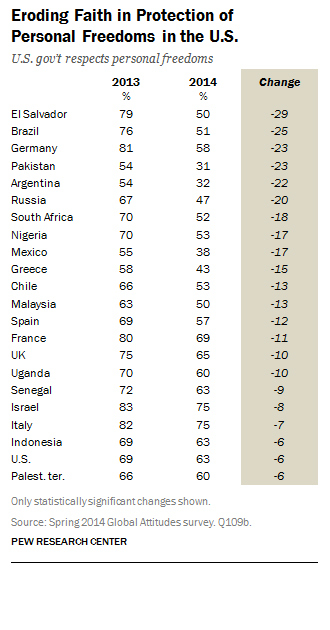
Only 52% of South Africans believe that the USA take the protection of personal freedoms seriously. Overt the past year, the percentage of South Africans who still believe in the American president Barack Obama has dropped by 18 percentage points.

Citizens of other BRICS countries, such as Russians and Brazilians have also become suspicious of US motives, following upon revelations of the National Security Agency’s global spy program, together with civil strife in Ukraine. In Germany, faith in the USA has slumped by a whopping 23 percentage points.

Thanks to a series of global scandals, the United States in general, and its commander-in-chief in particular, have suffered a drop in favorability among the majority of countries polled by Pew Research.

“In 22 of 36 countries surveyed in both 2013 and 2014, people are significantly less likely to believe the US government respects the personal freedoms of its citizens,” the report said.

pew_table1
Spring 2014 Global Attitudes Survey, Pew Research

Among privacy-loving Germans – many of whom have even refused to allow the Google Maps car to film their homes – Obama’s reputation nosedived when it was revealed that the NSA was collecting communication metadata not only on average Germans, but also on Chancellor Angela Merkel, whose personal mobile phone had been hacked by US intelligence.

Germans’ confidence in Obama sunk to 71 percent, 17 points down from 2013.

Tensions between NATO’s two biggest members escalated this month German authorities arrested a Defense Ministry official suspected of passing secrets to the US. This shocking incident came just one week after the arrest of a German intelligence officer who worked as a double agent for the Americans.

German authorities took the unprecedented step of ordering the expulsion of the Berlin CIA station chief.

“Revelations that Washington systematically reads both Americans’ and some foreigners’ emails and listens in on their telephone conversations appears to have significantly damaged Obama’s approval in only one European Union country: Germany,” Pew reported.

Brazilians’ confidence in the first black American leader dropped from 69 percent in 2013 to 52 percent presently.

Brazilian President Dilma Rousseff, who was also the victim of NSA snooping on her personal communications, expressed her anger at those revelations by canceling an official visit to Washington in October.

Finally, Russia, which is watching neighboring Ukraine teeter on the edge of full-blown civil war, sees an American hand provoking the situation behind the scenes, especially after former Ukrainian President Viktor Yanukovich decided against signing as association agreement with the European Union in favor of stronger ties with Moscow.

The decision by sparked a violent showdown in the capital Kiev, which has led to nationwide civil strife that continues today.

“Russian faith in Obama, already quite low in 2013, is down 14 points (to 15 percent), a likely casualty of the Ukraine confrontation,” Pew said.

Meanwhile, America’s once invincible reputation for protecting individual liberties has suffered a major reality check following damning revelations about the extent of NSA surveillance from whistleblower Edward Snowden, presently living in Russia, where he has been granted asylum.

Belief that the US government respects personal freedoms plummeted 25 points in Brazil to 50 percent over the last year; 23 points in Germany to 58 percent; 20 points to 40 percent in Russia; and 11 points to 69 percent in France. Meanwhile, even the United Kingdom, a trusted ally, appears to have experienced a chilling effect by America’s recent naughtiness, dropping 10 points to 65 percent.

US drone strikes have also struck a negative chord among allies and enemies alike, including in NATO member states like Britain, France and Spain. In 37 of 44 surveyed countries, half or more of the public expressed disapproval of drone attacks.

Young black women adore Obama

An Obama supporter

While Obama carried the youth vote overall, his support declined from 2008 among all young voters and among key subgroups. In particular, Obama lost ground among young whites, men and independents.

Only 44% of white voters under 30 backed Obama, while 51% voted for Romney. This is a substantial change compared with 2008, when Obama carried the young white vote by 10 points (54% to 44%). Far more young blacks and Hispanics backed Obama than Romney, and there was little fall off in his support among these groups from 2008.

Obama also lost support among young men. Overall, 53% of men under 30 supported Obama, down from 62% in 2008. Fully 66% of young women voted for Obama, similar to the 69% who voted for him in 2008.

However, Obama lost support among both white men and women. Overall, 41% of white men supported Obama while 54% supported Romney. In 2008, Obama won the vote among white men, 52% to 46%. While white women voted for Obama over McCain by a 56% to 42% margin four years ago, they were divided this year (48% voted for Obama, 49% for Romney).

Surprisingly, Obama’s vote also declined among young black men, by 14 points, while holding steady among young black women. – Pew Reasearch