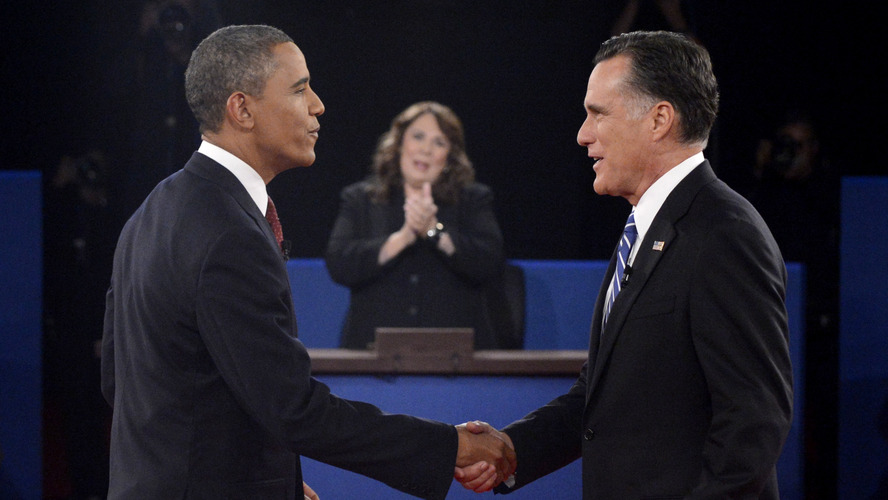
While Obama carried the youth vote overall, his support declined from 2008 among all young voters and among key subgroups. In particular, Obama lost ground among young whites, men and independents.
Only 44% of white voters under 30 backed Obama, while 51% voted for Romney. This is a substantial change compared with 2008, when Obama carried the young white vote by 10 points (54% to 44%). Far more young blacks and Hispanics backed Obama than Romney, and there was little fall off in his support among these groups from 2008.
Obama also lost support among young men. Overall, 53% of men under 30 supported Obama, down from 62% in 2008. Fully 66% of young women voted for Obama, similar to the 69% who voted for him in 2008.
However, Obama lost support among both white men and women. Overall, 41% of white men supported Obama while 54% supported Romney. In 2008, Obama won the vote among white men, 52% to 46%. While white women voted for Obama over McCain by a 56% to 42% margin four years ago, they were divided this year (48% voted for Obama, 49% for Romney).
Surprisingly, Obama’s vote also declined among young black men, by 14 points, while holding steady among young black women. – Pew Reasearch
As Republicans try to explain their Election Day losses in terms of policy, tactics, and strategy, one factor is emerging as the essential difference between the Obama and Romney campaigns on November 6: the absolute failure of Romney’s get-out-the-vote effort, which underperformed even John McCain’s lackluster 2008 turnout. One culprit appears to be “Orca,” the Romney’s massive technology effort, which failed completely.
A source within the Romney campaign agreed to share his reflections on Project Orca with Breitbart News:
It’s easy to point fingers after a loss and I wouldn’t normally do it, but consider what happened.
Project Orca was supposed to enable poll watchers to record voter names on their smartphones, by listening for names as voters checked in. This would give the campaign real-time turnout data, so they could redirect GOTV resources throughout the day where it was most needed. They recruited 37,000 swing state volunteers for this.
I worked on the Colorado team, and we were called by hundreds (or more) volunteers who couldn’t use the app or the backup phone system. The usernames and passwords were wrong, but the reset password tool didn’t work, and we couldn’t change phone PINs. We were told the problems were limited and asked to project confidence, have people use pencil and paper, and try to submit again later.
Then at 6PM they admitted they had issued the wrong PINs to every volunteer in Colorado, and reissued new PINs (which also didn’t work). Meanwhile, counties where we had hundreds of volunteers, such as Denver Colorado, showed zero volunteers in the system all day, but we weren’t allowed to add them. In one area, the head of the Republican Party plus 10 volunteers were all locked out. The system went down for a half hour during peak voting, but for hundreds or more, it never worked all day. Many of the poll watchers I spoke with were very discouraged. Many members of our phone bank got up and left.
I do not know if the system was totally broken, or if I just saw the worst of it. But I wonder, because they told us all day that most volunteers were submitting just fine, yet admitted at the end that all of Colorado had the wrong PIN’s. They also said the system projected every swing state as pink or red.
Regardless of the specific difficulties, this idea would only help if executed extremely well. Otherwise, those 37,000 swing state volunteers should have been working on GOTV…
Somebody messaged me privately after my email and told me that North Carolina had the same problems — every pin was wrong and not fixed until 6PM — and was also told it was localized to North Carolina.
The problems with Orca appear to have been nationwide, and predated Election Day itself. At Ace of Spades, John Ekdahl reported his frustrations as a volunteer in the field:
From the very start there were warning signs. After signing up, you were invited to take part in nightly conference calls. The calls were more of the slick marketing speech type than helpful training sessions. There was a lot of “rah-rahs” and lofty talk about how this would change the ballgame.
Working primarily as a web developer, I had some serious questions. Things like “Has this been stress tested?”, “Is there redundancy in place?” and “What steps have been taken to combat a coordinated DDOS attack or the like?”, among others. These types of questions were brushed aside (truth be told, they never took one of my questions). They assured us that the system had been relentlessly tested and would be a tremendous success.
Ekdahl describes how volunteers were expected to print their own materials, and were mistakenly not told to bring their poll watching credentials to polling places. Attempts to communicate with the Romney campaign to ask for assistance were unsuccessful:
By 2PM, I had completely given up. I finally got ahold of someone at around 1PM and I never heard back. From what I understand, the entire system crashed at around 4PM. I’m not sure if that’s true, but it wouldn’t surprise me. I decided to wait for my wife to get home from work to vote, which meant going very late (around 6:15PM). Here’s the kicker, I never got a call to go out and vote. So, who the hell knows if that end of it was working either.
Likewise, Twitchy recorded widespread real-time complaints and criticisms on Twitter by Project Orca volunteers. At one point during Election Day, the system had malfunctioned so badly that desperate volunteers wondered if the program had been hacked.
Romney volunteers in Virginia confirmed that the campaign had relied entirely on Project Orca to turn out the vote in key areas such as Roanoke, where Romney and Ryan had made appearances. Volunteers who had driven to Virginia from safely-Republican Tennessee were shocked at the disorganization they encountered.
While the Romney campaign waited for Orca to function as planned, the Obama campaign had placed signs outside every one of the city’s thirty-three polling places, and was fully staffed with two volunteers outside each polling place, and a strike list volunteer inside, all day long from 6 a.m. to 7 p.m. The best that the short-handed Tennessee volunteers could manage was 40% coverage of polling places; the local GOP, they said, had relied entirely on the campaign’s centralized Orca system in Boston to turn out the local vote.
Ekdahl concludes his account by hoping that the failures of Orca did cost Romney the election:
We lost by fairly small margins in Florida, Virginia, Ohio and Colorado. If this had worked could it have closed the gap? I sure hope not for my sanity’s sake.
In fact, Orca diverted scarce resources that would have been better used physically moving voters to polling places. By a rough calculation, Romney lost the election by falling 500,000 to 700,000 votes short in key swing states. If each of the 37,000 volunteers that had been devoted to Orca had instead brought 20 voters to the polls in those states over the course of the day, Romney would have won the election.
Before the election, there was much fear-mongering on the Democratic side about the Republicans’ supposed plans to suppress turnout among Obama voters. After the election, GOP strategist Karl Rove accused the Obama campaign of “suppressing the vote” by running a negative campaign against Romney that kept voters at home.
The truth is much worse. There was, in fact, massive suppression of the Republican vote–by the Romney campaign, through the diversion of nearly 40,000 volunteers to a failing computer program.
There was no Plan B; there was only confusion, and silence. Microsoft wrote the software and they tested it for months, however.
Microsoft in Washington State was very much against the Romney campaign. It wouldn’t be difficult to sabotage, said one technical advisor, a Microsoft Certified Systems Engineer. You could have a problem and blame the end user if you had an agenda, he said. – breitbart.com
President Barack Obama’s election victory exposed tectonic demographic shifts in American society that are reordering the U.S. political landscape.
The 2012 presidential election likely will be remembered as marking the end of long-standing coalitions, as voters regroup in cultural, ethnic and economic patterns that challenge both parties—but especially Republicans.
Older voters and white working-class voters, once core elements of the Democratic Party, have drifted into the Republican column. Rural and small-town voters, whose grandparents backed the New Deal, now fill the swath of the U.S. that leans reliably GOP.
But in cities and dynamic suburbs, a rapidly growing force of Latinos, Asian-Americans, African-Americans and higher-income whites emerged this week as the strength of Mr. Obama’s winning Democratic coalition.
“The Democrats now own a coalition of emerging metro areas where the whites and minorities live together, and where they vote Democratic,” said Robert Lang, a demographer who directs the Brookings Mountain West, a research center at the University of Nevada, Las Vegas.
In northern Virginia’s Fairfax County, for example, Democratic Rep. Gerry Connolly represents a district where 20 years ago, he said, 3% of residents were born outside the U.S. Now, it is nearly 30%, with the majority Asian immigrants.
What County-by-County Results Tell Us About the Election
The most detailed results from the 2012 election show the voting patterns for each county in the country. Changes from the previous election give us an idea of what geographic and demographic trends are impacting national politics.
Mr. Obama won big there Tuesday, helping him to tally the once reliably Republican state of Virginia for the second straight general election.
Similar shifts throughout the U.S. help explain how Mr. Obama was returned to the White House on support from young people, minorities, women and upscale whites, a coalition virtually identical to the one that carried him to victory four years ago.
Some political analysts thought that coalition came together only because of the historic nature of Mr. Obama’s 2008 victory and wouldn’t prove durable. That belief didn’t hold up this week.
The question now is whether Mr. Obama and other members of his party can solidify this coalition into a foundation of the Democratic Party.
Republicans said their party won a smashing victory in congressional elections just two years ago, when they took control of the House of Representatives, illustrating that there is no clear claim for either party.
Decision Day in America
Voters headed to the polls Tuesday in a presidential contest defined by its intensity and razor-thin margins.
The 2010 election, they said, shows that even with modest inroads among Latino and Asian-American voters, the GOP can build a solid majority on the foundation of its strong white support. Republicans enjoy historically high levels of control over governorships and state legislatures, which they say shows the party’s potential if it can improve its message to minorities.
In any case, both Democrats and Republicans see new contours of a split electorate.
Twenty years after supporting former President Bill Clinton, a majority of white voters have returned to where they were during the Reagan administration, firmly planted in the Republican camp. Nearly six in 10 white voters told exit pollsters Tuesday that they sided with Republicans, up from 40% during Mr. Clinton’s 1992 presidential victory.
More striking is the GOP’s loose grip on minority voters: just 29% of Latinos, 25% of Asians and 8% of African-Americans said Tuesday they identified with the Republican Party.
The trend has strengthened the Democrats’ hold in cities and extended a new reach into once-white suburbs now filling with successful Asian and South Asian immigrants, as well as Hispanics.
Mr. Obama scored a big win, for example, in Denver’s Arapahoe County, a bedroom community of family farms and high-tech firms. The county, in turn, helped propel Mr. Obama to victory for the second time in Colorado, formerly a Republican-leaning state.
The presidential election also cast a spotlight on a generational shift under way.
Senior citizens, who swung to the Democrats during the Medicare and Social Security fights of the 1990s, have swerved to Republicans. Close to six in 10 seniors backed Republican presidential candidate Mitt Romney, according to exit polls Tuesday, up from the 51% of the group siding with Sen. John McCain in 2008.
The split by age reached even deeper: A majority of voters age 40 and older sided with Mr. Romney. The majority of every younger age group voted for Mr. Obama, according to exit polls.
When former President George H.W. Bush, Mr. Reagan and Mr. Clinton won their respective elections, they won among all ages. But no Republican presidential candidate has won a majority of voters under age 30 since Mr. Bush in 1988.
Polls earlier this year showed cooling interest among young voters in the Obama re-election campaign. But turnout among voters ages 18 to 29, in fact, eclipsed the 2008 election, with nearly 60% siding with the president.
The robust turnout by younger voters boosted Democrats nearly as much as the strong showing among Latinos.
Concerns grew Wednesday among some Republicans that the party’s base will be hobbled in national elections if it becomes too old, too rural and too white. “What worries me is that the GOP is about to become the WOP—the White Old Party,” said Norm Coleman, a former Minnesota senator.
Nothing casts more fear in the GOP than estrangement with the swelling U.S. Hispanic population, which now accounts for 10% of the electorate.
During the 1970s and 1980s, Republican presidential candidates routinely received a third or more of the Latino vote. Former President George W. Bush garnered just over 40% in 2004. That share has since plummeted amid sometimes harsh debate over legislation to deal with millions of illegal immigrants, mostly from Mexico, living in the U.S.
Mr. Romney got 29% of the Hispanic vote Tuesday, the lowest share since Sen. Bob Dole ran for president in 1996.
“The party has hit a new floor,” said Al Cardenas, the head of the American Conservative Union and former chairman of the Florida Republican Party. “The reality is we face a very big, very important shifting demographic in the country, and we saw how it played out in Colorado, Florida, Nevada and Virginia.”
Mr. Obama beat Mr. Romney among Latinos by 58% to 40% in Florida; 87% to 10% in Colorado; 80% to 17% in Nevada; and 66% to 31% in Virginia, according to an ImpreMedia/Latino Decisions poll.
“Texas probably has a huge potential to trend Democratic if the Democratic Party engages the electorate there,” said Matt Barreto, co-founder of the Latino Decisions polling firm.
The Romney campaign devoted attention to Asian voters, particularly in northern Virginia. Exit polls showed the Asian vote expanding to 3% of the total U.S. electorate—an all-time high—with 75% of those votes cast for Mr. Obama. – WSJ
US President Barack Obama and Republican challenger Mitt Romney remain just about tied in the race for the White House with razor-thin margins in four key swing states, according to a Reuters/Ipsos daily tracking poll.
Ferrell pulls out all the stops to get voters behind Obama Ferrell pulls out all the stops to get voters behind Obama
Courts might have the last say Courts might have the last say
A day before the election, the men are neck and neck in Ohio, Florida, Virginia and Colorado, the poll showed.
Nationally, the electorate is divided. Of likely voters polled, 47% said they would back Obama, 46% Romney.
The results fall within the polls’ credibility interval, a tool used to account for statistical variation in internet-based polls.
The two men have been locked in a tight race for weeks. Both were doing final campaign swings at the weekend, trying to sway a small group of voters still undecided and to encourage their supporters to go to the polls.
A handful of states that traditionally swing between voting for Republican and Democratic presidential candidates will determine who wins the White House. All of them are close.
In one of the biggest prizes of the election, Ohio, Obama has a very slight lead over Romney, 46% to 45%, among likely voters, the poll showed.
In Florida, another big prize, they are tied at 47%.
In Virginia, Obama leads Romney 48% to 45% among likely voters. In Colorado, Romney leads Obama 47% to 45%.
“It’s really going to come down to the wire,” said Ipsos pollster Julia Clark, adding that Obama still had a better likelihood of winning the 270 state electoral votes needed to secure victory.
But, with the data tight in the swing states, she added: “I don’t think we can count any of them as in the bag yet.
“The electoral map does favour Obama – it’s just that it’s so on a razor’s edge.”
The precision of the Reuters/Ipsos online polls is measured using a credibility interval, which in the case of the national poll is plus or minus 3.4 percentage points for likely voters.
OBAMA
OBAMA CAMPAIGN LOWS
His first TV debate performance was timid, distracted and hollow and could cost him the election.
Saying in one interview that “you can’t change Washington from the inside”. Critics pointed out that if he couldn’t change it from the inside, there was little point in his being the president.
The administration has changed its story about the fatal attacks on the US consulate in Benghazi, giving the impression of a cover-up, even if one hasn’t been proved.
OBAMA CAMPAIGN HIGHS
A sure-footed performance before, and after, Hurricane Sandy – he was accompanied at one stage by Chris Christie, the Romney-supporting governor of New Jersey – reminded the nation that Obama is the man in charge.
Obama won, albeit narrowly, the second and third TV debates, showing his foreign policy experience in the latter and getting Romney to agree with him much of the time.
The president picked up the predictable celebrity endorsements but was also boosted by the thumbs-up from retired General Colin Powell and Michael Bloomberg, the Republican mayor of New York.
ROMNEY
ROMNEY CAMPAIGN LOWS
His secretly recorded comments that 47% of Americans possessed a “victim” mentality and would automatically vote for Obama.
Just before visiting London for the Olympics opening ceremony, Romney questioned the city’s readiness for the Games, prompting a public dressing-down by London mayor Boris Johnson.
Giving Clint Eastwood a prime speaking slot at the Republican convention without vetting what he was going to say. The star addressed an imaginary Obama, to widespread bemusement.
ROMNEY CAMPAIGN HIGHS
In the first TV debate, in Denver on October 3, Romney went from a near also-ran to a genuine contender. Confident, forceful and succinct, he at last seemed to be presidential material.
Picking staunch fiscal conservative and Minnesota congressman Paul Ryan as his running mate in August played well with Republican core voters who doubted Romney was a true believer.
His heartfelt testimony about his long and loving marriage, and faith in God, helped humanise an often robotic candidate. – Sunday Telegraph
White House challenger Mitt Romney stumbled and missed his mark as he attacked Barack Obama’s handling of last month’s deadly attack on a US mission in Libya.
The Obama camp had been flailing for a month to explain its response to the September 11 assault on the Benghazi consulate, at first blaming it on protesters before concluding it was a pre-planned attack by Islamist militants.
Four Americans, including US ambassador Chris Stevens, died in the attack, and Romney’s campaign has zeroed in on the issue to attack Obama’s broader Middle East policy and his perceived failure to understand looming threats.
It could have proved a weak point for the incumbent in the pair’s second televised debate on Thursday, with Romney returning to his theme that Obama’s policy is “unraveling before our very eyes.”
Obama had slammed Romney for trying to make political capital out of a national security issues and said in his own defense that he had declared the Benghazi assault an “act of terror” the very day after it took place.
Sensing a mistake, Romney went in for the kill.
“I think it’s interesting, the president just said something, which is that on the day after the attack he went into the Rose Garden and said that this was an act of terror,” Romney said.
“That’s what I said,” Obama replied.
“You said in the Rose Garden the day after the attack, it was an act of terror? It was not a spontaneous demonstration, is that what you’re saying?” Romney asked.
“Please proceed governor,” Obama said, relaxing back on his tall chair.
“I want to make sure we get that for the record — because it took the president 14 days before he called the attack in Benghazi an act of terror,” Romney protested.
“Get the transcript,” Obama suggested.
As Romney stood center stage, looking suddenly less sure of himself, CNN journalist and debate moderator Candy Crowley stepped in: “He did in fact, sir.”
“Can you say that a little louder, Candy?” Obama asked with amusement.
“He, he did call it an act of terror,” she stuttered, as Romney looked deflated.
In fact, on September 12, in the Rose Garden, Obama had indeed said in reference to the Benghazi attack: “No acts of terror will ever shake the resolve of this great nation.”
Aside from Romney’s stumble, which was seized upon with glee by Obama’s campaign and broader support base, both candidates landed some tough blows on the Libya issue — without either scoring a knockout.
Obama accused Romney of exploiting the issue and missing a chance to prove that he has the mettle to become US commander-in-chief.
“While we were still dealing with our diplomats being threatened, governor Romney put out a press release,” Obama said, referring to the Republican’s criticisms on the night of the attack.
“Trying to make political points, and that’s not how a commander-in-chief operates. You don’t turn national security into a political issue, certainly not right when it’s happening,” he said during an angry exchange.
Romney hit back, accusing Obama of going on a fundraising tour the day after the September 11 assault on the Benghazi consulate and declaring that his Middle East policy was “unraveling before our very eyes.”
But Obama retorted: “The suggestion that anybody on my team, whether it’s a secretary of state, our UN ambassador, anybody on my team, would play politics or mislead when we’ve lost four of our own, governor, is offensive.
“That’s not what we do. That’s not what I do as president, not what I do as commander-in-chief,” the president declared, fixing Romney with an angry stare before turning on his heel and heading back to his seat. – Sapa/AFP
African Americans show blind loyalty to President Barack Obama.
Are black people supporting Obama mainly because he’s black? If race is just one factor in blacks’ support of Obama, does that make them racist? Can blacks’ support for Obama be compared with white voters who may favor his Republican challenger, Mitt Romney, because he’s white?
These questions have long animated conservatives who are frustrated by claims that white people who oppose Obama’s policies are racist. This week, when a black actress who tweeted an endorsement of Romney was subjected to a stream of abuse from other African-Americans, the politics of racial accusation came full circle once again.
Stacey Dash, who also has Mexican heritage, is best known for the 1995 film “Clueless” and the recent cable-TV drama “Single Ladies.” On Twitter, she was called “jigaboo,” “traitor,” “house nigger” and worse after posting, “Vote for Romney. The only choice for your future.”
The theme of the insults: A black woman would have to be stupid, subservient or both to choose a white Republican over the first black president.
Russell Simmons, the hip-hop mogul and Obama backer, called Dash’s experience “racism.” Said Barbara Walters on “The View”: “If she were white, this wouldn’t have happened.”
Twitter users are by no means representative of America, and many black Obama supporters quickly denounced the attacks. But the reason Dash was attacked is simple: She is a black woman supporting a white candidate over a black one.
There is racial bias amongst whites, and there is racial bias amongst blacks. But as far as the press is concerned, it only goes one way, says a white critic.
When people speak out against a symbol of black progress like Obama, African-Americans tend to feel hurt.
“We still have a civil rights (era) mentality, but we’re not living in a civil rights-based world anymore,” says a black man. “We want to say, `You’re black, you need to stand behind black people.'”
He said one reason he voted for Obama in the 2008 primary against Hillary Clinton was because Obama is black: “Yes, I will admit that.”
Is that racism? Not in his mind. “It’s voting for someone who would understand your side of the coin a lot better.”
Such logic runs into trouble when applied to a white person voting for Romney because he understands whiteness better. Ron Christie, a black conservative who worked for former President George W. Bush, finds both sides of that coin unacceptable.
“It’s not the vision that our leaders in the civil rights movement would have envisioned and be proud of in the era of the first African-American president,” Christie said.
Martin Luther King Jr. fought Jim Crow laws, which deprived blacks of political rights after Reconstruction, upheld by Southern Democrats. But black voters switched after Democratic President Lyndon B. Johnson pushed through the 1960s civil rights legislation and Republicans successfully pursued the votes of white people who disliked the civil rights agenda.
Since then, Democrats have persistently wooed black voters with programs and platforms that African-Americans favor, and the party has been rewarded every four years.
Clinton got 83 percent of the black vote in 1992 and 84 percent in 1996; the third-party candidate Ross Perot probably sliced away some of Clinton’s black support. Al Gore got 90 percent in 2000; John Kerry got 88 percent in 2004. Obama captured 95 percent in 2008, and 2 million more black people voted than in the previous election.
Christie says he, too, shares the sense of pride in Obama smashing what for blacks is the ultimate glass ceiling. He understands that black pride springs from a shared history of being treated as less than human, while the history of pride in whiteness has a racist context.
Christie says black men shifted from calling candidate Obama “half-white” and “not one of us” to demanding that Christie stop opposing the first black president.
He sees it in the comments of radio host Tom Joyner, who told his millions of listeners a year ago, “Let’s not even deal with facts right now. Let’s deal with our blackness and pride – and loyalty. . I’m not afraid or ashamed to say that as black people, we should do it because he’s a black man.”
The actor Samuel L. Jackson said much the same thing: “I voted for Barack because he was black,” he told Ebony magazine. “Cuz that’s why other folks vote for other people – because they look like them.”
In 2011, as black unemployment continued to rise, the chairman of the Congressional Black Caucus said that if Clinton was still president, “we probably would be still marching on the White House . (but) nobody wants to do anything that would empower the people who hate the president.”
And just last week, the rapper Snoop Dogg posted a list of voting reasons, written by someone else, on a social media account. No. 1 on his pro-Obama list: He’s black. Snoop’s top reason to not vote for Romney: He’s white.
Black voters feel like white people are attacking their dignity whwn they say negative things about Obama, and they are closing ranks around him.
There should not be this resistance to pride over the first black president, says many blacks. The USA should only elect blacks to that position in the future to eradicate racism. The GOP probably agrees, but would prefer an Uncle Tom. – AP
Republican presidential candidate Mitt Romney says he would honor temporary work permits for young illegal immigrants who were allowed to stay in the U.S. because of a decision by President Barack Obama.
Romney told The Denver Post, in an interview appearing in Tuesday’s edition, that people who are able to earn the two-year visas to stay and work wouldn’t see them revoked under a Romney administration.
“The people who have received the special visa that the president has put in place, which is a two-year visa, should expect that the visa would continue to be valid. I’m not going to take something that they’ve purchased,” Romney told the Post, promising to put a comprehensive immigration reform plan into place before those visas expire.
In June, Obama issued a new policy that allows some young illegal immigrants who were brought to the U.S. as children to avoid deportation. Romney criticized Obama for circumventing Congress to make the change a few months before the presidential election.
During the Republican presidential primary, Romney said he would veto legislation to provide a path to citizenship for some of the young people who benefited from Obama’s new policy.
The Denver Post interview comes as Romney and Obama are fighting a heated battle for Colorado, whose significant Hispanic population could determine which candidate receives the state’s nine electoral votes.
TAMPA, Fla. (AP) — One way to think about this year’s election is as a contest between the impact of a sour economy (advantage Romney) and the power of the nation’s shifting demographics (advantage Obama).
Put simply, the groups that support President Barack Obama most strongly – blacks, Hispanics, young people, unmarried women – have been growing as a share of the electorate. Those who support Mitt Romney the most – white working men and older people – have not.
This demographic tide is so strong that some Democrats came away from their 2008 victory feeling that a political reordering was in the works that could be as important as the New Deal realignment that ushered in a generation of Democratic strength after the Great Depression.
The Great Recession put a deep dent in that hope of theirs, as it soured most other optimism around America.
But now both Republicans and Democrats see that the demographic tide is still running. But it is running into the effects of the bad economy.
As Republicans convened here this week, Jeb Bush, the former Florida governor, issued a warning to his fellow Republicans. Perhaps the economic hard times would get them through this year. But soon they would have to face the longer-term implications of America’s population shifts.
“Our demographics are changing, and we have to change. Not necessarily our core beliefs, but the tone of our message and the message and the intensity of it for sure,” Bush said. “I don’t think that’s going to have an impact in this election though. . But long-term, conservative principles, if they’re to be successful and implemented, there has to be a concerted effort to reach out to a much broader audience than we do today.”
—
DEMOCRATS ARE hoping Bush is wrong about the impact this year. In fact, it could be said they are hoping the continuing demographic shifts will salvage Obama from the wreckage of the economy.
Charles Cook, one of the country’s foremost analysts of election trends, says that basic public opinion about the election has been so stable now for so many months “that the makeup of the electorate is one of the few critical questions.”
There are different ways to express the changes that electoral makeup is undergoing.
The percentage of the electorate that is white and not of Hispanic origin has been dropping steadily. It was about 90 percent of the vote in the 1970s. By 2008 it was 74 percent. The white vote has declined an average of 3 points each presidential election since 1992.
Will the trend continue into 2012?
Yes, concludes a study by a liberal think tank that looked at census data in battleground states. The researchers, Ruy Teixeira and John Halpin of the Center for American Progress, combined declines in the white electorate (3 percent) with growth among blacks and Hispanics (2 percent) as well as college-educated whites (1 percent), who are more sympathetic to Democrats than white voters in general. That produced a total swing of 6 percent toward voters more likely to favor Obama.
But demographics are not always destiny. Population trends don’t actually register voters or bring them to the polls. The drubbing Democrats took in 2010 was largely explained by the very low turnout among some of their normally loyalist voters. Young voters who helped elect Obama in 2008 stayed away in droves at the midterm. So did blacks and Hispanics
The same thing could happen this year. “Will Democratic apathy and Republican energy make the electorate much more conservative leaning than its underlying demographics would suggest?” Teixera and Halpin asked.
That question is driving both sides, and the effects can be seen everywhere in the presidential campaign.
Just Wednesday, Obama campaigned among University of Virginia students in Charlottesville, one of four college-town appearances he is making in a week to gin up enthusiasm among young voters.
“Go out there, register,” he implored the students, “Stand up. If you do, we will win Virginia and if we win Virginia we will win this election and we will finish what we started.”
Meantime, Ann Romney went to the Latino Coalition lunch here at the Republican convention, part of a concerted Republican effort to reduce Obama’s margins among Hispanics. “I admire your community so much because I know how much you value family and what sacrifices you make for your families,” she said.
She stressed the Republican theme that Obama was unsympathetic to small business. “The Latino community is the huge engine of small business,” she said, and “they are mistaken if they think they are going to be better off” if Obama is re-elected.
—
REVIVING THE economy is an appeal Republicans hope will be heard by all voters, including those who have leaned Democratic. The downturn hit everyone, after all. Pat Mullins, Republican chair in Virginia, said party polling had found that Hispanic voters were less worried about immigration policy than unemployment.
“They’re concerned about the same things we are – that their kids have the advantage to better themselves,” he said. “That’s what they moved here for.”
But around the convention there is a palpable subtext, exemplified by Jeb Bush, that just relying on the economic message was a recipe for trouble, certainly in the long term. “We need to start being certain these various communities have leadership roles,” Mullins said.
The question of roles sparked some blunt exchanges this week.
The chairman of next week’s Democratic National Convention, Los Angeles Mayor Antonio Villaraigosa, took a shot at the Republicans for lining up a string of minority speakers at the opening night of the convention. “You can’t just trot out a brown face or a Spanish surname and expect people are going to vote for your party or your candidate,” Villaraigosa said.
Indeed, the racial fault lines between the parties are creating conversations that are not always pretty.
A search for black faces at the Republican convention has become a kind of game on Twitter under the hashtag “negrospotting.” The pop singer Clay Aiken wrote that he and his brother had been watching and taking a drink each time they spotted a black face and were, as their hashtag put it, “soberasamormon.” This prompted the country star John Rich to tweet that Aiken “should be ashamed for racist comments like that.”
The Republican Party says delegates aren’t asked to identify their race, so they don’t know how many are black. The Joint Center for Political and Economic Studies, which has been counting just that since 1974, says there are 46 black delegates, or about 2 percent.
And when it comes to Hispanics, Romney hurt himself during the primaries, particularly when he refused to support Republican Florida Sen. Marco Rubio’s legislation to address the problem of young illegal aliens who were brought to the United States by their parents and have lived here for years, gone to school and built lives but remain illegal. Obama then outmaneuvered Romney by unilaterally suspending deportations of these residents.
To counter this, Romney took a step that reflects the very notion Jeb Bush raised – to look at the makeup of the electorate, shape the message and change its intensity. For his speech Thursday evening, the newly minted nominee has chosen someone to introduce him who reflects that changing demographic and can, not coincidentally, help to deliver it: Marco Rubio.
Dozens of delegates for White House also-ran Ron Paul walked out of the Republican National convention for a second straight day Wednesday, angered by rule changes they say squelch grass roots political rights.
It was a rowdy end to Texas congressman Paul’s presidential bid, which fell short against rival Mitt Romney, the former Massachusetts governor who accepts the party’s nomination on Thursday.
Paul was not given a speaking slot at the convention in Tampa, Florida, but organizers aired a video tribute to the longtime lawmaker, and his son, Senator Rand Paul, did get to address the delegates Wednesday, praising the American system which led an immigrant’s son like Ron Paul to run for president.
Several loud supporters headed into the halls of the Tampa Bay Times Forum where they marched around the building chanting “As goes Maine, so goes the nation.”
The reference was to last-minute efforts by the Republican Party to award half of Maine’s delegates to Romney, and preventing the ousted Paul delegates from being seated at the convention.
“This walkout was specifically in support of the Maine delegation and how it was treated,” Ann Barnet of Nevada said.
GOP officials “have violated a lot of their own rules. It’s not a clean process,” she added.
Ron Paul won 154 delegates in this year’s state-by-state primary race, coming in third behind Romney and ex-senator Rick Santorum.
But Paul’s backers, through savvy and persistent maneuvering, managed to control additional delegates in the process, and they were pressing –unsuccessfully, in the end — to have Paul’s name entered into nomination before the roll call vote on Tuesday.
“We feel that this process has become a sham. How can these people stand up there and talk about the constitution if they don’t follow their own rules?” said Adam Bates, a Ron Paul supporter from Oklahoma who heard the chants and joined the group.
“The GOP can’t even run a convention, and want us to believe they can run the country.”
Paul lit a fuse under the party’s libertarian wing, uniting legions of young supporters behind his anti-tax, anti-war message.
The surge in popularity for the movement has coincided with US weariness at expensive overseas wars and seething anger at the 2008 financial crisis that made fiscal discipline more appealing to voters.
Paul, 77, retires in January, leaving the causes of personal liberty and small government without their Washington champion just as they appear to be gaining traction.
Son Rand, elected in 2010 as part of the Tea Party surge, is a constitutional conservative and libertarian, and he is the most logical person to take up the baton from his father.
But his endorsement of Romney alienated many in the movement who say the nominee, and former multimillionaire businessman, shares none of their beliefs. – AFP
Sarah Formato cuddled the whiny three-year-old on her lap and cast her thoughts back to 2008, when she had voted for Barack Obama.
“Politicians are in the pockets of big companies,” she said. “Obama understood the problem. He wasn’t going for that.”
Today, Formato’s enthusiasm has waned. “He hasn’t changed anything,” she complained. Nonetheless, she added with a shrug, “I would give him another shot.”
The president’s fierce struggle for re-election hinges in part on women such as Formato, whose support has turned lukewarm. The 31-year-old stay-at-home mom lives in a swing district in a swing state – the sprawling suburbs of Arapahoe County, southeast of Denver.
Few doubt that Obama will win a majority of female votes nationwide, as he did in 2008. The question is whether he will capture enough of them in key states to offset a comparative lack of enthusiasm among men. And the cracks in his support among women appear to depend on whether they have children or not.
According to a national Reuters/Ipsos poll of 25- to 45-year-olds, mothers tend to differ from women without children on issues ranging from the economy, taxes and military spending to healthcare and birth control – as well as on presidential candidates.
Childless working women favour Obama over Mitt Romney, the presumed Republican nominee, by a striking 20 points, 46% to 26%.
“Obama has done pretty well, stimulating the economy, getting out of Iraq and investing in healthcare,” said Joanna Giddens, 27, who works for a Denver nonprofit and can’t afford health insurance.
Working mothers were less likely to favour the president, by 42% to 34%. Stay-at-home mothers such as Formato, along with unemployed mothers, gave the president only a five-point margin: 37% to 32%.
What the groups have in common is that, so far, no more than three out of 10 of the women polled support Romney.
In 2008 women made up 53% of the electorate, and Obama won their vote by 13 points over John McCain, compared to his overall victory of seven points. Then in the 2010 congressional elections, women voted Republican by a narrow margin. They helped elect a GOP-controlled House that has sought to thwart the president’s agenda.
Today, Obama and Romney are neck and neck in the polls, and both are furiously courting female votes.
“It’s a scary time to be a woman,” says a thirtysomething woman in an Obama ad that aired in swing states. A narrator explains: “Romney opposes requiring insurance coverage for contraception, and Romney supports overturning Roe versus Wade,” the 1973 Supreme Court decision affirming the right to abortion.
Democrats are accusing Republicans of a “war on women”.
Romney has responded by homing in on women’s financial insecurity. “The real war on women is being waged by the Obama administration’s failure on the economy,” he says.
On Wednesday, Romney announced a new “Women for Mitt Coalition” headed up by his wife Ann, who is more popular than he is, according to some polls. – Reuters
WASHINGTON (AP) — Mitt Romney won three primaries, Rick Santorum countered coolly with a pair and the Republican rivals dueled for supremacy in Ohio on a Super Tuesday that stretched from one end of the country to the other in the most turbulent Republican presidential race in a generation.
Newt Gingrich won a home-field primary in Georgia, and Rep. Ron Paul looked to three caucus states for his first victory of the campaign season as Republicans choose a challenger for Democratic President Barack Obama.
Romney, who won at home in Massachusetts and in Vermont and Virginia, said, “This is a process of gathering enough delegates to become the nominee, and I think we’re on track to have that happen.”
But Santorum’s showing – he led in the North Dakota caucuses, too – on top of Gingrich’s triumph was fresh evidence that Romney’s rivals retain the ability to outpace him in parts of the country despite his huge organizational and financial advantages.
Santorum waited until Oklahoma and Tennessee fell into his column before speaking to cheering supporters in Ohio.
“We’re going to win a few. We’re going to lose a few. But as it looks right now, we’re going to get a couple of gold medals and a whole passel of silver,” he said.
Ohio was the marquee matchup of the night, the second industrial state showdown in as many weeks for the former Massachusetts governor and the former senator from Pennsylvania.
With the vote tallied from 49 percent of the Ohio precincts, Santorum was gaining 38 percent, to 36 for Romney. Gingrich had 15 percent and Paul 9.
There were primaries in Virginia, Vermont, Ohio, Massachusetts, Georgia, Tennessee and Oklahoma. Caucuses in North Dakota, Idaho and Alaska rounded out the calendar.
In all, 419 delegates were at stake in the 10 states, and Romney’s wins, by overwhelming margins, allowed him to pad his earlier lead for the nomination.
He picked up at least 90 during the evening, Gingrich 39 and Santorum 34 and Paul at least 6.
That gave the former Massachusetts governor 293, including endorsements from members of the Republican National Committee who automatically attend the convention and can support any candidate they choose. Santorum had 126 delegates, Gingrich 72 and Paul 31. It takes 1,144 delegates to win the nomination at the Republican National Convention in Tampa, Fla., this summer.
In interviews as voters left their polling places, Republicans in state after state said the economy was the top issue and an ability to defeat Obama was what mattered most as they made their Super Tuesday choices.
They also indicated nagging concerns about the candidate they supported, even in Massachusetts, There, one-third of all primary voters said they had reservations, and about three-quarters of those voted for Romney.
Massachusetts is a reliably Democratic state in most presidential elections, but in Ohio, 41 percent of primary voters said they, too, had reservations about the candidate they supported. No Republican has ever won the White House without capturing Ohio.
Gingrich’s victory was his first since he captured the South Carolina primary on Jan. 21, and the former House speaker said it would propel him on yet another comeback in a race where he has faded badly over the past six weeks.
Obama, the man they hope to defeat in November, dismissed the almost-constant criticism of his foreign policy efforts and accused Republicans of “beating the drums of war” over Iran. “Those folks don’t have a lot of responsibilities. They’re not commander in chief,” he said. Unopposed for the Democratic nomination to a second term, he stepped into the Republican race with a Super Tuesday news conference at the White House, then attended a $35,800-a-ticket fundraiser a few blocks from the White House.
Ohio was the day’s biggest prize in political significance, a heavily populated industrial state that tested Santorum’s ability to challenge Romney in a traditional fall battleground. Georgia, Gingrich’s home political field, outranked them all in the number of delegates at stake, with 76, a total that reflected a reliable Republican voting pattern as well as population.
Romney, the leader in the early delegate chase, flew to Massachusetts to vote and said he hoped for a good home-state win.
He also took issue with Obama, saying, “I think all of us are being pretty serious” about Iran and its possible attempt to develop nuclear weapons.
Gingrich effectively acknowledged he had scant Super Tuesday prospects outside Georgia, where he launched his political career nearly three decades ago. Instead, he was pointing to primaries next week in Alabama and Mississippi, and he told an audience, “With your help, by the end of next week we could really be in a totally new race.”
The polls show the president’s chances for re-election have improved in recent months, as the economy has strengthened, unemployment has slowly declined and Republicans have ripped into one another in the most tumultuous nominating campaign the party has endured since 1976.
The former Massachusetts governor campaigned into Super Tuesday on a winning streak. He captured the Washington state caucuses last Saturday, days after winning a little-contested primary in Arizona and a hard-fought one in Michigan. He won the Maine caucuses earlier in February.
The victories helped settle his campaign, which was staggered when Santorum won a pair of caucuses and a non-binding Missouri primary on Feb. 7.
Santorum and Gingrich have vied for months to emerge as the sole conservative alternative to Romney, and they battered him as a moderate who would lead the party to defeat in November.
But Romney, backed by a heavily financed super PAC, countered Gingrich’s victory in the South Carolina primary with a comeback win in Florida. Last week, it was Santorum’s turn to fall, as Romney eked out a win in Michigan after trailing by double digits in some polls 10 days before the primary.
Santorum’s recent rise has translated into campaign receipts of $9 million in February, his aides announced last week.
Even so, Romney and Restore our Future, the super PAC supporting him, outspent the other candidates and their supporters on television in the key Super Tuesday states.
In Ohio, Romney’s campaign purchased about $1.5 million for television advertisements, and Restore Our Future spent $2.3 million. Santorum and Red, White and Blue, a super PAC that supports him, countered with about $1 million combined, according to information on file with the Federal Election Commission, a disadvantage of nearly four to one.
In Tennessee, where Romney did not purchase television time, Restore Our Future spent more than $1 million to help him. Santorum paid for a little over $225,000, and Winning our Future, a super PAC that backs Gingrich, nearly $470,000.
In Georgia, where Gingrich acknowledged he must win, the pro-Romney super PAC spent about $1.5 million in hopes of holding the former House speaker below 50 percent of the vote, the threshold needed to maximize his delegate take.
While the day boasted more primaries and caucuses than any other in 2012, it was a shadow of Super Tuesday in 2008, when there were 20 Republican contests.
There was another big difference, a trend away from winner-take-all contests to a system of allocating delegates in rough proportion to a candidate’s share of the popular vote.
Sen. John McCain won eight states on Super Tuesday in 2008 and lost 12 to Romney and Mike Huckabee combined. But six of McCain’s victories were winner-take-all primaries, allowing him to build an insurmountable delegate lead that all but sealed his nomination
This website uses cookies to improve your experience. We'll assume you're ok with this, but you can opt-out if you wish. Cookie settingsACCEPT
Privacy & Cookies Policy
Privacy Overview
This website uses cookies to improve your experience while you navigate through the website. Out of these cookies, the cookies that are categorized as necessary are stored on your browser as they are essential for the working of basic functionalities of the website. We also use third-party cookies that help us analyze and understand how you use this website. These cookies will be stored in your browser only with your consent. You also have the option to opt-out of these cookies. But opting out of some of these cookies may have an effect on your browsing experience.
Necessary cookies are absolutely essential for the website to function properly. This category only includes cookies that ensures basic functionalities and security features of the website. These cookies do not store any personal information.
Any cookies that may not be particularly necessary for the website to function and is used specifically to collect user personal data via analytics, ads, other embedded contents are termed as non-necessary cookies. It is mandatory to procure user consent prior to running these cookies on your website.

 independents.