Agang promises EFF defectors money

Dr Ramphele pays
Dr Mamphela Ramphele luring away EFF members with money

The Economic Freedom Fighters claims Agang SA has lured its members to defect after Agang welcomed more than 100 former EFF members.

Agang SA lured members of the Economic Freedom Fighters (EFF) in Gauteng to defect with promises that they would be paid, the EFF claimed on Wednesday.

“We are … aware that many of them defected because they were promised payments for the work they will do in Agang SA,” EFF spokesperson Mbuyiseni Ndlozi said in a statement.

He was responding to an Agang SA press conference on Wednesday, when it welcomed more than 100 former EFF members.

“This means they were bought by [Agang leader] Dr Mamphela Ramphele with the money she got from the sweat and blood of mineworkers and our mineral resources,” he said, referring to her shareholdings in mining companies.

Agang could not immediately be reached to comment on the claim.

Ndlozi said the defectors represented less than 1% of the EFF’s Gauteng support base.

‘Attention-seeking’ party
“Indeed, many people will from time to time, particularly in a democratic society, move from party to party. Thus, we wish all those who left a farewell,” he said.

Ndlozi said the EFF had not drawn attention to the members it had recruited from other parties as it was not an “attention-seeking” party.

“The EFF is only going to its third month since it formed as a mass party, and it already boasts with programmes that have gained popularity with the popular classes.”

Earlier, Agang SA said in a statement that more than a 100 EFF members had defected to the party.

Former Gauteng EFF convenor Pule Matshitshe said the defectors believed Ramphele could change South Africa for the better.

“We trust Dr Ramphele to lead our country and we trust Agang SA to tackle corruption, poverty, and inequality,” he said.

“We are proud to become members of Agang SA and we urge all young and right-minded people across the country to join the party.”

New recruits
Former EFF Gauteng co-ordinator Nozi Poswayo and 15 other key members of the EFF’s Gauteng structures were among those who joined Agang SA.

Agang SA political director Moeketsi Mosola welcomed the new members and said his party was going “from strength to strength”.

“Young people across the country respect Dr Ramphele’s integrity and life-long fight for freedom. People from all walks of life see that Agang SA is the only non-racial home for all South Africans.”

Mosola said the new members would be expected to work hard in their structures.

The new recruits made a declaration of allegiance to Ramphele and Agang SA. – Sapa

Black models complain about ‘racism’ in fashion industry

Bethann Hardison
Bethann Hardison

Bethann Hardison’s Balance Diversity campaign is gaining steam–and some very famous advocates.

Supermodel icons Naomi Campbell and Iman, both of whom have persevered over the industry’s prejudice, are publicly throwing their support behind Hardison, who last week sent open letters to the fashion governing bodies of the major fashion cities. The two have joined Hardison’s new advocacy group Diversity Coalition, and yesterday, the three women went on Good Morning America to discuss why the lack of diversity on the runway is so troubling–and why designers should no longer dismiss it as artistic right.

“The statistics, it’s really shocking,” Campbell said. “Heartbreaking. Your body and beauty, it doesn’t matter what color you are. If you’ve got the right talent, you should be there having the opportunity to do the job.”

“There were more black models working [in the ’70s] than it is happening in 2013,” Iman added. “There is a time when silence is not acceptable at all. And if the conversation cannot be had publicly in our industry, then inherently there is something wrong with the industry.”

Campbell, for one, is calling BS on all this talk of a designer’s “creative vision.” “I think they hide behind aesthetics,” she said.

Yet the three wanted to clarify that, despite the language used in the open letters sent out last week, they aren’t calling designers themselves racist.

“You know, this is not the business of shaming,” Iman said. “And as we go back again to clarify it, nobody is calling any of these designers racist. The act itself is racism.”

That’s the whole point of Hardison’s campaign: To get designers and casting agents, who probably aren’t racist on a personal level, to examine how they could be contributing to sending such a negative message. “I think they’re ignorant and they’re arrogant, and I think it’s not even about racism,” Hardison says. “I think it’s a sense of laziness and they’ve told themselves a story.”

None of the designers named responded to Good Morning America about the campaign–though, to be fair, it’s the middle of fashion week so they’re probably pretty busy. Still, we hope that they’re listening. “Change does not happen easily,” says Iman–but starting a frank discussion about the issues is certainly the first step. – fashionista.com

Cubans coming to tackle SA’s water crisis

watersaSouth Africa is looking to Cuba – a country with its own urban water problems – for engineers and geo-hydrologists to help it tackle its looming water infrastructure crisis.

Water Affairs Minister Edna Molewa last night signed an agreement with her Cuban counterpart, Ines Maria Chapman Waugh, at OR Tambo International Airport, intended to pave the way for the recruitment of 34 Cuban engineers on two-year contracts from early next year.

Cuba has massive water problems. According to the Canadian International Development Research Centre, its water and sanitation services have deteriorated badly, resulting in an increase in water-borne diseases.

This is part of a wide-ranging recruitment drive by the department to find skilled professionals to deal with South Africa’s water problems.

“We have already signed up the first batch of six engineers and they will be arriving early next year,” said the department’s spokesman, Themba Khumalo.

“We are busy with the recruitment of the second batch of 13 engineers and [are planning to recruit] a third batch of 15,” he said.

He said the agreement was one of many to be signed with a number of countries in a bid to deal with the water crisis.

Dr Anthony Turton, an independent scientist specialising in water services, said that to import Cuban engineers to deal with the crisis was “skew, foolish and ill thought through”.

“You are saying to the South African engineer that you are not useful to our society,” he said.

Turton said South Africa had enough skilled professionals to deal with the water crisis but that white engineers had been “pushed out” of the public sector and were working as private contractors, selling their skills back to the state at “four or five times as much” as they would have earned in its employ.

“Transformation means you […] the underachievers keep their positions in the bureaucracy,” Turton said.

South Africa is at present losing 36.8% of its water through bad infrastructure management, mainly the result of an extreme shortage of skilled water professionals. The wastage costs the country more than R11-billion a year.

He said the Cuban engineers would be deployed in rural and disadvantaged areas.

Anti-fracking movement gains momentum

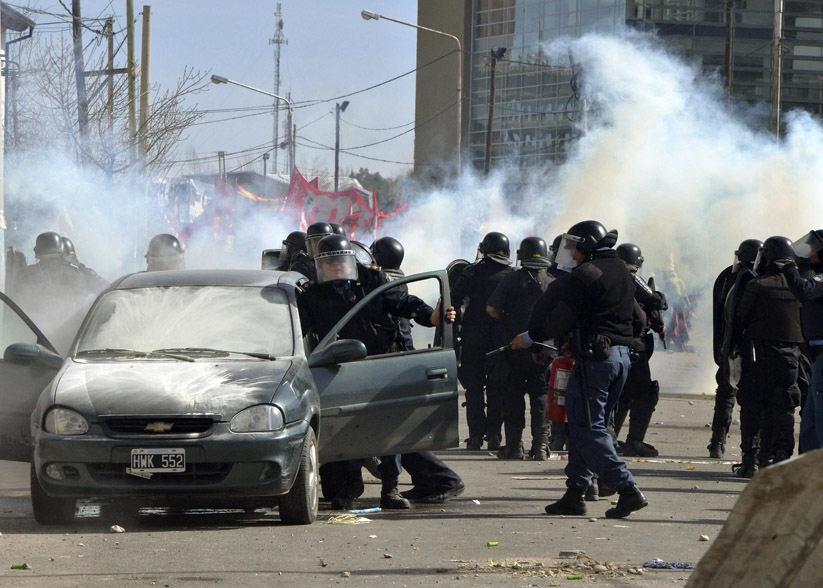
Police fire tear gas at demonstrators outside the provincial legislature where an agreement between YPF and Chevron is expected to be approved, in NeuquenThe momentum of the anti-fracking movement is growing as concerned communities across the globe feel the threat of natural gas development. On October 19, activists around the world will join together for the second annual Global Frackdown, an international day of action and an opportunity to, as one unified community, send a message to protect our resources. In anticipation of this year’s Frackdown, we can’t help but point to the recent victories of the anti-fracking movement in Argentina as an inspiring example of global resistance.

According to the U.S. Energy Information Agency’s June 2013 report, Argentina has the second greatest amount of shale gas resources in the world after China. The country’s potential for natural gas and oil development is disconcerting, but while some aspire for Argentina to become a global leader in shale gas, some communities are standing up to fight back. They have sought international support and strategy, mobilized their communities and targeted legislators to keep fracking out. Their efforts have paid off. More than six municipalities in Argentina have enacted local bans.

Chubut Province is one area formerly threatened by natural gas development. Chubut is located in Patagonia, the southern-most region of Argentina.

The President of Argentina, Cristina Fernández de Kirchner, together with Governor Martín Buzzi, inaugurated new shale exploration activities in Chubut in February. But after just a few months of activism and mobilization efforts, anti-fracking groups achieved a victory: A court in Argentina recently ordered Yacimientos Petrolíferos Fiscales (YPF) to halt fracking in “La Greta”, an exploratory well close to Río Mayo in the Chubut province.

Entre Ríos, a province in northeast Argentina, was also recently granted an injunction against fracking. Entre Ríos is located above one of the world’s largest aquifers, which supplies drinking water for the region.

Hugo Rivas, president of the Proyecto Sur Paraná, points to the community solidarity that was required to achieve this fracking victory: “In the movement to free Entre Ríos of fracking, social, professional, cultural and political sectors have participated and united in this action.”

These kinds of community-based and globally supported efforts are needed to combat the oil and gas industry. Indeed, they fuel the anti-fracking fire. Join us in this year’s Global Frackdown to send out a message as a unified, international community: the movement’s momentum is growing, it is strong, and together we will not allow fracking to destroy our water, air and communities.

Jaime Hamre is an intern for Food & Water Watch’s international program.

Malema, EFF backs Zanu-PF

effzanu
Malema backing Zanu-PF

Newly formed South African political party, the Economic Freedom Fighters (EFF) yesterday called on Zimbabweans to vote overwhelmingly for Zanu-PF in the July 31 harmonised elections to protect the gains of the war of liberation.The EFF party is led by former ANC youth league leader Julius Malema.

“The Economic Freedom Fighters (EFF) calls upon the revolutionary people of Zimbabwe to defend the Zimbabwean revolution by voting for Zanu-PF and retaining comrade Robert Mugabe as the President of that liberated nation,” the party said in a statement.

“The gains of the Zimbabwean revolution must be defended.

“These gains find concrete expression in the historic and unparalleled land redistribution programme that took land from 4 000 white settler farmers who owed 80 percent of Zimbabwean land, and redistributed it to more than 274 000 Zimbabweans! It is your victory. Defend it by any means necessary!”

The EFF said Zimbabweans stood to benefit economically by retaining a Zanu-PF government which has over the years implemented pro-poor policies aimed at uplifting the lives of ordinary Zimbabweans.

The party saluted Zimbabweans for enduring and surviving a brutal and illegal economic sanctions embargo imposed by the West as punishment for returning the stolen land to its rightful owners.

“The people of Zimbabwe have been punished as a strategy to separate the people from the revolutionary leadership of Zanu-PF and leadership of President Mugabe. We say do not allow the schemes of the enemies of Africa to succeed. Vote for liberation! Vote Zanu-PF!

“We implore the people Zimbabwe to realise that the Zimbabwean revolution is still under massive attacks and new plots are being hatched and new schemes cooked to reverse the gains you have made.

“The demonisation of Zanu-PF and comrade Mugabe is part of the plot to divide the nation for re-colonisation,” it said.

The EFF also called on Zanu-PF to continue implementing the indigenisation programme in order to complete the economic emancipation of the black majority. – The Herald

Martin Keevy ‘not fit to stand trial’ in treason case

Martin Keevy comforting his wife upon hearing that he has been refused bail

One of four rightwingers accused of plotting to murder senior ANC leaders is not fit to stand trial, his lawyer said on Friday.

Martin Keevy, 49, of Bloemfontein appeared in the Bloemfontein Magistrate’s Court on charges of treason and conspiracy to plan acts of terrorism.

Marius Bruwer, for Keevy, said a unanimous psychiatric report from the Free State Psychiatric Complex found he lacked criminal accountability and was unfit to stand trial.

Prosecutor Torie Pretorius told magistrate Andries Schoeman the State disputed the contents of the report and asked for a further 30-day postponement for a re-evaluation.

“The State does not agree with the conclusions of the report,” Pretorius said.

Bruwer did not oppose the application.

Keevy was admitted to the complex again on Friday, where the State’s experts would re-evaluate him. He would be back in court on August 16.

The State alleges that Keevy, Mark Trollip, Johan Prinsloo, and Hein Boonzaaier were part of a group who plotted to kill African National Congress leaders at the party’s Mangaung elective conference in December 2012. They allegedly called this “Die Slag van Mangaung” (The Battle of Mangaung).

Keevy, Trollip, and Prinsloo were denied bail, while Boonzaaier was granted R80,000 bail.

Trollip, Prinsloo, and Boonzaaier were expected to appear in court again on August 23. – Sapa

Plan for single African coastal policy

fishingAfrican leaders are looking seriously at an integrated maritime domain around the continent.

Such a domain would include an exclusive economic zone that would be key to the development of a sustainable “blue economy” for the continent. Today, each country with a coastline manages its 200 nautical mile zone, where it has full fishing and gas and mineral exploitation rights

Speaking at a symposium at UCT this week, Professor Patrick Vrancken of the Nelson Mandela Metropolitan University in Port Elizabeth, said this vision was contained in the 2050 African Integrated MaritimeStrategy presented to the second conference of African ministers responsible for maritime-related affairs in Addis Ababa, Ethiopia, in December.

The strategy recognised that fish made a vital contribution to the food and nutritional security of more than 200 million Africans and that there was an urgent imperative to develop a “blue economy”, he said.

He understood that the document was a draft that would be formally adopted by the AU Assembly of Heads of State and Government, “hopefully still this year”.

Vrancken was speaking at a Fisheries Crime Symposium organised by the Institute of Marine and Environmental Law and the Marine Research Institute, both at UCT.

The one-day academic symposium was a warm-up for a two-day closed workshop between Interpol and law enforcement officials from the national Department of Agriculture, Forestry and Fisheries, other Southern African Development Community fisheries departments and such South African agencies as the police, revenue service and maritime safety authority.

The thinking behind the proposal of an integrated maritime domain appeared to be that it would be easier to achieve than the mooted US of Africa, Vrancken suggested.

The strategy proposes a common fisheries policy for the conservation, management and exploitation of the continent’s marine resources. The draft urges all AU members to try to deter illegal, unregulated and unreported fishing, as well as other criminal activities in the maritime domain, such as piracy and robbery at sea, human trafficking, illegal oil bunkering and crude oil theft, and illegal arms and drug trafficking.

Among the measures recommended for reducing and containing illegal fishing are:

l Effective licensing and control of vessels allowed to fish by flag states.

l Real-time positional reporting by licensed vessels.

l Surveillance and interception of irresponsible fishing by patrols.

Regional economic communities have been asked to develop a common strategy that would warrant “24/7 patrolling of the seas” involving effective communications and rapid response capabilities with offshore patrol vessels and fast inshore boats, maritime patrol aircraft, unmanned aerial vehicles or drones, and helicopters for surveillance and deterrence.

Vrancken said the aim was to have the strategy in place by 2050. – Cape Argus

Snowden: Fresh allegations against the British, Germans

snowden2For weeks now, officials at intelligence services around the world have been in suspense as one leak after another from whistleblower Edward Snowden has been published. Be it America’s National Security Agency, Britain’s GCHQ or systems like Prism or Tempora, he has been leaking scandalous information about international spying agencies. In an interview published by SPIEGEL in its latest issue, Snowden provides additional details, describing the closeness between the US and German intelligence services as well as Britain’s acquisitiveness when it comes to collecting data.

In Germany, reports of the United States’ vast espionage activities have surprised and upset many, including politicians. But Snowden isn’t buying the innocence of leading German politicians and government figures, who say that they were entirely unaware of the spying programs. On the contrary, the NSA people are “in bed together with the Germans,” the whistleblower told American cryptography expert Jacob Appelbaum and documentary filmmaker Laura Poitras in an interview conducted with the help of encrypted emails shortly before Snowden became a globally recognized name.

Snowden describes the intelligence services partnerships in detail. The NSA even has a special department for such cooperation, the Foreign Affairs Directorate, he says. He also exposes a noteworthy detail about how government decision-makers are protected by these programs. The partnerships are organized in a way so that authorities in other countries can “insulate their political leaders from the backlash” in the event it becomes public “how grievously they’re violating global privacy,” the former NSA employee says.

SPIEGEL reporting also indicates that cooperation between the NSA and Germany’s foreign intelligence service, the BND, is more intensive than previously known. The NSA, for example, provides “analysis tools” for the BND to monitor signals from foreign data streams that travel through Germany. Among the BND’s focuses are the Middle East route through which data packets from crisis regions travel.

BND head Gerhard Schindler confirmed the partnership during a recent meeting with members of the German parliament’s control committee for intelligence issues.

But it’s not just the BND’s activities that are the focus of the interview with Snowden.

The 30-year-old also provides new details about Britain’s Government Communications Headquarters (GCHQ). He says that Britain’s Tempora system is the signal intelligence community’s first “full-take Internet buffer,” meaning that it saves all of the data passing through the country.

The scope of this “full take” system is vast. According to Snowden and Britain’s Guardian newspaper, Tempora stores communications data for up to 30 days and saves all content for up to three days in a so-called Internet buffer. “It snarfs everything in a rolling buffer to allow retroactive investigation without missing a single bit,” Snowden says.

Asked if it is possible to get around this total surveillance of all Internet communication, he says: “As a general rule, so long as you have any choice at all, you should never route through or peer with the UK under any circumstances.”

In other words, Snowden says, one can only prevent GCHQ from accessing their data if they do not send any information through British Internet lines or servers. However, German Internet experts believe this would be almost impossible in practice.

The attempt to conduct total data retention is noteworthy because most of the leaks so far in the spying scandal have pertained to so-called metadata. In the interview, Snowden reiterates just how important metadata — which can include telephone numbers, IP addresses and connection times, for example — really are. “In most cases, content isn’t as valuable as metadata,” Snowden says.

Those in possession of metadata can determine who has communicated with whom. And using the metadata, they can determine which data sets and communications content they would like to take a closer look at. “The metadata tells you what out of their data stream you actually want,” Snowden says.

It is becoming increasingly clear to recognize the way in which surveillance programs from the NSA and GCHQ — including Prism, Tempora and Boundless Informant — cooperate. The metadata provides analysts with tips on which communications and content might be interesting. Then, Snowden says, with the touch of a button they can then retrieve or permanently collect the full content of communications that have already been stored for a specific person or group, or they can collect future communications. But a person can also be “selected for targeting based on, for example, your Facebook or webmail content.” – Der Spiegel

Putin: Egypt going the same way as Syria

Putin sees another Syria in the making

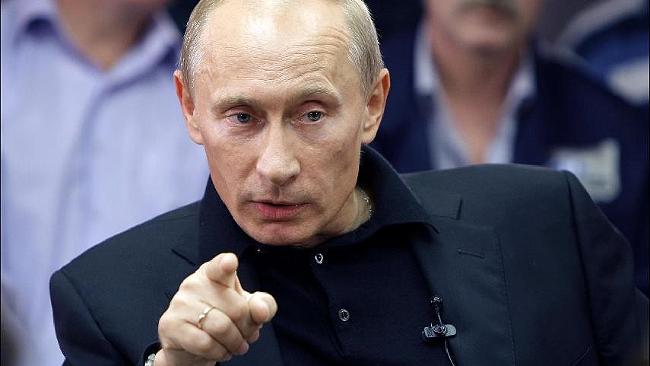
Russia’s President Vladimir Putin has said that Egypt risks slipping into civil war following the military overthrow of president Mohamed Morsi.

Dozens of people have been killed and more than 1 000 wounded in clashes between Morsi’s supporters, opponents and the military since the president’s exit.

“Syria is already in the grips of the civil war … and Egypt is moving in the same direction,” Putin told Russian state news agency RIA Novosti on Sunday during a visit to Kazakhstan’s capital Astana.

Meanwhile, Egypt’s transition has stumbled after the choice of Mohamed ElBaradei as interim prime minister was thrown into doubt by Islamist objections.

ElBaradei’s nomination had been confirmed by several sources and state media on Saturday, but just before midnight a presidential spokesperson told reporters that the prime minister had not in fact been chosen.

The abrupt U-turn came amid opposition to the appointment by the Nour Party, Egypt’s second Islamist force after Morsi’s Muslim Brotherhood movement, highlighting the challenge the military faces in finding consensus among liberals and conservatives on who should run the country.

Clashes between tens of thousands of pro- and anti-Morsi protesters swept the Arab world’s most populous nation on Friday and at least 35 people were killed and more than 1 000 wounded.

The violence, which saw rival factions fighting street battles in central Cairo and many others cities and towns, underlined the pressing need for a swift political solution seen as inclusive to all.

“We extend our hand to everyone, everyone is a part of this nation,” the spokesperson told reporters. “The Muslim Brotherhood has plenty of opportunities to run for all elections including the coming presidential elections or the ones to follow.”

Minutes after he spoke, state media reported that the public prosecutor ordered that four top Brotherhood leaders held this week be detained for a further 15 days on accusations that they incited violence against protesters.

The four included Saad el-Katatni, head of the group’s political wing, and Khairat El-Shater, its political strategist.

The Brotherhood has said it wants nothing to do with the military’s plans for a new interim government. It believes Morsi should be reinstated, and has pledged to keep protesting until he is.

The Nour Party, however, had agreed to the army-backed transition plan leading to new elections. Its withdrawal from the process would strip that plan of vital Islamist support.

And following the Nour rejection, the interim administration headed by Adli Mansour delayed naming the new prime minister.

On Sunday, people were still reeling from one of the bloodiest days in over two years of tumultuous upheaval since autocrat Hosni Mubarak, who ruled for 30 years, was toppled in a popular uprising that was part of the 2011 “Arab Spring”.

The Brotherhood called for another day of protest on Sunday.

Huge protests were staged on June 30 to pressure Morsi into resigning amid growing anger at economic stagnation and the perception among many that the Brotherhood was seeking to take control of every part of the state – a charge it fiercely denies.

Millions took to the streets to cheer his ouster on Wednesday, but for many Islamists it was a bitter reversal that raised fears of a return to the suppression they endured for decades under autocratic rulers.

The military said it had not carried out a coup, but merely enforced the will of the people. – Reuters

CIA helped jail Mandela

gerhardludiChicago Tribune —– June 10, 1990 – WASHINGTON – For nearly 28 years the U.S. government has harbored an increasingly embarrassing secret: A CIA tip to South African intelligence agents led to the arrest that put black nationalist leader Nelson Mandela in prison for most of his adult life.

But now, with Mandela en route to the U.S. to a hero`s welcome, a former U.S. official has revealed that he has known of the CIA role since Mandela was seized by agents of the South African police special branch on Aug. 5, 1962.

The former official, now retired, said that within hours after Mandela`s arrest Paul Eckel, then a senior CIA operative, walked into his office and said approximately these words: “We have turned Mandela over to the South African security branch. We gave them every detail, what he would be wearing, the time of day, just where he would be. They have picked him up. It is one of our greatest coups.”

With Mandela out of prison, the retired official decided there is no longer a valid reason for secrecy. He called the American role in the affair “one of the most shameful, utterly horrid” byproducts of the Cold War struggle between Moscow and Washington for influence in the Third World.

Asked about the tip to South African authorities, CIA spokesman Mark Mansfield said: “Our policy is not to comment on such allegations.”

Reports that American intelligence tipped off the South African officials who arrested Mandela have circulated for years. Newsweek reported in February that the agency was believed to have been involved.

Mandela, now 71, arrives in the United States June 20 as part of an international tour to bolster the anti-apartheid movement. The deputy African National Congress president, widely regarded as the world`s pre-eminent political prisoner when he finally was released in February, is due to be honored by a ticker-tape Broadway parade and to address a joint session of Congress.

But in 1962 the CIA`s covert branch saw the African National Congress as a threat to the stability of a friendly South African government. At the time, that government not only had just signed a military cooperation agreement with the United States but also served as an important source of uranium.

The CIA knew of Mandela`s whereabouts because it had put an undercover agent into the inner circle of the African National Congress group in Durban, according to Gerard Ludi, a retired South African intelligence official.

Mandela was being sought as a fugitive for his anti-apartheid activities. The morning after a secret dinner party with other congress members in Durban, Mandela, dressed as a chauffeur, ran into a roadblock. He was immediately recognized and arrested. – Cox News Service

Marine Le Pen demands political asylum for Snowden

marinesnowdenMarine Le Pen, leader of France’s anti-immigration National Front (FN) party, has demanded that the country give former American defense contractor and whistleblower Edward Snowden immediate political asylum.

In an open message, Le Pen said she was demanding French President François Hollande “to give, in the name of the French Republic, asylum to this young man who had the courage to reveal to humanity a very serious threat to democracy and to public freedoms.”

The FN leader is better known for calling on cuts to French asylum quotas.

During her campaign ahead of the 2012 presidential election, she called for an 80 percent reduction in the number of refugees taken in by France over five years.

Snowden, a former low-level CIA employee and sub-contractor to the US National Security Agency, revealed on Sunday that he was the source of a leak about a top-secret US program code named PRISM that monitored internet use and phone records.

The 29-year-old told the Guardian and Washington Post newspapers that he had blown the whistle on the NSA’s activity to protect “basic liberties for people around the world”.

On Monday, he told the Guardian he was holed up Hong Kong, which has an extradition treaty with the United States.

He said he was looking at trying to get political asylum in a country that shared his values – and that “the nation that most encompasses this is Iceland.”

Icelandic authorities said on Monday that they had not been contacted by Snowden, and that the only way to apply for asylum there was to arrive in the country itself. – France24

Pan Africanist Youth leader calls Mandela a ‘sell-out’

paycoPan Africanist Youth Congress of Azania spokesman Sello Tladi said former president Nelson Mandela was a sell-out, The Citizen reported on Monday..

“He betrayed us by rubber-stamping the 1913 Land Act through the adoption of [the] Freedom Charter,” Tladi was quoted as saying.

“The problem with the Freedom Charter is that it made African people to be landless.”

Tladi was reportedly addressing Pan Africanist Congress, Azanian People’s Organisation and Socialist Party of Azania supporters who had gathered at the Regina Mundi church in Soweto to commemorate Youth Day on Sunday.

Tladi said Mandela was greedy.

“… We have the majority of poor people dying of various diseases because they have no access to the expensive medication that Mandela is receiving.

“What is special with Mandela that is not special with the ordinary man in the street on Soweto,” Tladi said.

Mandela was admitted to a Pretoria hospital on June 8 due to a recurring lung infection. On Monday, he was spending his tenth day in hospital.

The African National Congress spokesman Keith Khoza hit back saying the comments were simply the view of an individual.

ANC Youth League national task team convenor Mzwandile Masina said the comments were unfortunate, insensitive and politically immature. – Sapa

Rand Paul to challenge unconstitutional snooping by US

Kentucky Senator Rand Paul took to Fox News Sunday to declare his legal opposition to the NSA’s surveillance programs. “I’m going to be seeing if I can challenge this at the Supreme Court level,” Paul said.

“I’m going to be asking all the internet providers and all of the phone companies: ask your customers to join me in a class action lawsuit,” Paul told host Chris Wallace. “If we get ten million Americans saying we don’t want our phone records looked at, then maybe someone will wake up and something will change in Washington.”

Like many lawmakers, Paul drew a distinction between targeted surveillance and the blanket surveillance revealed this week.

“They are looking at a billion phone calls a day,” Paul said. “That doesn’t sound to me like a modest invasion of primary, it sounds like an extraordinary invasion of privacy.”

“I have no problem if you have probable cause, you target people who are terrorists, and you go after them,” Paul continued. “But we’re talking about trolling through billions of phone records…That is unconstitutional.”

Paul also said he would introduce the Fourth Amendment Restoriation Act, though he offered few details about the still-hypothetical legislation.

“If you talk to young people who use computers every day, they’re absolutely with me,” Paul said. “What I spend on my Visa each month, that’s my business, where I spend it, and whether I read conservative magazines, whether I subscribe to Fox News, or whether I subscribe to Yahoo or Google—what I do with my private life is my private life. If you suspect me of a crime, have probable cause.”

“So much of our life now is digitalized, that we have to protect it from a snooping government,” Paul said. “We’ve now got a government that appears to target people based on their political beliefs. I don’t want my phone records being given to an administration I can’t trust.”

Paul remembered that the public outrage against SOPA and PIPA legislation last year were somewhat successful in pushing back the laws, and predicted that if people reacted with similar severity to the current surveillance measures, they would be successful in repealing them. – MediaITE

France attacks Amazon ‘destroyer of bookshops’

France’s culture minister has branded online retailer Amazon a “destroyer” of bookshops in the latest confrontation between the Socialist government in Paris and America’s giants of the digital economy.

“Today, everyone has had enough of Amazon, which, by dumping, slashes prices to get a foothold in markets only to raise them once they have established a virtual monopoly,” Culture Minister Aurelie Filippetti said.

“It is destructive for bookshops,” the minister told a conference of booksellers Monday in the southwestern city of Bordeaux.

Filippetti said that she would be examining measures that could curb Amazon’s growth in France by restricting the American giant’s ability to combine offers of free deliveries with discounts of up to five percent on cover prices, which is the maximum allowed in France under existing legislation designed to protect small booksellers.

The attack on Amazon is the latest in a series of disputes between the French government and American companies including Google, Yahoo! and Apple.

French authorities are already embroiled in a dispute with Amazon over a $252 million tax bill related to the company’s sales in France between 2006 and 2010.

The dispute arose because of Amazon’s practice of reporting European sales through a Luxembourg-based holding company, taking advantage of the tiny Duchy’s relatively low corporation tax rates for earnings outside its borders.

Amazon insists the arrangement, which has been criticised by politicians across Europe, is legal under the European Union’s single market rules.

Industrial Renewal Minister Arnaud Montebourg last month also infuriated Yahoo! by placing a series of conditions on its proposed takeover of French video-sharing site Dailymotion, causing the deal to collapse.

France is meanwhile at loggerheads with Google over privacy issues and over demands that it pass on part of its advertising revenues to newspapers and other content providers that the search engine links to.

The Paris government has also clashed with Apple and other hi-tech manufacturers over proposals to tax smartphones and tablets to fund French-language creative and artistic projects. – AFP