New poll shows majority of Americans are proud of Confederate flag

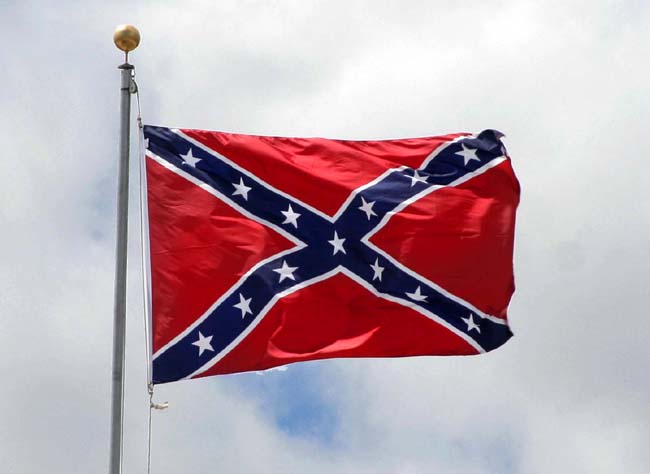
As debate rages in South Carolina over the Confederate flag on its statehouse property, a majority of Americans see the rebel flag as a symbol of Southern pride, not a reminder of racism, according to a new CNN/ORC poll out Thursday. Public opinion is about where it stood 15 years ago, when the Palmetto State removed the rebel St. Andrew’s cross from the Capitol dome.

But there is a stark racial divide on how the banner is perceived and what should be done about references to the Confederacy.

Among all 1,017 adults participating, 57 percent said it’s a symbol of Southern pride, 33 percent called it more a symbol of racism and 5 percent said it’s both equally. Among whites, 66 percent said it symbolizes pride, while just 17 percent of African-Americans responded that way. In May 2000, 59 percent of Americans in the CNN/USA Today/Gallup poll called the flag a point of regional and historical pride.

A majority of both blacks and whites said they would oppose renaming streets and highways named after Confederate leaders, with 68 percent overall in opposition.

Americans appear to be more split on whether they support private companies like Amazon, Wal-Mart, eBay and others’ decision not to sell or manufacture items featuring the flag. Just 50 percent support those measures, compared to 47 percent overall. The margin is wide among African-Americans (65 percent to 33 percent), but much smaller when it comes to whites (49 percent to 47 percent).

There is also a lack of overall support for redesigning state flags that feature Confederate emblems or symbols, like the official banners of Alabama, Arkansas, Florida, Georgia and Mississippi. Just 40 percent said they would back that, with 57 percent opposed.

At the same time, another majority (55 percent) supported removing Confederate flags from government property that is not a museum, but the racial divide grew more pronounced when respondents were asked if state flags should be redesigned (59 percent of non-Hispanic blacks support, compared to 35 percent of whites), and if tributes honoring Confederate soldiers should be removed from public places (49 percent of non-Hispanic blacks to 21 percent of whites).

The latest poll comes on the heels of another this week, by USA Today and Suffolk University, which found a more even split between those who found the flag racist and those who found it symbolic of Southern heritage. It should be noted that the question was framed slightly differently, as the 1,000 respondents were asked in that poll whether: “The confederate flag is a racist symbol and should be removed from state flags and other official locations” or “The Confederate flag is representative of Southern heritage and is not racist.” The poll found a split of 42 percent each responding either way.

The CNN/ORC poll was conducted June 26-28, surveying 1,017 Americans by telephone, carrying an overall margin of error of plus-or-minus 3 percentage points. The overall sample includes 303 African-Americans with a margin of error of plus-or-minus 5.5 percentage points.  – politico.com

In USA, Tom and Jerry cartoons now carry ‘racism’ warning

Tom and Jerry cartoons on television are being accompanied by a warning that they may depict scenes of “racial prejudice”.

The classic cat and mouse cartoons, some made more than 70 years ago, carry a warning for subscribers to Amazon Prime Instant Video.

There have been claims of racist stereotyping in the depiction of a black maid in the cartoon series.

A warning at the beginning of the cartoon, displayed by Warner Brothers

Amazon’s warning says such prejudice was once “commonplace” in US society.

Tom and Jerry, once a staple of children’s television on British television, is being presented with a cautionary note about “ethnic and racial prejudices”.

‘Trigger warnings’

Amazon’s streaming subscription service, formerly branded as LoveFilm, includes the cartoons in its comedy collection.

But Tom and Jerry: The Complete Second Volume is accompanied by the caution: “Tom and Jerry shorts may depict some ethnic and racial prejudices that were once commonplace in American society. Such depictions were wrong then and are wrong today.”

The wording is similar to disclaimers accompanying some collections of the cartoons on DVD.

The warning was attacked as “empty-headed” by cultural commentator and professor of sociology, Frank Furedi, who said it was a form of a “false piousness” and a type of censorship which “seems to be sweeping cultural life”.

“We’re reading history backwards, judging people in the past by our values,” said Prof Furedi from the University of Kent.

Tom and Jerry was first produced by the MGM film studio in 1940. The cartoons, directed by William Hanna and Joseph Barbera and produced by Fred Quimby, ran until 1957, with carefully choreographed chase scenes set in the homes and gardens of suburban America.

There were more than a hundred short films made in this original series, winning seven academy awards. These included the Cat Concerto in 1946, the Two Mouseketeers in 1951 and Johann Mouse in 1952.

In the subsequent decades there have been numerous re-launched television versions of the series, with varying styles and varying degrees of critical approval.

The claims of racism are longstanding. When the original versions were shown on US television in the 1960s some scenes were edited.

There have also been complaints about the characters smoking cigarettes, with changes made to recent screenings.

‘Superb’ animation

Steve Abrahart, senior lecturer in animation at De Montfort University, said the quality of animation in the early Tom and Jerry films was “superb”.

The cartoons are still seen as being among the best made, he said.

But Mr Abrahart said the attention to detail of the early versions was lost in some of the later re-makes.

On the question of the portrayals of race and ethnicity, he said today’s animation students were not shocked by what they saw in old cartoons.

He said they understood how attitudes changed over time.

As well as racial stereotypes, he said there were questions about the representation of women and other nationalities in animations from the 1940s.

The idea of running warnings ahead of potentially upsetting moments in films or books has become a controversial topic in US universities.

There have been calls for the use of “trigger warnings” which could flag up to students that they are about to come across descriptions of physical brutality, aggressive language or sexual violence.

The suggestion that these should be inserted into lessons about classic texts has angered some academics.

Prof Furedi said calls for such trigger warnings were a form of “narcissism”, with the concerns not really being about the content of a book or work of art but about individual students asserting their own importance.

“A tolerant society needs to discuss disturbing art,” he said. – BBC.COM

Amazon launches its ‘Fire’ smartphone

Amazon announced its first smartphone today, a bold move into a segment currently dominated by Apple and Samsung. At an event in Seattle, CEO Jeff Bezos unveiled the Fire Phone, a smartphone with a 4.7-in. 3-D display, a 2.2-GHz quadcore processor, a 13-megapixel rear-facing camera and 2 GB of RAM.

The device, which has a heavy focus on multimedia, will offer unlimited photo storage and a dedicated button to launch the camera app. It will be sold exclusively on AT&T’s network at a price of $199 for a 32-GB version with a two-year contract or $299 for a 64-GB version. Amazon is also throwing in a free year of Amazon Prime, its customer-loyalty program (existing Prime members will get a bonus year tacked onto their current subscription).

The device is currently available for preorder on Amazon’s website and will begin shipping on July 25.

The new phone is designed to be tightly integrated with Amazon’s myriad services. The company’s Instant Video service will be preinstalled on the device, as will Amazon’s newly launched music-streaming service. The phone will also come with a new program called Firefly, which allows people to scan objects, songs and TV shows (sort of like an all-purpose Shazam app) so that Amazon can identify them and offer a way to purchase them from its store. In total Firefly can recognize 100 million items, Bezos said. “Fire Phone puts everything you love about Amazon in the palm of your hand,” he said in a press release.

The phone’s 3-D capabilities are its most unique feature. Through a technology dubbed Dynamic Perspective, the Fire Phone uses four cameras placed on its front face to track a person’s head movements at all times. This allows the phone to offer a real-time 3-D-like display that presents more depth to images than a typical smartphone screen. During the event, Bezos demonstrated the phone’s map app, which showed looming skyscrapers leaping off the screen, as well as an app that allowed the user to sort through dresses as if they were in an actual 3-D space. The phone’s motion sensors allow users to scroll within certain apps by tilting the device rather than touching the screen.

Like the Kindle, the Fire Phone will run on a modified version of Android and support some apps native to Google’s operating system. Popular apps such as Instagram, Facebook, Netflix, ESPN and HBO Go should be available for the device when it launches. Amazon has also released development tools to allow companies to make apps that make use of Dynamic Perspective and Firefly.

The device demonstrates Amazon’s growing interest in creating hardware. In addition to its popular line of Kindle e-readers and tablets, the company released its first set-top box, the Amazon Fire TV, earlier this year. The company has always been reticent to disclose just how successful its hardware ventures are — Bezos said today that there are “tens of millions” of Kindle owners, and there’s no real data on Fire TV sales — but smartphone sales dwarf those other segments. More than a billion smartphones were shipped globally in 2013, with Samsung and Apple controlling nearly half the market between them.

Amazon will face an uphill battle taking on those two giants, but the company has a history of eschewing profits to smother competitors in other markets. They may be embarking on a similar strategy today — the 32-GB version of the Fire Phone, for instance, will sell for $100 less than a similar model of the iPhone 5S. – Time.com

Amazon to buy Washington Post

Jeff Bezos
Jeff Bezos

Amazon founder Jeff Bezos will buy the Washington Post newspaper for $250-million in a surprise deal that ends an 80-year ownership of the paper by the Graham family and hands one of the United States’s most influential publications to the businessman whose internet company has transformed retailing.

Bezos, hailed by many as technology visionary, called his acquisition a personal endeavor and reassured employees and readers of the 135-year-old newspaper that he will preserve its journalistic tradition, while driving innovation.

The acquisition, the latest in a flurry of deals for print publications, including the New York Times Company’s sale of the Boston Globe for $70-million, is a another sign of the unprecedented challenges newspapers face as advertising revenue and readership decline.

Shares of the Washington Post Company climbed more than 5% to $599.85 after the announcement – their highest level in almost five years.

Chairperson and chief executive of the Washington Post Company, Donald Graham, said in an interview that he and his niece Katharine Weymouth, Washington Post publisher, made the decision to put the newspaper up for sale earlier this year after looking at its financial forecasts.

“For the first time in either of our lives we said to each other: is ownership by the Washington Post Company the best thing for the newspaper? We could keep it alive, that wasn’t the issue. The issue was could we make it strong?”

The Amazon chief executive took his message directly to employees in a letter posted on the newspaper’s website.

“I understand the critical role the Post plays in Washington, DC and our nation, and the Post‘s values will not change,” Bezos wrote in the letter.

“There will of course be change at the Post over the coming years. That’s essential and would have happened with or without new ownership,” Bezos added. “We will need to invent, which means we will need to experiment.”

In addition to the newspaper, Bezos gets other publishing businesses, including the Express newspaper, The Gazette Newspapers, Southern Maryland Newspapers, Fairfax County Times, El Tiempo Latino and Greater Washington Publishing.

The real estate, including the paper’s headquarters business and online news sites such as Slate, will remain with the Washington Post Company, and the paper’s operations will be kept separate from Amazon.com, according to the Washington Post.

The Washington Post is the seventh largest daily in the US.

While its legend and status loom large, the Washington Post represents only a fraction of the company which has expanded into a stable of holdings, including education and healthcare services and, most recently, industrial supplies.

And yet, the Washington Post suffers from the same hurdles besieging big city newspapers across the US. The company’s newspaper division reported an operating loss of $49.3-million for the six months ending June, compared to a loss of $33.2-million during the same period last year.

Weymouth, who will continue to serve as the paper’s chief executive and publisher after the sale, said she did not think there was a “magic bullet” to resolving the paper’s problems, but that the resources Bezos brought to the table were a plus.

“He’s smart and innovative and has access to a lot of smart people,” she said.

Bezos, who has built Seattle-based Amazon.com into a shopping and online technology force over the last two decades, made a small foray into media earlier this year with an investment in internet news site Business Insider.

Bezos is the world’s 19th richest person with a fortune of $25.2-billion, according to Forbes. His investment vehicle, Bezos Expeditions, is invested in a number of companies including Twitter and Business Insider.

His major personal project is called Blue Origin, which aims to be one of the first non-government funded ventures to send people and cargo into space, potentially winning lucrative contracts that were once fulfilled by NASA.

Bezos has already spent millions of dollars on this project, with millions more in the pipeline.

He did not elaborate in great detail on his motivations behind his latest deal, which caught many industry watchers by surprise. He does not play a prominent role in politics but has been described by friends as holding libertarian views. He and his wife did make public a $2.5-million contribution to a Washington state campaign to legalize same-sex marriage last year.

The deal comes on the heels of near-unprecedented media deal activity this year, with the Globe transaction announced just over the weekend, News Corp spinning out its newspapers, and the Tribune Company hiving off its publishing business like the Los Angeles Times and Chicago Tribune from its broadcasting division.

“It will be interesting to see, is this the first step in the transformation of the business?” said John Miller, senior vice president at Chicago’s Ariel Investments, a top-10 investor in the Washington Post. “The board is making the right decision. They obviously felt like it was a good deal. It will be interesting to see how they allocate capital going forward.” – Reuters

Tablets to overtake PCs by 2015 as prices plummet

A tablet
A tablet

Tablet prices are plunging amid a flood of new devices and cutthroat competition for market share.

Amazon has slashed prices of its Kindle HD tablets to as low as $169 in the US and 139 pounds in Britain, while Barnes & Noble has cut the price of its Nook to as low as $129, and has announced plans to outsource production of its tablets.

“Since Hewlett-Packard launched its tablet, there has been a lot of pressure on prices,” said Rob Enderle, analyst with Enderle Group.

HP sells its Android-powered seven-inch Slate for as low as $139, helping make the paperback-size tablet computer an affordable commodity.

A Gartner survey suggests tablet sales globally will rise 67.9 percent to 202 million units this year, but analysts say the market is cooling after a couple of years of sizzling growth.

Gartner said the red-hot growth in tablets and smartphones will taper off as these devices gain longer life cycles. The report said many consumers are opting for “basic” tablets to cut costs.

“It looks like the market may be tiring of tablets and as makers get desperate, you may see more pressure on prices,” Enderle said.

Some retailers are selling tablets for less than $100, but Enderle said the flood of poor-quality devices may eventually backfire and turn off consumers.

Jitesh Ubrani, analyst at the research firm IDC, said many of the low-cost tablets come from small, sometimes unbranded “whitebox” vendors.

“The decline of the PC market makes it increasingly important for PC vendors to compete in the tablet space,” Ubrani said

“As more top-tier brands introduce low-cost products, we expect to see a reduction in the number of whitebox vendors.”

Even so, the analyst said, average prices for tablets is likely to drop further, and that tablet shipments are expected to overtake all PC shipments in 2015.”

The market leader, Apple, has so far kept above the fray, keeping prices steady on its iPad line of tablets, although it introduced the lower-cost iPad mini last year at $329, less than the $500 for its full-size iPad.

“Apple does not look at the competitive marketplace to determine its strategy,” said Jeff Orr, analyst with ABI Research. “They look at their buyers. Because of that I would expect their price points to remain consistent for the foreseeable future.”

Enderle said Apple is seeking to remain a “premium vendor” but faces a difficult choice — lowering prices, which can hurt its profits and worsen its share price declines, or giving up market share.

“Under Steve Jobs, when a product started to commoditize, they would come out with something new,” Enderle said. “Apple needs another premium product. It is overdue for whatever the next big thing is.”

Microsoft has also aimed at the high end of the market with its Surface, which debuted with a starting $500 price tag, but it has cut the price as low as $199 for education buyers.

Orr said some of the manufacturers may be forced out of the market if tablets are not part of their “core” business.

“Every brand believes it has an audience which will be interested in their device to connect to their ecosystem,” he said. “The reality is not every player can survive.”

Amazon sells its Kindles near the cost of production, in an effort to direct the buyers to Amazon content and apps. The others, including Apple, Google and Microsoft, also want to keep their customers tethered to an ecosystem for advertising and sales.

But Orr points out “there is none of that brand loyalty that some of these vendors had expected.” For example, an iPad user can still use Google, and Kindle users can buy from non-Amazon sellers.

Enderle noted that Google, which makes a $199 Nexus 7 tablet, “has a subsidized model in which advertising makes up the difference” of any lost profits from the device itself.

But he noted that Barnes & Noble faces an unusual predicament because it is primarily a brick-and-mortar bookseller, and needs to bring customers into its physical stores.

“Every Nook tablet sold causes them to lose a customer who might also go into the store,” he said. “They may need to go fully online and compete with Amazon.”

IDC’s Ubrani said it may be difficult for players like Barnes & Noble to compete with Amazon by subsidizing the tablets.

“Not every tablet vendor can afford to utilize this business model,” he said. “Yes, each can offer movies, music, apps, etc. to help subsidize the tablet, but none have the same scale and product selection that Amazon does.”

Enderle said that even though it seems to be a good time to buy a tablet, he advises people to wait.

“We are just short of a refresh” for many tablet makers, said Enderle. He expects new versions of the iPad, Surface and several Android models. Amazon is also reportedly working on new tablets.

“We will see a raft of new products in August and September,” he said. “Unless you find a really good buy. I would wait.” – AFP

Sales of George Orwell’s ‘1984’ soar on Amazon as America becomes surveillance society

George Orwell
George Orwell

George Orwell’s dystopian novel “1984” is enjoying a spike in sales in the wake of revelations on surveillance in the United States.

Amazon.com says the book, published in 1945, has gone from No. 13,074 to No. 193 on its selling list, and it is moving higher, The Guardian reported. To put it another way, sales are up 7,000 percent.

In the novel, Orwell imagines a world divided into three large states, all of them exercising near-constant surveillance on their subjects. The government manipulates the news, history and the language.

The novel is set in London, the city where Orwell spent much of his adult life. But his primary target appears to be the Soviet Union, although he was also concerned about trends he saw in the United States and Britain.

It was “1984” that made “Orwellian” a common adjective in English. It is one that has been used a lot since news broke of National Security Agency monitoring of Internet and telephone traffic.

“What does our Constitution mean? What kind of country do we want to be? Kids will grow up knowing that every damn thing that they do is going to be recorded somewhere in a file, and I think that will have a very Orwellian and inhibiting impact on our lives,” U.S. Sen. Bernie Sanders, Ind-Vt., said in a recent interview.

Orwell died in 1950 at the age of 46. But the book remains under copyright in Britain and the United States, so his estate benefits from its new popularity. – UPI

Apple clashes with Amazon in e-book case

Apple attorneys in the US antitrust case on e-books went on the offensive Thursday, attacking the credibility of government witnesses and seeking to debunk key elements of the government’s case.

Apple attorneys grilled a trio of witnesses from Apple rival Amazon and undertook a bruising cross-examination of a Google executive.

Apple attorney Howard Heiss peppered Amazon executives during a series of contentious exchanges with skeptical questions on Amazon statements about its business profile and pointed out inconsistencies between Amazon testimony and documentary evidence.

Amazon is very “metrics-focused,” Heiss said to Amazon’s vice president for Kindle Russell Grandinetti during a cross examination.

Grandinetti had previously testified that he did not know Amazon’s market share of the e-books market.

“We were a very large seller of e-books,” Grandinetti said, while denying he could estimate Amazon’s market share.

Heiss then presented a news article quoting another Amazon executive estimating the company’s market share at 70-80 percent.

Amazon is a key witness in the government’s case, which maintains that Apple conspired with publishers to orchestrate a transformation of the e-book market in early 2010 that cost consumers hundreds of millions of dollars.

In entering the market, Apple signed a series of “agency” model contracts with publishers, in which publishers set the price and guaranteed Apple a 30 percent commission.

Prior to Apple’s entry, the e-book industry was dominated by Amazon and run on a “wholesale” model where retailers set the prices. Amazon charged $9.99 for bestsellers prior to Apple’s entry into the market.

Part of the government’s case is that Apple and publishers forced Amazon to switch to the agency model, resulting in higher prices.

Apple attorneys sought to show that Amazon faced an increasingly difficult market in late 2009 and early 2010 in which publishers were already planning hardball tactics — even before Apple’s entry.

Amazon’s pricing model was unpopular not only with publishers, but also with agents and authors who worried about the erosion of intellectual property.

Grandinetti confirmed that by the end of 2009 four of the “Big Six” publishers announced plans to “window” bestselling books, meaning they would delay release of the Amazon e-book for a period of months until after the release of the physical book.

As five of the major publishers signed agency models with Apple, they contacted Amazon to renegotiate terms.

The first negotiation was with MacMillan Chief Executive John Sargent, who presented Amazon with the choice of shifting to an agency model or accepting a wholesale model with windowing for seven months.

“We expressed quite strongly how unpalatable the choice was,” Grandinetti said of his encounter with Sargent. “The meeting was very tense.”

Amazon initially tried to punish MacMillan by removing the “buy” button from MacMillan titles.

But Amazon ultimately capitulated after three days and quickly negotiated the agency model with MacMillan.

Soon after that, Amazon negotiated similar contracts with the other four publishers.

Apple attorneys sought to show that Amazon’s shift to the agency model was its own decision and not orchestrated by Apple.

But Amazon officials testified that the publishers were forcing the change at Apple’s behest.

Laura Porco, who was director of Amazon’s Kindle Books at the time, told the court in a written declaration that the publishers informed Amazon that they were switching to agency “because that’s what Apple made them do.”

Porco told the court Thursday she was “alarmed” when the publishers demanded agency from Amazon.

“I felt like we were being pushed into something that was really terrible for consumers,” Porco said.

Following Porco’s testimony, Apple attorney Orin Snyder aggressively questioned Thomas Turvey, an executive in Google’s book selling division.

Turvey said in a written deposition that publishers told him that they could not accept wholesale terms with Google because of their terms with Apple.

During the testimony, Turvey was unable however to name a single publishing executive who said this. -AFP

France attacks Amazon ‘destroyer of bookshops’

France’s culture minister has branded online retailer Amazon a “destroyer” of bookshops in the latest confrontation between the Socialist government in Paris and America’s giants of the digital economy.

“Today, everyone has had enough of Amazon, which, by dumping, slashes prices to get a foothold in markets only to raise them once they have established a virtual monopoly,” Culture Minister Aurelie Filippetti said.

“It is destructive for bookshops,” the minister told a conference of booksellers Monday in the southwestern city of Bordeaux.

Filippetti said that she would be examining measures that could curb Amazon’s growth in France by restricting the American giant’s ability to combine offers of free deliveries with discounts of up to five percent on cover prices, which is the maximum allowed in France under existing legislation designed to protect small booksellers.

The attack on Amazon is the latest in a series of disputes between the French government and American companies including Google, Yahoo! and Apple.

French authorities are already embroiled in a dispute with Amazon over a $252 million tax bill related to the company’s sales in France between 2006 and 2010.

The dispute arose because of Amazon’s practice of reporting European sales through a Luxembourg-based holding company, taking advantage of the tiny Duchy’s relatively low corporation tax rates for earnings outside its borders.

Amazon insists the arrangement, which has been criticised by politicians across Europe, is legal under the European Union’s single market rules.

Industrial Renewal Minister Arnaud Montebourg last month also infuriated Yahoo! by placing a series of conditions on its proposed takeover of French video-sharing site Dailymotion, causing the deal to collapse.

France is meanwhile at loggerheads with Google over privacy issues and over demands that it pass on part of its advertising revenues to newspapers and other content providers that the search engine links to.

The Paris government has also clashed with Apple and other hi-tech manufacturers over proposals to tax smartphones and tablets to fund French-language creative and artistic projects. – AFP