
Google memo emphasising male-female differences causing outrage

A 10-page memo that went viral inside Google and has been obtained by Gizmodo sees a Google software engineer arguing that women are underrepresented in tech not due to bias, but rather because of inherent psychological differences from men.

The memo has been shared repeatedly on the internal network and Google+. Motherboard first reported that the memo existed, and Gizmodo published it in its entirety.

The memo titled ‘Google’s Ideological Echo Chamber’ is essentially the personal opinion of a male software engineer working for Google.

In the document, the employee argues that he “values diversity and inclusion, am not denying that sexism exists, and don’t endorse using stereotypes.” However, some topics, he adds, now involve “shaming into silence.”

“This silencing has created an ideological echo chamber where some ideas are too sacred to be honestly discussed,” and the lack of discussion brings about “the most extreme and authoritarian elements of this ideology,” the memo says.

The software engineer goes on to claim that the reason why women don’t have a 50-percent representation in tech may be the “differences in distributions of traits between men and women,” and “discrimination to reach equal representation is unfair, divisive, and bad for business.”

The traits in question include “biological differences” that are “universal across human cultures” and are “highly heritable.”

Women in general have more “openness directed towards feelings and aesthetics rather than ideas,”“a stronger interest in people rather than things, relative to men,” so they end up working for front desk rather than coding, the memo’s author argues.

Women also have “extraversion expressed as gregariousness rather than assertiveness,” hence, “higher agreeableness,” and consequently, “women generally have a harder time negotiating salary, asking for raises, speaking up, and leading,” according to the memo.

“We need to stop assuming that gender gaps imply sexism,” the document says.

Feminists on Twitter have reacted with outrage and four-letter expletives.

Another issue the author highlights is that “feminism has made great progress in freeing women from the female gender role, but men are still very much tied to the male gender role.”

“If we, as a society, allow men to be more ‘feminine,’ then the gender gap will shrink, although probably because men will leave tech and leadership for traditionally feminine roles.”

The author concludes that “despite what the public response seems to have been, I’ve gotten many personal messages from fellow Googlers expressing their gratitude for bringing up these very important issues which they agree with but would never have the courage to say or defend because of our shaming culture and the possibility of being fired. This needs to change.”

Following the heated debate that surrounded the memo both inside and outside Google, the company’s new Vice President of Diversity, Integrity & Governance, Danielle Brown, issued a statement saying, “Many of you have read an internal document shared by someone in our engineering organization, expressing views on the natural abilities and characteristics of different genders, as well as whether one can speak freely of these things at Google. And like many of you, I found that it advanced incorrect assumptions about gender. I’m not going to link to it here as it’s not a viewpoint that I or this company endorses, promotes or encourages.”
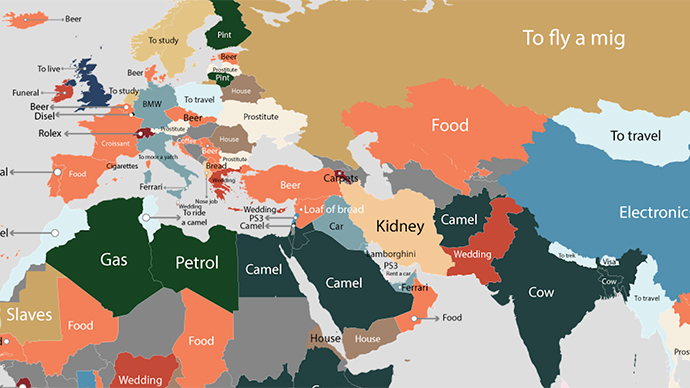

‘In vitro fertilization’ is Australia’s most popular search item on Google

The cost of flying a MiG fighter in Russia, buying kidneys in Iran, prostitutes in Ukraine and rhinoplasty in S. Korea are just a few of the most popular Google requests worldwide, a new map shows. It does give some weird insights into the countries.

Fixr.com, a cost-estimating website has put together a map of the world with the most-Googled things in each country, using the autocomplete formula of “How much does * cost in [x country].”

The search results turned out to be hilarious and informative, and gave a peek into humanity’s cost obsessions per country.

“Looking at some of the most popular Google searches throughout the World reveals some cultural differences, but also many key similarities. It also provides insights into the sometimes strange things people think about when they are alone,” says fixr.com website.

Russians are most interested in “How much does it cost to fly a MiG [military aircraft] in Russia?”

Iranians are eager to sell or to buy kidneys, while the South Koreans are obsessed with their appearance and fixated on rhinoplasty (nose plastic surgery) costs.

The Chinese, Apple’s biggest iPhone market, desire iPhones, of course. On Tuesday, Apple said it sold more iPhones in China than in the US.

The cost of a prostitute is the most Googled demand in a range of countries, such as in Brazil, Ukraine, Bulgaria, Hong Kong, Colombia and Latvia. Slaves crop up in Mauritania, diamonds shine in Sierra Leone and cocaine fires up Honduras, Chile and Taiwan – these are some of the most Googled and weird demands in each of these countries.

Why Japanese people want watermelons or Armenians are obsessed with carpets is as yet a mystery.

Citizens of some countries Google simple ‘tradable’ things, such as cows (India and Bangladesh) or camels (Egypt, Israel and Afghanistan), and apparently, the most devoted McDonald’s fans are Big Mac-loving Serbians.

Ceremonies are another passion worldwide. And not only weddings (Cyprus, Greece) and honeymoons (Maldives), but funerals (Ireland) and divorces (Trinidad and Tobago).

Venezuelans desire “A Gallon of Gas,” while Australians long for babies – IVF (In vitro fertilization) is one of the most Googled searches down under.

The results are not considered to be a scientific report as Google autocomplete results are based on the searcher’s history, and the time and place of search. – RT.COM

Google’s self-driving robotic cars take to Californian roads

Google Inc said on Thursday it had started testing the latest prototypes of its self-driving cars on Mountain View, California roads, with safety drivers aboard.

The prototypes will join Google’s Lexus cars, which use the same self-driving software, the company said in a blog post on Thursday. Google’s self-driving Lexus RX450h sport utility vehicles have been in operation for several years.

Although the prototypes are designed to work without a steering wheel or pedals, safety drivers will have a removable steering wheel, accelerator pedal and brake pedal during the test phase in case they need to take over driving.

Earlier this month, Google launched a website specifically for the self-driving car. That came after increasing criticism by customers and consumer groups that the search giant was not providing enough information about the project.

Google has so far reported 12 accidents involving the prototypes. Injuries have been minor, the search giant has said, and accidents were mostly a result of human error by the drivers of the other cars involved.

EU announces antitrust suit against Google

The European Union will accuse Google on Wednesday of abusing its dominant position in Internet searches, opening the US tech company up to a risk of massive fines and enforced changes in its business model, the Financial Times and Wall Street Journal said on Tuesday.

However, two sources familiar with the matter told Reuters that a formal antitrust charge sheet will not be ready for Wednesday and could take several more months to draw up.

The EU can impose fines of up to 10 percent of global turnover, or more than $6 billion in penalties in Google’s case.

An EU official said Competition Commissioner Margrethe Vestager would make an important announcement about Google on Wednesday, after the EU’s executive holds its weekly meeting.

The Commission’s chief spokesman would not confirm the reports, which cited EU officials, but said there would be a news conference around noon (1000 GMT) after the meeting.

Vestager, who had indicated she would not be rushed into a decision on the five-year-old case, is due to fly to the United States later on Wednesday for a high-profile working visit.

Americans, including business leaders and President Barack Obama, have questioned EU efforts to curb the power of U.S. tech companies.

The Danish liberal will accuse Google of breaching competition law by diverting traffic from rivals to favour its own services, said the FT, adding that some fellow commissioners had been concerned Vestager was narrowing the probe.

The possibility of an early announcement of action against Google was made public earlier this week by Guenther Oettinger, the conservative German commissioner for the digital economy, who has been a sharp critic of Google and has spoken up for the interests of European technology and publishing companies.

Separately, Vestager will launch an investigation into Google’s Android mobile software business, the FT said.

The Commission has been laying the groundwork for a case centred on whether Google abuses the dominant market share of Android to promote its own services.

Vestager made the decision to go ahead with charges on Tuesday together with European Commission President Jean-Claude Juncker and will inform her colleagues on Wednesday, the Journal said.

In office since November, Juncker’s executive has put the fostering of Europe’s digital economy and free trade with the United States among its priorities, but some EU officials are concerned U.S. companies are choking European competitors.

Vestager has narrowed the case, which she inherited from her Spanish predecessor, Joaquin Almunia – who rejected three settlement proposals from Google – the FT said.

Google did not immediately respond to requests for comment.

Andreas Schwab, a German conservative member of the European Parliament who has pushed for the EU executive to consider even breaking up Google, told Reuters earlier this week he expected the Commission to bring competition charges against the company.

However, industry and EU sources played down earlier on Tuesday suggestions that Vestager was about to announce charges against the Google.

The EU investigation is one of the highest profile competition cases of recent years, rivalling probes into Microsoft Corp, and comes amid political disquiet in Europe at the perceived dominance of U.S. tech companies.

Almunia launched the probe in 2010 and initially concluded that Google may have hurt competitors by favouring its own products and services in search results and blocking advertisers from moving their campaigns to rival platforms.

Since then, Google has offered three proposals to resolve the case.

Most recently, just over a year ago, it offered to give competing products and services bigger visibility on its website, let content providers decide what material it can use for its own services and make it easier for advertisers to move their campaigns to rivals.

Almunia initially accepted that deal, only to reverse his decision six months later and demand more concessions, leaving the ultimate decision to his successor.

Microsoft has been hit with total EU fines of more than 2.2 billion euros ($2.34 billion) over the past decade. ($1 = 0.9390 euros).

Source: Reuters

Google CEO predicts totally invasive internet

Google executive chairman Eric Schmidt on Thursday predicted a totally invasive Internet.

At the end of a panel at the World Economic Forum in Davos, Switzerland, where his comments were webcast, he was asked for his prediction on the future of the web. “I will answer very simply that the Internet will disappear,” Schmidt said ironically.

“There will be so many IP addresses…so many devices, sensors, things that you are wearing, things that you are interacting with that you won’t even sense it,” he explained. “It will be part of your presence all the time. Imagine you walk into a room, and the room is dynamic. And with your permission and all of that, you are interacting with the things going on in the room.”

Concluded Schmidt: “A highly personalized, highly interactive and very, very interesting world emerges.”

The panel, entitled The Future of the Digital Economy, also featured Facebook COO Sheryl Sandberg and others.

Earlier in the debate, Schmidt discussed the issue of market dominance. The European Union has been looking at Google’s search market dominance in a long-running antitrust case, and the European parliament late last year even called for a breakup.

“You now see so many strong tech platforms coming, and you are seeing a reordering and a future reordering of dominance or leaders or whatever term you want to use because of the rise of the apps on the smartphone,” Schmidt said Thursday. “All bets are off at this point as to what the smartphone app infrastructure is going to look like” as a “whole new set” of players emerges to power smartphones, which are nothing but super-computers, the Google chairman argued. “I view that as a completely open market at this point.”

Asked about his recent trip to North Korea, Schmidt said the country has many Internet connections through data phones, but there is no roaming and web usage is “heavily supervised.” Schmidt said “it’s very much surveillance of use,” which he said was not good for the country and others.

Sandberg and Schmidt lauded the Internet as an important way to give more people in the world a voice. Currently, only 40 percent of people have Internet access, the Facebook COO said, adding that any growth in reach helps extend people’s voice and increase economic opportunity. “I’m a huge optimist,” she said about her outlook for the industry. “Imagine what we can do” once the world gets to 50 percent, 60 percent and more in terms of Internet penetration.

Gunther Oettinger, a conservative German politician serving as the European Union’s commissioner for digital economy and society, said on the panel that “we need a convincing global understanding, we need a UN agency for data protection and security.” Asked what form that “understanding” should have, he said he was looking for “clear, pragmatic, market-based regulation.” Explained Oettinger: “It’s a public-private partnership.”

Source: Hollywoord Reporter

Apartheid for emoji characters

A new proposal drafted by the Unicode Consortium would introduce more “racial diversity”, apartheid actually, into the popular emoji characters used in messages on smartphones.

The proposal, edited by Google’s Mark Davis and Apple’s Peter Edberg, would bring skin tones, based on the Fitzpatrick scale for dermatology, to emoji characters in five hues ranging from a pale creme to a dark brown.

To use the new emoji, users would select the emoji person or character and then add a tone. On compatible phones, a single emoji image or glyph would be show up.

On phones that do not support the new font, users will likely see a standard emoji glyph and then a color swatch next to it indicating the skin tone.

The skin tone modifiers would work on all people-related characters, including those that depict couples. A possibility for emoji with couples would be to enter in the skin tone value for each person separately.

Right now, the proposal is still a draft and there is no timeline for implementation so we don’t know when it will reach your phones.

Source: TechCrunch

Snowden fingers Dropbox, Facebook, Google as hostile to privacy

Edward Snowden has hit out at Dropbox and other services he says are “hostile to privacy,” urging web users to abandon unencrypted communication and adjust privacy settings to prevent governments from spying on them in increasingly intrusive ways.

“We are no longer citizens, we no longer have leaders. We’re subjects, and we have rulers,” Snowden told The New Yorker magazine in a comprehensive hour-long interview.

There isn’t enough investment into security research, into understanding how metadata could better be protected and why that is more necessary today than yesterday, he said.

The whistleblower believes one fallacy in how authorities view individual rights has to do with making the individual forsake those rights by default. Snowden’s point is that the moment you are compelled to reveal that you have nothing to hide is when the right to privacy stops being a right – because you are effectively waiving that right.

“When you say, ‘I have nothing to hide,’ you’re saying, ‘I don’t care about this right.’ You’re saying, ‘I don’t have this right, because I’ve got to the point where I have to justify it.’ The way rights work is, the government has to justify its intrusion into your rights – you don’t have to justify why you need freedom of speech.”

In that situation, it becomes OK to live in a world where one is no longer interested in privacy as such – a world where Facebook, Google and Dropbox have become ubiquitous, and where there are virtually no safeguards against the wrongful use of the information one puts there.
In particular, Snowden advised web users to “get rid” of Dropbox. Such services only insist on encrypting user data during transfer and when being stored on the servers. Other services he recommends instead, such as SpiderOak, encrypt information while it’s on your computer as well.

“We’re talking about dropping programs that are hostile to privacy,” Snowden said.

The same goes for social networks such as Facebook and Google, too. Snowden says they are “dangerous” and proposes that people use other services that allow for encrypted messages to be sent, such as RedPhone or SilentCircle.

The argument that encryption harms security efforts to capture terrorists is flawed, even from a purely legalistic point of view, Snowden said, explaining that you can still retain encryption and have the relevant authorities requesting private information from phone carriers and internet providers on a need-to-know basis.

And the penchant for close, secretive cooperation with the government will only cost companies money and jobs, Snowden added, because no one would want to buy a phone made by a company that provides inherent backdoors for third parties to access your information.

“The same rights that we inherited our children deserve to inherit the same way,” Snowden said.

“But ultimately we have to remember that political reform in the United States is not going to solve the problem globally. Governments [everywhere] are going to have their own national laws. And these can be terrible governments… so, because of that, you have to use secure communications… the real key is that companies willing to collaborate with the government and compromise their products and services do not deserve to be trusted with your data. Because if they do it for one government, they’ll do it for another government,” Snowden said.

For consumers to retain trust in the services they use, they need to fight for the very idea of privacy, to keep the topic in focus, he said, adding: “I speak with computer scientists and cryptographers every day to try to figure out how we can create solutions” for metadata to be appreciated and viewed as someone’s own private business.

“There are solutions, there are ways forward, and we need to pursue them, to work toward them,” Snowden said. “And we need to say that this is an effort worth doing.”

The whistleblower continues to lead a secretive existence in Russia, where he’s been stranded since June 2013, hiding from his own government, which is seeking to prosecute him for his crimes behind closed doors.

“I’ve told the government again and again in negotiations, you know, that if they’re prepared to offer an open trial, a fair trial in the same way that Dan Ellsberg got, and I’m allowed to make my case to the jury, I would love to do so,” Snowden said. “But to this point they’ve declined.”

Source: RT

Tutu leads the climate divestment charge

John D. Rockefeller built a vast fortune on oil. Now his heirs are abandoning fossil fuels.

The family whose legendary wealth flowed from Standard Oil is planning to announce on Monday that its $860 million philanthropic organization, the Rockefeller Brothers Fund, is joining the divestment movement.

The announcement, timed to precede Tuesday’s opening of the United Nations climate change summit meeting in New York City, is part of a broader and accelerating initiative.

In recent years, 180 institutions — including philanthropies, religious organizations, pension funds and local governments — as well as hundreds of wealthy individual investors have pledged to sell assets tied to fossil fuel companies from their portfolios and to invest in cleaner alternatives. In all, the groups have pledged to divest assets worth more than $50 billion from portfolios, and the individuals more than $1 billion, according to Arabella Advisors, a firm that consults with philanthropists and investors to use their resources to achieve social goals.

Some say they are taking action to align their assets with their environmental principles. Others want to shame companies that they believe are recklessly contributing to a warming planet. Still others say that the fight to limit climate change will lead to new regulations and disruptive new technologies that will make these companies an increasingly risky investment.

Ultimately, the activist investors say, their actions, like those of the anti-apartheid divestment fights of the 1980s, could help spur international debate, while the shift of investment funds to energy alternatives could lead to solutions to the carbon puzzle.

Among the individual investors joining in the announcement on Monday is Mark Ruffalo, the actor. The news conference will include a videotaped message from Bishop Desmond Tutu, who said that because climate change has a disproportionate impact on the poor, it is “the human rights challenge of our time.”

Just how transparent the various funds and institutions will be about the progress of their asset sales is uncertain.

The family has also engaged in shareholder activism with Exxon Mobil, the largest successor to Standard Oil.

Members have met privately with the company over the years in efforts to get it to moderate its stance on issues pertaining to the environment and climate change. They acknowledged that they have not caused the company to greatly alter its course.

Other unlikely supporters also chimed in. Leonardo DiCaprio was one of them.

Google Chairman Eric Schmidt announced Monday that the firm would sever ties with a controversial conservative group because of its position on climate change.

The American Legislative Exchange Council, a prominent network of conservative state legislators works to roll back laws that promote solar and wind power.

Source: NYT/Bloomberg

The information Google doesn’t want you to organize

Back in February, in a San Jose courtroom, a bombshell was dropped that could have been erased from the public record.

It turns out that Google, which bases its business on collecting and analyzing huge reams of data for advertising purposes, has been scanning users’ emails even before users have a chance to open or read them, including email messages that are deleted without being opened. Google knows what’s in your email before you do.

The revelation came in a now-settled legal dispute over Google’s Gmail service. Dozens of the nation’s largest newspapers and media companies fought to make sure that the case — and its wide-ranging implications for Internet users — received a full public airing. It has been an unfolding drama ever since, affecting what analysts estimate are 500 million Gmail users worldwide.

Google tried, and failed, to redact information about its email scanning process from a transcript of a public court hearing. Last month, the judge in the case ruled that portions of the transcript from that February hearing could not be redacted retroactively, since that would be tantamount to closing a public courtroom.

The company’s attempt — akin to putting toothpaste back into a tube — was a reversal of its previous position in the lawsuit, a pledge that there would be a “fully public airing of the issues raised by plaintiffs’ motion for class certification.” The NSA recently used the very same tactic when it tried to secretly delete portions of a public court transcript in a lawsuit filed against its surveillance practices.

As a result, we now know much more about how Google collects personal information from users of Gmail and Google Apps and, in this case, how it plugged a critical gap in its data mining operation to sweep up even more of your information.

Here’s what happened:

Back in 2010, Google was facing a vexing problem. It was losing out on a treasure trove of personal information from millions of Gmail users who were slipping through its chief analytical tool, known as “Content OneBox.” Anytime they accessed their email through Outlook or on their iPhone, Google’s data machine wasn’t there to capture it all. So it needed a way to sidestep the problem.

Within a matter of months, the company shrewdly moved the Content OneBox from Gmail’s storage area to the “delivery pipeline” — meaning that it could now scan messages before they were received. As the plaintiffs explained:

“Google made a choice. They said, you know what, when people are accessing emails by an iPhone, we are not able to get their information. When people aren’t opening their emails or they are deleting them, we are not able to get their information. When people are using Google Apps accounts where ads are disabled, we are not able to get that information. When people are accessing Gmail through some other email provider, we are not able to get that information. So what they did is they took a device that was in existence already and operating just fine back in the storage area, and they moved it to the delivery pipeline.”

This move has sweeping consequences, as Chris Hoofnagle, director of privacy programs at Berkeley’s Center for Law & Technology, has described:

“Hiding ads while analyzing data takes advantage of a key deficit users have around internet services: users only perceive profiling if they receive ads. The content one box infrastructure would allow Google to understand the meaning of all of our communications: the identities of the people with whom we collaborate, the compounds of drugs we are testing, the next big thing we are inventing, etc. Imagine the creative product of all of Berkeley combined, scanned by a single company’s ‘free’ email system.”

Google’s stated goal is to “organize the world’s information,” but they fought to avoid disclosing how and why they’ve done it. Now we know.

Source: USAToday

German publisher warns against Google

Mathias Döpfner
Mathias Döpfner

The head of Europe’s biggest newspaper publisher by circulation has accused Google of seeking to establish a digital “superstate” free from the constraints of antitrust regulators and privacy concerns.

Google controls so much data, becoming the global equivalent of what Deutsche Post once was to mail or Deutsche Telekom to making phone calls in Germany, which is why it is so important for the American giant to be transparent and fair,

In a provocative open letter to Google chief Eric Schmidt, the chief executive of Axel Springer, says: “We are afraid of Google. I have to say so clearly and honestly because hardly any of my colleagues dares to do so publicly.”

Mathias Döpfner’s assault on Google begins on familiar terrain by lamenting the US tech company’s dominance of the search engine market, but shifts into broader anxiety about the extent of Google’s ambitions, including its development of driverless cars and purchase of dronemaker, Titan Aerospace.

He writes: “Google not only knows where we’re going in our cars but also what we do while we’re driving. Forget Big Brother – Google is better!”

The letter is published in Wednesday’s edition of the Frankfurter Allgemeine Zeitung, an upmarket conservative daily which is not part of the Springer stable, and responds to a guest column in the same newspaper by Mr Schmidt.

In his column, Google’s executive chairman welcomed an advertising partnership between the US company and Springer, which appeared to mark the end of a long confrontation between the two.

Springer is among the publishers that lobbied for ancillary copyright legislation that would give publishers the right to license their web content for use by others.

The changes to copyright law were passed by Germany’s parliament last year but watered down to enable news aggregators to continue to publish newspaper excerpts free of charge.

Mr Döpfner criticised the EU’s recent settlement with Google, which permitted the internet group to continue publishing paid-for links at the top of its pages ahead of algorithmically chosen results.

Google agreed with Brussels to allow rival search engines a showing alongside its own results, a concession Mr Döpfner described as “protection money”.

“As the saying goes: ‘if you don’t want us to kill you, you’ll have to pay,’” the Springer chief executive wrote.
The combative letter describes the US company as “Goliath” to Springer’s “David”.

In a passage speculating that Google may be planning to build offshore working environments to escape democratic accountability, Mr Döpfner writes: “Is Google planning to operate in a legal vacuum without the hassle of anti-trust regulators and data protection… does Google plan in all seriousness a digital superstate in which its citizens will naturally only do good and “won’t be evil”.”

Springer, publisher of the tabloid Bild, has long been reviled by German leftwingers for its ultraconservative views and political influence.

Mr Döpfner has reoriented the business away from print, selling regional newspapers including the Hamburger Abendblatt, the first daily newspaper created by company founder Axel Springer, and acquiring a 24 hour news channel that will be used to supply video for its digital platforms.

A Google spokesman declined to comment, but referred to Mr Schmidt’s column last week, in which he called for co-operation with publishers and warned against “heavy-handed regulation” such as copyright charges.

Mr Schmidt wrote that such regulation risked creating an “innovation desert” in Europe. “Some companies will leave and, worse still, others will never get off the ground – blocked by rules designed to protect incumbents.”

Source: FT

UK boasts most jihadis

One man's terrorist is another man's freedom fighter
One man’s terrorist is another man’s freedom fighter

We mapped the Facebook fans of some of the most violent jihadi organizations in the world.

Pop stars, sports teams and Hollywood actors aren’t the only ones with global followings on Facebook. Jihadis, too, have lots of rabid fans from around the world.

This global fandom to some degree mirrors the diversity of fighters on the ground in Syria, where the combatants have come from more than 80 countries, including Western nations like the U.K., France and the Netherlands.

Of those Facebook jihadi fans we were able to identify via their publicly available data, many express a strong religious affiliation, citing the likes of Al Qaeda or U.K., France and the Netherlandsas their employer. But despite a growing concern for privacy, and a near-ubiquitous trend for Western employers using social media profiles to screen employees, a large percentage of people who had liked extreme jihadi groups on Facebook did so side-by-side with listings for their actual places of work and study in Western countries. They list themselves as attending well-to-do high schools, Ivy League universities and military academies in the U.K., U.S. and elsewhere. They work at Google, Microsoft, Pizza Hut, JCPenney, Aeropostale and other globally recognized businesses.

Where in the West are the biggest pockets of radical Islam fandom? To find out, we picked 10 outspoken jihadis on Facebook and identified some of the groups they follow. We chose a total seven groups, covering a range of different countries, and then looked at where the people who follow those groups’ Facebook pages said they live. We also sorted the results to get rid of duplications among the people doing the liking.

As more jihadi groups use social networks to proselytize and even communicate with one another, governments and law-enforcement agencies halfway around the world are eager to know where the receptive audiences are located.

Turns out, Europe has way more jihadi fans than the U.S. does. Of the total 49,631 members in the groups we selected, 1,463 identify themselves as coming from European countries, while about 325 say they’re in the United States.

In Europe, the U.K. boasts 548 fans of the same pages—and London, with 260 fans, is far and away the most well-represented city in the data. Paris a distant second. Three of the four most well-represented cities in Europe are in the United Kingdom, with Birmingham and Manchester joining the capital on the list.

The U.S. numbers are much smaller, with New York City topping the city scales, and California taking the title for the state where most people are active on the jihadi Facebook pages we identified.

This ISIS page was deleted soon after we concluded our analysis.

Judging by their profiles, it’s clear that some are most likely expressing a passing interest or curiosity, while others may be monitoring the pages for work (journalists and academics). But others express consistently extreme views on their own page and also like a broad network of jihadi pages.

And some of these fans may be doing more than just liking the jihadi pages. While studies suggest that larger jihadi networks still rely on their own trusted forums, some rebel groups are using Facebook as a supplementary mechanism for contacting potential fighters.

Indeed, a large population of web-savvy European fighters have already made the trip to Syria, and they circulate that intelligence back to would-be jihadis. You can find long online conversations on social media that delve into the specifics of how to cross borders, how much money to bring, and what to expect upon arriving in the war zone.

So it stands to reason that the first contact a jihadi-curious teen or young adult may have with someone on the front line could be through Facebook.

Source: vocative.com

Naspers attacks Google over international tax practices

google
Eric Schmidt

Google is once again under fire for its international tax practices. This time though, the flak isn’t coming from an international government, but South Africa’s largest online publisher.

In a statement issued to the press 24.com CEO Geoff Cohen said: “In the digital age, we accept that we compete with businesses from all over the world.

“However, it is clearly wrong that, as we invest in building a tax-paying business employing hundreds of South Africans, we are competitively disadvantaged through aggressive tax planning strategies of global businesses.”

The publisher, which is a division of emerging markets media and internet giant Naspers, says that Google’s use of various off-shore accounts for its transactions means that it’s not paying anywhere near as much tax in the country as it should be.

This it says, means that South African publishers are simply unable to operate on a level playing field with the internet giant.

As Memeburn pointed out in mid 2013, Google pulls in around R1 billion in advertising a year in South Africa.

That’s about as much as South Africa’s digital ad industry makes as a whole. Google makes this revenue with very little infrastructure development needed and with only a small satellite office of about 30 or so people.

24.com reckons that this puts lost tax revenue from Google at an estimated R140 million per annum in corporate taxes, and possibly a further R100 million in PAYE.

They resort to tax-avoidance strategies known as the ‘Double Irish’ or ‘Dutch Sandwich’.

Google however strongly denies that this is the case, especially when it comes to PAYE, noting that it pays that tax for every employee it has in South Africa.

When Memeburn approached Google for comment on Cohen’s statement, a Google spokesperson said the company “complies with tax laws in South Africa and every country where we operate.

Google has come under fire for its international tax policies in the UK after it emerged that it had paid just £6 million on £2.5 billion worth of sales in the country in 2012.

A number of countries have now instituted special Google taxes in a bid to curb that kind of behaviour.

The most recent country to institute a Google tax is Italy, which did so in December 2013.

Other countries, such as France, have issued Google with massive fines for tax non-compliance.

24.com is in favour of applying the former approach in South Africa. Significant legislative changes will be required before South African internet businesses will be able to compete with some of their global counterparts on a level tax playing field, it says.

The state appears to be heading in that direction, as it readies legislation that will force overseas companies selling digital goods to South Africans to pay VAT on those sales.

In a 2012 interview, Google Chairman Eric Schmidt said he was “proud” of the way Google had avoided paying taxes. “It’s called capitalism,” he said, “We are proudly capitalistic. I’m not confused about this.”

Source: Memeburn.com

Data privacy goes offshore

deutschetelecomAmerican technology companies like Google and Facebook were put on the defensive when Edward Snowden’s allegations about U.S.-government surveillance of Internet traffic emerged this spring. Outside the U.S., some companies and politicians saw an opportunity.

Three of Germany’s largest email providers, including partly state-owned Deutsche Telekom AG teamed up to offer a new service, Email Made in Germany. The companies promise that by encrypting email through German servers and hewing to the country’s strict privacy laws, U.S. authorities won’t easily be able to pry inside. More than a hundred thousand Germans have flocked to the service since it was rolled out in August.

“We can say that we protect the email inbox according to German law,” says Jorg Fries-Lammers, a spokesman for one of the German companies, 1&1 Internet AG. “It’s definitely a unique selling point.”

The U.S. National Security Agency has acknowledged collecting email data about Americans through phone and Internet companies. Silicon Valley companies have said that they don’t give the government unfettered access to user data but that they are barred from disclosing details.

Fueled by the controversy, countries are seeking to use data-privacy laws as a competitive advantage—a way to boost domestic companies that long have sought an edge over Google, Microsoft Corp. MSFT +1.50% and other U.S. tech giants.

“Countries are competing to be the Cayman Islands of data privacy,” says Daniel Castro, a senior analyst at the Information Technology and Innovation Foundation, a nonpartisan Washington, D.C., think tank that receives funding from the tech industry.

While establishing these islands of privacy might make for good marketing, the initiatives face hurdles. Laws demanding that data be stored in-country can give domestic Internet-service providers a boost but also could raise their customers’ costs.

And creating domestic walls for online service runs into a hard reality.

“It basically ignores the entire Internet,” says Ronaldo Lemos, director of the Institute for Technology & Society, a Rio de Janeiro think tank. “This data has to circulate. It’s going to be sent to Miami, to Europe. It’s not going to be sitting idle.”

Nevertheless, some European leaders are renewing calls for a “euro cloud,” in which consumer data could be shared within Europe but not outside the region. Brazil is fast-tracking a vote on a once-dormant bill that could require that data about Brazilians be stored on servers in the country. And India plans to ban government employees from using email services from Google and Yahoo Inc. YHOO +2.38%

U.S. companies are watching such developments with trepidation.

“We should all be nervous when countries impose costly new requirements on companies as a condition of serving their citizens,” says Facebook Chief Operating Officer Sheryl Sandberg. “It means fragmenting the Internet and putting the economic and social opportunities it creates at risk.”

Google declined to comment for this article, and Yahoo didn’t respond.

It is too soon to tell if a major shift is under way. But the Information Technology and Innovation Foundation estimates that fallout from revelations about NSA activities could cost Silicon Valley up to $35 billion in annual revenue, much of it from lost overseas business. A survey conducted this summer by the Cloud Security Alliance, an industry group, found that 56% of non-U.S. members said security concerns made it less likely that they would use U.S.-based cloud services. Ten percent said they had canceled a contract.

“We talk to our sales leaders, who talk to customers every day, and this has the potential to significantly erode the trust of customers around the world,” says John Frank, a deputy general counsel at Microsoft.

It could be tough for U.S. companies to undo any damage, particularly when the extent of NSA activities is secret and other nations have been critical of the U.S. On Tuesday, Brazilian President Dilma Rousseff in a United Nations address assailed U.S. snooping on her country. Last week she canceled a planned visit to Washington.

European Commission Vice President Neelie Kroes, who supervises the European Union’s digital portfolio, has been encouraging the bloc’s companies to tout their privacy creds. “Privacy is not only a fundamental right,” she said in Estonia this summer. “It can also be a competitive advantage.”

For small German companies competing against big ones—like online-security company Symantec Corp. SYMC -1.32% and Amazon.com Inc., AMZN -0.67% which provides corporate cloud services—the NSA surveillance program “is a present from heaven,” says Oliver Dehning, chief executive of antispameuropeGmbH, which builds spam-protection software. “It’s kind of an opportunity to strike back and protect our home market.”

He turned the Snowden leaks into a marketing campaign, tweeting about the news and speaking at industry conferences about how Germans can protect themselves from spying.

Symantec and Amazon declined to comment for this article.

Some of the promises of the would-be data islands could be tough to meet.

While much of the legislation proposes that information about citizens be located in-country, that overlooks that the data may need to be transferred elsewhere.

And laws requiring domestic hosting could raise the price of computing. The in-country hosts could have trouble competing with the economies of scale enjoyed by big U.S. companies, says Jim Reavis, president of the Cloud Security Alliance. Also, it could well be less expensive to use a data center in another country than to build one at home.

Country-specific computing can have its own privacy concerns, meanwhile. Some countries pushing domestic hosting—Brazil, for example—don’t protect the privacy of citizens’ Internet data, so consumers wouldn’t be safe from their own governments’ eyes. Brazil made 715 requests for Facebook user data in the first half, according to the company.

Because Germany has strict privacy laws, Email Made in Germany says customers who send email to fellow subscribers can be assured the U.S. and German governments will have a difficult time accessing the users’ messages. Customers see a bright-green check mark next to messages sent by fellow subscribers. A gray check appears next to messages from other email providers. That means Germans can ensure their privacy only for email to people on German soil.

Even some companies that seek to profit from fears about U.S. snooping acknowledge that law-enforcement agencies in other countries want to catch up with Washington’s capabilities.

“In the long run, there won’t be any difference between what the U.S. or Germany or France or the U.K. is doing,” says Roberto Valerio, whose German cloud-storage company, CloudSafe GmbH, reports a 25% rise in business since the NSA revelations.

“At the end of the day, some agency will spy on you,” he says. – WSJ

11 Million users quit Facebook over spying

facebookA new report by the Daily Mail reveals Facebook users are abandoning the social media giant at an unprecedented rate over privacy concerns.

New research shows Facebook has lost a total of eleven million users, nine million in the US and two million in Britain. Researchers at the University of Vienna analyzed 600 users and found that almost half quit as a result of privacy concerns.

Studies show the majority of users that quit the site were older males.

Facebook, among other tech giants, have been repeatedly under scrutiny for their lack of user privacy, including turning over thousands of user’s info to the government. In August, Infowars revealed Facebook submitted information on approximately 38,000 users in 74 countries during the first half of 2013.

Over half of the requests originated from inside of the United States. Tech giants are unable to reveal absolute numbers on how many requests they’ve submitted to because the government prohibits them from doing so. However, companies like Google, Microsoft, Facebook and Yahoo have formed a unique alliance and are fighting back.

The tech alliance is putting pressure on the Foreign Intelligence Surveillance (FISA) court by filing motions asking to publicly disclose more details about secret national intelligence requests, instead of just releasing approximations.

“We believe there is more information that the public deserves to know, and that would help foster an informed debate about whether government security programs adequately balance privacy interests when attempting to keep the public safe,” said Facebook’s general counsel Colin Stretch.

“Editor of the journal Cyberpsychology, Behaviour and Social Networking which published the findings, said: ‘Given high profile stories such as WikiLeaks and the recent NSA surveillance reports, individual citizens are becoming increasingly more wary of cyber-related privacy concerns,’” reported Mail Online.

Facebook has also been under close examination for their recently updated “Statement of Rights and Responsibilities” policy which states users’ profile data including their profile picture, name and personal information “could show up as part of a Facebook ad their friends may see on the site,” according to a report by Mashable.

Even more controversy surrounded the social media giant when they announced the update of the “Tag Suggest” feature, which would allow facial recognition technology “to speed up the process of ‘tagging’ friends and acquaintances who appear in photos posed on the network,” reported Reuters.

As you can see, users’ concerns over privacy, or lack thereof, are certainly substantiated. However, if your information isn’t being collected through Facebook, NSA’s spy program, PRISM, is sure to scoop up your info in some other way, most likely through email or cellular data. – infowars.com