Obama prophesies climate zombie apocalypse

President Obama – who graduated Columbia University with a degree in political science – became an environmental and ecological expert Monday night in time to decry America’s contributions to global warming and the alleged melting of Arctic ice caps at this year’s GLACIER Conference, predicting a dire future for humanity.

During the GLACIER event, which stands for Global Leadership in the Arctic: Cooperation, Innovation, Engagement and Resilience, Obama blamed the recent rash of wildfires sweeping parts of Washington State on global warming, insisting that “climate is changing faster than our efforts to address it.”

Overall, the speech painted a fairly doom-and-gloom outlook for America and the rest of the world. So if you’re a Doomsday Prepper, here are a few excerpts from the president’s speech explaining the climate-related disasters heading to a town near you:


Your house might slide off into the ocean…

Reduced sea levels leaves villages unprotected from floods and storm surges. Some are in imminent danger; some will have to relocate entirely.

…or it might be engulfed in flames.

Alaska’s fire season is now more than a month longer than it was in 1950. At one point this summer, more than 300 wildfires were burning at once. Southeast of here, in our Pacific Northwest, even the rainforest is on fire…this is a threat to many communities.

And if it doesn’t, it will definitely get sucked into a sinkhole.

Thawing permafrost destabilizes the earth on which 100,000 Alaskans live, threatening homes, damaging transportation and energy infrastructure, which could cost billions of dollars to fix.

Your city will either look like Atlantis or something out of the zombie apocalypse.

…we will condemn our children to a planet beyond their capacity to repair: Submerged countries. Abandoned cities.

You might run out of fresh salmon en croûte.

Warmer, more acidic oceans and rivers, and the migration of entire species, threatens the livelihoods of indigenous peoples, and local economies dependent on fishing and tourism.

Or just food, in general.

Climate change is already disrupting our agriculture and ecosystems.

You may simultaneously die of thirst and drown, all at the same time.

Entire nations will find themselves under severe, severe problems. More drought; more floods; rising sea level…

You might have to begin training for the Hunger Games.

…more refugees; more scarcity; more conflict.

And if the famine, flood, fire and fighting doesn’t get you, the fumes definitely will.

Consider, as well, that many of the fires burning today are actually burning through the permafrost in the Arctic. So this permafrost stores massive amounts of carbon. When the permafrost is no longer permanent, when it thaws or burns, these gases are released into our atmosphere over time, and that could mean that the Arctic may become a new source of emissions that further accelerates global warming.

After all, we’re running out of time.


On this issue, of all issues, there is such a thing as being too late. That moment is almost upon us.

Perhaps the president got some of his research from the crew of the Canadian CCGS Amundsen during their four-month global warming expedition — you know, before they had to bail on their mission due to ships getting stuck in ice.

Source: MRC TV

Programmer develops bot to troll Twitter

Preaching the climate change gospel can be tough work, especially on Twitter. Software developer Nigel Leck got tired rehashing the same 140-character arguments against climate change deniers, so he programmed a bot that does the work for him. With citations!

Leck’s bot, @AI_AGW, doesn’t just respond to arguments directed at Leck himself, it goes out and picks fights. Every five minutes it trawls Twitter for terms and phrases that commonly crop up in Tweets that refute human-caused climate change. It then searches its database of hundreds to find a counter-argument best suited for that tweet—usually a quick statement and a link to a scientific source.

As can be the case with these sorts of things, many of the deniers don’t know they’ve been targeted by a robot and engage AI_AGW in debate. The bot will continue to fire back canned responses that best fit the interlocutor’s line of debate—Leck says this goes on for days, in some cases—and the bot’s been outfitted with a number of responses on the topic of religion, where the arguments unsurprisingly often end up.

AI_AGW has been prone to mess up, shooting messages to people who sarcastically mention how climate change is a myth. In these cases, Leck always follows up with a human apology.

Source: Technology Review

Who controls the weather?

The CIA, ever the innovators, have decided it would be quite useful to know how to control the weather.

A prominent climate scientist at Rutgers University in New Jersey has reported receiving a strange phone call from CIA consultants who wanted to know if hostile countries could be triggering floods or drought in the United States.

Professor Alan Robock said: “Consultants working for the CIA rang and said we’d like to know, if someone is controlling the world’s climate would we know about it?”

Robock said he told the mysterious callers that any attempts to control another country’s weather on a large scale would be detectable, which probably led to some disappointed sighs over in Langley—because of course, the real query wasn’t that difficult to decipher:

“Of course they were also asking—if we control someone else’s climate would they then know about it?” Robock said.

Now, while this all does sound a bit like a science fiction movie, the Daily Mail reports that Robock has in fact warned about the weaponization of weather in the past.

He told the American Association for the Advancement of Science’s annual conference in San Jose, that during the Vietnam War, American scientists made attempts to increase rainfall by spraying particles into the clouds which would hamper the progress of the enemy.

In Cuba, he said, the CIA seeded clouds to “make it rain and ruin the sugar harvest”.

“I’d learned of lots of other things the CIA had done that haven’t followed the rules and that wasn’t how I wanted my tax money spent,” he said.

Robock said any research into geoengineering should be “open and international” to remove any ability to use it for “hostile purposes”.

Interestingly, the CIA is reported to have partly-funded a recent National Academy of Sciences report on the different approaches to tackling climate change. The report looked at ways to remove carbon dioxide from the atmosphere and examined ways to reflect sunlight in order to manually cool the earth.

It concluded that the risks of such methods are “not well understood” and that extensive research would be needed to determine if they could become viable strategies in the future.

Professor Robock was speaking at the launch of a new report looking into the possibilities of addressing climate change by increasing the Earth’s reflectivity, a process known as albedo modification, which was largely funded by the CIA.

However the experts agreed that most plans were ‘irrational and irresponsible’ and could trigger war. They said cutting greenhouse gases was a far safer way of tackling climate change.

“Albedo modification approaches show some evidence of being effective at temporarily cooling the planet, but at a currently unknown environmental price.

“That scientists are even considering technological interventions should be a wake-up call that we need to do more now to reduce emissions, which is the most effective, least risky way to combat climate change,” said Maria McNutt, head of the National Research Council committee which compiled the report.

The committee has also called for a rapid response team to study the effects of volcano eruptions on global weather

Source: Russia Insider

Fracking, climate change, solar in the security mix

The global oil market is going through an upheaval, with non-OPEC production led by North American producers surging while OPEC’s traditional price-setting role changes. First, US oil production and proven oil reserve growth over the past several years is astonishing. Despite the current oil price decline, US oil production growth in 2015 is expected to grow around 1 million barrels per day. However, those growth rates probably won’t be sustained over the long term.

Second, if you look at the world’s largest oil reserve holders and countries that have reserve-to-production ratios in excess of 100 years, they are almost exclusively OPEC members. The cartel’s market influence has diminished in the face of robust non-OPEC production, but the group’s power is likely to endure over the long term purely due to the sheer volume of oil its members collectively control.

The Saudis will remain the de facto leaders of OPEC until another country can build comparable spare production capacity, which in the Saudis case is currently around 2 mmb/d. Saudi Arabia has 266 billion barrels of proven high-quality, cheap-to-produce oil reserves. The US, in contrast, boasts only 44.2 billion barrels of mostly expensive-to-produce oil reserves. Technology is a wild card that has the potential to unlock additional petroleum resources and reduce production costs, but it would be a mistake to discount Saudi Arabia’s power as an oil country, particularly over the long term.

That means, of course, that the Bahrain-based Fifth Fleet will remain a key asset. Add the Iranian nuclear talks, the predations of the Islamic State of Iraq and the Levant (ISIL), and the simmering tensions between Israel and its neighbors to the oil that flow through the Strait of Hormuz and there seems little doubt we will keep substantial naval, air and expeditionary forces in the area for the foreseeable future.
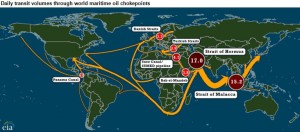
Oil-sea-routes-map

But these shifting energy markets raises larger strategic questions.

Colin spoke with one of the wisest analysts about the energy sector and its national security implications, Tony Cordesman of the Center for Strategic and International Studies. A former senior Pentagon and NATO official, Cordesman also served as director of policy and planning for resource applications at the Department of Energy. He doesn’t foresee any immediate major strategic shifts created by the energy market changes. At the same time, he acknowledges that major technological and market shifts have usually gone unnoticed until they hit us in the face.

Cordesman points to the solar and nuclear markets, where we have all been expecting or hoping for major technological breakthroughs “since the Nixon administration.” Then he notes that, in the oil market, “no one predicted that the most critical technological breakthrough would prove to be fracking.” Can we expect a breakthrough in the solar, nuclear or biofuel arenas? “It may take 25 to 50 years or it will happen almost without warning,” he predicts.

The current situation in the alternative energy world: We’re seeing the strong growth of renewable energy, albeit from a low base. The growth rate of installed US solar power capacity has been impressive, but that growth rate has slipped in the past few years as the technology has gained market share. “U.S. solar power capacity would need to grow at an annual rate of 22 percent in order for solar to provide 10 percent of the nation’s electricity in 2030, from less than 1 percent now,” Breaking Energy recently reported.

Wind and solar are used to generate electricity but coal will remain a significant source of US power generation for decades, although its market share looks likely to decline — for environmental reasons. The renewable energy story is important, and while it is changing the way utilities do business, wind and solar are only beginning to compete with fossil fuels on price. In most cases, their competitiveness is a result of tax incentives often referred to as subsidies. Also, the intermittent nature of these resources is a technical challenge that must be overcome in order to efficiently integrate large volumes of wind and solar energy into the power grid during times of peak demand. Creative financing and technological advances – particularly in energy storage – will help renewable electricity sources compete over time, but coal and natural gas will remain significant components of the US power generation mix for the foreseeable future.

At the international level, the issue of burning coal to generate power is far more complex. It is cheap and represents a comparatively cost-effective way to electrify large portions of the global population that currently have no access to power. Indeed, nine countries are collectively about to build roughly 550 gigawatts of new coal-fired capacity over the next two and a half decades.

And Then, Climate Change

In many ways, reducing emissions from coal-fired power generation is the key to dealing with climate change. China has been acting to address coal plant emissions due to its dangerous air pollution levels, which is an important piece of the climate change puzzle.

This poses a great conundrum for China. The Communist Party’s leaders are trying to forge a China united between rural and urban areas and that requires huge and fast economic development — much of it dependent on the use of cheap and readily available coal. Weaning themselves off of coal may be promising in terms of reducing emissions, but Cordesman says they are unlikely to be able to accept the economic tradeoffs.

For the same reasons, many other developing countries including India, Bangladesh and Pakistan are increasing their coal-fired power generation fleets.

Some think the ship has already sailed on preventing the impacts of climate change and now focus on adapting to extreme weather and other consequences as opposed to mitigating emissions such that they limit global temperatures from increasing more than 2 degrees Celsius.

Optimists remain however, and international agreements are not the only thing to focus on when thinking about what the world is doing to address the issue. “At every level—individuals, families, cities, states, provinces, even multinational corporations—efforts to cut CO2 are underway,” David Biello, associate editor for environment and energy at Scientific American, wrote in a recent post. He goes on to point out, “these are first steps and they are coming at a quickening pace, which suggest a possible future free of catastrophic climate change. More and faster should be the new slogan for action to address global warming. How much more and how much faster should be the only issue for negotiation.”


India, China ignore climate bait

Five years after over 150 heads of state cobbled up a rickety climate deal that fell through, the one-day UN Climate Summit is another attempt of rich nations to push India and China – responsible for one-third of total carbon emissions in 2013 – to accept some strong measures to check global warming.

But the two Asian giants are not willing to take the bait unless the developed world anchored by the United States and the European Union offers substantial incentives to developing nations for adopting a cleaner growth trajectory, cutting down on emissions.

The rich nations’ commitment to provide US $30 billion between 2010 and 2012 for climate mitigation and adaptation is yet to fructify, resulting in the Green Climate Fund remaining a defunct body.

Officially, Prime Minister Narendra Modi and Chinese premier Xi Jinping are not attending the summit called by UN chief Ban Ki-moon because of conflicting schedules.

But it is, in fact, a snub to the developed nations for pushing climate talks outside the United Nations framework. “It creates confusion and we don’t agree,” environment minister Prakash Javadekar, who will represent the country at the summit, said without mentioning to the event.

China has opted for a relatively senior functionary, vice-premier Zhang Gaoli, for the talks. While some island nations threatened by rising sea levels because of climate change expressed shock and disappointment, this will achieve little as India and China do not expect Obama to deliver generous green currency that would motivate emerging economies to revise their country-centric stands.

Neither the American president, nor the European leaders have the mandate to offer money at the summit like in Copenhagen, 2009.

New data shows carbon emissions in the atmosphere closing in on the threshold level to limit temperature rise by two degree Celsius, and India and China being the fastest-growing emitters, would put the two emerging economies under some pressure.

Source: Hindustan Times

Tutu leads the climate divestment charge

John D. Rockefeller built a vast fortune on oil. Now his heirs are abandoning fossil fuels.

The family whose legendary wealth flowed from Standard Oil is planning to announce on Monday that its $860 million philanthropic organization, the Rockefeller Brothers Fund, is joining the divestment movement.

The announcement, timed to precede Tuesday’s opening of the United Nations climate change summit meeting in New York City, is part of a broader and accelerating initiative.

In recent years, 180 institutions — including philanthropies, religious organizations, pension funds and local governments — as well as hundreds of wealthy individual investors have pledged to sell assets tied to fossil fuel companies from their portfolios and to invest in cleaner alternatives. In all, the groups have pledged to divest assets worth more than $50 billion from portfolios, and the individuals more than $1 billion, according to Arabella Advisors, a firm that consults with philanthropists and investors to use their resources to achieve social goals.

Some say they are taking action to align their assets with their environmental principles. Others want to shame companies that they believe are recklessly contributing to a warming planet. Still others say that the fight to limit climate change will lead to new regulations and disruptive new technologies that will make these companies an increasingly risky investment.

Ultimately, the activist investors say, their actions, like those of the anti-apartheid divestment fights of the 1980s, could help spur international debate, while the shift of investment funds to energy alternatives could lead to solutions to the carbon puzzle.

Among the individual investors joining in the announcement on Monday is Mark Ruffalo, the actor. The news conference will include a videotaped message from Bishop Desmond Tutu, who said that because climate change has a disproportionate impact on the poor, it is “the human rights challenge of our time.”

Just how transparent the various funds and institutions will be about the progress of their asset sales is uncertain.

The family has also engaged in shareholder activism with Exxon Mobil, the largest successor to Standard Oil.

Members have met privately with the company over the years in efforts to get it to moderate its stance on issues pertaining to the environment and climate change. They acknowledged that they have not caused the company to greatly alter its course.

Other unlikely supporters also chimed in. Leonardo DiCaprio was one of them.

Google Chairman Eric Schmidt announced Monday that the firm would sever ties with a controversial conservative group because of its position on climate change.

The American Legislative Exchange Council, a prominent network of conservative state legislators works to roll back laws that promote solar and wind power.

Source: NYT/Bloomberg

‘Africa needs fertility management’

Bill and the many natives

Stopping overpopulation is one way the dangers of climate change can be mitigated, according to two of the most prominent believers in global warming.

Former Vice President Al Gore and Microsoft founder Bill Gates said at the World Economic Forum in Davos that contraception is a key in controlling the proliferation of unusual weather they say is endangering the world.

“Depressing the rate of child mortality, educating girls, empowering women and making fertility management ubiquitously available … is crucial to the future shape of human civilization,” said Gore, who won the Nobel Peace Prize in 2007 for his work on global warming.

Gore said Africa’s population is expected to surpass India’s and China’s by the mid-21st century and will be more than both combined by the end of the century.

Source: CNBC

Media totally ignores that ice-locked ship was on global warming mission

Akademic Shokalskiy
Akademic Shokalskiy

A group of climate change scientists were rescued by helicopter Jan. 2, after being stranded in the ice since Christmas morning. But the majority of the broadcast networks’ reports about the ice-locked climate researchers never mentioned climate change.

The Russian ship, Akademic Shokalskiy, was stranded in the ice while on a climate change research expedition, yet nearly 98 percent of network news reports about the stranded researchers failed to mention their mission at all. Forty out of 41 stories (97.5 percent) on the network morning and evening news shows since Dec. 25 failed to mention climate change had anything to do with the expedition.

In fact, rather than point out the mission was to find evidence of climate change, the networks often referred to the stranded people as “passengers,” “trackers” and even “tourists,” without a word about climate change or global warming.

Chris Turney, the expedition’s leader, is a professor of climate change at the University of South Wales. According to Turney’s personal website, the purpose of the expedition is to “discover and communicate the environmental changes taking place in the south.”

Twenty-two crew members stayed with the ship for the time being, as the scientists and researchers were rescued. According to CNN, the ship has enough supplies for “a very long time.”

Three rescue attempts had been thwarted by growing levels of sea ice and weather conditions.

“Outside, blizzard conditions packing an abnormal amount of ice in to the area for this time of the year, summer in the Antarctic,” ABC News Correspondent Gio Benitez reported on “Good Morning America” Dec. 31.

On Jan. 2, all 52 passengers were airlifted to a nearby Australian icebreaker ship which had tried, and failed, to plow through the ice and free the Akademic Shokalskiy, on Dec. 30. “Good Morning America” said on Dec. 30, that “the ice could be as thick as 13 feet.”

According to Fox News, Turney admitted “we’re stuck in our own experiment.” They reported on Dec. 30, that a statement from the Australasian Antarctic Expedition said, “Sea ice is disappearing due to climate change, but here ice is building up.”

There was only one news story out of 41 that mentioned climate change. That was CBS “This Morning” Dec. 30. “Despite being frozen at a standstill, the team’s research on climate change and Antarctic wildlife is moving forward,” CBS News Correspondent Don Dahler said. That night, all three evening news programs still failed to make any mention of the group’s climate change research.

The MRC’s Business and Media Institute was unable to view a copy of CBS “Sunday Morning” for Dec. 29, so that broadcast had to be excluded from the tally.

Before their ship got stuck in ice, the researchers were following the trail of the explorer Douglas Mawson, who was stranded in Antarctica for more than a year, beginning in December 1912, according to the website about the expedition. – http://newsbusters.org

Bob Geldof: World will end in 2030

bobtony
Blair and Geldof

Sir Bob Geldof has declared we ALL have less than 17 years to live.The musician-turned-activist reckons the world will end in 2030 – leading to the extinction of humankind.

Sir Bob, 61, based his miserable prediction on the effects of climate change.

“The world can decide in a fit of madness to kill itself,” he told a group of youngsters at a summit in Johannesburg, South Africa.

“We may not get to 2030. We need to address the problem of climate change urgently”

The former Boomtown Rats singer also warned “the next war will not be a World War One or a World War Two, it will be the end.”

He added: “We may not get to 2030. We need to address the problem of climate change urgently.”

Sir Bob is best-known for his attempts in helping to fight famine in Africa, staging Live Aid at Wembley Stadium in 1985.

He finished his speech by apologising for being “bloody miserable”, but added: “just get on with it”.

Despite the dire warnings on climate change, it emerged last month that a million square miles of Arctic seas have frozen in the past year as a new environmental trend takes hold, dubbed “global cooling”.

The extraordinary “reverse” of global warming has led to a 60 per cent rise in ice-covered ocean. Just six years ago, some scientists were predicting that all of this ice would have melted away by 2013.

The big chill has persuaded some experts that temperatures will keep falling for decades and throws fresh doubts on claims that global warming will devastate the planet.

Bob Geldof claims man-made climate change has wrecked the planet

Details of the latest twist in the debate emerged in a secret memo to the United Nations Intergovernmental Panel on Climate Change.

It says that a chillier-than-usual summer has left a thick ice layer stretching from the Canadian islands to the northern coast of Russia.

The ice prevented dozens of yachts and a cruiser getting through America’s North-West Passage.

The shock memo surfaced just days before the Arctic freeze is about to begin and six years after warnings that global warming would melt the ice by this winter.

An ice-free Arctic was boldly predicted in a 2007 by Professor Wieslaw Maslowski, of the Naval Postgraduate School in Monterey, California.

He said his grim but conservative estimate was provided by the most realistic computer models. Cambridge University expert Professor Peter Wadhams added: “This is not a cycle, not just a fluctuation. In the end, it will all just melt away quite suddenly.”

On the back of the dire warnings, billions of pounds were invested in green measures to combat agents of climate change such as greenhouse gas emissions.

But the secret UN memo revealed that the ice has spread quickly following the smallest ever frozen surface area, this time last year.

It also shows how governments who fund the panel are terrified at the implications of the new predictions. – dailystar.co.uk

CIA backs study on controlling global climate

geoengineeringThe Central Intelligence Agency is funding a scientific study that will investigate whether humans could use geoengineering to alter Earth’s environment and stop climate change. The National Academy of Sciences (NAS) will run the 21-month project, which is the first NAS geoengineering study financially supported by an intelligence agency. With the spooks’ money, scientists will study how humans might influence weather patterns, assess the potential dangers of messing with the climate, and investigate possible national security implications of geoengineering attempts.

The total cost of the project is $630,000, which NAS is splitting with the CIA, the National Oceanic and Atmospheric Administration, and NASA. The NAS website says that “the US intelligence community” is funding the project, and William Kearney, a spokesman for NAS, told Mother Jones that phrase refers to the CIA. Edward Price, a spokesman for the CIA, refused to confirm the agency’s role in the study, but said, “It’s natural that on a subject like climate change the Agency would work with scientists to better understand the phenomenon and its implications on national security.” The CIA reportedly closed its research center on climate change and national security last year, after GOP members of Congress argued that the CIA shouldn’t be looking at climate change.

The goal of the CIA-backed NAS study is to conduct a “technical evaluation of a limited number of proposed geoengineering techniques,” according to the NAS website. Scientists will attempt to determine which geoengineering techniques are feasible and try to evaluate the impacts and risks of each (including “national security concerns”). One proposed geoengineering method the study will look at is solar radiation management—a fancy term for pumping particles into the stratosphere to reflect incoming sunlight away from the planet. In theory, solar radiation management could lead to a global cooling trend that might reverse, or at least slow down, global warming. The study will also investigate proposals for removing carbon dioxide from the atmosphere.

The National Academies has held two previous workshops on geoengineering, but neither was funded by the intelligence community, says Edward Dunlea, the study director for the latest project. The CIA would not say why it had decided to fund the project at this time, but the US government’s apparent interest in altering the climate isn’t new. The first big use of weather modification as a military tactic came during the Vietnam War, when the Air Force engaged in a cloud seeding program to try to create rainfall and turn the Ho Chi Minh Trail into muck, and thereby gain tactical advantage. Between 1962 and 1983, other would-be weather engineers tried to change the behavior of hurricanes using silver iodide. That effort, dubbed Project Stormfury, was spearheaded by the Navy and the Commerce Department. China’s “Weather Modification Office” also controversially seeded clouds in advance of the 2008 Beijing Olympics, hoping to ensure rain would fall in the Beijing suburbs instead of over the Olympic stadiums.

Although previous efforts to manipulate weather and climate have often been met with mockery, many geoengineering proposals “are fundamentally doable, relatively cheap, and do appear to be able to reduce climate risk significantly, but with risks,” explains David Keith, a Harvard researcher and top geoengineering proponent.

But if geoengineering is cheap and “fundamentally doable,” as Keith claims, that suggests foreign countries, or even wealthy individuals, could mess with the climate to advance their own ends. “This whole issue of lone actors: Do we need to be concerned about China acting unilaterally? Is that just idle chatter, or is that something the US government should prepare for?” asks Ken Caldeira, a geoengineering researcher at the Carnegie Institution’s Department of Global Ecology and a member of the current National Academy of Sciences panel.

At least one individual has already tried modifying the climate. Russ George, the former head of Planktos, a company that works to develop technology to deal with global warming, seeded the Pacific Ocean off western Canada with iron to generate a plankton bloom that, in turn, was supposed to suck up carbon dioxide from the air. George’s effort was widely condemned, but at present there’s little to stop other individuals or countries from trying it or something similar. That’s part of what has the US intelligence community interested.

The CIA’s decision to fund scientific work on geoengineering will no doubt excite conspiracy theorists. The last time the government tried to do cutting-edge research related to the atmosphere—with the High Frequency Active Auroral Research Program (HAARP), which aimed to protect satellites from nuclear blasts—people speculated that it might be a death ray, a mind control weapon, or, worst of all…a way to control the weather. – Mother Jones