India, China ignore climate bait

Five years after over 150 heads of state cobbled up a rickety climate deal that fell through, the one-day UN Climate Summit is another attempt of rich nations to push India and China – responsible for one-third of total carbon emissions in 2013 – to accept some strong measures to check global warming.

But the two Asian giants are not willing to take the bait unless the developed world anchored by the United States and the European Union offers substantial incentives to developing nations for adopting a cleaner growth trajectory, cutting down on emissions.

The rich nations’ commitment to provide US $30 billion between 2010 and 2012 for climate mitigation and adaptation is yet to fructify, resulting in the Green Climate Fund remaining a defunct body.

Officially, Prime Minister Narendra Modi and Chinese premier Xi Jinping are not attending the summit called by UN chief Ban Ki-moon because of conflicting schedules.

But it is, in fact, a snub to the developed nations for pushing climate talks outside the United Nations framework. “It creates confusion and we don’t agree,” environment minister Prakash Javadekar, who will represent the country at the summit, said without mentioning to the event.

China has opted for a relatively senior functionary, vice-premier Zhang Gaoli, for the talks. While some island nations threatened by rising sea levels because of climate change expressed shock and disappointment, this will achieve little as India and China do not expect Obama to deliver generous green currency that would motivate emerging economies to revise their country-centric stands.

Neither the American president, nor the European leaders have the mandate to offer money at the summit like in Copenhagen, 2009.

New data shows carbon emissions in the atmosphere closing in on the threshold level to limit temperature rise by two degree Celsius, and India and China being the fastest-growing emitters, would put the two emerging economies under some pressure.

Source: Hindustan Times
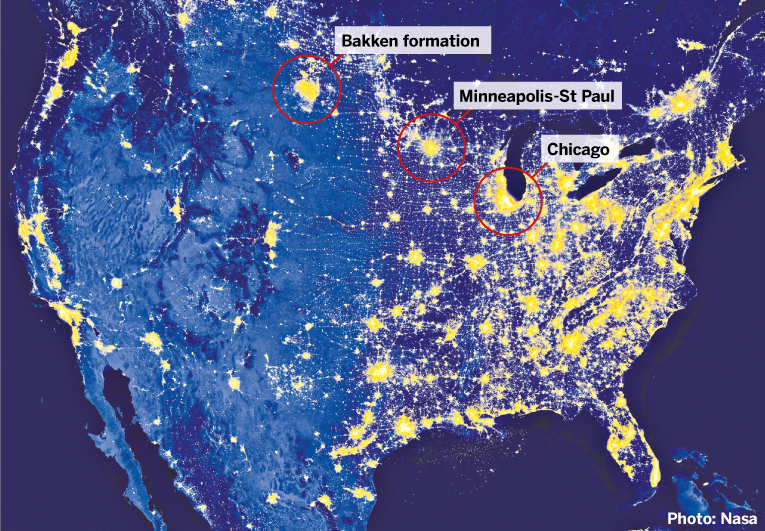
Shale gas boom visible from space

Oil companies at the heart of the US shale oil boom are burning off enough gas to power all the homes in Chicago and Washington combined in a practice causing growing concern about the waste of resources and damage to the environment.

The volume of unwanted gas being flared off in North Dakota, the state leading the shale revolution transforming the outlook for US energy, rose about 50 per cent last year. The surge at the state’s Bakken formation is being replicated in other shale regions with the Texas state regulator issuing 1,963 permits to flare in 2012, more than six times the number of 306 in 2010.

The rapid increase has made the US one of the world’s worst countries for gas flaring. The volume of gas flared in the US has tripled in just five years, according to World Bank estimates and is now fifth highest in the world, behind Russia, Nigeria, Iran and Iraq.

The flaring is a result, in large part, of the low price of natural gas in North America, which can make it uneconomic to build pipelines and tanks to handle the gas released by oil production. Flaring is often the safest way to dispose of it.

The lights of the flares burning in the Bakken and Texas’ Eagle Ford shale fields can clearly be seen in night-time satellite photography.

Flaring has been attracting attention from investors and environmental campaigners because of the waste of gas and its consequences for greenhouse gas emissions, local air pollution and disturbance to nearby communities.

Flaring in North Dakota increases by about 20 per cent the greenhouse gas emissions resulting from the state’s oil production, refining and transport, compared with the US average, according to Financial Times analysis of official data.

Investors managing a total of $500bn last year wrote to oil companies including ExxonMobil, Chevron, Statoiland US independents urging them to do more to cut their flaring. They warned that “excessive flaring, because of its impact on air quality and climate change, poses significant risks for the companies involved.”

Since then, flaring in the US and concerns over it have only increased.

The North Dakota legislature is considering a bill to encourage flaring reduction through tax breaks. The state is also pushing producers to use gas to power drilling rigs.