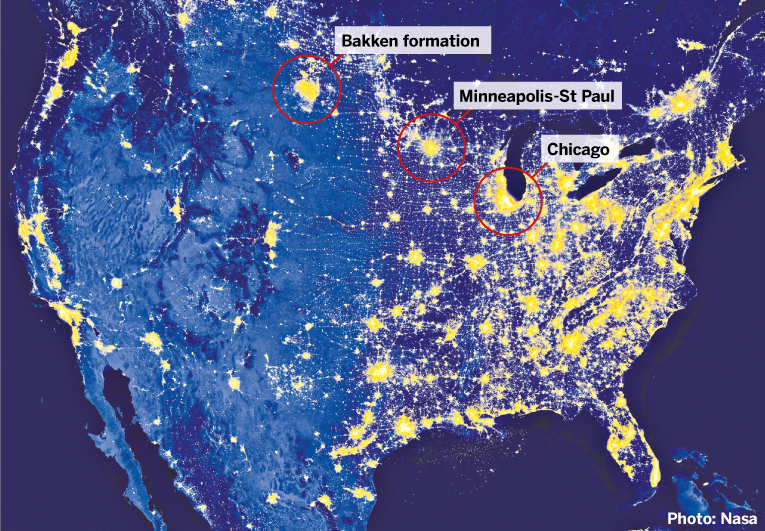
A video made by a man from North Dakota shows him cautiously holding a lighter up against the stream of water coming out of his tap, prompting large flames to rise up into the faucet. North Dakota has been home to a fracking boom over the past few years.
“First time I did it, it was a huge fireball [that] took up the entire sink – so that’s why I’m a little jumpy doing it. I don’t want to blow up the bathroom here,” he laughed during the demonstration. A huge flame shot up as the running water appeared to catch alight.
“Really weird, right?” he questioned as he switched the camera off. The video has had over 400,000 views. It was only uploaded within the last three weeks, garnering attention on a global scale. The video prompted one commenter to note sarcastically that there was “nothing like a refreshing glass of fire.”
His stunt with the tap water seems reminiscent of notorious 2010 documentary film ‘Gasland’ when a Colorado resident conducts a similar feat.
The scene in particular has been thrown into question by investigative journalist, Phelim McAleer, who postulated that residents in the man’s neighborhood had been able to light tap water on fire since around the 1930s because of naturally occurring methane. The filmmaker later said that his findings were irrelevant.
However, Haughney’s video has sparked speculation that the North Dakota fracking boom and nearby oil drilling and hydraulic fracturing is responsible for the apparently flammable tap water.
A Louisiana family noted a similar incident at the beginning of December, and they blamed a gas company for nearby drilling. The fire “blew up and caught the fringe of the curtains,” according to the daughter Sarah Evans, who spoke to local station, KSLA12
The highly controversial process of injecting water, sand and various chemicals into layers of rock in hopes of releasing oil and gas deep underground has drawn harsh criticism from environmentalists.
While supporters say fracking brings jobs and opportunities for energy independence, detractors have pointed to exaggerated employment claims – not to mention the health risks related to chemicals used in the practice.
And experts say the flammable water could be caused by a high concentration of methane in the line, which occasionally occurs naturally.
In October, researchers found high levels of radioactivity, salts, and metals in water and sediment located downstream from a treatment facility which processes fracking wastewater from oil and gas production sites in Pennsylvania’s Marcellus shale formation.
At the end of November, northern Texas towns experienced some 16 earthquakes over a period of three weeks, while in December, opponents of the practice experienced a rare victory when the Pennsylvania Supreme Court that a 2012 law allowing gas companies to drill anywhere in the state unconstitutional.
North Dakota is the second largest oil-producing state in the US, reaping more than 911,000 barrels of shale gas on a daily basis. – RT