BP is no longer trading in Kenya, Tanzania, Zambia, Zimbabwe, Malawi, Namibia, Swaziland, Lesotho, Botswana or Malawi.
In some of these countries had a BP presence for almost a century. Were all these BP associate companies suddenly unprofitable or was something deeper at work?
The sub-Saharan oil industry has registered the withdrawal from the region of major oil companies.
A clue could be the recent spat between Chevron and a new oil industry entrant in Cape Town in the shape of a black economic empowerment company called Burgan. Chevron claims it threatens the viability of their refinery with its ability to import, store and sell motor fuels.
Chevron’s complaints go further. Probably speaking for the other South African crude oil refiners, it points bitterly to the refusal or delay, by the government, to allow a “cost recovery mechanism” to make it worthwhile to upgrade local refineries to produce the higher quality fuels demanded by motor manufacturers.
Chevron argues that our regulated oil industry is a strategic asset with sacred status. It believes nothing should be changed without industry approval.
A more powerful reason for a reluctance to invest in new plant without a sweetener from the Treasury may be found in what has been happening in Saudi Arabia and India. In both countries there are now new and massive crude oil refineries producing, and selling to all comers, large volumes of motor fuels and other petroleum products.
The nearest customers for production surpluses of these huge refineries are in Africa, particularly those on its eastern seaboard – South Africa being the biggest.
The economies of scale is deadly. Saudi Arabia can undercut any refinery far from crude oil sources – such as those in Durban, Cape Town, and Gauteng. It can also produce the new higher quality fuel. Local refineries cannot do so.
South Africa’s crude oil refining capacity is 553 000 barrels a day. Saudi Arabia production is huge by comparison. Estimates are 3 million barrels a day and upwards. Some analysts (The Wall Street Journal) expect Saudi Arabian refining capacity to rise to 8 million barrels a day within a decade. Others predict 12 million barrels a day within 10 years.
Not only Saudi refineries pose a severe threat to our local ones. There are large ones in India too. In particularly the one recently completed by Reliance. It alone can produce more that all six of our refineries (including Sasol) combined. It has a reported capacity of 1.2 million barrels a day. It is the world’s largest.
High principles dominate the rhetoric on freedom-loving Ukraine, writes JP Sottile. But more mundane realities – like the interests of US oil corporations and Ukraine’s vast shale gas capacity – are part of the volatile equation.
In Ukraine, Chevron’s deal continues a long tradition of intermarriage between ‘national’ and corporate interests under the guise of national security.
Everybody’s got an opinion about the ‘showdown’ with Russia.
Some say it’s about freedom and the right to self-determination. Some say it’s about standing up to aggression and halting a dictator’s march.
Some say it’s about the future of everything-from Syria to North Korea to Iran’s nuclear program – and, according to Sen. Lindsey Graham, it all stems from Obama’s failure to kill the people who killed Americans at Benghazi.
But the most-revealing voice in the chorus is Condi Rice. She penned a tension-filled op-ed on Ukraine for the Washington Post – the newspaper of broken records.
Her nostalgic, “Baby, It’s a Cold War Outside” ditty on the “Ukrainian Problem” came just two days after a Teflon-coated Henry Kissinger opined about the “art of establishing priorities” in his own Ukraine-themed op-ed for the Post.
Why should we care about Condi?
As the world learned through painful experience, Condi Rice, much like Henry Kissinger, was all about establishing priorities. But now that she’s out of power, why should anyone waste any time considering Ms. Rice’s opinion about anything, much less about the ‘crisis’ in Ukraine?
Why? Because it’s telling. Like most American Exceptionalists, her bluster and posturing can be reverse-engineered to find the banal truth about US foreign policy.
For example, her steadfast belief that Ukraine “should not be a pawn in a great-power conflict but rather an independent nation” might have something to do with Chevron’s 50-year lease to develop Ukraine’s shale gas reserves.
It’s the gas, stupid
When that lease was signed on November 5, 2013, it stoked Russian fears about losing its influence on, and a major gas market in, a former satellite.
It also came on the eve of the much-disputed trade deal with the European Union that, once abandoned due to Russian pressure, led to the toppling of Ukraine’s government.
Reuters characterized Ukraine’s “$10 billion shale gas production-sharing agreement with US Chevron” as “another step in a drive for more energy independence from Russia.”
Of course, Ms. Rice knows something about driving for more energy. She sat on Chevron’s board of directors for ten years before resigning to become President Bush’s National Security Adviser in January of 2001.
She was such a titanic figure at Chevron and so beloved by their corporate captains that they even named a 129,000-ton oil tanker ‘Condoleezza Rice’. Do people name tankers after people? People do!
But four months after leaving Chevron, they “quietly renamed” the tanker, apparently sensitive to the implication that she might prioritize their interests in places like Kazakhstan (a de facto dictatorship never targeted by American Exceptionalists) or the Caspian Sea (where Chevron is heavily invested) or Afghanistan (where they’ve long sought a pipeline from the Caspian region to the Indian Ocean).
Corporate Interests Abroad
In the case of Ukraine, Chevron’s deal continues a long tradition of intermarriage between ‘national’ and corporate interests under the guise of national security.
As the International Business Times stated immediately after the deal, “Chevron’s agreement with Ukraine was supported by the US as part of its national security strategy to help reduce Russia’s hold on Europe and Kiev.”
As quoted in the article, US Ambassador Geoffrey Pyatt said, “I’m very determined to cooperate with the Ukrainian government in strengthening Ukraine’s energy independence.”
That “cooperation” is couched in the language of “independence” – but it’s actually about shifting to financial interdependence with powerful, American corporate interests. It’s not about freedom or self-determination or human rights.
It’s about the ‘Open Door’.
Since the US proposed the Open Door Policy in China at the end of the 19th Century, American ‘soft imperialism’ has exploited resource opportunities for American corporate interests in dozens of ‘friendly’regimes – their commitment to freedom notwithstanding.
We have been there before
Whether it was oil in Iran, bananas in Guatemala or sugar-cane in Cuba, any move to close the door on US business interests has traditionally been met with dire warnings about the dangers of isolationism and specious claims about America’s national interests – which, oddly enough, always seem to be located in another country.
Throughout the Cold War, those ‘endangered’ national interests inspired CIA hijinks around the world. US foreign policymakers supported regime change in places like Chile (calling Dr. Kissinger) and around Central America.
And they doled out generous foreign aid packages to a motley crew of anti-communist ‘strongmen’. If push came to shove, the US military might even get involved.
Since the end of the Cold War, US policy has been kicking open doors around the world and particularly around the edges of the former Soviet Union. Expansion of NATO and US involvement in the former ‘Soviet Stans’ around Afghanistan extended a semi-circle of US military might around Russia.
A declaration of economic war
And the Ukrainian energy independence trumpeted by Ambassador Pyatt amounted to a declaration of economic warfare on Russia’s oil and gas-based economy. Like Condi Rice before him, Ambassador Pyatt’s well-established priority is to ensure that well-connected businesses get in on the ground floor.
Once on the ground floor, they need insurance – either from local clients or from a neighborhood patrol by US forces. Perhaps that’s why Ms. Rice used her Ukraine op-ed as an opportunity to advocate leaving a permanent military force in Afghanistan.
She doesn’t want to hear “talk of withdrawal from Afghanistan whether the security situation warrants it or not.” For her, nothing less than 10,000 troops will do. Otherwise, the US is “not serious about helping to stabilize that country.”
Freedom, liberty, justice … and hydrocarbons
Yet, one wonders if she – like all the professional hand-wringers, truculent think tankers, and once and future policymakers who’ve grandstanded on the showdown with Russia – isn’t quietly more concerned about something more basic than freedom, liberty and justice for all.
Perhaps the former Secretary of State, former Chevron big-wig and former oil tanker is more concerned with the ability of Chevron to realize its Turkmenistan-Afghanistan-Pakistan-India (TAPI) pipeline dream.
Her old cohorts practicing soft imperialism at the US State Department have certainly been doing their part to help Chevron score that lucrative contract.
The banal truth is that America’s long-standing policy is to help people anywhere and everywhere when those people just so happen to be living on or near valuable resources.
Unless, of course, it’s Bahrain, Nigeria, Kazakhstan or anywhere else repressive and corrupt governments are already interdependent upon US corporate interests.
Ukraine signed a $10 billion shale gas production-sharing agreement with U.S. Chevron on Tuesday, another step in a drive for more energy independence from Russia.
The deal to develop its western Olesska field followed a similar shale gas agreement with Royal Dutch Shell in January and boosts Ukraine’s leadership at a time of fraught relations with Moscow over gas supplies.
“The agreements with Shell and Chevron … will enable us to have full sufficiency in gas by 2020 and, under an optimistic scenario, even enable us to export energy,” President Viktor Yanukovich told investors shortly before the signing.
The highest end of expectations for Olesska’s potential reserves would match around three years of European Union gas demand, but similarly sunny hopes for shale reserves in neighboring Poland have been very sharply downsized.
Chevron houses some 6,000 people at the Malongo compound, built in the 1960s, in Angola, but capacity constraints mean contractors have had to seek lodging outside the base that protected employees through decades of conflict.
Chevron’s 2,965-acre (1,200-hectare) Malongo compound became a veritable fort to survive the nation’s 1961-1975 struggle for independence followed by a 27-year civil war between the ruling Popular Movement for the Liberation of Angola and the U.S.-funded rebel National Union for the Total Independence of Angola, known as Unita, which ended in 2002.
At one point in a twist of the usual Cold War alliances, Cuban troops were used to protect Chevron’s Cabinda installations from Unita attacks.
Cabinda’s under-supplied market has raised rental and property prices and created a proliferation of cramped, basic facilities. It’s also prompted almost $200 million of developments that will house local residents and workers of companies such as Schlumberger Ltd. (SLB), the world’s largest oilfield-services provider, and help fulfill the state’s push to integrate oil companies into the wider economy.
“Malongo is like a colony and we have to break it up because the war is over,” Gianni Martins, a petroleum engineer at state oil company Sonangol EP, said in an interview in Cabinda. “The expats have needs, the locals have services and we have to bring them together.”
The $100 million Futila Sea Breeze Condominium will open the first of its 464 luxury units in 2015, said Pedro Godinho, president of Servicab SA, the developer of the project.
Housing Developments
The nearby $97 million Malembo Development Center, being built by Operatec Lda and OPI International, expects to fill 280 of its 1,440 beds this quarter with employees of companies such as Schlumberger, Saipem SpA (SPM) and Fugro NV (FUR), the biggest deepwater-oilfield surveyor.
Cabinda province, with a population of about 440,000, half of which live in rural areas away from the coast, is separated from the rest of Angola by a sliver of the Democratic Republic of Congo. The predominant language in some areas is French, while Portuguese is spoken in the rest of the country.
Capital’s Improvements
Companies including Total SA (FP), Braspetro BV and Eni SpA (ENI) have wells offshore the province, which used to comprise most of Angola’s production and now makes up about a quarter of output. The OPEC member pumped 1.48 million barrels a day in January, according to data compiled by Bloomberg.
The province’s capital is studded with unfinished or abandoned low-rise buildings. Governor Aldina Matilde da Lomba embarked on a program in the past year to improve the core area and roads. The main port has been dredged and expanded while a nearby deepwater port is being readied, Pedro Sia, her spokesman, said in a Feb. 20 phone interview.
Most of the province-managed Olympic Village development, built for civil-war veterans, is being rented to oil workers, Sia said.
Luis Franque, chief of staff for Macario Romao Lembe, the deputy governor for economic affairs, denied in a Feb. 20 phone interview the village was for veterans and said the government built the 150-unit Condominio Santa Catarina for the soldiers.
Cabinda Separatists
The separatist Front for the Liberation of the Enclave of Cabinda, known as FLEC, has conducted a guerrilla campaign for Cabindan independence for the past few decades, a struggle unrelated to Angola’s 27-year civil war. FLEC claimed responsibility for killing two Togolese soccer team members in an ambush on a bus travelling to the African Cup of Nations tournament in Angola in January 2010.
“People see multinationals making a lot of money from their resources and they get nothing,” Servicab’s Godinho said in an interview in Luanda. “People are starving and with an AK-47 they have nothing to lose, so it makes people think why we have problems with FLEC.”
Isabel Ordonez, a spokeswoman based in Houston for Chevron, said by e-mail on Feb. 19 she couldn’t immediately reply to a request for comment.
Swimming Pools
Halliburton Co., the world’s biggest provider of hydraulic fracturing services, is also building accommodation in Cabinda for its workers, Sid Whyte, then company country manager, said in an interview last year. Further details weren’t immediately available.
The Malembo compound, to be constructed over four phases with swimming pools, gyms, central dining and a 600 square-meter (6,458 square-foot) retail space for local businesses, is on a 346-acre site just 3.5 kilometers (2.2 miles) from Malongo.
“The center can serve the needs of Chevron, the contractors and the community since it is open to not only to the contractors, but for locals to provide services,” Clay Etheridge, Director of MDC, said in an interview. “It’s win-win for the community and the oil sector.”
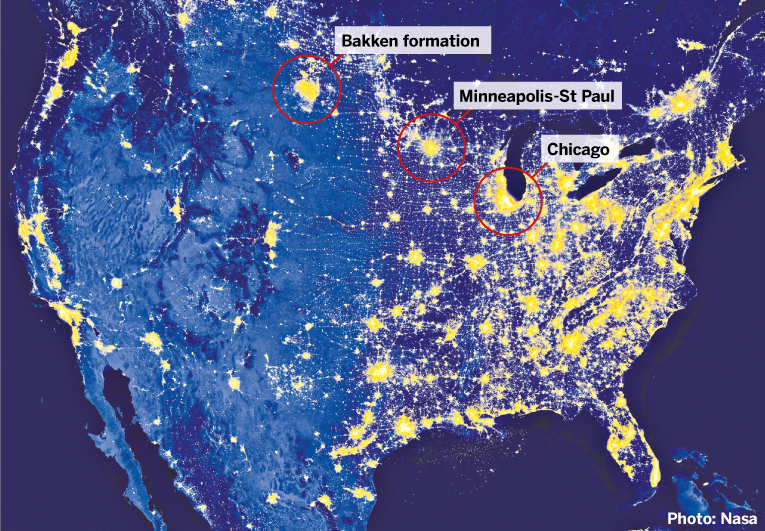
Oil companies at the heart of the US shale oil boom are burning off enough gas to power all the homes in Chicago and Washington combined in a practice causing growing concern about the waste of resources and damage to the environment.
The volume of unwanted gas being flared off in North Dakota, the state leading the shale revolution transforming the outlook for US energy, rose about 50 per cent last year. The surge at the state’s Bakken formation is being replicated in other shale regions with the Texas state regulator issuing 1,963 permits to flare in 2012, more than six times the number of 306 in 2010.
The rapid increase has made the US one of the world’s worst countries for gas flaring. The volume of gas flared in the US has tripled in just five years, according to World Bank estimates and is now fifth highest in the world, behind Russia, Nigeria, Iran and Iraq.
The flaring is a result, in large part, of the low price of natural gas in North America, which can make it uneconomic to build pipelines and tanks to handle the gas released by oil production. Flaring is often the safest way to dispose of it.
The lights of the flares burning in the Bakken and Texas’ Eagle Ford shale fields can clearly be seen in night-time satellite photography.
Flaring has been attracting attention from investors and environmental campaigners because of the waste of gas and its consequences for greenhouse gas emissions, local air pollution and disturbance to nearby communities.
Flaring in North Dakota increases by about 20 per cent the greenhouse gas emissions resulting from the state’s oil production, refining and transport, compared with the US average, according to Financial Times analysis of official data.
Investors managing a total of $500bn last year wrote to oil companies including ExxonMobil, Chevron, Statoiland US independents urging them to do more to cut their flaring. They warned that “excessive flaring, because of its impact on air quality and climate change, poses significant risks for the companies involved.”
Since then, flaring in the US and concerns over it have only increased.
The North Dakota legislature is considering a bill to encourage flaring reduction through tax breaks. The state is also pushing producers to use gas to power drilling rigs.
This website uses cookies to improve your experience. We'll assume you're ok with this, but you can opt-out if you wish. Cookie settingsACCEPT
Privacy & Cookies Policy
Privacy Overview
This website uses cookies to improve your experience while you navigate through the website. Out of these cookies, the cookies that are categorized as necessary are stored on your browser as they are essential for the working of basic functionalities of the website. We also use third-party cookies that help us analyze and understand how you use this website. These cookies will be stored in your browser only with your consent. You also have the option to opt-out of these cookies. But opting out of some of these cookies may have an effect on your browsing experience.
Necessary cookies are absolutely essential for the website to function properly. This category only includes cookies that ensures basic functionalities and security features of the website. These cookies do not store any personal information.
Any cookies that may not be particularly necessary for the website to function and is used specifically to collect user personal data via analytics, ads, other embedded contents are termed as non-necessary cookies. It is mandatory to procure user consent prior to running these cookies on your website.