America’s infrastructure crisis: Israel, Iran and the growing pressure on Washington

America’s nationwide aviation shutdown has exposed serious weaknesses in its ageing infrastructure. Meanwhile, Israel’s Mossad chief has travelled to Washington as Benjamin Netanyahu presses Donald Trump to resume military action against Iran.

The nationwide grounding of US flights has exposed serious weaknesses in America’s ageing infrastructure, while a high-level visit by Israel’s Mossad chief to Washington has highlighted the growing pressure on Donald Trump to resume military action against Iran.

The United States experienced one of its most significant aviation disruptions in decades on Friday, November 13, when the Federal Aviation Administration (FAA) ordered a nationwide ground stop following a breakdown in its air traffic communications network.

The shutdown lasted almost five hours and affected more than 20,000 flights. Seventeen of the FAA’s 22 en-route air traffic control centres experienced communications problems, disrupting the systems used to coordinate aircraft movements and radar information.

Although flights subsequently resumed, the incident exposed the vulnerability of critical American infrastructure and raised fresh questions about the country’s ability to maintain and modernise essential technological systems.

An ageing system brought to a standstill

US Transportation Secretary Sean Duffy attributed the disruption to a technical failure during routine maintenance work carried out by L3Harris, a longstanding contractor responsible for operating the FAA’s telecommunications network.

The work involved replacing ageing copper telecommunications lines with fibre-optic connections. According to Duffy, a router associated with the upgrade began generating an extraordinary number of connection attempts, overwhelming other routers in the network.

Officials reported more than 1,000 connection attempts every four to five seconds.

The resulting instability affected communications between air traffic controllers and aircraft, as well as radar feeds. The FAA consequently decided to ground departing flights nationwide as a precautionary measure.

Duffy said investigators were examining whether the incident resulted from human error, faulty installation or defective equipment. No definitive technical cause had yet been established.

The administration also stated that there was no indication of a cyberattack or deliberate hostile action.

The incident nevertheless highlighted a wider problem: parts of America’s air traffic control infrastructure remain dependent on equipment and telecommunications systems that are decades old.

Congress has already approved substantial funding for modernisation, but the transition has been slow and technically complicated.

The episode raises questions about the resilience of infrastructure that is essential not only to commercial aviation but also to the functioning of the world’s largest economy.

Netanyahu presses Trump over Iran

While Washington was dealing with the aviation crisis, another development was unfolding in the relationship between the United States and Israel.
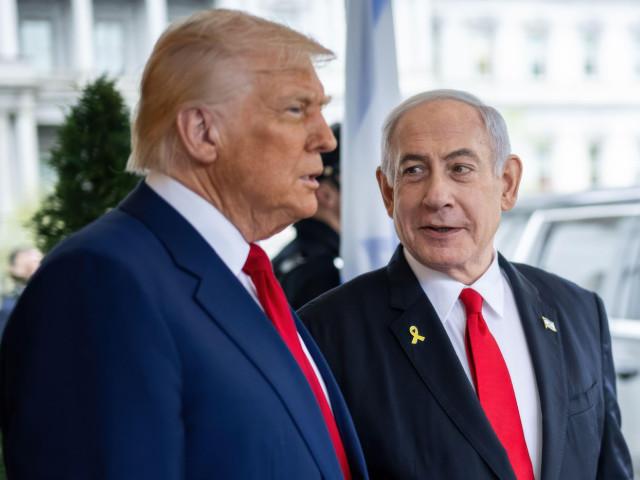
President Trump and Israeli prime minister Benjamin Netanyahu

According to a report by Axios on November 13, Mossad director Roman Gofman was in Washington for discussions with senior Trump administration officials concerning the war with Iran.

Gofman was reportedly scheduled to meet CIA director John Ratcliffe and was also expected to travel to Miami for discussions with White House envoy Steve Witkoff.

The visit coincided with renewed pressure from Israeli Prime Minister Benjamin Netanyahu for the United States to resume military operations against Iran.

Trump has so far resisted this pressure, although his position on the conflict has fluctuated. Reports have described disagreements over whether to continue diplomatic efforts or return to a more extensive military campaign.

The Israeli government considers Iran’s military and nuclear capabilities an existential security concern. Washington, meanwhile, must weigh the consequences of renewed hostilities, including the possibility of a wider regional conflict, disruption to energy markets and further American military commitments.

The presence of the Mossad director in Washington therefore illustrates the extent to which intelligence and military cooperation form part of the relationship between the two countries.

It also raises an important question about the degree of influence Israel exercises over American strategic decision-making.

Intelligence cooperation and political pressure

The relationship between American and Israeli intelligence agencies has traditionally been close. Cooperation between the CIA and Mossad covers a range of regional security issues, including Iran, counterterrorism and intelligence gathering.

However, cooperation does not necessarily imply agreement over every strategic decision.

The reported Washington visit comes at a particularly sensitive moment. Israel wants to prevent Iran from consolidating its regional military position, while the Trump administration faces the economic and political consequences of prolonging a costly conflict.

The question is whether American foreign policy is being determined primarily by Washington’s assessment of its own national interests or increasingly by the strategic priorities of a close regional ally.

This is a legitimate subject for public debate, particularly when decisions about war and peace are involved.

There have also been allegations and speculation in political circles about possible intelligence leverage, blackmail and pressure exerted on American political leaders. However, no independently verified evidence has established that Mossad is blackmailing Trump or that Israeli intelligence has been responsible for the recent American infrastructure disruptions.

Such allegations should not be confused with the documented diplomatic and political pressure surrounding the Iran conflict.

Is America becoming more vulnerable?

The FAA incident and the renewed diplomatic activity surrounding Iran are separate developments. There is currently no evidence connecting the aviation shutdown to Israel, Mossad or the conflict in the Middle East.

Nevertheless, both events illustrate different aspects of the challenges confronting the United States.

On the domestic front, an advanced industrial economy remains dependent on ageing infrastructure that can be disrupted by relatively isolated technical failures.

On the international front, Washington faces competing strategic priorities and pressure from allies whose regional objectives do not necessarily coincide with American interests.

The United States possesses enormous military, technological and economic resources. Yet the ability to project power abroad ultimately depends on the reliability of institutions and infrastructure at home.

The question facing Washington is therefore not simply whether it should resume military action against Iran. It is whether American foreign policy can remain independent, coherent and sustainable while the country struggles to modernise the systems upon which its own security and prosperity depend.

For a country that has long presented itself as the guarantor of international stability, these are questions that cannot easily be ignored.

PRAAG — November 15, 2026

No Brains In Washington

Washington’s IQ follows the Fed’s interest rate — it is negative. Washington is a black hole into which all sanity is sucked out of government deliberations.

Washington’s failures are everywhere visible. We can see the failures in Washington’s wars and in Washington’s approach to China and Russia.

The visit of Chinese President Xi Jinping, was scheduled for the week-end following the Pope’s visit to Washington. Was this Washington’s way of demoting China’s status by having its president play second fiddle to the Pope? The President of China is here for week-end news coverage? Why didn’t Obama just tell him to go to hell?

Washington’s cyber incompetence and inability to maintain cyber security is being blamed on China. The day before Xi Jinping’s arrival in Washington, the White House press secretary warmed up President Jinping’s visit by announcing that Obama might threaten China with financial sanctions.

And not to miss an opportunity to threaten or insult the President of China, the US Secretary of Commerce fired off a warning that the Obama regime was too unhappy with China’s business practices for the Chinese president to expect a smooth meeting in Washington.

In contrast, when Obama visited China, the Chinese government treated him with politeness and respect.

China is America’s largest creditor after the Federal Reserve. If the Chinese government were so inclined, China could cause Washington many serious economic, financial, and military problems. Yet China pursues peace while Washington issues threats.

Like China, Russia, too, has a foreign policy independent of Washington’s, and it is the independence of their foreign policies that puts China and Russia on the outs with Washington.

Washington considers countries with independent foreign policies to be threats. Libya, Iraq, and Syria had independent foreign policies. Washington has destroyed two of the three and is working on the third. Iran, Russia, and China have independent foreign policies. Consequently, Washington sees these countries as threats and portrays them to the American people as such.

Russia’s President Vladimir Putin will meet with Obama next week at the UN meeting in New York. It is a meeting that seems destined to go nowhere. Putin wants to offer Obama Russian help in defeating ISIS, but Obama wants to use ISIS to overthrow Syrian President Assad, install a puppet government, and throw Russia out of its only Mediterranean seaport at Tartus, Syria. Obama wants to press Putin to hand over Russian Crimea and the break-away republics that refuse to submit to the Russophobic government that Washington has installed in Kiev.

Despite Washington’s hostility, Xi Jinping and Putin continue to try to work with Washington even at the risk of being humiliated in the eyes of their peoples. How many slights, accusations, and names (such as “the new Hitler”) can Putin and Xi Jinping accept before losing face at home? How can they lead if their peoples feel the shame inflicted on their leaders by Washington?

Xi Jinping and Putin are clearly men of peace. Are they deluded or are they making every effort to save the world from the final war?

One has to assume that Putin and Xi Jinping are aware of the Wolfowitz Doctrine, the basis of US foreign and military policies, but perhaps they cannot believe that anything so audaciously absurd can be real. In brief, the Wolfowitz Doctrine states that Washington’s principal objective is to prevent the rise of countries that could be sufficiently powerful to resist American hegemony. Thus, Washington’s attack on Russia via Ukraine and Washington’s re-militarization of Japan as an instrument against China, despite the strong opposition of 80 percent of the Japanese population.

“Democracy?” “Washington’s hegemony don’t need no stinkin’ democracy,” declares Washington’s puppet ruler of Japan as he, as Washington’s faithful servant, over-rides the vast majority of the Japanese population.

Meanwhile, the real basis of US power—its economy—continues to crumble. Middle class jobs have disappeared by the millions. US infrastructure is crumbling. Young American women, overwhelmed with student debts, rent, and transportation costs, and nothing but lowly-paid part-time jobs, post on Internet sites their pleas to be made mistresses of men with sufficient means to help them with their bills. This is the image of a Third World country.

In 2004 I predicted in a nationally televised conference in Washington, DC, that the US would be a Third World country in 20 years. Noam Chomsky says we are already there now in 2015. Here is a recent quote from Chomsky:

“Look around the country. This country is falling apart. Even when you come back from Argentina to the United States it looks like a third world country, and when you come back from Europe even more so. The infrastructure is collapsing. Nothing works. The transportation system doesn’t work. The health system is a total scandal–twice the per capita cost of other countries and not very good outcomes. Point by point. The schools are declining . . .”

Another indication of a third world country is large inequality in the distribution of income and wealth. According to the CIA itself, the United States now has one of the worst distributions of income of all countries in the world. The distribution of income in the US is worse than in Afghanistan, Albania, Algeria, Armenia, Australia, Austria, Azerbaijan, Bangladesh, Belarus, Belgium, Benin, Bosnia/Herzegovina, Burkina Faso, Burundi, Cambodia, Cameroon, Canada, Cote d’Ivoire, Croatia, Cyprus, Czech Republic, Denmark, Egypt, Estonia, Ethiopia, Finland, France, Germany, Ghana, Greece, Guinea, Guyana, Hungary, Iceland, India, Indonesia, Iran, Ireland, Israel, Italy, Japan, Jordan, Kazakhstan, Kenya, South Korea, Kyrgyzstan, Laos, Latvia, Liberia, Lithuania, Luxembourg, Macedonia, Malawi, Mali, Malta, Mauritania, Mauritius, Moldova, Mongolia, Montenegro, Morocco, Nepal, Netherlands, New Zealand, Nicaragua, Niger, Nigeria, Norway, Pakistan, Philippines, Poland, Portugal, Romania, Russia, Senegal, Serbia, Slovakia, Slovenia, Spain, Sweden, Switzerland, Taiwan, Tajikistan, Tanzania, Timor-Leste, Tunisia, Turkey, Turkmenistan, Uganda, Ukraine, UK, Uzbekistan, Venezuela, Vietnam, and Yemen.

The concentration of US income and wealth in the hands of the very rich is a new development in my lifetime. I ascribe it to two things. One is the offshoring of American jobs. Offshoring moved high productivity, high-value-added American jobs to countries where the excess supply of labor results in wages well below labor’s contribution to the value of output. The lower labor costs abroad transform what had been higher American wages and salaries and, thereby, US household incomes, into corporate profits, bonuses for corporate executives, and capital gains for shareholders, and in the dismantling of the ladders of upward mobility that had made the US an “opportunity society.”

The other cause of the extreme inequality that now prevails in the US is what Michael Hudson calls the financialization of the economy that permits banks to redirect income away from driving the economy to the payment of interest in service of debt issued by the banks.

Both of these developments maximize income and wealth for the One Percent at the expense of the population and economy.

As Michael Hudson and I have discovered, neoliberal economics is blind to reality and serves to justify the destruction of the economic prospects of the Western World. It remains to be seen if Russia and China can develop a different economics or whether these rising superpowers will fall victim to the “junk economics” that has destroyed the West. With so many Chinese and Russian economists educated in the US tradition, the prospects of Russia and China might not be any better than ours.

The entire world could go down the tubes together.

Dr. Paul Craig Roberts was Assistant Secretary of the Treasury for Economic Policy and associate editor of the Wall Street Journal. He was columnist for Business Week, Scripps Howard News Service, and Creators Syndicate. He has had many university appointments. His internet columns have attracted a worldwide following. Roberts’ latest books are The Failure of Laissez Faire Capitalism and Economic Dissolution of the West and How America Was Lost.

Moscow hopes US will abandon AMD plans for Europe

Moscow hopes the US will fulfill its promise not to develop a system of missile defense in Europe after a deal with Iran has been reached, Russian Foreign Minister Sergey Lavrov said in Vienna on Tuesday.

“We all probably remember that in April 2009 in Prague [US] President [Barack] Obama said that if the Iran nuclear program issue is sorted out, then the task of creating the European segment of the missile defense system will disappear,” Lavrov said at press conference in Vienna.

He said that Tehran and the P5+1 powers (the United States, the UK, France, Germany, Russia and China) have agreed on “joint all-inclusive plan of actions, which consists of the main document and five very detailed technical appendices.”

A draft of UN Security Council resolution has also been agreed upon which all participants of the talks will present as co-authors in New York in the next few days, Lavrov said, adding that the resolution will be considered by the UN SC and voted on. “We believe, it will be unanimously approved,” he added.

Historic nuclear deal reached with Iran

Iran and six leading world powers signed a comprehensive plan for ending international sanctions against Iran in exchange for putting restrictions on its controversial nuclear program. RT takes a look at the groundbreaking document.

The deal signed in Vienna on Tuesday is meant to break a 12-year standoff over Iran’s nuclear activities, which some nations claimed involved military research. The Joint Comprehensive Plan of Action (JCPOA) acknowledges Iran’s right for peaceful nuclear development on par with any other signatory to the nuclear Non-Proliferation Treaty.

The agreement provides for a joint commission to be established to monitor the implementation of the action plan and handle dispute situations. The International Atomic Energy Agency (IAEA) is tasked with verifying voluntary nuclear-related measures by Iran. Iran and the six nations – China, France, Germany, Russia, the UK and the US, are to hold ministerial-level meetings at least once every two years to monitor the progress.

For 15 years Iran will carry out enrichment only at the Natanz facility and will only enrich uranium up to 3.67 percent. The stockpile would not exceed 300kg of uranium hexafluoride or equivalent chemical forms. The stockpile limit does not include fuel assemblies used in Iran’s nuclear reactors. Excesses are to be sold or exchanged for raw uranium.

The Fordow facility is to be converted into an internationally-supported technological center. Some of the centrifuges currently placed there would be allowed to continue spinning, but they would only produce stable isotopes and not enrich uranium. Some of the equipment will be removed completely.

Iran will start phasing out its older IR-1 centrifuges in 10 years, will not develop new models, will not increase the number of more advanced centrifuges currently in its possession, and will observe certain restrictions on testing them.

Iran will modify the Arak nuclear reactor with the help of the international community. It will be used for peaceful research and isotope production. It will not produce plutonium. Spent fuel will be shipped out of Iran for entire lifetime of the reactor. Iran keeps a leadership role in the Arak partnership.

No heavy water will be produced or accumulated for 15 years and Tehran will seek to use reactor designs not requiring heavy water.

Iran is to leave spent fuel re-processing to other nations.

Iran will adopt several additional safeguards and allow the IAEA to verify those voluntary measures. The nuclear watchdog is to monitor uranium stockpiles and centrifuges in Iran, including with modern surveillance measures like online enrichment measurement and electronic seals.

Tehran pledges not to conduct research that could conduct development of a nuclear explosive device, as specified in a technical annex to the agreement.

Clinton Foundation cashed in as Sweden lobbied Hillary

Bill Clinton’s foundation set up a fundraising arm in Sweden that collected $26 million in donations at the same time that country was lobbying Hillary Rodham Clinton’s State Department to forgo sanctions that threatened its thriving business with Iran, according to interviews and documents obtained by The Washington Times.

As US prosecutors go after 14 people — nine current and former FIFA officials, four sports marketing executives and an accused intermediary — in corruption allegations, seven were taken into custody in Zurich on Wednesday.

But strangely the Clintons and their dealings are not up for scrutiny it seems.

The Swedish entity, called the William J. Clinton Foundation Insamlingsstiftelse, was never disclosed to or cleared by State Department ethics officials, even though one of its largest sources of donations was a Swedish government-sanctioned lottery.

As the money flowed to the foundation from Sweden, Mrs. Clinton’s team in Washington declined to blacklist any Swedish firms despite warnings from career officials at the U.S. Embassy in Stockholm that Sweden was growing its economic ties with Iran and potentially undercutting Western efforts to end Tehran’s rogue nuclear program, diplomatic cables show.

At the time of Mr. Clinton’s foray into Swedish fundraising, the Swedish government was pressing Mrs. Clinton’s State Department not to impose new sanctions on firms doing business with Iran, including hometown companies Ericsson and Volvo.

Mrs. Clinton’s State Department issued two orders identifying lists of companies newly sanctioned in 2011 and 2012 for doing business with Iran, but neither listed any Swedish entities.

Behind the scenes, however, the U.S. Embassy in Stockholm was clearly warning the State Department in Washington that Sweden’s trade was growing with Iran — despite Swedish government claims to the contrary.

The Swedes were resistant to new sanctions, telling State Department officials repeatedly and unequivocally that they were worried new penalties would stifle the business between its country’s firms and Tehran. At the time, Iran was Sweden’s second-largest export market in the Middle East after Saudi Arabia.

“Behind the Swedish government’s reluctance to support further sanctions in Iran, especially unilateral European measures, is a dynamic (though still fairly small) trade involving some of Sweden’s largest and most politically well-connected companies: Volvo, Ericsson and ABB to name three,” the U.S. Embassy wrote in one cable to Washington.

U.S. intelligence officials told The Times that they kept the Obama administration apprised of Ericsson’s activities inside Iran, including the fact that the Swedish firm had provided Iran’s second-largest cellular provider with location-based technology to track customers for billing purposes. The technology transfer occurred in late 2009, shortly after Tehran brutally suppressed a pro-democracy movement in that country, the officials said.

U.S. intelligence further learned that Ericsson in 2010 discussed with Iran’s largest cellular firm providing tracking technology that could be used directly by Iranian security authorities.

Russia to Deliver S-300 Missiles to Iran

Russia lifted a ban on sending Iran its sophisticated S-300 surface-to-air missile system, officials said Monday. The weapons could be shipped shortly, giving Tehran a new way to defend itself against any future bombing campaign.

The decision was made as Iran continues to negotiate with the United States and five other world powers about its nuclear program in return for an easing of sanctions.

The S-300 missile system is able to hit multiple targets at once, and is typically launched from the back of a truck. The missiles can target aircraft and missiles flying more than 16 miles high, according to specifications published by the American Federation of Scientists, a nonprofit organization that provides analysis on national security issues.

Russia signed an $800 million deal to deliver S-300s to Iran in 2007, but decided to halt the weapons delivery after the United States and Israel protested that Tehran could use them to protect its nuclear facilities. Russian officials said Monday that sending the missile system to Iran wouldn’t jeopardize security in the region.

The Kremlin wanted to sell the system to Syria in 2013, but came under pressure. Secretary of State John F. Kerry warned Russia at the time.

Israeli officials also warned that if Russia completed the S-300 deal with Syria, they would use military force to ensure the system didn’t become operational.

Source: Washington Post

Shale Gas Might Rescue South Africa’s Dying Economy

At this point of time, a barrel of oil costs $60, showing some signs of improvement from its previous value of below $50 back in March. Yet, full recovery of oil seems very unlikely, and people wonder whether fossil fuels will last that much longer as our primary source of power. Research indicates that oil demand will peak at 2030, while others believe another oil crisis could happen again in the future, with permanent damages as a consequence

Slowing rates of consumption have led to the closure of oil and gas rotaries in the United States. But many still see the fossil fuel industry as a lucrative investment as they pour capital into Iraq’s oil-rich fields in Rumaila and spend their funds on exploration programs throughout Africa, particularly in Namibia where around 60 petroleum exploration licenses have already been issued to local and foreign investors. Others have joined the race for renewable energy as the prices of solar and wind power continues to decrease. South Africa have taken a different route to address the slump in commodities, as they believe that shale gas exploration in the Karoo region could help survive the economy.

In the last 12 months, 36 mining rights have been granted with the hope to create around 6,000 jobs, as explained by Mineral Resources Minister Ngoako Ramatlhodi. The nation’s budding shale industry may soon have a new program starting up within the next several weeks, should the government approve new regulations on shale exploration in Karoo.

It’s been said that the semi-desert area holds up to 400 trillion cubic feet of shale gas, and passing these new rules will mitigate the current energy shortages. Environmentalists fear that extraction would damage the water supply of surrounding communities, which is why it’s of the utmost importance that extractors conduct all the appropriate assessments and work with local communities to minimize disturbances.

Prior to Western-led sanctions against Iran, South Africa had been the leading importer for Iran’s crude oil and the ninth in the world, which was reported by the Tasnim News Agency earlier this month. If the sanctions are ever lifted, South Africa are prepared to cooperate with Iran once again to boost each other’s economies, given the amount of potential in shale gas.

Iran urges Israel to give up nuclear weapons

Iran has demanded that Israel give up its nuclear weapons, as it spoke on behalf of the 120-nation Non-Aligned Movement. Iran’s Foreign Minister, Mohammad Javad Zarif said the bloc also wants a nuclear free-zone in the Middle East.

Mohammad Javad Zarif was speaking at the United Nations for the non-aligned group of countries. Israel has never admitted or denied the widespread assumption it has nuclear weapons. However, Zarif says Israel’s assumed nuclear arsenal was a threat to regional security.

The Iranian Foreign Minister said the non-aligned movement regards Israel’s nuclear program as, “a serious and continuing threat to the security of neighboring and other states, and condemned Israel for continuing to develop and stockpile nuclear arsenals,” according to Reuters.

Israel has not signed up to the nuclear Non-Proliferation Treaty (NPT), though it has sent an observer to the month long conference for the first time in 20 years.

Zarif added that the non-aligned bloc are looking to create a nuclear free-zone in the Middle East “as a matter of high priority,” which will only be possible, if Israel abandons its nuclear stockpile.

“Israel, [is] the only one in the region that has neither joined the NPT nor declared its intention to do so, (…) renounce possession of nuclear weapons,” AFP cited Zarif as saying.

Putin lifts ban on S-300 missile system supplies to Iran

Russian President Vladimir Putin has signed a decree to lift the ban on supplies of S-300 air defense missile systems to Iran.

“The decree cancels the ban from transit through Russia (including by air), transportation outside the territory of Russia to the Islamic Republic of Iran and also handover to the Islamic Republic of Iran outside the territory of Russia with the use of ships and aircraft flying the Russian state flag of the air defense missile systems S-300,” the Kremlin’s press-service has said.

The decree is effective immediately.

Russian Foreign Minister Sergey Lavrov is expected to make a statement on the decision to lift the ban soon.

It introduces amendments to the presidential decree of September 22, 2010 on measures for implementing the UN Security Council’s Resolution 1929 of June 9 2010. The sub-item concerning S-300 has been removed from it.

The implementation of the Russian-Iranian contract of 2007 for supplying the S-300 systems was suspended following the introduction of sanctions against Iran in September 2010. Tehran later protested that decision in court.

Shortly after Russian Defense Minister Sergey Shoigu visited Iran last January the US Department of State said that supplies of Russian air defense systems to Iran would be unacceptable. In the meantime, Iran has repeatedly voiced the hope Russia would eventually agree to provide the launchers.

The head of the Rostech corporation, Sergey Chemezov, in February said that Russia had offered Tehran to buy the upgraded system Antey-2500 instead of S-300 and that Iran was still considering that option and remained undecided. The US Department of State said it had no objections to Russia’s alternative proposal to Iran.

S-300 systems (NATO reporting name SA-10 Grumble) are designed to defend major facilities from air attacks. They are considered to be some of the world’s most capable anti-aircraft missile systems.

Meanwhile the Pentagon slammed the Russian move to sell missiles to Iran.

Source: Itar-TASS

Oil tumbles as Iran, China discuss supply

Brent crude oil fell below $58 a barrel on Tuesday on signs of growing oversupply as Iranian officials visited Beijing to seek more oil sales following the framework nuclear deal that could lead to the lifting of sanctions.

China is Iran’s largest trade partner and has bought roughly half of its crude exports since 2012, when sanctions against the Islamic Republic were tightened.

Oil markets were also pressured by a Goldman Sachs report saying prices needed to remain low for months to slow U.S. oil output growth.

Brent LCOc1 was down 70 cents at $57.42 a barrel by 1335 GMT. U.S. crude CLc1 was down 75 cents at $51.39 a barrel.

Representatives of state-run National Iranian Oil Company will meet China’s biggest crude buyers including Unipec, the trading arm of top Asian refiner Sinopec Corp (0386.HK), and state trader Zhuhai Zhenrong Corp, officials told Reuters.

Global oil markets already face a supply glut with producers pumping over 1.5 million barrels per day (bpd) more than demand in the first half of this year, analysts say.

“There is a massive oversupply. Stocks are rising and now we have the prospect of more Iranian oil coming onto the market,” said Carsten Fritsch, analyst at Commerzbank in Frankfurt.

Goldman said in a research note it expected U.S. crude inventories to top out in April and subsequently be drawn down at 350,000 bpd during the May-September period, when demand for fuel to power cars and air-conditioners is at its greatest.

Still, the bank said it saw little upside for its $40-a-barrel forecast over the next three months, anticipating inventories would rise again by October, pressuring prices into 2016.

“Prices need to remain low in coming months to achieve a sufficient and sustainable slowdown in U.S. production growth,” the bank said, adding that the U.S. outlook for 2016 made its forecast for $65-a-barrel oil next year look too high.

Source: Reuters

Senator McCain suggests Israel ‘go rogue’ against Iran

As Iran talks appear to be coming to a close with a successful agreement that would both lead to the lifting of international sanctions and restrictions that would prevent the country from obtaining nuclear weapons, most in the international community are relieved.

Yet Republicans have teamed up with their counterparts in the Israeli political system to do everything they can to obstruct a deal – with tactics such as drafting new sanctions legislation and warning the Iranian leadership that the nuclear agreement will not outlast President Obama.

But this past week Senator John McCain (R-AZ) ratcheted up this sabotage to a new level. During a floor speech he gave on March 24th, the senator suggested that Israel “go rogue” and that if they don’t they may not survive the next 22 months of the Obama presidency:

The Israelis will need to chart their own path of resistance. On the Iranian nuclear deal, they may have to go rogue. Let’s hope their warnings have not been mere bluffs. Israel survived its first 19 years without meaningful U.S. patronage. For now, all it has to do is get through the next 22, admittedly long, months.

Recall that McCain is head of the Senate Armed Services Committee and a former Republican presidential candidate.

His call for a foreign state to openly obstruct U.S. policy and in the process initiate a catastrophic regional war is perhaps unprecedented for someone of his senior position.

Oil sinks on hopes of Iran deal

Oil prices edged lower on Tuesday on high hopes for a deal on Iran’s nuclear program and increased Iranian crude-oil exports.

Light, sweet crude for May delivery settled down 0.48% at $47.37 a barrel on the New York Mercantile Exchange.
Brent, the global benchmark, slid 0.14%, to $56.13 a barrel on ICE Futures Europe.

Both benchmarks fell for the third straight quarter on expectations of a final deal on Iran’s nuclear program in exchange for lifting international sanctions on Tehran. Market analysts say additional oil supplies from Iran would flood an already-oversupplied market and push prices even lower.

Crude prices have dropped more than 50% from their mid-June high due to growing production and lackluster demand.
Talks between Iran and six world powers to settle a dispute around Tehran’s nuclear program extended beyond a Tuesday deadline, as the parties moved towards a deal but failed to agree to crucial details such as the lifting of UN sanctions.

Efforts to reach a framework deal were scheduled to continue on Wednesday in the Swiss city of Lausanne.
Russian Foreign Minister Sergei Lavrov said a general agreement had been reached on all key aspects of a future deal.

“If the flood gates to Iranian crude open, (prices) will probably test this year’s lows again,” Phillip Futures analyst Daniel Ang told Reuters.

Iran’s oil production is expected to rise by around 500,000 barrels per day within six months if sanctions are removed, and by a further 700,000bpd within another year.

Source: Sputnik News

Nuclear deal with Iran reached says Russian diplomat

The P5+1 group and Iran agreed on all key aspects and are due to start drafting preliminary deal on Tehran’s nuclear program, Russian Foreign Minister Sergei Lavrov said Wednesday.

“We can quite certainly say that on all the key aspects of final settlement of this problem, the ministers have reached principal consent that will be, hopefully in the next hours, maybe a day, put on the paper. The experts were tasked with this,” Lavrov told reporters Wednesday.

Lavrov also said that the preliminary agreement on Iran’s nuclear program will include verification mechanisms guaranteeing peaceful nature of Tehran’s nuke and stipulate lifting sanctions.

However, clearing the “technical details” of a final deal may take until June, he added.

Tehran also hopes that a draft agreement will soon be finalized, with Iranian Foreign Minister Mohammad Javad Zarif saying the sides will “hopefully start drafting tomorrow.”

The White House announced that US President Barack Obama received an update on the talks from his national security team via a video teleconference, but did not give any details.

The deal would put restrictions on Iranian nuclear activities, which would prevent it from rushing towards nuclear capability while allowing it to develop a civilian nuclear industry.

A diplomat close to negotiations meanwhile told Reuters it was “not true” that agreement was reached on all key issues, without specifying any stumbling blocks that remain.

A draft document could soon be approved by the sides, a diplomatic source close to negotiations told journalists earlier, not specifying whether it would be a joint statement or a draft resolution.

France, US at odds over Iran

As a March 31 deadline looms in the negotiations over Iran’s nuclear program, the United States and France, two strong allies, have found themselves increasingly at odds, at times quite publicly.

While the White House has been pushing hard for consensus on the framework for a deal ahead of the deadline, Paris has been pushing back. “Repeating that an agreement has to be reached by the end of March is a bad tactic. Pressure on ourselves to conclude at any price,” Gérard Araud, France’s ambassador in Washington, tweeted on March 20. On Tuesday, François Delattre, France’s ambassador to the United Nations, said that Iran’s progress was “insufficient.”

The word from Paris has been equally unsupportive of the U.S. push for a deal. “France wants an agreement, but a robust one that really guarantees that Iran can have access to civilian nuclear power, but not the atomic bomb,” French Foreign Minister Laurent Fabius declared on March 21.

What gives? Is France’s Socialist President François Hollande actually a neoconservative? Has Paris suddenly turned into a hawk among nations?

Not quite. France’s policy is dictated by a set of principles with regard to nonproliferation that have guided administrations on both sides of the political spectrum in the talks with Tehran since 2002. And the tension with Washington is just one expression of a larger disagreement between the two countries over U.S. strategy in the Middle East.

Differences between Washington and Paris have been quietly brewing for months. The French feel that they are being kept out of the loop in critical discussions. The multilateral framework of Iran and the P5+1 (the five permanent U.N. Security Council members plus Germany) has turned into a bilateral discussion between Iran and the United States.

This exclusion has been coupled with increasing pressure from Washington. French diplomats complain (albeit only privately) that their American counterparts are trying to force them to make concessions on issues like the number of centrifuges allowed or sanctions in order to reach an agreement by March 31, a deadline that the French, like many of the White House’s critics back home, see as artificial and counterproductive.

The French do not share the sense of hurry that Washington seems to feel. As France’s ambassador to the United States tweeted on March 3: “We want a deal. They need a deal. The tactics and the result of the negotiation should reflect this asymmetry.”

But the differences between the French and American positions go beyond process and into matters of substance. The lifting of sanctions, the scope of inspections, research and development capacities, the number of centrifuges Iran will be allowed to maintain, and how long the agreement will last are all areas in which Paris and Washington differ. In Lausanne last week, France rejected Iran’s demand to immediately lift United Nations Security Council sanctions linked to proliferation after an agreement, arguing that this can only come progressively, with verifications.

A central concern is “breakout time” (the minimum time needed to make weapons-grade uranium). According to current reports, a deal would ensure that Iranian breakout time would be moved back to one year. French negotiators want to ensure that Iran’s agreed-upon breakout time will last the entire duration of the deal — and after. They also want a deal that lasts as long as possible. “Ten years is short when you talk about nuclear issues,” one diplomat said.“Ten years is short when you talk about nuclear issues,” one diplomat said.

Another diplomat summed it up: “We spent more than 10 years talking, slowly setting an architecture of sanctions, of pressure, defining principles of negotiations. Once we dismantle this, it won’t come back up. So we better get the best possible deal.”

French diplomats insist a political agreement, if reached by March 31, will only be a first step. Tough negotiations will continue. Bruno Tertrais, an expert in nuclear issues who is influential in the French diplomatic community, even suggested recently that a series of temporary deals could be a better alternative to a bad definitive deal.

None of this goes against long-standing French policy, though. France has consistently been the toughest member of the European Union when it comes to Iran, going back to the administration of President Nicolas Sarkozy in 2007. Paris has consistently advocated for firmer sanctions and EU sanctions, beyond the scope of United Nations resolutions. In 2012, France was notably responsible for convincing Europeans to ban the import on oil products, despite the objections of many countries.

Nuclear deterrence has been central to France’s foreign policy ever since Charles de Gaulle’s presidency, a pillar that has been largely bipartisan. And just as nuclear doctrine has stayed remarkably stable through the years, so have the officials in charge of conducting French nuclear strategy and proliferation policy, regardless of who is in the Élysée.

In fact, some of the most preeminent positions in the French diplomatic and defense establishments are occupied by career civil servants trained as nuclear strategists who have worked on Iran for over a decade. This close-knit group of diplomats includes, among others, Araud, as well as Jacques Audibert, Hollande’s diplomatic advisor, both of whom previously served as France’s chief nuclear negotiator with Iran.

These diplomats generally share the conviction that Tehran’s enrichment program is aimed at obtaining a nuclear weapon and that a bad deal that allows the Iranians to keep enriching uranium at dangerous levels will lead to a disastrous game of regional proliferation. Araud, Audibert, and their colleagues know the situation well: They have been engaged in 12 years of talks on these issues and at this point they feel they have little reason to trust the Iranians, or to believe that regional arrangements with Iran would decrease Tehran’s desire to acquire nuclear capabilities.

But policymakers in Paris might not trust the Americans much, either — and not just when it comes to the nuclear negotiations. French officials no longer hide their dismay at many of Washington’s policies in the Middle East.

Numerous French diplomats suspect that the United States, now that it is less dependent on Gulf oil, “pivoting” to Asia, and focused on fighting the Islamic State in Iraq and Syria, is on the verge of profoundly reshaping its traditional alliance system in the Middle East, moving from a system where Iran replaces Saudi Arabia as the central pillar of regional stability. This especially concerns the French because they have built strong political and defense relationships with Saudi Arabia, Qatar, and the United Arab Emirates in recent years.

The nuclear talks, French diplomats suspect, are just one part of a strategic rapprochement with Iran. Washington has practically subcontracted the war against the Islamic State’s forces in Iraq to Iranian special forces and Tehran’s Iraqi militia proxies. The French view this as a potentially counterproductive move, one more part of Washington’s turn away from its Sunni allies and toward Tehran.

French officials are also critical of the American strategy of fighting the Islamic State first in Iraq, then in Syria, disregarding the fact that both theaters are interlinked. Paris would rather see more and better inclusion of Sunnis in both countries, including more concrete support for the moderate Syrian rebel factions.

Meanwhile, the U.S. approach to Syria’s civil war is seen in Paris as hesitant and ambiguous, lacking means and resolve, and indirectly leaving aside the core question of the Assad regime’s fate — thus comforting the dictator in Damascus. This issue has come up publicly recently, such as after Secretary of State John Kerry said on March 15 that negotiating with Assad would be necessary to end the war in Syria. French Prime Minister Manuel Valls said a day later that “There will not be a political solution, there will not be a solution for Syria as long as Bashar al-Assad stays, and John Kerry knows it.” Among the concerns for French policymakers is that the temporary survival of Assad endangers Lebanon, a country that remains dear to France.

Relations between Paris and Washington have been tainted with suspicion ever since Syria used chemical weapons in August 2013 and Obama failed to enforce his “red line.” The sudden American about-face was perceived by Hollande as a sign that Obama was dumping his allies. European countries, and France in particular, were ready to attack Syria in September 2013, after two weeks of stepping up pressure and building up their military presence in the Mediterranean.

Paris is in good company, alongside many of Washington’s traditional allies in the region, including the Gulf states, Israel, and Turkey, which have all felt shunted aside in the interest of reconciliation with Iran. Within the nuclear talks, France, which has strong ties with Gulf countries, has voiced these concerns.

Source: AFP