French famers protest against EU ban on Russia

French milk and meat farmers demanded an increase in purchasing prices for their produce and a negotiated lifting of a Russian ban on food imports from France.

The farmers complained that prices for their products are so low that they can’t even meet their costs. In protest, they are blocking roads to tourist attractions, RTL radio reported on Wednesday.

In response to the farmers’ protests, which have been going on for several weeks now, officials argue that the government is unable to regulate the purchasing prices.

Former Agriculture Minister, Bruno Le Maire, believes that new markets for French food exports could help solve the problem and that Russia is an indispensable trading partner.

Le Maire, who served as the French Minister of Food, Agriculture and Fishing from 2009 to 2012, blames the farmers’ plight on an “ongoing tug-of-war over other diplomatic issues.”

The French government has already set in motion a program to help the country’s struggling agricultural sector, but the farmers fear that the promised assistance may never come.

Russia banned the import of meat, fish, diary, fruit and vegetables from the European Union last summer in response to European economic sanctions imposed on Russia earlier over its alleged involvement in the Ukrainian conflict.

Source: Sputniknews

Berlusconi’s party urge lifting of anti-Russian sanctions

The members of the Forza Italia party plan to come forth with the initiative that envisages the lifting of sanctions imposed on Russia by Italy, party leader Silvio Berlusconi said

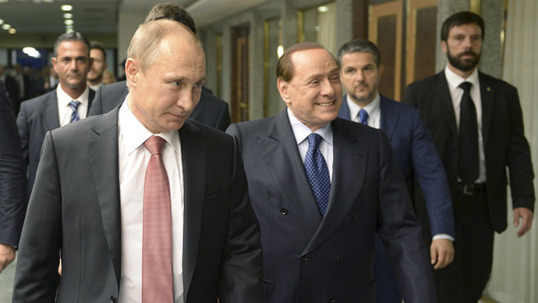
Silvio Berlusconi’s party, Forza Italia, will urge the government to lift anti-Russian sanctions, which are crippling bilateral ties and harming Italy’s national interests, the former Prime Minister said after his meeting with President Vladimir Putin.

“Tomorrow we will present a motion calling on [the] government not to continue the sanctions against Russia, sanctions which harm our interests, causing significant financial losses,” Silvio Berlusconi said after his meeting with Putin at Fiumicino airport in Rome.

Berlusconi also said his Forza Italia party was planning to urge the Italian government to “commit itself” in convincing other European countries to follow its lead in lifting sanctions and “convince our American friends that the return to the atmosphere of the Cold War is inadmissible.”

The issue of Western sanctions and bilateral trade ties took center stage of Putin’s short visit to Italy.

While meeting with the current Italian Prime Minister Matteo Renzi in Milan, Putin was quick to point out that Italian companies had lost more than $1 billion due to the restrictive measures, while the trading volume shrank by one quarter in the first three months of 2015. The Russian president said that the sanctions also affected Russian-Italian military cooperation.

In Rome, meeting with Italian President Sergio Mattarella, the leaders discussed the necessity of maintaining strategic bilateral relations in “all spheres” and not allowing them to “become hostage” of current difficulties, Kremlin spokesman Dmitry Peskov said. He added both Mattarella and Putin agreed “all countries in Europe are paying too high a price for the ongoing internal Ukrainian conflict.”

Mattarella’s stance seems to echo statements by the Italian Foreign Minister Paolo Gentiloni who recently said that “Italy can’t afford to close the doors to Russia” and “can’t cut ties” with Moscow.

Berlusconi got a chance to meet Putin right before his departure to Moscow, and reminisce about the good old days of positive NATO-Russia relations.

The 78-year-old Italian said he remembers the times when world peace was fragile between the two nuclear superpowers. Berlusconi and Putin recalled the 2002 dialogue and cooperation, which established the NATO-Russia Council (NRC), which the former Italian Prime Minister said had put an end to the nuclear “nightmare.”

Berlusconi stressed the need to normalize relations between the West and Russia, insisting that is vital for cooperation on a global scale.

The 78 year-old said he is happy that Putin found time to visit Italy and even meet him personally, announcing that he will soon return the favor and come to Moscow. Berlusconi and Putin share a long personal connection over the years, and according to the Russian President, the bond of friendship they share doesn’t depend on political necessities.

Clinton Foundation cashed in as Sweden lobbied Hillary

Bill Clinton’s foundation set up a fundraising arm in Sweden that collected $26 million in donations at the same time that country was lobbying Hillary Rodham Clinton’s State Department to forgo sanctions that threatened its thriving business with Iran, according to interviews and documents obtained by The Washington Times.

As US prosecutors go after 14 people — nine current and former FIFA officials, four sports marketing executives and an accused intermediary — in corruption allegations, seven were taken into custody in Zurich on Wednesday.

But strangely the Clintons and their dealings are not up for scrutiny it seems.

The Swedish entity, called the William J. Clinton Foundation Insamlingsstiftelse, was never disclosed to or cleared by State Department ethics officials, even though one of its largest sources of donations was a Swedish government-sanctioned lottery.

As the money flowed to the foundation from Sweden, Mrs. Clinton’s team in Washington declined to blacklist any Swedish firms despite warnings from career officials at the U.S. Embassy in Stockholm that Sweden was growing its economic ties with Iran and potentially undercutting Western efforts to end Tehran’s rogue nuclear program, diplomatic cables show.

At the time of Mr. Clinton’s foray into Swedish fundraising, the Swedish government was pressing Mrs. Clinton’s State Department not to impose new sanctions on firms doing business with Iran, including hometown companies Ericsson and Volvo.

Mrs. Clinton’s State Department issued two orders identifying lists of companies newly sanctioned in 2011 and 2012 for doing business with Iran, but neither listed any Swedish entities.

Behind the scenes, however, the U.S. Embassy in Stockholm was clearly warning the State Department in Washington that Sweden’s trade was growing with Iran — despite Swedish government claims to the contrary.

The Swedes were resistant to new sanctions, telling State Department officials repeatedly and unequivocally that they were worried new penalties would stifle the business between its country’s firms and Tehran. At the time, Iran was Sweden’s second-largest export market in the Middle East after Saudi Arabia.

“Behind the Swedish government’s reluctance to support further sanctions in Iran, especially unilateral European measures, is a dynamic (though still fairly small) trade involving some of Sweden’s largest and most politically well-connected companies: Volvo, Ericsson and ABB to name three,” the U.S. Embassy wrote in one cable to Washington.

U.S. intelligence officials told The Times that they kept the Obama administration apprised of Ericsson’s activities inside Iran, including the fact that the Swedish firm had provided Iran’s second-largest cellular provider with location-based technology to track customers for billing purposes. The technology transfer occurred in late 2009, shortly after Tehran brutally suppressed a pro-democracy movement in that country, the officials said.

U.S. intelligence further learned that Ericsson in 2010 discussed with Iran’s largest cellular firm providing tracking technology that could be used directly by Iranian security authorities.

Oz misled by fake evidence about MH-17?

Pointing the finger of blame at Russian President Putin for the Malaysia Airlines shoot-down last July, an Australian news show claims to have found the spot where the Russian BUK missile battery made its getaway, but the images don’t match, raising questions of journalistic fakery, writes Robert Parry.

An Australian television show claims to have solved the Malaysia Airlines Flight 17 shoot-down mystery – the Russians did it! – but the program appears to have faked a key piece of evidence and there remain many of the same doubts as before, along with the dog-not-barking question of why the U.S. government has withheld its intelligence data.

The basic point of the Australian “60 Minutes” program was that photographs on social media show what some believe to be a BUK anti-aircraft launcher aboard a truck traveling eastward on July 17, 2014, the day of the shoot-down, into what was generally considered rebel-controlled territory of eastern Ukraine, south and east of Donetsk, the capital of one of the ethnic Russian rebellious provinces.

Citing one image, the program’s narrator says the “launcher is heading east further into rebel territory,” south and east of Donetsk.

However, in mid-July, the ethnic Russian rebels were reeling under a Ukrainian military offensive to the north of Donetsk. Despite shifting their forces into the battle zone, they had lost Sloviansk, Druzhkivka, Kostyantynivka and Kramatorsk. In other words, the lines of control were fluid and chaotic in mid-July 2014 with the possibility that an unmarked Ukrainian government truck, maybe carrying a concealed anti-aircraft battery, could have moved into the titular rebel zone, especially in the lightly defended south.

Another problem with the Australian TV account is that the video and photographic images show the truck heading eastward toward Russia, but there are no earlier images of the truck moving westward from Russia into eastern Ukraine. If the mysterious truck was supposedly so obvious on the day of the shoot-down, why wasn’t it obvious earlier?

For the Australian TV account to be true – blaming the Russians – the launcher would have to have crossed from Russia into Ukraine, traveled somewhere west of Donetsk, before turning around and heading eastward back toward Russia, yet the trail seems to begin only with photos on July 17 showing the truck headed east.

Indeed, I was told shortly after the MH-17 crash, which killed 298 people including Australians, that one of the problems that U.S. intelligence analysts were having in pinning the blame on the Russians was that they could not find evidence that the Russians had delivered a BUK missile system to the rebels who – until then – were known only to have short-range Manpads incapable of reaching MH-17 flying at around 33,000 feet.

Another part of the Australian TV narrative stretched credulity. If the Russians had somehow snuck a BUK missile system into eastern Ukraine without U.S. intelligence knowing and were moving it back toward Russia, why would the crew stop en route to shoot down a civilian airliner before continuing on the way? There was no military value in destroying a civilian airliner and it was obvious – in the Western media hysteria then surrounding Ukraine – that Russia and its president, Vladimir Putin, would be blamed.

What I was told by a source briefed by U.S. intelligence analysts was that at least some of them – after reviewing electronic intercepts, overhead satellite images and other intelligence – had reached the conclusion that the shoot-down was a provocation, or a false-flag operation, carried out by a rogue element of the Ukrainian military operating under one of the hard-line oligarchs.

However, it was not clear to me whether that was the opinion of just a few U.S. analysts or whether that had become the consensus. When I sought an updated briefing from the Office of the Director of National Intelligence in March, I was told that the U.S. intelligence community had not updated or refined its analysis of the shoot-down since five days after the event, a claim that was not credible given the significance of the MH-17 case to tensions between nuclear powers, United States and Russia.

In reality, Western intelligence services have been hard at work trying to determine who was responsible for the shoot-down. Last October, Der Spiegel reported that the German intelligence service, the BND, had concluded that Russia was not the source of the missile battery – that it had been captured from a Ukrainian military base – but the BND still blamed the rebels for firing it. The BND also concluded that photos supplied by the Ukrainian government about the MH-17 tragedy “have been manipulated,” Der Spiegel reported.

And, the BND disputed Russian government claims that a Ukrainian fighter jet had been flying close to MH-17, the magazine said, reporting on the BND’s briefing to a parliamentary committee on Oct. 8, 2014. But none of the BND’s evidence was made public — and I was subsequently told by a European official that the evidence was not as conclusive as the magazine article depicted. [See Consortiumnews.com’s “Germans Clear Russia in MH-17 Case.”]

Possible TV Fakery

There also appears to have been some fakery involved in the Australian documentary. In several instances, as the film crew traveled to eastern Ukraine to seek out scenes from July 17 video showing the truck possibly carrying BUK missiles, images of those sites – then and now – were overlaid to show how closely the scenes matched.

However, for one crucial scene – the image of an alleged “getaway” BUK launcher lacking one missile and supposedly heading back to Russia after the shoot-down – the documentary broke with that pattern. The program showed the earlier video of the truck moving past a billboard and then claiming – based on information from blogger Eliot Higgins – that the TV crew had located the same billboard in Luhansk, a rebel-held city near the Russian border.

This was the documentary’s slam-dunk moment, the final proof that the Russians and particular Vladimir Putin were guilty in the deaths of 298 innocent people. However, in this case, there was no overlay of the two scenes, just Australian correspondent Michael Usher pointing to a billboard and saying it was the same one as in the video.

But the scenes look nothing at all alike if you put them side by side. While Usher is standing in an open field, the earlier video shows an overgrown area. Indeed, almost nothing looks the same, which might explain why the film crew didn’t try to do an overlay this time.

A screen shot of the roadway where the suspected BUK missile battery passes after the shoot-down of Malaysia Airlines Flight 17 on July 17, 2014. (Image from Australian “60 Minutes” program)

A screen shot of the roadway where the suspected BUK missile battery passes after the shoot-down of Malaysia Airlines Flight 17 on July 17, 2014. (Image from Australian “60 Minutes” program)

Correspondent Michael Unger of Australia’s “60 Minutes” claims to have found the billboard visible in a video of a BUK missile launcher after the shoot-down of Malaysia Airlines Flight 17 on July 17, 2014. (Screen shot from Australia’s “60 Minutes”)

Correspondent Michael Usher of Australia’s “60 Minutes” claims to have found the billboard visible in a video of a BUK missile launcher after the shoot-down of Malaysia Airlines Flight 17 on July 17, 2014. (Screen shot from Australia’s “60 Minutes”)

This discrepancy is important because the Russian government placed the scene of the “getaway” BUK launcher in the town of Krasnoarmiis’k, northwest of Donetsk and then under Ukrainian government control. Usher dismissed that Russian claim as a lie before asserting that his team had located the scene with the billboard in Luhansk.

The significance of the Australian news show’s sleight of hand is that if the BUK launcher was making its “getaway” through government-controlled territory, not through Luhansk on its way back to Russia, much of the Russia-did-it scenario collapses. It also means the Australian audience was grossly misled.

Source: Consortium News

Belgians ignore EU sanctions against Moscow

Belgian companies continue expanding their businesses in Russia despite the sanctions imposed by the West against Moscow over its alleged involvement in the Ukrainian conflict, Russian Foreign Ministry spokesman Alexander Lukashevich told RIA Novosti in an interview.

“Despite the unfavorable conjuncture, Belgian companies haven’t frozen their projects in Russia, and even continue to develop their businesses,” Lukashevich said.

Both, Russian and Belgian companies express unflagging interest in future cooperation, Lukashevich said.“Even given the counterproductive European Union policy of maintaining sanctions against Russia, the business circles of the two countries continue expressing unflagging mutual interest in increasing bilateral cooperation,” he stated.

The Foreign Ministry’s representative said that some 35 Belgian companies are currently implementing their projects in Russia.

Lukashevich cited an example when in March 2014, Belgian Fluxys and Russia’s Yamaltrade signed a 20-year agreement to organize the transit of up to 8.8 billion tons of Yamal liquefied natural gas per year through the Port of Zeebruge.

Since 2014, the United States, the European Union, and their allies have imposed several rounds of economic sanctions against Moscow, citing the Kremlin’s alleged involvement in Ukraine’s internal affairs. Russia has repeatedly denied the accusations, adding that the sanctions policy is ineffective and counterproductive.

Several European companies that have been successful in the Russian market have also expressed their disappointment with the anti-Russia sanctions, saying that the measures hinder their businesses.

Moscow and Athens forge new alliance

The Greek prime minister’s visit to Moscow aimed at improving relations with Russia angers many in Europe – this is what reports in Greek media, covering the visit, boil down to.

Greek Prime Minister Alexis Tsipras is on a two-day visit to Moscow, making headlines in Greek media.”Alexis Tsipras’ upcoming visit to Moscow and meeting with Putin has generated much talk, analysis and warnings,” iefimerida.gr wrote in a piece titled Tsipras-Putin: Smiles in Moscow, Annoyance in Brussels. “Both sides underline that Moscow and Athens will discuss many issues and there is no shortage of speculations on what Tsipras will ask and what Putin will offer.

“The visit could help return Greek produce to the Russian market, according to the media outlet. “Exports are worth 125 million Euros and are of primary importance to the agriculture in northern Greece,” iefimerida.gr said.

EU sanctions and the Russian food ban, investments, privatization, energy cooperation and the Turkish Stream gas pipeline, tourism, the Ukrainian crisis and Greece-Turkey relations are the main topics on the agenda.

“Putin is preparing a ‘gift’ for Tsipras,” newsit.gr said, adding that it is the first visit of a Greek prime minister to Moscow in five years. According to the media outlet, Tsipras’ visit “caused outrage in Brussels” that “thinks the Russian president is trying to undermine the European stance on sanctions against Moscow.”

The visit sent partners and creditors, especially in Berlin, into turmoil. Some “on the other side of the Atlantic Ocean also worry that Greece would throw itself into Russia’s arms to come up with ‘alternative plans’ to solve the Greek problem,” the Crete media outlet pointed out.

“Tsipras and Putin are forging a new alliance,” according to protothema.gr. “All eyes in Europe are on Tsipras and Putin. ‘The spring’ in Greek-Russian relations gets on Europe’s nerves. The visit has created an atmosphere of enthusiasm in Moscow. … It is seen as a breakthrough in the bilateral relations that would revive and strengthen cooperation in a number of areas,” the media outlet said.”

The visit also sends important political signals: both countries are discontent with the West. In this context Tsipras wants to develop a diverse foreign policy and alliances, while Putin wants to show that he has power and influence to attract the attention of European leaders and countries,” protothema.gr said.

Source: Sputniknews

Oil tumbles as Iran, China discuss supply

Brent crude oil fell below $58 a barrel on Tuesday on signs of growing oversupply as Iranian officials visited Beijing to seek more oil sales following the framework nuclear deal that could lead to the lifting of sanctions.

China is Iran’s largest trade partner and has bought roughly half of its crude exports since 2012, when sanctions against the Islamic Republic were tightened.

Oil markets were also pressured by a Goldman Sachs report saying prices needed to remain low for months to slow U.S. oil output growth.

Brent LCOc1 was down 70 cents at $57.42 a barrel by 1335 GMT. U.S. crude CLc1 was down 75 cents at $51.39 a barrel.

Representatives of state-run National Iranian Oil Company will meet China’s biggest crude buyers including Unipec, the trading arm of top Asian refiner Sinopec Corp (0386.HK), and state trader Zhuhai Zhenrong Corp, officials told Reuters.

Global oil markets already face a supply glut with producers pumping over 1.5 million barrels per day (bpd) more than demand in the first half of this year, analysts say.

“There is a massive oversupply. Stocks are rising and now we have the prospect of more Iranian oil coming onto the market,” said Carsten Fritsch, analyst at Commerzbank in Frankfurt.

Goldman said in a research note it expected U.S. crude inventories to top out in April and subsequently be drawn down at 350,000 bpd during the May-September period, when demand for fuel to power cars and air-conditioners is at its greatest.

Still, the bank said it saw little upside for its $40-a-barrel forecast over the next three months, anticipating inventories would rise again by October, pressuring prices into 2016.

“Prices need to remain low in coming months to achieve a sufficient and sustainable slowdown in U.S. production growth,” the bank said, adding that the U.S. outlook for 2016 made its forecast for $65-a-barrel oil next year look too high.

Source: Reuters

‘Israel should nuke Germany and Iran’

An Israeli newspaper, Israel National News, published an opinion piece on Tuesday in which it called for Israel to attack Germany and Iran with nuclear bombs. The article claims that only through the nuclear annihilation of Germany and Iran, with 20 or 30 nuclear bombs, can Israelis prevent destruction of the state.

„If Israel does not follow the way of the Torah, it will be almost completely destroyed by a severe punishment and only a few will survive“ writes Chen Ben-Eliyahu, the author of the piece, in Hebrew.

Israel must respond in kind in order to prevent this. “We must answer an existential threat with an existential threat”; he writes, “not with speeches to the US-Congress. We must make it clear to the Iranians that Israel will wipe out their nuclear program and Teheran and Isfahan as well.

“If an enemy sets out to destroy you, then you must destroy him first. Twenty or thirty nuclear bombs will get the job done”, he explains.

He reminds the Israelis of their near destruction at the hands of the Nazis and calls for revenge on Germany, although the German government is now, next to the US, Israel’s biggest supporter.

Ben-Eliyahu demands a turnaround of the „Final Solution“ and writes „twenty to thirty nuclear bombs on Berlin, Munich, Nuremberg, Cologne, Frankfurt, Stuttgart, Dresden, Dortmund and so on will ensure obliteration.” And in allusion to the “Thousand Year Reich” he continues, “afterwards the country will be quiet for a thousand years“.

The editors of the newspaper „Israel National News“ refused to react to queries about why this opinion had been published in the first place. For it is a racist’s expression of pure hate and it incites genocide.

His reasons are anyway based on the lie that Iran has a nuclear weapons program. Such a person should be accused, convicted and imprisoned for sedition and sanctioning nuclear war.

What Chen Ben-Eliyahu admits with his demand for an attack on Iran and Germany with „twenty or thirty nuclear bombs“ is that Israel possesses a nuclear arsenal, a fact which Israeli government has hitherto vehemently denied.

Translated from German

Source: Alles Schall und Rauch

‘Don’t kick Russia out of SWIFT’

European Central Bank policymaker Ewald Nowotny has warned against kicking Russian banks out of the SWIFT payments transfer system as part of tighter sanctions on Moscow, the Austria Press Agency quoted him as saying on Thursday.

Such a move “we would see as very problematic because it could perhaps undermine confidence in this system,” the governor of Austria’s central bank told reporters in Brussels after meeting European Commissioner Pierre Moscovici.

Russia has drafted a law to regulate a local equivalent to SWIFT in response to concerns that the Belgian-based system, the world’s biggest for electronic payments, could be a focus of Western sanctions against Moscow over the Ukraine crisis.

In 2012, SWIFT cut off Iranian banks that were the subject of EU sanctions over Iran’s nuclear program — a step that shut down a major avenue through which Iran did business with the rest of the world.

APA quoted Nowotny as saying Austria would not be immediately affected should Russian banks be excluded from SWIFT, but that Russia could retaliate, “and this could of course affect all companies that do business in Russia.”

He reiterated that Austrian banks had no plans to leave Russia because they had proven themselves to be an element of stability in the latest economic crisis. Raiffeisen Bank International and Bank Austria are active there.

Source: Reuters

China ready to help Russia says foreign minister

Chinese Foreign Minister Wang Yi said Monday that China is ready to help Russia overcome its economic difficulties.

Beijing is willing to help Moscow and believes that Russia “has the ability and the wisdom to overcome the current economic difficulties,” the minister was quoted as saying by the South China Morning Post.

Wang did not outline any specific measures, according to the newspaper.

Last week, China’s Minister of Commerce Gao Hucheng stated that China could increase the use of yuan in trade with Russia amid falling ruble rates.

Russia has seen a rapid depreciation of its national currency in recent months due to falling oil prices and sanctions imposed by the West over Moscow’s alleged involvement in the Ukrainian crisis.

No more US sanctions for Cuba

White House says measures will “end our outdated approach,” promote change in Cuba consistent “with US national security interests”

Oddly, during a week when President Obama prepares to launch new sanctions against Venezuela and Russia, The White House admits that sanctions do not work.

“It is clear that decades of US isolation of Cuba have failed to accomplish our enduring objective of promoting the emergence of a democratic, prosperous, and stable Cuba,” the Obama administration declared.

Diplomatic relations between the United States and Cuba were severed in January 1961 after the rise of Fidel Castro and his Communist government.

Obama has now instructed Secretary of State John Kerry to immediately initiate discussions with Cuba about reestablishing diplomatic relations and to begin the process of removing Cuba from the list of states that sponsor terrorism, which it has been on since 1982, the White House said.

 In coming months, the US “will re-establish an embassy in Havana and carry out high-level exchanges and visits between our two governments as part of the normalization process”.
The US will thus lift sanctions on Cuban nationals outside Cuba.

The initial step will involve US-Cuba Migration Talks in January after which institutions will be allowed to open accounts at Cuban financial institutions for authorized transactions and US credit, debit cards permitted for use by travelers to Cuba.

But in 2010, the same Obama administration warned the world against Cuba:

Recent events in Cuba, including the tragic death of Orlando Zapata Tamayo, the repression visited upon Las Damas de Blanco, and the intensified harassment of those who dare to give voice to the desires of their fellow Cubans, are deeply disturbing.

These events underscore that instead of embracing an opportunity to enter a new era, Cuban authorities continue to respond to the aspirations of the Cuban people with a clenched fist.

Today, I join my voice with brave individuals across Cuba and a growing chorus around the world in calling for an end to the repression, for the immediate, unconditional release of all political prisoners in Cuba, and for respect for the basic rights of the Cuban people.

During the course of the past year, I have taken steps to reach out to the Cuban people and to signal my desire to seek a new era in relations between the governments of the United States and Cuba. I remain committed to supporting the simple desire of the Cuban people to freely determine their future and to enjoy the rights and freedoms that define the Americas, and that should be universal to all human beings.

White House mulling sanctions against Israel

The Obama administration is refusing to discuss reports that emerged early Thursday claiming that the White House is considering imposing sanctions on Israel for continuing construction on Jewish homes in Jerusalem.

State Department spokeswoman Marie Harf dodged several questions on Thursday when confronted with reports that the administration had held secret internal meetings to discuss taking action against Israel for its ongoing building in East Jerusalem.

The classified meetings were reportedly held several weeks ago and included officials from both the State Department and White House, according to the Israeli daily Ha’aretz, which first reported on the meetings.

The possibility of sanctioning Israel for its ongoing construction sends a signal that the Obama administration is willing to go further in its denunciations of Israel then any previous White House.

When asked to address the reports Thursday afternoon, Harf declined to take a stance.

“I’m obviously not going to comment one way or another on reported internal deliberations,” she said. “We’ve made clear our position on settlement activity publicly and that hasn’t changed.”

When pressed to address whether the White House has reached a point at which it believes its harsh rhetoric against Israel is not enough, Harf again demurred, stating that she would not “address hypotheticals.”

A White House National Security Council (NSC) official also would not comment on the report when contacted Thursday by the Washington Free Beacon.

News of the supposed meeting leaked to the press though Israeli officials who were apparently apprised of the discussion.

Senior Israeli officials told Haaretz “that White House officials held a classified discussion a few weeks ago about the possibility of taking active measures against the settlements,” according to the report.

The discussion about levying sanctions on Israel reportedly began after Israeli Prime Minister Benjamin Netanyahu’s October meeting at the White House and the subsequent battle between Washington and Jerusalem over settlement construction.


‘Sanctions are aimed at regime change in Russia’

The ultimate goal of the anti-Russian sanctions imposed by some Western nations is to stir public protests and oust the government, Russian Foreign Minister Sergey Lavrov said.

“Western leaders publicly state that the sanctions must hurt [Russia’s] economy and stir up public protests. The West doesn’t want to change Russia’s policies. They want a regime change. Practically nobody denies that,” he told a leading think-tank in Moscow.

Lavrov said that the tensions between Russia and the West had been brewing for years before the Ukrainian crisis, adding that now the Europeans had decided to go for all-or-nothing and play chicken with Russia. But at least the positions have been made clear, Lavrov said.

Russia and the EU are having a moment of truth focused on Ukraine, Lavrov said, but stressed that Moscow would not be the one to break off ties with Europe. However, Russia won’t simply go back to how things were before the crisis hit, he said.

“The EU is our largest partner,” Lavrov said. “Nobody is going to shoot himself in the foot and reject cooperation with Europe, but everyone understands that it won’t be business as usual anymore.

“But we don’t need the kind of business we had. [That] was like ‘Russia must do this and must do that,’ and we want to cooperate as equals,” he added.

He laid the blame for the escalation on an “aggressive minority” among EU nations, who pursue ideologically-driven grabs of power in eastern Europe, including Ukraine, instead of focusing on the serious problems that Europe is facing due to the turmoil across the Mediterranean in North Africa and the Middle East.

“Exporting any kind of ideology, whether it is democratic or communist or any other kind, won’t do any good,” he warned.

Ideology blinds Europeans to some problems, which Russia believes need to be solved, Lavrov said. For example, EU officials are reluctant to speak about the persecution of Christians by Muslim militants in Iraq and Syria or elsewhere, because they fear that this would be perceived as politically incorrect. Meanwhile there is a growing Christianophobia in the world, he said.

“Most of EU members avoid discussing this issue. They are ashamed to pronounce it as they were ashamed to put a phrase acknowledging the Christian roots of Europe into the EU Constitution,” Lavrov said. “If you don’t remember and don’t respect your own roots and traditions, how can you respect the traditions of other people?”

‘Russia not anti-American’
Lavrov blamed the US for claiming global leadership at a time when both its resources and leadership skills are in decline. Particularly, he said, Washington is increasingly tuning its policies with electoral cycles, as long-term goals are sacrificed for short-term gains of popularity among voters.

“We cannot accept the position of those who tell us: ‘Put up with it. Everyone has to suffer from America having elections every two years, and nothing should be done about it. Relax and take it as a given’. This won’t do. We won’t take it because the stakes are too high,” Lavrov said.
He added that while some take Russia’s opposition to America’s global influence as anti-Americanism, this is not the case.

“It’s not about anti-Americanism or forming some sort of anti-American coalition. It’s about the natural desire of an increasing number of nations to ensure their vital interests and doing it in a way they see right, not the way they are being told by a foreign party,” he said.

If the US pursues leadership not out of a false perception that it has a God-given burden to take responsibility for everybody, but by developing the skill to form a consensus, Moscow would be the first to back Washington, Lavrov said.

But now Washington is bullying other nations into toeing their line, and few dare to object publicly out of fear of reprisal, while complaining in private, he added.

Russia to root out corruption

Vladimir Putin sat motionless as the minister, seizing on the Russian leader’s first major meeting with his economic team in months, itemized the challenges.

A recession is imminent, inflation is getting out of hand and the ruble and oil are in freefall, Economy Minister Alexei Ulyukayev told Putin, according to people who attended the meeting at the presidential mansion near Moscow in mid-October. Clearly, Ulyukayev concluded, sanctions need to be lifted.

At that, Putin recoiled. Do you, Alexei Valentinovich, he asked, using a patronymic, know how to do that? No,Vladimir Vladimirovich, Ulyukayev was said to reply, we were hoping you did. Putin said he didn’t know either and demanded options for surviving a decade of even more onerous sanctions, leaving the group deflated, the people said.

Days later, they presented Putin with two variants. To their surprise, he chose an initiative dubbed “economic liberalization,” aimed at easing the financial burden of corruption on all enterprises in the country, the people said. It was something they had championed for several years without gaining traction.

The policy, which Putin plans to announce during his annual address to parliament next month, calls for a crackdown on inspections and other forms of bureaucratic bullying that cost businesses tens of billions of dollars a year in bribes and kickbacks, the people said. It entails an order from the president to end predatory behavior, with prosecution being the incentive for compliance, they said.

Thieves Beware

“Wastefulness, an inability to manage state funds and even outright bribery, theft, won’t go unnoticed,” Putin said at a meeting with supporters in Moscow yesterday.

Russia’s growing isolation over its support for the separatist rebellion in Ukraine has created a divide among competing factions within Putin’s inner circle. One group, the “siloviki,” is dominated by men who share Putin’s background in the security services and reject U.S. hegemony. They’ve held the upper hand over another bloc, centered around Prime Minister Dmitry Medvedev, that favors less state control over the economy, according to five officials close to the president.

Putin’s spokesman, Dmitry Peskov, said he wasn’t aware of any specific “liberalization plan” and declined to comment on what the president plans to say in his address to parliament.

“We are constantly and purposefully cutting the bureaucratic burden on businesses,” Peskov said by phone. Ulyukayev declined to comment through his press service.

Putin’s Choice

Putin’s backing of the program marks a revival of sorts for the Medvedev faction, which advocates closer integration with the U.S. and Europe, a process now derailed by sanctions, as the path most beneficial to the country. This group, which includes Ulyukayev, had been sidelined since February, when the overthrow of Ukrainian President Viktor Yanukovych, Russia’s ally, spurred the siloviki to organize the annexation of Crimea.

Putin chose the corruption crackdown policy over the other option presented by his economic team: the “mega-projects” program. That path would further enrich two of his closest allies, billionaires Gennady Timchenko and Arkady Rotenberg, by transfering huge sums of money to contractors.

With sanctions hurting more than anticipated, declaring a war on corruption is an “obvious” course of action, but it’s bound to fail, said Boris Makarenko, deputy director of the Center for Political Technologies in Moscow.

‘New Reality’

“Such measures are alien to the mentality of the government bureaucracy, whose natural instinct is to go for more of the same, more regulation, more squeezing revenues from businesses,” Makarenko said.

It was only in September and October that officials and executives fully realized that sanctions will be in place for a long time and that urgent measures are needed to limit the damage, according toSergey Dubinin, the former central bank governor who is now chairman of state-run VTB Group, Russia’s second-largest bank.

“They were hoping the sanctions were temporary,” Dubinin said in an interview in the Russian capital. “Now they’ve woken up to the new reality.”

The call to action was triggered by the “shocking devaluation” of the ruble, which unfolded as the closure of foreign financial markets coincided with falling prices for oil, the country’s largest export, Dubinin said. That has sparked a cash crunch for companies that have $44 billion of debt due by year’s end, according to central bank estimates.

Oil Burden

Putin said last week Russia is prepared to withstand a “catastrophic” slump in oil prices. Brent, a benchmark for more than half of the world’s crude, has plunged 30 percent since the end of June. The ruble has declined the same amount against the dollar this year, the most of 24 emerging-market currencies tracked by Bloomberg.

Before the first round of sanctions were imposed in March, the government did a good job of creating a “favorable external environment” for Russian companies, even though corruption and other internal pressures remained burdensome, said Sergei Vasilyev, deputy head of state development bank VEB.

“Now the external environment has become very difficult, so we need to liberalize the internal environment to create better conditions for economic agents,” Vasilyev said. “Liberalization can help offset adverse external conditions without increasing the tax burden.”

Official Swindlers

Former Finance Minister Alexei Kudrin, who sits on the president’s Economic Council, said a successful campaign against extortion would be akin to cutting taxes without further weakening public finances. Corruption is one of the greatest obstacles to growth and if Putin pushes the policy with the same vigor he pursues security issues, the impact on the economy may be profound, Kudrin said in an interview.

“The key driver for the development of the country is citizens’ confidence in the economy,” Kudrin said. “The first thing to do is to limit the number of control and supervisory functions of the state. Authorities simply have to stop going to enterprises to swindle money. We have to limit fire, sanitary and technical inspections.”

In 2008, when Putin swapped jobs with Medvedev for four years, businesses were paying more than $200 billion a year in bribes, Moscow-based research group Indem said in a report that year, using data from prosecutors. Most Russians say corruption has only gotten worse since, according to a survey published by Transparency International.

‘Economic Freedom’

Business Solidarity, a Moscow-based organization that campaigns against corruption, estimates that bribes, kickbacks and related illegal activities end up increasing the retail price of most goods by 30 percent.

A crackdown on inspections, if done right, could have an “immediate impact” on the economy, saidMDM Bank Chairman Oleg Vyugin, who served as first deputy head of the central bank from 2002 to 2004. As it is now, law-enforcement agencies have a simple business model: the more they inspect, the more they earn, Vyugin said in an interview.

“The economic powers of the Investigative Committee, the Prosecutor General’s Office and the police must be curbed,” Vyugin said. “This is the only way to convince people that it’s possible to develop a business here.”

There’s an irony about the U.S. and European sanctions that isn’t lost on the members of Putin’s economic team. While the penalties have pushed foreign investors away, they’ve also become the catalyst for meeting one of their key demands — rooting out corruption.

One of the major debates about the new program now is what to call it because Putin thinks “Economic Liberalization” sounds too western, according to one of the people who attended last month’s policy meeting. The frontrunner is “Economic Freedom” and everyone is praying he doesn’t change his mind, the person said.

Source: Bloomberg