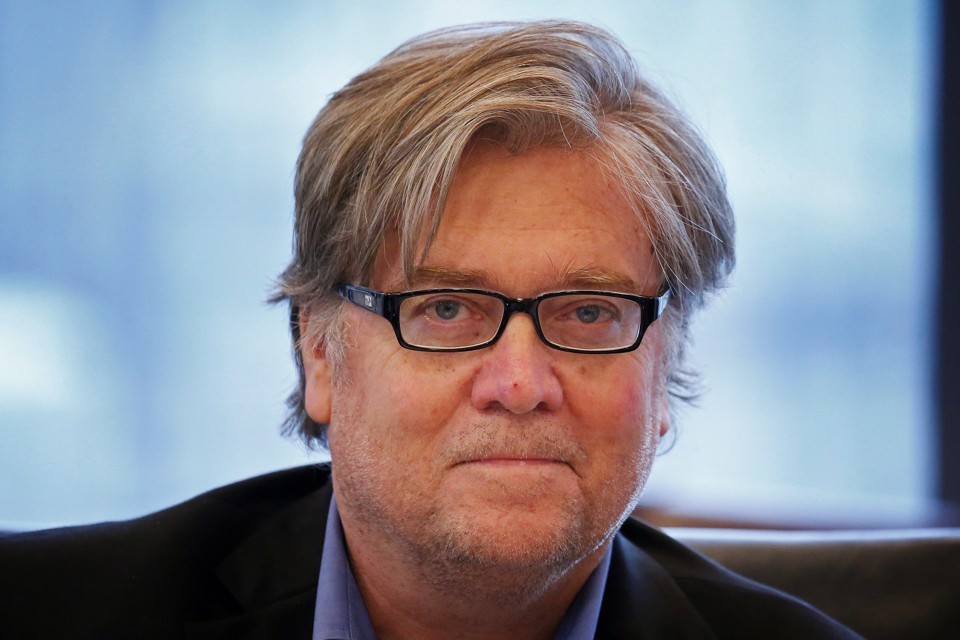
Steve Bannon to leave White House

Stephen Bannon is leaving his role as Donald Trump’s chief strategist, the White House announced Friday, ending a his tenure at the exact same momente that the administration is being attacked in the media over the president’s remarks on violence in Virginia.

His exit caps a tumultuous four weeks in which a slew of senior officials have announced their departures, including the former White House chief of staff Reince Priebus, former press secretary Sean Spicer and former communications director Anthony Scaramucci, who was hired and fired within the space of 11 days.

Bannon’s departure was agreed on mutually with new White House Chief of Staff John Kelly and his last day on the job will be Friday, White House press secretary Sarah Sanders said.

The benchmark S&P 500 Index rallied as much as 0.4 percent, rebounding from its second-biggest drop of 2017, touching its daily high point after the New York Times confirmed Bannon’s departure. It remained up 0.1 percent in afternoon trading in New York. Investors interpreted his departure as removing a powerful advocate for a protectionist agenda and direct confrontation with China over trade.

Bannon, 63, the chief executive of Trump’s presidential campaign and an architect of his election victory, was the leading champion of conservative populism within the administration. The former chairman of Breitbart News, Bannon served as a link to the so-called “alt-right” movement attuned to the attitudes of the most conservative elements of the president’s base.

“Steve played an integral part in the president’s journey to the White House,” said former Trump adviser Sam Nunberg. “Steve went into the White House and didn’t betray his values, worked every day to advance the agenda that the president was elected on. Trump’s voters may get upset that America’s not being made great again. We’ll find out.”

Gorka Endangered

Sebastian Gorka, a Bannon ally who previously worked with him at Breitbart News, also may face removal from his post as a counter-terrorism aide to the president, said two people with knowledge of the situation.

The possible dismissal of Gorka suggests that Kelly is looking to root out Bannon allies and other officials prone to igniting public firestorms. Last week, Gorka told the BBC it was “simply nonsensical” for Secretary of State Rex Tillerson to discuss military matters related to recent provocations by North Korea. He subsequently accused the media of distorting his remarks.

Bannon had advocated that the president delve into racial issues and applauded Trump’s widely criticized handling of the Charlottesville situation. The president appeared to press forward with that strategy with a series of tweets Thursday morning decrying the removal of Confederate statues.

House Democratic Leader Nancy Pelosi of California called Bannon’s ouster “welcome news, but it doesn’t disguise where President Trump himself stands on white supremacists and the bigoted beliefs they advance.”

“Personnel changes are worthless so long as President Trump continues to advance policies that disgrace our cherished American values,” she added.

A person close to Bannon portrayed his departure as unrelated to the backlash against Trump’s comments this week that appeared to confer legitimacy on white supremacists following the violence in Virginia. The person said Bannon had turned in his resignation on Aug. 7 to take effect on Aug. 14. The announcement was delayed following last weekend’s melees in Charlottesville to put distance between those events and his exit, the person said.

Bannon, whose relationship with Trump was forged through campaign battles, has been one of the president’s closest advisers, skilled at infighting and cultivating the media. His departure strengthens Kelly, who has sought to better organize a West Wing known for chaos and disorder.

Bolsters Cohn

The move also will bolster Bannon’s rivals within the administration, including National Security Adviser H.R. McMaster and top economic aide Gary Cohn, with whom Bannon frequently clashed over policy. During an interview Sunday with NBC News, McMaster pointedly and repeatedly refused to say whether he could effectively work with Bannon going forward.

The American Prospect, a progressive magazine, on Wednesday published an interview with Bannon in which the president’s chief strategist discussed his efforts to undermine fellow Trump aides and seemed to undercut the president on key foreign policy issues.

Bannon told the magazine political opponents at the State Department and Pentagon were “wetting themselves” over his plans to root out employees he disagreed with over policy. And despite the president’s threats of a swift military response to provocations from North Korea, Bannon conceded “there’s no military solution here” that wouldn’t result in millions of deaths.

Even before the interview, the president signaled Bannon’s fate could be in jeopardy. Asked about Bannon’s job security during a freewheeling press conference Tuesday at Trump Tower in New York, the president was noncommittal. He said Bannon was “not a racist” and was treated unfairly by the press, but contended he “came on very late” to his presidential campaign.

There were also signals in recent days that friends of the president were souring on Bannon.

Chris Ruddy, the CEO of Newsmax Media and a frequent confidant of the president, said earlier this week that Trump was “not getting good advice from the people that are around him” in the aftermath of the president’s comments on the violence in Charlottesville.

“Whoever is advising him that now is the time to argue in favor of confederate monuments, is not giving him good advice,” Ruddy said in an interview before Bannon’s ouster.

Trump had been considering removing Bannon even in the months before the Charlottesville controversy, frustrated with perceptions that his adviser was the one pulling the strings at the White House. He was angered by a Saturday Night Live sketch that depicted Bannon as the grim reaper, sitting at the Resolute Desk in the Oval Office while Trump was given a child’s table. A Time magazine cover labeling Bannon “The Great Manipulator” also hurt his standing, as did his portrayal as a key to the president’s electoral success in a recent book by Bloomberg Businessweek reporter Joshua Green.

The president was also frustrated by perceptions that his senior aide was behind leaks to the media. Scaramucci, who was fired last month after less than two weeks on the job, said repeatedly he believed Bannon was a leaker.

New Risks

But moving Bannon outside the White House raises new risks. Even if he continues to support the president, he may become aggressive in attacking the administration’s more traditional Republican players and policies. He has ample access to funding through his close relationships with conservative billionaire Bob Mercer and other major Republican donors.

Some in the White House disagreed with the decision to oust Bannon, and argued that the move weakened the president’s ability to translate his ideas into policy.

Bannon was the administration’s most effective advocate for delivering on the Trump campaign agenda, said one official who requested anonymity to discuss internal dynamics. His removal also will isolate Stephen Miller, the president’s senior adviser who’s best known for his efforts to curtail immigration, the person argued, and leave Trump more vulnerable than ever to the so-called “globalists” on his team.

The official also discounted the notion that Bannon’s removal was a victory for liberals who had long advocated for his dismissal, arguing that his power will only increase once he leaves.

Bannon may once again devote his attention to media interests, Ruddy said in an interview on Friday after the departure was announced.

“Steve is a media guy,” Ruddy said. “He thrives in it and has done very well in it. I assume he’ll be back in some role at Breitbart and using that as a platform for radio or television.”

Kurt Bardella, a Republican communications specialist who worked for Bannon at Breitbart but later denounced him, echoed the view, predicting the strategist would “feel liberated” by his departure.

“Now, he will be able to operate openly and freely to inflict as much damage as he possibly can on the ‘globalists’ that remain in the Trump Administration,” Bardella said. – Bloomberg.com

US drone kills US, Italian hostages ‘by mistake’

The White House says two hostages, an American and an Italian, died in Pakistan earlier this year as the result of a United States-launched drone strike that also killed two US citizens involved with Al-Qaeda.

“It is with tremendous sorrow that we recently concluded that a US government counterterrorism operation in January killed two innocent hostages held by Al-Qaeda since 2011,” reads a statement released by the White House press office on Thursday morning.

Officials say an attack in January against a suspected Al-Qaeda compound caused the death of American development expert Dr. Warren Weinstein and Giovanni Lo Porto, an Italian aid worker.

Two Americans considered by the US government to be prominent members of Al-Qaeda were also killed during counter-terrorism operations in the same region, the administration said. Ahmed Farouq, an American considered by the US government to be an Al-Qaeda leader, was killed in the same strike that caused the deaths of Weinstein and Lo Porto, the White House said. The administration has also concluded that Adam Gahan, “a prominent member of Al-Qaeda,” was killed during a separate strike that month.

US President Barack Obama is expected to speak on the matter during an address Thursday morning.

According to the Wall Street Journal, the White House has already launched an investigation into the incident. The results may prompt the administration to revamp its drone program.

The death of Weinstein, the paper acknowledged, is the first known instance in which a US drone strike has accidentally caused the death of an American hostage. Previously, the White House has admitted that drone strikes ordered by the US in 2011 had killed two suspected members of Al-Qaeda with American citizenship and one of their teenage sons, also a US citizen. – RT.COM

White House mulling sanctions against Israel

The Obama administration is refusing to discuss reports that emerged early Thursday claiming that the White House is considering imposing sanctions on Israel for continuing construction on Jewish homes in Jerusalem.

State Department spokeswoman Marie Harf dodged several questions on Thursday when confronted with reports that the administration had held secret internal meetings to discuss taking action against Israel for its ongoing building in East Jerusalem.

The classified meetings were reportedly held several weeks ago and included officials from both the State Department and White House, according to the Israeli daily Ha’aretz, which first reported on the meetings.

The possibility of sanctioning Israel for its ongoing construction sends a signal that the Obama administration is willing to go further in its denunciations of Israel then any previous White House.

When asked to address the reports Thursday afternoon, Harf declined to take a stance.

“I’m obviously not going to comment one way or another on reported internal deliberations,” she said. “We’ve made clear our position on settlement activity publicly and that hasn’t changed.”

When pressed to address whether the White House has reached a point at which it believes its harsh rhetoric against Israel is not enough, Harf again demurred, stating that she would not “address hypotheticals.”

A White House National Security Council (NSC) official also would not comment on the report when contacted Thursday by the Washington Free Beacon.

News of the supposed meeting leaked to the press though Israeli officials who were apparently apprised of the discussion.

Senior Israeli officials told Haaretz “that White House officials held a classified discussion a few weeks ago about the possibility of taking active measures against the settlements,” according to the report.

The discussion about levying sanctions on Israel reportedly began after Israeli Prime Minister Benjamin Netanyahu’s October meeting at the White House and the subsequent battle between Washington and Jerusalem over settlement construction.


Presidential Crimes: Then And Now

Writing for Americans is not always an enjoyable experience. Many readers want to have their prejudices confirmed, not challenged. Emotions rule their reason, and they are capable of a determined resistance to facts and are not inhibited from displays of rudeness and ignorance. Indeed, some are so proud of their shortcomings that they can’t wait to show them to others. Some simply cannot read and confuse explanations with justifications as if the act of explaining something justifies the person or event explained. Thankfully, all readers are not handicapped in these ways or there would be no point in trying to inform the American people.

In a recent column I used some examples of Clinton-era scandals to make a point about the media, pointing out that the media and the American people were more interested in Clinton’s sexual escapades and in his choice of underwear than in the many anomalies associated with such serious events as the Oklahoma City bombing, Waco, and the mysterious death of a White House legal counsel.

Reaganphobes responded in an infantile way, remonstrating that the same standards should be applied to “your dear beloved Ray-Gun” as to Clinton. Those readers were unable to understand that the article was not about Clinton, but about how the media sensationalizes unimportant events in order to distract attention from serious ones. Examples from the Clinton era were used, because no question better epitomizes the level of the American public’s interest in political life than the young woman’s question to President Clinton–”boxers or briefs?”

It is doubtful that journalists and historians are capable of providing accurate understandings of any presidential term. Even those personally involved often do not know why some things happened. I have been in White House meetings from which every participant departed with a different understanding of what the president’s policy was. This was not the result of lack of clarity on the president’s part, but from the various interests present shaping the policy to their agendas.

Many Americans regard the White House as the lair of a powerful being who can snap his fingers and make things happen. The fact of the matter is that presidents have little idea of what is transpiring in the vast cabinet departments and federal agencies that constitute “their” administration. Many parts of government are empires unto themselves. The “Deep State,” about which Mike Lofgren, formerly a senior member of the Congressional staff has written, is unaccountable to anyone. But even the accountable part of the government isn’t. For example, the information flows from the cabinet departments, such as defense, state, and treasury, are reported to Assistant Secretaries, who control the flow of information to the Secretaries, who inform the President. The civil service professionals can massage the information one way, the Assistant Secretaries another, and the Secretaries yet another. If the Secretaries report the information to the White House Chief of Staff, the information can be massaged yet again. In my day before George W. Bush and Dick Cheney gave us the Gestapo-sounding Department of Homeland Security, the Secret Service reported to an Assistant Secretary of the Treasury, but the official had no way of evaluating the reliability of the information. The Secret Service reported whatever it suited the Secret Service to report.

Those who think that “the President knows” can test their conviction by trying to keep up with the daily announcements from all departments and agencies of the government. It is a known fact that CEOs of large corporations, the relative size of which are tiny compared to the US government, cannot know all that is happening within their organizations.

Nixon: Villain or Centrist Reformer?

I am not particularly knowledgeable about the terms of our various presidents. Nevertheless, I suspect that the Nixon and Reagan terms are among the least understood. Both presidents had more ideological opponents among journalists and historians than they had defenders. Consequently, their stories are more distorted by how their ideological opponents want them to be seen and remembered. For example, compare your view of Richard Nixon with the portrait Patrick Buchanan provides in his latest book, The Greatest Comeback. A person doesn’t have to agree with Buchanan’s view of the issues of those years, or with how Buchanan positioned, or tried to position, Nixon on various issues, to learn a great deal about Nixon. Buchanan can be wrong on issues, but he is not dishonest.

For a politician, Richard Nixon was a very knowledgable person. He travelled widely, visiting foreign leaders. Nixon was the most knowledgable president about foreign policy we have ever had. He knew more than Obama, Bush I and II, Clinton, Reagan, Ford, and Johnson combined.

The liberal-left created an image of Nixon as paranoid and secretive with a long enemies list, but Buchanan shows that Nixon was inclusive, a “big tent” politician with a wide range of advisors. There is no doubt that Nixon had enemies. Many of them continue to operate against him long after his death.

Indeed, it was Nixon’s inclusiveness that made conservatives suspicious of him. To keep conservatives in his camp, Nixon used their rhetoric, and it was Nixon’s rhetoric rather than his policies that generated Nixon-hatred among the liberal-left. The inclination to focus on words rather than deeds is another indication of the insubstantiality of American political comprehension.

Probably, the US has never had a more liberal president than Nixon. Nixon went against conservatives and established the Environmental Protection Agency (EPA) by executive order. He supported the Clean Air Act of 1970. Nixon federalized Medicaid for poor families with dependent children and proposed a mandate that private employers provide health insurance to employees. He desegregated public schools and implemented the first federal affirmative action program.

Declaring that “there is no place on this planet for a billion of its potentially most able people to live in angry isolation,” Nixon engineered the opening to Communist China. He ended the Vietnam War and replaced the draft with the volunteer army. He established economic trade with the Soviet Union and negotiated with Soviet leader Brezhnev landmark arms control treaties–SALT I and the Anti-Ballistic Missile Treaty in 1972, which lasted for 30 years until the neoconized George W. Bush regime violated and terminated the treaty in 2002.

These are astonishing achievements for any president, especially a Republican one. But if you ask Americans what they know about Nixon, the response is Watergate and President Nixon’s forced resignation.

I am convinced that Nixon’s opening to China and Nixon’s arms control treaties and de-escalation of tensions with the Soviet Union threatened the power and profit of the military/security complex. Watergate was an orchestration used to remove the threat. If you read the Watergate reporting by Woodward and Bernstein in the Washington Post, there is no real information in it. In place of information, words are used to create an ominous presence and sinister atmosphere that is transferred to Nixon.

Nixon himself had done nothing that justified impeachment, but his liberal policies had alienated conservative Republicans. Conservatives never forgave Nixon for agreeing with Zhou Enlai that Taiwan was part of China. When the Washington Post, John Dean, and a missing segment of a tape got Nixon in trouble, conservatives did not come to his defense. The liberal-left was overjoyed that Nixon got his comeuppance for supporting the exposure and prosecution of Alger Hiss two decades previously.

The Reagan era is also misunderstood. Just as President Jimmy Carter was regarded as an outsider by the Democratic Washington Establishment, Ronald Reagan was an outsider to the Republican Establishment whose candidate was George H. W. Bush. Just as Carter’s presidency was neutered by the Washington Establishment with the frame-up of Carter’s Budget Director and Chief of Staff, Reagan was partially neutered before he assumed office, and the Establishment removed in succession two national security advisors who were loyal to him.

Reagan’s Priorities and the Establishment’s Agenda

When Reagan won the Republican presidential nomination, he was told that although he had defeated the Establishment in the primaries, the voters would not be able to come to his defense in Washington. He must not make Goldwater’s mistake and shun the Republican Establishment, but pick its presidential candidate for his vice president. Otherwise, the Republican Establishment would work to defeat him in the presidential election just as Rockefeller had undermined Goldwater.

As a former movie star, Nancy Reagan put great store on personal appearance. Reagan’s California crew was a motley one. Lynn Nofziger, for example, sported a beard and a loosely knotted tie if a tie at all. He moved around his office in sock feet without shoes. When Nancy saw Bush’s man, Jim Baker, she concluded that the properly attired Baker was the person that she wanted standing next to her husband when photos were made. Consequently, Reagan’s first term had Bush’s most capable operative as Chief of Staff of the White House.

To get Reagan’s program implemented with the Republican Establishment occupying the chief of staff position was a hard fight. I don’t mean that Jim Baker was malevolent and wished to damage Reagan. For a member of the Republican Establishment, Jim Baker was very intelligent, and he is a hard person to dislike.

The problem with Baker was two-fold. He was not part of the Reagan team and did not understand what we were about or why Reagan was elected. Americans wanted the stagflation that had destroyed Jimmy Carter’s presidency ended, and they were tired of the ongoing Cold War with the Soviet Union and its ever present threat of nuclear armageddon.

It is not that Baker (or VP Bush) were personally opposed to these goals. The problem was, and still is, that the Establishment, whether Republican or Democratic, is responsive not to solving issues but to accommodating the special interest groups that comprise the Establishment. For the Establishment, preserving power is the primary issue.

The Republican Establishment and the Federal Reserve did not understand Reagan’s Supply-Side economic policy. In the entire post World War II period, reductions in tax rates were associated with the Keynesian demand management macroeconomic policy of increasing aggregate demand. The Reagan administration had inherited high inflation, and economists, Wall Street, and the Republican Establishment misunderstood Reagan’s Supply-side policy as a stimulus to consumer demand that would cause inflation, already high, to explode.

On top of this, conservatives in Congress were disturbed that Reagan’s policy would worsen the deficit–in their opinion the worst evil of all.

Reagan’s supply-side economic policy was designed not to increase aggregate demand, but to increase aggregate supply. Instead of prices rising, output and employment would rise. This was a radically new way of using fiscal policy, but instead of helping people to understand the new policy, the media ridiculed and mischaracterized the policy as “voodoo economics,” “trickle-down economics,” and “tax cuts for the rich.” These mischaracterizations are still with us three decades later.

Nevertheless, the supply-side policy was partially implemented. It was enough to end stagflation and provided the basis for Clinton’s economic success.

Ending the Cold War and Bad CIA Advice

President Reagan’s goal of ending the Cold War was also upsetting to both conservatives and the Establishment. Conservatives warned that wily Soviets would deceive Reagan and gain from the negotiations. The Establishment regarded Reagan’s goal of ending the cold war as a threat to the military/security complex comparable to Nixon’s opening to China and arms limitations treaties with the Soviet Union. President John F. Kennedy had threatened the same powerful interests when he realized from the Cuban Missile Crisis that the US must put an end to the risk of nuclear confrontation with the Soviet Union.

With the success of his economic policy in putting the US economy back on its feet, Reagan intended to force a negotiated end to the Cold War by threatening the Soviets with an arms race that their suffering economy could not endure. However, the CIA advised Reagan that if he renewed the arms race, he would lose it, because the Soviet economy, being centrally planned, was in the hands of Soviet leaders, who, unlike Reagan, could allocate as much of the economy as necessary to win the arms race.

Reagan did not believe the CIA. He created a secret presidential committee with authority to investigate the CIA’s evidence for its claim, and he appointed me to the committee. The committee concluded that the CIA was wrong.

Reagan always told us that his purpose was to end, not win, the Cold War. He said that the only victory he wanted was to remove the threat of nuclear annihilation. He made it clear that he did not want a Soviet scalp. Like Nixon, to keep conservatives on board, he used their rhetoric.

Curing stagflation and ending the Cold War were the main interests of President Reagan. Perhaps I am mistaken, but I do not think he paid much attention to anything else.

Grenada and the Contras in Nicaragua were explained to Reagan by the military/security complex as necessary interventions to make the Soviets aware that there would be no further Soviet advances and, thus, help to bring the Soviets to the negotiating table to end the nuclear threat. Unlike the George W. Bush and Obama regimes, the Reagan administration had no goal of a universal American Empire exercising hegemony over the world. Granada and Nicaragua were not part of an empire-building policy. Reagan understood them as a message to the Soviets that “you are not going any further, so lets negotiate.” Some conservatives regarded the revolutionary movements in Grenada and Nicaragua as communist subversion, but the general concern was that they would ally with the Soviet Union, thus creating more Cuba-like situations. Even President Carter opposed the rise of a left-wing government in Nicaragua.

America Playing the Foreign Policy Game

Today the Western governments support and participate in Washington’s invasions, but not then. The invasion of Grenada was criticized by both the British and Canadian governments. The US had to use its UN Security Council veto to save itself from being condemned for “a flagrant violation of international law.”

The Sandinistas in Nicaragua were reformers opposed to the corruption of the Somoza regime that catered to Washington’s interests. The Sandinistas aroused the same opposition from Washington as every reformist government in Latin America always has. Washington has traditionally regarded Latin American reformers as Marxist revolutionary movements and has consistently overthrown reformist governments in behalf of the United Fruit Company and other private interests that have large holdings in countries ruled by unrepresentative governments.

Washington’s policy was, and still is, short-sighted and hypocritical. The United States should have allied with representative governments, not against them. However, no American president, no matter how wise and well-intentioned, would have been a match for the combination of the interests of politically-connected US corporations and the fear of more Cubas. Remember Marine General Smedley Butler’s confession that he and his US Marines served to make Latin America safe for the United Fruit Company and “some lousy investment of the bankers.”

Information is Power

Americans, even well informed ones, dramatically over-estimate the knowledge of presidents and the neutrality of the information that is fed to them by the various agencies and advisors. Information is power, and presidents get the information that Washington wants them to receive. In Washington private agendas abound, and no president is immune from these agendas. A cabinet secretary, budget director, or White House chief of staff who knows how Washington works and has media allies is capable, if so inclined, of shaping the agenda independently of the president’s preferences.

The Establishment prefers a nonentity as president, a person without experience and a cadre of knowledgable supporters to serve him. Harry Truman was, and Obama is, putty in the hands of the Establishment.

If you read Oliver Stone and Peter Kuznick’s True History of the US, you will see that the Democratic Establishment, realizing that FDR would not survive his fourth term, forced his popular Vice President Henry Wallace off the ticket and put in his place the inconsequential Truman. With Truman in place, the military/security complex was able to create the Cold War.

From Bad to Worse

The transgressions of law that occurred during the Nixon and Reagan years are small when compared to the crimes of Clinton, George W. Bush and Obama, and the crimes were punished. Nixon and Reagan would have been impeached if they had started major wars in the Middle East based on lies and used US armed forces to invade or bomb numerous countries without Congressional authorization, or had claimed to be above both Constitution and statutory law, setting aside habeas corpus and due process and detaining US citizens indefinitely, engaging in torture, spying without warrants, and executing US citizens without due process of law.

Moreover, unlike the Clinton, Bush, and Obama regimes, the Reagan administration prosecuted those who broke the law. Assistant Secretary of State Elliott Abrams was convicted, National Security Advisor Robert McFarlane was convicted, Chief of CIA Central American Task Force Alan Fiers was convicted, Clair George, Chief of the CIA’s Division of Covert Operations was convicted. Richard Secord was convicted. National Security Advisor John Poindexter was convicted. Oliver North was convicted. North’s conviction was later overturned, and President George H.W. Bush pardoned others. But the Reagan Administration held its operatives accountable to law. No American President since Reagan has held the government accountable.

Clair George was convicted of lying to congressional committees. Richard Secord was convicted of lying to Congress. John Poindexter was convicted of lying to Congress. Alan Fiers was convicted of withholding information from Congress. Compare these convictions then with James R. Clapper now. President Obama appointed Clapper Director of National Intelligence on June 5, 2010, declaring that Clapper “possesses a quality that I value in all my advisers: a willingness to tell leaders what we need to know even if its’s not what we want to hear.” With this endorsement, Clapper proceeded to lie to Congress under oath, a felony. Clapper was not indicted and prosecuted. He was not even fired or forced to resign. For executive branch officials, perjury is now a dead letter law.

The destruction of the rule of law and accountable government has extended to state and local levels. Police officers no longer “serve and protect” the public. The most dangerous encounter most Americans will ever experience is with police, who brutalize citizens without cause and even shoot them down in their homes and on their streets. A police badge has become a license to kill, and police use it to the hilt. During the Iraq War, more Americans were murdered by police than the military lost troops in combat.

And nothing is done about it. The country is facing the November 4 elections, and the abuse of US citizens by “their” police is not an issue. Neither are the many illegal interventions by Washington into the internal affairs of other sovereign countries or the unconstitutional spying that violates citizens’ privacy. The fact that Washington is gearing up for yet another war in the Middle East is not an important issue in the election.

In the US the rule of law, and with it liberty, have been lost. With few exceptions, Americans are too ignorant and unconcerned to do anything about it. The longer the rule of law is set aside, the more difficult it is to reestablish it. Sooner or later the rule of law ceases even as a memory. No candidate in the upcoming election has made the rule of law an issue.

Americans have become a small-minded divided people, ruled by petty hatreds, who are easily set against one another and against other peoples by their rulers.

Dr. Paul Craig Roberts was Assistant Secretary of the Treasury for Economic Policy and associate editor of the Wall Street Journal. He was columnist for Business Week, Scripps Howard News Service, and Creators Syndicate. He has had many university appointments. His internet columns have attracted a worldwide following. Roberts’ latest books are The Failure of Laissez Faire Capitalism and Economic Dissolution of the West and How America Was Lost.

White House hit by sustained cyber attack

White House technicians recently detected suspicious activity on a computer network at the US presidential mansion, and have taken steps to resolve the issue, an official said Tuesday.

The White House – or the Executive Office of the President (EOP) – is routinely struck with cyber attacks, but the one revealed Tuesday had a more significant duration, affecting the system’s functionality for nearly two weeks.

“In the course of assessing recent threats, we identified activity of concern on the unclassified EOP network,” the official said.

“Any such activity is something we take very seriously. In this case, we took immediate measures to evaluate and mitigate the activity.”

In the course of addressing the suspicious cyber activity, some White House users were temporarily disconnected from the network.

“Our computers and systems have not been damaged, though some elements of the unclassified network have been affected. The temporary outages and loss of connectivity for our users is solely the result of measures we have taken to defend our networks,” the official said.

US Senate torture report vanishes

By Philip Giraldi

The crisis involving the Islamic State in Iraq and Syria (ISIS) is a Godsend to politicians, which is probably why the threat actually posed by the group is being hyped as it is while the White House and Pentagon continue to change the meaning of commonly used English expressions to enable the attacking of just about anyone anywhere. We are told that the United States will have a free hand in bombing Syria, an independent nation with which Washington is not at war. The Administration has warned that if Damascus attempts to defend itself from the air armada there will be consequences in the form of “retaliation,” suggesting that the US would be striking back after being attacked. Oddly enough, my dictionary suggests that it would be the Syrians who would be retaliating, but one supposes that in the Emerald City everything is not as it seems and certain words have little or no meaning.

The welcome distraction afforded by ISIS means that the issue of Gaza, which was recently devastated by the Israelis, has largely disappeared from the mainstream media, enabling Benjamin Netanyahu to steal still more land on the West Bank for new settlements. And remember MH-17? Still a whodunit and nobody cares anymore.

Back here at home, the dispute over the Senate Intelligence Committee report on Central Intelligence Agency (CIA) torture, a hot button issue earlier this year, has also benefited, largely disappearing from sight. The meticulously researched Senate report, covering 6000 pages and including 35,000 footnotes, apparently concluded that torturing terrorist suspects was not only illegal under the United Nations Convention on Torture, to which Washington is a signatory, it was also ineffective, producing no intelligence that was otherwise unobtainable.

Since a “forgive and forget” forward-looking White House has already indicated that no one will ever be punished for illegal actions undertaken in the wake of 9/11, why is the torture issue important beyond the prima facie case that a war crime that was authorized by the highest levels of the federal government? It is important because of its constitutional implications and its impact on rule of law in the United States, which is again being flouted by the Administration in its rush to “destroy” ISIS, which is little more than a terrorist group du jour being exploited to terrify the American public. The constitutional issue, in its simplest terms, is that the CIA works for the president and when it operates without legally mandated oversight by the legislative branch and judiciary it does so in defiance of separation of powers, making the Agency little better than a secret army run by POTUS.

The inability of the Senate Committee to compel the Agency and White House to come up with an acceptable draft of its report and agreement over what parts of it can be made public is also important because it reveals that the best the US Congress can do to oversee the country’s intelligence agencies is not very good at all. The past 22 months of delay in the report’s release have demonstrated that the intel community, with the support of the White House, can stonewall any issue until the cows come home.

The latest account of the head butting between the Agency and Congress reveals a bad working relationship between the Senate and CIA while also suggesting that Langley is again closing ranks against its critics. At a top secret behind closed doors meeting on September 9 th Agency Director John Brennan refused to divulge who at CIA authorized the actual intrusion into the computers being used by Senate staffers to compile their report. Brennan would also not address what the presumed legal authority to do so was. A shouting match with several Senators, all Democrats, ensued with several Senators demanding to know how Brennan could refuse to answer their questions.

The Agency had initially contended in its defense that the computer search was motivated by the alleged accessing and removal of restricted CIA reports by the Senate staffers, but it is no longer making that claim. Brennan reportedly refused to answer the two questions posed by the Senators because he did not want to “compromise” the ongoing investigations by the Justice Department and the CIA Inspector General into the computer hacking, but the committee felt he was stonewalling over questions that invited a relatively simple response. If he did not know the answers he could have said so. It might also be noted in passing that the two investigations are hardly independent, one being conducted in house by CIA and the other by a highly politicized Attorney General who will be inclined to protect the president.

CIA has also been working on its own rebuttal of the Senate report which is intended to demonstrate that torture actually worked and that no one at the Agency broke any laws. It is also reportedly seeking to redact major sections of the sixty page summary, which is the part most likely to see the light of day, an effort, which, if successful, will likely make the end product largely unreadable. It would probably also avoid including any blame or suggestion of “mission failure” which would be damaging to broader Agency political interests.

There also has been some speculation that the CIA would like to drag out the process in hopes that the Republicans will take control of the Senate in November, making any release of any part of the report unlikely. The White House has been brokering the review process between the intelligence community and Senate but has been largely mum about its preferences. It would likely want the report to remain classified or in limbo as its release might increase pressure on President Barack Obama to do something about criminal activity that might be revealed, which would be politically dangerous ground.

CIA has also welcomed back former Director George Tenet to help in crafting its own rebuttal report that it hopes will exonerate it from any blame, or at least point the finger elsewhere. Tenet was in charge of the Agency when the torture took place, so on one hand he would be a logical choice to craft a defense though on the other hand he would be keen to conceal any direct role on the part of himself and his accomplices, if only to preserve what remains of their reputations since there is no chance that any of them will be going to jail.

Let’s review who George Tenet is. He is a Greek American from Queens who never was an actual spy or analyst but made his way upwards in the intelligence community through a series of staff positions in Congress. As senior staffer for the Senate Select Committee on Intelligence he got to know many important politicians. George could talk the talk in an affable way with Bill Clinton, who eventually named him Director of Central Intelligence in 1997, and then went on to discuss baseball minutiae with George W Bush, cementing his tenure with the new Republican administration. Tenet also presided over 9/11, which was a bit of an embarrassment for the Agency. He later utterly destroyed his own credibility when he declared that making a case for war with Iraq was a “slam dunk” before misleading both the United Nations and Secretary of State Colin Powell about the threat posed by Iraq’s Saddam Hussein. Tenet later retired into some well remunerated directorships before writing a book called At the Center of the Storm which reportedly earned him an advance of $4 million while demonstrating clearly that he is a great American hero.

So George will be reviewing what George did when he was good ol’ George DCI. When I was with the government I once served in a foreign city where a new United States Consul General’s residence was being built. It was so poorly constructed that there were holes in the ceilings and water running down inside the walls but the State Department Admin officer who was responsible left post before the project was completed. He came back a year later, after complaints, as the inspector to review the project. He determined that everything was just fine. That is sort of like putting George in charge of investigating George, but if the ISIS thing continues to pick up steam everyone in the media and among the public will in any event forget that there was ever a Senate torture report. In intelligence slang, it will “be disappeared.”

Chinese fighter jet makes ‘dangerous’ pass at US Navy aircraft

The United States charged Friday that a Chinese war plane made a “dangerous intercept” of a US Navy aircraft over international waters this week in the South China Sea.

The US has registered “strong concerns” with the Chinese government about “unsafe and unprofessional” conduct by its air force that put the safety of the US crew at risk, said Rear Admiral John Kirby, the Pentagon spokesman.

The incident happened Tuesday, within 220 kilometres east of China’s Hainan Island, Kirby said.

The Chinese war plane made several passes around the US Navy’s Poseidon 8 plane, coming at one point within 9 metres of the P8’s wing.

The Chinese plane passed the nose of the P8 at a 90-degree angel, showing its belly and most likely its weapons load, Kirby said, and conducted a barrel roll over the top of the P8 at 15 metres.

“This kind of behaviour is not only unprofessional. It’s unsafe,” Kirby said. “It undermines efforts to continue developing military to military relations with the Chinese military.” Kirby said he was not aware of any radio communications from the Chinese plane before the intercept.

“The message we are sending back to China is that it is unacceptable,” Kirby said.

Deputy White House national security adviser Ben Rhodes said the move was a “deeply concerning provocation”.

“We have communicated directly to the Chinese government our objection to this type of action,” Mr Rhodes said.

Source: DPA

‘Osama bin Laden story is one big lie’

Seymore Hersh
Seymour Hersh

Seymour Hersh has got some extreme ideas on how to fix journalism – close down the news bureaus of NBC and ABC, sack 90% of editors in publishing and get back to the fundamental job of journalists which, he says, is to be an outsider.

It doesn’t take much to fire up Hersh, the investigative journalist who has been the nemesis of US presidents since the 1960s and who was once described by the Republican party as “the closest thing American journalism has to a terrorist”.

He is angry about the timidity of journalists in America, their failure to challenge the White House and be an unpopular messenger of truth.

Don’t even get him started on the New York Times which, he says, spends “so much more time carrying water for Obama than I ever thought they would” – or the death of Osama bin Laden. “Nothing’s been done about that story, it’s one big lie, not one word of it is true,” he says of the dramatic US Navy Seals raid in 2011.

Hersh is writing a book about national security and has devoted a chapter to the bin Laden killing. He says a recent report put out by an “independent” Pakistani commission about life in the Abottabad compound in which Bin Laden was holed up would not stand up to scrutiny. “The Pakistanis put out a report, don’t get me going on it. Let’s put it this way, it was done with considerable American input. It’s a bullshit report,” he says hinting of revelations to come in his book.

The Obama administration lies systematically, he claims, yet none of the leviathans of American media, the TV networks or big print titles, challenge him.

“It’s pathetic, they are more than obsequious, they are afraid to pick on this guy [Obama],” he declares in an interview with the Guardian.

He is certain that NSA whistleblower Edward Snowden “changed the whole nature of the debate” about surveillance. Hersh says he and other journalists had written about surveillance, but Snowden was significant because he provided documentary evidence – although he is sceptical about whether the revelations will change the US government’s policy.

“Duncan Campbell [the British investigative journalist who broke the Zircon cover-up story], James Bamford [US journalist] and Julian Assange and me and the New Yorker, we’ve all written the notion there’s constant surveillance, but he [Snowden] produced a document and that changed the whole nature of the debate, it’s real now,” Hersh says.

“Editors love documents. Chicken-shit editors who wouldn’t touch stories like that, they love documents, so he changed the whole ball game,” he adds, before qualifying his remarks.

“But I don’t know if it’s going to mean anything in the long [run] because the polls I see in America – the president can still say to voters ‘al-Qaida, al-Qaida’ and the public will vote two to one for this kind of surveillance, which is so idiotic,” he says.

The 76-year-old Hersh is on full throttle, a whirlwind of amazing stories of how journalism used to be; how he exposed the My Lai massacre in Vietnam, how he got the Abu Ghraib pictures of American soldiers brutalising Iraqi prisoners, and what he thinks of Edward Snowden.

He was hired by the New York Times to follow up the Watergate scandal and ended up hounding Nixon over Cambodia. Almost 30 years later, Hersh made global headlines all over again with his exposure of the abuse of Iraqi prisoners at Abu Ghraib.

For students of journalism his message is put the miles and the hours in. He knew about Abu Ghraib five months before he could write about it, having been tipped off by a senior Iraqi army officer who risked his own life by coming out of Baghdad to Damascus to tell him how prisoners had been writing to their families asking them to come and kill them because they had been “despoiled”.

“I went five months looking for a document, because without a document, there’s nothing there, it doesn’t go anywhere.”

Hersh is adamant that Obama is worse than Bush.

“Do you think Obama’s been judged by any rational standards? Has Guantanamo closed? Is a war over? Is anyone paying any attention to Iraq? Is he seriously talking about going into Syria? We are not doing so well in the 80 wars we are in right now, what the hell does he want to go into another one for. What’s going on [with journalists]?” he asks.

“Like killing people, how does [Obama] get away with the drone programme, why aren’t we doing more? How does he justify it? What’s the intelligence? Why don’t we find out how good or bad this policy is? Why do newspapers constantly cite the two or three groups that monitor drone killings. Why don’t we do our own work?

“Our job is to find out ourselves.”

Asked what the solution is for the sorry state of journalism, Hersh says: “I’ll tell you the solution, get rid of 90% of the editors that now exist.”

Hersh is currently on a break from reporting, working on a book which undoubtedly will make for uncomfortable reading for both Bush and Obama.

“The republic’s in trouble, we lie about everything, lying has become the staple.” And he implores journalists to do something about it. – The Guardian

White House ‘not familiar with Chris Lane murder’

trayvonobamaJosh Earnest, principal deputy White House press secretary, said he was not familiar with the murder of Australian jogger Chris Lane during Wednesday’s White House briefing.

When asked by Fox News chief White House correspondent Ed Henry about the Chris Lane case, Earnest responded, “I’m not familiar with it, actually.”

Henry explained the case in brief to Earnest looking for reaction to the Oklahoma shooting death of Lane at the hands of “bored” African-American teens who thought it would be “fun” to kill somebody.

“This sounds like a pretty tragic case. I wouldn’t want to get ahead of the legal process here and it’s clear that law enforcement officials are involved and are investigating,” Earnest said. “But any act of violence is something that — the president I think himself has spoken pretty eloquently about violence in our communities and he stood at this podium a few weeks ago where he talked about his concern about the impact that violence is having on, in particular, young people in this country.”

Henry pressed Earnest, noting that the President spoke about slain teen Trayvon Martin in the Rose Garden and in the briefing room.

“Why hasn’t [the president] spoken out about this? In this case, you said there was a judicial proceeding. There was one in the Trayvon Martin case. He spoke out extensively on that one,” Henry said.

“There are some people in this room I don’t thing who would agree with you that the president spoke out extensively on it,” Earnest responded.

Henry reiterated his point explaining that the President did speak about the Martin case in response to a question prior to the trial and then spoke about it after the trial in the briefing room.

“He expressed his concerns about the impact of violence on communities across the country and he talked about a number of things that the government can do, but also a number of things that we can do in our communities, whether it’s parents, churches, and communities can do to try to address the impact of violence and whether there is more we can do to try to protect our children,” Earnest said. – Daily Caller


White House wants Snowden extradited from Russia to America

Edward Snowden
Edward Snowden

The U.S. assumes National Security Agency leaker Edward Snowden remains in Russia, and officials are working with Moscow in hopes he will be expelled and returned to America to face criminal charges, President Barack Obama’s spokesman said Monday. He declared that a decision by Hong Kong not to detain Snowden has “unquestionably” hurt relations between the United States and China.

Snowden left Hong Kong, where he has been in hiding, and flew to Moscow but then apparently did not board a plane bound for Cuba as had been expected. His whereabouts were a mystery. The founder of the WikiLeaks secret-spilling organization, Julian Assange, said he wouldn’t go into details about where Snowden was but said he was safe.

Snowden has applied for asylum in Ecuador, Iceland and possibly other countries, Assange said.

At the White House, spokesman Jay Carney said the U.S. was expecting the Russians “to look at the options available to them to expel Mr. Snowden back to the United States to face justice for the crimes with which he is charged.”

“The Chinese have emphasized the importance of building mutual trust,” he added. “And we think that they have dealt that effort a serious setback. If we cannot count on them to honor their legal extradition obligations, then there is a problem. And that is a point we are making to them very directly.”

Snowden has given highly classified documents to The Guardian and The Washington Post newspapers disclosing U.S. surveillance programs that collect vast amounts of phone records and online data in the name of foreign intelligence, often sweeping up information on American citizens. He also told the South China Morning Post that “the NSA does all kinds of things like hack Chinese cellphone companies to steal all of your SMS data.”

Snowden still has perhaps more than 200 sensitive documents, Sen. Dianne Feinstein, chairwoman of the Senate Intelligence Committee, said over the weekend.

He had been in hiding in Hong Kong, a former British colony with a degree of autonomy from mainland China. The United States formally sought Snowden’s extradition but was rebuffed by Hong Kong officials who said the U.S. request did not fully comply with their laws. The Justice Department rejected that claim, saying its request met all of the requirements of the extradition treaty between the U.S. and Hong Kong.

Said Carney: “We are just not buying that this was a technical decision by a Hong Kong immigration official. This was a deliberate choice by the government to release a fugitive despite a valid arrest warrant, and that decision unquestionably has a negative impact on the U.S.-China relationship.”

The dual lines of diplomacy — harsh with China, hopeful with the Russians — came just days after Obama met separately with leaders of both countries in an effort to close gaps on some of the major disputes facing them.

Snowden arrived in Moscow on Sunday, but his whereabouts were thrown into question Monday when a plane took off from Moscow for Cuba with an empty seat booked in his name. The U.S. has revoked his passport.

In Washington, U.S. Secretary of State John Kerry said it would be “deeply troubling” if Russia or Hong Kong had adequate notice about Snowden’s plans to flee to a country that would grant him asylum and still allowed him leave.

“We don’t know, specifically, where he may head, or what his intended destination may be,” Kerry said, responding to a question during a news conference in New Delhi where he was discussing bilateral issues between the U.S. and India.

U.S. officials pointed to improved cooperation with the Russians in the aftermath of the Boston Marathon bombing and to assistance the U.S. has given Russia on law enforcement cases.

“We continue to hope that the Russians will do the right thing,” Kerry told NBC News. “We think it’s very important in terms of our relationship. We think it’s very important in terms of rule of law. These are important standards. We have returned seven criminals that they requested for extradition from the United States over the last two years. So we really hope that the right choice will be made here.”

“We don’t know, specifically, where he may head, or what his intended destination may be,” Kerry said during a news conference in New Delhi.

Carney said the U.S. was in touch through diplomatic and law enforcement channels with countries through which Snowden might travel or where he might end up.

“The U.S. is advising these governments that Mr. Snowden is wanted on felony charges and as such should not be allowed to proceed in any further international travel, other than is necessary to return him here to the United States,” Carney said.

An Aeroflot representative who wouldn’t give her name told The Associated Press that Snowden wasn’t on flight SU150 to Havana, which was filled with journalists trying to track him down.

In Moscow, security around the aircraft was heavy prior to boarding and guards tried to prevent the scrum of photographers and cameramen from taking pictures of the plane, heightening the speculation that Snowden might have been secretly escorted on board.

After spending a night in Moscow’s Sheremetyevo Airport, Snowden had been expected to fly to Cuba and Venezuela en route to possible asylum in Ecuador.

Some analysts said it was likely that the Russians were questioning Snowden, interested in what he knew about U.S. electronic espionage against Moscow.

“If Russian special services hadn’t shown interest in Snowden, they would have been utterly unprofessional,” Igor Korotchenko, a former colonel in Russia’s top military command turned security analyst, said on state Rossiya 24 television.

The White House’s tough response to Hong Kong’s decision to let Snowden leave came just two weeks after Obama met with Chinese President Xi Jinping for two days of personal diplomacy in a desert retreat in California.

Carney said that after the U.S. sought Snowden’s extradition from Hong Kong, authorities there requested additional information from the U.S.

“The U.S. had been in communication with Hong Kong about these inquiries and we were in the process of responding to the request when we learned that Hong Kong authorities had allowed the fugitive to leave Hong Kong,” Carney said.

Ecuador’s foreign minister, Ricardo Patino, said his government had received an asylum request, adding Monday that the decision “has to do with freedom of expression and with the security of citizens around the world.”

Ecuador has rejected some previous U.S. efforts at cooperation and has been helping Assange avoid prosecution by allowing him to stay at its embassy in London.

But Assange’s comments that Snowden had applied in multiple places opened other possibilities of where he might try to go.

WikiLeaks has said it is providing legal help to Snowden at his request and that he was being escorted by diplomats and legal advisers from the group.

Icelandic officials have confirmed receiving an informal request for asylum conveyed by WikiLeaks, which has strong links to the tiny North Atlantic nation. But authorities there have insisted that Snowden must be on Icelandic soil before making a formal request. – AP