America’s nationwide aviation shutdown has exposed serious weaknesses in its ageing infrastructure. Meanwhile, Israel’s Mossad chief has travelled to Washington as Benjamin Netanyahu presses Donald Trump to resume military action against Iran.
The nationwide grounding of US flights has exposed serious weaknesses in America’s ageing infrastructure, while a high-level visit by Israel’s Mossad chief to Washington has highlighted the growing pressure on Donald Trump to resume military action against Iran.
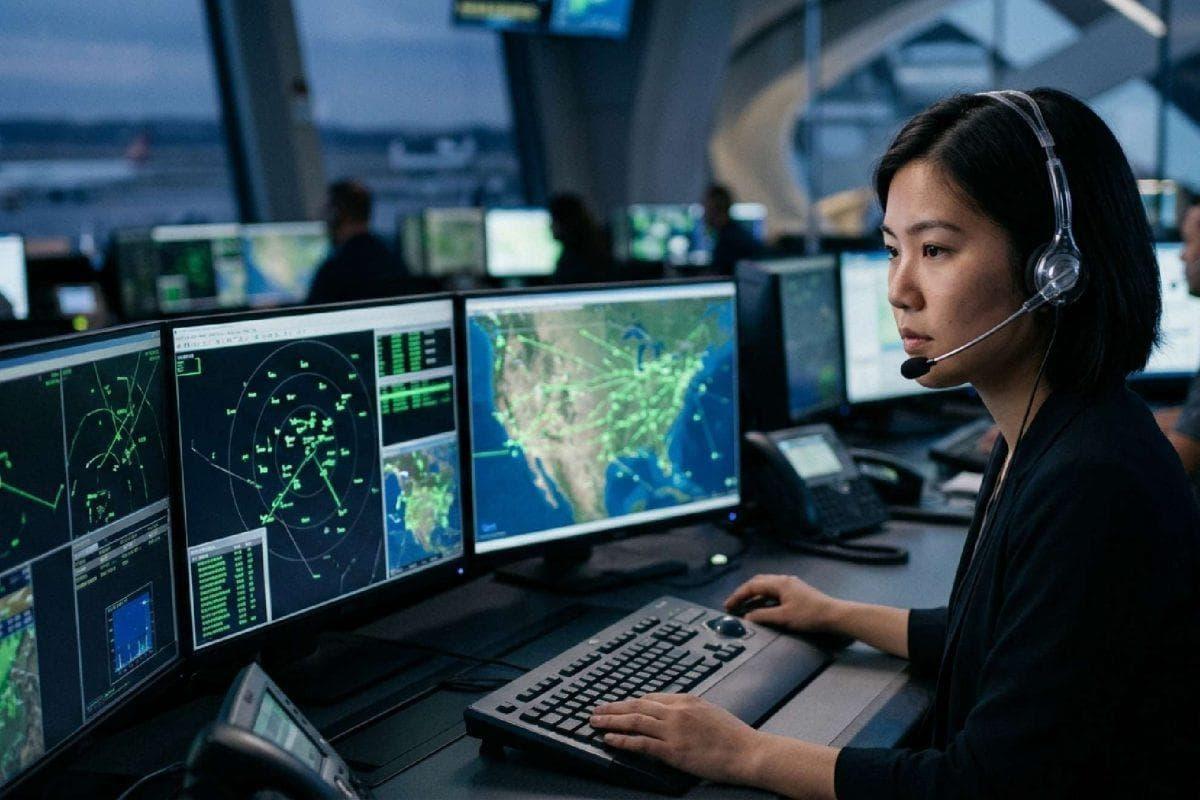
The United States experienced one of its most significant aviation disruptions in decades on Friday, November 13, when the Federal Aviation Administration (FAA) ordered a nationwide ground stop following a breakdown in its air traffic communications network.
The shutdown lasted almost five hours and affected more than 20,000 flights. Seventeen of the FAA’s 22 en-route air traffic control centres experienced communications problems, disrupting the systems used to coordinate aircraft movements and radar information.
Although flights subsequently resumed, the incident exposed the vulnerability of critical American infrastructure and raised fresh questions about the country’s ability to maintain and modernise essential technological systems.
An ageing system brought to a standstill
US Transportation Secretary Sean Duffy attributed the disruption to a technical failure during routine maintenance work carried out by L3Harris, a longstanding contractor responsible for operating the FAA’s telecommunications network.
The work involved replacing ageing copper telecommunications lines with fibre-optic connections. According to Duffy, a router associated with the upgrade began generating an extraordinary number of connection attempts, overwhelming other routers in the network.
Officials reported more than 1,000 connection attempts every four to five seconds.
The resulting instability affected communications between air traffic controllers and aircraft, as well as radar feeds. The FAA consequently decided to ground departing flights nationwide as a precautionary measure.
Duffy said investigators were examining whether the incident resulted from human error, faulty installation or defective equipment. No definitive technical cause had yet been established.
The administration also stated that there was no indication of a cyberattack or deliberate hostile action.
The incident nevertheless highlighted a wider problem: parts of America’s air traffic control infrastructure remain dependent on equipment and telecommunications systems that are decades old.
Congress has already approved substantial funding for modernisation, but the transition has been slow and technically complicated.
The episode raises questions about the resilience of infrastructure that is essential not only to commercial aviation but also to the functioning of the world’s largest economy.
Netanyahu presses Trump over Iran
While Washington was dealing with the aviation crisis, another development was unfolding in the relationship between the United States and Israel.
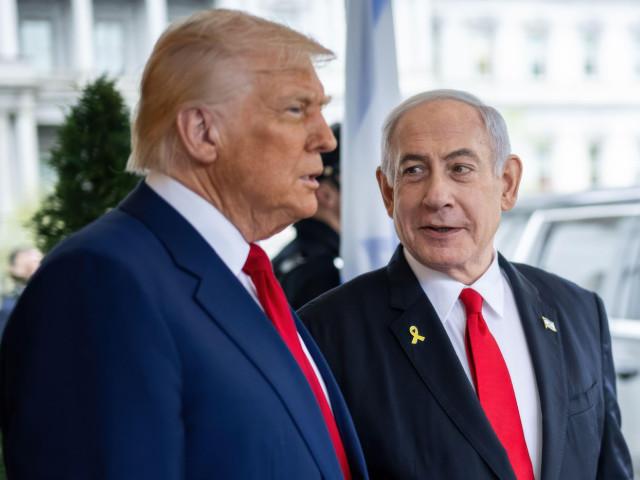
President Trump and Israeli prime minister Benjamin Netanyahu
According to a report by Axios on November 13, Mossad director Roman Gofman was in Washington for discussions with senior Trump administration officials concerning the war with Iran.
Gofman was reportedly scheduled to meet CIA director John Ratcliffe and was also expected to travel to Miami for discussions with White House envoy Steve Witkoff.
The visit coincided with renewed pressure from Israeli Prime Minister Benjamin Netanyahu for the United States to resume military operations against Iran.
Trump has so far resisted this pressure, although his position on the conflict has fluctuated. Reports have described disagreements over whether to continue diplomatic efforts or return to a more extensive military campaign.
The Israeli government considers Iran’s military and nuclear capabilities an existential security concern. Washington, meanwhile, must weigh the consequences of renewed hostilities, including the possibility of a wider regional conflict, disruption to energy markets and further American military commitments.
The presence of the Mossad director in Washington therefore illustrates the extent to which intelligence and military cooperation form part of the relationship between the two countries.
It also raises an important question about the degree of influence Israel exercises over American strategic decision-making.
Intelligence cooperation and political pressure
The relationship between American and Israeli intelligence agencies has traditionally been close. Cooperation between the CIA and Mossad covers a range of regional security issues, including Iran, counterterrorism and intelligence gathering.
However, cooperation does not necessarily imply agreement over every strategic decision.
The reported Washington visit comes at a particularly sensitive moment. Israel wants to prevent Iran from consolidating its regional military position, while the Trump administration faces the economic and political consequences of prolonging a costly conflict.
The question is whether American foreign policy is being determined primarily by Washington’s assessment of its own national interests or increasingly by the strategic priorities of a close regional ally.
This is a legitimate subject for public debate, particularly when decisions about war and peace are involved.
There have also been allegations and speculation in political circles about possible intelligence leverage, blackmail and pressure exerted on American political leaders. However, no independently verified evidence has established that Mossad is blackmailing Trump or that Israeli intelligence has been responsible for the recent American infrastructure disruptions.
Such allegations should not be confused with the documented diplomatic and political pressure surrounding the Iran conflict.
Is America becoming more vulnerable?
The FAA incident and the renewed diplomatic activity surrounding Iran are separate developments. There is currently no evidence connecting the aviation shutdown to Israel, Mossad or the conflict in the Middle East.
Nevertheless, both events illustrate different aspects of the challenges confronting the United States.
On the domestic front, an advanced industrial economy remains dependent on ageing infrastructure that can be disrupted by relatively isolated technical failures.
On the international front, Washington faces competing strategic priorities and pressure from allies whose regional objectives do not necessarily coincide with American interests.
The United States possesses enormous military, technological and economic resources. Yet the ability to project power abroad ultimately depends on the reliability of institutions and infrastructure at home.
The question facing Washington is therefore not simply whether it should resume military action against Iran. It is whether American foreign policy can remain independent, coherent and sustainable while the country struggles to modernise the systems upon which its own security and prosperity depend.
For a country that has long presented itself as the guarantor of international stability, these are questions that cannot easily be ignored.
Every weekday before dawn, a morning migration takes place near the desert on Africa’s southwestern coast. At 5:30 in the Namibian enclave Swakopmund, whose century-old buildings still bear the imprint of German colonization, solitary men in khaki uniforms emerge from houses and apartment complexes, the white reflective strips on their pants flashing as they walk briskly through the darkness. They are not African but Chinese. No one else is stirring in the Atlantic Coast town as the men converge on a tidy house on Libertina Amathila Avenue, the only one in the neighborhood with its lights ablaze.
Dylan Teng, a boyish 29-year-old engineer with a brush cut and wire-rimmed glasses, is among the last to arrive. Just as he has done nearly every day since landing in Namibia three and a half years ago, Teng joins the others in wolfing down a breakfast of steamed buns and rice porridge. He picks up a packed lunch prepared by a company chef and at precisely 6 o’clock, with stars still glimmering overhead, he boards a bus emblazoned with the letters C.G.N. — China General Nuclear, a state-owned behemoth that owns the biggest Chinese project in all of Africa.
An hour later, as the sun clears the horizon, the bus winds through a craggy moonscape and descends to the Husab Uranium Mine, a $4.6 billion investment that is the second-largest uranium mine in the world. Teng has made this trip nearly a thousand times, but Husab always seems like a mirage: a virtual city stretching seven miles across the desert floor, from two vast open pits being gouged out of the rocky substratum to a processing plant that, on the last working day of 2016, produced its first drums of U₃O₈, the yellowcake that can be used to generate nuclear power (and also to make weapons). “We had a big ceremony that day,” Teng says.
One of the few university graduates from his village in China’s southwestern Sichuan Province, Teng is keenly aware of Husab’s significance. It is not simply a lifeline for Namibia’s struggling economy, one that the country estimates will increase its gross domestic product by 5 percent when the mine reaches full production next year. The uranium itself, almost all of which will go to China, will also help turn Teng’s homeland into a world leader in nuclear energy and reduce its dependence on coal. In Beijing, where he worked before coming here, Teng lived under the gray blanket of coal-generated pollution that hangs over much of eastern China. Now he is working for the future — his own and his country’s — under an endless African sky of cobalt blue. “I never imagined,” he says, “I would end up halfway around the world.”
China’s gravitational pull can be felt today in every nook of the globe. Few countries feel the tug more strongly than Namibia, a wind-swept nation with a population of 2.4 million — barely a tenth the size of Beijing’s — some 8,000 miles away from the Chinese capital. The desert where the Husab mine has materialized in recent years used to be known only for the presence of Welwitschia mirabilis, the short, droopy national plant that grows just two leaves — and can live for more than 1,000 years. Now, in little more than 1,000 days, China’s reach has spread far beyond the uranium mine.
Just north of Swakopmund, a Chinese telemetry station sprouts from the desert floor, its radar dishes pointing skyward to track satellites and space missions. Twenty-five miles south, in Walvis Bay, a state-owned Chinese company is building an artificial peninsula the size of 40 baseball fields as part of a vast port expansion. Other Chinese projects nearby include new highways, a shopping mall, a granite factory and a $400 million fuel depot. Chinese trade flows through the port: shipping containers filled with cement, clothing and machinery coming in; tiles, minerals and — in some cases — illegal timber and endangered wildlife heading out to China. The activity is so frenzied that rumors of a proposed naval base in Walvis Bay, though vehemently denied by Chinese officials, do not strike locals as implausible.
This small outpost offers a glimpse of what may be the largest global trade-and-investment spree in history. Driven by economics (a hunger for resources and new markets) and politics (a longing for strategic allies), Chinese companies and workers have rushed into all parts of the world. In 2000, only five countries counted China as their largest trading partner; today, more than 100 countries do, from Australia to the United States. The drumbeat of proposed projects never stops: a military operating base, China’s first overseas, in Djibouti; an $8 billion high-speed railway through Nigeria; an almost-fantastical canal across Nicaragua expected to cost $50 billion. Even as China’s boom slows down, its most ambitious scheme is still ramping up: With the “One Belt, One Road” initiative — its name a reference to trade routes — President Xi Jinping has spoken of putting $1.6 trillion over the next decade into infrastructure and development throughout Asia, Africa and the Middle East. The scheme would dwarf the United States’ post-World War II Marshall Plan for Europe.
China’s relationship with Africa goes back to the 1960s, when Chairman Mao Zedong promoted solidarity with the developing world — “Ya Fei La,” as he called it, using the first syllables for Asia, Africa and Latin America. Though it was poor and mired in the chaos of the Cultural Revolution, China won new allies in Africa by finishing, in 1976, a 1,156-mile railroad through the bush from Tanzania to Zambia. Aid continued to trickle in, but there were no other big projects for nearly 30 years, as China focused on building up its domestic economy, following its leader Deng Xiaoping’s prescription to “hide your strength and bide your time.” That ended in the 2000s, when Beijing, recognizing the need for foreign resources and allies to fuel its economic growth, exhorted the nation’s companies to “go out” into the world.
Today, if you take the red-eye flight from Shanghai to Addis Ababa, the Ethiopian capital, chances are you’ll be seated among Chinese workers heading to a construction site in oil-rich Equatorial Guinea, a cotton-processing plant in Mozambique, a telecom project in Nigeria. China’s trade with African nations has increased fortyfold in the past 20 years. The workers and migrants carrying out China’s global vision are now so ubiquitous in Africa — as many as a million of them, according to one estimate — that when my wife and I wandered into a Hunanese restaurant in Addis, the red-faced workers devouring twice-cooked pork blurted out: “Ah, laowai laile!” “Foreigners have come!” It seemed rude to point out that they were foreigners, too.
China’s advances have come as the West seems to be retreating. United States engagement in Asia, Africa and Latin America declined after the Cold War, when the regions served as proxies for superpower rivalries. China’s rise and the wars in the Middle East also pulled away resources and attention. And now, with Washington raising doubts about global agreements on issues like free trade and climate change, Beijing has more leverage to push its own initiatives and show its capacity for global leadership. President Trump’s disdain for the Trans-Pacific Partnership has already made Beijing’s trade proposals, which exclude the United States, more appealing. “In certain parts of the world, the relative inattention of the Trump administration is definitely creating an opening for China to fill,” says David Shambaugh, director of the China Policy Program at George Washington University and author of the 2013 book “China Goes Global.” But “China remains very much a partial power — and only offers other countries an economic relationship.”
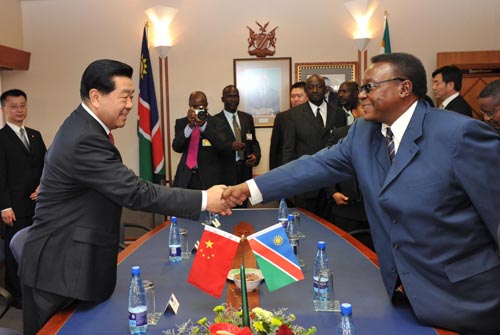
Still, for a nation like Namibia, China’s pitches can be irresistible partly because they’re rooted in historical solidarity. Beijing backed the black nationalist movement’s liberation struggle against apartheid and its white South African overlords. Sam Nujoma, the leader of the South West Africa People’s Organization (Swapo), visited Beijing in search of guns and funds in the early 1960s. When Namibia finally claimed independence in early 1990, with Nujoma as president, China became one of its first diplomatic allies, pronouncing the two countries “all-weather friends.” (Beijing was also desperate for allies to break its diplomatic isolation after its violent crackdown on the 1989 democracy movement.) – New York Times, fragment
It’s “R & R for Megyn Kelly,” the Fox News channel announced last week on its website, followed by a gooey note from Kelly herself. Why was FNC broadcasting the vacation schedule of the Golden Goose that henpecked Donald Trump? Had Kelly been licked into shape by Trump? Was she off to lick her wounds?
Since the testy exchange between Trump and Kelly, at the first prime-time Republican debate, in Cleveland, Ohio, the anchor’s eponymous TV show, “The Kelly File,” has covered the meteoric rise of Mr. Trump sparingly. Perhaps Kelly has come to view herself as a kingmaker. Perhaps she thinks that should she choose not to report about a newsmaker; he’ll somehow fade into obscurity.
Full disclosure: At first blush, I was impressed by the quality of Fox News’ journalism, in Cleveland, writing too exuberantly that “the true stars of the debate were the ruthless, impartial, analytical” reporters. Better that Kelly be the one to ask foolish, fem-oriented questions of The Donald than future Dem moderators. It neutralizes the latter. Or so I reasoned.
Moreover, it’s indisputable that compared to previous presidential debates overrun as they were by Democrat journos—Kelly, Bret Baier and Chris Wallace did a good job.
No presidential debate should, however, be gauged by how it departs from debates in which questions such as these are posed:
“Senator Obama, how do you address those who say you’re not authentically black enough?”
“Senator Dodd, you’ve been in Congress more than 30 years. Can you honestly say you’re any different?”
“Congressman Kucinich, your supporters certainly say you are different. Even your critics would certainly say you are different … What do you have that Senators Clinton and Obama do not have?” [Wait a sec. I know the answer: a trophy wife.]
And how about this intellectually nimble follow-up?
“Senator Clinton, you were involved in that [how-am-I-different] question. I want to give you a chance to respond [to that how-am-I-different question].”
“Senator Obama, you were also involved in that [how-am-I-different] question, as well. Please respond.”
The final crushingly stupid question to the 1-trick donkeys debating, in the 2007 CNN/YouTube Democratic presidential debate, was this:
“Who was your favorite teacher and why, Senator Gravel?”
The “journalist” pounding the presidential candidates was jackass Anderson Cooper of CNN.
Before she beat a retreat, Kelly had assembled a studio audience of Republican establishmentarian, to whom she directed another leading question: She herself knew nobody who’d call a woman a pig or a dog. Could they say the same? Kelly was alluding to the litany she had directed at Trump during her Cleveland performance (where she had cast herself as leading lady).
Kelly: “You’ve called women you don’t like, ‘fat pigs,’ ‘dogs,’ ‘slobs,’ and ‘disgusting animals.”
Trump [in good humor]: “Only Rosie O’Donnell.”
Megyn [bare-fanged]: “No it wasn’t. For the record, it was well beyond Rosie O’Donnell. Your Twitter account has several disparaging comments about women’s looks. You once told a contestant on ‘Celebrity Apprentice’ it would be a pretty picture to see her on her knees. Does that sound to you like the temperament of a man we should elect as president?”
Still under the brain-addling spell of the Cooper-Candy Crowley brain trust, I thought no less of Kelly for that dumbest of questions. Her anti-individualist, collectivist feminism is news to her fans, but not to me. Kelly’s vocabulary is of a piece with the nauseating vocabulary of third-wave feminism.
More irksome was the allusion to the dignity of The Office. A while ago, fancy pants Kelly joined Don Lemon (CNN), Cooper and Rachel Mad Cow to editorialize angrily at Obama for damaging the dignity of The Office. These celebrity journos were, in fact, green with envy over GloZell Green, a YouTube sensation to whom president Obama granted an interview. Good for him.
Our TV narcissists—they live not for the truth, but for a seat at the Annual White House Sycophant’s Supper, or alongside the smarmy Jon Stewart (or his unfunny South African replacement), or next to the titillaters of “The View,” or on the late-night shows—were jealous. Dented was the vanity of the egos in the anchor’s chair.
Besides which the American presidency was pimped out a longtime ago—well before the current POTUS and FLOTUS held soirees sporting disco balls and the half-nude, pelvis-grinding Beyoncé.
Kelly herself has fast succumbed to the female instinct to show-off, bare skin, flirt and wink. She now also regularly motormouths it over the occasional smart guest she entertains (correction: the one smart guest, Ann Coulter). At the same time, Kelly has dignified the tinnitus named Dana Perino with a daily slot as Delphic oracle.
Trump, on the other hand, has proven he can be trusted to beat up on the right women.
Exhibit A is Elizabeth Beck, a multitasking “attorney,” who once deposed Donald Trump while also waving her breast pump in his face, demanding to break for a breast-pumping session.
“You’re disgusting. You’re disgusting,” the busy billionaire blurted in disbelief. And she was. Still is. Accoutered for battle, Beck recently did the rounds on the networks. In addition to a mad glint in the eye, Beck brought to each broadcast a big bag packed with milking paraphernalia.
Had she cared about boundaries and propriety, Kelly would have asked Trump how he kept his cool during a legal deposition, with an (ostensible) professional, who insisted on bringing attention to her lactating breasts.
Writes Fred Reed, who regularly tracks our malevolent matriarchy’s “poor sense of social boundaries”:
The United States has embarked, or been embarked, on a headlong rush into matriarchy, something never before attempted in a major country. Men remain numerically dominant in positions of power, yes, but their behavior and freedom are ever more constrained by the wishes of hostile women. The effects have been disastrous. They are likely to be more so. The control, or near control, extends all through society. Politicians are terrified of women. … The pathological egalitarianism of the age makes it career-ending to mention that women in fact are neither equal nor identical to men. …
Not quite in the league of Elizabeth Beck yet, Megyn Kelly was, nevertheless, in need of a dressing-down and a time-out.
Nicolas Bonnal of Boulevard Voltaire believes Russia is lucky that it wasn’t invited to the G7 summit this year, comparing the group to the company of hypocritical “idiots.”
As the West is reaching new heights of absurdity, Russia should be happy that it didn’t end up in the company of “idiots,” Nicolas Bonnal said in Boulevard Voltaire.
Russia certainly shouldn’t be ashamed of not being invited to the G7 summit this year. The group of the richest Western nations gathered in Germany, without Russia and China, but with “Italy and its crowds of Libyan refugees,” Bonnal said, comparing the summit akin to being in a luxurious hotel up in mountains, but with non-alcoholic beer.
Even Ethiopia was invited to attend the summit, but not Russia. Russia was punished for not dancing to Washington’s tune.
Moscow was put in a corner for the alleged aggression against Ukraine and the lack of respect for human rights, the author said.
Meanwhile, the United States has 2.2 million prisoners, Guantanamo Bay and the Patriot Act, 1,200 victims of police brutality and over a million people killed because of drug-related gang wars.
American neoconservatives started a series of atrocious wars in Libya, Iraq, and Syria in their “irrational and even frightening desire to harm,” Bonnal said.
The contemporary G7, which was originally seen as the collection of the world’s largest economies, lacks not only Russia, but also China, India and Brazil. Currently, the group consists of the United States, Germany, Britain, France, Japan, Canada and Italy. And almost no economic growth.
Documents posted on the web reveal a high-level anti-Russian propaganda war being waged in south and eastern Ukraine by the US, the UK and NATO on behalf of the Kiev Government, using non-governmental organisations (NGOs) as agents.
According to the Drakula blog, the West is raising its game in its campaign against Russian President Vladimir Putin. While it is — on the one hand — pumping up the military volume by moving NATO and US hardware nearer to the Ukraine and Russian borders, it is also playing a hybrid war by pumping funds into an anti-Russian propaganda war.
NATO documents show that a “co-ordination meeting on StratCom training for Ukraine” was held in Riga, Latvia on February 19, 2015 as part of its “on-going capacity building programme”.
StratCom stands for Strategic Communication, which means dealing with the “inability of Ukrainian media to provide sufficient reach for the south/east of the country; vast reach of media originating from Russia; lack of strong Public Broadcaster; lack of success stories; [and] lack of trust of the population of the south/eastern regions in the central government”.
The NATO document reveals the Kiev Government has a “weak Public Affairs capacity” and sets out proposals to counter Russian influence and tackling what it describes as a lack of cross-government work and co-ordination as well as a lack of understanding of the importance of “national narrative”.
Further documents reveal a project run by the UK Foreign Office, the Department for International Development and the Ministry of Defence worth $360,500 with the purpose of: “National reconciliation in Ukraine through effective communication for restoring public trust and empowering of the participatory democracy mechanisms using regional media coverage, counteraction to Russian information influence”.
It outlines a pro-Kiev propaganda battle using Ukrainian agencies including the Ukrainian Institute for International Politics (UIIP); the Analytical Center for Geopolitical Studies ‘Borysfen Intel’ (BI); and the Department of the civil-military cooperation, HQ of the armed forces.
The program involves “resuming the communication and community dialog in Eastern and Southern regions of Ukraine using international experience shared by UIIP and BI foreign partners; informational support of national reconciliation ideas through broadcasting and media coverage of Eastern and Southern Ukraine regions by new alternative regional mass-media and Internet resources; and decreasing the Russian information influence in Ukraine, discredit of the Russian political and military leaders.”
The revelations will embarrass the US, NATO and UK who have been at pains to denounce Russia for promoting what they call a ‘hybrid war’ in Ukraine.
White House says measures will “end our outdated approach,” promote change in Cuba consistent “with US national security interests”
Oddly, during a week when President Obama prepares to launch new sanctions against Venezuela and Russia, The White House admits that sanctions do not work.
“It is clear that decades of US isolation of Cuba have failed to accomplish our enduring objective of promoting the emergence of a democratic, prosperous, and stable Cuba,” the Obama administration declared.
Diplomatic relations between the United States and Cuba were severed in January 1961 after the rise of Fidel Castro and his Communist government.
Obama has now instructed Secretary of State John Kerry to immediately initiate discussions with Cuba about reestablishing diplomatic relations and to begin the process of removing Cuba from the list of states that sponsor terrorism, which it has been on since 1982, the White House said.
In coming months, the US “will re-establish an embassy in Havana and carry out high-level exchanges and visits between our two governments as part of the normalization process”.
The US will thus lift sanctions on Cuban nationals outside Cuba.
The initial step will involve US-Cuba Migration Talks in January after which institutions will be allowed to open accounts at Cuban financial institutions for authorized transactions and US credit, debit cards permitted for use by travelers to Cuba.
But in 2010, the same Obama administration warned the world against Cuba:
Recent events in Cuba, including the tragic death of Orlando Zapata Tamayo, the repression visited upon Las Damas de Blanco, and the intensified harassment of those who dare to give voice to the desires of their fellow Cubans, are deeply disturbing.
These events underscore that instead of embracing an opportunity to enter a new era, Cuban authorities continue to respond to the aspirations of the Cuban people with a clenched fist.
Today, I join my voice with brave individuals across Cuba and a growing chorus around the world in calling for an end to the repression, for the immediate, unconditional release of all political prisoners in Cuba, and for respect for the basic rights of the Cuban people.
During the course of the past year, I have taken steps to reach out to the Cuban people and to signal my desire to seek a new era in relations between the governments of the United States and Cuba. I remain committed to supporting the simple desire of the Cuban people to freely determine their future and to enjoy the rights and freedoms that define the Americas, and that should be universal to all human beings.
Surprisingly, despite the apparent failure of Iraq and Afghanistan and “strong fiscal constraints,” Washington is still expanding its war plans
The US should get ready for a new era of endless wars, stated Pentagon’s chief Chuck Hagel, noting that “tyranny,” “terrorism,” national security challenges and climate change pose a substantial threat to the US and its allies.
Although the Pentagon’s chief urges to prepare for an endless war, the question remains open if ordinary Americans will support the new doctrine.
More than half of American respondents said that the US had not achieved its goals in both Iraq and Afghanistan, expressing their discontent with US foreign policy, according to the Pew Research poll conducted in the beginning of the 2014. Although 57 percent of US citizens approved the US campaign against Islamic State according to the October poll, 55 percent strongly oppose sending US ground troops to Iraq and Syria.
“I think we are living through one of these historic, defining times. We are seeing a new world order—post-World War II, post-Soviet Union implosion—being built. There are many questions, foremost among the American people: What’s the role of America in this new world that is evolving? Should we have a role? What is appropriate?” said Chuck Hagel, as cited by the Atlantic.
The US Secretary of Defense claims that as the global leader, the US will “continue to grapple with overseas threat for the foreseeable future,” containing international terrorism and tyrannical regimes. “Hagel didn’t seem especially sanguine that it would end anytime soon. In other words: Get used to endless war,” stressed the Atlantic, characterizing the Pentagon’s new doctrine.
Remarkably, practically none of the previous US overseas military campaigns has proved effective. “US soldiers have been laboring under sad paradox: even though the United States enjoys unprecedented global military dominance that should cow enemies mightily, it has found itself in constant combat for longer than ever before in its history, and without much to show for it,” writes Richard K. Betts, the Arnold Saltzman Professor of War and Peace Studies in the Department of Political Science, in his article “Ending America’s Era of Permanent War” published in Foreign Affairs. The professor points out that of the US military actions in Kosovo, Afghanistan, Iraq, and Libya, “only the first can be counted a success.”
Surprisingly, despite the apparent failure of the US military campaigns in Iraq and Afghanistan and “strong fiscal constraints,” Washington is still expanding its war plans. According to the expert, the White House should not cut back its overseas military operations, but prepare for “more action.”
“Frightening challenges in three critical regions are demanding yet more action: Islamic extremists have seized large swaths of territory in Iraq and Syria, Russia has intervened in Ukraine, and China is flexing its muscles in East Asia,” stressed Richard K. Betts.
The idea of the US “moral obligation” to meddle into domestic affairs of other countries in order “to set them right” is a “mythological concept,” aimed at justification of American interventionism, contended Justin Raimondo, the editorial director of Antiwar.com and a senior fellow at the Randolph Bourne Institute.
“The idea that the United States must exercise “global leadership” is rationalized by our interventionists as a necessary prerequisite for maintaining some type of “world order,” Mr. Raimondo underscores in his article “Putin’s Complaint: Is Washington a Revisionist Power?”
However, the Pentagon’s “endless war,” cannot last forever, as it is the American taxpayers who pay for the extortionately expensive military operations. For instance, the Afghanistan campaign cost the US “roughly $45 billion a year from 2001 to 2013,” while Iraq cost “about $100 billion a year from 2003 to 2011,” Kenneth M. Pollack, a Senior Fellow at the Brooking Institution and former CIA analyst, noted in his article “An Army to Defeat Assad.”
It should be also noted that the December poll in 2013 carried out by the Pew Research indicated that 52 percent thought the United States “should mind its own business internationally and let other countries get along the best they can on their own.” The researchers underscore that the tendency demonstrated by the poll reflects a gradual and longstanding decline. According to the October 2014 poll, most Americans consider inequality more dangerous than nuclear weapons, or sectarian religious threats.
The EU is trapped between anti-Russian members and threats to European companies
EU foreign policy has become a prisoner of the United States, trapped and forced to impose and maintain sanctions against Russia, prominent French economist Jacques Sapir told RIA Novosti Wednesday.
“The EU at first had no intention of moving to a sanctions regime as harsh as the US. But, the US trick was to let the threat of a possible move by the US against any EU company, doing business with Russia in US dollars hovering,” Sapir said.
Then, the EU ended up trapped between on one hand some EU countries (Poland and the Baltic countries) that are deeply anti-Russian and possible US threats against EU companies if they did not abide US sanctions. We could consider that EU foreign policy has been successfully captured by the United States.”
Late Tuesday, permanent representatives to the European Union decided against altering the existing sanctions regime against Russia.
Jacques Sapir explained that “it would be extremely difficult to cancel the sanctions “at least before a delay of 6 months.”
“To do that, the EU would have to build a “consensus” and if Poland and the Baltic countries don’t agree, sanctions could not be cancelled. But, we have to remind ourselves that the sanctions were put in place for 6 months. Once we reach this deadline (by early January 2015) the situation could evolve in another direction,” Sapir told RIA Novosti.
Sapir noted that “the sanctions process against Russia is the only way the EU could be seen to react to Russian policies on Crimea and Ukraine.” But the fact of using sanctions and “that European sanctions were, at first, only cosmetic” demonstrates the weakness of the European Union in facing the United States.
The European Union and the United States have imposed sanctions on Russia over its alleged involvement in the Ukrainian crisis, a claim Moscow has repeatedly denied.
The latest round of sanctions came into effect on September 12, targeting Russian defense companies, alongside the country’s largest banks, energy companies and certain high profile individuals.
The healthiest and most intuitive response to deep-seated, irreconcilable unhappiness—political or personal—is not to hold a constitutional convention, Mark Levin, but to leave; to exit the abusive relationship.
It is indeed inexplicable how the famous broadcaster trashes secession but, at the same time, looks to the states for salvation.
To reclaim the republic, Levin and his listeners hold out hope for the atrophied states and their unexercised role in the amendment process, as stipulated in Article V of the Constitution.
Never mind that the states, contrary to the mistaken predictions and hopes of the Constitution makers, have never initiated a constitutional amendment; and never mind that even in the event that the states demand a constitutional convention, there is no mechanism to compel Congress to act.
The great constitutional scholar James McClellan was no “neo-confederate.” Yet even an ardent defender of the Constitution as was McClellan conceded that, sadly, “the Framers relied on the good faith of Congress for the observance of the requirement” and that, when it came to a constitutional convention, “there was no way to force Congress to act.” (“Liberty, Order, And Justice: An Introduction to the Constitutional Principles of American Government,” p. 310.)
Ultimately, the legislatures of two-thirds of the states have to unite to call on Congress to hold a national constitutional convention for the purpose of amending the dead-letter Constitution. Levin and his listeners are deluded if they think that the states, which are hardly bastions of freedom, will unite for this purpose; salvation is more likely to come from dissolving dysfunctional political bonds.
Still, what a force for liberty Levin would be were he a libertarian.
Alas, in one of his magnificent rants against the regime the radio mouth wanted to know why no Democrat had protested Obama’s overweening ways.
This is not quite true. As this column has pointed out, the late, great, Democratic Senator Robert Byrd was driven to distraction by Big Man Obama and said as much. Byrd, RIP, was “a stern constitutional scholar who always stood up for the legislative branch in its role in checking the power of the White House.”
This old Southern gentleman, whom Republicans continually berated for his past indiscretions, warned about Obama’s executive-branch power grab and the extra-constitutional creation of a number of new White-House fiefdoms: on health reform, urban affairs policy, energy and climate change, on and on.
In 2009, “Sen. Byrd issued this warning regarding the procedural shenanigans the Democrats tried to deploy to pass the healthscare bill”:
“I oppose using the budget reconciliation process to pass health care reform and climate change legislation…. As one of the authors of the reconciliation process, I can tell you that the ironclad parliamentary procedures it authorizes were never intended for this purpose.”
The frail senator had taken to the floor of the United States Senate on October 14, 2009, “to discuss the situation in Afghanistan and voice his concerns over the possibility of a major increase in U.S. forces into Afghanistan”:
“General McChrystal, our current military commander in Afghanistan, has requested 30,000-40,000 additional American troops to bolster the more than 65,000 American troops already there. I am not clear as to his reasons and I have many, many questions. What does General McChrystal actually aim to achieve?” “So I am compelled to ask: does it really, really take 100,000 U.S. troops to find Osama bin Laden?”
Magnificent too has been liberal constitutional scholar Jonathan Turley, who has protested the emergence of the Über-Presidency in the person of Barack Obama.
Then there is WND columnist Nat Hentoff. I know not whether he is a Democrat, but Hentoff has long been considered liberal and now labels himself a libertarian. He has accused Obama of “an unprecedented abuse of powers,” calling him the “most un-American president in the nation’s history.”
… The journalist said he doesn’t think any other president has acted so lawlessly as a matter of habit.
“So, if this isn’t a reason for at least the start of an independent investigation that would lead to impeachment, what is?”
Hentoff is baffled that Obama should escape such scrutiny when former President Bill Clinton faced impeachment just for being “a lousy liar.”
A big part of the problem, the journalist believes, is what he calls the utter ignorance of a huge portion of the population, which is not outraged at losing its basic right to be self-governing.
Obama “doesn’t give a damn, because he can get away with whatever he wants.”
And that’s why Hentoff surmised—and Levin would indubitably agree—that this was the worst state the country has ever been in: “Even worse than Woodrow Wilson’s regime, when people could be arrested for speaking German.”
Ever since Nelson Mandela died, but even before, one was utterly flabbergasted before the intensity of media fervour pouring out en hommage to the Big Man. In Africa, of course, there are all kinds of theories about Big Men, some more politically correct than others. The tribal elder meets the Soviet personality cult, and we get Idi Amin Dada. Or Charles Taylor. Or Robert Mugabe.
If there is one thing I can stand even less than African Big Men, it is British journalists convulsing on the ground in effusive praise of them. Who still remembers the blasts of praise from Fleet Street when Mugabe assumed power in the ex-Rhodesia? For much of the past ten days while South Africa lit the long-awaited Big Candle, visible from outer space without a doubt, we had to endure near-hysterical outpourings exalting the deceased ex-terrorist. One such scribe from the island north of the Continent – I forget which, there were so many this week – wrote: “Mandela could have been president for life but he chose to stay a single term, for the sake of democracy in Africa!”
Democracy in Africa. Oh, yes. If Mandela’s successor at the helm of this decaying country, Thabo Mbeki, were to be believed, democracy was invented in Africa. No less. The point is that there is now such an Afrocentric phantasmagoria, cultivated in Britain and the United States, that anything is now possible, even Mbeki’s “African century”. The notion that Africa will come to dominate the globe economically, politically and militarily, was first articulated by another African Big Man, born Joseph-Desiré Mobutu but whose full regal appellation afterwards became Mobutu Sese Seko Kuku Ngbendu wa Za Banga.
Novelist V.S. Naipaul wrote somewhat ironically about Mobutu’s dreams of impoverished Europeans beseeching African countries for much-needed aid in 2000. Yet the notion of Nelson Mandela being “the greatest leader of the twentieth century” and voted as the most respected global leader in at least one poll. must inspire some doubt in Naipaul himself. Contemplating the “transformed” inner city of Johannesburg in our postapartheid paradise, Naipaul wrote in The masque of Africa:
It sent my mind back to other places of dereliction and ruin I had seen: the wartime rubble of East Berlin kept as a monument in the communist days. But it seemed easier even in the bad days for that part of East Berlin to be rebuilt than it would be for the half-life of this part of Johannesburg to be restored to something like its original meaning. Where would one begin? One would have to begin with the idea of the city, the idea of civilisation; and already, before one had even begun, one would be swamped by protest.
There were further discoveries to be made within that new slum. A sturdy old warehouse had been given over to new merchandise, which would have been like a parody of what had been here. It was a market of witchdoctors’ goods, and it was extensive. These were the muti goods that witchdoctors required their customers to get, to be used by the witchdoctor as he pleased, usually to make medicines, which the unfortunate bewitched man or woman had to drink.
I have often thought that Mandela had bewitched a good portion of the Anglo-American ruling class that in turn infected the stupid Europeans who are progressively losing the capacity for independent thought. All this talk of “Madiba magic” might be code for some supernatural, Harry Potter-like influence.
As everone knows, some forms of muti are taken as a cure for an evil spell, while others are used precisely to bewitch the victim. A black man who has designs on a woman who is rejecting him could buy some muti from a sangoma to ensure that she falls in love with him.
In Europe, Nietzsche and others wrote about the “twilight of the idols”. However, in Africa the idols are thriving, with the messianic Mandela being the biggest idol of them all. It seems only a few cantankerous Christians still refuse to bow to him, but not the Clintons, the king of the Netherlands or Barack Obama. Even George W. Bush came as a pilgrim to South Africa this week.
During his speech at Soccer City on the outskirts of black Soweto, Obama cast himself in the role of Mandela’s understudy, a humble disciple to the famous Xhosa.
I suppose in the days of the Roman Empire, people were also nonplussed about the seemingly inexorable rise of a strange new cult, Christianity. In the face of global grief over Mandela’s “exchanging the temporary for the eternal”, as the local Afrikaans saying goes, most mainstream conservatives have joined in eulogizing Mandela. British PM David Cameron, who had wanted to “hang Mandela”, together with other Young Conservatives, reacted to Mandela’s death with:
A great light has gone out in the world. Nelson Mandela was a hero of our time.
The normally truculent George W. Bush who had unleashed a war on other terrorists had only kind words for the man who had co-authorized the Church Street and Amanzimtoti bombs:
President Mandela was one of the great forces for freedom and equality of our time. He bore his burdens with dignity and grace, and our world is better off because of his example.
How do we explain such empathy, nay admiration, for a card-carrying member of the South African Communist Party in so-called Western conservative leaders? After all, I cannot recall similar expressions of sorrow when Georges Marchais of the French Communist Party or the East German stalwart, Erich Honecker, expired in 1997 and 1994, respectively.
The answer is that, unlike the venerable European leftists Marchais and Honecker, who had also waged a life-long struggle against fascism and racism – both leaders were among Mandela’s staunchest allies – Comrade Mandela assuages white guilt.
Susan Sontag’s notorious adage, that “the white race is the cancer of human history”, has become almost an official doctrine in the United States and Great Britain, eagerly emulated by the hapless Europeans. Few people have written about this phenomenon, except French “new philosopher” Pascal Bruckner who published two books about it, aptly entitled The tears of the white man: compassion as contempt and The tyranny of guilt: an essay on Western masochism.
Throughout the past week, here in South Africa and elsewhere, whites indulged in moral self-flagellation. A Dutch journalist, resident in South Africa, declared apropos of Mandela as symbol: “We had 40 years of apartheid, but 400 years of colonialism.” I daresay, four hundred years will not be enough to atone for the sins of colonialism and apartheid.
Probably I have referred to this process before, but one of the most repulsive aspects of white, Western guilt, is how South African whites in general, and Afrikaners in particular, have been made into literal scapegoats for it. Every time one of us gets murdered, raped or tortured under the mayhem that Mandela’s ANC regime has brought to South Africa, the West’s burden is proportionately leavened.
For all the odes to Mandela’s “wisdom”, sense of politics and so on, most of his public pronouncements consist of commonplaces and homilies befitting a school boy of very young age. His listeners melt away in awe when he says: “Let bygones be bygones.” His theatrical, even cheap and calculated trick of putting on the Springbok rugby jersey in 1995 is praised as a stroke of genius.
Buy Dan Roodt’s book through Amazon.com
Many Afrikaners have experienced this from Western whites. To them, nothing that we can say, write or compose is even remotely interesting. The handful of modern Afrikaner composers are arguably among the most creative and interesting in the world, yet their music is almost completely unknown. Afrikaans poetry is arguably among the best, even compared to that in much larger languages, yet besides Afrikaners and a few Flemings, no-one has ever taken cognisance of its existence. White guilt excludes the recognition of white talent, especially in the ranks of other “guilty” whites.
Once a young, blonde woman from here recounted to me how she was sent to a European country on a scholarship, together with a black counterpart. Although attractive, intelligent and educated, her European hosts evinced a degree of disinterest in her bordering on rudeness. Despite having been born and bred in Africa, she was white and therefore deemed to be just some displaced European like themselves. The exact opposite behaviour was de rigueur when it came to her fellow black student. She was seen as an object of immense fascination and hidden wisdom, almost like Mandela. Every white European in her presence smiled broadly, addressed her in overly polite terms and posed unending questions about her past and her upbringing. In the same way, the fact that Mandela had herded cattle as a boy according to Xhosa custom arouses far more curiosity than the pedestrian upbringing of some white in Pretoria who learned the cello and read Greek myths and Grimm’s fairytales as a child.
It is as if whites have taken on the behaviour of blacks described by black revolutionary, Frantz Fanon in Black skin, white mask:
The black man has two dimensions. One with his fellows, the other with the white man. A Negro behaves differently with a white man and with another Negro. That this self-division is a direct result of colonialist subjugation is beyond question…
After his organisation had placed bombs on city sidewalks, in bars and restaurants and killed thousands of blacks in internecine power struggles, including by the infamous necklace method, Mandela was praised for preaching moderation and “reconciliation”. Mandela presided over hordes of sadists wantonly looting, burning and killing their fellows. Such incidence of violence and destruction was, as usual, reinterpreted and recoded by guilt-complexed white journalists and pundits as being pleas for democracy and togetherness. Or free housing, affirmative action and racial quotas in sport, all of which South African blacks deserve in copious amounts, as liberals and leftists clamorously assure us. Of course, riots, violence and sadism continue unabated in South Africa, but because there is now a black government and the perpetrators of such violence are black too, any criticism of such behaviour is expressed in muted tones, if at all.
The Western world expected of South African whites to commit political suicide, which they meekly did. De Klerk and his National Party’s vague dreams of power-sharing came to nought and the former so-called Afrikaner leaders are too embarrassed to admit their abject failure in securing any kind of reasonable future for their constituents.
The corollary of white surrender in South Africa has been the sudden birth of a ready-made black state, a kind of African dream. Whites have been simply pushed aside and most of the state, industrial and mining apparatus taken over by blacks and those communist whites having clearly demonstrated their loyalty to the ANC and SACP through participation in terror and sabotage.
Through the sheer effects of the vast propaganda campaign conducted around Mandela and the apartheid stereotype, many people assume that prior to 1994 South Africa had been as backward as Burkina Faso or Malawi where locals subsist on slightly more than a dollar a day. It is routinely supposed by outsiders that under white rule there were hardly any schools or universities, except ones reserved for whites where they were taught some form of Nazi/racist doctrine. Presumably the roads, multi-storey buildings, concrete bridges and highways, hospitals and more than twenty universities were constructed by Mandela himself or those in his immediate entourage. After all, as the BBC journalists and others in the know assure us, he was the “father of modern South Africa”. A miracle worker, indeed.
Many whites in Europe and North America feel extremely uncomfortable about the fact that Africa is so backward and poor – “underdeveloped” – compared to other continents and regions of the world. European colonialism is usually blamed for this state of affairs, except that it has endured under African rule since the early nineteen-sixties. Also, countries like Haiti, Liberia and Ethiopia that have been independent of white rule for centuries, have not fared any better. Both Liberia and Ethiopia are classified among the poorest countries in the world, with Haiti – “the world’s first black republic” as Thabo Mbeki called it – being not only among the world’s poorest, but also the poorest country in the western hemisphere. Eighty percent of Haitians live under the poverty line and fifty-four percent in abject poverty. According to the Red Cross, seven out of Haitians survive on less than US$2 per day.
However, thanks to the “miracle” brought by Mandela and his backers in the ex-Warsaw Pact countries, as well as the UK, the USA, Sweden, Norway and the Netherlands, everyone may now point to a successful “black state”, the Republic of South Africa. Even the names of towns and cities founded by Afrikaner pioneers are changed to Bantu ones to make them “more African”, completing the illusion of black engineering, scientific, architectural, financial and economic success.
It is no wonder that FW de Klerk is so popular in the West and was cheered in Soweto this week. He had his own people subjugated and their hard-earned assets taken away so that not only South African blacks could feel better about themselves, but in order that the white man shedding tears over his guilt in Western Europe and North America could breathe a sigh of relief.
In a real sense, Mandela and his myth are the muti of the West. But his fame and glory come at a terrible price: the disenfranchisement of the white minority, the hijacking of their public and private assets, as well as their ultimate expulsion from their fatherland as in the Zimbabwean example.
Unless South African whites are able to shake off the stupor in which they find themselves as a result of their decades-long brainwashing into left-extremist illusions by the viciously lying Western media, their ultimate fate will be far more tragic than that of their Zimbabwean counterparts. as many more will be killed than are already dying in the ubiquitous farm murders and suburban house attacks.
The indigenous Afrikaners are now seen as foreigners in the country they had built, together with – ironically – the illegal immigrants from other African countries who are also randomly massacred by South African blacks in so-called “xenophobic attacks”.
All those Africans elsewhere on the continent who cheer Mandela for his “victory over the hated whites” should be aware that Mandela’s followers would kill you too, if ever you set foot here.
While the West and its media perverts will maintain its silence over such atrocities.
Some 300 Swiss banks had until the end of Monday to determine whether to give the United States records of Americans hiding assets there as Washington threatens institutions with legal action for assisting those avoiding US taxes.
The US and Switzerland have been at odds in recent years, with Washington alleging that Swiss banks have helped US citizens hide billions of dollars in assets from authorities.
Pursuant to a deal between the nations, Swiss banks can avoid US prosecution by volunteering account information on American clients, along with paying a fine.
The penalty equals between 20 and 50 percent of the value of the undeclared accounts, based on when they were conceived. If a bank opened an undeclared account before 2009 – when the Swiss banking giant UBS was fined US$780 million by the US for tax evasion – it would face a lower penalty.
Notoriously secretive Swiss banks that do not disclose account information will face stiffer penalties and prosecution in the US if Washington finds they have hidden Americans’ assets.
Egon Vorfeld, managing partner at the Forum Finance Group SA, suggested smaller banking entities will feel the brunt of the high fines even though they are less likely to hide US citizen assets.
“Most of the larger banks are already cooperating, and it’s fairly clear which direction they are going,” Vorfeld told RT in an interview. “They have run the numbers and know exactly what they are doing. Perhaps some of the smaller banks could be affected because the fines – the worst of them – could be very onerous on them.”
Negotiator of the deal Swiss Finance Minister Eveline Widmer-Schlumpf has encouraged banks to comply, but experts are split on whether bending to Washington and offering disclosure is a good idea.
“If the United States is threatening all the Swiss banks that it will block their access to the US market and to conducting operations in dollars, let it say so clearly, and let Switzerland take the country before…the World Trade Organization for abusing its dominant position,” wrote business lawyer Douglas Hornung in a recent opinion piece in the Le Temps daily.
“But please, don’t give in to inexcusable blackmail and let us remain the proud masters of our destiny, and of our past. We have a choice,” he added.
Vorfeld told RT the issue of why the US feels it should be able to tell Swiss banks what to do comes down to its large footprint in global banking operations.
“The US has an awful lot of clout and is able to throw its weight around, and feels justified to do so. But clearly a lot of other people feel there is injustice in this supposed justice system, that a lot of the smaller banks will be possibly victims,” Vorfeld said, suggesting those smaller institutions are also more likely to possibly evade the US demand. RT
Last month a very interesting interview appeared with French thinker Alain de Benoist in American Renaissance. One of its main ideas is that we are living in an increasingly fragmented world. As Benoist puts it:
To see solutions we must conceive of globalization as a dialectic. The more the world is homogenized, the more there is rebellion. Thus, the impulse that homogenizes the planet creates new kinds of fragmentation, new kinds of divisions. Sometimes this resistance can be excessive—it can take the form of terrorism, for example.
Benoist’s solution to this is “localism”, that we should think and work locally to create “liberated spaces”. He is also skeptical of politics as such, especially the party-political system and what he calls the “new class” of politicians, financiers and media. The Swiss system of direct democracy exercised at a local level is the best example of localism at work.
In essence, one has to agree with Benoist’s ideas and that peoples all over the world could benefit from a cantonal system whereby power is devolved down to the lowest level where each town or suburb, arondissement and so on, looks after its own education, health, security and economy. Of course, the globalist and centralist powers will resist such change. As we know so well here in South Africa, globalism and centralism are both forms of parasitism extracting wealth and power from citizens.
Recently I read about an American initiative in Baton Rouge, Louisiana, where a group of people wish to secede and form a new municipality called St. George. Within multicultural societies where people chafe under disparate, conflicting norms and standards, everyone wants to secede from something. Apparently underlying the desire of mostly suburban St. George to become independent from inner-city Baton Rouge, are squabbles over the schooling system, educational standards and the power relations between different racial/ethnic groups.
According to the black mayor of Baton Rouge, “Kip” Holden, the movement for the secession of St. George will fail. He is a member of the “new class” that Benoist speaks of, the global nomenklatura that is to be found in all countries and that sees us all as “the same”, to be mixed together so that ultimately there will only be one global consumer left, consuming the same global brands and having one universal, syncretic religion that will go under different names.
The question is: how do we advance the interests of locals against the powerful centralist bureaucrats, financiers and media moguls? For this struggle is not taking place in a vacuum, but amid the reality of geopolitical and financial power relations.
I daresay Benoist takes a somewhat acerbic view of the USA, referring to naive and contradictory statements by Ronald Reagan and Nelson Rockefeller. Similarly, he is justifiably critical of the absurdities of American feminism, exemplified by Judy Butler. He also questions another myth of American academe, that race and sex “don’t exist because they are social constructs; they are only what your mind says they are”.
Of course, South Africa has been so thoroughly Americanized when it comes to race and what is called “gender” that we know all about the absurd slogan: “Race and sex do not exist, but we must fight racism and sexism”. Even that modish, albeit tragic document known as the new South African constitution, expectorates these clichés in its eleven official languages.
However, if our struggle is to succeed, I believe that we must rise above our mutual gripes with one another. I do not know which is worse: America seen from France or France seen from America. An even worse case of mutual stereotyping and historical hostility is that between the USA and Russia, maintained by the continued existence of enough ICBMs to destroy the planet and most of the population in the northern hemisphere.
I feel so much in agreement with Benoist’s thinking – including his exaltation of smaller identities, tribes, etc. – that I can hardly be critical. But if I do have a critique of sorts it is that there is something very French – “hexagonal” as they say in France – about his view of America. This is no mere chauvinism, but like the rest of us, he is a prisoner of history. I get the sense that the relics of the cold war still influence our view of the world, this very new world with its “multicultural” populations and dependence upon technology and the internet.
In summary, both the internet and the end of the cold war have changed us radically and we should try and look at our problems in a new way, unlike George Soros and the American generals who are still fighting Russia.
Whence the title of this piece: “The unity of European culture.” I specifically omitted any reference to “Western” culture. When I grew up, we were taught at school that South Africa was part of the West, just like Britain, France, the USA or West Germany. Toynbee wrote about that West in his little book The world and the West, but we can safely say that that West is dead now. Increasingly, Europe and America are at loggerheads as the USA, being the sole remaining superpower, feels no need for Western European allies anymore. Instead of an alliance, NATO has become more of a colonial army with local recruits, lording it over Europeans and even extending its reach further and further eastwards, threatening to overwhelm Russia.
I really love America. Its culture of resilience, gun ownership and vestiges of race realism are very attractive, as attractive as European refinement and intellectualism. Benoist too, commends Americans for their honesty in at least keeping racial statistics, saying:
You can go to the government and find race statistics on everything, including crime and social patterns. The collection of these kinds of statistics is forbidden in Europe — certainly in France.
Benoist criticises us for not listening to each other’s music or watching each other’s films. Instead, the whole world just consumes American cultural products, in English or some translated form. But last night I watched a horrible French film that had come out earlier this year, a comedy called Les profs (The teachers).
Fortunately I fell asleep halfway as it was French in name only. It contained the same images of multicultural utopia encountered in Hollywood films, dished up with insipid humour.
The point is valid that, as a friend once put it: “I do not have to visit the USA, because I already have it in my living room.” However, that is not our main problem; being a vociferous critic of anglicisation in South Africa I will be forgiven for saying this.
Our main problem is that the global nomenklatura, the people that Alex Jones from Texas calls “the New World Order”, are applying a policy of “divide and rule” against us. If they have a project, it is one of world domination, a one-world government that will impose multiculturalism and sameness on all of us, whether we like it or not. They will probably have some kind of Spanish Inquisition or Guantanamo Bay torture squad hunting down people who do not accept that race is “social construct” or who cling to local identities and languages, if they do not have that already.
The one thing that I like about American movies is that there is usually one man (or woman, as feminism obliges) fighting the whole of the CIA, US government and system. Naturally, this is entirely unrealistic and fantastical, but at least US individualism still keeps open the possibility of resistance to the anonymous leviathan.
Perhaps the CIA and George Soros’s Open Society Foundation are using Toynbee’s views on Russia to steer their assault on that country. According to Toynbee, despite being Christian, Russia has never been part of the West. Interestingly, Toynbee saw communism in that country as “a Western weapon for waging an anti-Western spiritual warfare”. Despite the vast political changes since, most establishment American observers, both liberal and conservative, will agree with Toynbee’s statement from 60 years ago:
The Russian attitude of resignation towards an autocratic régime that has become traditional in Russia is, of course, one of the main difficulties, as we Westerners see it, in the relations between Russia and the West today. (The World and the West, p. 6)
On the other hand, if ever the CIA and American liberal NGOs had to engineer an orange revolution in Moscow and appoint some or other puppet pro-American leader there as they have done in so many East European countries, it will probably be the final nail in the coffin for all of us. Like no other so-called “Western”leader on the world stage, Vladimir Putin has come out in favour of nationality and sovereignty. So his demise will be a major triumph for the globalists and one-world people.
Over the next decade or three, the population of the African continent will double again while that of Europe will decline, and we may even include in that decline the 200 million white Americans. Already, Europeans make up less than ten percent of the world population, with five percent looming on the horizon.
The challenge for us is to overcome the ideological, military, cultural and linguistic divisions of the past in attempting to conceive of a unified European culture and worldview. Linguists are aware of just how close our languages are to one another. Notwithstanding all the universalist ideology of the European enlightenment, each one of us speaks a Germanic or Latin dialect, sometimes (as in the case of English) a mixture of the two.
I am always struck by the way in which philoligists such as Georges Dumézil, for example, could see European and even Indo-European civilisation as a coherent religious, mythological and cultural whole, stretching far back into history. In this respect, I do not agree with Benoist’s characterisation of America as being somehow “non-European”. And if Calvinism played a role in the USA, did it not influence Switzerland too, the country cited by Benoist as a model for us to look up to?
The juxtaposition between “old Europe” and “new America” does not hold either. Europeans went to the USA, not bereft of a tradition, but very much driven and sustained by one. The republicanism of America’s founding fathers was invented in Europe, notably in France, as we know. Much of American modernism consisted of the application of European avant-garde ideas over there, especially in architecture. For Mies van der Rohe and many others, America was simply a playground for experimenting with European modernity. Unfortunately, many decadent, postmodern ideas first dreamed up in Europe, such as cultural relativism, have also made their way to the USA, where they have informed US-style political correctness. Simone de Beauvoir is probably cited even more than Judy Butler or Andrea Dworkin when it comes to the notion that “patriarchy” must be abolished.
Regarding information technology, we have to recognise the sea change that has taken place and which has contributed to the current “deterritorialization”, to use another French term from Gilles Deleuze which has become globally fashionable. It would be a mistake to think of “Europe” simply as a continent. It is more of a civilisation, a Kultur, an idea, which has unfortunately been bureaucratized and given a bad name by Brussels.
To my mind, it has become high time to conceive of a non-territorial Europe which would include Russia, Serbia, Greece and the rest of the Orthodox world rejected by Toynbee and the classical “Western” theorists. It should include those non-mestizo Spanish-speaking nations of Latin America, as well as Australia and the pockets of European settlement in South Africa and elsewhere.
After all, Pan-Africanism includes everyone of African descent, whether they reside in the USA, the Caribbean, the UK, France or Africa itself. Whereas the anarchic competition between nation states has been a threat to many smaller European cultures, not to mention the cause of many catastrophic wars, Pan-Europeanism might be that ultimate “empire” that would ensure our survival and prosperity, being compatible with localism as Benoist astutely observes.
The tripartite rivalry between America, Europe and Russia is not conducive to European survival in the face of the demographic cataclysm already in motion.
We should support any form of a Eurocentric canton, be it in: Baton Rouge, Louisiana; Pretoria, South Africa; or Marseilles, France.
The United States is calling for deeper international involvement to halt violence in Central African Republic, amid growing alarm that the impoverished nation is on the brink of a possible genocide.
US Secretary of State John Kerry on Wednesday unveiled $40 million in new funding to help the country, with the bulk of the aid going to support the African Union-led peacekeeping mission known as MISCA.
“It’s a very, very serious situation right now,” a top State Department official told AFP, asking not to be named.
“It will require extensive, continued and deepened international commitment working with the CAR government to address the humanitarian crisis, to strength MISCA so that it can carry out its security mission, civil protection mission and lay the ground work for” elections set to take place in February 2015, the official added.
In the latest in a long line of rebellions and coups, the Seleka rebel coalition ousted president Francois Bozize in March and put the CAR’s first Muslim leader, President Michel Djotodia, in power.
But the move has unleashed unprecedented sectarian bloodshed, with fighting between the mainly Muslim former rebels who seized power in March and militia groups set up to protect Christian communities, which make up about 80 percent of the population.
The unrest has displaced almost 400,000 of the country’s estimated 4.6 million people, left 2.3 million in need of assistance and some 1.1 million scrambling to find food, according to the latest UN figures.
France’s Foreign Minister Laurent Fabius said Thursday that the country was “on the verge of genocide,” while a Kerry deputy told US lawmakers this week that it was in a “pre-genocidal” phase.
“The needs are so extensive, it’s really hard to say one is greater than the others,” the US official said in an interview.
“One area there’s going to be a serious need in over the coming year is in food aid, and that’s because the population has been so terrorized and traumatized by what’s happening in the country, that it’s had a serious impact on the planting season and necessarily that’s going to cause greater food insecurity in the months ahead.”
The US is supporting moves at the United Nations to boost an AU-led force to some 3,652 troops made up of soldiers from Chad, Cameroon, Gabon, Congo-Brazzaville and Equatorial Guinea with a contribution also expected from Burundi.
“The mandate is excessively broad given the very extensive challenge in front of them,” the official said, stressing that it was felt the AU force would be better placed to restore order and stability than a UN peacekeeping mission.
Apart from being quicker to set up and equip, “often the UN missions are more peacekeeping and this is not a peacekeeping situation, this is more enforcement,” he said.
The UN Security Council plans to vote in early December on a resolution to allow CAR’s neighbors, the African Union and France to intervene in the sprawling nation.
French President Francois Hollande said Paris was planning to “significantly increase” its contingent in the country, where it already has 400 soldiers in place to help protect the airport in Bangui and French nationals. – AFP
A US drone killed six people in northwest Pakistan Thursday in only the second such strike outside the country’s lawless tribal districts, threatening to inflame tensions between Washington and Islamabad.
The missile attack targeted a religious seminary that security officials said belonged to the Haqqani network — blamed for some of the deadliest attacks in neighbouring Afghanistan — in the Hangu district of Khyber Pakhtunkhwa province.
Earlier this month the network’s chief financier Nasirudddin Haqqani was gunned down in mysterious circumstances in a village on the edge of Islamabad.
Thursday’s drone strike was the first in the country since Pakistani Taliban chief Hakimullah Mehsud was killed in a similar attack in the North Waziristan tribal district on November 1.
That attack prompted a furious response from Pakistan, with the interior minister accusing Washington of sabotaging fledgling peace efforts with the Taliban and opposition parties calling for a blockade of NATO supply lines to Afghanistan.
“The drone strike targeting the seminary killed six people,” police official Farid Khan told AFP.
Two local security officials identified two of the dead as Mufti Ahmad Jan and Mufti Hameedullah and said they were both members of the Haqqani network.
“The seminary belonged to one Qari Noor Muhammad, a previously unknown figure. It was not clear if he was present in the seminary at the time of attack”, an official said.
Washington has long demanded that Pakistan take action against the Haqqanis, who are blamed for numerous bloody attacks in Afghanistan including one on the US embassy in Kabul in 2011.
US officials have in the past accused Pakistani intelligence agencies of links to the Haqqani network, which has bases in the tribal districts.
Since 2004 the United States has carried out hundreds of missile attacks from unmanned aircraft on suspected militants linked to the Taliban and Al-Qaeda.
The vast majority of them have hit targets in the seven tribal areas bordering Afghanistan, which have a separate legal and political governance system from the rest of the country.
Thursday was the first time a US drone hit a district inside Khyber Pakhtunkhwa. The only previous strike outside the tribal areas came in Bannu district, a so-called “frontier region”.
The number and identity of casualties is often hard to determine because the tribal areas are off-limits to foreign journalists and aid organisations, but the London-based Bureau of Investigative Journalism estimates deaths at between 2,500 and 3,700.
Hundreds of civilians have died in the attacks, according to various estimates, prompting outrage in Pakistan and abroad.
A major report last month from rights campaigners Amnesty International said the US may be guilty of war crimes.
The Pakistani government officially condemns drone strikes as a violation of its sovereignty, and last month Sharif urged US President Barack Obama to halt the programme during a meeting in Washington.
Despite their deep unpopularity in Pakistan, the US sees them as a vital tool in the fight against militants in the tribal areas.
This website uses cookies to improve your experience. We'll assume you're ok with this, but you can opt-out if you wish. Cookie settingsACCEPT
Privacy & Cookies Policy
Privacy Overview
This website uses cookies to improve your experience while you navigate through the website. Out of these cookies, the cookies that are categorized as necessary are stored on your browser as they are essential for the working of basic functionalities of the website. We also use third-party cookies that help us analyze and understand how you use this website. These cookies will be stored in your browser only with your consent. You also have the option to opt-out of these cookies. But opting out of some of these cookies may have an effect on your browsing experience.
Necessary cookies are absolutely essential for the website to function properly. This category only includes cookies that ensures basic functionalities and security features of the website. These cookies do not store any personal information.
Any cookies that may not be particularly necessary for the website to function and is used specifically to collect user personal data via analytics, ads, other embedded contents are termed as non-necessary cookies. It is mandatory to procure user consent prior to running these cookies on your website.