Archive documents reveal the US and UK’s role in getting the ANC into power

Sue Onslow, School of Advanced Study and Martin Plaut, School of Advanced Study

It is a quarter of a century since the end of apartheid in South Africa. But it’s easy to forget how complex, difficult and violent the birth of full democracy really was. This was particularly true in KwaZulu-Natal, where battles between the African National Congress (ANC) and the mainly Zulu Inkatha Freedom Party (IFP) claimed the lives of as many as 20,000 in the decade between 1984 and 1994.

In the three months before the first elections in April 1994 an estimated 1 000 people were killed. The British and Americans were becoming increasingly concerned. The conflict between Inkatha and the ANC was just one crisis: another was developing with far right white extremists, who were threatening to resort to violence.

The US Central Intelligence Agency (CIA) reported that there was an:

eight in 10 chance that violence will surge immediately before and during the election, when emotions are at their highest.

The agency also warned of the threat of a right wing coup, although it considered this “unlikely”. (This CIA report is available in hard copy only.)

As the situation grew increasingly tense, Britain’s Prime Minister John Major and the US’s President Bill Clinton became personally involved. Their interventions are shown in documents just released by the UK National Archives.
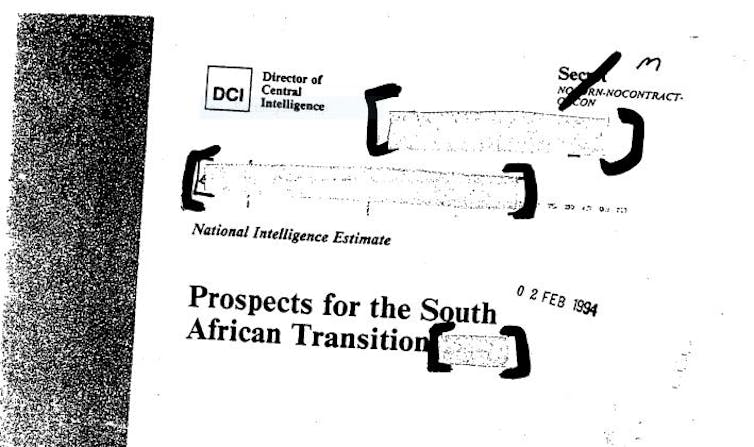
The cover page of the CIA document.
Author provided

The documents reveal just what a close-run thing the first truly democratic election was, and how much time and effort Britain and the USA spent ensuring that the voting went ahead.

Desperate times

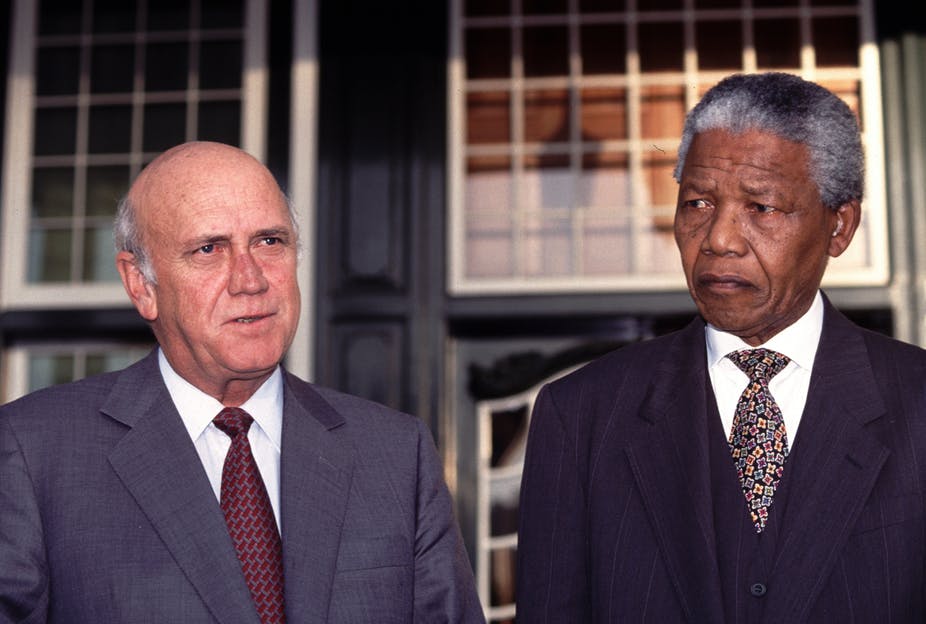
Prime Minister Major took a phone call from Nelson Mandela on 22 February, in which the ANC leader described the situation as “very difficult.” Major briefed Mandela on a meeting between the British ambassador and the Inkatha leader, Mangosuthu Buthelezi. He gave Mandela a full account of the conversation, which he warmly welcomed.

On 24 February there is the first indication of a joint Anglo-American mediation effort to resolve the crisis. This arose during planning for a visit to Washington by Major three days later.

Our starting point is that the situation has now deteriorated to the point where it seems very unlikely that left to themselves the South Africans will reach an agreement that will enable to participate in the elections. The consequences are likely to be very serious.

The British suggested that Major and Clinton might “offer their joint help to the transition process”.

The following day – having held discussions with Mandela, Buthelezi and President Frederik de Klerk – the British ambassador in Pretoria, Sir Anthony Reeve, was able to report that all three were prepared to go along with the Anglo-American initiative, although with some reservations. The ambassador concluded:

These responses do, I think, give us the green light to consult the Americans in detail on our thinking.

The proposal was discussed between Mandela and Buthelezi at a meeting on March 1 and both leaders agreed to “explore” the possibility of international mediation. Lord Carrington, who had negotiated the end of Rhodesia and its transition to Zimbabwe in 1980, was on a lecture tour of South Africa. He was approached by the ANC’s Thabo Mbeki who asked whether he might act as one of a panel of mediators.

Others suggested were US Secretary of State Henry Kissinger and former Tanzanian head of state Julius Nyerere.

There followed intensive discussions between London and Washington, over how such mediation might work; indeed, Carrington and Kissinger travelled to South Africa. In the end a failure to agree on the terms of reference for the mediators, and South African government fears that the elections might be delayed, put paid to the plan.

It has been claimed the crisis – the most immediate was that Buthelezi was threatening to boycott the poll – was resolved by surprising last minute mediation by Kenyan Professor, Washington Okumu. Other Commonwealth envoys who had excellent contacts with both the ANC leadership and Buthelezi, including the late Ghanaian diplomat Moses Anafu, doubt this, arguing that forces that led Buthelezi into the election were much bigger.

Indeed, Buthelezi’s brinkmanship had ensured key constitutional concessions. Okumu’s intervention seems then a face-saving device for the IFP leader. A joint statement was agreed between Mandela, Buthelezi and de Klerk on 19 April, which allowed the election to take place just a week later (April 26-28).

Close-run thing

It had been a close-run thing and South Africa’s first truly democratic election almost came to grief. But there were two more potential obstacles.

In the tense run-up to polling day, a report on the role of the apartheid state in stoking internal tension and violence was published. The Commission of Inquiry Regarding the Prevention of Public Violence and Intimidation, led by Justice Richard Goldstone had been established in 1991: its report was published on 21 April 1994. Judge Goldstone’s investigations revealed that sections of the South African Police had armed Inkatha, and pointed to attempts by senior police officers to subvert the work of his enquiry.

The charges were explosive and for a while the judge and his family were clearly at risk from white extremists. With de Klerk’s support and the knowledge of Mandela, Goldstone, his wife and a “key witness” (a former South African police officer) asked whether they might come to Britain. John Major agreed, and they were given temporary asylum and a safe house.

The second obstacle was the South African government’s clandestine chemical and biological weapons programme, known as “Project Coast.” The British Foreign Secretary, Douglas Hurd, contacted Washington about the possibility of issuing a formal public protest unless President de Klerk publicly admitted his government’s involvement in the use of these weapons against ANC and Namibian prisoners.

The British had apparently intervened to prevent the proliferation of these weapons to other rogue states or terrorist groups. On April 11 the US and British ambassadors delivered their protest to President de Klerk – which apparently did the trick. There was an agreement that all the chemical and biological systems would be destroyed and one of the key South African experts, Wouter Basson, who had travelled to Libya on several occasions, was subsequently prosecuted.

Political triumph

The April 1994 election proved to be a watershed for South Africa. In technical terms, the election was a fiasco, but it was a political triumph, according to the Commonwealth’s leading election official, Carl Dundass. Inkatha’s surprising victory in Natal-KwaZulu strongly suggest Natal “horsetrading” involved overturning an actual ANC victory to manage anticipated post-election violence.

Despite all the violence, tension and drama the election ended apartheid and allowed Major to phone Mandela with his congratulations – a highly satisfactory conclusion to an intense period of international diplomacy.The Conversation

Sue Onslow, Reader, Institute of Commonwealth Studies, School of Advanced Study and Martin Plaut, Senior Research Fellow, Horn of Africa and Southern Africa, Institute of Commonwealth Studies, School of Advanced Study

This article is republished from The Conversation under a Creative Commons license. Read the original article.
Institution for African ‘luminaries’ in crisis

The key institution in higher education for Africans “luminaries” is in dire straits.

Fort Hare offered an academic education to blacks from across sub-Saharan Africa, creating a pro-British black African elite.

The alumni featured prominently in subsequent independence movements and governments of newly independent African countries.

Nelson Mandela, Oliver Tambo, Robert Sobukwe (of the Pan Africanist Congress), Desmond Tutu, Kenneth Kaunda, Julius Nyerere, Robert Mugabe and Joshua Nkomo all studied there.

The institution in Alice in the Eastern Cape was initially funded by British missionaries with a political goal.

Mandela studied at Fort Hare for almost two years in the 1940s, but left the institution without a degree.

He later wrote in his autobiography that “For young black South Africans like myself, it was Oxford and Cambridge, Harvard and Yale, all rolled into one.”

Fort Hare is currently in such financial distress that it has used student funding to pay staff.

The revelation is contained in a forensic report by FastTrac Freelance Business Specialists, which paints a picture of a university in financial crisis.

The document says the university received a R35-million advance payment from the National Student Financial Aid Scheme in December to settle claims.

Vice-chancellor Dr Mvuyo Tom admitted the university redirected student grants to pay salaries because it “had no choice”.

He called on students who owed money to pay what was due. “If they don’t, they won’t be allowed to write their exams.”

No pics allowed at Mandela grandson hearing

A stern message was issued on Friday morning to the media in the Johannesburg Magistrate’s Court not to take photos inside or outside the court in the matter of a struggle icon’s grandson’s appearance on charges of rape.

Magistrate Paul du Plessis reminded the media that these are preliminary investigations and ordered that no pictures be taken inside or outside the court for the purpose of identifying the parties.

The magistrate made the order after the family complained.

He said the order was made in terms of Sexual Offences and Related Matters Act 32 of 2007 which prohibits the identification of an accused person before he pleads on charges against him.

The accused made a brief appearance and seemed composed.

After this, prosecutor Komos Mbhele told the magistrate the accused was facing a Schedule 6 offence which means the onus is on him to show exceptional circumstances which would allow him to be released on bail.

A spokesman for the family of the girl said Winnie Madikizela-Mandela tried to derail a complaint.

The spokesman said that Madikizela-Mandela, the late Mandela’s divorced wife, sent her bodyguard to the 15-year-old girl’s home. The spokesman said the bodyguard posed as a policeman but had no badge.

The spokesman, who refused to allow his name to be used by any of the media, said the bodyguard then revealed that he was there on behalf of Madikizela-Mandela.

The spokesman said Madikizela-Mandela promised to ask the provincial police commissioner to handle the case. The family reported the rape when they did not hear from Madikizela-Mandela again.

Madikizela-Mandela’s office has not responded to questions.

Source: The Star

Mandela grandson charged with rape

President Nelson Mandela’s grandson remains in police custody after the rape case against him was postponed in the Johannesburg Magistrates Court on Monday.

The 24-year-old Mbuso Mandela is accused of raping a 15-year-old girl, and was arrested at the weekend after the victim opened the rape case against him.

It’s alleged the teenager went to the toilet at a pub in Greenside earlier this month when he grabbed her and raped her inside one of the cubicles.

The police has confirmed that he remains in custody and the case was remanded to Friday for a formal bail application.

In June, another one of Mandela’s grandsons, Mandla, received a suspended sentence in the Mthatha Magistrates Court.

The Mvezo chief was previously found guilty of assaulting a local teacher in a road rage incident in 2013.

Mandla had been convicted of assault with intent to do grievous bodily harm, an offence that could result in a jail term, but he has been granted leave to appeal his assault conviction.

‘Mandela’s’ granddaughter stabbed to death

The granddaughter of black actor Morgan Freeman was stabbed to death on a Manhattan sidewalk early Sunday during what law-enforcement sources and witnesses described as an “exorcism” at the hands of her ranting boyfriend.

Freeman played the part of Nelson Mandela in the movie Invictus. It is a 2009 biographical sports drama film on how rugby was used to brainwash white voters to accept black rule.

The black killer of Freeman’s granddaughter yelled: “Get out, devils! I cast you out, devils! In the name of Jesus Christ, I cast you out!” while he plunged a hunting knife into 33-year-old E’Dena Hines’ chest, according to George Hudacko, who witnessed the 3 a.m. attack from his apartment window in Washington Heights.

Hines, an actress who had appeared on Broadway and on red carpets at Freeman’s side, was stabbed 16 times, officials said.

“The girl was making a lot of noise, screaming,” Hudacko said, adding. “I called 911 — I was begging them to come.”

Hines — whose grandmother Jeanette Adair Bradshaw was Freeman’s first wife — was attacked on West 162 Street near St. Nicholas Avenue, a few buildings from where she lived, cops and sources said.

Her live-in boyfriend, Lamar Davenport, 30, was in the throes of a drug-induced psychosis when he came after her, police sources said.

“Jesus Christ is born!” he shouted maniacly over her body.

A friend who’d had dinner with Davenport and Hines just hours earlier described her as “ecstatic,” the Daily Beast reported.

By 3 a.m., Davenport was so crazed that he continued his attack even as Hines lay lifeless on the sidewalk, one police source said.

When cops wrestled him off her, he “was still making a stabbing motion with his arm, but he had nothing in his fist — the knife was jutting out of her chest,” the police source said.

Davenport — an actor and rapper wannabe whose nickname is “Lyric” — abuses cocaine, pot and booze, and has two young children, according to law-enforcement sources. Hines was not their mother

Davenport was taken to New York-Presbyterian Hospital for a psychological evaluation, sources said. Davenport has been charged with murder.

Freeman, 78, issued a statement soon after the attack.

“The world will never know her artistry and talent and how much she had to offer,” the Oscar winner said. “Her star will continue to shine bright in our hearts, thoughts and prayers. May she rest in peace.”

Hines was Freeman’s granddaughter because her mother had been adopted by the star.

He was so close to Hines that in 2012, he had to squash reports that they were lovers.

Source: NYP

Fear of rape force girls to bunk school

Girl pupils in farming communities bunk school not out of choice but out of fear of being robbed, assaulted and raped on their way to and from school, a survey has revealed.

They live far from their schools and have to walk long distances either because they do not qualify for the government’s schools transport scheme or the service in their area is unreliable.

Of the 320 pupils in the Stellenbosch, Wellington, Grabouw and Wolseley farming areas who took part in the study, 48 percent have been robbed on their way to school and 37 percent have been exposed to sexual assault.

These statistics were revealed last week in a Women on Farms Project (WFP) study.

The WFP said its survey revealed many rural youngsters spent over an hour walking to school in the mornings and another hour walking back home in often harsh weather conditions.

Karen Roos, WFP’s women’s health and empowerment programme co-ordinator, said “girls have been raped and some girls encounter men exposing their genitals or asking them for sex”.

The study also revealed transport schemes plagued with problems, including overloaded buses, buses in a poor state of repair and an unreliable bus service which often results in pupils reaching school after classes have started.

Source: Weekend Argus

Letter: Why call me a ‘white bitch’ when I also love Mandela?

I am a white born-free. I was born in the year 1995 into a post-apartheid, democratic South Africa – the “Rainbow Nation” as Archbishop Tutu affectionately named us.

I am a “Millennial” or “Generation Y” as Time magazine likes to call me – free from the categorical narrow-minded stereotype my parents (“Generation X”) and their parents are neatly packed into.

A millennial is ideally a free- thinker, an open-minded spirit ready to take risks, as well as accepting of all races, and religions however diverse they are from their own. This is me.

This, supposedly, is also the girl who infringed my human right to dignity, as well as my right to feel safe in any given situation.

The boy and girl in the car that practised racism, violence, hate speech and assault against my friend and me in Stamford Hill Road outside Live – The Venue on a Saturday night in January could not have been older than 22.

While technically they may not be “born-frees” strictly speaking, these two people were born long after the apartheid regime had come to an end and democracy was a leading force in South Africa.

They have no excuse to harbour hate, vengeance, bitterness or any other negative feelings towards white people. The “race card” is being pulled out far too often in this country when nine times out of 10 race has absolutely nothing to do with the situation at hand.

All my friend did was cry out “a*******!” in frustration at the occupants of a speeding car that nearly ran us over as we crossed the road to get to our own car that night. But things escalated quickly.

Before I knew it, the speeding car had stopped and a drunk couple alighted, tumblers in hand, cussing at us.

The phrase “white bitches” were among others thrown at us as the girl screamed in my friend’s face, threatening to assault her.

We removed ourselves from the situation and as we walked away, we felt liquid on our backs as a glass sailed past, narrowly missing my head and shattering on the pavement in front of us.

One of the main things which set our Generation Y apart is that we are classified as “tolerant”.

Our generation is supposedly tolerant of other races, cultures, points of view, political standpoints.

I could fill this letter with a long list of examples of our tolerance, but the fact is many of us in South Africa are not tolerant and it sends a surging pang of guilt to my very core when I think of what dear Madiba would say of these attitudes.

This is the country he spent his entire life moulding into something he could finally be proud of.

But I do not think Madiba would be proud. He would look down on these backward, destructive, unproductive, entitled Millennials.

You don’t even deserve to be associated with the term since Millennials are meant to be forward-thinking go-getters. We are supposed to be a generation that makes its own future. But you sit back and wait for your futures to make you.

Well, guess what? You’re going to be waiting a long time and your frustration will cause you to riot and fight and scream and tear down statues unnecessarily.

You are your worst enemies and that will eventually destroy you. I can wash off the alcohol you throw at me, but you cannot wash away the hate that is inside of you.

All Millennials need to read this and consider which category they fall into for the good of their future – and more importantly, the good of our beautiful country’s future.

– Meghan Deonn Oberholzer, Vredehoek

Mandela’s grandson to be sentenced for assault

Former President Nelson Mandela’s grandson Zwelivelile Mandla Mandela is expected to be sentenced in the Mthatha Magistrate’s Court in the Eastern Cape on Tuesday.

He was convicted of assaulting Mthatha teacher Mlamli Ngudle two years ago.

While the Chief of Mvezo, Mandela was found guilty of assault, he was acquitted on a charge of pointing a firearm.

Mandela attacked Ngudle at Sprigg Street in Mthatha in 2013 after he allegedly bumped a car belonging to Mandela’s business associates.

According to Ngudle, Mandela slapped him across the face and kicked him while pointing him with a firearm. Magistrate Noluthando Conjwa said there was no evidence supporting the allegation of a firearm.

Sowetans attack Eskom for blackouts

Eskom is under attack – by the City of Joburg and the regional ANC over the almost week-long spate of power outages in Soweto.

The council has slammed the power utility for inefficiency and for failing to deliver on its mandate.

The City of Joburg claimed areas supplied by its own utility, City Power, still had power, but those Eskom supplied did not.

“This is why new housing and business developments such as RDP houses, flats and hotels have power in the township, while the large part of Soweto supplied by Eskom has been cut off,” said Matshidiso Mfikoe, the city’s mayoral committee member for Environment and Infrastructure Services.

She accused Eskom of being “insensitive” and showing “complete and utter disregard” for the people of Soweto.

But Eskom spokesman Khulu Phasiwe said there was “nothing sinister” about the power outages.

He attributed the blackouts to load shedding and then, when the power was due to be switched on again, overloading that caused the transformer to trip.

“When you have in some houses four or five backrooms using stoves at the same time, there is absolutely no way that the power will hold.

“We can’t control unplanned outages resulting from overloading,” Phasiwe said.

Eskom has been involved in a long-running battle with Soweto consumers over unpaid bills. Phasiwe said Soweto owed Eskom about R8 billion, of which R4bn was overdue.

“Some 84 percent of residents have not been paying their debt. Ideally, you should be having 16 percent not paying and 84 percent paying,” Phasiwe pointed out.

A key dispute – related to the outstanding billing problem – is the installation of prepaid electricity meters in Soweto. Both Eskom and City Power are installing meters for their customers. There have been ongoing protests across Soweto against their installation. Last week, Orlando West residents blockaded streets in protest against Eskom’s prepaid meters.

Mfikoe accused Eskom of changing the payment system unilaterally. She suggested it was inconceivable that the prolonged outages could occur without notice “in the township internationally renowned as home to two Nobel peace laureates, Dr Nelson Mandela and Archbishop Emeritus Desmond Tutu”.

Source: IOL

Necklacing reaches Burundi

Protesters burned a man alive in Burundi’s capital yesterday, saying he was a member of the ruling party’s youth wing, which had attacked them during their demonstrations against the president’s bid for a third term, a witness said.

Protesters have been on Bujumbura’s streets for almost two weeks, often hurling stones at the police, whom they say have fired live rounds at them. The police deny this.

Opponents of the government say the June 26 presidential election should be delayed by a few weeks because of the unrest.

President Pierre Nkurunziza’s spokesman said a delay was unnecessary because most of the country was calm.

The violence has plunged the nation into its worst crisis since the end of a civil war in 2005 that pitted the ethnic Hutu majority against the powerful Tutsi minority.

“They put tyres around his neck and then burnt him,” a witness said in the Nyakabiga district of Bujumbura.

Local media also reported the incident and the Red Cross said a man was killed in Nyakabiga but, in line with its usual practice, did not say how he died. It said a woman was killed in another area yesterday.

Protesters said the victim of the burning was a member of the Imbonerakure youth wing of the ruling CNDD-FDD party, which they say has attacked them. The government has repeatedly dismissed charges that Imbonerakure is fomenting violence.

Activists say at least 14 people have been killed since the protests erupted. Police gave lower figures.

Winnie Madikizela-Mandela, wife of Nelson Mandela, called on her supporters to burn political opponents alive.

She is often called ‘Mother of the Nation’, but was personally responsible for the murder, torture, abduction and assault of numerous men, women and children, as well as indirectly responsible for an even larger number of such crimes.

In Munsieville on 13 April 1986, she openly endorsed the practice of necklacing (burning people alive using tyres and petrol) by saying: “[W]ith our boxes of matches and our necklaces we shall liberate this country.”

Source: Reuters/Wikipedia

SA performs first penis transplant

South African doctors announced Friday that they had performed the world’s first successful penis transplant, three months after the ground-breaking operation.

South Africa has long been a pioneer of transplant surgery. In 1967, Chris Barnard performed the world’s first heart transplant at Groote Schuur Hospital in Cape Town.

The 21-year-old black patient had his penis amputated three years ago after a botched circumcision at a traditional initiation ceremony. Scores of black South African men from certain tribes have their penises amputated each year after botched circumcisions during primitive rituals.

In a nine-hour operation at the Tygerberg Hospital in Cape Town, he received his new penis from a deceased donor from the same racial group.

Professor Frank Graewe, head of plastic reconstructive surgery at Stellenbosch University, performed the operation. Graewe studied at Pretoria University.

The patient has made a full recovery since the operation on December 11 and regained all urinary and reproductive functions only five weeks after the procedure.

“Our goal was that he would be fully functional at two years and we are very surprised by his rapid recovery,” said Professor Andre van der Merwe, head of Stellenbosch’s urology division.

“There is a greater need in South Africa for this type of procedure than elsewhere in the world,” Van der Merwe said in a statement.

The South African transplant team included three senior doctors, transplant coordinators, anaesthetists, theatre nurses, a psychologist and an ethicist.

Surgeons from Stellenbosch University and Tygerberg Hospital had searched extensively for a suitable donor from the same racial group as part of a pilot study to develop penis transplants in Africa.

Some techniques were developed from the first facial transplant in France in 2005.

They now plan to perform nine more similar operations.

Some 486 Xhosa boys died at the winter initiation schools between 2008 and 2013, with a major cause being complications such as infection, rotting penises, septicaemia and inadvertent castrations after circumcision. The initiates are drugged with marijuana and witchcraft potions.

Xhosas spend about a month naked in secluded bush or mountain regions as part of their secretive initiation ritual. They thus become part of the Xhosa ethnic tribe. They paint their faces white during the ritual.

Former presidents Nelson Mandela, Thabo Mbeki and Archbishop Desmond Tutu are all circumcised Xhosas, belonging to South Africa’s second largest tribe, who never gave up the practice. President Jacob Zuma is regarded as a “boy” because he is an uncircumcised Zulu.

All gain a warrior name and are briefed on the terrible dangers of white witches during the initiation ceremony.

The Zulu king, King Goodwill Zwelithini’s decision in 2010 to reintroduce circumcision 200 years after it was scrapped by King Shaka, alarmed health officials who said HIV is spread because the same blunt knife is used on large groups.

Merkel warns UK could exit EU over immigration policy

Germany’s Chancellor Angela Merkel has signaled she would rather see the UK leave the EU than compromise the free movement of immigrants, German magazine Der Spiegel reported.

The UK is nearing a “point of no return,” as British Prime Minister David Cameron attempts to renegotiate the terms of the country’s EU membership targeting the freedom of movement, Merkel reportedly said.

According to the 2011 census, 579,000 Poles reside in the UK, making up under 1% of the UK population.

This tiny white minority receive enormous attention from British rightwing media and politicians, who prefer black immigrants from Africa, Muslim immigrants from Pakistan and worship the legacy of Nelson Mandela.

David Cameron’s comments that Polish migrants are taking advantage of UK benefits has sparked much anger in Poland. Poles became the target of violence and political attacks.

The prime minister, Donald Tusk, and the opposition leader, Jaroslaw Kaczynski (whose party sits alongside UK Conservatives in a European parliamentary group) immediately announced that they would veto any changes in EU migration rules.

The large numbers of Polish and Czech immigrants that arrived throughout the last decade did not run the British economy into the ground.

A 2013 report from the Centre for Research and Analysis of Migration found that European Union immigrants contributed more to the economy than they collected in benefits, contrary to native-born citizens.

On the whole, Polish immigrants were younger and more highly skilled than average citizens, and the majority found work in the UK.

Britain’s reaction to the Romanian and Bulgarian immigrants has been particularly strong for a number of historical and political reasons.

This was Merkel’s first hint that the UK’s exit from the union is a possibility, according to German media.

Cameron earlier said he wants to renegotiate the country’s EU membership before going through with a referendum on the subject, with the European principle of freedom of movement “at the very heart of my renegotiation strategy for Europe.”

Merkel has stressed that her support for UK membership could be reversed, if Cameron pursues migration reform.

Cameron has extended the EU laws “to their limits,” trying to turn away unemployed migrants and seeking deportation of those unable to make ends meet after three months, according to the report.

Earlier in October, the former European Commission (EC) president Jose Manuel Barroso stated that freedom of movement is an essential principle of the EU, and any plan by Britain to cap the number of migrants through the limitation of national insurance numbers would be illegal under EU law.

With next year’s general election on the horizon, British politicians are talking tougher on the issue of migrant workers. It will be the first election since the anti-immigration Independence Party (UKIP) emerged as a serious political player.

The latest opinion poll revealed that support for UKIP has reached a record high following Brussels’ recent effort to levy a mammoth £1.7 billion ($2.7 billion) extra charge on Britain. Cameron has been forced to adjust his policies to win back public support.

Cameron announced plans to reduce the number of low skilled migrant workers coming to the UK from other EU countries by limiting the number of national insurance numbers given to them.

In the recent policy shift, he said EU migrants could now only claim benefits for a maximum of three months, down from six.

These legislative changes, which apply to child tax credit, child benefits and job seeker’s allowance, will be implemented in November.

Cameron is likely to make a speech on immigration policies before Christmas, according to media reports.

Meanwhile, the EC says it endorses the principle of free movement within the EU, where citizens have the right to work and live in all member states.

Ebola translator steals the show

This is not the first time that has sign language translator has grabbed the headlines at a major event.

While an Ebola news conference should have been grabbing the headlines, a signer stole the show. The signer has now gone viral on social media, with some even questioning whether he was a legitimate interpreter.

The media conference was headed by New York Mayor Bill de Blasio and health officials, who were giving updates on the city’s first case of Ebola on Friday. However, as the officials continued, attention started to be diverted to a man sitting on the very left of the platform.signing

At Nelson Madela’s funeral in December 2013, South African Thamsanqa Jantjie appeared on stage and proceeded to conduct fake sign language gestures during the dignitaries’ speeches – including by US President Barack Obama – in an event that was watched by 95,000 mourners at Soccer City stadium in Johannesburg and millions around the world.

“There was zero percent accuracy. He couldn’t even get the basics right. He couldn’t even say thank you,” Delphin Hlungwane, a South African sign language interpreter at DeafSA, told Reuters.

Jantjie later claimed he was suffering a schizophrenic episode at the Mandela memorial service.

South African broadcaster, eNCA investigations, discovered that Jantjie, who is receiving treatment for his schizophrenia, has also faced rape (1994), theft (1995), housebreaking (1997), malicious damage to property (1998), murder, attempted murder and kidnapping (2003) charges.

Winnie contests divorce from Mandela

Winnie Madikizela-Mandela has claimed in papers filed in the High Court in Mthatha that her divorce from former president Nelson Mandela was fraudulently obtained, the Daily Dispatch reported on Wednesday.

She claimed her marriage certificate was also a fraud and sought to have the divorce order rescinded.

The 78-year-old, who was Mandela’s second wife for 38 years, was left out of Mandela’s will.

“The certificate is clearly a fraudulent document and is quite obvious that [during] the divorce hearing the court was misled and the divorce order was obtained through fraud or misrepresentation,” she submitted in her affidavit, according to the newspaper.

She was not in the country when the divorce was finalised, she says, and only saw the divorce order for the first time in August this year.

She pointed out inaccuracies in the marriage certificate, which the newspaper had seen a copy of. The certificate was issued by the then Republic of Transkei for the marriage in June 1958.

Madikizela-Mandela said the Transkei Republic did not exist in 1958 as “independence” was only granted in 1976. The signatures on the certificate did not belong to her or Mandela, she alleged.

“Our marriage officer was Reverend Gamndana and not GGK Madikiza,” as stated on the certificate.

The certificate stated they were married in Bizana, and that community of property was excluded.

Madikizela-Mandela contended that the court never ordered the forfeiture of the Qunu property as they never engaged in any settlement negotiations on their properties.

In her application, Madikizela-Mandela challenged Mandela’s estate, seeking the rights to his home in Qunu, Eastern Cape.

Mandela died in December last year.