FW de Klerk Foundation kow-tows to its critics after ‘apartheid statement’

The FW de Klerk Foundation has completely retracted its previous statement that characterising “apartheid” as a “crime against humanity… was, and remains, an ‘agitprop’ project initiated by the Soviets and their ANC/SACP allies to stigmatise white South Africans” (see below).

It seems that the statement had been sent out by the Foundation’s CEO, Dr Dayne Morkel. However, the chairman of the board, Dr. Theuns Eloff, said that “no-one would be fired or resign”.

“It was a mistake to issue that statement, and I believe that the mistake was made because of an error in judgement and some emotionality over the attacks by the EFF,” said Eloff.

In another statement issued on 17 February by his foundation, De Klerk apologised profusely and stated:

“I have taken note of the vehement reaction to our response to the EFF’s attack on me at the State of the Nation address on Thursday night.

“I agree with the Desmond and Leah Tutu Foundation that this is not the time to quibble about the degrees of unacceptability of apartheid. It was totally unacceptable.

“The FW de Klerk Foundation has accordingly decided to withdraw its statement of 14 February unconditionally and apologises for the confusion, anger and hurt that it has caused.”

The original statement issued on 14 February reads as follows:

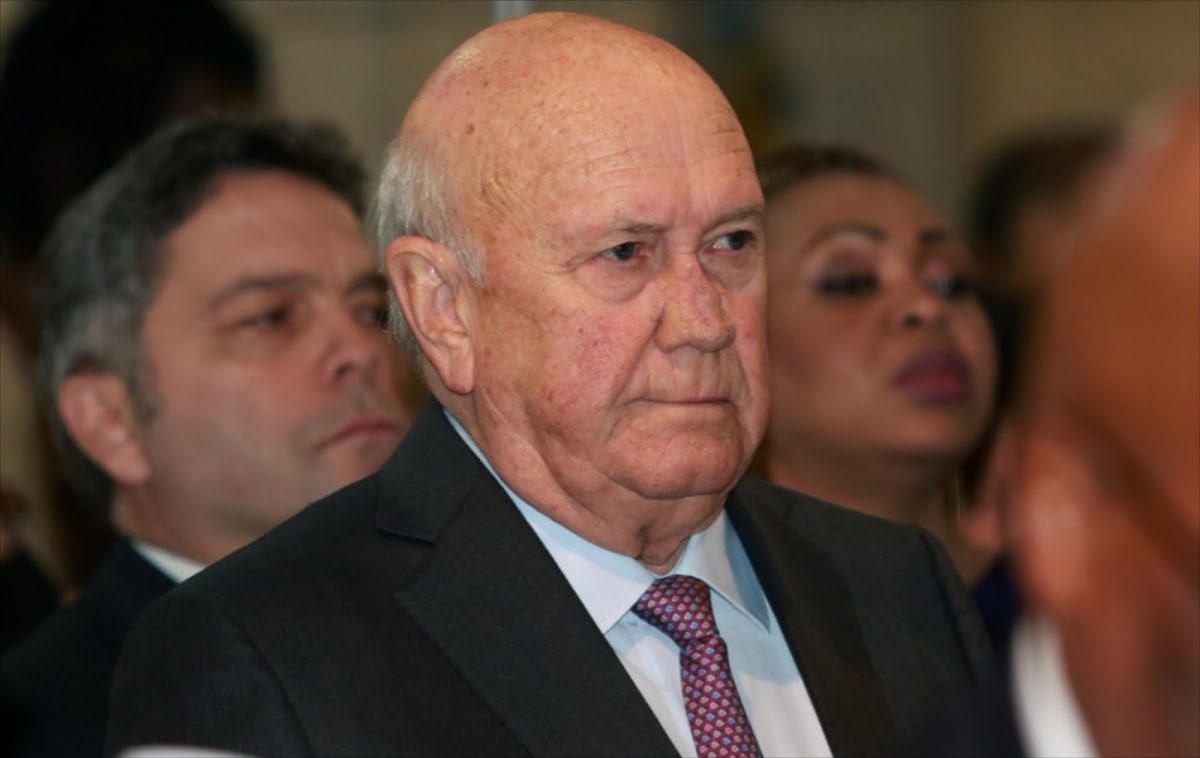
Last night at the opening of SONA, FW de Klerk, former President and Nobel Peace Laureate, and his wife Elita had to endure wave after wave of vitriolic attacks by Julius Malema and EFF members of Parliament, clad in their trademark red boiler suits. They claimed that his hands were dripping “with blood”, including the blood of those who had been slaughtered at Boipatong. Worst of all, FW de Klerk had denied – in a TV interview the previous week – that apartheid was “a crime against humanity.” Their demands that he should be removed from the chamber were rejected by the Speaker, Thandi Modise. De Klerk – who will turn 84 next month – sat impassively in the public gallery as he watched the spectacle below.

De Klerk has repeatedly acknowledged the grave injustices committed under apartheid and has sincerely apologised on a number of occasions to those who suffered under previous governments. These were more than empty words: he dedicated his entire presidency to the abolition of apartheid and the negotiation of a new Constitution that would entrench the rights of all South Africans regardless of race. He oversaw the process that culminated in the repeal of all the remaining apartheid laws.

But was apartheid a crime against humanity?

First we have to look at the origins of the charge: In November 1966 the UN General Assembly declared apartheid to be a crime against humanity – and in 1973 it adopted the Convention on the Suppression and Punishment of the Crime of Apartheid.

Both the Resolution and the Convention were political initiatives of the Soviet Union – which had itself committed atrocious crimes against humanity that involved the killing of millions of people. In 1976, when the Convention came into force, 23 of the 31 signatories were, according to Freedom House in New York, “not free”. Six were partly free – and only two were free. Ironically, South Africa was classified as “partly free” – and had a better human rights score than 27 of the signatories.

The 109 states that subsequently joined the Convention included none of the core democracies. According to the United States delegate:

“Deplorable as it is, we cannot, from a legal point of view, accept that apartheid can in this manner be made a crime against humanity. Crimes against humanity are so grave in nature that they must be meticulously elaborated and strictly construed under existing international law…”

The idea that apartheid was ‘a crime against humanity’ was, and remains, an ‘agitprop’ project initiated by the Soviets and their ANC/SACP allies to stigmatise white South Africans by associating them with genuine crimes against humanity – which have generally included totalitarian repression and the slaughter of millions of people.

By contrast, some 23 000 people died in South Africa’s political violence between 1960 and 1994 – of whom fewer than 5 000 were killed by the security forces. Most of the rest of the deaths occurred in the conflict between the IFP and the ANC. In Kenya, the British interned more than 320 000 people during the Mau-Mau uprising and hanged more than a thousand Mau-Mau members. In Algeria, the French killed more than 140 000 people in a war that claimed some 700 000 lives.

None of this is meant to whitewash the injustices that were undoubtedly committed under apartheid. However, we need a balanced understanding of the past – not one based on a simplistic black/white, good/evil framework – but on a framework that reflects the infinite shades of grey that actually characterise history.

John Allen, a close associate of Archbishop Desmond Tutu, acknowledges in his book “Rabble Rouser for Peace” that “no evidence was ever forthcoming (at the TRC) implicating De Klerk in violence.” This was despite the fact that Truth and Reconciliation Commission (TRC) clearly had an agenda to incriminate De Klerk. He writes of the TRC’s “frustration” at its failure to “pin responsibility for violations of human rights on De Klerk” and acknowledges “the embarrassing weakness of its finding against him.”

As for Boipatong, the TRC’s amnesty committee found in November 2000 that the IFP supporters who perpetrated the Boipatong killings in June 1992 had acted alone.

It is ironic that Julius Malema who launched the vitriolic attack on De Klerk, threatened to commit a real crime against humanity when he said on 7 November 2016 that “We are not calling for the slaughtering of white people – at least not now.”

In a way, an attack by Julius Malema and the EFF, is the sincerest form of compliment. We have seen his kind before: those who wear colour-coded uniforms; who use bully boy tactics to disrupt democratic processes; who whip up race hatred and call their leaders “Führer, or Duce, or Commander in Chief”. The words of a WB Yeats, (whom Malema would not doubt regard as a ‘colonialist’), came to mind while watching the EFF debacle in Parliament:

“Things fall apart; the centre cannot hold; Mere anarchy is loosed upon the world,

The blood-dimmed tide is loosed, and everywhere The ceremony of innocence is drowned;

The best lack all conviction, while the worst

Are full of passionate intensity.”

Issued by the FW de Klerk Foundation, 14 February 2020

Archive documents reveal the US and UK’s role in getting the ANC into power

Sue Onslow, School of Advanced Study and Martin Plaut, School of Advanced Study

It is a quarter of a century since the end of apartheid in South Africa. But it’s easy to forget how complex, difficult and violent the birth of full democracy really was. This was particularly true in KwaZulu-Natal, where battles between the African National Congress (ANC) and the mainly Zulu Inkatha Freedom Party (IFP) claimed the lives of as many as 20,000 in the decade between 1984 and 1994.

In the three months before the first elections in April 1994 an estimated 1 000 people were killed. The British and Americans were becoming increasingly concerned. The conflict between Inkatha and the ANC was just one crisis: another was developing with far right white extremists, who were threatening to resort to violence.

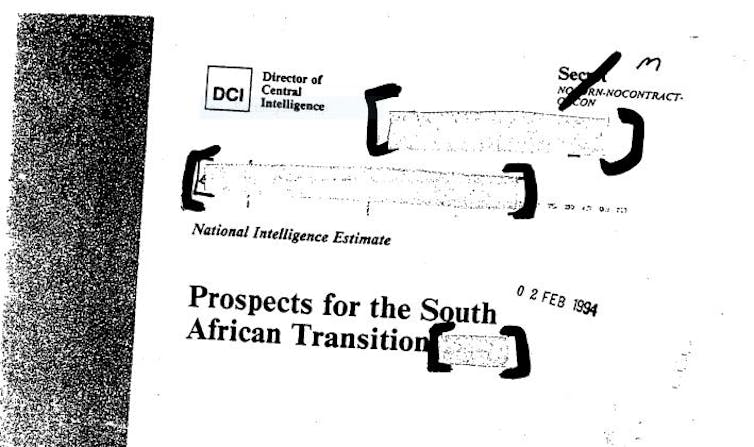
The US Central Intelligence Agency (CIA) reported that there was an:

eight in 10 chance that violence will surge immediately before and during the election, when emotions are at their highest.

The agency also warned of the threat of a right wing coup, although it considered this “unlikely”. (This CIA report is available in hard copy only.)

As the situation grew increasingly tense, Britain’s Prime Minister John Major and the US’s President Bill Clinton became personally involved. Their interventions are shown in documents just released by the UK National Archives.

The cover page of the CIA document.
Author provided

The documents reveal just what a close-run thing the first truly democratic election was, and how much time and effort Britain and the USA spent ensuring that the voting went ahead.

Desperate times

Prime Minister Major took a phone call from Nelson Mandela on 22 February, in which the ANC leader described the situation as “very difficult.” Major briefed Mandela on a meeting between the British ambassador and the Inkatha leader, Mangosuthu Buthelezi. He gave Mandela a full account of the conversation, which he warmly welcomed.

On 24 February there is the first indication of a joint Anglo-American mediation effort to resolve the crisis. This arose during planning for a visit to Washington by Major three days later.

Our starting point is that the situation has now deteriorated to the point where it seems very unlikely that left to themselves the South Africans will reach an agreement that will enable to participate in the elections. The consequences are likely to be very serious.

The British suggested that Major and Clinton might “offer their joint help to the transition process”.

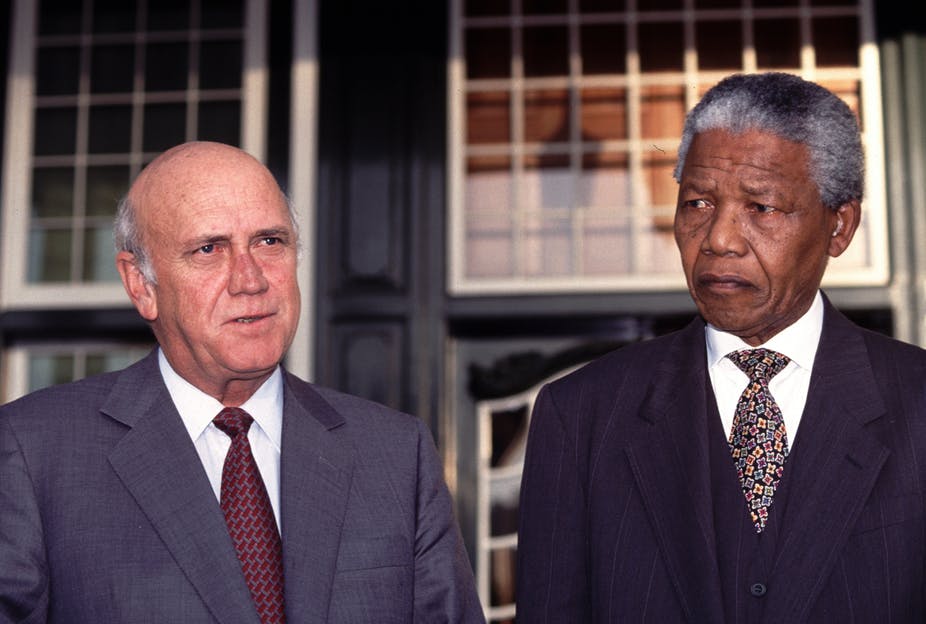
The following day – having held discussions with Mandela, Buthelezi and President Frederik de Klerk – the British ambassador in Pretoria, Sir Anthony Reeve, was able to report that all three were prepared to go along with the Anglo-American initiative, although with some reservations. The ambassador concluded:

These responses do, I think, give us the green light to consult the Americans in detail on our thinking.

The proposal was discussed between Mandela and Buthelezi at a meeting on March 1 and both leaders agreed to “explore” the possibility of international mediation. Lord Carrington, who had negotiated the end of Rhodesia and its transition to Zimbabwe in 1980, was on a lecture tour of South Africa. He was approached by the ANC’s Thabo Mbeki who asked whether he might act as one of a panel of mediators.

Others suggested were US Secretary of State Henry Kissinger and former Tanzanian head of state Julius Nyerere.

There followed intensive discussions between London and Washington, over how such mediation might work; indeed, Carrington and Kissinger travelled to South Africa. In the end a failure to agree on the terms of reference for the mediators, and South African government fears that the elections might be delayed, put paid to the plan.

It has been claimed the crisis – the most immediate was that Buthelezi was threatening to boycott the poll – was resolved by surprising last minute mediation by Kenyan Professor, Washington Okumu. Other Commonwealth envoys who had excellent contacts with both the ANC leadership and Buthelezi, including the late Ghanaian diplomat Moses Anafu, doubt this, arguing that forces that led Buthelezi into the election were much bigger.

Indeed, Buthelezi’s brinkmanship had ensured key constitutional concessions. Okumu’s intervention seems then a face-saving device for the IFP leader. A joint statement was agreed between Mandela, Buthelezi and de Klerk on 19 April, which allowed the election to take place just a week later (April 26-28).

Close-run thing

It had been a close-run thing and South Africa’s first truly democratic election almost came to grief. But there were two more potential obstacles.

In the tense run-up to polling day, a report on the role of the apartheid state in stoking internal tension and violence was published. The Commission of Inquiry Regarding the Prevention of Public Violence and Intimidation, led by Justice Richard Goldstone had been established in 1991: its report was published on 21 April 1994. Judge Goldstone’s investigations revealed that sections of the South African Police had armed Inkatha, and pointed to attempts by senior police officers to subvert the work of his enquiry.

The charges were explosive and for a while the judge and his family were clearly at risk from white extremists. With de Klerk’s support and the knowledge of Mandela, Goldstone, his wife and a “key witness” (a former South African police officer) asked whether they might come to Britain. John Major agreed, and they were given temporary asylum and a safe house.

The second obstacle was the South African government’s clandestine chemical and biological weapons programme, known as “Project Coast.” The British Foreign Secretary, Douglas Hurd, contacted Washington about the possibility of issuing a formal public protest unless President de Klerk publicly admitted his government’s involvement in the use of these weapons against ANC and Namibian prisoners.

The British had apparently intervened to prevent the proliferation of these weapons to other rogue states or terrorist groups. On April 11 the US and British ambassadors delivered their protest to President de Klerk – which apparently did the trick. There was an agreement that all the chemical and biological systems would be destroyed and one of the key South African experts, Wouter Basson, who had travelled to Libya on several occasions, was subsequently prosecuted.

Political triumph

The April 1994 election proved to be a watershed for South Africa. In technical terms, the election was a fiasco, but it was a political triumph, according to the Commonwealth’s leading election official, Carl Dundass. Inkatha’s surprising victory in Natal-KwaZulu strongly suggest Natal “horsetrading” involved overturning an actual ANC victory to manage anticipated post-election violence.

Despite all the violence, tension and drama the election ended apartheid and allowed Major to phone Mandela with his congratulations – a highly satisfactory conclusion to an intense period of international diplomacy.The Conversation

Sue Onslow, Reader, Institute of Commonwealth Studies, School of Advanced Study and Martin Plaut, Senior Research Fellow, Horn of Africa and Southern Africa, Institute of Commonwealth Studies, School of Advanced Study

This article is republished from The Conversation under a Creative Commons license. Read the original article.

Tycoon says Apartheid was bad for business

Apartheid was not good for his businesses Johann Rupert, chairman of the Remgro and Richemont groups, declared on Tuesday.

He was one of the speakers at the FW de Klerk Foundation’s conference on issues related to the South African economy and race.

On 2 February 1990 De Klerk unbanned most terrorist organisations, including the ANC, SACP and the PAC and announced the liberation of Mandela and all leftwing and communist political prisoners.

Almost all rightwing political prisoners are still in prison after 25 years, an indication of De Klerk’s total lack of popularity amongst whites.

Rupert, De Klerk, former deputy president Kgalema Motlanthe and Lord Renwick were guest speakers at the annual FW de Klerk Foundation conference in Cape Town, commemorating the 25th anniversary of Nelson Mandela’s release.

“We had businesses here and overseas and the businesses in foreign countries did much better [during apartheid]. Over there returns were 10% or 12% more than in South Africa,” Rupert said.

Rupert dismissed the notion of wealth redistribution as the panacea for inequality, saying the issue was rather to create the conditions to create wealth.

“Trade unions destroy jobs. Their job is not to create jobs, their job is to protect people who are already employed. They do not represent the interests of the unemployed,” he said.

His remarks were made a week after the Heritage Foundation, a Washington DC thinktank, pointed an accusatory finger at the strong influence of the unions in the economy.

De Klerk told the forum he was convinced that “what we have now is much better than what we had in the past”.

Lord Robin Renwick, the British ambassador to South Africa prior to Mandela’s release, said South Africa would do best by “defending its constitution and the independence of the judiciary”.

Progressive redistribution was not an unrealistic goal, he added, but the question was how it would unfold as perceptions could affect the country.

If there was to be increased state intervention, he said, “then you need to have a state more efficient than we have seen anywhere in the world ever”.

Not even East Germany managed that, he said, quipping: “Karl Marx is dead everywhere, except in South Africa.”

But debate was urgently needed to forge social cohesion, the two former presidents, the Afrikaner tycoon and British diplomat agreed on Tuesday.

Former president Kgalema Motlanthe deplored the fact that South Africans criticised the country’s “black government”, saying it was both a political misnomer because the government was democratically elected and an indicator of division.

“Labelling the government black may say more about their thinking than anything they are trying to express. The result is a misinformed and misleading discourse which often entrenches social stereotypes, fuelling feelings of alienation.

“If there is one space that provides a useful index of race relations in the country it is social media. In the recent past the social-media space has seen torrential racial abuses across the social spectrum openly advocating the biological, historical, economic and social utility of the construct of race as the organising principle in human affairs.

“Most disheartening about this open manifestation of racial hostilities is the debilitating effects on what we are trying to build, a nation united in diversity.”

Europe created the Afrikaner problem in South Africa

A recent statement by the FW de Klerk Foundation in Cape Town after the Constitutional Court’s finding in the Renate Barnard affirmative-action case, said that “[the judgement] is, in effect, a prescription for, and validation of, harmful discrimination against millions of South African citizens for an indefinite period, on no basis other than their race – and with no reference to their individual merits, circumstances or concerns”.

[followbutton username=’danroodt’ count=’true’ lang=’en’ theme=’light’]

roodt_fbfotoLegalised “positive discrimination” against South African whites is now a fact of life, as is the growing racial nationalism of the country’s blacks. “Africa for the Africans” is the underlying slogan in South Africa, by which we must understand “African” in a racial sense. Many of South Africa’s radicalised black intellectuals and celebrities affirm that every African has the right to cross the border and settle in South Africa, but that whites “belong to Europe”.

Raidersblad2
Buy Dan Roodt’s new ebook essay for only $3 or R30.

In essence, what black racial nationalists assert is that Afrikaners have not naturalised after 360 years in the country. This might have been dismissed as simple talk by blacks, if it were not supported by the courts and the political system in South Africa which effectively exclude the Afrikaner minority of all political power and influence. Outside the Western Cape, there is not even a single municipality where Afrikaners have any say in how their taxes are spent, let alone a province or the central government.

Objectively speaking, Afrikaners have been disarmed, disenfranchised, culturally marginalised and now find themselves in the position summed up by the Canadian political scientist, Heribert Adam, as an “internal diaspora” in South Africa. Being an internal diaspora is but a few nuances removed from having the status of internal refugees.

Since 1994, criminal, political and social violence has been constantly rising in South Africa and Afrikaners have been victims of so-called “farm murders” and attacks during which they are tortured and executed in dehumanising ways reminiscent of ethnic war and ethnic cleansing. In the cities too, house robberies and interracial attacks are rising. Together with legislation all but prohibiting them from holding state and corporate jobs, it is clear that the only rational choice for Afrikaners is to leave as many have already done, emigrating to Australia, New Zealand and other countries in the British Commonwealth.

With the benefit of hindsight, both South Africa and the ex-Rhodesia were deliberately brought under the control of radical black-nationalist movements that saw no long-term future for whites in Southern Africa, notwithstanding the posturing of Nelson Mandela before the world media, which was simply meant to ensure a smooth transfer of military and police power to the ANC and the South African Communist Party.

Over the past decade or two we have seen many countries destabilised by the Western drive for “democracy”, which is usually an ill-concealed strategy to strip the target countries of their mineral wealth and other assets. In that respect, South Africa is no different to Afghanistan, Iraq, Libya, Pakistan, Somalia, and Yemen where the USA is currently fighting wars. America also has military personnel deployed in other states, including Algeria, Bahrain, Djibouti, Egypt, Israel, Jordan, Kuwait, Lebanon, Morocco, Oman, Pakistan, Qatar, Saudi Arabia, Tunisia, and the United Arab Emirates.

While Europe normally pays obeisance to the USA in its global strategy and foreign adventures, lately also seen in Ukraine where Russian commentators have accused the EU of being a “lapdog” of the USA, the Old Continent carries a heavy responsibility for the destabilisation of Southern Africa. Instead of finding a compromise between the various peoples and interest groups in this part of the world, European states have consistently supported the most radical, anti-white, quasi-Marxist revolutionary groups. The rise of Malema and the Economic Freedom Fighters in South Africa portend exactly the same future for South Africa as the present Zimbabwe, with the confiscation of white-owned farms, urban property and other assets.

As in Gabriel García Márquez’s famous novel, Chronicle of a Death Foretold, we know exactly what the outcome is going to be: the ethnic cleansing of Afrikaners from South Africa, with or without even more violence than we are experiencing at present from the marauding, anomic killers that prosper under the ANC government’s policy of laissez-faire and a gradual descent into general lawlessness.

At least five European states may be held accountable for Afrikaners’ becoming a stateless people: Sweden, Norway, the Netherlands, (East) Germany and our former colonial power, the United Kingdom. They financed and supported, also through propaganda and diplomatic means, the African National Congress and South African Communist Party, knowing full well that these were radical, revolutionary movements that would ultimately “chase the whites into the sea” as had occurred in several other African states, notably the Belgian Congo (currently the DRC), Algeria, and the Portuguese colonies such as Mozambique and Angola.

It is telling that, after finally seeing the writing on the wall, albeit 20 years too late, the FW de Klerk Foundation has just launched an appeal to the “international community” in trying to stem the devastating effects of permanent affirmative action upon a politically powerless minority. According to the FW de Klerk Foundation, “We must make it clear that we are not prepared to accept a status as second-­‐class citizens.”

Clearly, De Klerk merely followed European and particularly British dictates twenty years ago, in the optimistic belief that there would be some kind of Western or European “veto” in the future if things had to go wrong. However, with so many countries being destabilised by American wars, the international community would simply regard South Africa as yet another casualty of internal divisions without acknowleding the key role played by Europe in setting what used to be an organised Western-style industrial state on the road to radicalism, revolution and ethnic cleansing.

There is an expression in Afrikaans, gedane sake het geen keer, which is more or less equivalent to the English “no use in crying over spilt milk”. Afrikaners will never rule South Africa again and the country is living through a miniature “decline of the West”, with long-forgotten African beliefs and superstitions displacing Christianity and even the secular, scientific thought of the European Enlightenment. Mbeki’s so-called AIDS denialism was but one, highly publicised challenge to science which is also taking place in many other fields.

South Africa, like Zimbabwe, has been broken and it will never be fixed, unless there takes place such a vast conceptual revolution in the world which makes possible another basis for political power besides sheer numbers and demography, but there are very few signs of such a development. In truth, no-one cares about the fact that Zimbabwe has gone from bread basket to basket case, and neither does anyone care that South Africa is slouching towards the same fate.

VOC_shipThe only question that remains is: What is to become of the Afrikaner people? We started life out here in this colony almost four centuries ago as either refugees from Catholic France or as indentured employees of the Dutch East India Company. Today and once more, we have become at best a stateless people or “minority at risk”, holding South African passports but without any say in government, in our schools, universities, municipalities or other institutions from which we are being increasingly displaced. Everywyhere, we are subjected to a rapidly intensifying racial quota system and our children hardly have the right to study, let alone to find work within the state or corporate sector. At worst, we are already internal refugees and unlike the Portuguese of Angola or Mozambique, or even the white Rhodesians, we do not have the luxury of holding European passports. In a certain sense, having destroyed or at least destabilised our heimat, Europe does not want us back.

The behaviour of Europe could perhaps be compared to that of a man burning down his brother’s house and then refusing him shelter afterwards. Being the victims of European and American geopolitical scheming and social engineering, we do not have any form of recourse as to the consequences of their destructive designs. It was also cleverly done by means of indigenous proxies or “exiled” ones, so it is going to be difficult to prove European mischief in destabilising South Africa.

Even though we speak a variant of seventeenth-century Dutch and Low German, that former lingua franca of Northern Europe from 1300 to 1600 when the Hanseatic League held sway, we have long since ceased to think of ourselves as Europeans. We named the standardised form of our language “Afrikaans” in honour of our adopted continent, that same continent which is now rejecting us in the name of the slogan, “Africa for the Africans”, understood in a racial and cultural sense. The paradox is that the anglicised or americanised African speaking English, but racially African, is able to stigmatise the white Afrikaner as a foreigner, an interloper, despite the fact that our cultural roots in this place are deeper and more ancient than his.

However, Europe too, although it does not seem to accept the principle of “Europe for the Europans”, also enthusiastically supports the notion of “Africa for the Africans”. Most European companies apply discrimination against indigenous whites with alacrity, as it is the law of the land.

Given the continuing African population explosion, with the continent’s population set to rise to 2,5 billion in the next 30 years, the demographic pressure on us is going to be relentless, added to all the other pressures such as the violence and institutionalised discrimination. What kind of racial quota do you get by the time that you constitute only one or two percent of the population? A percent or nothing?

During the call for sanctions against South Africa during the 1980s, Mrs. Margaret Thatcher opposed it on the basis that up to a million whites from here had British passports and could therefore swell the ranks of British unemployed. Presumably the same million whites of British descent could still return to the United Kingdom, like the Portuguese from Africa did or the French pieds noirs from Algeria. But what about us, descendants of the French Huguenots, the Dutch, the Flemish and the Northern Germans whose forgotten trading language from centuries gone by we still speak, write and school our children in?

If all else goes wrong, as increasingly seems likely, do we not have the same right of return as the British, the Portuguese, the pieds noirs or the Belgians, even though we are technically “non-Europeans”?

Will Europe, as it welcomes the Syrian, Iraqui, Afghan and other refugees from destabilised countries where the Anglo-Saxon oil wars have played themselves out, reject us, despite being its own flesh and blood? Not only that, but we are truly the victims of the European political junkyard dumped on South Africa, with its Swedish theory of the melting pot, of multiculturalism, of communism, of white guilt and the rest.

In more senses than one, Afrikaners are a problem of Europe’s making.

[followbutton username=’danroodt’ count=’true’ lang=’en’ theme=’light’]

Mandela’s legacy: the Shell House massacre

danr2

by Dan Roodt

[followbutton username=’danroodt’ count=’true’ lang=’en’ theme=’light’]

Like Dan Roodt’s Facebook page

Twenty years ago, on 28 March 1994, the ANC’s militia massacred a crowd of protesting Zulus in downtown Johannesburg, using automatic weapons against men armed only with symbolic “cultural weapons”, such as spears and cowhide shields. Mandela himself gave the order “to kill, if necessary”.

The official death toll ranges from 9 to 53, but anecdotal evidence suggests it may have been much larger. Pamela Wallace, a commenter on the Daily Maverick article on the massacre, claims that there was so much blood on the floors of the Johannesburg General Hospital on 28 March that staff had to wear gumboots:

My late husband was working at the Johannesburg General at the time. They wore gum boots as they waded in blood and that hospital alone declared more than a hundred and fifty dead when the official figure at the time was about ten. I wonder what that figure is today?

And here lies the rub: no-one has ever been charged with any wrongdoing! Mandela, who gave the order to mow down the Inkatha men, afterwards delivered a speech in parliament exonerating himself and placing the blame squarely on the Zulu nationalist movement. Even more curiously, the De Klerk government – who were still in charge at the time – did nothing to ensure justice for the many people who were killed on 28 March.

FW de Klerk was just a puppet leader at the time; his response to the Shell House massacre constitutes one more proof of his spineless expediency.

If ever I find the time, I want to write a proper history of South Africa from after World War II to the present, showing the rapid rise and decline of the Afrikaner nation. Thanks to the patriotic fervour of our people, our previously fine education system with its emphasis on literature, mathematics and science, we were able to build an industrial society on the African continent within a few decades. The whole of the subcontinent benefited from this feat and even today South Africa is considered an exception, surrounded by countries such as Zimbabwe and Mozambique that have held or are still holding the dubious position of “poorest country in the world”. The growing squalor, corruption and decay of present-day South Africa stands in stark contrast to the order, progress and optimism of the immediate postwar period. Ultimately Afrikaners were not conquered militarily, but they were utterly defeated through propaganda, terrorism and calumny.

In the grand scheme of the relentless propaganda war against Afrikaners, the armed police response to the black rioters at Sharpeville on 21 March 1960 became a cause célèbre and to this day is constantly referred to in the media worldwide, while Shell House and the ANC’s war crimes in the form of terrorist attacks on unarmed civilians go almost unmentioned. It is therefore curious that a liberal website such The Daily Maverick should even recall the events of Shell House as they did today, including some gruesome photographs of the bloodshed.

Incidents such as Shell House, together with the ANC and Communist Party’s terror campaign during the 1980s demonstrate the doctrine of “people’s war”, an apparently North-Vietnamese strategy whereby one gains “democratic support through terror and violence”. The seasoned political and historical researcher, Dr. Anthea Jeffery, wrote a lengthy book on the ANC’s strategy of People’s War: New Light on the Struggle for South Africa (Jonathan Ball Publishers, 2009), which explains why we were destined to become a one-party state.

Video warning the public against ANC terrorist bombings in the 1980s:

Communist Party leader Joe Slovo had a master plan to conquer South Africa through a combination of propaganda, people’s war and urban terror, in which he largely succeeded.

And still the carnage continues; just look at the murder of Afrikaner farmers today which have as object the destruction of the rural economy and agriculture. When there is famine, he who controls the food supply, controls the population, as Mengistu and his British “humanitarian” collaborators so amply demonstrated in Ethiopia.

South Africa remains in the grip of the ruthlessly radical people who summarily shot practically unarmed Zulu nationalist demonstrators in the streets of Johannesburg twenty years ago. That the whole of the so-called West, in the form of the USA and EU, still bend over backwards in rolling out the red carpet to them at every occasion, speaks volumes about the moral confusion that exists out there.

Donate or subscribe to praag!

Mandela for Dummies

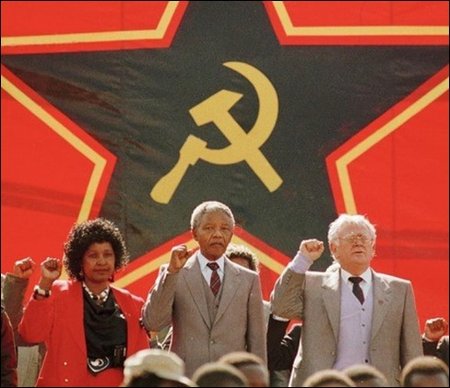
Winnie and Nelson Mandela, as well as Joe Slovo of the SACP, singing "Kill the whites"
Winnie and Nelson Mandela, as well as Joe Slovo of the SACP, singing “Kill the whites”

by Albert Brenner

[followbutton username=’albertbrenner1′ count=’true’ lang=’en’ theme=’light’]

It simply boggles the mind having to witness people still prostrating themselves in the dust whenever the name Mandela is spoken. Elevated to a modern-day god, Mandela is believed to be three, a `Holy Trinity`… yet he is only one – the one ultimately responsible for having turned South Africa into a failed-state-in-the-making.

Mandela No 1 is the latest poster boy of the secularization process which dictated the morality of the West after WWII. It is, basically, the moral world in which the 10 Commandments were replaced by Human Rights. A world in which the biblical “love God and love thy neighbor like thyself” has been replaced by “love thy neighbor like thyself because /she is thyself, (both) God”.

This is the moral universe of George Soros’ Open Society Foundation – which turned the Afrikaners Beyers Naude, Van Zyl Slabbert, Max du Preez, etc. into Walter Lippman`s useful-idiots of Mandela No 2`s world. And it is the world that grounded Pax Americana…

“We hold these truths to be self-evident, that all men are created, that they are endowed by their Creator with certain unalienable Rights, that among these are Life, Liberty and the pursuit of Happiness.”

Funny; if this “Creator” is no more – i.e. the moral rationale driving secular-humanism – how can we still state with such hubristic certainty that we are still “endowed” with them? Rather silly, but then; no wonder it has become the Inquisition.

Mandela No 2 is the world of End Game. A world which saw the dumbest Afrikaner philosopher ever, Willie Esterhuyse, formally hand South Africa’s future over to the cold Queen of England… at the behest of Her Holocaust card-playing Randlords. The world which saw Mandela and his inner-circle “struggle” buddies become some of the richest men in Africa… simply because Mandela No 3 did everything KGB colonel Joe Slovo taught him.

Mandela No 3, the real Mandela, is the great “democrat” who wrote; “If force will advance [the struggle], then it must be used whether or not the majority agrees with us.” And that is precisely what he, and his murderous “necklacing” wife, Winnie Mandela, did… killing 15 000 fellow blacks in the process!

This is the true world painstakingly depicted in the fantastic book The People’s War, by Dr Anthea Jeffery of the SAIRR…

  • “the ANC had little compunction about attacking black civilians, including its own supporters, for the formula for people’s war draws no distinction between combatants and others and regards all civilians (irrespective of their political affiliation) as expendable in conflict;
  • the ANC had a motive to unleash violence, for it wanted to create enough mayhem and unrest either to spark an insurrection or to weaken its opponents to the point where it could triumph in negotiations;
  • the ANC had the means to unleash violence, for the peace process allowed it to bring back into South Africa some 13 000 armed and trained combatants whom it then refused to disarm or disband; and
  • the ANC was the only organisation to draw benefit from the 15 000 political killings that took place in the early 1990s (after all major apartheid laws had been repealed), for it used these to;
  1. stigmatise De Klerk and the IFP,
  2. stampede negotiators into giving it what Joe Slovo called ‘a famous victory’ in negotiations, and
  3. put great pressure on the first all-race election, while making it unthinkable for anyone to demand a re-run of the deeply flawed April 1994 poll in which it was accorded (no accurate count being possible) some 63% of the vote” (source).

Well, there you have it. Mandela is not three. He is only one, No 3 – although No 1 and No 2 gave him – and his murderous, greedy and woefully incompetent ANC thugs – the Noble Prize for Peace… for having turned South Africa into a failed-state-in-the-making.

But then; only dummies won`t believe it.

[followbutton username=’albertbrenner1′ count=’true’ lang=’en’ theme=’light’]

Why no military coup before 1994?

sadf_coupby Albert Brenner


Many of us still wonder why no military coup was carried out by the, erstwhile, formidable South African Defense Force in the early 1990s – an army rated as one of the top four at the time, and one which contributed hugely to the final defeat of Communism.

It goes without saying that the SADF had some of the best soldiers in the world. True winners! So it is a very pertinent question to ask why these top people failed to take matters into their own hands, especially given the fact that what FW de Klerk and ilk did was illegal in terms of internationally-recognized norms and conventions governing the democratic process.

I have received personal permission to publish the opinion of one of those former SADF members. A man who has some knowledge and insight regarding what transpired during those tumultuous years… in which political treachery bested even one of the top armies on the planet at the time:

During the time period leading up to 1994, there were plans made within the SADF military hierarchy to oppose, and possibly prevent, the impending hand-over of South Africa to the main South African terrorist organisation and our enemies. These plans were never executed, for various reasons. However, even if they had been attempted, they would probably have failed, at the latest in the long run, because they were simply not good enough. They did not sufficiently take into account the political aspect and what is nowadays called ‘sustainability’.

Let us start with what we could see was coming, and what our SADF ‘coup’ planners were up against: A hand-over of our internationally recognised state, the Orange-White-and-Blue RSA, to our enemies BY MEANS OF AN ELECTION. An Azanian election, dressed up and touted as an all-inclusive South African one, i.e. one in which WE, the voters of the Orange-White-and-Blue republic, were seen to take part in and thus recognise. Now, if you go against this with military force only, – even though you have the power to do so, – you will lose the legality and acceptance which our own state had had ever since 1910. You needed a righteous and un-smearable issue to make a stand. A stand on which you would and could JUSTIFY your resistance and action, – at the very least in the eyes of your own people, and then also in the eyes of your friends and people of goodwill overseas (who did exist, make no mistake, they weren’t all loony left).

Such an issue had, in fact, been presented to us by FW de Klerk and his scheming Broeders. In fact, they had no choice, because, in essence, what they were planning was illegal. You cannot simply eliminate an internationally recognised state and replace it with another one, which was basically what they were doing. ‘Freedom once conferred cannot be taken away’, – old English international law. De Klerk’s elimination-and-hand-over plan had more than one such weak point, in fact. I will mention just two, the most vulnerable ones in my opinion. First, he stopped our traditional, democratic by-elections. And ‘sommer’ all of our own democratic elections. And thereby our whole democratic election process, undermining his own legitimacy. This was after he saw during the Florida by-election in 1992 that his government would lose the next national election. Then, in 1993, he handed over, officially, the authority of our state to an UNELECTED body, the Transitional Executive Council, on 7 December to be exact. A total no-no if you think about it, what with unelected terrorists with the blood of innocent civilians like those of the Church Street massacre on their hands sitting there and ruling over us.

Any military action by the SADF to try stop FW de Klerk would have had to utilize, and home in on, these weak points of our enemies’ and traitors’ plans. Thereby giving the resistance to it the necessary legality, righteousness and appeal to decent people in our own ranks and overseas. For example, making an armed, militarily overwhelming stand somewhere, – not necessarily at the Union Buildings and not necessarily using force or shedding blood, – at the time of, or just after, the above illegal (in terms of our own constitution) acts by de Klerk. Demanding the restoration of our democracy and legality of government. Making it clear to our own people and the world that it is about restoring our democracy, our right to elect our own leaders, and have an elected, loyal government of our own as we had had since 1910, as set up by Great Britain and with the full approval of the international community. SUCH a military action would have had a chance of success.


Britten’s indifference

One very positive side-effect of the Red October protest was that it aired the stale house of the MSM in Mandelatopia. This breath of fresh air made the usual suspects, and a few newbies, cough convulsively, as expected.

The loudest convulsion was a coarse phlegm-ejecting piece by the foul-mouthed Irish colonial reject Chris McEvoy. It is not worth reading. The second raffish algospasm was by Georgina Guedes. She tried, via an attempt at irony, to persuade her readers that it was oh so bleeding-heart symbolic of the freedom of democratic expression in Mandelatopia seeing a “dignified” black policeman escorting and “protecting” the white Red October marchers. She somehow conveniently forgot that the “dignified” policeman’s colleagues killed another peaceful protester, Mark Tatane, not so long ago – not even to speak of the Marikana massacre, the 1000-plus deaths per year in police custody since 1994, or the fact that both the ex-bosses of the “dignified” policeman are criminals.

The third bawdy paroxysm came from Lady Nicky Falkof, fresh from her 14-year sabbatical at the feet of Her Majesty the Queen of England. Her strident call for “progressive language” (e.g. rights, minorities, diversity, etc.) to remain the sole moral property of those who run Manor Mail & Guardian – at the behest of the Queen and her moneymongers – is only out-cramped by her near-autistic fixation with proper syntax and correct spelling. I’ll deal with Miss Commonwealth Spelling Bee 2013 in my next column.

The most interesting throe was thrown by the ever-so-swanky MSM darling, Sarah Britten. Her piece, albeit well-argued and neatly packaged, was pure sentiment. And it was precisely this appeal to emotion which prompted me to, once more, put my theory about white liberal irrationality to the test.

It only took six tweets of 140 letters/characters each to confirm said theory.This was how it was done. I simply asked her if she supported black lesbians protesting against “corrective” rape. She answered in the affirmative, of course. Then I pointed out that rape affects all women, not just black lesbians. Meaning that black lesbians form a sub-group protesting that which affects them specifically namely “corrective” rape. But, as mentioned before, rape affects all women, not just black lesbians.

From this it follows that it is logically and, even more importantly, morally inconsistent to laud one sub-group (black lesbians, in this case) for their “discriminatory” form of protest – i.e.they only protest against corrective rape, and not all rape – whilst demonising another (in this case, Red October whites) by accusing them of partaking in a “discriminatory” form of protest.. based on the fact that crime affects all, not just whites. Ergo, the rationale underpinning the protest by whites against their slaughter at the hands of blacks is no different to that of black lesbians protesting against corrective rape. Yet, the former is demonised while the latter is lauded and applauded by Britten and her MSM ilk.

It suffices to say that that which is good for the black lesbian goose is not good for the Red October white gander. This means that people like Britten discriminate on the basis of race – in terms of the above-mentioned biased sentiments expressed publicly. Given the above context, and what we know from all the standard definitions of racism, this would make Britten a racist.

Yet I doubt whether Britten could be classified as a racist, for she loves all those whites and blacks, et cetera, who agree with her. Meaning that her irrationality must be founded on something other than race-based zealotry. Or is it?

Britten is part and parcel of the upper-class British establishment in Mandelatopia. This group is the richest and (still) most influential collective in the country. They are just another appendage of her Majesty the Queen of England. And, as we know, England is the fons et origo of Pax Britannica. This (former) global empire was built by men like Cecil John Rhodes… whose moral motivations can best be summed up by the following quote; “

I contend that we British are the finest race in the world and that the more of the world we inhabit the better it is for the human race. Just fancy those parts that are at present inhabited by the most despicable specimens of human beings what an alteration there would be if they were brought under Anglo-Saxon influence…

At first glance the above quote seems like the paragon of racism. Not even Verwoerd ever said anything remotely similar. But I think it goes deeper than that. Is it “hate”? I mean, you really need to dislike others quite a lot to refer to them as “despicable specimens of human beings”. In short: are upper-class Brits like Britten hateful racists, like their forebearers, like Rhodes?

I think not. They are simply indifferent to all others, other than themselves. If dislike were an adjective, hate would be its comparative… and indifference its superlative. I mean it is beyond hate to, for example, kill 33 000 women and children in concentration camps and coldly go about carrying out a scorched-earth policy which reduced a unique nation to the poorest white nation on the planet, just for the sake of gold and diamonds. Similarly, it is beyond hate to try and turn the whole population of one of the oldest civilisations on the planet, the Chinese, into opium drug addicts… simply because your love of/for tea caused a huge trade deficit at the time.

It is a cardinal mistake to think that this indifference has, somehow, mysteriously vacated the non-soul of the British upper-class. Just think about the following fact: England is the only country in the Western world which (still) has such a huge divide between the upper and middle class. This divide is rigorously enforced, by complete indifference to the wishes and aspirations of the British middle and lower classes.

And this indifference is still very much present in modern South Africa. Just listen to Nobel Prize winner Nadine Gordimer – a representative of the British elite in this country:

Afrikaner women are lower than rats, closer related to plants, just fit enough to be raped in an act of genus preservation.

Lovely lady, ain’t she? She may have said “hate”, but it is clear from the magnitude of her hate that it is indifference. They only disguise their indifference as hate, so as to appear as if they actually give a continental toss… as if they actually still have one shred of humanity left.

Meaning that the imperial indifference that was once projected (and protected) by the military might of the old British Empire has simply morphed into an imperial indifference enforced by morality. In short; what the sword did for Rhodes, neo-liberalism (à la Pax Brittanica) is now doing for Gordimer, Britten and their useful idiots like Helen Zille, boy-man Fransie Cronje, Eusebius McKaiser, Piet Croucamp, Djonitin Jansen, Anton van Niekerk, Tim du Plessis, Max du Preez, Leopold Scholtz, Willie Esterhuyse, FW de Klerk and ilk.

Therefore never think that they actually care. They feel zilch for other nations, other peoples, cultures, traditions and their moral idiosyncrasies. They are completely indifferent to the plight of all others, especially poor blacks and the white farmers in this country.

The quickest way to rid this warm country of these cold bastards would be to unleash Raka in the form of a Mugabe-Malema on them. But that would lead to wanton slaughter; something the Afrikaner, unlike the British upper-class, has not got the stomach for, unfortunately. The Afrikaner hates wanton slaughter… that is why they organized the Red October protest.

The most humane way to ship their pitiless afters back to their crappy little mud-island with its Islam(ic) weather (partly Sunni, mostly Shiite) would therefore be to treat them with the exact same indifference they display towards all and sundry on the planet. Now that would be cricket, wouldn`t it, Sarah?

Beware the Black Borg!

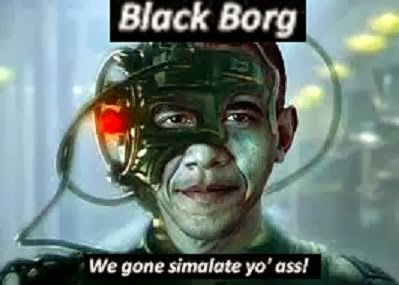
Borg Art  Pic

by Albert Brenner

[followbutton username=’albertbrenner1′ count=’true’ lang=’en’ theme=’light’]

The greatest bogeyman ever conjured up in order to keep rebellious white South Africans in line, comes in the form of an amorphous, same-thinking, same-feeling, black entity. This all-dominant Jungian (archetypal) mass of collective agency was reinvigorated by the half-wit CEO of the South African Institute of Race Relations (SAIRR), Fransie Cronjé, in a Rapport (read Naspers Pravda) column last weekend.

According to Fransie, whites in Mandelatopia must stop rebelling against their de facto enslavement forthwith, lest blacks destroy them utterly in a “second revolution”. In short – in line with the finest Stockholm Syndrome diagnosis – Fransie is screaming; “Keep quiet, otherwise they will kill us!”.

Now the thing is just whether the little bald pseudo-intellectual shyster is actually dim-witted or just plain ignorant. For he neither knows or represents white South Africans, nor does he know or represent black South Africans. Yet he presumes to do both, in public!

The simple fact is that this amorphous collective black entity that he so dreads, simply does not exist. It is simply another bogeyman created by the MSM and Hollywood – an entity akin to the Borg in the science-fiction series Star Trek. The former fictional being – written in the singular because they all share the same consciousness, and conscience – is famous for their (dreaded) command; “This is the Borg. We`ll assimilate you now. Resistance is futile”!

All fiction, all guano… in the real world. Never in recorded history has there been absolute hegemony among Africans – and, especially not in South Africa. The various black groupings – mostly tribal, in nature – were at each others throat before Apartheid, during Apartheid, and even now… after Apartheid.

To even think that all blacks share the exact same thoughts, feelings, moral sentiments, et cetera, – just because they share the same skin colour – is not only incredibly naive, it is also downright patronising and racist. In short; there is no absolute hegemony among the other races; so why should blacks be different in this regard?!

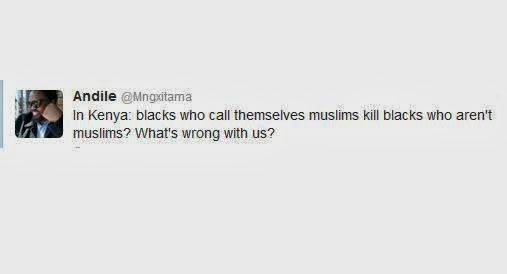
It therefore beggars belief when even (self-appointed) black intellectuals, like the awfully trite Hegel-emulating “Bikoist”, Andile Mngxitama, throw tantrums when blacks – wherever they may find themselves in space and time – do not act as “one” (see picture below).

andilem

Be that as it may; the “Black Borg” myth is only topped by its inverse, the myth of the Noble Savage. The latter, a neo-Romantic Rousseauian-regurgitating MSM/Hollywood creation, sees all blacks as inherently cherubic beings who only want the best for humanity, the universe… and the environment, of course. All little Mandela`s in heart, soul and suffering… all “one” in their eternal victimhood at the hands of the White Devil.

It is, frankly, beyond belief that even blacks themselves ascribe to this sickening denigration of their very being. I mean honestly, how can they acquiesce to a perception that only allows them collective agency, and not individual agency? But then, hey; they have been baby-sat for so long by bleeding-heart White Guilt-driven liberals that they, blacks, have left it up to others, like little lentil Fransie, to speak on their behalf.

Whatever the moral weather on that one; it is a fact that blacks have never, and will never, act as “one”. And the threat by the SAIRR vegetable, Fransie, that disillusioned (`”bitter”) whites will cause the Black Borg to suddenly appear from the Delta-quadrant wormhole just because they, the whites, are justifiably recalcitrant, is equally preposterous. Nothing, in the context of Mandelatopia, illustrates this more succinctly than the transition period to black rule in the early 90s.

During this time, the blacks did not rise up as “one” to take revenge on their Tutu-myth Holocaust oppressors, the whites. On the contrary; once the blacks realised that FW (fuck-wit) De Klerk was just going to hand over the whole caboodle, they went straight for each other’s throats…to get at the loot first.

Near-civil war circumstances prevailed as the Zulus of Buthulezi’s IFP fought the (mostly Xhosa) ANC of Mandela. More than 16 000 blacks died during that period. Hardly any whites were harmed, except for the cowardly APLA attacks on the St George’s Pub and the Roseview Church.

In her brilliant bookThe People’s War, Anthea Jeffery painstakingly researched the true facts behind the so-called “liberation struggle”. Her findings illustrate, beyond any doubt, how blacks used fellow blacks as a mere means to an end. It is an indisputable fact that the vast majority of blacks in South Africa were coerced, by threat of physical violence, to partake in Joe Slovo’s callous revolution.

  • `”the ANC had little compunction about attacking black civilians, including its own supporters, for the formula for people’s war draws no distinction between combatants and others and regards all civilians (irrespective of their political affiliation) as expendable in conflict;
  • the ANC had a motive to unleash violence, for it wanted to create enough mayhem and unrest either to spark an insurrection or to weaken its opponents to the point where it could triumph in negotiations;
  • the ANC had the means to unleash violence, for the peace process allowed it to bring back into South Africa some 13 000 armed and trained combatants whom it then refused to disarm or disband; and
  • the ANC was the only organisation to draw benefit from the 15 000 political killings that took place in the early 1990s (after all major apartheid laws had been repealed), for it used these to;
  1. stigmatise De Klerk and the IFP,
  2. stampede negotiators into giving it what Joe Slovo called ‘a famous victory’ in negotiations, and
  3. put great pressure on the first all-race election, while making it unthinkable for anyone to demand a re-run of the deeply flawed April 1994 poll in which it was accorded (no accurate count being possible) some 63% of the vote.” (source)

The above-quoted just illustrates, once more, that Fransie is as dumb as mud… especially given the fact that Dr Jeffery is his chief researcher at the SAIRR!

Hell, one does not even need to read a single book to understand that blacks are not “one”. Just look at the dismal moral state of all post-colonial sub-Saharan countries. The chief “liberator” and his inner circle have always enriched themselves shamelessly, at the expense of their own people.

In Mandelatopia, Mandela, like his cronies Sexwale, Zuma, Ramaphosa, et cetera, are drowning in money, while the vast majority of their fellow blacks are suffering under extreme poverty. It suffices to say that they, the former, couldn’t`t give a continental damn. There is no “oneness”, no ubuntu, no Noble Savage and no Black Borg. Period!

That a “second revolution” will take place in Mandelatopia is a fact. But it will not be because whites are standing up for their rights. It will be because blacks will revolt against their own leaders because of the broken promises of the past 20 years of typically-African mis-governing. That whites will bear the brunt of the coming (inevitable) revolution is obvious, because they (still) have those things that the black leaders promised their black sheeple, but failed to deliver… as always.

It is thus abundantly clear that the motive behind Fransie`s reinvigoration of the Black Borg myth is everything but noble, in the sense of heroically”saving” the enslaved backsides of whites in Mandelatopia.

For you see, for Fransie – as one of the main Afrikaner H-G men in Mandelatopia – it is all about keeping his ill-earned privileges and prestige. Had the playing-field with his white peers been level, half-wits like Fransie, Piet Croucamp, JP Landman, Tim du Plessis, Pierre de Vos, etc. would never have reached the level they have attained now.

But then; Fransie`s DNA is coward-based. His survival instincts and skills were honed in his dad’s nutsack… where he used to cower in the most remote corner because he was the lesser of 60 million. Now he is still cowering, in front of 60 million blacks. But that is his saving grace, his claim to fame. For unlike the one million whites who were forced to emigrate in order to seek employment, Fransie is in league with the new Master of South Africa. He is a made-man!

So the next time Fransie screams at you, as a white South African, to shut the fcuk up and continue paying unquestioningly for the `”sins of your forefathers”, just think of the picture below.

frans

FW’s Folly, a cautionary tale

Cartoon_ZAPIRO_FW_De_Klerk_speaks_with_a_forked_Tongueby Gustav Venter

[followbutton username=’GustavSVenter’ count=’false’ lang=’en’ theme=’light’]

FW de Klerk, pink peeling face bloated as if by cortisone, funereal smile stretched under dull eyes, his political ideas as obsolete as a typewriter, his opinion blighted by the ridicule of opponents – and his opponents are everywhere and everybody – his memory distorted by his misapprehensions and his reputation finally tarnished by extra-marital dalliance, will have what he has desired above all else: he will leave a legacy. “Legacy” in the mind of the career politician means “place in history.” And a place in history FW de Klerk will have and it will be that of a rare enough political bird, and though he represents a well-developed example of a certain category, he certainly is not without company in his corner of history. There future historians will find him with a coterie of some of history’s most flamboyant figures. Montezuma, the Aztec king, will be there, as will Rehoboam the grandson of ancient Israel’s great king David, as will France’s “Sun King” Louis XIV and Phillip II of Spain, a lineage of Renaissance popes and England’s “Farmer” George the Third.

What distinguishes these men; why are they in that particular corral of history? They were leaders sure, as were thousands of others, but they are remarkable for having devastated their countries and their people, not by one massive miscalculation, but in persisting in a course of action that was so foolish that historians are at a loss to explain the slow meltdown of mental processes.

Popular historian Barbara Tuchman (popular historians are the same as regular or “academic” historians except that they write readable prose) considers the effect in her pondering (as opposed to ponderous) work, The March of Folly. She beautifully describes the nature and mechanisms of folly, but concedes that she does not understand why the leaders in our list persisted in it. And persist in it, that they did.

Farmer George lost America forever for England, Louis expelled the Huguenots and thus impoverished his country and then vaingloriously waged unnecessary wars which bankrupted France and shoved the country over the precipice towards revolution, popes Sixtus IV to Clement VII through their perversions and arrogance triggered the Reformation which split the church and eventually led to it forever losing its pre-eminent position in the world, but only two of the leaders in the list – Montezuma and FW de Klerk – rushed from heights of enormous power to prostrate themselves – and their people – at the feet of a ruthless but weak and outmanoeuvred foe.

Montezuma was the mighty leader of the Aztecs, a people so ruthless they habitually sacrificed people in an effort to cajole some goodwill from their imaginary gods. They were safely ensconced in the natural fortresses of the high mountains and were a prosperous lot. There was no reason to even contemplate a radical change in position or fortune. They had every reason to feel safe behind the aggressive bulk of a standing army exceeding six hundred thousand men. Then, at the height of their power, one Hernán Cortés came calling. He’d sailed from the Old to the New World, not with an armada, but with a few dainty wooden ships containing 600 men, seventeen horses and 17 small cannons in all.

Cortés was a conquistador, a Spanish invader and fortune seeker. He was utterly ruthless, decisive and fearless. And outmanned. His enemy had the decisive advantage of 1,000 men under arms for every one of Cortés’s adventurers. Montezuma could have summoned his cooks to do his fighting and still overwhelmed Cortés and his avaricious band. This he did not do. What he in fact did was to meekly submit to the conquistador, thereby cracking the door to his country for the thin edge of the wedge. Soon he was deposed and his people subjugated under the unsympathetic heel of Catholic Spain.

This stunning capitulation still renders historians nonplussed. Tuchman has a tentative stab at an answer, but if she is not convincing it is because she is not convinced. She timidly ascribes Montezuma’s meltdown to the superstition of the Aztecs. “Their ‘gray’ faces, their ‘stone’ garments, their arrival at the coast in waterborne houses with white wings, their magic fire that burst from tubes to kill at a distance, their strange beasts that carried the leaders on their backs…” apparently was too much evidence for the idol-worshipping Montezuma who forthwith caved in. But who can tell?

If Tuchman cannot explain Montezuma’s brain freeze, she is in her own mind sure what constitutes folly. In her “inquiry” she defines it as “policy contrary to self-interest” and lists three requirements for a policy to receive full recognition as folly. She writes that “it must have been perceived as counter-productive in its own time, not merely by hindsight.” “Secondly a feasible alternative course of action must have been available.” The third requirement is that “the policy in question should be that of a group, not an individual ruler, and should persist beyond any one political lifetime.”

Montezuma’s actions were decidedly contrary to his self-interest and that of his followers. He was ignominiously stoned to death and the Aztecs subjected under the iron heel of the avaricious conquistadors and eventually removed as a culture and distinct people from the face of the earth.

It can be argued that the demise of Montezuma and his people was inevitable. They were in the way of the ambitions of a restless and ruthless force. If Cortés did not wipe them out, some other trigger-happy European conqueror would have been all too happy – and capable – to perform the deed. Western expansion was an unstoppable force and the primitive Aztec hardly an unmoveable object.

Myth, superstition, obsolete defence equipment, political naiveté and the appearance of an unknown foe will all make good strands to weave a case in mitigation of Montezuma’s disastrous handling of his ultimate political crisis. But what to make of a leader who was not hobbled by any of these debilitations and yet unexpectedly, cravenly and completely caved in to a defeated enemy? And, since history is not merely a repository of interesting snippets, what can one learn from it and what should its influence be on our planning for the future? Tuchman’s examination of folly ends with the Vietnam war but one can only imagine the glee with which she would have picked through the debris of National Party policy to explain the unnecessary, completely self-defeating and irrevocable surrender of FW de Klerk to that comical “liberation movement,” the ANC.

While there are clear similarities between the way in which Montezuma and De Klerk pursued “policies contrary to” their “self-interest,” there are also obvious differences. The Aztec had to deal with an unknown foe. De Klerk cannot possibly make use of this defence. His people, the Afrikaners, had been living among the Bantu for three and a half centuries. Nothing about the nature, history, customs and capabilities – and  lack thereof – of black Africans was unknown to the National Party. Even the modern cant of the ANC, its Marxist and Afro-nationalist roots were well-known to the Nationalists. FW very well knew that the black people of South Africa were incurably envious of the very capable and successful whites, especially the Afrikaner.

Before the arrival of Cortés Montezuma had no data of the capabilities of a Western force and he could never be certain how an armed clash between Aztec and conquistador would turn out. De Klerk, by contrast, was well aware of the power of the armed forces under his control. The South African Defence Force had dispersed its foes during the Border War. It had severed SWAPO’s supply chain in Angola and devastated its bases and forced the terrorist organization to scurry to the negotiation table, leading to a tame Namibian independence. The “Boers” had seen off the communist threat, culminating in the severe mauling it handed the Cuban forces at Cuito Cuanavale before staring down Castro’s last charge to the border of Namibia. The South African security forces in the early nineties were a lean, tough, hell-for-leather outfit.

There is also the quality of opposition to bear in mind when comparing Motezuma’s folly with that of FW de Klerk. The Aztec king had every right to be taken aback by the sheer daring of Cortés and his merry men. A man who brazenly sails to the shores of a hostile and unknown country and then burns his ships to prevent a premature withdrawal, might very well know something the king does not. This valiant approach is not something to be found in the ANC playbook.

The ANC were the Keystone Kops of the revolutionary world. They bungled so many operations that they killed more of their own than of the enemy. Their leadership was corrupt and mostly in the pocket of the state. It is indicative that their most revered induna failed miserably under arms and was, by the mercy of the Afrikaner government, reshaping rocks on an island prison.

The South African government had to confront the two-faced sanctions of the world, yet the economy proved surprisingly robust, so much so that the very sanctions designed to smother it was forcing it to bloom in surprising areas. The South African armaments industry, for instance, was thriving. The ANC’s loss of its communist sponsor after the unravelling of the Iron Curtain also meant that new markets were opening up to South African products, while the country’s stranglehold on certain strategic minerals could be used to lever trade with other countries.

FW’s South Africa, then, was militarily strong, its people resourceful and hardworking, its economy stable, its foes vanquished and its agriculture so productive it could feed the region. For goodness sake, South Africa had six self-developed nuclear devices which represented the ultimate bargaining chip.

FW de Klerk had nothing to gain by a transition of government and everything to lose. The Afrikaner possessed the strength to retain everything and the ANC was too weak to force the president’s hand. And yet, in a mad rush, within a few months, in the face of furious warnings, FW de Klerk and his National Party completely surrendered as if they’d been whipped by an overwhelming foe.

It remains a modern political mystery. De Klerk is certainly not unintelligent. He was a deft political operator and by stealth, decisiveness and sometimes calumny disarmed the right-wing threat to his plans. He was a good communicator and a skilled debater. In an SABC TV debate, for instance, he easily outclassed a glum, muttering, somewhat confused Nelson Mandela. Why then the abrupt change of course, from an untouchable position to utter defeat? Barbara Tuchman’s “inquiry” only stretched to Vietnam, but with what glee would she have poked through the debris of the National Party’s ruinous folly!

Tuchman has a dim view of politicians. Right in the beginning of her book she ruminates about the nature of people in government. “Mankind,” she writes, “makes a poorer performance of government than of almost any other human activity… Why do holders of high office so often act contrary to the way reason points and enlightened self-interest suggests?”

When Tuchman refers to “self-interest” she clearly sees the interest of the ruler and the interests of his people as the same. Yes, on the face of it De Klerk served his own interests very well, thank you. He was for a heady period touted by tout le monde – and still by some die-hard liberal ex-Nats – as the enlightened vanquisher of evil. He pocketed half a Nobel Prize, was financially sumptuously greased and even waltzed out of his marriage with the glamorous wife of a Greek friend on his arm.  All in all FW was personally well served by his political folly. The lot of his people is an entirely different issue. They were stripped of their power and rendered at the mercy of a merciless people. They are subjected to discrimination and have to stare in horror from the sidelines as the fine country they built is ransacked and ruined by the cupidity and stupidity of inept rulers.

This hardly resonates with De Klerk. Having ingested too much of his own political snake oil, he still stubbornly believes that he did not only do the right but a noble and admired thing. That is why he still feels called upon to chide other African countries on their treatment of minorities – this from the man who stripped the powers of the most envied and therefore feared and hated minority in the world.

He may try and duck behind the ruse that his people are all the races in the country, but it will ultimately not serve him well. Only a small collection of people benefited from his folly. The rest – the overwhelming majority – of South Africans will reap misery from his actions. The economy is wrecked and the hoof beats of the grey horseman, famine, are already thudding through the dry crust of abandoned farms.

De Klerk, then, has fooled so many people, worst of all himself. And it is just too tempting to avoid answering the most intriguing question of all: Why?

The few people who can definitively answer the question aren’t talking, so we are free to conjecture. While his precise motives are murky leaves on the bottom of the tea cup, we can be more certain of when he took the fateful and fatal decision to betray his people and surrender himself to the currents of folly. The FW de Klerk of October 1989 does not resemble the determined fool of February 1990. During that particular October he primly scolded his elder brother, Willem, for hobnobbing with the enemy, the ANC, during the infamous “Dakar Safari.” Not even four months later he released the brakes on the wagon of surrender by unbanning the ANC and setting their terrorist-in-chief, Nelson Mandela, free.

The elder De Klerk brother, in a biography he wrote on his kid brother, puzzles over this abrupt change of tack. He calls it an astonishing political conversion.

Who got hold of FW and what was said? Maybe one day all will be revealed. In the meantime it seems clear that the carrot jiggled in front of his nose is the one so very few party-political animals can resist – the possibility of a legacy.

For the modern party politician a legacy is a big deal.

Winston Churchill (in words quoted by FW de Klerk in his lecture to African leaders) damned democracy with faint praise. “Democracy,” he said, “is the worst form of government in the world – apart from all the others.”

This is somewhat bombastic for somebody who has not experienced a single day of pure democracy. The warped version of democracy so beloved by him and touted as the panacea for all political ills by the West is in fact little more than a popularity contest run by unscrupulous, self-serving people.

Ever since the invention of the political party the fortunes of the country has been embedded with the self-serving interests of a collection of vainglorious shysters. Cynics, yoked with the modern press, have gradually made the manipulation of voters and election results a finely tuned science.

This system inevitably produces a warped hierarchy of interests. For the modern-day politician the party comes first, followed by whichever partners helped it to beat the ballot box. The country and its people come a very distant third.

The very nature of political office in the party system necessarily produces a peculiar political animal. What kind of person exactly does it take to be enamoured by the prospect of rising through the ranks to gain political favour? A very determined individual, yes, one that is so focused on the success of campaign and career that he will sacrifice anything to attain it. In this strident selection process morality and integrity are drawbacks. Even when couched in terms of ends justifying means, the politician of necessity must first of all do what is best, not for his constituents, but his political career. This demands an intense focus on himself. Therefore the successful party politician is almost invariably self-obsessed. And narcissism is hardly the right stuff for a righteous ruler.

Running a country is heady stuff. The political self is so well served by the office.  People come when he calls and go forth when he commands. The only shame, to the very few who obtain the position, is that it cannot last forever. Political leaders will gladly strike a deal with any devil to prolong the situation. The manful struggle to obtain political power does not compare in desperation with the fight to retain it. And that is why the “legacy” is of such all-consuming importance. It is often the only way to let the effect linger. To leave a proper legacy, however, the leader has to perform deeds of such heroism, courage and flamboyance that other people will find it necessary to preserve his memory.

Between October 1987 and 2 February 1990 FW de Klerk came to believe he had found the one thing, in his mind of such courage and dash, which would leave him touted for the ages to come. And so he delivered his people into the hands of their enemies.

Folly, remember, is an act contrary to self-interest and ultimately FW’s treachery undermined himself and his ultimate goal of leaving a treasured legacy. The only people who truly celebrate him as the national saviour he imagines himself to be are a few NP dinosaurs, his immediate family, FW himself and Dave Steward who runs the ex-president’s feeble attempt to manufacture the scaffolding of his own legacy, the FW de Klerk Foundation. The press consigned him to the status of an oddity. His main competitor, that old terrorist, Nelson Mandela, was swept away on tides of adulation. He usurped all the praise De Klerk expected to garner.

So he will leave a legacy. His tale will be part of the anthology that includes the history of Montezuma, the Renaissance popes, Louis XIV, Farmer George III and other incompetents. If ever a future leader carefully but with great determination follows a program of self-destruction – where the “self” is not just the ruler but his people – observers will grin knowingly and say: “Just like FW de Klerk.” His legacy then is having been a fool.

Oh, they will be talking about FW de Klerk for a while longer. There are lessons to be drawn from his career and actions. But not in the way he hoped for. FW de Klerk’s life has become a cautionary tale.

He was not the first leader to devastate his country through his own folly. And, more importantly, he will not be the last.

The current South African regime, that foul political party, the ANC, would do well to consider the tale of FW and his folly. They are marching to their own demise, deaf to the entreaties of caution. They know that history will cold-shoulder FW de Klerk but they are so cock-sure that it will treat them well. However, there is a rule of history: From those to whom much has been given, much will be expected. Nowhere in history has so much been given as to the undeserving ANC. And when future historians peer through the smoke above the debris of a once magnificent country, their judgment of the ANC, starting with the failed terrorist and statesman Nelson Mandela, will be harsh.

And yet they will also see pockets of prosperity among the ruins. A betrayed people will be at work, rebuilding the country as their forefathers once did.

And that will be the legacy of the Afrikaner.

[followbutton username=’GustavSVenter’ count=’false’ lang=’en’ theme=’light’]

Five factors that will shape SA’s future: FW de Klerk

FW de Klerk
FW de Klerk

Former President says country continues to present an anomalous picture to the world

SPEECH BY FORMER PRESIDENT FW DE KLERK FOXHILLS RESORT, ENGLAND, September 13 2013

SOUTH AFRICA: PAST, PRESENT AND FUTURE

I should like to talk about South Africa: our past, our present and our future -­‐ about

  • where we have come from since the 1980s;
  • where we now find ourselves; and
  • where we are going.

It is especially appropriate to do so now -­‐  because I can recall no time since 1994 when so many South Africans have been so despondent.

We should remember 1994 -­‐ not only because it was the birth  of  our  new  society -­‐  but because it provides an important reminder  that  we  South  Africans  have  the  ability  to  solve even  the  most  intractable  problems.

It is easy to forget now how desperate our situation was in the mid-­1980s:

  • Our efforts to reform apartheid -­‐ including the scrapping of more than 100 apartheid laws and the introductions of the tricameral parliament had simply redoubled demands for “one-­‐man, one vote”;
  • We were beset with internal unrest and increasingly violent protests;
  • Scenes of chaos and  insurrection  in our streets dominated  TV  screens throughout the world;
  • After the Rubicon speech the rand had plummeted through the floor;
  • Unsure  of  the  government’s  ability  to  control  the  situation,  international  banks  had pulled the plug on us by refusing to roll over our short-­‐term debt;
  • Demands for comprehensive economic sanctions were reaching crescendo pitch;
  • Our armed forces were confronting increasing attacks on our borders and the borders of Namibia -­‐ attacks that were supported by 50 000 Cuban troops.

There were no signs of light on the dark and stormy horizon.

And yet -­‐  by 1990 -­‐  we had clawed our way back from the precipice.

The victory of our forces at the battle of the Lomba River in September 1987 had finally convinced the  Soviets, the Cubans  and the Angolans that there  was no  prospect of a military victory.

  • The  following  year  we  began  negotiations  on  the  withdrawal  of  Cuban  forces  from Angola and the parallel implementation of the UN independence process in Namibia;
  • Also by 1987 the ANC had accepted that there would not be a revolutionary outcome in South Africa and that the only path to the future lay through negotiations;
  • The successful independence process in Namibia in 1989 showed that it was possible to negotiate successful outcomes with enemies;
  • Finally,  the  collapse  of  the  Soviet  Union -­‐   symbolized  by  the  fall  of  the  Berlin  Wall  in November, 1989 -­‐  signaled the arrival of an entirely new global paradigm.

By the beginning of 1990 these events had opened a historic window of opportunity for a peaceful and negotiated settlement. We did not hesitate. We jumped through -­‐ and after almost four years of roller-­‐coaster negotiations we were able to reach a national accord on our future.

It was our proudest moment.

Our 1993 and 1996 constitutions were the outcome of the genuine give and take process inherent in all negotiations. The final agreement was at least as close to original negotiating positions of the non-­‐ANC parties as it was to that of the ANC.

It contains all the basic rights that we need to maintain a free and prosperous society.

It  articulates  the  values  of  human  dignity,  equality,  fundamental  rights  and  non-­‐ discrimination on which the new South Africa has been established.

It acknowledges the supremacy of the Constitution and the rule of law.

It  makes  provision  for  all  the  institutions  and  mechanisms  that  are  necessary  for multiparty democracy based on accountability, openness and responsiveness.

It has served us well for the past 19 years. Which brings me to the present.

It is important to remember the many, many successes that we have achieved since 1994 -­‐ many of them as a result of government action:

  • We have experienced 19 years of economic growth -­‐  interrupted only briefly by the global  economic  crisis  of  2008.
  • The regulation of our security exchanges and our reporting standards are the best in the world;
  • Our banks are the second soundest in the world and our corporate boards are the second most efficacious. Our financial services and protection of minority shareholders are third best in the world and our ability to finance local equity is the fourth best internationally.
  • We are one of the primary gateways to Africa -­‐  and are now the fifth largest investor in the   continent.

We have also made significant social progress:

  • The  percentage  of  the  population  living  in  absolute  poverty  has  declined  to  less  than 20% -­‐  largely because of social grants.
  • More than three million housing units have been built -­‐  enough to house almost a quarter of the population -­‐  with another million units in the pipeline;
  • More than three quarters of the population now have access to electricity, drinkable water and sanitation
  • We have experienced moments -­‐  like the 2010 Soccer World Cup -­‐  when we have lived up  to  Archbishop  Tutu’s  characterization  of us  as  the  Rainbow  Nation  of  God;
  • We have seen the rapid growth of new and self-­‐confident black middle class. Whites now comprise less than 40% of the top decile of income earners.

At the same time we are beset by serious problems. One can hardly disagree with  the diagnosis of the National Planning Commission regarding  the  nature  of  these  challenges. They include:

  • High unemployment -­‐  closer to 40% than the official figure of 25,6%;
  • Poor education -­‐  especially for black South Africans -­‐  who fare badly in comparative tests with  children  from  the  poorest  African  countries;
  • Poor public service delivery -­‐  which has led to virtually daily protests throughout the country;
  • rising levels of corruption; and
  • the fact that South Africa is still a divided society.

Another growing problem is the increasingly destructive role that is being played  by  our militant trade unions. It is one of the main causes of unemployment and of our failure to attract the foreign investment that we need for sustained economic growth:

  • South Africa has the worst labour relations in the world. According to the World Economic Forum’s Global Competitiveness Report it is the worst of 144 countries assessed in terms of co-­‐operation in labour-­‐employer relations;
  • COSATU has continuously raised labour costs without  commensurate  productivity increases -­‐ which has inevitably resulted in job losses. South Africa’s flexibility of wage determination is the fourth worst in the world.
  • Our labour legislation is amongst the most onerous anywhere. South Africa’s hiring and firing practices are the second worst in the world.
  • COSATU’s campaign to abolish labour brokers would lead to the loss of more than half a million jobs.
  • COSATU has steadfastly opposed proposals to open labour markets to the unemployed.
  • It   is   destroying   jobs   by   alienating   foreign   and   domestic   investors   through   its confrontational stance and open support for nationalisation.
  • On top of all this came the Marikana massacre of 16 August last year; the subsequent wave of violent and uncontrolled wildcat strikes and hopelessly unrealistic wage demands. All this has been compounded by the precipitate fall of the rand against the US dollar.

So South Africa continues to present an anomalous picture to the world:

  • on  the  one  hand  a  picture  of  failing  governance;  out  of  control  trade  unions;  rising corruption and daily service delivery protests -­‐ and
  • on  the   other  hand,  a  picture   of  economic   dynamism,  enormous  opportunities  and  a counter-­‐intuitive sense of optimism -­‐  particularly in bustling Johannesburg.

But what of the future?

Predicting the future is one of the most risky of all endeavours -­‐ since we live in such rapidly changing times. Nevertheless one can identify some of the  salient  factors  that  will undoubtedly influence the course of events:

  • Whatever happens in South Africa will take place within the framework of macro-­‐ developments on the global stage -­‐ just as they have always done in the past;
  • Secondly, current developments within the ANC’s ruling alliance will play a key role. The question is whether the leadership will be able to hold together an alliance which now encompasses the whole spectrum
    • from Stalinism to social democracy;
    • from exclusive black nationalism to inclusive non-­‐racialism;
    • from  genuine  commitment  to  sound  governance  to  pervasive  crony  capitalism and entrenched kleptocracy?
  • Will the ANC be able to continue to plaster over these increasing obvious cracks   -­‐  or will it  split?
  • Thirdly, will it be possible to moderate the behavior of our rampant and wildly irresponsible trade unions?
  • Fourthly, will the government break away from its race-­‐based ideology and accept the idea that the skills of all South Africans must be used to enable the country to address its problems and achieve its potential?
  • Finally, a critical factor will be our ability to maintain the excellent Constitution that we South Africans negotiated between 1990 and 1996 and the institutions that it mandates including
  • free and impartial courts;
  • an independent National Prosecuting Authority; and
  • government that is accountable, transparent and responsive.

So, these are the factors that will play significant roles in determining our future:

  • What will happen on the global stage?
  • What will happen within the ANC Alliance?
  • Will we be able to control the trade unions?
  • Will we be able to liberate ourselves from race-­‐based ideologies? And,
  • Will we be able to uphold our Constitution and achieve the vision that it articulates?

Personally,  I  remain  an  optimist -­‐  and  believe  that  we  shall  be  able  to  surmount  the challenges that confront us now -­‐ just as we were able to overcome the  much  greater problems that we  faced  25  years ago.

Issued by the FW de Klerk Foundation, September 16 2013

De Klerk cuts short European visit, prays for Mandela

FW de Klerk
FW de Klerk

Former president FW de Klerk has cut short his Europe trip because of former president Nelson’s Mandela’s ill-health, De Klerk’s foundation said on its website on Saturday.

“Mr FW de Klerk and his wife Elita have decided to suspend their current working visit and holiday in Europe because of Mr Mandela’s medical condition,” it said.

“They will arrive back in Cape Town tomorrow. Their thoughts are with the Mandela family during this difficult time and they join in the prayers for an improvement in Mr Mandela’s health.”

There was no further information on whether De Klerk would be visiting Mandela.

It has been three weeks since Mandela was admitted to the Medi-Clinic Heart Hospital in Pretoria.

On Saturday, President Jacob Zuma said his condition was still critical but stable.

“We’re hoping that it [Mandela’s health] is going to improve,” Zuma said at a press briefing on Saturday.

“I think with all the prayers and good wishes that are being made, certainly it would do something.” – Sapa

FW de Klerk accepts apology for ‘kill whites’ tweet

FW de Klerk, former President of South Africa

The FW de Klerk Foundation on Thursday formally accepted the apology of a man who allegedly posted a racist tweet.

The foundation said spiritual leader Kemo Waters had apologised for the tweet.

In January last year, the foundation laid a complaint with the SA Human Rights Commission (SAHRC) about the Twitter post.

Waters allegedly tweeted on January 7, 2012: “The only way to end racism is to kill a material number of whites @hellenzille your indifferent and patrionizing stance in a double dare”.

Waters recently released an apology statement: “I… hereby tender my summary and unequivocal apology to the public, the Commission, the FW de Klerk Foundation.”

He undertook to refrain from “conducting myself in a manner associated with hate speech or racism in the form complained about”.

On Thursday, the FW de Klerk Foundation said that while the Bill of Rights provided for freedom of expression, it prohibited advocacy of hatred based on race, ethnicity, gender or religion, and incitement to cause harm.

“It is imperative that all South Africans should bear in mind the constitutional prohibition against hate speech when they are participating in the national debate.”

It was also important for the public to complain about language that incited hatred or violence.

The foundation thanked the SAHRC for its work on the matter and the way it was handled.

In a statement last week SAHRC spokesman Isaac Mangena said that during mediation the commission was satisfied that the comments could be interpreted as hate speech.

However, it felt that this needed to be seen in the context of Waters’s experiences and perceptions.

During the mediation, Waters said he had experienced racial prejudice himself since moving to the Western Cape.

The SAHRC also took into consideration that Waters already apologised publicly, on a radio show and on Twitter, for his comment before the commission received the complaint.

The commission advised him to release a formal written apology to all South Africans.

“The FW de Klerk Foundation accepted Mr Waters’ apology and a mediation agreement was signed between Mr Waters and the complainant in April 2013,” Mangena said. – Sapa

President Zuma’s comments regarding the impact of apartheid on South Africa’s present problems

FW de KlerkIn comments that he made to mark the 20th anniversary of Chris Hani’s assassination, President Zuma alluded to the recent debate regarding the impact of apartheid on the current problems confronting South Africa.

He said that “to suggest we cannot blame apartheid for what is happening in our country now, I think is a mistake, to say the least. We don’t need to indicate what it is apartheid did. The fact that the country is two in one – you go to any city, there is a beautiful part and squatters on the other side – this is not the making of democracy and we can’t stop blaming those who caused it.”

“While wanting to see change happening fast in every corner of the country, we are under no illusion that South Africa will automatically and comprehensively change in only 20 years. That is impossible. The legacy of apartheid runs too deep and too far back for the democratic administration to reverse it in so short a period.”

President Zuma’s remarks were a repetition of what has become a central refrain in ANC communication: that the legacy of the past – i.e. apartheid or “colonialism of a special kind” – is responsible for the triple crisis of inequality, unemployment and poverty. The remarks are usually accompanied by simplistic comparisons between whites who live in the “beautiful part” and blacks who live “on the other side.”

We are all the products of our past – and there can be no doubt that apartheid created serious distortions in the normal development process that black South Africans would otherwise have experienced. However, the roots of inequality and poverty are far more complex than that. They include, in particular, lack of access to decent education, employment and effective government services – all factors that have been within the sphere of government policy since 1994.

The inequality that characterised our society in 1994 may certainly be ascribed to the complex legacies of the past. However, the fact that, 19 years later, we are an even more unequal society is the consequence of the failure of government policy. Unacceptable levels of inequality have their roots – among other things – in:

  • the dismal performance of our education system caused overwhelmingly by government mismanagement and the depredations of SADTU;
  • the fact that almost 40% of black South Africans are unemployed – primarily as a result of rigid labour policies; policies and attitudes that discourage foreign and domestic investment and the refusal of COSATU to countenance competition in freer labour markets;
  • the inability of government to deliver decent services – which is attested to by service delivery protests throughout the country almost on a daily basis; and
  • the implementation of inappropriate policies to promote equality – which have greatly benefited the top 10% of the black population – but which have done nothing for the bottom 60%.

Attempts to blame these failures on “apartheid” will simply divert government and public attention from the urgent need to implement the kind of realistic solutions called for in the National Development Plan. They also serve intentionally or unintentionally to stir up racial animosities that we simply cannot afford. When President Zuma says that “we cannot  stop blaming those who caused it”, he is playing the very dangerous game of making whites the racial scapegoats for the manifest failures of his own government.

The reality is that many of the beautiful parts to which President Zuma refers are now increasingly inhabited by the emerging black elite and middle class. In 1995 whites accounted for 69% of those in the top earnings decile. By 2007 their share had diminished to 43%. By now it will be even smaller. The nature of the squatter camps is also changing: several are now inhabited by impoverished whites. The country may be “two in one” as President Zuma observes but they can no longer be simplistically characterised as ‘rich white’ and ‘poor black’.

Clearly we South Africans need to engage one another in frank discussions about the legacy of the past, the challenges of the present and  our vision for the future.

ISSUED BY THE FW DE KLERK FOUNDATION

CAPE TOWN, 12 APRIL 2013