Littering in South Africa is the expression of wider selfish – and costly — culture

Roger Southall, University of the Witwatersrand

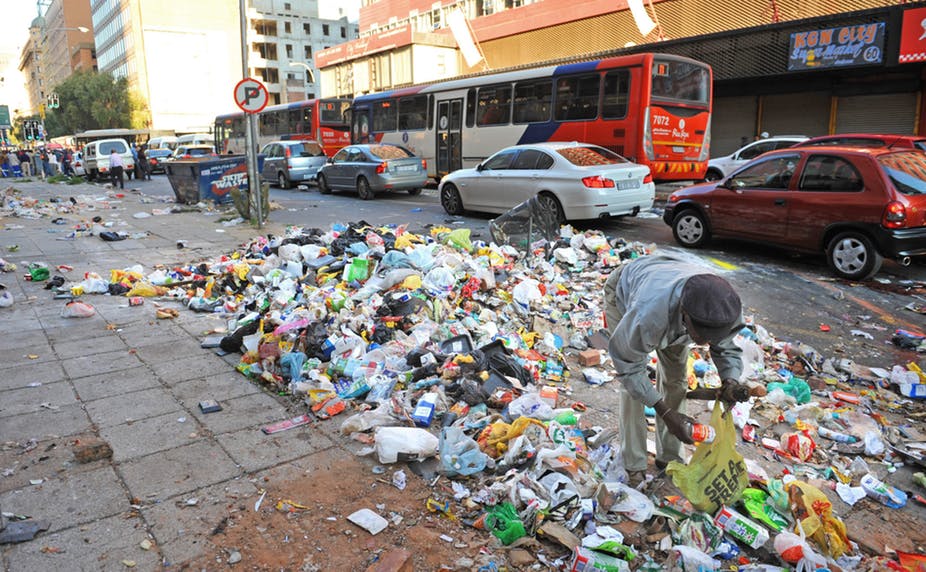
It is common when municipal workers go on strike in South Africa to resort to upturning garbage cans and strewing litter around city centres. Their message is clear: we may be at the bottom of the social heap, and you may think we are human trash, but by God, society needs us, and if you don’t listen to us and give us a living wage, we’ll make you pay for it.

Trashing a city is more than a demand for a better wage. Often, it’s also an expression of rage against employer arrogance or unaccountability, and a demand for basic respect. Such tactics are manifestly expressions of class struggle and class power, workers resorting to their most effective weapon. While they are unlikely, in extremis, to be able to confront the armed might of the state, they may well be able to make city managers and the general population wilt in the face of the stink and mess of uncollected garbage.

Yet such actions are indicative of a discordant society, and a culture of littering can tell us a lot about a society’s ethos.

Littering is an act of individual or group disposal of waste at the public expense in terms, not only of the cost of public collection, but also at worst, of public health, and always in terms of public enjoyment of the environment. It prioritises the private interest over the public, and places the burden of collection or consequences of litter on the collective.

Doubtless too, it is expressive of class, income, status and power. It is no accident that in most – if not all countries – better-off residential areas are likely to be freer of litter than worse off localities. They have more public clout and more private resources.

Littering tells us a great deal about community spirit. It is surely no accident that the Scandinavian countries, which regularly top the World Happiness Index, are relatively litter free. Their governments have long prioritised the collective interest and there is less social inequality than in similarly industrialised nations.

Industrialised countries such as Britain and the US are rich, but they’ve embraced austerity and encouraged rampant consumerism, making them sadly notorious for being far more publicly dirty, as captured by Kenneth Galbraith’s (1958) critique of “Private Affluence and Public Squalor”. South Africa has similarly developed a culture of externalising private costs onto the public, a culture of not caring about the environment which has been emblematic of the country’s mining industry for more than a century.

Public interest

South Africa is a country still deeply divided along lines of race, class, and geography in which there may be a public, but a limited sense of “public interest”. It’s a country where the needs of the better off were historically always prioritised over those of the poor.

For example, the expansion of the road system was accompanied by the massive expansion of white suburbia from the 1960s, where tellingly, pedestrians – many of them black domestic workers going to and from work – were denied pavements and left to walk in the road. Because the white inhabitants of suburbia were ratepayers, and because they employed domestic labour to tend to their verges, they enjoyed a generally litter free environment. The scholarship is not available to tell us about the state of litter and waste in the townships at that time, but we may guess it was distressingly different.

Johannesburg Mayor Herman Mashaba, second from left, joins the city’s Are Sebetseng (Let’s work) cleaning campaign.
Enoch Lehung

Today, the South African environment is pockmarked by the detritus of mass consumption. The culture of takeaway culture is also the culture of throwaway, and if there is no litter bin available, or if it’s full, too bad. It’s just easier to dump. So, what if it adds to the mess? Does anyone really care about the one more bottle or can lying on the ground?

There are worries, as there should be, that the appalling littering along South Africa’s highways and the litter to be found even in many of South Africa’s beauty spots, is a threat to our tourist industry, and that in turn, means fewer jobs (let alone less general enjoyment). Yet the problems resulting from poor disposal of waste run far deeper.

Yes, the fast food industry and the supermarket chains, which have a fetish for unnecessary packaging, have much to answer for. But the externalisation of production costs onto to the public is hard-wired into South African industry.

South Africa is a country whose industrial origins lie in mining, and mining systematically produces massive waste and pollution which often has hugely detrimental effects on the environment and public health. This culture continues today, sadly encouraged by lax governmental environmental supervision and excessive concern for profits, investment and private gain.

“Littering” by individuals is merely the expression of a far wider selfish – and publicly, costly – culture.

Addressing the issue

There are no great mysteries about how to address the issue of litter. What is needed first is the political will. This in turn requires the recognition of the importance of the problem.

There is more at stake than what many people might consider to be merely a middle class distaste for littering and general physical untidiness. Indeed, any presumption that middle class people have a greater dislike of litter than working class people or the poor needs itself to be questioned. After all, poor people bear the brunt of the problem. Where there is litter, there is filth, and where there is filth, there is disease.

Political will must be backed up by public resources, and all the paraphernalia of waste collection – from collection lorries, appropriate waste sites and disposal mechanisms, and litter bins. So much is obvious. Yet what is also required is far greater effort by government and ordinary citizens to curb the waste encouraged by excess packaging.

South Africa’s recycling industries – providers of thousands of jobs in the informal sector – need to be backed up by greater requirements imposed on retailers to provide collection points for plastic, cans, bottles and so on. The lack of effort by municipalities to encourage recycling by requiring householders to sort their waste into categories is scandalous, especially in middle class, high consumption areas where this would be easy to implement.

Legislation to curb use of plastic is spreading around the world, and South Africa should not want to be left behind.

A cleaner environment, cleaner air, cleaner towns and cities, needs to be placed firmly on the public agenda.The Conversation

Roger Southall, Professor of Sociology, University of the Witwatersrand

This article is republished from The Conversation under a Creative Commons license. Read the original article.
Smoking gun? Social media accounts tied to unrest

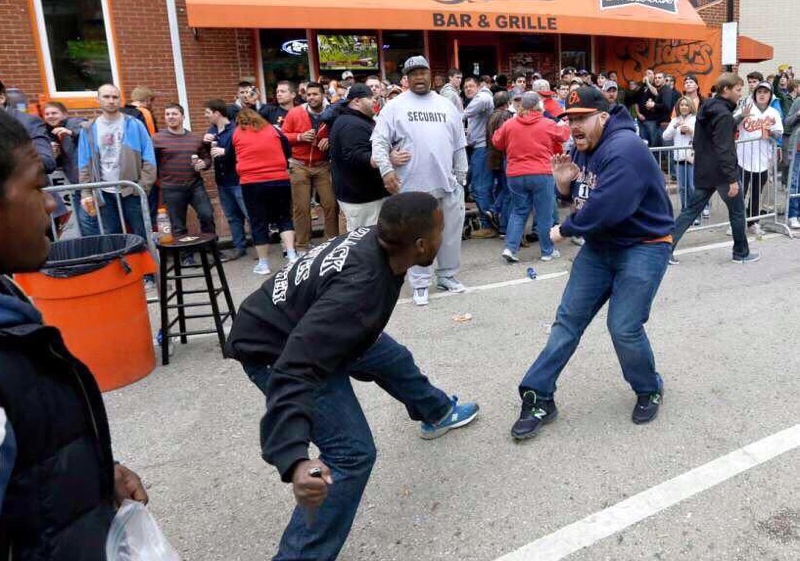
An analysis of social media traffic in downtown Baltimore Monday has unearthed striking connections to the protests in Ferguson, Mo. last year, according to a leading data mining firm that shared its findings exclusively with Fox News.

The firm, which asked to remain anonymous because of its government work, found between 20 and 50 social media accounts in Baltimore that were also tied to the peak period of violence in Ferguson.

While further analysis is being conducted on the data, it suggests the presence of “professional protesters” or anarchists taking advantage of Freddie Gray’s death to incite more violence.

Gray, 25, died April 18, a week after being injured while in police custody. A wave of violence erupted in Baltimore following his funeral Monday.

One account, which also tracked the recent union protests in New York City as well as other disturbances, tweeted photos of Gray’s funeral and used language that seemed to anticipate violence in Baltimore.

Source: FOXNews.com

Tycoon says Apartheid was bad for business

Apartheid was not good for his businesses Johann Rupert, chairman of the Remgro and Richemont groups, declared on Tuesday.

He was one of the speakers at the FW de Klerk Foundation’s conference on issues related to the South African economy and race.

On 2 February 1990 De Klerk unbanned most terrorist organisations, including the ANC, SACP and the PAC and announced the liberation of Mandela and all leftwing and communist political prisoners.

Almost all rightwing political prisoners are still in prison after 25 years, an indication of De Klerk’s total lack of popularity amongst whites.

Rupert, De Klerk, former deputy president Kgalema Motlanthe and Lord Renwick were guest speakers at the annual FW de Klerk Foundation conference in Cape Town, commemorating the 25th anniversary of Nelson Mandela’s release.

“We had businesses here and overseas and the businesses in foreign countries did much better [during apartheid]. Over there returns were 10% or 12% more than in South Africa,” Rupert said.

Rupert dismissed the notion of wealth redistribution as the panacea for inequality, saying the issue was rather to create the conditions to create wealth.

“Trade unions destroy jobs. Their job is not to create jobs, their job is to protect people who are already employed. They do not represent the interests of the unemployed,” he said.

His remarks were made a week after the Heritage Foundation, a Washington DC thinktank, pointed an accusatory finger at the strong influence of the unions in the economy.

De Klerk told the forum he was convinced that “what we have now is much better than what we had in the past”.

Lord Robin Renwick, the British ambassador to South Africa prior to Mandela’s release, said South Africa would do best by “defending its constitution and the independence of the judiciary”.

Progressive redistribution was not an unrealistic goal, he added, but the question was how it would unfold as perceptions could affect the country.

If there was to be increased state intervention, he said, “then you need to have a state more efficient than we have seen anywhere in the world ever”.

Not even East Germany managed that, he said, quipping: “Karl Marx is dead everywhere, except in South Africa.”

But debate was urgently needed to forge social cohesion, the two former presidents, the Afrikaner tycoon and British diplomat agreed on Tuesday.

Former president Kgalema Motlanthe deplored the fact that South Africans criticised the country’s “black government”, saying it was both a political misnomer because the government was democratically elected and an indicator of division.

“Labelling the government black may say more about their thinking than anything they are trying to express. The result is a misinformed and misleading discourse which often entrenches social stereotypes, fuelling feelings of alienation.

“If there is one space that provides a useful index of race relations in the country it is social media. In the recent past the social-media space has seen torrential racial abuses across the social spectrum openly advocating the biological, historical, economic and social utility of the construct of race as the organising principle in human affairs.

“Most disheartening about this open manifestation of racial hostilities is the debilitating effects on what we are trying to build, a nation united in diversity.”

Half of global wealth held by the 1%

Billionaires and politicians gathering in Switzerland this week will come under pressure to tackle rising inequality after a study by Oxfam found that – on current trends – by next year, 1% of the world’s population will own more wealth than the other 99%.

The charity’s research, published on Monday, shows that the share of the world’s wealth owned by the best-off 1% has increased from 44% in 2009 to 48% in 2014, while the least well-off 80% currently own just 5.5%.

Oxfam added that on current trends the richest 1% would own more than 50% of the world’s wealth by 2016.

Winnie Byanyima, executive director of Oxfam International and one of the six co-chairs at this year’s WEF, said the increased concentration of wealth seen since the deep recession of 2008-09 was dangerous and needed to be reversed.

“The message is that rising inequality is dangerous. It’s bad for growth and it’s bad for governance. We see a concentration of wealth capturing power and leaving ordinary people voiceless and their interests uncared for.”

Oxfam made headlines at Davos last year with a study showing that the 85 richest people on the planet have the same wealth as the poorest 50% (3.5 billion people). The charity said this year that the comparison was now even more stark, with just 80 people owning the same amount of wealth as more than 3.5 billion people, down from 388 in 2010.

Separate research by the Equality Trust, which campaigns to reduce inequality in the UK, found that the richest 100 families in Britain in 2008 had seen their combined wealth increase by at least £15bn, a period during which average income increased by £1,233. Britain’s current richest 100 had the same wealth as 30% of UK households, it added.

Pope Francis and the IMF managing director Christine Lagarde have been among those warning that rising inequality will damage the world economy if left unchecked, while the theme of Thomas Piketty’s best-selling book Capital was the drift back towards late 19th century levels of wealth concentration.

Barack Obama’s penultimate State of the Union address on Tuesday is also expected to be dominated by the issue of income inequality.

He will propose a redistributive tax plan to extract more than $300bn (£200bn) in extra taxes from the 1% of rich earners in order to fund benefits specifically targeted at working families.

However, the odds of the White House having any success persuading Congress to adopt the plan, given the Republicans’ new grip on both chambers, are extremely long.

Oxfam said the wealth of the richest 80 doubled in cash terms between 2009 and 2014, and that there was an increasing tendency for wealth to be inherited and to be used as a lobbying tool by the rich to further their own interests. It noted that more than a third of the 1,645 billionaires listed by Forbes inherited some or all of their riches, while 20% have interests in the financial and insurance sectors, a group which saw their cash wealth increase by 11% in the 12 months to March 2014.

These sectors spent $550m lobbying policymakers in Washington and Brussels during 2013. During the 2012 US election cycle alone, the financial sector provided $571m in campaign contributions.

Source: The Guardian

South Africa sliding backwards economically under black rule

Finance Minister Nhlanhla Nene will have his work cut out at next week’s budget to try and reassure disillusioned South Africans that the government still has gas in its tank to pull the economy out of the doldrums.

Twenty years after Nelson Mandela swept the African National Congress to power, pledging to unleash the economy and ensure universal access to quality education, jobs and houses, very little of the optimism that engulfed the country then remains.

For South Africans like Mulalo Ramavu, a self-employed handyman who barely scratches out a living for his family of four in Johannesburg’s poverty-stricken Alexandra township, confidence that the ANC can reduce social inequality and significantly improve living standards for blacks has long gone.

The future looks even bleaker for his young sons.

“This is not the South Africa I expected after apartheid,” said 40-year-old Ramavu, reflecting on his long-abandoned dreams of becoming an engineer and buying a house in the suburbs, the preserve of whites during apartheid rule.

“After a promising start, the ANC now seems to be taking us backwards, and I fear for the future. I don’t see how Nene can convince me otherwise.”

Even the ruling party’s harshest critics concede it has done a lot to better the lives of black South Africans since 1994, building over 3 million houses, improving access to water and power and providing social grants to over 15 million people.

But many are growing impatient with the government’s failure to get the economy moving after a 2009 recession.

After averaging 5 percent previously, annual economic growth has struggled to reach 2 percent in the last five years.

In February, then Finance Minister Pravin Gordhan predicted growth of 2.7 percent for 2014, but Nene has admitted that now looks unattainable after months of debilitating strikes that have hit efforts to reduce 25 percent unemployment.

Official data shows nearly 3 million 18 to 24-year-olds cannot find jobs, translating to a youth unemployment rate of above 60 percent.

“Unemployment has turned our youth to crime and lawless behaviour. The desperation is simmering towards boiling point,” said Mkhuleko Hlengwa, chairman of the youth wing of the opposition Inkatha Freedom Party.

“The desperation of our people may translate into a catastrophe which will reverse the gains of the past 20 years,” he told a conference this week, noting young people have been at the forefront of protests against poor services.

President Jacob Zuma in May promised “radical socio-economic transformation” through industrialisation, black empowerment and expanding the state’s role in the economy, but few believe his plan will be realised.

Confidence in Zuma’s leadership, moreover, is at an all-time low after the public protector found the government had inappropriately used more than 240 million rand in state funds to upgrade the president’s country home.

Economists urge the government to overhaul restrictive labour regulations to attract more investment, slash the bloated civil service and clamp down on corruption by government officials to free up funds for productive sectors of the economy.

But they expect little progress on this from Nene in his budget.

South Africa, which recently lost its status as Africa’s biggest economy to Nigeria, is still suffering from protracted wage strikes in the platinum mining and manufacturing sectors earlier this year, meaning Nene has limited funds at his disposal for the quarter of the population that rely on social grants.

Already, the government is sitting on a debt-to-GDP ratio of 40 percent, the result of years of spending to boost growth and finance what critics say is an unwieldy public sector wage bill.

“What we should be doing is shrinking government. We should be finding ways to do more with less, not less with more,” said George Glynos, managing director at ETM Analytics.

“The government has done a very poor job of boosting confidence in the longer-term prospects of the economy.”

Business confidence is close to record lows, with firms worried about rigid labour laws they say have given unions free rein to stage crippling strikes to press for above-inflation wage demands.

The ANC has, over the years, flirted with policies which, on paper, promise to boost growth and lift the black majority out of poverty.

Foremost has been a Black Economic Empowerment (BEE) employment code that critics say has only benefited ruling party cronies.

Many studies suggest the critics might be right, with several measures of overall inequality widening from 1994 levels – albeit with a small black minority joining the ranks of the super wealthy.

A recent report coordinated by Oxfam and funded by the European Union noted that South Africa’s Gini coefficient – a widely used equality indicator – rose to 70 percent in 2008, one of the highest levels in the world, from 66 percent in 1993.

Few people dispute the need to redress the imbalances left by apartheid but white South Africans, such as retired school teacher Anne Sharpe, believe BEE is unfairly edging their children out of the labour market, forcing many to emigrate.

“Many young whites see no future for themselves here and feel persecuted for a history they were not part of,” said Sharpe, 69.

“Apartheid was wrong, but so, in some ways, is BEE. Two wrongs don’t make a right.” – Reuters

SAIRR: Rising expectations lead to more violent uprisings

opstandRising expectations and youth unemployment have been identified as some of the sources of violent protests which have increased dramatically in the country in recent months.

The South African Institute of Race Relations, SAIRR’s programme manager and researcher, Georgina Alexander, says: “We have more people on social welfare at the moment in the country than those who have employment.”

In his State of the Nation Address last week, President Jacob Zuma promised on Thursday that South Africa would enter a new radical phase of accelerated socioeconomic transformation after the May election.

“More importantly, after the elections, the country will enter a new radical phase in which we shall implement socioeconomic transformation policies and programmes that will meaningfully address poverty, unemployment and inequality.

“It is a phase of focusing on economic transformation in particular. We have achieved political freedom, now we must achieve economic freedom and ensure that the ownership, management and control of the economy is deracialised further.

More needed to be done to advance blacks, he said.

“The number of black people and women in senior management has increased from less than 10% in the 1990s to over 40% today, which is a good achievement for the country. But it is not enough. Each year, the Employment Equity report releases statistics that indicate that the economy is still controlled by white South Africans in terms of senior and top management positions.

“We must therefore intensify the implementation of affirmative action policies in order to deepen reconciliation and social cohesion in our country,” Mr Zuma said.

Alexander says, “There is a threat that these protests will increase and become more violent. […] The government can see that the delivery protests are becoming more violent. They need to address the deeper causes of these service delivery protests.”

The deeper reasons for the protest lie in levels of youth unemployment and dependency on state as well as increasing rising expectations that people have, but it’s all directly reliant on the state to do something about it.

“This is just a spark, the deeper reasons for the protest lie in levels of youth unemployment and dependency on state as well as increasing rising expectations that people have, but it’s all directly reliant on the state to do something about it like to increase people’s living standard for them.”

Police officials and the South African Human Rights Commission (SAHRC) recently met to discuss the violent protests.

The SAHRC’s Danny Titus says, “The commissioner indicated to us that she would like to have a meeting next March with the Human Rights Commission focusing specifically on human rights and policing, and the number of issues around that.”

He says, “We would like to establish this relationship where we can make each other understand each other’s picture.”

Meanwhile, National Police Commissioner Riah Phiyega says they are struggling to control violent protests because of a shortage of public order policing officers. There are only 4 000 such officers and yet there was double the number in 2006.

Oxfam: Inequality rises after Apartheid

The world’s 100 richest people earned a stunning total of $240 billion in 2012 – enough money to end extreme poverty worldwide four times over, Oxfam has revealed, adding that the global economic crisis is further enriching the super-rich.

“The richest 1 percent has increased its income by 60 percent in the last 20 years with the financial crisis accelerating rather than slowing the process,” while the income of the top 0.01 percent has seen even greater growth, a new Oxfam report said.

For example, the luxury goods market has seen double-digit growth every year since the crisis hit, the report stated. And while the world’s 100 richest people earned $240 billion last year, people in “extreme poverty” lived on less than $1.25 a day.

Oxfam is a leading international philanthropy organization. Its new report, ‘The Cost of Inequality: How Wealth and Income Extremes Hurt us All,’ argues that the extreme concentration of wealth actually hinders the world’s ability to reduce poverty.

The report was published before the World Economic Forum in Davos next week, and calls on world leaders to “end extreme wealth by 2025, and reverse the rapid increase in inequality seen in the majority of countries in the last 20 years.”

Oxfam’s report argues that extreme wealth is unethical, economically inefficient, politically corrosive, socially divisive and environmentally destructive.

The report proposes a new global deal to world leaders to curb extreme poverty to 1990s levels by:

– closing tax havens, yielding $189bn in additional tax revenues

– reversing regressive forms of taxation

– introducing a global minimum corporation tax rate

– boosting wages proportional to capital returns

– increasing investment in free public services

The problem is a global one, Oxfam said: “In the UK inequality is rapidly returning to levels not seen since the time of Charles Dickens. In China the top 10 percent now take home nearly 60 percent of the income. Chinese inequality levels are now similar to those in South Africa, which is now the most unequal country on Earth and significantly more [inequality] than at the end of apartheid.”

In the US, the richest 1 percent’s share of income has doubled since 1980 from 10 to 20 percent, according to the report. For the top 0.01 percent, their share of national income quadrupled, reaching levels never seen before.

“We can no longer pretend that the creation of wealth for a few will inevitably benefit the many – too often the reverse is true,” Executive Director of Oxfam International Jeremy Hobbs said.

Hobbs explained that concentration of wealth in the hands of the top few minimizes economic activity, making it harder for others to participate: “From tax havens to weak employment laws, the richest benefit from a global economic system which is rigged in their favor.”

The report highlights that even politics has become controlled by the super-wealthy, which leads to policies “benefitting the richest few and not the poor majority, even in democracies.”

“It is time our leaders reformed the system so that it works in the interests of the whole of humanity rather than a global elite,” the report said.

The four-day World Economic Forum will be held in Davos starting next Wednesday. World financial leaders will gather for an annual meeting that will focus on reviving the global economy, the eurozone crisis and the conflicts in Syria and Mali. – RT

‘Inequality causes violence’ – academic

Gender and economic inequality are prevalent in violent societies, a conference on crime reduction heard on Thursday.

“South Africa is one of the wealthiest countries in Africa, but we also have one of the highest levels of violence,” said KwaZulu-Natal University academic Anthony Collins.

“There are African countries that are poor, for instance Malawi, but have less violence.”

He said rich countries, such as the United States, were also violent, because of high levels of inequality.

“What research is showing is that it is not the poverty; it is the economic inequality that is more significant,” Collins said.

“South Africa and Brazil are among the most unequal societies in the world and they also have among the highest levels of violence, although South Africa is higher.”

Collins cautioned that this was not a simple matter of cause and effect. Many other factors had to brought into the mix.

“There is a lot of social behaviour, cultural traditions, values, ideas [and] historical causes like in instances where societies have been through a lot of conflict, like South Africa.”

He said in the past there had been two views on violence. One was that people were violent because they disrespected the law.

Then, the progressive view came which said society was violent because of social circumstances.

“That was obviously true, but that got over-simplified into this claim that poverty causes violence,” said Collins.

“It is where you’ve got poverty and wealth in the same society next to each other. This creates a condition in which violence flourishes.”

Another contributing factor shown by research was the prevalence of gender inequality.

“A lot of societies where women and men have a more equal status are less violent… in a society with a lot of patriarchal structure, those societies turn to be violent,” said Collins.

Delegates from around the world attended the conference, themed “National And International Perspectives On Crime Reduction and Criminal Justice”. – Sapa

FW de Klerk pontificates on inequality and our ‘catastrophic education system’

FW de Klerk, former President of South Africa

The outcome of the ANC’s elective conference in Mangaung at the end of the year could have a big effect on South Africa’s future, former president FW de Klerk said on Thursday.

“I do think the choice of leadership in this December can positively or negatively effect our future in the short and the medium term,” he said, speaking at a Cape Town Press Club memorial dinner.

It was important that African National Congress members attending the conference acted in the interests of the country, and not individuals.

“Therefore I think it’s important that, in the context of a party structure, that the conference goers take good account of what is in the best interests not of person A or person B, but what is in the best interests of South Africa.”

De Klerk called for a return to the spirit of seeking reconciliation that prevailed in the country in the years immediately after 1994.

“How can we rise above grabbing and looking for positions and filling your pockets?”

South Africa needed political leaders who could serve communities and “put their hands and their heads together in ensuring we tackle the challenges we face”.

Responding to a question on whether South Africa should not be promoting itself with a massive international “road show”, De Klerk said investors had been frightened by what they had seen happening in South Africa over the past 18 months.

“What has happened at Marikana will make a joke of any road show,” he said, referring to the shooting dead of 34 striking mineworkers by police in North West on August 16.

They were also put off by reports of corruption.

“Investors are put off by factual accounts of the unbridled corruption that is taking place in South Africa. You can’t have a road show unless your house is in order.

“We need to sell ourselves, but we need to get the product right [first].”

Earlier, De Klerk, who turned 76 in March this year, said the main inequality divide in South Africa was no longer between blacks and whites, but between unionised and employed workers on the one hand, and unemployed on the other.

“It is a divide that lies at the heart of our inequality challenge.”

It was also a divide “that the Congress of SA Trade Unions is determined to defend by vigorously opposing any efforts to make the labour market more flexible”.

Another principal cause of inequality was the “catastrophic failure of our education system”.

A total of 60 percent of those who left school did so without a matric, and those who passed matric did so with an average mark of less than 40 percent.

De Klerk criticised the ruling party’s affirmative action and black economic empowerment policies.

“In the face of increasing national inequality, there is good reason to conclude that the government’s affirmative action and BEE policies have failed to address inequality, and might even have aggravated it.

“This is because most affirmative action and BEE occur in the top 10 to 15 percent of the income pyramid and have little or no impact on the bottom 85 percent of our society.

De Klerk, who served as South Africa’s last apartheid president from 1989 to 1994, called for these policies to be abandoned.

“Shift the accent in affirmative action programmes from race to relative disadvantage,” he said.

He also offered recommendations for the promotion of equality, including a more flexible labour dispensation, accelerated economic growth, and the rooting out of corruption, among others.

– Sapa

Despite radical affirmative action, racial income gap remains in South Africa

Inequalities in South Africa are threatening economic growth, with children born into poor families unlikely ever to escape poverty or reap the rewards of living in Africa’s largest economy.

The World Bank’s sobering assessment released last week found that a child’s gender and ethnicity at birth, combined with a lack of education, largely determine that person’s chances of success in life — even 18 years after the end of apartheid.

“South Africa, the continent’s largest economy by far and its only G-20 member, displays strikingly high and persistent inequality and marginalization for an upper middle-income country,” said the report.

Although South Africa has made great strides in transforming the economy, which has produced one of the continent’s fastest-growing black middle classes, poverty levels and unemployment remain high outside urban centres.

South Africa is often compared to Brazil, which also has a huge income gap, but while the Latin American country has narrowed the divide over the last decade, here the chasm is as deep as ever, the World Bank said.

The richest 10 percent of South Africans account for 58 percent of the nation’s income, while the bottom 10 percent accounts for 0.5 percent, the Bank said. The bottom half earns less than eight percent of the nation’s income.

The country will struggle to grow the economy until its riches are spread more evenly, the Bank said.

Sharp economic and social inequalities were especially visible along racial lines, said the report, with whites largely shielded from economic hardships thanks to privileges inherited from the fallen apartheid regime.

“Peering past the first-world living conditions of urban South Africa, it is not too hard to see the downcast situation of townships, informal settlements, and former homelands,” said Sandeep Mahajan, who headed the report.

“Our results show that a South African child not only has to work harder to overcome the disadvantages at birth due to circumstances, but having done so, finds that these reemerge when seeking employment as an adult,” he said.

The report said residents of these areas were usually unemployed or lacked the means to look for jobs, as they were disconnected from the job market.

Unemployment in the first quarter of 2012 rose to 25.2 percent, up from 23.9 percent in the previous quarter, and black people form the bulk of the jobless.

Modest economic growth, which averaged 3.2 percent since 1995, had proved “insufficient to absorb the wave of new entrants to the labour market from dismantling apartheid’s barriers”, the report said.

Labour analyst Andrew Levy said challenges of inequality were “deep rooted and not unique to South Africa”.

“History has shown that societies that have emerged from any kind of unjust system of governance struggle with inequality,” said Levy. But he added that the new government “could have done better”.

Much of the blame is laid on the education system.

The World Bank found that black children from rural areas with parents who did not finish school were most likely not to finish school or have access to health care.

Children in some parts of the country are forced to learn in open spaces or under trees, even though education is the government’s single biggest expenditure.

This year education campaigners took the government to court after schools across the poor northern province of Limpopo were left without textbooks, months into the academic year. More than one month after a court order, government has not delivered books to all the schools.

“The only way to reverse the trend of inequality is to invest in education,” said economist Azar Jammine. – Sapa

Also read Education under white rule was better – black South African activist-academic

FW de Klerk attacked for ‘defending the white man’

A black South African columnist has just published the following article in the London Guardian, blaming whites for blacks’ continuing poverty under a black government.

FW de Klerk: defender of the white man

South Africa is trying to move on from apartheid. It’s a shame its former president is not

by Justice Malala

The last undemocratically elected president of South Africa, the Nobel Peace laureate FW de Klerk, has in recent months been holding forth on the state of the nation. It’s a familiar view: that South Africa is becoming yet another post-colonial country destined to fall into maladministration, corruption, famine and finally war because the white man has lost political power.

In his utterances, it seems, the only thing that can save the nation from this preordained state of affairs is continued protection of white minority privileges and rights. All attempts to discuss a South Africa that is not riven by the terrible inequalities wrought by apartheid are seen, by him, as a threat to these privileges.

We heard elements of this narrative again this week. “The Mandela and Mbeki era of reconciliation is over,” de Klerk warned darkly. “White males are quite unjustly blamed for the continuing triple crisis of unemployment, inequality and poverty.”

He did not ask South Africans to come together and find solutions to these problems. Instead, he asked them to “get [on to the] playing field and become politically active”. The message is clear: they must fight and stop the ruling ANC’s talk of speeding up measures to stem unemployment and poverty.

These utterances come in the wake of De Klerk’s interview on CNN in May when he claimed that black people under apartheid “were not disenfranchised, they voted”. In this he was defending the heinous homeland system, under which Africans were “cleaned out” from “white South Africa” and confined to impoverished “black reserves”.

It increasingly seems that De Klerk cannot change from the person an angry Nelson Mandela identified during the democracy negotiations in 1991: “His weakness is to look at matters from the point of view of the National party and the white minority in this country, not from the point of view of the population of South Africa.”

Though De Klerk chooses to appoint himself defender of the country’s white males, they need very little defending. Almost all of the 20 best-paid directors in Johannesburg Stock Exchange-listed companies are white men. This is not to vilify them, but it is a reminder that all of us South Africans need to do something, urgently, about inequality and poverty. After all, just this week the World Bank said South Africa is one of the most unequal countries in the world, with the top 10% of the population accounting for 58% of its income and the bottom half less than 8%. “Circumstances at birth are important drivers of inequality in South Africa,” said the bank’s report.

South Africa faces massive problems of unemployment and poverty. The ruling ANC has spectacularly failed the poor after 18 years in power. Under President Zuma things are getting worse: the challenges of poverty, unemployment and inequality need a new vision and new leaders. But the De Klerk soundtrack, that South Africa is on the verge of collapse because the white man is allegedly under threat, is tiring and depressing. It does nothing to solve these urgent and collective problems.

De Klerk still believes he is the leader of a threatened white minority. He should learn to think of not just the white males whose survival he so energetically claims to defend, but also of the poor and marginalised who every day stand on our street corners and beg for alms.

That is the complex narrative of a country that has defied stereotypes and had three democratically elected presidents in 18 years; which has avoided racial conflagration; which has given more electricity to more people in the shortest space of time than any other in the world. It is not the narrative of a country whose sole obsession is the survival of a white minority’s privileges.

Original article.