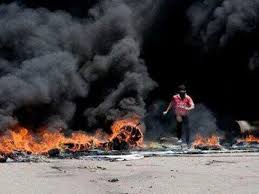
SAIRR: Rising expectations lead to more violent uprisings

opstandRising expectations and youth unemployment have been identified as some of the sources of violent protests which have increased dramatically in the country in recent months.

The South African Institute of Race Relations, SAIRR’s programme manager and researcher, Georgina Alexander, says: “We have more people on social welfare at the moment in the country than those who have employment.”

In his State of the Nation Address last week, President Jacob Zuma promised on Thursday that South Africa would enter a new radical phase of accelerated socioeconomic transformation after the May election.

“More importantly, after the elections, the country will enter a new radical phase in which we shall implement socioeconomic transformation policies and programmes that will meaningfully address poverty, unemployment and inequality.

“It is a phase of focusing on economic transformation in particular. We have achieved political freedom, now we must achieve economic freedom and ensure that the ownership, management and control of the economy is deracialised further.

More needed to be done to advance blacks, he said.

“The number of black people and women in senior management has increased from less than 10% in the 1990s to over 40% today, which is a good achievement for the country. But it is not enough. Each year, the Employment Equity report releases statistics that indicate that the economy is still controlled by white South Africans in terms of senior and top management positions.

“We must therefore intensify the implementation of affirmative action policies in order to deepen reconciliation and social cohesion in our country,” Mr Zuma said.

Alexander says, “There is a threat that these protests will increase and become more violent. […] The government can see that the delivery protests are becoming more violent. They need to address the deeper causes of these service delivery protests.”

The deeper reasons for the protest lie in levels of youth unemployment and dependency on state as well as increasing rising expectations that people have, but it’s all directly reliant on the state to do something about it.

“This is just a spark, the deeper reasons for the protest lie in levels of youth unemployment and dependency on state as well as increasing rising expectations that people have, but it’s all directly reliant on the state to do something about it like to increase people’s living standard for them.”

Police officials and the South African Human Rights Commission (SAHRC) recently met to discuss the violent protests.

The SAHRC’s Danny Titus says, “The commissioner indicated to us that she would like to have a meeting next March with the Human Rights Commission focusing specifically on human rights and policing, and the number of issues around that.”

He says, “We would like to establish this relationship where we can make each other understand each other’s picture.”

Meanwhile, National Police Commissioner Riah Phiyega says they are struggling to control violent protests because of a shortage of public order policing officers. There are only 4 000 such officers and yet there was double the number in 2006.
Costly ambitions of NDP not discussed

fastfactsThe National Development Plan (NDP) tries to do too much and its costly ambitions are not discussed, the South African Institute of Race Relations said on Monday.

“It reads as if various government departments have provided wish-lists without much attempt to pull them all together,” it said in the July edition of its monthly magazine Fast Facts.

“But one thing the NDP does not do is put a price tag on all the wish lists it incorporates and endorses.”

These included an extension of tertiary education, faster land reform, national health insurance, racial preferencing in procurement contracts, and guaranteed minimum living standards subsidies of various kinds.

There was no chapter in the 500 page document discussing how all of this would be paid for, the SAIRR said.

Here and there were reference to taxpayers having to fund things where there were no user charges, and that raising taxes might reduce profitability.

It was assumed that if the economy grew more than five percent a year, government revenue and the profit of private firms would more than double over the next 20 years, but whether this would be enough to fund all the plans in the NDP was not discussed.

“There are employment scenarios, but no scenarios about tax revenue, or the budget deficit, or public debt,” the SAIRR said.

“To endorse the NDP amounts to giving government a blank cheque for more taxation and more borrowing and probably for both.”

The institute said there were many internal contradictions within the document, but it was also undermined by external contradictions.

There was also no “command centre” to implement the plan.

“The nominally responsible [Minister in the Presidency for National Planning Commission] Trevor Manuel, has no executive authority.

“But Ministers who are actually running departments do as they please, since President Jacob Zuma fails to exercise any leadership over his government,” the SAIRR said.

It said departments which were key to the success or failure of the NDP were headed by ministers, some of them SA Communist Party members, who believed in more state control and were busy extending it.

These departments were trade and industry, mineral resources, energy, communications, economic development, agriculture, public enterprises, public works, higher education and labour.

“For them, in fact, the NDP is the perfect smokescreen.

“While the attention of the country is focused on the NDP… these ministers can steadily introduce dirigiste legislation in mining, energy, employment equity, black economic empowerment, labour, business licensing, land, and property rights.”

Dirigiste legislation is directed by a central authority and controlled by the state. – SAPA

Education, not race determines employment in South Africa – SAIRR

Educational achievement is a more important indicator of why people are employed rather than race, the SA Institute of Race Relations (Sairr) said on Wednesday.

“The proportion of people by race in professional positions closely mirrors the proportion of people by race with professional qualifications,” said research manager Lucy Holborn in a statement.

The data challenged the view that South African employers were resisting racial transformation in the workplace.

According to the data, there were about 41 percent of black people with degrees and there were 36 percent of blacks in professional positions.

There were 45 percent of white people with degrees or higher qualifications and there were 42 percent of them in professional positions.

“While a degree of racial prejudice exists in all societies, the data suggests that educational achievement will determine the pace of future employment equity progress in South Africa,” she said.

Sairr sourced information from Statistics SA and the Commission for Employment Equity.