Spain is militarizing against citizens

By Martin Armstrong.

The Spanish government is militarizing gearing up for violent protests against the EU that are expected to turn up before a hot autumn. Spain is now equipping the police for about one billion euros with new combat equipment. Violent protests in Spain since the crisis began almost a daily occurrence. Movements such as 25 de Mayo or the Indignados call Spaniards of all strata of the population to protest against the government on the streets. The police will always respond violently. They cover up their brutal responses by banning any video of police beatings making it a crime in itself. This is certainly illustrating the loss of freedom and any democratic process within Europe. The police scandals have only charged the atmosphere within the population and we may see this erupt into civil war as we move forward.

Goya’s painting of the brutal treatment of citizens during the Spanish Civil War is a reminder of what we could face in the aftermath of the militarization of Spain against its own citizens. Since June, the Spanish Interior Ministry has signed four contracts for the purchase of protective vests, shields and other riot gear. These weapon purchases are causing many to relive very bad memories in Spain. Spain has also bought water canons, a weapon that by the end of the Franco dictatorship was in continuous use. Opposition leader Antonio Trevin called the purchase therefore “a return to the times we would rather forget.” The Interior Ministry has responded merely justifying their rearming as necessary “because of the current social dynamics”, necessary, reports the Guardian.

The protests are mainly directed against the always new austerity measures, tax increases, the extremely high youth unemployment, homelessness following the bursting of the housing bubble, and also against a restrictive policy such as the recent bill to ban abortions. Then there is the movement to establish a referenda for the abolition of the monarchy. Then throw in the separatist movement as we see in Scotland where the Catalans are moving for their independence. There were protests against the recent visit of German Chancellor Angela Merkel that had to be violently dispersed by the government.

Spain is moving toward civil war. Even the human rights organization Amnesty International has expressed concern over the arming of the police. The police are there to protect the government – not the people. That is a dangerous position that sets the stage for civil war.

Source: armstrongeconomics.com
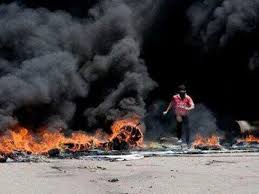
SAIRR: Rising expectations lead to more violent uprisings

opstandRising expectations and youth unemployment have been identified as some of the sources of violent protests which have increased dramatically in the country in recent months.

The South African Institute of Race Relations, SAIRR’s programme manager and researcher, Georgina Alexander, says: “We have more people on social welfare at the moment in the country than those who have employment.”

In his State of the Nation Address last week, President Jacob Zuma promised on Thursday that South Africa would enter a new radical phase of accelerated socioeconomic transformation after the May election.

“More importantly, after the elections, the country will enter a new radical phase in which we shall implement socioeconomic transformation policies and programmes that will meaningfully address poverty, unemployment and inequality.

“It is a phase of focusing on economic transformation in particular. We have achieved political freedom, now we must achieve economic freedom and ensure that the ownership, management and control of the economy is deracialised further.

More needed to be done to advance blacks, he said.

“The number of black people and women in senior management has increased from less than 10% in the 1990s to over 40% today, which is a good achievement for the country. But it is not enough. Each year, the Employment Equity report releases statistics that indicate that the economy is still controlled by white South Africans in terms of senior and top management positions.

“We must therefore intensify the implementation of affirmative action policies in order to deepen reconciliation and social cohesion in our country,” Mr Zuma said.

Alexander says, “There is a threat that these protests will increase and become more violent. […] The government can see that the delivery protests are becoming more violent. They need to address the deeper causes of these service delivery protests.”

The deeper reasons for the protest lie in levels of youth unemployment and dependency on state as well as increasing rising expectations that people have, but it’s all directly reliant on the state to do something about it.

“This is just a spark, the deeper reasons for the protest lie in levels of youth unemployment and dependency on state as well as increasing rising expectations that people have, but it’s all directly reliant on the state to do something about it like to increase people’s living standard for them.”

Police officials and the South African Human Rights Commission (SAHRC) recently met to discuss the violent protests.

The SAHRC’s Danny Titus says, “The commissioner indicated to us that she would like to have a meeting next March with the Human Rights Commission focusing specifically on human rights and policing, and the number of issues around that.”

He says, “We would like to establish this relationship where we can make each other understand each other’s picture.”

Meanwhile, National Police Commissioner Riah Phiyega says they are struggling to control violent protests because of a shortage of public order policing officers. There are only 4 000 such officers and yet there was double the number in 2006.