The Greek authorities want to investigate alleged misconduct by a number of journalists who attended seminars organized by the IMF and were allegedly instructed to promote the organization’s advice to Greece.
The accusations were voiced by Greece’s former representative to the International Monetary Fund Panagiotis Roumeliotis, who testified Tuesday in front of a special parliamentary committee on the country’s debt. Newspaper Proto Thema published excerpts from the testimony on its website.
Roumeliotis was cited as saying that he accidentally bumped into Greek journalists during a visit to Washington DC, who told him that they were attending a seminar organized by the IMF. The fund held a number of similar events in the US and in Greece with the goal of explaining its operations and apparently was spinning its work positively, he said.
The former Greek official endorsed criticism by committee member Leonidas Vatikiotis, who said that the seminars were held in an opaque manner and that the journalists afterward became “mouthpieces of the IMF, preachers of austerity, opponents of strikes and public workers.”
The committee said the Greek parliament should demand to know from the IMF who exactly attended the seminars and what they were told there. It also said the Greek journalists’ union ESIEA should be asked to comment on a possible breach of professional ethics.
The Spanish government is militarizing gearing up for violent protests against the EU that are expected to turn up before a hot autumn. Spain is now equipping the police for about one billion euros with new combat equipment. Violent protests in Spain since the crisis began almost a daily occurrence. Movements such as 25 de Mayo or the Indignados call Spaniards of all strata of the population to protest against the government on the streets. The police will always respond violently. They cover up their brutal responses by banning any video of police beatings making it a crime in itself. This is certainly illustrating the loss of freedom and any democratic process within Europe. The police scandals have only charged the atmosphere within the population and we may see this erupt into civil war as we move forward.
Goya’s painting of the brutal treatment of citizens during the Spanish Civil War is a reminder of what we could face in the aftermath of the militarization of Spain against its own citizens. Since June, the Spanish Interior Ministry has signed four contracts for the purchase of protective vests, shields and other riot gear. These weapon purchases are causing many to relive very bad memories in Spain. Spain has also bought water canons, a weapon that by the end of the Franco dictatorship was in continuous use. Opposition leader Antonio Trevin called the purchase therefore “a return to the times we would rather forget.” The Interior Ministry has responded merely justifying their rearming as necessary “because of the current social dynamics”, necessary, reports the Guardian.
The protests are mainly directed against the always new austerity measures, tax increases, the extremely high youth unemployment, homelessness following the bursting of the housing bubble, and also against a restrictive policy such as the recent bill to ban abortions. Then there is the movement to establish a referenda for the abolition of the monarchy. Then throw in the separatist movement as we see in Scotland where the Catalans are moving for their independence. There were protests against the recent visit of German Chancellor Angela Merkel that had to be violently dispersed by the government.
Spain is moving toward civil war. Even the human rights organization Amnesty International has expressed concern over the arming of the police. The police are there to protect the government – not the people. That is a dangerous position that sets the stage for civil war.
France’s government of Prime Minister Manuel Valls has resigned; after senior ministers slammed President Francois Hollande’s plans for taxation and spending cuts, and called for alternative ways to Germany-led austerity to exit the crisis.
The statement published Monday said the new office would be formed on Tuesday and would be in the “direction he (the president) has defined for our country.”
Economic Minister Arnaud Montebourg said it was time to resist Germany’s “obsession” with austerity and work out some alternative ways to promote household consumption. He said that measures that had been introduced since the 2008 financial crisis were not doing anything to help the country’s economy grow.
“You have to raise your voice. Germany is trapped in an austerity policy that it imposed across Europe,” the Socialist minister said in the interview.
“France is the eurozone’s second-biggest economy, the world’s fifth-greatest power, and it does not intend to align itself, ladies and gentlemen, with the excessive obsessions of Germany’s conservatives,” the Economic Minister added.
The announcement comes after the country’s Education Minister Benoît Hamon criticized Hollande’s economic policy, calling to shift the focus form the deficit-reduction measures.
“The priority must be exiting crisis and the dogmatic reduction of deficits should come second,” Mr. Montebourg said in an interview with Le Monde published ahead of the annual Fête de la Rose meeting of Socialist Party activists at Frangy-en-Bresse in eastern France.
Finance Minister Michel Sapin said this month that if the economy did not pick up, France would miss its deficit-reduction target for this year. However, he stressed that there was no need to panic and that the government would continue cutting the deficit “at an appropriate pace”.
The Ministers reminded that the economic weakness was causing political extremism and could turn into recession.
Hollande is facing a lot of domestic pressure, due to his failure to get the economy moving in the right direction.
An Ifop poll on Sunday showed he was the most unpopular president in France in more than 50 years. Meanwhile, Valls, who was appointed to the position of Prime Minister in March, had an approval rating of just 36 percent.
Protesters clashed with police in Spain’s capital on Tuesday as the government prepares a new round of unpopular austerity measures for the 2013 budget that will be announced on Thursday.
Thousands gathered in Neptune plaza, just a few meters away from El Prado museum in central Madrid where they formed a human chain around parliament, surrounded by barricades, police trucks and more than 1,500 police in riot gear.
Police fired rubber bullets and beat protesters with truncheons, first as several protesters were trying to tear down barriers and later to clear the square. The police said at least 15 people had been arrested and at least 6 injured.
The protest, promoted over the Internet by different activist groups, was younger and more rowdy than recent marches called by labor unions. Protesters said they were fed up with cuts to public salaries and health and education.
“My annual salary has dropped by 8000 euros and if it falls much further I won’t be able to make ends meet,” said Luis Rodriguez, 36, a firefighter who joined the protest. He said he is considering leaving Spain to find a better quality of life.
With this year’s budget deficit target looking untenable, the conservative government is now looking at such things as cuts in inflation-linked pensions, taxes on stock transactions, “green taxes” on emissions or eliminating tax breaks.
The 2013 budget is the second one conservative Prime Minister Mariano Rajoy has had to pass since he took office in December. Spain must persuade its European partners that it can cut the budget shortfall by more than 60 billion euros by 2014.
Rajoy has already passed spending cuts and tax hikes worth slightly more than that over the next two years, but half-year figures show the 2012 deficit target slipping from view as tax income forecasts will not be hit due to economic contraction.
He said earlier this month the 2013 budget would cut spending further in all areas of government apart from pensions and borrowing costs.
Spain is at the centre of the euro zone debt crisis on concerns the government cannot control its finances and those of highly indebted regions, bitten by a second recession since 2009 which has put one in four workers out of a job.
Regional tension
On the regional front, Catalonia, which generates about 20 percent of the national output, announced on Tuesday it would hold early elections on November 25 after its call for more tax autonomy was rejected last week by Rajoy.
Political uncertainty in cash-strapped Catalonia, along with an announcement from southern region Andalucia it might seek a 4.9 billion euros credit line from the central government, will pile more pressure on Madrid to seek European aid.
Rajoy is holding back from applying for help, which would activate a European Central Bank bond-buying programme and bring down Spain’s punishing debt premiums.
With the threat of the plan alone reducing 10-year yields by around 2 percentage points, the cautious leader, known for keeping his cards close to his chest, is playing for time.
Rajoy says he is mulling the conditions of a bailout application, but suspicion that he may wait until after regional elections on October 21 pushed short-term yields higher at auction on Tuesday.
The government is also expected on Thursday or Friday to set a fresh timetable for economic reforms, seen as an attempt to pre-empt strict EU-imposed conditions for aid.
“Let us in, we want to evict you,” protesters chanted outside parliament. Evictions have soared in Spain as thousands of people have defaulted on bank loans.
Demonstrators said they were angry that the state has poured funds into crumbled banks while it is cutting social benefits.
“We’re protesting against the cuts. I’ve had to give up my apartment,” said Ondina, a 30-year-old fine arts graduate who is without a job. She said she can’t survive on an unemployment benefit of 260 euros ($340) a month.
Running out of options
Half-year deficit data indicate national accounts are already on a slope that will drive Spain into a bailout. The deficit to end-June stands at over 4.3 percent of gross domestic product, including transfers to bailed out banks, making meeting the 6.3 percent target by the end of the year almost impossible.
On Tuesday, the treasury ministry said the central government deficit to end-August had reached 4.77 percent of GDP, already above its year-end target of 4.5 percent of GDP.
“Its going to be difficult keeping the deficit to around 2 percent in the second half, when the first half was closer to 4 percent, especially since traditionally, the second half deficit is higher than the first,” said Juan Ignacio Conde-Ruiz, economist at Madrid’s Complutense University.
For 2012, the measures aim to reap savings of over 13 billion euros, but economists see the deficit missing the target by almost 1 percentage points implies further saving needs of up to 10 billion euros for this year alone.
Rajoy has been careful to highlight the importance of next year’s deficit target of 4.5 percent of GDP though any shortfall this year will weigh on 2013’s accounts. After slashing civil servants’ wages, raising value added tax and cutting health and education spending, Rajoy is running out of options. – Reuters
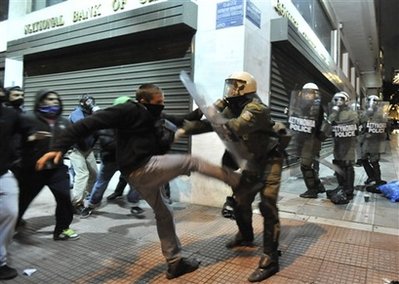
Greece’s parliament approved a deeply unpopular austerity bill Monday to secure a second EU/IMF bailout and avoid national bankruptcy, as buildings burned across central Athens and violence spread around the country.
Cinemas, cafes, shops and banks were set ablaze in central Athens and black-masked protesters fought riot police outside parliament before lawmakers voted on the package that demands deep pay, pension and job cuts — the price of a 130 billion euro ($172 billion) bailout needed to keep the country afloat.
State television reported the violence spread to the tourist islands of Corfu and Crete, the northern city of Thessaloniki and towns in central Greece. Police said 150 shops were looted in the capital and 34 buildings set ablaze.
Altogether 199 of the 300 lawmakers backed the bill, but 43 deputies from the two parties in the government of Prime Minister Lucas Papademos, the socialists and conservatives, rebelled by voting against It. They were immediately expelled by their parties.
Asian shares and the euro gained modestly Monday, relieved by the Greek parliament’s passage of austerity measures that put the country a step closer to securing a much-needed bailout fund and avoiding a messy default.
MSCI’s broadest index of Asia Pacific shares outside Japan edged up as much as 0.3 percent on the news.
The rebellion and street violence foreshadowed the problems the Greek government faces in implementing the cuts, which include a 22 percent reduction in the minimum wage — a package critics say condemns the economy to an ever-deeper downward spiral.
Papademos, a technocrat brought in to get a grip on the crisis, denounced the worst breakdown of order since 2008, when violence gripped Greece for weeks after police shot a 15-year-old schoolboy.
“Vandalism, violence and destruction have no place in a democratic country and won’t be tolerated,” he told parliament as it prepared to vote.
“SHORT-TERM SACRIFICES”
But he admitted that imposing the austerity on a nation that has already endured several years of cuts would be tough.
“The full, timely and effective implementation of the program won’t be easy. We are fully aware that the economic program means short-term sacrifices for the Greek people,” Papademos said.
Greece needs the international funds before March 20 to meet debt repayments of 14.5 billion euros, or suffer a chaotic default which could shake the entire euro zone.
Outside parliament chaos reigned. A Reuters photographer saw buildings in Athens engulfed in flames and huge plumes of smoke rose in the night sky.
“We are facing destruction. Our country, our home, has become ripe for burning, the center of Athens is in flames. We cannot allow populism to burn our country down,” conservative lawmaker Costis Hatzidakis told parliament.
The air in Syntagma Square outside parliament was thick with teargas as riot police fought running battles with youths who smashed marble balustrades and hurled stones and petrol bombs.
Terrified Greeks and tourists fled the rock-strewn streets and the clouds of stinging gas, cramming into hotel lobbies for shelter as lines of riot police struggled to contain the mayhem.
State NET television reported that trouble had also broken out in Heraklion, capital of Crete, as well as the towns of Volos and Agrinio in central Greece.
On the streets of Athens many businesses were ablaze, including the neo-classical home to the Attikon cinema dating from 1870 and a building housing the Asty, an underground cinema used by the Gestapo as a torture chamber during World War Two.
NO GOOD CHOICES
The EU and IMF say they have had enough of broken promises and that the funds will be released only with the clear commitment of Greek political leaders that they will implement the reforms whoever wins an election potentially in April.
Euro zone paymaster Germany ratcheted up the pressure on Sunday. “The promises from Greece aren’t enough for us any more,” German Finance Minister Wolfgang Schaeuble said in an interview published in Welt am Sonntag newspaper.
“Greece needs to do its own homework to become competitive, whether that happens in conjunction with a new rescue program or by another route that we actually don’t want to take.”
When asked if that other route meant Greece quitting the euro zone, Schaeuble said: “That is all in the hands of the Greeks themselves. But even in the event (Greece leaves the euro zone), which almost no one assumes will happen, they will still remain part of Europe.”
The bill sets out 3.3 billion euros ($4.35 billion) of extra budget cuts for this year alone.
It also provides for a bond swap to ease Greece’s debt burden by cutting the real value of private-sector investors’ bond holdings by some 70 percent. Greece would have missed a February 17 deadline to offer a debt “haircut” to private bondholders if the vote had not been passed.
Many Greeks believe their living standards are collapsing already and the new measures will deepen their misery.
“Enough is enough!” said 89-year-old Manolis Glezos, one of Greece’s most famous leftists and a national hero. “They have no idea what an uprising by the Greek people means. And the Greek people, regardless of ideology, have risen.”
Glezos is a national hero for sneaking up the Acropolis at night in 1941 and tearing down a Nazi flag from under the noses of the German occupiers, raising the morale of Athens residents. – Reuters
(Reuters) – Greek leaders clinched a long-stalled deal on reforms and austerity measures needed to secure a bailout and avoid a messy default, government sources said, hours before the country’s financial backers were to meet in Brussels on Thursday.
Athens’ partners in the European Union and the International Monetary Fund have been exasperated by a lack of agreement on the sacrifices they demanded in return for a 130 billion euro ($172 billion) bailout, with time running out for Greece before a major March 20 bond redemption.
Finance Minister Evangelos Venizelos set off for Brussels without a complete deal after all-night talks with leaders of the three Greek coalition parties and chief EU and IMF inspectors left one sensitive issue – pension cuts – unresolved.
But following further negotiation on Thursday, two government sources said an overall agreement had been reached.
“A few minutes ago, I got a call from the Prime Minister of Greece saying that an agreement had been reached and has been endorsed by the major parties,” European Central Bank President Mario Draghi told a news conference in Frankfurt in the first official confirmation.
The euro and European stocks strengthened on news of the breakthrough, which raised prospects of averting a chaotic hard default by the euro zone’s most indebted country within weeks, that could send tremors around the global economy.
The risk premium investors charge for holding Italian and Spanish bonds rather than safe-haven German Bunds fell back.
Euro zone officials say the full package must be agreed with Greece and approved by the EU, IMF and European Central Bank by February 15 so legal paperwork can be completed in time to avoid a chaotic default that may threaten the global economic recovery.
“The financial survival of the country in the coming years depends on the new program … It is a time of responsibility for everyone,” Venizelos said.
Greece’s two major labor unions called a 48-hour strike for Friday and Saturday against the reforms that the party chiefs managed to agree on.
“The painful measures that create misery for the youth, the unemployed and pensioners do not leave us much room,” secretary general of the ADEDY union, Ilias Iliopoulos, told Reuters.
“We won’t accept them. There will be a social uprising.”
Venizelos should now be able to present to fellow euro zone finance ministers a fully-fledged new bailout plan, including a commitment for 3.3 billion euros in budget cuts this year, when they meet at 1700 GMT.
Before then, all eyes will be on what the ECB is willing to do to help Greece at its monthly policy meeting.
WRITTEN COMMITMENT SOUGHT
After the overnight talks, a senior government official said the party chiefs had agreed on how to make about 90 percent of the promised savings, leaving a relatively small hole in the calculations.
Asked how the differences over pension cuts had been resolved, another government official told Reuters: “”There will be cuts in other areas of public spending and we will see how we will minimize reductions in pensions.”
International lenders are demanding that the party leaders commit themselves in writing to implement the program of pay and pension cuts, structural and administrative reforms.
The leaders have been loath to accept the lenders’ tough conditions, which are certain to be unpopular with voters. They face parliamentary elections possibly as early as April.
“In these difficult hours we have to look after the ordinary people, the pensioners,” conservative New Democracy leader Antonis Samaras said after the political leaders’ meeting.
“I haven’t got the right to not negotiate hard and I don’t care what other people think about that. We have to make sure that people will suffer less.”
Newspaper editorials criticized the harshness of the austerity measures demanded by Greece’s lenders, but said there was no other option but to give in and agree.
“The memorandum seems, and in fact is, heavy and unbearable for the majority of the Greek people but unfortunately it is the only choice so that the country is not led over the cliff,” financial daily Imerisia said.
Greece has been falling deeper into recession since it was rescued by a first bailout deal in May 2010, and latest unemployment data showed the country’s jobless rate rose to a new record of 20.9 percent in November.
Industrial output fell 11.3 percent in December, in further proof of the deep economic malaise.
ALMOST THERE
Prospects for a bailout deal had brightened when the finance ministers’ chairman Jean-Claude Juncker called the Brussels meeting – which IMF managing director Christine Lagarde will attend – to examine the bailout plan.
On offer from the EU and IMF is a package involving the new rescue funds and a bond swap with private creditors to ease the nation’s large debt burden.
Athens is also urging the ECB to forego profits on its Greek bond holdings in what could raise 12 billion euros or more. The bank’s 23-member Governing Council met on Thursday but Draghi declined to say how the Greek bonds held by the ECB and national central banks would be handled.
For the bailout, Athens must accept conditions requiring big cuts in many Greeks’ living standards. The smallest member of the coalition, the far-right LAOS party, was particularly uncomfortable with the measures.
Panos Beglitis, spokesman for PASOK which is in the coalition along with LAOS and the conservative New Democracy party, said the leaders had agreed to cut the minimum wage by 22 percent as part of efforts to make the economy more competitive. Plans to scrap holiday bonuses paid to private sector workers had been dropped.
Two sources said the government would promise spending cuts and tax rises worth 13 billion euros from 2012 to 2015, almost double the seven billion originally pledged.
Other elements of the deal have been gradually slotting into place, including the bond swap with private creditors to ease Greece’s debt burden by reducing the value of government bonds held by banks and insurers.
Private bondholders are expected to take real losses of about 70 percent on their holdings as part of the swap, under which they receive new, longer-dated Greek bonds to try to reduce Greece’s debt burden by about 100 billion euros.
Talks on the swap have dragged on for weeks, complicated by the position of hedge funds and demands that public creditors also chip in. Officials and bankers say the deal cannot be finalized until the rest of the rescue package is nailed down.
($1 = 0.7545 euros)
(Additional reporting by Renee Maltezou, Lefteris Papadimas and Karolina Tagaris in Athens and Paul Carrel in Frankfurt; Writing by David Stamp and Deepa Babington; editing by Elizabeth Piper)
This website uses cookies to improve your experience. We'll assume you're ok with this, but you can opt-out if you wish. Cookie settingsACCEPT
Privacy & Cookies Policy
Privacy Overview
This website uses cookies to improve your experience while you navigate through the website. Out of these cookies, the cookies that are categorized as necessary are stored on your browser as they are essential for the working of basic functionalities of the website. We also use third-party cookies that help us analyze and understand how you use this website. These cookies will be stored in your browser only with your consent. You also have the option to opt-out of these cookies. But opting out of some of these cookies may have an effect on your browsing experience.
Necessary cookies are absolutely essential for the website to function properly. This category only includes cookies that ensures basic functionalities and security features of the website. These cookies do not store any personal information.
Any cookies that may not be particularly necessary for the website to function and is used specifically to collect user personal data via analytics, ads, other embedded contents are termed as non-necessary cookies. It is mandatory to procure user consent prior to running these cookies on your website.