Hungary closes main migrant crossing as EU struggles with deal

Hungary closed the main migrant crossing with Serbia and more states imposed border checks Monday as the failure of EU ministers to agree how to share the burden of a flood of refugees deepened the crisis.

With Europe’s 20-year-old Schengen passport-free zone creaking under the pressure, Austria and Slovakia said they would follow economic powerhouse Germany’s lead in reinstating border controls to deal with the flow of people.

Poland said it was considering similar steps while the Netherlands said it would have “more patrols” on its frontiers.

Long traffic jams built up on the Germany-Austria border and refugees were left stranded on non-EU Serbia’s side of the frontier with Hungary in the latest chaotic scenes from the biggest such crisis since World War II.

Yet amid opposition from eastern states, EU ministers failed to reach agreement on a plan to share out 120,000 refugees and ease the burden on frontline states from the tide of people fleeing war zones like Syria and Afghanistan.

A day before Hungary has vowed to begin arresting illegal migrants, police fenced off a gap in the razor-wire barrier with Serbia that hardline Prime Minister Viktor Orban’s government is racing to complete.

At the Roszke border crossing, several dozen migrants including many children, some in pushchairs, were stuck on the Serbian side of the border, with several women crying, after police shut the border, AFP journalists saw.

“We had heard the Hungarians were closing their border, but they told us it would be Tuesday,” cried Hassan, a Syrian in his thirties who is trying to reach Sweden.

The migrants were redirected to the official crossing around two kilometres (1.6 miles) away, from where they were being taken on buses to Roszke train station, officials said.

Hungary is on the frontline of Europe’s migrant crisis, with almost 200,000 people travelling up from Greece through the western Balkans and entering the country this year, most of them seeking to travel on to economic powerhouse Germany.

Austria and Slovakia pounced on the U-turn by Chancellor Angela Merkel’s government — which had previously said it would throw open its doors to Syrian refugees — to reinstate their own border checks.

“We will proceed as Germany did,” Austrian Interior Minister Johanna Mikl-Leitner said in Brussels.

Poland said it will impose border controls at the first sign of “any threat” while Netherland promised “more” patrols.

Source: AFP

Germany backs down on Greece

Germany is at last bowing to pressure as a chorus of countries and key institutions demand debt relief for Greece, a shift that could break the five-month stalemate and avert a potentially disastrous rupture of monetary union at this Sunday’s last-ditch summit.

In a highly significant move, the European Council has called on both sides to make major concessions, insisting that the creditor powers must do their part as the radical Syriza government puts forward a new raft of proposals on economic reforms before a deadline expires tonight.

“The realistic proposal from Greece will have to be matched by an equally realistic proposal on debt sustainability from the creditors,” said Donald Tusk, the European Council president.

This is the first time Europe’s institutions have acknowledged clearly that Greece’s public debt – 180pc of GDP – can never be repaid and that no lasting solution can be found until the boil is lanced.

Any such deal would give Greek premier Alexis Tspiras a prize to take back to the Greek people after they voted by 61pc to 39pc to reject austerity demands in a landslide referendum last weekend.

While he would still have to deliver on tough reforms and breach key red lines, a debt restructuring of sufficient scale would probably be enough to clinch a deal, and allow him to return to Athens as a conquering hero.

The Greek parliament is due to vote to ratify the measures on Friday.

Source: The Telegraph

Greece also has an immigration problem

Unbelievable scenes on the island of Lesvos as refugees try to raid a food truck. The incident took place when nearly 2,500 migrants hosted in the camp of Lesvos (Mytilene) municipality in Kara Tepe saw the catering truck approaching. They started to run for a plate of food.

Reason for the panic was a rumor claiming that catering services for refugees had stopped on the island of Samos due to debts.

On Tuesday, another boat carrying people to Greece sank, more than 10 people missing.

Next to the Greek humanitarian and economic crisis and the country on the brink of collapse, there is also the Refugees Crisis.

Europe is keeping eyes and ears closed, while Eurocrats like European Commission President Jean-Claude Juncker are making ‘nice promises’ for aid and relocation to other EU countries.

Watch here.

Greece asks for 3-year facility from EU, agrees to ‘quick reforms’

Greece has officially asked for a three-year loan facility from the European Stability Mechanism (ESM) and agreed to quick reforms, promising to present a new plan on July 9 at the latest.

“The loan will be used to meet Greece’s debt obligations and to ensure stability of the financial system,” reads the letter sent by the new Greek finance minister.

Greece proposed to immediately implement a set of measures starting from the beginning of the next week, such as tax reform related measures and pension related measures. It also promised action to further strengthen and modernize the country’s economy.

“The Greek government will on Thursday 9 July at the latest set out in detail its proposals for a comprehensive and specific reform agenda for assessment by the three institutions to be presented to the Eurogroup,” the document added.

The requested 3-year bailout package from the IMF is estimated to be over €51 billion, however there is no exact amount.

On June 30 Greece asked for a 2-year bailout program hours before the deadline to repay €1.6 billion to the IMF expired. That request also included a debt restructuring plan, which the Eurogroup rejected that day.

Greece rejects austerity

Nearly 150 protesters rallied in the streets of Athens Monday just hours after the Greeks voted resoundingly to reject more austerity measures in exchange for another bailout from the country’s international lenders.

The triumph of the No camp in the Greek referendum means Athens will possibly default on its debt and run out of money because the European Central Bank will not lend the country any more cash. It will leave the EU, re-adopt its old currency, the drachma, according to a Barclays analysis.

Police said between 100 and 150 anarchist protesters had started throwing firebombs at riot police and setting trash cans on fire in the central Athens neighborhood of Exarcheia.

This is far from the place where celebrations are taking place by supporters of the “no” vote in Sunday’s referendum.

There was no indication that the violence was connected to the political campaigns involved in the vote.

The results of Sunday’s referendum — 61 percent voted “no,” compared with 39 percent for “yes” — left the country’s future in the European Union and its euro currency in tatters.

A total of 6.16 million Greeks voted in Sunday’s referendum, or 62.5 percent of eligible voters. The poll needed a minimum 40 percent turnout to be valid.

According to analysts, if Greece adopted national currency, it would automatically abandon the euro area.

The ECB is scheduled to meet tomorrow morning to decide on emergency liquidity assistance (ELA) policy. An outright suspension would effectively put the banking system into immediate resolution and would be a step closer to Eurozone exit.

All outstanding Greek bank ELA liquidity (and hence deposits) would become immediately due and payable to the Bank of Greece.

The maintenance of ELA at the existing level is the most likely outcome, at least until the European political reaction has materialized. This will in any case materially increase the pressure on the economy in coming days.

Greek crisis ignites

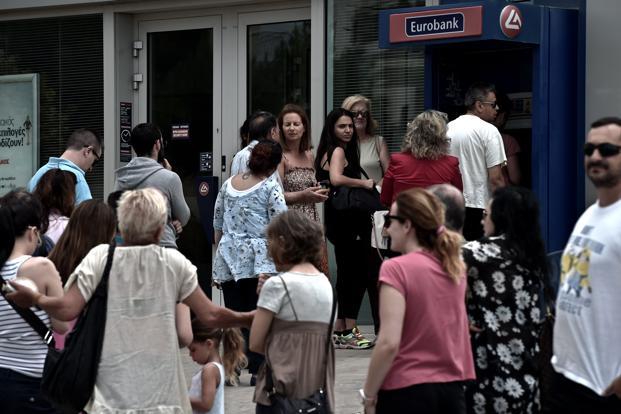
Banks in Greece and the country’s stock exchange will be shut all week in a sign of the deepening financial crisis.

The drastic move comes after people rushed to withdraw their cash amid panic ahead of the referendum on bailout terms.

Under the controls, there will be a daily €60 limit on withdrawals from cash machines, which will reopen on Tuesday.

The Foreign Office has warned British tourists to take enough cash to cover emergencies in case cash machines are emptied.

It said: “Visitors to Greece should be aware of the possibility that banking services – including credit card processing and servicing of ATMs – throughout Greece could potentially become limited at short notice.”

The euro fell sharply against the dollar amid investor jitters of a Greek debt default and exit from the eurozone.

Speaking in a televised address, Prime Minister Alexis Tsipras urged calm and insisted bank deposits were safe.

He blamed European partners and the European Central Bank for forcing Greece’s hand.

And he said the latest developments would not halt the planned referendum next Sunday.

But queues at petrol stations and the declining number of bank machines still dispensing cash underlined the scale of the country’s economic plight.

European creditors have refused a request to extend Greece’s international bailout beyond Tuesday, until after the referendum.

Source: Skynews

Grexit? Eurogroup says ‘Greece has closed the door’ with its referendum idea

AFP reports that Eurogroup head Jeroen Dijsselbloem on Saturday said Greece’s decision to hold a referendum over the future of its bailout programme was a “sad” decision that shut the door to further talks.

“The Greek government has apparently rejected our last proposals… that is a sad decision for Greece because it has closed the door for further talks where the door was still open in my mind,” the Dutch finance minister said as he arrived for talks with his eurozone counterparts.

Greece: Faint hopes for a last-minute deal over the weekend

BRUSSELS  — The latest developments involving Greece and its bailout negotiations:

___

5:35 p.m./ 1535GMT/ 11:35 a.m. EDT

The eurozone’s top official, Jeroen Dijsselbloem, says new proposals from Greece came in too late for a proper assessment during the European Union summit, which will end on Friday. That has forced the negotiations to stretch into the weekend.

He says the international creditors “will have a last look at the last Greek proposals which came in very late.”

A eurozone finance ministers’ meeting broke up Thursday without a deal for Greece. It will resume Saturday.

Dijsselbloem says the issues are so technical it is pointless to keep the ministers in Brussels while technical experts assess the new proposals’ validity. “The door is still open for the Greek side to come with new proposals or to accept what is on the table.”

He insists it would not be easy: “We are very — on a number of issues — quite far apart. So it is going to be difficult.”

___

5:30 p.m./ 1530GMT/ 11:30 a.m. EDT

The head of the International Monetary Fund, Christine Lagarde, says Greece’s creditors need more time to examine new offers Athens has made.

She said Thursday after a meeting on Greece broke up without a deal: “We were given a proposal by the Greek parties at the last hour. We need to so some more work to examine their proposals, to see how it can be reconciled.”

She added: “We really want to show flexibility and we want to be as growth friendly as possible and we want to work. But it has to be balanced.”

___

4:50 p.m./ 1450GMT/ 10:50 a.m. EDT

Finnish Finance Ministrer Alexander Stubb says that the eurozone meeting on Greece has wrapped for the day without an agreement on new bailout loans for the country.

Stubb wrote on his official Twitter account: “Eurogroup back later, but not today.”

The decision is a big setback since there had been hopes to wrap up the bailout negotiations in time for European leaders to approve a deal later in the day.

Greece needs new loans by June 30, when it has a debt repayment it cannot otherwise afford.

___

10:45 a.m. EDT/ 1445GMT

The International Monetary Fund says Greece will not get any extra time to make a debt repayment it owes the organization on June 30.

Greece owes the IMF 1.6 billion euros on June 30 but does not have the money to pay it. It is in talks with creditors, including the IMF, on getting more loans before then.

IMF spokesman Gerry Rice says “We’re expecting the payment to be made June 30,” adding that Greece will be granted no extensions.

He says creditors are “on the same page” about the need for Athens to introduce deeper reforms. The creditors say a Greek proposal this week didn’t go far enough and needs to make deeper cuts in the costly pension system, while sparing the poor.

Despite the impasse in talks, the IMF says it would be flexible. “The IMF doesn’t do take it or leave it,” Rice said. “That’s not how we work. It’s always give and take.”

___

4:15 p.m./ 1415GMT/ 10:15 a.m. EDT

French President Francois Hollande is exhorting Greece and its international creditors to speed up talks on new loans for the country, as a default would affect the entire continent.

With decisive talks between dragging on for days, Hollande says that “when Greece, Europe, the eurozone is at stake, we have to know how to finish negotiations.”

He said Thursday as he entered a summit of European Union leaders: “There is nothing to gain by letting time go by. I think Greece has none left.”

The leaders were meant to rubberstamp any deal on Greece, but an agreement remains elusive.

___

4:00 p.m./ 1400GMT/ 10:00 a.m. EDT

German Chancellor Angela Merkel says officials have “not yet made the necessary progress” in the talks to get Greece more financial aid.

As she arrived for a summit of European Union leaders Thursday, she told reporters that “in some places we even have the impression that we are falling back a bit.”

She said the negotiating was a matter for the eurozone finance ministers and technical experts. The talks are about what reforms Greece should adopt in exchange for loans.

Creditors, which include eurozone states like Germany as well as the International Monetary Fund, have made their reform proposals and Greece has submitted its own. Differences remain, however.

___

2:40 p.m./ 1240 GMT/ 8:40 a.m. EDT

The head of Germany’s national central bank is warning that the lifeline keeping Greece’s banks afloat may run afoul of European rules.

Jens Weidmann, who sits on the governing council of the European Central Bank, says the long-term provision of emergency credit to Greek banks “has become the banks’ only source of funding.”

He said lending to banks that can’t borrow elsewhere so they can lend to a government in similar straights “raises serious monetary financing concerns.” That means Weidmann questions whether the practice violates the European Union’s legal prohibition on using central bank powers to finance governments.

The ECB must decide at regular intervals whether to continue to permit Greece banks to draw such emergency credit. Turning off the credit could deepen financial turmoil. Weidmann has only one vote on the 25-member ECB board but a significant one since represents Germany, the eurozone’s largest member.

___

1:55 p.m./ 1155 GMT/ 7:55 a.m. EDT

German Finance Minister Wolfgang Schaeuble says he’s not hopeful about the prospects for Thursday’s meeting of finance ministers because Greece’s negotiating stance appears to have gone backward.

Greece and its creditors are in talks on what reforms the country should make to get more loans it needs to avoid default next week.

Schaeuble says the Greek government so far has “not moved, rather moved backward, and so I am not very confident for our meeting today.”

He says there is nothing new on the table and added that “there is a bigger difference rather than a coming together.”

Schaeuble insists “the decision lies exclusively with those responsible in Greece.”

___

1:50 p.m./ 1150 GMT/ 7:50 a.m. EDT

The eurozone’s top official says creditors are presenting Greece today with a new proposal on reforms it should make in return for loans.

Jeroen Dijsselbloem, the Dutchman who heads the eurozone finance ministers’ meetings, held talks with Greek Prime Minister Alexis Tsipras earlier in the day to seek a breakthrough.

He said the creditors have made proposals, but says that “we don’t have an agreement on the Greeks from that.”

He says eurozone finance ministers will hear “from the Greek side what their ideas are, what they could agree to, what they could not agree to.”

___

1:00 p.m./ 1100 GMT/ 7:00 a.m. EDT

Austrian Finance Minister Hans Joerg Schelling is amazed at the apparent lack of urgency in Greece’s negotiations over a bailout deal.

With the clock clicking down to Tuesday, when Greece has a debt repayment it cannot afford, Schelling says “it is really surprising how carefree Greece deals with its business and constantly comes up with new requests.”

After days of talks, Greek Prime Minister Alexis Tsipras has made changes to proposed reforms his country would make in exchange for loans.

Tsipras, meanwhile, has complained that the International Monetary Fund came up with last-minute conditions on how the Greek reform program should work.

___

12:45 p.m./ 1045 GMT/ 6:45 a.m. EDT

Greek Prime Minister Alexis Tsipras has wrapped up the latest round of talks in Brussels with the leaders of the International Monetary Fund and European Central Bank.

Tsipras gave a thumbs-up as he left, but participants and other senior officials have otherwise declined to speak about the state of the negotiations.

Greece and the creditors are in talks on what reforms it should make to get more bailout loans.

Meanwhile, eurozone finance ministers begin arriving for their meeting. They will assess what technical experts have made of reform proposals made by Greece.

___

12:30 p.m./ 0930 GMT/ 5:30 a.m. EDT

A Greek banking official says the European Central Bank has approved a request from Athens to increase the amount of emergency liquidity Greek lenders can tap from the country’s central bank.

The ECB approved the request Thursday, as it has done every day since Friday as Greece headed into the final stretch of tough bailout negotiations with no clear solution in sight. The banking official, who spoke on condition of anonymity because the decision was not publicly released, said the ECB would meet again within the next 24 hours if necessary.

Worried Greeks have been withdrawing their money from their country’s banks, fearing the imposition of restrictions on banking transactions. An estimated more than 4 billion euros ($4.5 billion) left Greek banks last week. – AP

IMF coached Greek journalists on spin

The Greek authorities want to investigate alleged misconduct by a number of journalists who attended seminars organized by the IMF and were allegedly instructed to promote the organization’s advice to Greece.

The accusations were voiced by Greece’s former representative to the International Monetary Fund Panagiotis Roumeliotis, who testified Tuesday in front of a special parliamentary committee on the country’s debt. Newspaper Proto Thema published excerpts from the testimony on its website.

Roumeliotis was cited as saying that he accidentally bumped into Greek journalists during a visit to Washington DC, who told him that they were attending a seminar organized by the IMF. The fund held a number of similar events in the US and in Greece with the goal of explaining its operations and apparently was spinning its work positively, he said.

The former Greek official endorsed criticism by committee member Leonidas Vatikiotis, who said that the seminars were held in an opaque manner and that the journalists afterward became “mouthpieces of the IMF, preachers of austerity, opponents of strikes and public workers.”

The committee said the Greek parliament should demand to know from the IMF who exactly attended the seminars and what they were told there. It also said the Greek journalists’ union ESIEA should be asked to comment on a possible breach of professional ethics.

Russia asks Greece to join BRICS bank

Russian Deputy Finance Minister Sergei Storchak spoke with Greek PM Alexis Tsipras today, proposed that Greece become 6th member of New Development Bank set up by Brazil, Russia, India, China, South Africa, a Greek govt official says in e-mail to reporters.

Meanwhile the $100 billion BRICS development bank will be based in Shanghai, according to its founding agreement, and will be headed by an Indian for the first five years, followed by a Brazilian and then a Russian.

Kundapur Vaman Kamath, a 67-year-old, is the non-executive chairman of India’s second largest bank by asset size, ICICI Bank, and India’s third largest IT firm, Infosys.

Now, Kamath will have another position to tend to: The first head of the BRICS bank.

The bank’s $100 billion capital—with an initial subscribed capital of $50 billion that will be equally shared by all BRICS members—will be used for infrastructure financing and sustainable development project funding within the BRICS nations. Other low- and middle-income countries will be able to access loans.

In February this year, India’s cabinet, headed by prime minister Narendra Modi, approved the establishment of the bank, after founding members sorted out several contentious issues. “The New Development Bank will mobilise resources for infrastructure and sustainable development projects in BRICS and other emerging economies and developing countries, to supplement existing efforts of multilateral and regional financial institutions for global growth and development,” the Indian government said in a statement.

The bank, according to the Russian finance ministry, is expected to be fully functional by the end of 2015.

EU paymaster Germany suggested on Monday that Greece might need a referendum to approve painful economic reforms on which its creditors are insisting, but Athens said it had no such plan for now and others warned a vote could delay vital aid.

Greece calmed immediate fears of a default by making a crucial 750 million euro payment to the International Monetary Fund a day early. But Finance Minister Yanis Varoufakis said the liquidity situation was “terribly urgent” and a deal to release further funds was needed in the next couple of weeks.

Euro zone finance ministers welcomed some progress in slow-moving talks on a cash-for-reform deal between Athens and the IMF, the European Commission and the European Central Bank but said more work was needed to each a deal.

“We acknowledged that more time and effort are needed to bridge the gaps on the remaining open issues,” they said in a short statement after spending barely an hour on a progress review on the negotiations behind held among senior officials.

Source: Bloomberg/Reuters

Greece misses deficit target as bailout deadline looms

Cash-strapped Greece fell well short of its budget deficit reduction targets last year, official figures showed Wednesday in a development that’s likely to add pressure on the radical left-led government during tortuous talks with bailout creditors.

The country’s statistical authority said the 2014 deficit was 3.5 percent of Greece’s annual GDP, considerably higher than the 0.8 percent forecast. And after stripping out the cost of servicing Greece’s crippling public debt, a modest primary surplus of 0.4 percent was recorded — short of the 2 percent target.

The new government elected Jan. 25 had already said the shortfall would be bigger than expected. But the official confirmation comes at a time Greece is negotiating a long-delayed rescue loan installment, without which it will run out of cash.

Greece is unable to tap the international bond market for funds due to sky-high borrowing rates, which reflect a lack of confidence in the country being able to repay its debts. Greek stocks closed 1.9 percent down Wednesday, another sign that investors in the country are jittery.

Greece has been surviving on rescue loans from its European partners and the International Monetary Fund since mid-2010, and the new government won a four-month extension to the main, European part of its bailout in February.

Under the extension agreement, Athens must present a series of economic reform measures that meet the approval of its creditors. Authorities are hoping for a final agreement next week, when all 19 finance ministers from the eurozone countries, including Greece’s Yanis Varoufakis, meet on April 24 in the Latvian capital of Riga.

But several European officials have raised doubts about the possibility of a deal then. Greece has some big repayments coming up over the next few months and without the rest of its bailout cash, the country could be staring at a possible default and an exit from the euro.

Source: eNCA

Moscow and Athens forge new alliance

The Greek prime minister’s visit to Moscow aimed at improving relations with Russia angers many in Europe – this is what reports in Greek media, covering the visit, boil down to.

Greek Prime Minister Alexis Tsipras is on a two-day visit to Moscow, making headlines in Greek media.”Alexis Tsipras’ upcoming visit to Moscow and meeting with Putin has generated much talk, analysis and warnings,” iefimerida.gr wrote in a piece titled Tsipras-Putin: Smiles in Moscow, Annoyance in Brussels. “Both sides underline that Moscow and Athens will discuss many issues and there is no shortage of speculations on what Tsipras will ask and what Putin will offer.

“The visit could help return Greek produce to the Russian market, according to the media outlet. “Exports are worth 125 million Euros and are of primary importance to the agriculture in northern Greece,” iefimerida.gr said.

EU sanctions and the Russian food ban, investments, privatization, energy cooperation and the Turkish Stream gas pipeline, tourism, the Ukrainian crisis and Greece-Turkey relations are the main topics on the agenda.

“Putin is preparing a ‘gift’ for Tsipras,” newsit.gr said, adding that it is the first visit of a Greek prime minister to Moscow in five years. According to the media outlet, Tsipras’ visit “caused outrage in Brussels” that “thinks the Russian president is trying to undermine the European stance on sanctions against Moscow.”

The visit sent partners and creditors, especially in Berlin, into turmoil. Some “on the other side of the Atlantic Ocean also worry that Greece would throw itself into Russia’s arms to come up with ‘alternative plans’ to solve the Greek problem,” the Crete media outlet pointed out.

“Tsipras and Putin are forging a new alliance,” according to protothema.gr. “All eyes in Europe are on Tsipras and Putin. ‘The spring’ in Greek-Russian relations gets on Europe’s nerves. The visit has created an atmosphere of enthusiasm in Moscow. … It is seen as a breakthrough in the bilateral relations that would revive and strengthen cooperation in a number of areas,” the media outlet said.”

The visit also sends important political signals: both countries are discontent with the West. In this context Tsipras wants to develop a diverse foreign policy and alliances, while Putin wants to show that he has power and influence to attract the attention of European leaders and countries,” protothema.gr said.

Source: Sputniknews

Russia offers Greece loans, gas discount

Russia may offer Greece a discount on gas deliveries and new loans when Greek Prime Minister Alexis Tsipras visits Moscow this week, the Kommersant business daily reported on Tuesday, citing one source in the Russian government.

A Kremlin spokesman said last week that Russian President Vladimir Putin and Tsipras planned to discuss economic ties and EU sanctions on Moscow when they meet for talks, which Kommersant said would take place on Thursday.

“We are ready to consider the issue of a gas price discount for Greece,” the newspaper said quoting an unnamed Russian government source.

Russia’s state-controlled producer Gazprom declined to comment. The Energy Ministry also declined to comment.

The source said that in exchange for the discount and some unspecified loans, Russia would want access to Greek assets. The source did not name any specific assets.

In recent weeks, the gas price charged by Gazprom has fallen, tracking lower oil prices. Gazprom said it wanted to acquire DEPA in 2013 but dropped its bid after failing to receive enough guarantees over DEPA’s financial position.

Source: Reuters

Whatever became of economists and the American economy?

According to the official economic fairy tale, the US economy has been in recovery since June 2009.

This fairy tale supports America’s image as the safe haven, an image that keeps the dollar up, the stock market up, and interest rates down. It is an image that causes the massive numbers of unemployed Americans to blame themselves and not the mishandled economy.

This fairy tale survives despite the fact that there is no economic information whatsoever that supports it.

Real median household income has not grown for years and is below the levels of the early 1970s.

There has been no growth in real retail sales for six years.

How does an economy dependent on consumer demand grow when real consumer incomes and real retail sales do not grow?

Not from business investment. Why invest when there is no sales growth? Industrial production, properly deflated, remains well below the pre-recession level.

Not from construction. The real value of total construction put in place declined sharply from 2006 through 2011 and has bounced around the 2011 bottom for the past three years.

How does an economy grow when the labor force is shrinking? The labor force participation rate has declined since 2007 as has the civilian employment to population ratio.

How can there be a recovery when nothing has recovered?

Do economists believe that the entire corpus of macroeconomics taught since the 1940s is simply incorrect? If not, how can economists possibly support the recovery fairy tale?

We see the same absence of economics in the policy response to the sovereign debt crisis in Europe. First of all, the only reason that there is a crisis is because instead of writing off that part of the debt that cannot be paid, as in the past, so that the rest of the debt could be paid, creditors have demanded the impossible–that all the debt be paid.

In an attempt to achieve the impossible, heavily indebted countries, such as Greece, have been forced to reduce old age pensions, fire government employees, reduce social services such as health care and education, reduce wages, and sell-off public property such as ports, municipal water companies, and the state lottery. These austerity packages deprive the government of revenues and the population of spending power. Consequently, consumption, investment, and government spending all fall, and the economy sinks lower. As the economy sinks, the existing debt becomes a larger percentage of the GDP and becomes even more unserviceable.

Economists have known this ever since John Maynard Keynes taught it to them in the 1930s. Yet there is no sign of this foundational economics in the policy approach to the sovereign debt crisis.

Economists it appears have simply vanished from the earth. Or, if some are still present, they have lost their voices and do not speak.

Consider “globalism.” Every country has been convinced that globalism is imperative and that not to be part of the “global economy” means economic death. In fact, to be part of the global economy means death.

Understand the economic destruction that globalism has wreaked on the United States. Millions of middle class factory jobs and professional skill jobs such as software engineering and Information Technology have been taken away from the American middle class and given to people in Asia. In the short-run this drops labor costs and benefits the profits of the US corporations that offshore the jobs, but the consequence is to destroy the domestic consumer market as jobs that permit the formation of households are replaced with lowly paid part-time jobs that do not.

If households cannot form, the demand for housing, home appliances and furnishings declines. College graduates return home to live with their parents.

Part-time jobs hurt the ability to save. People are only able to purchase cars because they can get 100 percent financing, and more in order to pay off an existing car loan that exceeds the vehicle’s trade-in value, in a six-year loan. These loans are possible, because those who make the loans sell them. The loans are then securitized and sold as investments to those desperate for yield in a zero interest rate world. Derivatives are spun off these “investments,” and a new bubble is put in place.

When manufacturing jobs are offshored, the US plants are closed, and the tax base of state and local governments declines. When the governments have trouble servicing their accumulated debt, the tendency is not to meet their pension obligations. This reduces retiree incomes, incomes already reduced by zero or negative interest rates.

This unraveling of consumer demand, the basis for our economy, was entirely obvious at the very beginning. Yet junk economists or hired corporate mouthpieces promised Americans a “New Economy” that would provide them with better, higher paying, cleaner jobs to take the place of the jobs moved abroad. As I have pointed out for more than a decade, there is no sign of these jobs anywhere in the economy.

Why did economists make no protest as the US economy was shipped abroad and deep-sixed at home?

Globalism also devastates “emerging economies.” Self-sufficient agricultural communities are destroyed by the introduction of large-scale monoculture agriculture. The uprooted peoples relocate to cities where they become a drain on social services and a source of political instability.

Globalism, like neoliberal economics, is an instrument of economic imperialism. Labor is exploited, while peoples, cultures, and environments are destroyed. Yet the propaganda is so powerful that people partake of their own destruction.

Dr. Paul Craig Roberts was Assistant Secretary of the Treasury for Economic Policy and associate editor of the Wall Street Journal. He was columnist for Business Week, Scripps Howard News Service, and Creators Syndicate. He has had many university appointments. His internet columns have attracted a worldwide following. Roberts’ latest books are The Failure of Laissez Faire Capitalism and Economic Dissolution of the West and How America Was Lost.