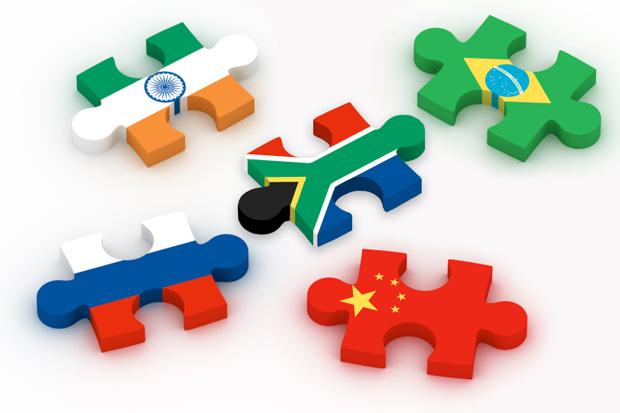
Russia asks Greece to join BRICS bank

Russian Deputy Finance Minister Sergei Storchak spoke with Greek PM Alexis Tsipras today, proposed that Greece become 6th member of New Development Bank set up by Brazil, Russia, India, China, South Africa, a Greek govt official says in e-mail to reporters.

Meanwhile the $100 billion BRICS development bank will be based in Shanghai, according to its founding agreement, and will be headed by an Indian for the first five years, followed by a Brazilian and then a Russian.

Kundapur Vaman Kamath, a 67-year-old, is the non-executive chairman of India’s second largest bank by asset size, ICICI Bank, and India’s third largest IT firm, Infosys.

Now, Kamath will have another position to tend to: The first head of the BRICS bank.

The bank’s $100 billion capital—with an initial subscribed capital of $50 billion that will be equally shared by all BRICS members—will be used for infrastructure financing and sustainable development project funding within the BRICS nations. Other low- and middle-income countries will be able to access loans.

In February this year, India’s cabinet, headed by prime minister Narendra Modi, approved the establishment of the bank, after founding members sorted out several contentious issues. “The New Development Bank will mobilise resources for infrastructure and sustainable development projects in BRICS and other emerging economies and developing countries, to supplement existing efforts of multilateral and regional financial institutions for global growth and development,” the Indian government said in a statement.

The bank, according to the Russian finance ministry, is expected to be fully functional by the end of 2015.

EU paymaster Germany suggested on Monday that Greece might need a referendum to approve painful economic reforms on which its creditors are insisting, but Athens said it had no such plan for now and others warned a vote could delay vital aid.

Greece calmed immediate fears of a default by making a crucial 750 million euro payment to the International Monetary Fund a day early. But Finance Minister Yanis Varoufakis said the liquidity situation was “terribly urgent” and a deal to release further funds was needed in the next couple of weeks.

Euro zone finance ministers welcomed some progress in slow-moving talks on a cash-for-reform deal between Athens and the IMF, the European Commission and the European Central Bank but said more work was needed to each a deal.

“We acknowledged that more time and effort are needed to bridge the gaps on the remaining open issues,” they said in a short statement after spending barely an hour on a progress review on the negotiations behind held among senior officials.

Source: Bloomberg/Reuters

Putin signs law ratifying BRICS bank

Following the Duma, or Russian Parliament, President Vladimir Putin has signed the ratification of a law that sanctions Russian participation in the $100 billion BRICS Bank on Monday.

The BRICS bank, Putin has said, “will become one of the largest multilateral financial development institutions in the world”.

“The bank and the Currency Pool, with combined resources of 200 billion dollars, lay the foundation for coordinating a macroeconomic policy between our nations,” Putin said during the 6th BRICS Summit in Brazil.

The BRICS Bank launched last year will fund infrastructure projects in Brazil, Russia, India, China and South Africa, and challenge the dominance of the Western-led World Bank and the IMF.

The Agreement will enter into force and the Bank will begin operations only after all member countries deposit their instruments of ratification with Brazil.

Central Banks of the member countries will also have to finalize an Inter-Central Bank Agreement containing the operational details of swap transactions and the Standing Committee’s Operational Procedures (SCOP) before the arrangement can be operational.

Russian Finance Minister Anton Siluanov is likely to become the bank’s first Chairman of the Board of Governors while India will nominate the first President of the BRICS Bank.

The first board meeting is supposed to take place in April in the Russian city of Ufa and the Bank is expected to start fully functioning by the end of 2015, according to the Russian Finance Ministry.

BRICS launched a $100 billion development bank and a currency reserve pool in July this year in their first concrete step toward reshaping the Western-dominated international financial system.

“The creation of the BRICS Development Bank and the Contingency Reserve Agreement (CRA) had been discussed for several years, and yet it still comes as a surprise to most Western analysts who consistently argued that the BRICS countries were too different from each other to ever agree on much,” writes Professor Oliver Stuenkel who teaches at the Getulio Vargas Foundation (FGV) in São Paulo, Brazil.

Each of the five-member countries is expected to allocate an equal share of the $50 billion startup capital that will be expanded to $100 billion.

The next BRICS Summit will be held in the Russian city of Ufa on July 9-10 this year.

Russia ratifies $100 billion BRICS development bank

The Russian State Duma has ratified the $100 billion BRICS bank that’ll serve as a pool of money for infrastructure projects in Russia, Brazil, India, China and South Africa, and challenge the dominance of the Western-led World Bank and the IMF.

The New Development Bank is expected to start fully functioning by the end of 2015, according to the Russian Finance Ministry.

Russia has agreed to provide $2 billion dollars from the federal budget for the bank over the next seven years.

It will have three-tiers of corporate governance, with a Board of Governors, Board of Directors and a President.

The bank’s board of directors will hold its first meeting in Ufa in Russia in April. Russian Finance Minister Anton Siluanov is likely to become the bank’s first Chairman of the Board of Governors, according to Deputy Finance Minister Sergei Storchak talking on the Russia 24 TV channel.

The decision to establish the BRICS bank, along with a $100 billion reserve currency pool, was made in July 2014. Each of the five member countries is expected to allocate an equal share of the $50 billion startup capital that will be expanded to $100 billion.

The bank will be headquartered in Shanghai, India will serve as the first five-year rotating president, and the first Chairman of the Board of Directors will come from Brazil.

Source: RT

New BRICS bank to challenge IMF

A new development bank launched by emerging economies will help all nations in distress to return to health, South African President Jacob Zuma said Monday.

The so-called Brics – Brazil, China, India, Russia and South Africa – announced last month that they were setting up a development bank and emergency reserve fund. This was seen as a major challenge to the Washington-based International Monetary Fund and World Bank, which some emerging powers see as biased towards Western policy positions.

Zuma, visiting Washington for a US-Africa summit, argued that the IMF has few success stories to show despite the often austere regimens it imposes on troubled economies in return for emergency loans.

For now, only the Brics nations will be able to draw from the $50-billion in the New Development Bank and $100-billion in the Contingent Reserve Arrangement. The IMF, set up with the World Bank during the Bretton Woods conference in 1944, has faced criticism for imposing onerous conditions and for not giving wider representation to developing nations on its controlling committees.

The Brics bank plan came after an agreement to give China and other emerging powers more voting power in the IMF got bogged down in the US Senate due to opposition by conservative Republicans.

Source: Sapa

BRICS reach consensus on creating joint development bank

The five BRICS countries have reached a broad consensus on their $100 billion development bank though some differences remain, the Chinese Vice Foreign Minister Li Baodong said on Monday ahead of a summit in Brazil next week to be attended by President Xi Jinping.

The new bank will symbolize the growing influence of emerging economies in the global financial architecture long dominated by the United States and Europe through the International Monetary Fund and the World Bank.

Leaders of Brazil, Russia, India, China and South Africa are expected to sign a treaty to launch the bank officially when they meet at a BRICS summit in the northern Brazilian city of Fortaleza on July 15.

A senior Brazilian government official said in May the five BRICS nations were likely to agree to fund the bank equally, giving them the same rights, Reuters reports.

The new development bank would help cover growing demand for project financing that has not been entirely met by global multilaterals, which, for years, have been heavily criticized for meddling in the domestic policies of sovereign borrowers.

The BRICS also need to decide if the bank will be based in New Delhi, Shanghai, Johannesburg or Moscow. Brazil will not offer headquarters because of upcoming presidential elections that could delay negotiations, the Brazilian official said.

Argentina has been invited to join the sixth BRICS Summit, due to take place in July in the Brazilian city of Fortaleza. The country will join the bloc of major emerging economies, made up of Brazil, Russia, India, China, and South Africa, which jointly account for as much as nearly quarter of the world’s economy.

Russia voiced the news following the recent meeting held between the country’s Foreign Minister Sergei Lavrov and his Argentine counterpart Héctor Timerman, which resulted in signing a joint declaration on the non-proliferation of arms in outer space.

Argentina’s Timerman stressed the “strategic association” between both countries “is based on a common vision about the essence of international relations, values and objectives of common well-being that both nations are building.”

The officials have discussed both the global and regional policies, “assuming that international conflicts have a sustainable solution” if political leaders work toward “the strengthening of a solid multilateral system based in cooperation and mutual collaboration and the non-intervention in states’ domestic affairs through economic, political or military means.”

Timerman, notably, “stressed Argentina’s position against double-standard” messages, referring to Western powers denouncing the referendum recently held in Crimea while the same parties supported the 2012 voting in the Malvinas Islands as their inhabitants reaffirmed their decision to stay British.

Sergei Lavrov said Russian leader Vladimir Putin will likely meet with President Cristina Fernández de Kirchner and other Latin American heads of state during Putin’s upcoming visit to the region.

Source: VoR

Zuma attends G20 in St Petersburg

G20russiaPresident Jacob Zuma has arrived in St Petersburg, Russian Federation for the G20 Leaders’ Summit.

A meeting of BRICS Leaders was scheduled, giving leaders an opportunity to reflect on the progress made with regards to the implementation of the eThekwini Declaration, notably receiving progress reports in respect of the New Development Bank and the Contingent Reserve Arrangement.

President Zuma is accompanied by the Minister of Finance, Mr. Pravin Gordhan, and the Minister of International Relations and Cooperation, Ms. Maite Nkoana-Mashabane.

The primary objectives of the G20 are to facilitate policy coordination in order to achieve global economic stability and promote long-term sustainable growth.

South Africa’s participation in the G20 is guided by national interests and the primacy of the African Agenda. South Africa therefore seeks to use its participation in multilateral fora such as the G20 to promote and strengthen the interests of the African continent and those of the Southern hemisphere. In this regard, the G20 presents meaningful opportunities for advancing much-needed global governance reforms and orienting the international development agenda.

G20 countries account for 85 percent of global economic output, 80 percent of global trade, and two-thirds of the world’s population.

It is envisaged that the G20 Summit will focus on a set of measures aimed at boosting sustainable, inclusive and balanced global growth, including the creation of decent jobs. During its tenure as G20 President, Russia has focused its work on the interconnected issues on the G20 agenda around three priorities, which are intended to promote:

* Growth through quality jobs and investment;

* Growth through trust and transparency; and

* Growth through effective regulation.

Unemployment and ongoing problems and vulnerabilities in the global economy were discussed by Brics leaders on the margins of the G20 summit in Russia on Thursday, the presidency said.

“[We] believe that major economies, including the G20, could do more to boost global demand and market confidence,” said President Jacob Zuma, who chairs Brics — which consists of the Brazil, Russia, India, China, and South Africa group of emerging economies.

The leaders reiterated the concerns they expressed at the Durban Brics summit in March about the unintended negative spill-overs of the unconventional monetary policies of certain developed economies.

“[We] recalled the urgent need to implement the 2010 International Monetary Fund quota and governance reform, as well as to complete the next general quota review by January 2014, as agreed at the G20 Seoul summit in order to ensure the fund’s credibility, legitimacy, and effectiveness,” said Zuma.

Brics looked forward to the ninth World Trade Organisation ministerial conference, to be held in December.

“[We] expect that it will be a stepping stone to the successful and balanced conclusion of the Doha Development Round,” Zuma said.

The leaders also congratulated Russia on successfully hosting the G20 summit, which started on Thursday and runs until Friday. – Sapa