Russia, Argentina sign energy deals worth billions

Russia and Argentina signed agreements which amounted to an “all-encompassing strategic partnership” during Argentine President Cristina Fernandez de Kirchner’s visit to Moscow.

Russia and Argentina signed a number of deals on developing hydroelectric, nuclear and fossil-based energy and announced intentions to use each other’s currencies in trade.

The memorandums are a massive breakthrough for economic relations between Russia and Argentina. Russian President Putin called the negotiations rich and fruitful.

“There were important long-term deals made in economic and political spheres. Russia and Argentina are entering a new stage of cooperation,” the head of Argentina’s Foreign Ministry Timerman Hector told Sputnik.

Argentine President Cristina Fernandez de Kirchner said the two sides agreed to conduct thorough consultations on using national currencies in trade calculations instead of US dollars.

Argentina’s New Power Sources

A $2 billion memorandum was signed to build a new hydroelectric dam and will consider switching to national currencies for mutual deals. Russia’s VEB bank will provide $1.2 billion of the total investments needed, 35 percent of which will be used to pay Argentine subcontractors.

In addition, Russia will provide Argentina with access to Russian nuclear power technology. The deal will be prepared by the end of the year. The head of Russian nuclear power plant company Rosatom declined to give an estimate to the deals, saying that one bloc costs “billions of dollars.”

“Rosatom has joined the project to build the sixth bloc of the Atucha nuclear power plant,” Putin said.

Russian energy giant Gazprom signed a memorandum to explore and develop gas fields with Argentine state gas company YPF. The deal may amount to $1 billion in investments according to Argentina’s Minister of Industry.

Russian company Uralmash will also construct a plant which will manufacture oil extraction equipment, which will amount to an additional $1.9 billion in Russian investments.

Putin also said that Russia and Argentina will cooperate in the military-technical sphere and pledged to accelerate the construction of GLONASS satellite navigation systems in Argentina.

In the mutual statement, Kirchner and Putin agreed that the situation in Ukraine can only be solved by peaceful means. Putin added that Russia supports Argentina in the Malvinas (Falkland) Islands dispute.

“Russia supports Argentina’s striving for direct talks with Britain to achieve prompt resolution to the Malvinas Islands dispute,” Putin added.

The Eurasian Economic Union and the Latin American MERCOSUR bloc also plan to sign a cooperation memorandum.

Source: Sputnik News

Falklands on high alert

Extra British troops will be stationed on the island for three to six weeks.

They are part of a force of more than 1,000 soldiers being prepared for duty in the south Atlantic and will be sent out in five tranches of 150 to 300.

They will include members of the Royal Artillery and 3 Commando, Royal Marines, with each group staying on the islands for three to six weeks.

Military chiefs are mounting a series of “high readiness reinforcement” exercises to plug a strategic gap until the Queen Elizabeth aircraft carrier is operational in 2020.

Senior military sources say the war games will be “low profile” as part of a commitment to ensure the UK can secure its overseas garrisons.

Currently the islands have a core military presence of 1,200 troops, four Typhoon fighter jets and a missile battery.

A senior source said: “The aim is to put more than 1,000 troops from five different cap badges into the islands by November but they will deploy in small groups from 150 to 300, for short tours.”

Last night the Ministry of Defence said there were “currently no plans to increase the number of troops deployed to the Falklands”.

However, the military source said the plan did not represent a “permanent increase in garrison numbers but a series of high-readiness exercises”.

Meanwhile Argentina will discuss a government-sponsored bill set to reform the Intelligence services in Congress on Friday.

New regulations will bring transparency to the country’s intelligence system the government says.

The dissolution of the Intelligence Secretariat (SI, formerly SIDE) and the creation of a new Federal Intelligence Agency (AFI), is “a major, transcendent” move, according to analysts.

The measure was first announced by President Cristina Fernández de Kirchner last Monday, a week after the mysterious death of AMIA special prosecutor Alberto Nisman.

Nisman’s death brought to the forefront issues associated with the country’s intelligence agencies.

Source: UK Express

Argentine court grants orangutan human rights

In an unprecedented decision, an Argentine court has ruled that the Sumatran orangutan ‘Sandra’, who has spent 20 years at the zoo in Argentina’s capital Buenos Aires, should be recognized as a person with a right to freedom.

The ruling, signed by the judges unanimously, would see Sandra freed from captivity and transferred to a nature sanctuary in Brazil after a court recognized the primate as a “non-human person” which has some basic human rights. The Buenos Aires zoo has 10 working days to seek an appeal.

The “habeas corpus” ruling in favor of the orangutan was requested last November by the Association of Professional Lawyers for Animal Rights (AFADA) alleging that Sandra suffered “unjustified confinement of an animal with proven cognitive ability.”

Lawyers argued that just as a person, the ape is capable of maintaining emotional ties and has the ability to reason, while feeling frustrated with her confinement. Furthermore, the legal team claimed that the 29-year old orangutan can make decisions, has self-awareness and perception of time. And therefore, all things considered, Sandra’s presence at the Zoo constituted illegal deprivation of liberty.

Habeas corpus is a fundamental legal term in human rights, dating back to the early fourteenth century during the reign of Edward I in England. At that time courts began requiring the monarchy to report the reasons behind restricted freedom of a subject.

“This opens the way not only for other Great Apes, but also for other sentient beings which are unfairly and arbitrarily deprived of their liberty in zoos, circuses, water parks and scientific laboratories,” the daily La Nacion newspaper quoted AFADA lawyer Paul Buompadre as saying.

Sandra who was born in 1986 in the German zoo of Rostock, arrived in Buenos Aires in September 1994, where she’s spent 20 years behind bars. The World Wildlife Foundation (WWF) claims Sumatran orangutan to be the most endangered of the orangutan species. Found only in the northern and western provinces of Sumatra, Indonesia, the species is fast losing its natural habitat to agriculture and human settlements.

Sandra’s case is not the first in which “habeas corpus” was invoked to secure the release of wild animals in human captivity. However, in the US the two recent cases failed. A New York court, earlier this month has ruled that Tommy chimpanzee was not legally a person and is therefore not entitled to human rights. And in 2011, a lawsuit against SeaWorld to free five wild-captured orca whales was dismissed by the San Diego court.

China, Argentina agree on currency swap

Argentina, which defaulted on its debt in July, will receive the first tranche of a multi-billion dollar currency swap operation with China’s central bank before the end of this year, the South American country’s La Nacion newspaper reported on Sunday.

The swap will allow Argentina to bolster its foreign reserves or pay for Chinese imports with the yuan currency at a time weak export revenues and an ailing currency have put the Latin American nation’s foreign reserves under intense pressure.

La Nacion said Argentina would receive yuan worth $1 billion by the end of 2014, the first payment of a loan worth a total $11 billion signed by Argentina’s President Cristina Fernandez and her Chinese counterpart in July.

The daily newspaper said the presidents of the countries’ two central banks had met on the sidelines of a meeting in Switzerland, but did not say how it had obtained the information.

Fernandez’s government has imposed stringent import and capital controls to safeguard the dwindling reserves, now at around eight-year lows, which it needs to pay its debts.

Source: Reuters

What happened in Argentina

Vulture funds buy insolvent debts for a song and later try to cash in on them by force. Billionaire Paul Singer has made it his specialty. Today he is intent on consolidating his fortune at the expense of the Argentinian people, while already setting his sights on Spain

By Jérome Duval, Fatima Fafatale.

The vulture fund NML Capital that, together with others, has Argentina on the edge of suspending payments, is already devouring the rotting flesh of the Spanish market. Elliott Management, the opportunistic fund of the serial U.S. speculator Paul Singer, has already pocketed a billion euros of Bankia’s failed credit and 300 million euros of Santander. It is estimated that it has paid hardly 50 million for both these portfolios, according to Auraree.com.

In March 2013, the Spanish financial press informed that Elliott had acquired from the Santander Group a portfolio of 300 million euros of defaulting credit of Santander Consumer Finance with a discount approaching 96%. The price that was paid was laughable: about 12 million euros, according to Cinco Dias.

Elliott had acquired from the Santander Group a portfolio of 300 million euros as defaulting consumer credit of Santander Consumer Finance.

In August of the same year, 2013, Bankia, the nationalised entity that most benefited from the rescue of the Spanish banks, which had considerably raised the public debt, informed that three portfolios of bad credit had been sold for a total debt volume of 1,353.9 million euros. In the relevant communication to the CNMV (National Stock Market Commission), it was not mentioned to whom the loans had been sold to or at what price. Despite the evident lack of transparency, the financial press has put names and numbers to the operation, which it is estimated “may have a discount of 95%”. The buyers of the three portfolios were the vulture fund Cerberus, which is advised by José Maria Aznar Jr, the son of the former President, Elliott and the Norwegian recovery business, Lindorff. “The portfolio was valued at 1,354 million but only forked out 68,” according to Finanzas.com. We have been in contact with Bankia for confirmation from the other side and its response has been that “for confidentiality” they never give the number and “the buyers who do not want to be identified”.

A few months later, it emerged that Elliott bought the household debt recovery firm Gesif to convert it into his operational base for the Spanish market. Its director-general was Melania Sebastián, who was in charge of information management at the Banca Comercial de Caja Madrid, who will continue with the moneylenders of Gesif. It is worth noting how a former director of Caja Madrid acts as the intermediary between the nationalised Bankia and Elliott’s vulture fund.

What happened in Argentina

The vulture funds make money taking advantage of countries in difficulties, like Argentina during the crisis of 2001, to buy debts cheap. Later they wait for an opportune moment to oblige them to buy them back at a much higher price with court orders, including deferred interests and judicial costs.

This is how they speculate on public debts, endangering the social spending that benefits the great majority of the population. These vultures went for lawsuits after having refused to form a part of the 93% of creditors who accepted the exchange with the government. Now the New York district judge, Thomas Griesa, has prioritised the payment of the vulture funds, which opens the door to an avalanche of demands that could result in the suspension of payments in Argentina on July 30. As Julio C. Gambina puts it so well, “nobody precisely knows where the demands of the creditors could reach of the unpayable debt”, but we know that the cost for the Argentinean people could be catastrophic.

Who are behind these vulture funds? NML Capital is a subsidiary of the inversion fund, Elliott Management Corporation, registered in the fiscal paradise Cayman Islands. It is the empire of Paul Singer, the multimillionaire champion of the gay rights and neo-conservative aggression.

Elliott speculates, among other things, with public debts, violating the sovereignty of the states and its peoples. But he also speculates with private debts and in 2011 came to possess two million dollars of Lehman Brothers.

Singer was the major financier of the presidential campaign of George W. Bush in 2004; he also contributed to Mitt Romney’s campaign in 2012 and to that of the New York mayor, Rudolph Giuliani. Moreover, he is the major private financier of the New York police. As one of the principal financiers of the Republican Party, he plays an important part in the U.S. politics and, therefore, also in international politics.

The foundation that bears his name, The Paul E. Singer Foundation, praises him for his philanthropy, his leadership in the expansion of free trade, his contribution to U.S. national security and the “future of Israel”. Moreover, Singer is president of the Manhattan Institute for Policy Research.

The frigate is not for handing over or for sale

Regarding the Argentinean case, NML is the principal financier of the organisation, American Task Force Argentina (AFTA), a lobby that influences the Congress and the U.S. justice, harming Argentina. To give ourselves an idea of the power of these vultures, NML could even embargo the Argentinean frigate, Liberty, in Ghana in October 2012, demanding the Argentinean state for about $370 million for unpaid bonds.

Enough of vultures: Argentina united for a national cause

What is happening in Argentina is emblematic of what Greece is starting to feel where vultures like Dart Management operate, with its headquarters in Cayman Island and which also operates in Latin American countries. In 1999, NML achieved, through a ruling in the United States, the payment from Peru of $58 million for a debt that the fund had bought for $11 million. It also did business with the Democratic Republic of Congo.

Source: voltairenet.org

Cry for me, Argentina

Riot police fired tear gas and rubber bullets late Sunday to restrain a group of vandals who disturbed a peaceful rally celebrating Argentina’s gutsy performance in a 1-0 loss to Germany in the World Cup finals.

Parents with small children could be seen fleeing in fear after police, who initially remained on the sidelines as jubilant fans poured into downtown Buenos Aires, began chasing down the vandals on motorcycles. The youths, many of them with their faces covered and drinking heavily, responded by hurling rocks, destroying store fronts and even breaking into a theater.

Police said 20 officers were injured and at least 60 people were arrested. The vandals tore down street lights and ripped up the stone from some streets to throw at officers.

The chaotic situation marred what was an otherwise spontaneous show of support for Argentina’s national team after its best World Cup run in 24 years.

Amid the outpouring of gratitude, there was a hint of frustration that Messi, the four-time world player of the year, didn’t turn in a stronger performance.

“Messi still isn’t Maradona,” said 31-year-old Eduardo Rodriguez, referring to Diego Maradona, who lifted the championship trophy for Argentina in 1986 and led the ‘albiceleste’ to its last World Cup final, also against Germany, in 1990. “But this here is a party. We’re all proud of our warriors.”

Despite the pride over their team’s performance, many Argentines couldn’t hide the pain.

In Rio de Janeiro, more than 70,000 Argentina fans cheered on their team, many having traveled upward of 40 hours by car.

Source: AP

BRICS reach consensus on creating joint development bank

The five BRICS countries have reached a broad consensus on their $100 billion development bank though some differences remain, the Chinese Vice Foreign Minister Li Baodong said on Monday ahead of a summit in Brazil next week to be attended by President Xi Jinping.

The new bank will symbolize the growing influence of emerging economies in the global financial architecture long dominated by the United States and Europe through the International Monetary Fund and the World Bank.

Leaders of Brazil, Russia, India, China and South Africa are expected to sign a treaty to launch the bank officially when they meet at a BRICS summit in the northern Brazilian city of Fortaleza on July 15.

A senior Brazilian government official said in May the five BRICS nations were likely to agree to fund the bank equally, giving them the same rights, Reuters reports.

The new development bank would help cover growing demand for project financing that has not been entirely met by global multilaterals, which, for years, have been heavily criticized for meddling in the domestic policies of sovereign borrowers.

The BRICS also need to decide if the bank will be based in New Delhi, Shanghai, Johannesburg or Moscow. Brazil will not offer headquarters because of upcoming presidential elections that could delay negotiations, the Brazilian official said.

Argentina has been invited to join the sixth BRICS Summit, due to take place in July in the Brazilian city of Fortaleza. The country will join the bloc of major emerging economies, made up of Brazil, Russia, India, China, and South Africa, which jointly account for as much as nearly quarter of the world’s economy.

Russia voiced the news following the recent meeting held between the country’s Foreign Minister Sergei Lavrov and his Argentine counterpart Héctor Timerman, which resulted in signing a joint declaration on the non-proliferation of arms in outer space.

Argentina’s Timerman stressed the “strategic association” between both countries “is based on a common vision about the essence of international relations, values and objectives of common well-being that both nations are building.”

The officials have discussed both the global and regional policies, “assuming that international conflicts have a sustainable solution” if political leaders work toward “the strengthening of a solid multilateral system based in cooperation and mutual collaboration and the non-intervention in states’ domestic affairs through economic, political or military means.”

Timerman, notably, “stressed Argentina’s position against double-standard” messages, referring to Western powers denouncing the referendum recently held in Crimea while the same parties supported the 2012 voting in the Malvinas Islands as their inhabitants reaffirmed their decision to stay British.

Sergei Lavrov said Russian leader Vladimir Putin will likely meet with President Cristina Fernández de Kirchner and other Latin American heads of state during Putin’s upcoming visit to the region.

Source: VoR

Should Britain give the Falklands back?

cristinakirchnerArgentine leader Cristina Fernandez de Kirchner recalled that the UN Charter stipulates the right of people to self-determination, which means that this rule should be applied to all countries without any exception.

Kirchner compared the situation in Crimea with another event in modern history. The Falkland Islands also held a referendum a year ago. It was a disputed territory, claimed by both Argentina and the United Kingdom. In 1982, differences resulted in an open military conflict.

Britain then defended the Falklands by force of arms, and last March almost all the residents voted to stay a part of the UK in a plebiscite. The UN did not question the legality of the vote at that time, Kirchner said.

“Many of the major powers, which have secured the Falklands’ people right to self-determination, do not want to do the same in relation to the Crimea now. How can you call yourselves guarantors of world stability, if you do not apply the same standards for everyone? It looks like the Crimeans cannot express their will, but the residents of the Falklands can. There is zero logic in that,” she said.

The EU countries and the US government refused to recognize the results of the referendum in the Crimea, with region’s residents voting almost unanimously for joining Russia.

The EU imposed second-tier sanctions against Russia on Monday, as a retaliation measure to the holding of a referendum in Crimea. Financial assets freezing and a visa ban on entry into the EU countries were applied to those Russian officials, who the West calls responsible for the annexation of the Crimea.

The US sanctions have affected an even higher tier – Barack Obama signed a decree that prohibits entry into the United States and seizes US assets of seven Russian officials and deputies: the Federation Council Speaker Valentina Matviyenko, Deputy Prime Minister Dmitry Rogozin, Presidential Adviser Sergei Glazyev, Assistant to President Vladislav Surkov, State Duma deputies Elena Mizulina and Leonid Slutskiy, Senator Andrey Klishas.

Rejecting contacts with Russia, the West harms himself, not us, the Vzglyad newspaper states. As a response to the US and European sanctions the State Duma issued a document named “On the US and EU sanctions,” suggesting that Western leaders should extend restrictions on all Russian deputies.

Argentinian farmland fetch high prices

Argentine agri exports looking good

Twenty percent of GDP in Argentina is agriculture-related, making it an important country for agriculture production due its high yields.

Argentina is the world’s largest exporter of sunflower oil, a leading exporter of soybean oil and among the top five exporters of soybeans and corn. More than a third of Argentina’s exports are in agri products, which earned them $25 billion in 2010/2011.

Export oportunities is a key driver for agricultural production for 1014/2015, particulary for grains, rice and sugar. However a key risk is the county’s rising food inflation, which could force the government to try and stem exports as has been done to beef exports in the past.

The government is taking positive steps to change grain seed laws to increase the biofuel blending limit, which could increase production in the medium term.

It could help foster a good relationship with the farmers and capitalize on its strong production potential.

Beef consumption is expected to decline as consumers switch to poultry. It has unintended consequences.

Farmers will build stocks on the back of high prices and Argentina could return to being one of the world’s largest beef exporters over the medium term.

The long-term soybean forecasts should be revised as the government passes new seed laws to encourage farmers to use genetically modified GM seeds.

Only 35% use it now and that could change to 80% shortly. It would cut production costs while allowing farmers to earn more revenue from their output.

It could mean that Argentina could surpass Brazil and become the world’s second largest soybean exporter. At the moment they are in third place.

A continued rebound in corn is expected as Buenos Aires Grains Exchange already saw a 4% area increase in corn planted for the 2011 season. Argentina is the world’s second largest corn exporter.

Anti-fracking movement gains momentum

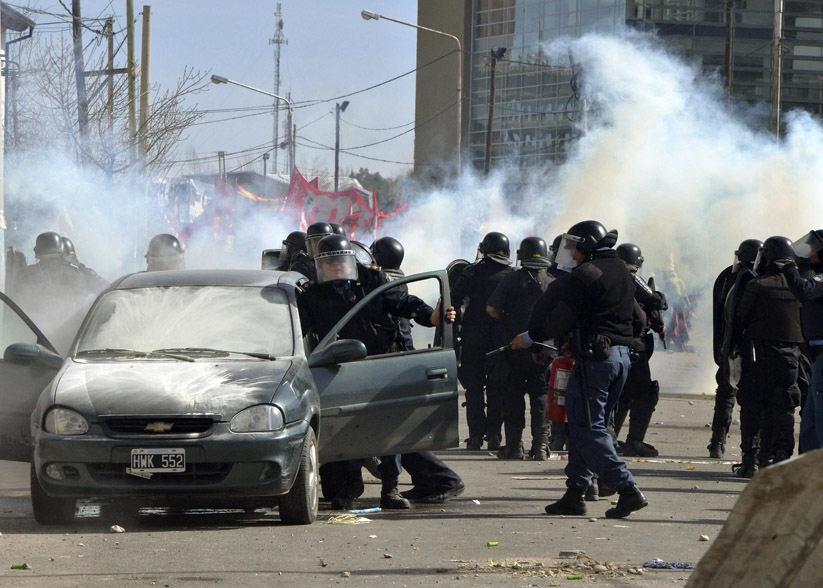
Police fire tear gas at demonstrators outside the provincial legislature where an agreement between YPF and Chevron is expected to be approved, in NeuquenThe momentum of the anti-fracking movement is growing as concerned communities across the globe feel the threat of natural gas development. On October 19, activists around the world will join together for the second annual Global Frackdown, an international day of action and an opportunity to, as one unified community, send a message to protect our resources. In anticipation of this year’s Frackdown, we can’t help but point to the recent victories of the anti-fracking movement in Argentina as an inspiring example of global resistance.

According to the U.S. Energy Information Agency’s June 2013 report, Argentina has the second greatest amount of shale gas resources in the world after China. The country’s potential for natural gas and oil development is disconcerting, but while some aspire for Argentina to become a global leader in shale gas, some communities are standing up to fight back. They have sought international support and strategy, mobilized their communities and targeted legislators to keep fracking out. Their efforts have paid off. More than six municipalities in Argentina have enacted local bans.

Chubut Province is one area formerly threatened by natural gas development. Chubut is located in Patagonia, the southern-most region of Argentina.

The President of Argentina, Cristina Fernández de Kirchner, together with Governor Martín Buzzi, inaugurated new shale exploration activities in Chubut in February. But after just a few months of activism and mobilization efforts, anti-fracking groups achieved a victory: A court in Argentina recently ordered Yacimientos Petrolíferos Fiscales (YPF) to halt fracking in “La Greta”, an exploratory well close to Río Mayo in the Chubut province.

Entre Ríos, a province in northeast Argentina, was also recently granted an injunction against fracking. Entre Ríos is located above one of the world’s largest aquifers, which supplies drinking water for the region.

Hugo Rivas, president of the Proyecto Sur Paraná, points to the community solidarity that was required to achieve this fracking victory: “In the movement to free Entre Ríos of fracking, social, professional, cultural and political sectors have participated and united in this action.”

These kinds of community-based and globally supported efforts are needed to combat the oil and gas industry. Indeed, they fuel the anti-fracking fire. Join us in this year’s Global Frackdown to send out a message as a unified, international community: the movement’s momentum is growing, it is strong, and together we will not allow fracking to destroy our water, air and communities.

Jaime Hamre is an intern for Food & Water Watch’s international program.

Springboks aim to keep momentum against Argentina

by Daniel Lorenzo

South Africa hope to maintain the momentum from four victories and 25 tries this season when they face Argentina for the second consecutive weekend in Mendoza Saturday.

The Springboks made a dream start to the Rugby Championship last Saturday in Soweto, scoring nine tries in a 73-13 romp against Los Pumas.

It was a record winning margin for the southern hemisphere championship and cast South Africa in a new light of adventurous and exciting rugby rather than a predictable kick-and-chase outfit.

Full-back Willie le Roux

South Africa scored 23 tries in 12 Tests last year — this season they have already notched 25 against Italy, Scotland, Samoa and Argentina with JJ Engelbrecht and Bryan Habana claiming four each.

The try fest stems from a settled backline with full-back Willie le Roux, wings Bjorn Basson and Habana, centres Engelbrecht and Jean de Villiers, and star goal-kicking fly-half Morne Steyn beginning all four games.

Forwards have also got in on the scoring act with hooker Adriaan Strauss and flank Francois Louw bagging two apiece and four others also dotting down.

Satisfied that the team have improved since he took charge last year, coach Heyneke Meyer wants to see the recent home form transferred to western Argentina.

His ambition with an unchanged starting line-up is another bonus-point victory against opponents who have made five alterations, three of them injury induced.

“We are developing a killer instinct as a team and the challenge now is to have the same attitude away from home,” Meyer told reporters.

“Last weekend has to be forgotten and we must show ruthlessness against a wounded opponent. We were clinical in Soweto and we must be equally clinical in Mendoza.

“Those tries did not come from throwing the ball around, the team played with structure and purpose and wore down the Pumas. That is what we must build on.”

Meyer hardly needs to remind his men in green and gold how close they came to suffering a first defeat in Argentina at the Estadio Malvinas Argentinas last season.

A try by currently injured centre Francois Steyn after he charged down a clearance kick gave the Springboks a 16-16 draw they did not deserve.

Among the Argentine stars last August in the city at the foothills of the Andes were prop Rodrigo Roncero and No.8 and captain Juan Martin Hernandez Lobbe.

They instilled a passion to the Pumas pack that was sadly lacking last weekend with the South Americans a beaten team long before the final whistle.

It did not help a team competing in the Championship for only the second season that they lost lock Patricio Albacete and full-back Juan Martin Hernandez to early injuries.

Nor were chances of a maiden win boosted by the yellow carding of hooker Eusebio Guinazu for a deliberate knock-on and No.8 Leonardo Senatore for a high, dangerous tackle.

England-based Guinazu and Senatore are in the starting line-up again, but veteran workhorse Albacete and enterprising Hernandez have not recovered.

Lobbe, who helped French side Toulon win the Heineken Cup last season, remains sidelined and his continued absence is a massive blow.

“We had a lot of things to do this week, starting with the mentality of the players,” admitted Argentina coach and former star forward Santiago Phelan.

“The team realises that the second season is going to be much tougher than the first and we are up against the three best rugby teams in the world.

“We need to grow up, we need to learn about intensity, we need to keep playing the top teams in order to learn and improve,” he stressed.

Dominant in the set pieces and loose exchanges a week ago, South Africa seem set to triumph in a country where their biggest winning margin was 32 points nine years ago.

But if Argentina can rekindle the passion of last season and tackle better — they missed one in three in Soweto — another humiliating defeat should be avoided. – AFP

Springboks dump black player for missing flights

Trevor Nyakane
Trevor Nyakane

by David Legge

Prop Trevor Nyakane has been dumped from the South Africa squad for missing flights and a video session, the national rugby union announced Sunday.

A statement said the 24-year-old forward would miss the trip to Argentina for a Rugby Championship match on August 24 because of “repeated breaches of team protocol”.

And a tweet from the official Springbok rugby account shed greater light: “No great scandal folks. Breach of protocol in Trevor’s case means missing flights and video session.”

Nyakane was among 30 players chosen for home and away Tests against the Pumas at the start of the annual southern hemisphere rugby championship that includes title-holders New Zealand and Australia.

But the prop from Bloemfontein-based Super 15 outfit the Cheetahs did not make the matchday 23 in the 73-13 rout of Argentina at Soccer City stadium in Soweto this weekend.

The 118-kilogram forward rose to prominence as an second-half impact player for his province and won his first Springboks cap against Italy last June as a replacement.

Nyakane also came off the bench against Scotland and Samoa in other four-nation tournament games and is considered a long-term challenger to tighthead incumbent Jannie du Plessis.

Coach Heyenke Meyer has replaced Nyakane with uncapped Lourens Adriaanse in his 26-man touring squad while Piet van Zyl takes the place of unavailable scrum-half Fourie du Preez.

Japan-based Du Preez, who came off the bench this weekend after a two-season absence, has been freed by Suntory Sungoliath only for the three South African home fixtures in the Championship..

Nyakane, injured hooker Chiliboy Ralepelle, full-back Zane Kirchner, centre Juan de Jongh, Du Preez and lock Franco van der Merwe drop out of the original 30-strong squad.

“We are allowed to travel with only 26 players and it was difficult to leave out a few of our squad members,” Meyer admitted before the Springboks flew to South America Sunday.

“The players that stay behind will benefit from game time in the Currie Cup and will certainly be in the selection frame when we select the squad for Australia and New Zealand.”

Despite the 60-point triumph against the Pumas, South Africa will be wary of facing them in western city Mendoza, where they snatched an undeserved 16-16 draw last season.

Squad

Backs: Bjorn Basson, JJ Engelbrecht, Bryan Habana, Patrick Lambie, Ruan Pienaar, Willie le Roux, Jan Serfontein, Morne Steyn, Jano Vermaak, Jean de Villiers (capt), Piet van Zyl

Forwards: Lourens Adriaanse, Willem Alberts, Marcell Coetzee, Eben Etzebeth, Siya Kolisi, Juandre Kruger, Francois Louw, Flip van der Merwe, Tendai Mtawarira, Coenie Oosthuizen, Bismarck du Plessis, Jannie du Plessis, Gurthro Steenkamp, Adriaan Strauss, Duane Vermeulen – Sapa

Springboks annihilate Argentina

The Springboks got their Rugby Championship campaign off to a good start with a 73-11 annihilation of Argentina at FNB Stadium on Saturday.

The Boks were in rampant form as they scored nine tries to one for their biggest winning margin over the South Americans to sound a warning that they want to stake a claim for the title in this year’s competition.

They were not only impressive on attack but deprived Los Pumas of possession, while their defensive line proved to be impenetrable.

The match, played as part of the Nelson Mandela Sport and Culture Day, had little entertainment value in the opening 10 minutes.

However, Springbok flyhalf

Morné Steyn
Morné Steyn

 converted two penalties in this period to hand his side a six-point lead.

At the quarter-hour mark Argentine captain Felipe Contepomi added to the scoreline with a successful conversion.

The two placekickers exchanged two more penalties between them, with only three points separating the two sides.

However, the momentum swung in the hosts’ favour when a deliberate knock down by hooker Eusebio Guinazo metres from the line earned him a yellow card and a penalty try against his team.

Steyn converted the try to extend the Boks’ lead to 10 points after 27 minutes of play.

The try sparked the Boks into action as they added another five-pointer six minutes later when JJ Engelbrecht fielded a Willie le Roux grubber kick to canter through for the try.

Steyn converted and added another penalty conversion in the 38th minute which saw the Boks go into the change room leading 26-6.

Shortly after the restart the Boks showed their intent with a driving maul from a lineout that saw Adriaan Strauss crossing the whitewash for the their third try of the match, with Steyn converting.

To add insult to injury Argentina received their second yellow card of the match, with Leonardo Senatore receiving his marching orders for a dangerous tackle on Engelbrecht in the 50th minute.

Four minutes later Willem Alberts scored the Boks’ bonus-point try, while captain Jean de Villiers added the fourth a minute later as he intercepted an Argentine ball from the kickoff to find an open goalline, with Steyn converting both tries.

Playing in his first match in more than a year, Fourie du Preez also got onto the score sheet in the 62nd minute.

In the 66th minute Bryan Habana scored the team’s seventh try in the to bring up their 66th point in the match, with only six points against them.

Four minutes before the end of the match Bismarck du Plessis closed South Africa’s try-scoring account, with Steyn finding his target once again.

The Argentineans had the final say of the match as Contepomi got over the whitewash to add some respectability to the score sheet.

Scorers: Springboks 73 (26): Tries: Penalty Try, JJ Engelbrecht, Adriaan Strauss, Willem Alberts, Jean de Villiers, Bryan Habana, Fourie du Preez, Duane Vermeulen, Bismarck du Plessis. Conversions: Morne Steyn (8). Penalties: Steyn (4).

Argentina 11 (6): Tries: Felipe Contepomi. Penalties: Contepomi (2). – Sapa

South Africa crush Argentina to top table

springbok-rugby-logo51South Africa crushed Argentina 73-13 at Soccer City stadium in Soweto Saturday to set the early pace in the Rugby Championship.

The bonus-point win over rivals who had two forwards sin binned put the Springboks level with New Zealand on five points, but well ahead on points difference. – Sapa