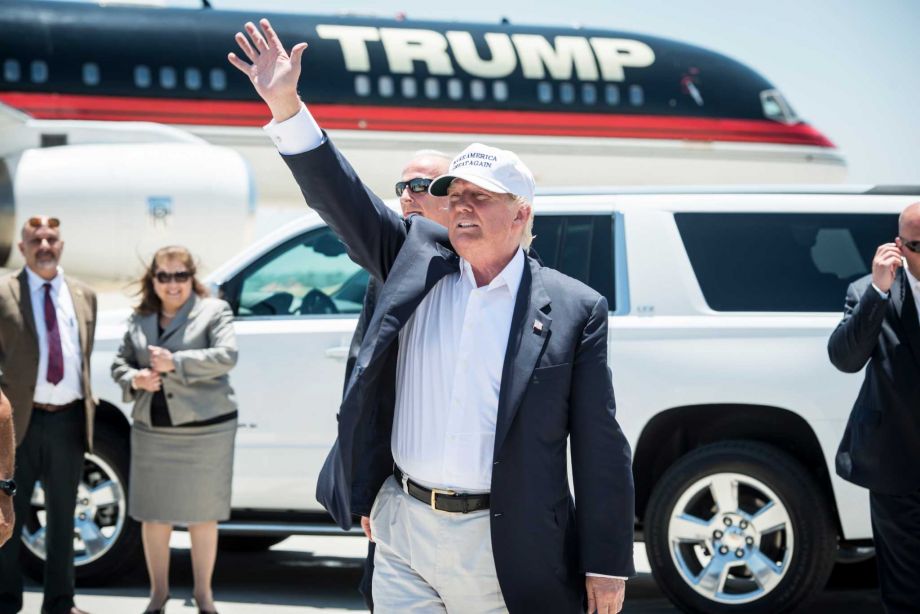
Trump goes big in Texas

Trump detractors, supporters and police all clash outside the arena

Donald Trump brought his Texas-sized swagger to a Texas-sized rally of 15,000 people, declaring here on Monday night, “We are really killing it. We are killing it.”

As his lead in many national and early-state polls continues to grow, Trump gave one of the longest speeches of his campaign and continued to crowd-test the possibility that he may begin accepting large campaign contributions. With Republican rival Ben Carson drawing significant Christian support, he also touted his affinity with evangelicals.

Meanwhile, both the number of protesters that have become common outside his campaign events and the intensity of their clashes with Trump supporters reached new heights.

Recognizing the roused spirit of the crowd inside the arena, Trump reevaluated the label of “the new silent majority” he has bestowed on his supporters. “Maybe we should call it the noisy, the aggressive, the wanting-to-win majority,” he said. “That’s what it is.”

The raucous event marked one of Trump’s largest crowds yet and kicked off a week that will again have the billionaire businessman dominating the news cycle. Before he heads to the Ronald Reagan Presidential Library in Simi Valley for the second GOP presidential debate, Trump will talk national security and veterans issues on board a battleship in San Pedro on Tuesday night, as he amps up his outreach to the military community.

On Monday evening, the most pointed message at the rally came from Trump’s introductory speakers, tea party activists Katrina Pierson and Scottie Nell Hughes, and was aimed at the Republican Party. “I hope Donald Trump tears up that loyalty pledge,” said Pierson, who railed against the Republican establishment’s attempts to undermine tea party candidates, including the Republican National Committee’s insistence that White House contenders sign a pledge to support the eventual GOP nominee, whoever that might be.

Hughes said the Republican Party takes its conservative base for granted. “They think we’ll always be there. We need to end that this election cycle,” she said.

As it ended, attendees filing out, mostly white, clashed with 200 or so lingering protesters, mostly black and Hispanic. Police intervened in several heated exchanges, including some involving members of the Black Lives Matter movement. “Blue lives matter,” chanted several young Trump supporters.

Source: Politico

Obama wants to ‘break up’ white, Republican-voting neighbourhoods

The Obama administration is moving forward with regulations designed to help diversify America’s wealthier neighborhoods, drawing fire from critics who decry the proposal as executive overreach in search of an “unrealistic utopia.”

A final Department of Housing and Urban Development (HUD) rule due out this month is aimed at ending decades of deep-rooted segregation around the country.

The regulations would use grant money as an incentive for communities to build affordable housing in more affluent areas while also taking steps to upgrade poorer areas with better schools, parks, libraries, grocery stores and transportation routes as part of a gentrification of those communities.
“HUD is working with communities across the country to fulfill the promise of equal opportunity for all,” a HUD spokeswoman said. “The proposed policy seeks to break down barriers to access to opportunity in communities supported by HUD funds.”

It’s a tough sell for some conservatives. Among them is Rep. Paul Gosar (R-Ariz.), who argued that the administration “shouldn’t be holding hostage grant monies aimed at community improvement based on its unrealistic utopian ideas of what every community should resemble.”

“American citizens and communities should be free to choose where they would like to live and not be subject to federal neighborhood engineering at the behest of an overreaching federal government,” said Gosar, who is leading an effort in the House to block the regulations.

Civil rights advocates, meanwhile, are praising the plan, arguing that it is needed to break through decades-old barriers that keep poor and minority families trapped in hardscrabble neighborhoods.

“We have a history of putting affordable housing in poor communities,” said Debby Goldberg, vice president at the National Fair Housing Alliance.

HUD says it is obligated to take the action under the Fair Housing Act of 1968, which prohibited direct and intentional housing discrimination, such as a real estate agent not showing a home in a wealthy neighborhood to a black family or a bank not providing a loan based on someone’s race.

The agency is also looking to root out more subtle forms of discrimination that take shape in local government policies that unintentionally harm minority communities, known as “disparate impact.”

“This rule is not about forcing anyone to live anywhere they don’t want to,” said Margery Turner, senior vice president at the left-leaning Urban Institute. “It’s really about addressing long-standing practices that prevent people from living where they want to.”

“In our country, decades of public policies and institutional practices have built deeply segregated and unequal neighborhoods,” Turner said.

Children growing up in poor communities have less of a chance of succeeding in life, because they face greater exposure to violence and crime, and less access to quality education and health facilities, Turner suggested.

“Segregation is clearly a problem that is blocking upward mobility for children growing up today,” she said.

To qualify for certain funds under the regulations, cities would be required to examine patterns of segregation in neighborhoods and develop plans to address it. Those that don’t could see the funds they use to improve blighted neighborhoods disappear, critics of the rule say.

The regulations would apply to roughly 1,250 local governments.

Hans von Spakovsky, a fellow at the conservative Heritage Foundation, called the Obama administration “too race conscious.”

“It’s a sign that this administration seems to take race into account on everything,” Spakovsky said.

Republicans are trying to block the Affirmatively Furthering Fair Housing rule. Before passing HUD’s funding bill this week, the GOP-led House approved Gosar’s amendment prohibiting the agency from following through with the rule.

Though segregationist policies were outlawed long ago, civil rights advocates say housing discrimination persists.

HUD is looking to break down many barriers, but Gosar suggested the regulation would have negative repercussions.

“Instead of living with neighbors you like and choose, this breaks up the core fabric of how we start to look at communities,” Gosar said. “That just brings unease to everyone in that area.”

“People have to feel comfortable where they live,” he added. “If I don’t feel comfortable in my own backyard, where do I feel comfortable?”

Critics of the rule say it would allow HUD to assert authority over local zoning laws. The agency could dictate what types of homes are built where and who can live in those homes, said Gosar, who believes local communities should make those decisions for themselves rather than relying on the federal government.

If enacted, the rule could depress property values as cheaper homes crop up in wealthy neighborhoods and raise taxes, Gosar warned.

It could also tilt the balance of political power as more minorities are funneled into Republican-leaning neighborhoods, he suggested.

The Supreme Court is expected to weigh in on housing discrimination in a related case in the coming weeks. At issue is whether government policies that unintentionally create a disparate impact for minority communities violate federal laws against segregation.

The Texas Department of Housing and Community Affairs is facing accusations that it makes low-income housing funds more readily available in minority neighborhoods than in white neighborhoods. This promotes segregation, critics argue, by encouraging minorities to continue living in poor communities where government assistance is available.

Court observers say the case could have a profound impact on HUD’s rule. – thehill.com

What happened in Argentina

Vulture funds buy insolvent debts for a song and later try to cash in on them by force. Billionaire Paul Singer has made it his specialty. Today he is intent on consolidating his fortune at the expense of the Argentinian people, while already setting his sights on Spain

By Jérome Duval, Fatima Fafatale.

The vulture fund NML Capital that, together with others, has Argentina on the edge of suspending payments, is already devouring the rotting flesh of the Spanish market. Elliott Management, the opportunistic fund of the serial U.S. speculator Paul Singer, has already pocketed a billion euros of Bankia’s failed credit and 300 million euros of Santander. It is estimated that it has paid hardly 50 million for both these portfolios, according to Auraree.com.

In March 2013, the Spanish financial press informed that Elliott had acquired from the Santander Group a portfolio of 300 million euros of defaulting credit of Santander Consumer Finance with a discount approaching 96%. The price that was paid was laughable: about 12 million euros, according to Cinco Dias.

Elliott had acquired from the Santander Group a portfolio of 300 million euros as defaulting consumer credit of Santander Consumer Finance.

In August of the same year, 2013, Bankia, the nationalised entity that most benefited from the rescue of the Spanish banks, which had considerably raised the public debt, informed that three portfolios of bad credit had been sold for a total debt volume of 1,353.9 million euros. In the relevant communication to the CNMV (National Stock Market Commission), it was not mentioned to whom the loans had been sold to or at what price. Despite the evident lack of transparency, the financial press has put names and numbers to the operation, which it is estimated “may have a discount of 95%”. The buyers of the three portfolios were the vulture fund Cerberus, which is advised by José Maria Aznar Jr, the son of the former President, Elliott and the Norwegian recovery business, Lindorff. “The portfolio was valued at 1,354 million but only forked out 68,” according to Finanzas.com. We have been in contact with Bankia for confirmation from the other side and its response has been that “for confidentiality” they never give the number and “the buyers who do not want to be identified”.

A few months later, it emerged that Elliott bought the household debt recovery firm Gesif to convert it into his operational base for the Spanish market. Its director-general was Melania Sebastián, who was in charge of information management at the Banca Comercial de Caja Madrid, who will continue with the moneylenders of Gesif. It is worth noting how a former director of Caja Madrid acts as the intermediary between the nationalised Bankia and Elliott’s vulture fund.

What happened in Argentina

The vulture funds make money taking advantage of countries in difficulties, like Argentina during the crisis of 2001, to buy debts cheap. Later they wait for an opportune moment to oblige them to buy them back at a much higher price with court orders, including deferred interests and judicial costs.

This is how they speculate on public debts, endangering the social spending that benefits the great majority of the population. These vultures went for lawsuits after having refused to form a part of the 93% of creditors who accepted the exchange with the government. Now the New York district judge, Thomas Griesa, has prioritised the payment of the vulture funds, which opens the door to an avalanche of demands that could result in the suspension of payments in Argentina on July 30. As Julio C. Gambina puts it so well, “nobody precisely knows where the demands of the creditors could reach of the unpayable debt”, but we know that the cost for the Argentinean people could be catastrophic.

Who are behind these vulture funds? NML Capital is a subsidiary of the inversion fund, Elliott Management Corporation, registered in the fiscal paradise Cayman Islands. It is the empire of Paul Singer, the multimillionaire champion of the gay rights and neo-conservative aggression.

Elliott speculates, among other things, with public debts, violating the sovereignty of the states and its peoples. But he also speculates with private debts and in 2011 came to possess two million dollars of Lehman Brothers.

Singer was the major financier of the presidential campaign of George W. Bush in 2004; he also contributed to Mitt Romney’s campaign in 2012 and to that of the New York mayor, Rudolph Giuliani. Moreover, he is the major private financier of the New York police. As one of the principal financiers of the Republican Party, he plays an important part in the U.S. politics and, therefore, also in international politics.

The foundation that bears his name, The Paul E. Singer Foundation, praises him for his philanthropy, his leadership in the expansion of free trade, his contribution to U.S. national security and the “future of Israel”. Moreover, Singer is president of the Manhattan Institute for Policy Research.

The frigate is not for handing over or for sale

Regarding the Argentinean case, NML is the principal financier of the organisation, American Task Force Argentina (AFTA), a lobby that influences the Congress and the U.S. justice, harming Argentina. To give ourselves an idea of the power of these vultures, NML could even embargo the Argentinean frigate, Liberty, in Ghana in October 2012, demanding the Argentinean state for about $370 million for unpaid bonds.

Enough of vultures: Argentina united for a national cause

What is happening in Argentina is emblematic of what Greece is starting to feel where vultures like Dart Management operate, with its headquarters in Cayman Island and which also operates in Latin American countries. In 1999, NML achieved, through a ruling in the United States, the payment from Peru of $58 million for a debt that the fund had bought for $11 million. It also did business with the Democratic Republic of Congo.

Source: voltairenet.org

Pew: Next US generation more than 50% non-white

American rolemodels
American rolemodels

For the first time in American history, non-whites will make up half or more of the next generation, likely pushing Washington toward a bigger government — and the GOP better tone down their anti-government rhetoric if they want to win them, according to a top polling outfit.

At a briefing for congressional aides hosted by the moderate Republican Ripon Society, Pew Research Vice President Michael Dimock said that the trend among younger Americans is support for government programs and acceptance of Democratic Party policies.

“Their tendency is more liberal, their tendency is bigger government,” he said of so-called “millennials” born between 1979 and 1995. They will likely set the trend for the still-unnamed next generation.

“This is a generation that is 41 percent non-white; the generation behind it is likely to be close to 50 if not more than 50 percent non-white, and the anti-government kind of tone is one that really doesn’t resonate with that non-white sector in particular,” said Dimock at the Ripon retreat.

His advice to the GOP: “Try to take as much of the anti-government rhetoric out.”

Ripon provided Secrets with a video of his recent presentation. In it, he said that younger voters are both pro-government and pro-business, split over gun control, back abortion and believe welfare does more good than harm. What’s more, they are not angry voters and are still politically diverse.

“I think he confirmed what a lot of Republicans already know, that the party has a lot of work to do with younger Americans, who view the GOP as politically rigid and ideologically out of step. If there’s a bright spot, it’s that millennials are increasingly untethered to either party, which means there’s a chance for Republicans to win them back,” said Ripon’s Lou Zickar.

Pollster John Zogby, who has dubbed millennials First Globals in his new book, said those born after 1979 already number 75 million and will grow to become bigger than the 78-million strong Baby Boom generation, and that should be good for Democrats.

We asked him about Dimock’s prediction and characterization of the current and coming generation.

Said Zogby, who does our weekly report card on President Obama: “The 41 percent non-white figure is right on the money and so is the projection. There is a strong libertarian streak, but they largely do not hate government if it can prove to be a problem-solver. They have no patience for loud debates and for bureaucratic entropy, favoring quick and streamlined forms of problem-solving and decision-making — just as they have learned in video games. There is also an upside to their all having received a trophy: They are great believers and practitioners in teamwork. This is potentially great news for Democrats and liberals (34 percent call themselves such), but mainly it is worse news for the GOP, who have no meaningful outreach or connectivity with them.”

Source: The Washington Examiner

Obama inches ahead

US President Barack Obama and Republican challenger Mitt Romney remain just about tied in the race for the White House with razor-thin margins in four key swing states, according to a Reuters/Ipsos daily tracking poll.

Ferrell pulls out all the stops to get voters behind Obama Ferrell pulls out all the stops to get voters behind Obama
Courts might have the last say Courts might have the last say

A day before the election, the men are neck and neck in Ohio, Florida, Virginia and Colorado, the poll showed.

Nationally, the electorate is divided. Of likely voters polled, 47% said they would back Obama, 46% Romney.

The results fall within the polls’ credibility interval, a tool used to account for statistical variation in internet-based polls.

The two men have been locked in a tight race for weeks. Both were doing final campaign swings at the weekend, trying to sway a small group of voters still undecided and to encourage their supporters to go to the polls.

A handful of states that traditionally swing between voting for Republican and Democratic presidential candidates will determine who wins the White House. All of them are close.

In one of the biggest prizes of the election, Ohio, Obama has a very slight lead over Romney, 46% to 45%, among likely voters, the poll showed.

In Florida, another big prize, they are tied at 47%.

In Virginia, Obama leads Romney 48% to 45% among likely voters. In Colorado, Romney leads Obama 47% to 45%.

“It’s really going to come down to the wire,” said Ipsos pollster Julia Clark, adding that Obama still had a better likelihood of winning the 270 state electoral votes needed to secure victory.

But, with the data tight in the swing states, she added: “I don’t think we can count any of them as in the bag yet.

“The electoral map does favour Obama – it’s just that it’s so on a razor’s edge.”

The precision of the Reuters/Ipsos online polls is measured using a credibility interval, which in the case of the national poll is plus or minus 3.4 percentage points for likely voters.

OBAMA

OBAMA CAMPAIGN LOWS

His first TV debate performance was timid, distracted and hollow and could cost him the election.

Saying in one interview that “you can’t change Washington from the inside”. Critics pointed out that if he couldn’t change it from the inside, there was little point in his being the president.

The administration has changed its story about the fatal attacks on the US consulate in Benghazi, giving the impression of a cover-up, even if one hasn’t been proved.

OBAMA CAMPAIGN HIGHS

A sure-footed performance before, and after, Hurricane Sandy – he was accompanied at one stage by Chris Christie, the Romney-supporting governor of New Jersey – reminded the nation that Obama is the man in charge.

Obama won, albeit narrowly, the second and third TV debates, showing his foreign policy experience in the latter and getting Romney to agree with him much of the time.

The president picked up the predictable celebrity endorsements but was also boosted by the thumbs-up from retired General Colin Powell and Michael Bloomberg, the Republican mayor of New York.

ROMNEY

ROMNEY CAMPAIGN LOWS

His secretly recorded comments that 47% of Americans possessed a “victim” mentality and would automatically vote for Obama.

Just before visiting London for the Olympics opening ceremony, Romney questioned the city’s readiness for the Games, prompting a public dressing-down by London mayor Boris Johnson.

Giving Clint Eastwood a prime speaking slot at the Republican convention without vetting what he was going to say. The star addressed an imaginary Obama, to widespread bemusement.

ROMNEY CAMPAIGN HIGHS

In the first TV debate, in Denver on October 3, Romney went from a near also-ran to a genuine contender. Confident, forceful and succinct, he at last seemed to be presidential material.

Picking staunch fiscal conservative and Minnesota congressman Paul Ryan as his running mate in August played well with Republican core voters who doubted Romney was a true believer.

His heartfelt testimony about his long and loving marriage, and faith in God, helped humanise an often robotic candidate. – Sunday Telegraph

‘Some girls, they rape so easy’

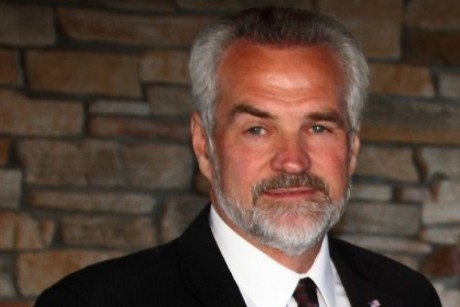
Roger Rivard

The controversial comments led Republican vice presidential hopeful Paul Ryan, a Wisconsin congressman, to withdraw his endorsement of Roger Rivard just hours before Ryan was set to debate Vice President Joe Biden.

It was the second time Ryan has withdrawn an endorsement from a fellow Republican due to offensive rape comments.

Missouri congressman Todd Akin drew widespread condemnation for declaring in August that a woman’s body can prevent conception in cases of “legitimate rape” as he tried to explain his opposition to abortion even in cases of rape.

Ryan, who also opposes abortion in cases of rape, is expected to be pressed on his pro-life views during the debate.

Rivard, a 60-year-old state representative, first made the statement when discussing the case of a local high school student who had been charged with sexual assault for having sex with an underage girl in the school’s band room.

The Chetek Alert paper quoted him in December as saying that his father had warned him “some girls rape easy” — meaning that some girls could decide later that sex wasn’t consensual.

He doubled down on the comments in an interview with the Milwaukee Journal Sentinel Wednesday, saying that he took his father’s warnings about the dangers of premarital sex seriously.

“He also told me one thing, ‘If you do (have premarital sex), just remember, consensual sex can turn into rape in an awful hurry,'” Rivard told the paper.

“Because all of a sudden a young lady gets pregnant and the parents are madder than a wet hen and she’s not going to say, ‘Oh, yeah, I was part of the program.’ All that she has to say or the parents have to say is it was rape because she’s underage. And (my father) just said, ‘Remember, Roger, if you go down that road, some girls,’ he said, ‘they rape so easy.'”

Rivard went on to say: “What the whole genesis of it was, it was advice to me, telling me, ‘If you’re going to go down that road, you may have consensual sex that night and then the next morning it may be rape.’ So the way he said it was, ‘Just remember, Roger, some girls, they rape so easy. It may be rape the next morning.'”

About three hours after speaking to the paper, Rivard — who is engaged in a tight re-election race — sent a statement to the Sentinel in which he acknowledged that “rape is a horrible act of violence.”

“Sexual assault is a crime that unfortunately is misunderstood and my comments have the potential to be misunderstood as well,” his statement said.

“I have four daughters and three granddaughters and I understand the importance of making sure that awareness of this crime is taken very seriously.”

But activists said his initial statement belies his inability to comprehend the realities of sexual assault and are part of a broader problem of blaming victims.

“Unfortunately, comments like these are all too common, and an indication of ways in which the culture is generally undereducated about what sexual assault is,” Pennie Meyers of the Wisconsin Coalition Against Sexual Assault said in a statement. “Sexual assault remains an underreported and underprosecuted crime.”

Rivard, who is married with six children and ten grandchildren, said in his campaign biography that he learned the “value of a hard day’s work at a young age” while working at his parent’s restaurant in Rice Lake, Wisconsin. Sapa/AFP