UCT’s SRC vice riles gays

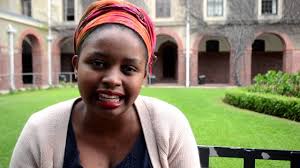
A Facebook status update written by UCT’s black SRC vice-president Zizipho Pae has sparked massive uproar on social media and the student community in Cape Town.

Many interpreted Pae’s status as being related to the US Supreme Court ruling last week requiring states to allow same-sex marriages.

”We are institutionalising and normalising sin! Sin. May God have mercy on us,” Pae wrote.

Her statement came two days after the US court’s decision which effectively legalised same-sex marriage in all 50 states in the country.

Pae’s comment has left the mostly white lesbian, gay, bisexual and transgender (LGBT) community seething.

Source: IOL

Obama wants to ‘break up’ white, Republican-voting neighbourhoods

The Obama administration is moving forward with regulations designed to help diversify America’s wealthier neighborhoods, drawing fire from critics who decry the proposal as executive overreach in search of an “unrealistic utopia.”

A final Department of Housing and Urban Development (HUD) rule due out this month is aimed at ending decades of deep-rooted segregation around the country.

The regulations would use grant money as an incentive for communities to build affordable housing in more affluent areas while also taking steps to upgrade poorer areas with better schools, parks, libraries, grocery stores and transportation routes as part of a gentrification of those communities.
“HUD is working with communities across the country to fulfill the promise of equal opportunity for all,” a HUD spokeswoman said. “The proposed policy seeks to break down barriers to access to opportunity in communities supported by HUD funds.”

It’s a tough sell for some conservatives. Among them is Rep. Paul Gosar (R-Ariz.), who argued that the administration “shouldn’t be holding hostage grant monies aimed at community improvement based on its unrealistic utopian ideas of what every community should resemble.”

“American citizens and communities should be free to choose where they would like to live and not be subject to federal neighborhood engineering at the behest of an overreaching federal government,” said Gosar, who is leading an effort in the House to block the regulations.

Civil rights advocates, meanwhile, are praising the plan, arguing that it is needed to break through decades-old barriers that keep poor and minority families trapped in hardscrabble neighborhoods.

“We have a history of putting affordable housing in poor communities,” said Debby Goldberg, vice president at the National Fair Housing Alliance.

HUD says it is obligated to take the action under the Fair Housing Act of 1968, which prohibited direct and intentional housing discrimination, such as a real estate agent not showing a home in a wealthy neighborhood to a black family or a bank not providing a loan based on someone’s race.

The agency is also looking to root out more subtle forms of discrimination that take shape in local government policies that unintentionally harm minority communities, known as “disparate impact.”

“This rule is not about forcing anyone to live anywhere they don’t want to,” said Margery Turner, senior vice president at the left-leaning Urban Institute. “It’s really about addressing long-standing practices that prevent people from living where they want to.”

“In our country, decades of public policies and institutional practices have built deeply segregated and unequal neighborhoods,” Turner said.

Children growing up in poor communities have less of a chance of succeeding in life, because they face greater exposure to violence and crime, and less access to quality education and health facilities, Turner suggested.

“Segregation is clearly a problem that is blocking upward mobility for children growing up today,” she said.

To qualify for certain funds under the regulations, cities would be required to examine patterns of segregation in neighborhoods and develop plans to address it. Those that don’t could see the funds they use to improve blighted neighborhoods disappear, critics of the rule say.

The regulations would apply to roughly 1,250 local governments.

Hans von Spakovsky, a fellow at the conservative Heritage Foundation, called the Obama administration “too race conscious.”

“It’s a sign that this administration seems to take race into account on everything,” Spakovsky said.

Republicans are trying to block the Affirmatively Furthering Fair Housing rule. Before passing HUD’s funding bill this week, the GOP-led House approved Gosar’s amendment prohibiting the agency from following through with the rule.

Though segregationist policies were outlawed long ago, civil rights advocates say housing discrimination persists.

HUD is looking to break down many barriers, but Gosar suggested the regulation would have negative repercussions.

“Instead of living with neighbors you like and choose, this breaks up the core fabric of how we start to look at communities,” Gosar said. “That just brings unease to everyone in that area.”

“People have to feel comfortable where they live,” he added. “If I don’t feel comfortable in my own backyard, where do I feel comfortable?”

Critics of the rule say it would allow HUD to assert authority over local zoning laws. The agency could dictate what types of homes are built where and who can live in those homes, said Gosar, who believes local communities should make those decisions for themselves rather than relying on the federal government.

If enacted, the rule could depress property values as cheaper homes crop up in wealthy neighborhoods and raise taxes, Gosar warned.

It could also tilt the balance of political power as more minorities are funneled into Republican-leaning neighborhoods, he suggested.

The Supreme Court is expected to weigh in on housing discrimination in a related case in the coming weeks. At issue is whether government policies that unintentionally create a disparate impact for minority communities violate federal laws against segregation.

The Texas Department of Housing and Community Affairs is facing accusations that it makes low-income housing funds more readily available in minority neighborhoods than in white neighborhoods. This promotes segregation, critics argue, by encouraging minorities to continue living in poor communities where government assistance is available.

Court observers say the case could have a profound impact on HUD’s rule. – thehill.com

US support for gay marriage hits record high

Support for same-sex marriage in the United States has soared to a record 60 percent, a new Washington Post-ABC News poll released Thursday said.

The poll was conducted a week ahead of historic US Supreme Court hearings on whether the Constitution allows state restrictions on recognizing the legality of same-sex marriage. The country’s highest court is expected to debate the issue April 28.

The court will review cases from four states — Michigan, Ohio, Kentucky and Tennessee — where injunctions on same-sex marriage were overturned by federal courts of appeals.

In March, the Obama administration filed a brief with the Supreme Court stating the White House opinion that it is unconstitutional to ban same-sex marriage.

In 2013, the Supreme Court ruled that the Defense of Marriage Act (DOMA) signed in 1996 by former US President Bill Clinton which prevented the federal government from recognizing same-sex marriages legalized by states was unconstitutional.

Source: Sputnik News

Child-rape acquittal in Sweden causes social media frenzy

A Swedish girl who says she was raped by a 27-year-old man when she was just 13 has lost her appeal against his acquittal after a court ruled that the man could not have known she was under age because of her “well-developed” body.

News of the court judgments sent Sweden’s social media into a frenzy on Tuesday, with Swedish tabloid Aftonbladet’s version of the story the second most read news article in the country according to social news site socialanyheter.se.

The girl – who has not been named in the Swedish media – said she was raped while on the run from her foster home. She said she had travelled to Västerås, just outside Stockholm, but did not have any money, a mobile phone or a place to stay when she got talking to the older man at a playground near his home.

According to her police statements, he invited her in for a drink after explaining that she was hungry and thirsty and police secured evidence that the pair later had sex.

The man initially denied that the girl had been in his home but later admitted it after police found some of his sperm on her underwear.

Under Swedish law, having intercourse with someone under the age of 15 is classified as ‘child rape’, but both Västmanland District Court and Sweden’s Court of Appeal have now thrown out the girl’s case, because the legislation also states that a defendant must “know” or have “reasonable grounds to believe” that the child is under age.

After viewing video evidence including the girl’s interview with police, both courts decided that the 13-year-old’s body was so “well-developed” that the suspect could not have known that she was under the legal age for having sex in Sweden.

The girl’s lawyer Göran Landerdahl told the TT news agency that he planned to take the case to Sweden’s Supreme Court and hoped to set a precedent for future similar claims.

“Judges read newspapers too, so perhaps someone will realize that there are irregularities in this case,” he said.

Speaking to Sweden’s Aftonbladet newspaper, he added that anyone who had sex with someone who looked “borderline 15 years old” without checking their age, should be called to account.

However, legal expert Madeleine Leijonhufvud believes that the chances that the case will be accepted by the Supreme Court are slim.

“The Supreme Court has been very restrictive when it comes to applying legal sexual abuse clauses to cases involving young teenagers,” she told TT, adding that “less serious crime classifications” than “child rape” had often ended up being used in other similar cases.

NOW president likens Hobby Lobby ruling to apartheid, Jim Crow

The US Supreme Court’s ruling in favor of protecting religious freedom for private business owners is on par with arguments favoring race-based segregation in South Africa and the United States in the past, according to National Organization for Women president Terry O’Neill.

“I think it’s really important to remember apartheid in South Africa was justified on religious grounds; the Southern Baptist Convention justified slavery, and later Jim Crow and segregation, on religious grounds,” O’Neill said on MSNBC on Monday. “There are some religious beliefs we no longer honor in our government, and the Supreme Court is simply wrong to honor gender bigotry that Hobby Lobby stores and Conestoga Wood are promoting.”

“It’s bigotry to keep women away from having basic health care,” she added.

Later, columnist Connie Schultz also lamented the Court’s ruling. “As a Christian, I am so offended by the notion that to be a Christian means you want to harm women,” she said. – National Review

‘Whites only group discriminated against legally in US’

Pat Buchanan
Pat Buchanan

Syndicated columnist Pat Buchanan made a statement Friday guaranteed to make liberal media members’ heads spin.

During a discussion about Affirmative Action on PBS’s McLaughlin Group, Buchanan said, “Whites are the only group that you can discriminate against legally in America now”

JOHN MCLAUGHLIN, HOST: Are you saying college admissions should be based on diversity?

ELEANOR CLIFT, NEWSWEEK/DAILY BEAST: Yeah, I mean, I think lots of factors go into diversity. I think race can be one of them, and I think the Supreme Court so far agrees with that.

MCLAUGHLIN: 67 percent opposed it, 28, you’re in the minority. Only 28 percent are in favor of it.

PAT BUCHANAN: It should be based on excellence, John.

CLIFT: As long as the Supreme Court agrees with me, I’m fine.

BUCHANAN: It should be like the NFL: whoever’s the best player plays, and whoever does best academically should be advanced. What is wrong with that?

MICHELLE BERNARD: Here’s a question I have. One of the things I always say because I think you can measure diversity in a lot of ways, but I think there’s an argument to be said that the greatest Affirmative Action program that there is in the country is being born white. There is a natural assumption when you are applying to institutions of higher education that you are excellent or you are more superb than others.

BUCHANAN: With due respect, whites are the only group that you can discriminate against legally in America now. – newsbusters.com

Unusual delay in Supreme Court’s decision on Abigail Fisher and race-based admissions

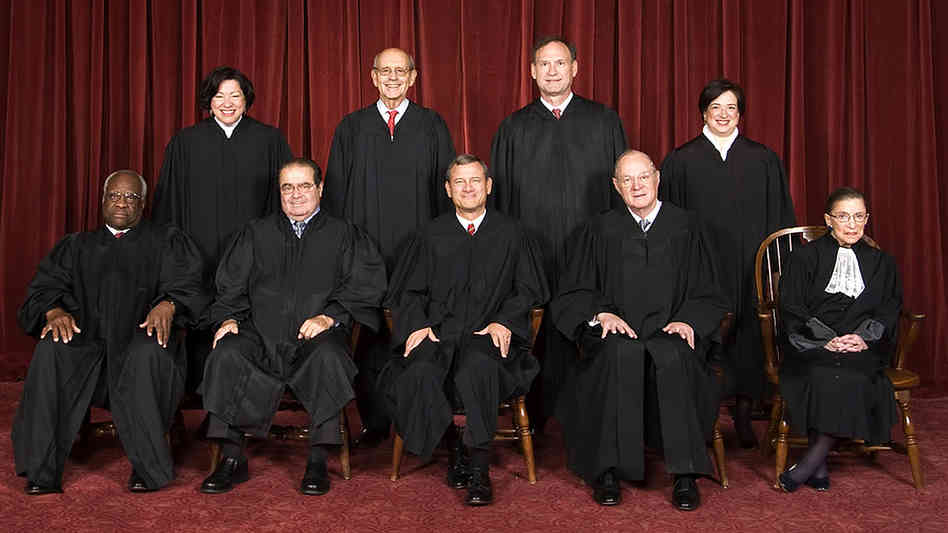
Justices of the Supreme Court

Eight months after attorneys for Abigail Fisher argued in front of the Supreme Court that the University of Texas’ affirmative action admissions policy discriminates against white students, the justices still have not handed down their decision in the potentially paradigm-shifting case.

The unusual delay has many court-watchers stumped, though as with everything Supreme Court-related, all explanations for the wait are, at best, educated guesswork.

Lyle Denniston, who has covered the Supreme Court for more than 50 years and now works for the legal website SCOTUSblog, said he couldn’t remember another case that had been argued in the fall yet still undecided by mid-June.

“I have absolutely no idea what is holding it up,” Denniston said.

One reason why the delay is so surprising: During oral arguments in October, it seemed fairly clear that the four conservative justices would band together with swing vote Justice Anthony Kennedy in striking down the use of race as a factor in undergraduate admissions. Kennedy has voted against affirmative action policies in the past and showed no willingness during questioning to reconsider his past position.

Additionally, the four liberal-leaning justices are short Elena Kagan, who had to recuse herself in this case due to her work on it while a part of the Obama administration. That seemed to clear the way for an easy 5-3 decision in favor of Fisher.

“It’s really surprising that it’s taken this long for the court to issue an opinion,” said Adam Winkler, a constitutional law professor at UCLA School of Law. “It’s almost unheard of for the court to take the entire term to decide what really is a straightforward case.”

Winkler said he believes the court will rule broadly against the University of Texas in a way that will outlaw affirmative action programs nationwide. He thinks that instead of ruling narrowly against this particular school, the court will overturn its own 2003 Grutter v. Bollinger decision that said affirmative action is allowable as long as it’s not a quota system as a way to ensure schools have a diverse student body. In that decision, the court ruled that eventually, in 25 years, the use of race would again becoming legally suspect, but that until then it’s needed to correct societal discrimination.

Winkler guesses the decision is taking so long because the liberal justices are writing lengthy dissents to the conservative judges’ sweeping decision.

“The dissenting justices are very upset about something,” Winkler predicted. “A narrow ruling only striking down Texas’ policy without significantly reshaping the law of affirmative action should be an easy opinion to write and shouldn’t inspire unusually long dissents.”

Long-time court reporter Linda Greenhouse, however, wrote in The New York Times that it’s possible Kennedy’s decision is considered “frustratingly narrow” by his conservative colleagues, since the court has already agreed to hear another affirmative action case in the fall. That suggests they may want another crack at the issue next year.

Another theory floating around legal circles is that the court may be waiting to release the Fisher case at the same time as it hands down Shelby County v. Holder, another landmark case this term (heard in February) that has the potential to significantly diminish the reach of the Voting Rights Act. Alabama sued the federal government, arguing that Southern and other states covered under the act are unfairly monitored by the federal government for discrimination in voting.

One theory is that the court will release the decisions together to make a broader statement about race in society today and how far government institutions may consider race as a way to correct past institutionalized discrimination. The justices could strike down the use of race in admissions as unconstitutional while upholding the Voting Rights Act, as a way to split the issue down the middle and avoid charges of overreach.

But other court watchers said it’s routine for the court to save its most controversial opinions for the last minute, and that it’s impossible to know why the supremes are dawdling.

“This means nothing,” Geoffrey Stone, the former dean of the University of Chicago Law School, said. “The court generally holds its most important decision for the end of the term. We can’t read anything at all into the fact that it hasn’t handed down Fisher yet.”

“I think the more likely explanation is simply that dealing with tough issues requires a lot of thought and care,” said Gail Heriot, a law professor at the University of San Diego. – Yahoo News

Federal prosecutor in hot water over racial remark

Supreme Court Justice Sonia Sotomayor upbraided a federal prosecutor Monday for asking racially-charged questions in court.

The justices almost never elaborate on cases they decline to hear, but Sotomayor took the unusual step of issuing a statement condemning the prosecutor, whom she did not name.

She said the prosecutor “tapped into a deep and sorry vein of racial prejudice that has run through the history of criminal justice in our nation.”

The case at hand came from a drug arrest in Texas. The defendant took a road trip with friends and said he did not know they were planning a drug deal.

The prosecutor in the case invoked racial stereotypes in questioning the defendant’s explanation.

“You’ve got African Americans, you’ve got Hispanics, you’ve got a bag full of money. Does that tell you — a light bulb doesn’t go off in your head and say, This is a drug deal?” the prosecutor asked.

Sotomayor harshly criticized the questioning in a statement sharing the African Americans’s decision not to hear an appeal from the defendant.

“Such conduct diminishes the dignity of our criminal justice system and undermines respect for the rule of law,” Sotomayor wrote. “We expect the government to seek justice, not to fan the flames of fear and prejudice.”

Justice Stephen Breyer joined her statement.

The court rejected an appeal in the case on technical grounds. Sotomayor said she agreed with that decision, noting that the defendant’s lawyers limited their ability to appeal by not initially objecting to the prosecutor’s questioning during the trial.

Sotomayor also criticized the Justice Department for downplaying the prosecutor’s remark and acknowledging too late that it was inappropriate.

“I hope never to see a case like this again,” Sotomayor said.

Affirmative action about to be redefined?

The case for racial preferences in awarding places at US universities is no longer  about minorities held back by centuries of discrimination, says Simon Barber.

Rather, it is all about letting educators decide what will be best to prepare the youth for racial diversity. That, at any rate, is how proponents of affirmative action are framing the discussion as the matter is about to be heard by the US Supreme Court.

Solicitor-general Donald Verrilli, the Obama administration’s chief litigator, told the court last week: “The core of our interest is in ensuring that the nation’s universities produce graduates who are going to be effective citizens and effective leaders in an increasingly diverse society and effective competitors in diverse global markets.”

Just over half the Fortune 100 chimed in with an amicus brief. “The only means of obtaining a properly qualified group of employees,” they argued, “is through diversity in institutions of higher education which are allowed to recruit and instruct the best qualified minority candidates and create an environment in which all students can meaningfully expand their horizons.”

The case pits Abigail Fisher against the University of Texas. Ms Fisher, who is white, says her rights under the constitution’s 14th Amendment were violated when she failed to get in. The university says that while it does indeed take race into account in selecting candidates, it does so as part of a “holistic” review fully consistent with the court’s precedents, in particular Justice Sandra Day O’Connor’s opinion in the landmark 2003 case, Grutter v Bollinger. Writing for a slim 5-4 majority Justice O’Connor held that the University of Michigan Law School’s admissions strategy passed muster: it was adopted in “good faith”, did not rely on demographically-based quotas and was “narrowly tailored to a compelling interest in attaining a diverse student body (with a) critical mass” of minority students.

Opponents of affirmative action would like to believe that, with Justice O’Connor’s replacement by the far more conservative Justice Samuel Alito, there is now a critical mass on the court for banning race-based preferences altogether. They hope Ms Fisher will persuade a majority if not to reverse Grutter v Bollinger, then at least, in the words of Justice Sonia Sotomayor (who will not be part of that majority), “gut it”.

There is a school of progressive thought which would not mind seeing Ms Fisher prevail. In a new study for The Century Foundation, Richard Kahlenberg looks at how universities have been handling diversity in the seven states, including California, where racial preferences have already been banned by referenda, state legislatures or gubernatorial executive order. The news is good.

Responses include partnerships with disadvantaged schools, new race-neutral preferences for students from all difficult environments, no more automatic slots for offspring of alumni, and guaranteed places, regardless of test scores, for a fixed percentage of top students from all in-state public schools. Many of these are terrible, de facto segregated and disproportionately starved of resources.

“For people who care about social equality, all these new measures are intrinsically desirable,” Mr Kahlenberg writes. But they do not come naturally to university administrators because they are harder and more expensive to implement.

“While higher education’s vigorous defence of affirmative action on one level represents a sincere desire for greater racial equality, it has another less virtuous side to it, as racial preferences avoid the hard work of addressing deeply rooted inequalities and instead provide what (one critic) has called ‘racial justice on the cheap’ … recruiting fairly privileged students of colour is far less expensive than including low-income and working class kids of all races.”

Research by Derek Bok, a former Harvard president, found that 86% of African Americans at universities with selective admissions standards were either middle or upper class. At Ivy League schools, 41% of black students were not even African American, but immigrants from relatively advantaged backgrounds.

While it is invidious to invoke the voices of revered figures who can no longer speak for themselves in support of one’s favoured positions, it is interesting to conjecture what Dr Martin Luther King might have said of class, as opposed to race-based affirmative action. He did say, in calling for a Bill of Rights for the Disadvantaged in 1967, “it is a simple matter of justice that America, in dealing creatively with the task of raising the Negro from backwardness should also be rescuing a large strata of the forgotten white poor”. Simon Barber, bdaylive.com

What happened to race-neutral admissions?

The Supremes

Nine years after the Supreme Court said colleges and universities can use race in their quest for diverse student bodies, the justices have put this divisive social issue back on their agenda in the middle of a presidential election campaign.

Nine years is a blink of the eye on a court where justices can look back two centuries for legal precedents. But with an ascendant conservative majority, the high court in arguments Wednesday will weigh whether to limit or even rule out taking race into account in college admissions.

The justices will be looking at the University of Texas program that is used to help fill the last quarter or so of its incoming freshman classes. Race is one of many factors considered by admissions officers. The rest of the roughly 7,100 freshman spots automatically go to Texans who graduated in the top 8 percent of their high school classes.

A white Texan, Abigail Fisher, sued the university after she was denied a spot in 2008.

The simplest explanation for why affirmative action is back on the court’s calendar so soon after its 2003 decision in Grutter v. Bollinger is that the author of that opinion, Sandra Day O’Connor, has retired. Her successor, Justice Samuel Alito, has been highly skeptical of any use of racial preference.

Justice Anthony Kennedy, a dissenter in the 2003 decision, probably holds the deciding vote, and he, too, has never voted in favor of racial preference.

As a result, said Supreme Court lawyer Thomas Goldstein, “No matter what the court does, it is quite likely that the UT program is going to be in big trouble.”

The challenge to the Texas plan has gained traction in part because the university has produced significant diversity by automatically offering about three-quarters of its spots to graduates in the top 10 percent of their Texas high schools, under a 1990s state law signed by then-Gov. George W. Bush. The admissions program has been changed so that now only the top 8 percent gain automatic admission.

More than eight in ten African-American and Latino students who enrolled at the flagship campus in Austin last year were automatically admitted, according to university statistics. Both sides acknowledge that the use of race is present.

In all, black and Hispanic students made up more than a quarter of the incoming freshmen class. White students constituted less than half the entering class when students with Asian backgrounds and other minorites were added in.

“For decades, the defense of racial preferences was, `We’d love to find a way to get diversity without using race, but it’s just not possible. There’s just no other way.’ And Texas found another way,” said Richard Kahlenburg, a senior fellow at the Century Foundation and prominent advocate of class-based affirmative action.

The university says the extra measure of diversity it gets from the slots outside automatic admission is crucial because too many of its classrooms have only token minority representation, at best. At the same time, Texas argues that race is one of many factors considered and that it “is impossible to tell whether an applicant’s race was a tipping factor.”

The Obama administration, 57 of the Fortune 100 companies and large numbers of public and private colleges that could be affected by the outcome are backing the Texas program. Among the benefits of affirmative action, the administration argues, is that it creates a pipeline for a diverse officer corps that it called “essential to the military’s operational readiness.” In 2003, the court cited the importance of a similar message from military leaders.

But lawyers for Fisher, of Sugar Land, Texas, said the race-blind method under which the university automatically admits most of its students has been successful. They say Fisher, who has since graduated from Louisiana State University, was excluded because of her race, and they point to a handful of African-American and Latino students who were admitted with lower scores than hers.

“If any state action should respect racial equality, it is university admission,” Fisher’s lawyers said in their written submission to the court.

The university says that a fuller picture of the process shows that white students with lower scores also were admitted, while many more minority students with higher scores than Fisher also were not offered admission.

The case also raises several contentious side issues, including whether affirmative-action programs hurt the very people they are supposed to be helping. A new book by law professor Richard Sander and journalist Stuart Taylor argues that “large preferences often place students in environments where they can neither learn nor compete effectively, even though these same students would thrive had they gone to less competitive but still quite good schools.”

Their book, “Mismatch,” says these students are set up to fail, getting lower grades and dropping out more often than white students with similar backgrounds.

Taylor and Sander, a law professor at the University of California at Los Angeles, point to statistics in California to support their argument. After voters changed the state constitution to outlaw racial preferences, UCLA saw significant declines in enrollment by black and Hispanic students.

But the number of African-American and Latino graduates was unchanged for the five classes after the ban when compared to the five years before the change in state law, they said.

The dozens of legal briefs in the Texas case also highlight a debate over whether racial preference programs actually limit the number of students from Asian backgrounds, who are disproportionately represented in student bodies relative to their share of the population.

The university says Asian-American enrollment has increased under the policy that is being challenged. The numbers would be even higher if Texas stopped factoring in race, Fisher and others say. – AP

Fisher vs. University of Texas – one girl against Obama and corporate America

University of Texas Austin
The University of Texas at Austin

WASHINGTON — Last month the Obama administration threw its support behind the University of Texas’ use of race as a standard in its admissions policies, asking the Supreme Court not to interfere with the consideration of racial preferences in college admissions.

Abigail Fisher, who was denied admission to the Univerity of Texas in 2008 on the basis that she was white, has filed suit before the US Supreme Court in a bid to overturn affirmative action at the university level. In her submission before the court, she argues that the university has imposed a racial quota system that excluded her for the sake of admitting students of lesser ability. As a result, her civil and constitutional rights were violated.

Arguments in the case will start on October 10, not long before the US presidential election and are bound to attract national attention in America, as well as all other countries where affirmative action and racial quotas are being applied, such as South Africa.

According to a recent article in Forbes magazine, dozens of groups have weighed in as the Supreme Court prepares to hear oral arguments over the constitutionality of affirmative action.

Everyone from professors (one group calls itself the “Empirical Scholars,” another, the “Texas Association of Scholars”) to think tanks (the Cato Institute) to advocacy organizations (the NAACP) to universities (Brown University) to student groups (the National Black Law Students Association) to various state and local governments (California) and public officials (Senate Majority Leader Harry Reid) have submitted amicus briefs trying to influence the Court in what is likely to become one of the most controversial decisions of its upcoming term.

The present case seeks to overturn a previous ruling in Grutter v. Bollinger in 2003, which again opened the door wide for anti-white racial preference policies in America. In that case, Big Business also supported the argument for affirmative action. In a filing to the Court at the time, 65 corporations with more than a trillion dollars in annual revenues – including Intel, Merck, Boeing, and Coca-Cola – had underligned the importance of affirmative action in their “continued success in the global marketplace.”

The Court took notice of their concerns.  The 5-4 majority upholding the University of Michigan Law School’s admissions policy emphasized these efforts to establish a diverse workforce to meet the challenges of a global economy in Grutter v. Bollinger, the key ruling stemming from the pair of lawsuits.

“What is more,” former Justice Sandra Day O’Connor wrote in Grutter at the time, “high-ranking officers and civilian leaders of the United States military” also looked for a “racially diverse officer corps.”  O’Connor’s opinion elaborated on the military’s use of affirmative action to ensure “an officer corps that is both highly qualified and racially diverse.”  As several retired military leaders with decades of experience had urged the Court, she applied this line of reasoning from the military setting to the nation’s public universities.

Abigail Fisher
Abigail Fisher, who was denied admission to the University of Texas because of race preference

For Fisher v. University of Texas, the US Justice Department, in a court brief co-signed by several other government agencies, told the high court that a diverse college population was in the university’s — and the government’s — best interests. “The armed services and numerous federal agencies have concluded that well-qualified and diverse graduates are crucial to the fulfillment of their missions,” Solicitor General Donald B. Verrilli said.

The court brief was cosigned by lawyers from the departments of Defense, Education, Commerce, Labor and Health and Human Services.

The Supreme Court’s ruling on the University of Texas’ admission program will be its first ruling on affirmative action in higher education since 2003.

However, the same groups in the military and corporate America that supported race preference in 2003 have largely repeated their arguments in a new round of amicus briefs filed in response to Fisher.

“Fulfillment of the national security interest in officer corps diversity must not be imperiled by a sweeping ruling against race-conscious admissions,” argued the brief filed on behalf of General Anthony C. Zinni, Admiral Dennis C. Blair, General Wesley K. Clark, and dozens of other high-ranking former officials from all branches of the US armed forces.

Likewise, dozens of the nation’s largest companies – including Pfizer, Starbucks, and Wal-Mart to name a few – also echoed the arguments put forth nine years earlier by a similar list of corporations.

Texas admits most of its students because they rank among the top 10 percent in their high school classes. Fisher’s grades did not put her in that category. For other students, Texas officials say that race is considered among many factors, including academic record, personal essays, leadership potential, extracurricular activities, and honors and awards. The school says race is not used to set quotas, which the high court has previously rejected.

“Race is not considered on its own, and it is never determinative of an applicant’s admission by itself,” Verrilli said. “Rather, race is one of a number of contextual factors that provide a more complete understanding of the applicant’s record and experiences. That is a far cry from impermissible racial balancing.”

The Texas policy has been upheld by federal appeals courts, which said it was allowed under the high court’s decision in Grutter vs. Bollinger in 2003 that upheld racial considerations in university admissions at the University of Michigan Law School. But Fisher appealed to the current Supreme Court, which is considered to be more conservative than the one that ruled in 2003 and more likely to jettison that decision or at least limit when colleges may take account of race in admissions.

Before adopting race as part of its admission policy, Texas’ student body was 21 percent African-American and Hispanic. By 2007, the year before Fisher filed her lawsuit, African-Americans and Hispanics accounted for more than a quarter of the entering freshman class.

“Race is considered not on its own, but as a piece of information that provides valuable context in understanding an applicant’s achievements and his likely contributions to the university,” Verrilli said. “That individualized consideration is designed to work in conjunction with the Top 10 plan to enable the university to construct a class that is diverse in all ways valued by the institution.”

The case is Fisher v. University of Texas at Austin, 11-345.

– AP, Forbes and various other sources

Why no scholarships for white people?

by Alex Urbina Favela

Why is it that there are no scholarships that specifically target white people?

I mean, there are plenty of scholarships out there that are designed for people of certain ethnicities, such as the Hispanic Scholarship Fund, the Asian and Pacific Islander American Scholarship Fund, and the Thurgood Marshall College Fund, but it is hard (or maybe impossible) to find one that specifically caters to Caucasians. I mention this in order to point out a double standard in our society.

Although it does not directly address scholarships, affirmative action upholds a similar double standard in our country.

The Supreme Court has recently decided to review a case that is tied to affirmative action, and it seems the chances for upholding racial quotas are weaker than ever.

The case in question is Fisher v. the University of Texas. Abigail Fisher has alleged that UT denied her admission due to her race.

Since the last time it ruled in favor of an affirmative action plan in 2003, the Supreme Court has become decisively more conservative.

Justice Samuel Alito has subsequently replaced the moderate Justice Sandra Day O’Connor after her retirement in 2006, marking a shift away from a liberal majority. This leaves the Supreme Court with five conservative justices out of a total of nine.

In addition to that, Supreme Court Justice Elena Kagan, who most likely would have voted for use of race quotas in admissions, has recused herself from the upcoming review due to her involvement in the case as Solicitor General. No, things do not look well for affirmative action at all.

But we must ask ourselves if affirmative action is something we think truly represents the American spirit.

Consider this: what if you were told that you could not receive admission into a university or receive a scholarship because of the color of your skin? It would be devastating and blatantly outrageous, correct? Well, this argument used to only apply to ethnic minorities’ rights to education, but I think the same can now be said of those with a Caucasian background.

Now, don’t get me wrong; I am of Mexican descent and as swarthy as they come. But I just cannot help but call out this obvious hypocrisy in our culture.

We are all so quick to preach equality and fair opportunities for everyone regardless of race, but at the heart of the issue is a general notion to combat the idea of whites getting everything.

Accordingly, we establish that it is okay to grant scholarships and college admission to some and not to others. Is this not racism in and of itself? Is this not what the previous generations tried so hard to eliminate?

It is my opinion that affirmative action should be discontinued. It is nothing more than racial balancing with a catchy title. It purposely gives a select few an advantage while denying that same advantage to others. Racial balancing is racist and we all know it.

However, I will give our racism in this matter some credit: it does increase classroom diversity. Proponents of affirmative action could say that this increase in diversity leads to better classroom discussion and an increase in overall learning.

But I would argue that the link between classroom diversity and classroom learning is not as strong as one would think. It, of course, plays a role in greater multi-cultural understanding but we must not fool ourselves into thinking of classroom diversity as a cure-all solution for learning.

I propose that instead of continuing to discriminate based on race, college admissions should be based solely on merit.

This way, race would not even be taken into consideration and everyone would have an equal chance at gaining admission to the college of their choice. This is only fair.

Whatever the solution is, race needs to be kept out of the acceptance process. Until things like this are dealt with, racism will be hard at work in the U.S. as double standards continue to exist.