Class-based affirmative action?

The US Supreme Court in April upheld Michigan’s ban on race-based affirmative action in university admissions.

Indeed, affirmative action as we know it is probably doomed: voters have banned it at universities in at least eight states, and four more look likely to follow suit.

The Economist has argued against race-based admissions policies. Instead, we encourage selection procedures that offer modest preferences to economically disadvantaged students. This is the plan set out in “Place, Not Race”, a new book from Sheryll Cashin of Georgetown Law School.

She proposes a race-blind, class-based type of affirmative action whereby students who have thrived in poor schools or rough neighbourhoods are given special consideration. Some worry that this may lead colleges to accept ill-prepared applicants, who may then drop out (a problem that has plagued some universities with race-based preferences). But new research suggests that these concerns may be unjustified.

In an article published in the latest issue of the Economics of Education Review, Sigal Alon of Tel Aviv University and Ofer Malamud of University of Chicago write about the promising results of a colour-blind, class-based affirmative-action programme in Israel. In the early 2000s, four of Israel’s most selective universities began giving preferential treatment to poorer students, as indicated by an applicant’s neighbourhood and high school. Based largely on these two factors, an applicant is scored on an index of socioeconomic disadvantage; those who meet a pre-determined threshold are eligible for special consideration, but not guaranteed admission. After analysing the academic outcomes of more than 5,000 students, the authors found three particularly noteworthy results.

First, those who met the threshold were more likely than average students to have come from deprived neighbourhoods, to be of Asian, African or Arabic origin, to have immigrated and to be poor. Second, the policy had a significant impact on admissions; applicants who met the threshold were 13% more likely to have been accepted to one of the four elite institutions than those who fell just short of the required number of points. Third, the students who were likely to have been admitted in part because of their disadvantaged backgrounds did not fall behind; they had the same average GPA and graduation rate as their peers who were ineligible for the programme. The researchers concluded that the programme works. It has increased the diversity of the student bodies at top universities by helping the poor without increasing the risk of admitting unqualified applicants. Students admitted through the programme “are not falling behind academically, even at the most selective majors,” the authors found.

Israel is a unique—and uniquely small—country with its own social complications, and there is no guarantee that a programme that works there would work in America. But the study offers some hope for those who seek to create more diverse student bodies and perhaps improve social mobility without explicitly privileging groups based on race.

Source: The Economist
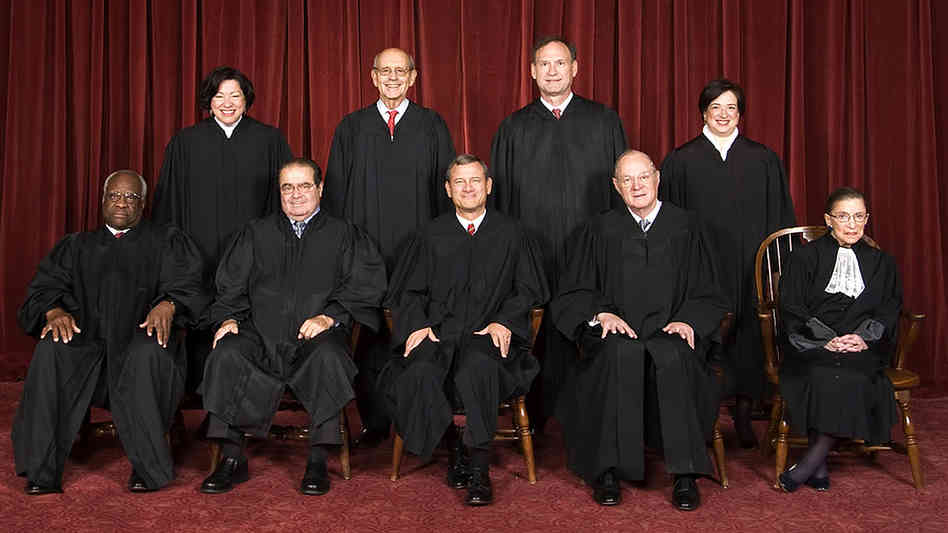
 

Unusual delay in Supreme Court’s decision on Abigail Fisher and race-based admissions

Justices of the Supreme Court

Eight months after attorneys for Abigail Fisher argued in front of the Supreme Court that the University of Texas’ affirmative action admissions policy discriminates against white students, the justices still have not handed down their decision in the potentially paradigm-shifting case.

The unusual delay has many court-watchers stumped, though as with everything Supreme Court-related, all explanations for the wait are, at best, educated guesswork.

Lyle Denniston, who has covered the Supreme Court for more than 50 years and now works for the legal website SCOTUSblog, said he couldn’t remember another case that had been argued in the fall yet still undecided by mid-June.

“I have absolutely no idea what is holding it up,” Denniston said.

One reason why the delay is so surprising: During oral arguments in October, it seemed fairly clear that the four conservative justices would band together with swing vote Justice Anthony Kennedy in striking down the use of race as a factor in undergraduate admissions. Kennedy has voted against affirmative action policies in the past and showed no willingness during questioning to reconsider his past position.

Additionally, the four liberal-leaning justices are short Elena Kagan, who had to recuse herself in this case due to her work on it while a part of the Obama administration. That seemed to clear the way for an easy 5-3 decision in favor of Fisher.

“It’s really surprising that it’s taken this long for the court to issue an opinion,” said Adam Winkler, a constitutional law professor at UCLA School of Law. “It’s almost unheard of for the court to take the entire term to decide what really is a straightforward case.”

Winkler said he believes the court will rule broadly against the University of Texas in a way that will outlaw affirmative action programs nationwide. He thinks that instead of ruling narrowly against this particular school, the court will overturn its own 2003 Grutter v. Bollinger decision that said affirmative action is allowable as long as it’s not a quota system as a way to ensure schools have a diverse student body. In that decision, the court ruled that eventually, in 25 years, the use of race would again becoming legally suspect, but that until then it’s needed to correct societal discrimination.

Winkler guesses the decision is taking so long because the liberal justices are writing lengthy dissents to the conservative judges’ sweeping decision.

“The dissenting justices are very upset about something,” Winkler predicted. “A narrow ruling only striking down Texas’ policy without significantly reshaping the law of affirmative action should be an easy opinion to write and shouldn’t inspire unusually long dissents.”

Long-time court reporter Linda Greenhouse, however, wrote in The New York Times that it’s possible Kennedy’s decision is considered “frustratingly narrow” by his conservative colleagues, since the court has already agreed to hear another affirmative action case in the fall. That suggests they may want another crack at the issue next year.

Another theory floating around legal circles is that the court may be waiting to release the Fisher case at the same time as it hands down Shelby County v. Holder, another landmark case this term (heard in February) that has the potential to significantly diminish the reach of the Voting Rights Act. Alabama sued the federal government, arguing that Southern and other states covered under the act are unfairly monitored by the federal government for discrimination in voting.

One theory is that the court will release the decisions together to make a broader statement about race in society today and how far government institutions may consider race as a way to correct past institutionalized discrimination. The justices could strike down the use of race in admissions as unconstitutional while upholding the Voting Rights Act, as a way to split the issue down the middle and avoid charges of overreach.

But other court watchers said it’s routine for the court to save its most controversial opinions for the last minute, and that it’s impossible to know why the supremes are dawdling.

“This means nothing,” Geoffrey Stone, the former dean of the University of Chicago Law School, said. “The court generally holds its most important decision for the end of the term. We can’t read anything at all into the fact that it hasn’t handed down Fisher yet.”

“I think the more likely explanation is simply that dealing with tough issues requires a lot of thought and care,” said Gail Heriot, a law professor at the University of San Diego. – Yahoo News

American ‘research war’ over affirmative action

by Scott Jaschik, Inside Higher Ed

With the U.S. Supreme Court about to hear arguments in the Fisher v. University of Texas case that could decide the fate of affirmative action in admissions, a research war has broken out. Defenders and critics of the consideration of race are releasing new studies (some of which were submitted in briefs to the court) on the impact of affirmative action.

Several studies presented Friday at the Brookings Institution suggested that eliminating the consideration of race would not have as dramatic an effect on minority students as some believe, and that the beneficiaries of affirmative action may in fact achieve less academic success than they would otherwise. The studies were criticized by some present for being one-sided.

Yield Rates After a Ban

One of the studies explored the impact on the yield rate — the proportion of admitted students who enroll — of black, Latino and Native American students to the University of California after the state barred the consideration of race in admissions. Minority enrollments fell after voters adopted the ban, in part because greater proportions of white and Asian applicants, on average, have the academic and other credentials required for admission.

But the paper focused on a subset of minority students: those who gained admission after the ban on affirmative action. Many observers at the time predicted that these students would be less likely to enroll, as they would perceive the system to be hostile, and news articles quoted minority students to this effect.

But a paper by Kate Antonovics, an economist at the University of California at San Diego, and Richard Sander, a law professor at the University of California at Los Angeles, found that the ban on affirmative action didn’t produce “chilling effects,” but actually produced “warming effects” on the likelihood of minority students’ accepting offers of admission.

The paper examined the yield rates by students in the three years after Proposition 209 (the ban) took effect. Across the system, the yield rate increased by about 10 percent. The increase was the greatest at Berkeley and UCLA. At Berkeley, the pre-Proposition 209 yield rate for underrepresented minority groups was 37.9 percent, and that increased by 5.7 percentage points after affirmative action considerations were barred from the admissions process. At UCLA, a 38.8 percent yield rate increased by 3.9 percentage points.

Antonovics, who presented the paper, said that the findings were important. She said that critics of affirmative action might expect (and accept) that the end of the consideration of race would lead to an overall decline in minority enrollment rates, but that there would be “a layer of concern” if some of that drop could be attributed to students who met race-neutral admissions standards opting not to enroll. She said that she and Sander expected to find this “chilling effect,” and were surprised to find “no evidence for it” and instead see evidence showing the opposite impact.

[ad 1]

‘Mismatch’ Theory

The fear Antonovics expressed is that minority students might not be enrolling at highly competitive institutions at which they would be a good academic match. Another kind of “mismatch” has also been the focus of much research on affirmative action in recent years — and that idea (hotly debated) is that minority students who are admitted to better institutions because of affirmative action may end up with lower academic achievement as a result. (Sander, who helped organize the Brookings program, has been a leading proponent of the idea.)

On Friday, Doug Williams, chair of economics at the University of the South, presented a paper arguing that law schools provide solid evidence for the existence of mismatch. He said that because of the requirement that lawyers pass a bar exam, there is an independent measure of successful learning in law school. Because some minority students with similar academic credentials (judged by undergraduate grads and LSAT scores) enroll at more or less competitive law schools, he said it is possible to see whether there is a mismatch.

There has long been a gap between black and white law graduates on bar passage rates, he noted. Currently, about 97 percent of white law school graduates pass the bar, with 92 percent passing on the first try. For black law graduates, the figures are 78 and 61 percent, respectively. But Williams said that these gaps are partly explained by the differing academic credentials of black and white law students, and so by themselves don’t back mismatch theory.

But in comparing minority law graduates of comparable academic preparation who enroll in more or less competitive law schools, Williams said that those (from among those with comparable academic credentials) who enroll in the bottom two tiers of law schools pass the bar at a rate that is 14 percentage points higher than that of those who enroll at the top law schools. And he said that suggested a statistically significant mismatch.

Williams said that he would like more detailed information about law students — including the law schools that they apply to and are admitted to — but based on the information he does have, he said that he had “strong evidence” to back mismatch.

Sander said that panelists at the program were “ideologically diverse” and that there was no attempt to include only scholars of one point of view.

The debate will likely continue Thursday when a coalition of social science groups — the American Educational Research Association, the American Sociological Association, the American Statistical Association, the Association for the Study of Higher Education, the Law and Society Association and the Linguistic Society of America — hold a briefing on research those organizations cited in their brief to the Supreme Court encouraging the justices to uphold the legality of the consideration of race and ethnicity in admissions.