Orthodox Jews protest against Pride with hired help

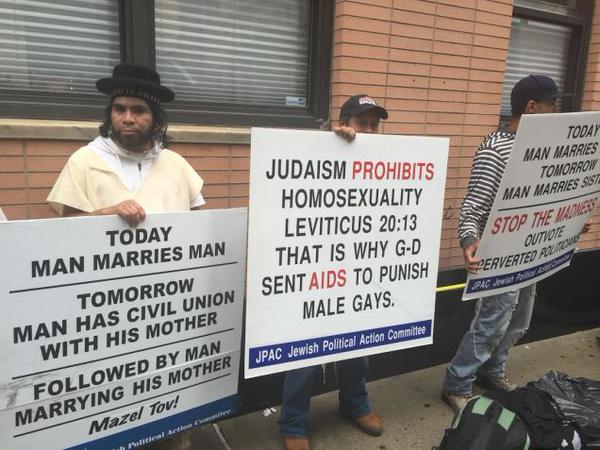
A group of Mexican men were paid to protest homosexuality at the New York City Pride parade. But what they wore made them stand out: They were dressed as Orthodox Jews in tzitzit (fringed Jewish prayer garments), black hats and fake peyot (sidelocks).

The unexpected sight was first reported on by the New York Times, which snapped a photograph of the men as they stood behind a barricade near the parade route. Accompanying the men were numerous signs proclaiming an opposition to same-sex marriage.

One sign declared that “Judaism prohibits homosexuality,” while another read, “Today man marries man; tomorrow man marries sister.”

The most interesting part about the Orthodox Jewish protest, though, was the fact that the men protesting were not actually Jewish.

“They were Mexican laborers, protesting because they were paid to protest, said one of the men, who would not give his name,” the NY Times reported.

The signs featured the logo of the Jewish Political Action Committee, a group run out of Brooklyn. One member of the committee, Heshie Freed, told the Times that the non-Jewish men were protesting because Jewish students were not allowed to actually come out and witness the annual parade, which celebrates the lesbian, gay, bisexual and transgender culture.

“The rabbis said that the yeshiva boys shouldn’t come out for this because of what they would see at the parade,” Freed said.

Class-based affirmative action?

The US Supreme Court in April upheld Michigan’s ban on race-based affirmative action in university admissions.

Indeed, affirmative action as we know it is probably doomed: voters have banned it at universities in at least eight states, and four more look likely to follow suit.

The Economist has argued against race-based admissions policies. Instead, we encourage selection procedures that offer modest preferences to economically disadvantaged students. This is the plan set out in “Place, Not Race”, a new book from Sheryll Cashin of Georgetown Law School.

She proposes a race-blind, class-based type of affirmative action whereby students who have thrived in poor schools or rough neighbourhoods are given special consideration. Some worry that this may lead colleges to accept ill-prepared applicants, who may then drop out (a problem that has plagued some universities with race-based preferences). But new research suggests that these concerns may be unjustified.

In an article published in the latest issue of the Economics of Education Review, Sigal Alon of Tel Aviv University and Ofer Malamud of University of Chicago write about the promising results of a colour-blind, class-based affirmative-action programme in Israel. In the early 2000s, four of Israel’s most selective universities began giving preferential treatment to poorer students, as indicated by an applicant’s neighbourhood and high school. Based largely on these two factors, an applicant is scored on an index of socioeconomic disadvantage; those who meet a pre-determined threshold are eligible for special consideration, but not guaranteed admission. After analysing the academic outcomes of more than 5,000 students, the authors found three particularly noteworthy results.

First, those who met the threshold were more likely than average students to have come from deprived neighbourhoods, to be of Asian, African or Arabic origin, to have immigrated and to be poor. Second, the policy had a significant impact on admissions; applicants who met the threshold were 13% more likely to have been accepted to one of the four elite institutions than those who fell just short of the required number of points. Third, the students who were likely to have been admitted in part because of their disadvantaged backgrounds did not fall behind; they had the same average GPA and graduation rate as their peers who were ineligible for the programme. The researchers concluded that the programme works. It has increased the diversity of the student bodies at top universities by helping the poor without increasing the risk of admitting unqualified applicants. Students admitted through the programme “are not falling behind academically, even at the most selective majors,” the authors found.

Israel is a unique—and uniquely small—country with its own social complications, and there is no guarantee that a programme that works there would work in America. But the study offers some hope for those who seek to create more diverse student bodies and perhaps improve social mobility without explicitly privileging groups based on race.

Source: The Economist


Conned about marriage, constitution and ‘states’ rights’

mercer_ilanaby Ilana Mercer

[followbutton username=’IlanaMercer’ count=’true’ lang=’en’ theme=’light’]

Like Ilana Mercer’s Facebook page

The ban on the ban is unconstitutional.

This was the gist of broadcaster Mark Levin’s angry tirade against the humdrum, and certainly predicable, decision of a federal judge to strike down “Oklahoma’s voter-approved ban” on gay marriage.

At the center of conservative contretemps are similar decisions in California, New Mexico and Utah, following on which U.S. District Judge Terence Kern had “determined that Oklahoma’s constitutional amendment” violated the 14th Amendment’s Equal Protection Clause. It stipulates that “No state shall make or enforce any law which shall abridge the privileges or immunities of citizens of the United States; nor shall any state deprive any person of life, liberty, or property, without due process of law; nor deny to any person within its jurisdiction the equal protection of the laws.”

Broadly speaking, WND’s Alan Keyes concurred with Levin, alluding to the Constitution’s 10th and Ninth Amendments by which “the judges and justices of the federal judiciary are forbidden to … deny the antecedent rights retained by the people.”

Indeed, “the prevailing view in 1791,” observed The Honorable Robert T. Donnelly, former chief justice of the Supreme Court of the state of Missouri, “was that the national government had only delegated powers and that reserved to the people was an undefined sphere of non-government within which people may not be interfered with by government.”

But that was then.

In voiding “voter-approved law,” Justice Kern has resorted to perfectly proper 14th Amendment judicial activism. Deploying the Equal Protection Clause of the 14th Amendment, Kern nullified the 10th. It specifies that, “The powers not delegated to the United States by the Constitution, nor prohibited by it to the States, are reserved to the States respectively, or to the people.”

As expressed in the once-impregnable 10th Amendment, the Constitution’s federal scheme has long since been obliterated by the 14th Amendment and the attendant Incorporation Doctrine.

What does this mean?

If the Bill of Rights was intended to place strict limits on federal power and protect individual and locality from the national government—the 14th Amendment effectively defeated that purpose by placing the power to enforce the Bill of Rights in federal hands, where it was never intended to be.

Into the Cannibal's Pot

In their love of Lincoln and the 14th, conservative constitutional originalists will disagree. They’ll say the 14th was meant to limit the power of the states and enlarge the power of Congress, not the Courts. “Congress, not the Court,” was to “implement the provisions of the 14th Amendment,” subject to judicial review.

And that’s somehow a good thing?

They “say tomato, I say tomahto.” As I see it, the 14th Amendment was a gargantuan grant of power to the federal government. That the judiciary has done what was left undone by Congress does nothing to alter the dismal outcome for liberty. The 14th spelt the demise of our Constitution’s decentralized dispensation.

Either way, the freedoms afforded by federalism are no longer because American federalism is no longer.

“The natural progress of things [being] for liberty to yield, and government to gain ground,” this inevitable momentum, in the form of the invented legal doctrine of “selective incorporation,” soon progressed—regressed is the right word—to complete incorporation.

A précis of Incorporation-Doctrine jurisprudence in the legal dictionary admits that “most provisions of the Bill of Rights were eventually incorporated to apply to the states.”

Put differently, matters previously subject to state jurisdiction have been pulled into the orbit of the judiciary.

Among other legal decisions to have been implicated by Justice Donnelly in expunging federalism from the Constitution is Cooper v. Aaron. In 1958, “the United States Supreme Court asserted for the first time in its history and in the history of the nation that its interpretations of the written Constitution in a particular case in one State constitute the ‘supreme law of the land’ under Article VI of the Constitution and are of binding effect in all of the States.”

“It is emphatically the province and duty of the judicial department to say what the law is,” declared the Court. (See Cooper v. Aaron, 358 U.S. 1, 1958.)

So much for Alexander Hamilton’s promise, in Federalist No. 78 (May 28, 1788), that the Judiciary would be the weakest of the three branches of his proposed government.

“Instead of protecting the legitimate interests of the states,” surmised Justice Donnelly (in “The Demise of Federalism: With Consent of the Governed?”), “the Supreme Court competes with Congress to dictate to the states their ‘legitimate’ interests.”

Commensurate with the power they’ve amassed, nine unaccountable, unelected, Supreme-Court judges now sit as “a Council of Revision over the states.”

Just as the interpretation of the 14th Amendment in Brown v. Board of Education became the supreme law of the land, so, too, will the states likely lose their (petty) marriage-licensing jurisdiction, once that coven of casuists, the Supreme Court, embroils itself in setting social policy for all the states.

Conservatives as astute as Mr. Levin, Esq., ought to quit misleading their readers and listeners about the restoration of a constitutional structure that has suffered death by a thousand cuts, long before the dreadful cur Obama appeared on the scene.

[followbutton username=’IlanaMercer’ count=’true’ lang=’en’ theme=’light’]

Like Ilana Mercer’s Facebook page

Court halts US lawsuits against apartheid crime

tortA federal appeals court on Wednesday ruled that three major companies cannot be held liable in the United States for crimes South Africa’s former apartheid government committed, saying a recent US Supreme Court decision “plainly bars” such lawsuits.

The plaintiffs brought their suits under the Alien Tort Statute (ATS), a law passed in 1789 that allowed non-US citizens to bring cases in US federal courts for violations of international law, such as piracy. In recent decades it took on renewed importance, employed to allow non-US citizens to sue for alleged human rights violations abroad.

But a recent Supreme Court decision found that “federal courts may not, under the ATS, recognize common-law causes of action for conduct occurring in the territory of another sovereign,” Circuit Judge Jose Cabranes wrote in the unanimous decision.

In April, the Supreme Court unanimously ruled that a federal court in New York could not hear claims by 12 Nigerians who accused Anglo-Dutch oil company Royal Dutch Shell Plc of complicity in a violent crackdown on protestors in Nigeria from 1992 to 1995. The case, Kiobel v. Royal Dutch Petroleum Co, was seen as a major victory for multinational corporations.

The appeals court ruling on Wednesday could mark the end for plaintiffs in the long-running case, who accused Daimler AG , Ford Motor Company and International Business Machines Corp of facilitating decades of race-based crimes such as torture and extrajudicial killings because their South African subsidiaries sold products to it.

The automakers knew their vehicles were being used by South African forces to violently suppress protesters, while IBM knew its computers were being used to help strip black citizens of their rights, plaintiffs said.

The defendant companies can now request that the case be dismissed in district court, the ruling said. Attorneys for the plaintiffs and representatives of the defendant companies were not immediately available. Apartheid ended in 1994 when South Africa held its first all-race elections, bringing Nelson Mandela and the African National Congress to power.

More than 50 major corporations were initially sued in 2002, but the complaints were later amended to target fewer companies. Supporters of the lawsuits included South African Archbishop Desmond Tutu, a recipient of the Nobel Peace Prize. – Sapa/AP

Stop crying racism, sexism – the 1960s are over

david_masciotraby David Masciotra

The 1960s divided America. An activist and rebellious youth fought, sang and partied for more freedom and equality. The Civil Rights Movement, the free speech campaign at Berkeley and anti-Vietnam war protests helped push America into a necessary blender of tumult and turbulence.

Now, one of the divides of contemporary American culture separates those who celebrate the progress, changes and improvements the country has made in the past five decades, and those who believe we still live in the 1960s.

Trapped in a sociopolitical version of the movie “Groundhog Day,” there is a powerful cadre of citizens devoted to maintaining the fight against racism, sexism and other “isms,” even though, thankfully, the prejudices of the past lose relevance every day.

The U.S. Supreme Court recently ruled to remove a section of the Voting Rights Act that placed the voting laws and procedures of Alabama, Alaska, Arizona, Georgia, Louisiana, Mississippi, South Carolina, Texas and Virginia, under federal authority. Lawmakers passed the provision in 1965, because the singled-out states had such a cruel record of racism. No reasonable person believed that elected leaders in those states would fairly implement the reforms of the Voting Rights Act and open the polls to black voters. It was a good move and one that ensured accountability. Consider that in Mississippi, in the 1964 election, black voter turnout was a mere 6 percent.

But in 2012, the percentage of black voters in Mississippi, along with black voter turnout in eight of the nine states singled out by the law, was higher than white voter turnout. Looking at the new data confirms that the worst offenders of voter suppression in the 1960s have now achieved voter equality. Chief Justice Roberts wrote that there was no good reason to continue to punish states based on “40-year-old facts having no logical relationship to the present day.”

President Obama disagreed, claiming “deep disappointment in the ruling.” Al Sharpton said that the decision “cancels Martin Luther King’s dream” and Bill Maher called it “racism 2.0.” The fact that a higher percentage of black people than white people in the previously punished states voted for a black president, who won re-election, is of no importance to Sharpton, Maher or even that president.

It’s not just in the campaign to divide the country between “racists” and egalitarians that statistics, evidence and logical argument are dismissed.

President Obama won re-election in part because he convinced a significant percentage of the electorate that American culture, led by the Republican Party, is waging a patriarchal “war on women.” Obama, naturally, was the knighted dragon slayer dedicated to protecting every maiden from attack.

The problem with the sexism narrative is that women now graduate college at higher rates than men. They hold 51.4 percent of managerial positions. They are rising in all the professions, while men are dropping, and in married households, they account for 40 percent of breadwinners.

In America, leading institutions were undeniably at one time racist and sexist, but we have steadily marched toward equality. Racism and sexism, like all forms of evil, will never die, because evil itself is ineradicable, but they maintain no influence over the general culture.

But in liberal “Groundhog Day,” America of 2013 is just like America of 1965.

One of the college courses I teach is African-American Literature and Blues and Jazz Music. I instruct my students that the beauty and brutality of American history is impossible to understand or appreciate without a full confrontation with the role that race has played in the formation and evolution of the country.

It is important to study history and realize that America, like any country, will never become a sociological Eden. But to parrot the slogans of 1968, while rejecting the evidence that proves their vacuity, is to not only to deny reality, but also to encourage racial resentment and gender tension and advance a debilitating culture of victimhood. It also ignores the real problems of today — the lack of economic opportunity leading to upward mobility, our failing public schools and the infringements on personal freedom.

The crises of the 21st century are solvable only by people living in the 21st century.

Masciotra is the author of “All That We Learned About Livin’: The Art and Legacy of John Mellencamp” (forthcoming, The University Press of Kentucky) and “Against Traffic: Essays on Politics and Identity.” For more information visit www.davidmasciotra.com.

US top court green lights gay marriage

gayokThe US Supreme Court on Wednesday struck down a central portion of a federal law that restricted the definition of marriage to opposite-sex couples in a major victory for the gay rights movement.

The ruling, on a 5-4 vote, means that legally married gay men and women are entitled to claim the same federal benefits that are available to opposite-sex married couples.

It sidestepped a broad ruling that would affect the whole country, however, by saying it could not decide a closely watched case on the constitutionality of a California law that restricts marriage to opposite-sex couples.

By finding that supporters of the ban on gay marriage did not have standing to defend the law, the court effectively gave the green light for at least some gay weddings to proceed in California because a federal judge’s original ruling that struck down the law, known as Proposition 8, will remain intact.

Justice Anthony Kennedy wrote in the majority opinion that the Defence of Marriage Act violated the US constitution’s guarantee of equal protection.

“The federal statute is invalid, for no legitimate purpose overcomes the purpose and effect to disparage and to injure those whom the state, by its marriage laws, sought to protect in personhood and dignity,” he wrote.

Justice Kennedy, often the court’s swing vote in close decisions, also said the law imposed “a stigma upon all who enter into same-sex marriages made lawful by the unquestioned authority of the states”.

Chief Justice John Roberts and Justice Antonin Scalia both wrote dissenting opinions.

In his dissent, Justice Roberts wrote that the court in the coming Proposition 8 case would not reach the issue of constitutionality of state laws that limited the definition of marriage.

By striking down section 3 of the law, the court clears the way to more than 1,100 federal benefits, rights and burdens linked to marriage status.

As a result of Wednesday’s ruling, Edith Windsor of New York, who was married to a woman and sued the government to get the federal estate tax deduction available to heterosexuals when their spouses die, will be able to claim a $363,000 tax refund. – Reuters

Key affirmative action case to be decided this month

The controversial issue of affirmative action will be decided this month by the US Supreme Court and will set a precedent in how colleges and universities accept students. It is not expected to have significant impact on the current admissions policies of Utah’s colleges and universities, however.

The case, Fisher v. University of Texas, which has been on a legal track toward the top court since 2008, centers on a woman who claims she was denied admission to the University of Texas at Austin despite being equally or more qualified than minority students who were admitted under the university’s policy of considering family circumstance and race in its application process.

University officials claim Abigail Fisher, a white student from the Houston area with a 3.59 grade-point average, the plaintiff in the case, was not qualified to attend the school and said her race was not the reason she was not accepted into the school. Officials at the school also argued that schools have the right to assemble a diverse student body, a position upheld by the court in a 2003 case (Grutter v. Bollinger) focused on affirmative action admissions decisions at the University of Michigan.

Prior to reaching the U.S. Supreme Court, a district court in 2009 ruled in favor of the University of Texas at Austin. The case was then appealed to a three-judge panel from the 5th Circuit Court of Appeals, which also ruled in favor of the university.

Supreme Court Justice Elena Kagan has recused herself from hearing the case. Five of the remaining eight judges would need to rule against the university’s policy, as a tie would uphold the lower courts’ decisions. A decision is expected by the end of June, possibly as early as Monday.

A ruling in favor of Fisher would give legal precedent to individuals challenging affirmative action admission policies, which are sometimes cited as perpetuating racial divisions, and the dispute has been among the key cases the court is ruling on this month.

Utah’s standards

Pamela Silberman, spokeswoman for the Utah System of Higher Education, said the court’s decision, while impactful nationally and precedent-setting, will have little immediate impact either way on Utah’s public colleges and universities. It could certainly impact Utah students seeking education out of state, particularly in hard-to-get-into programs making use of affirmative action policies.

Of the eight schools in the Utah public system, five are open enrollment, meaning all applicants are accepted based on a basic entrance requirement. The remaining three schools — the University of Utah, Utah State University and Southern Utah University — determine enrollment by a minimum index score combining high school grade-point averages and ACT or SAT exam scores.

“There’s really not any sort of consideration of race or ethnicity or other demographic standards there,” Silberman said. “It’s going to have almost no impact in the state of Utah because there hasn’t been a strong history of those kinds of policies anyway.”

Because Utah’s schools determine admission based on academic criteria, it is not likely that a decision against the University of Texas would lead to Utah students challenging their denied admission applications, she said.

“I think that if the criteria for entrance are really clear, then you’re going to avoid that,” Silberman said. “We want all students to be prepared so they can meet those criteria, and I think that’s the focus we have.”

The U. recently transitioned to a holistic application process, which considers extracurricular factors like creative endeavors and community service in addition to GPA and test scores.

Octavio Villalpando, associate vice president for equity and diversity at the U., said the policy is still being fine-tuned, but because it does not give special consideration to race or demographics, he does not foresee it running into conflict with the court’s decision on Fisher.

Villalpando said U. officials have studied the effects of anti-affirmative action laws in other states to avoid conflict.

“We don’t anticipate any significant changes here at the campus,” he said. “Looking across the country in states where a version of this law passed, the flagship campuses didn’t have to change much of their admissions process.”

Of the 33,291 students enrolled at the University of Utah in the fall of 2012, about 70 percent were white, 7 percent were Hispanic and 4 percent were Asian, according to data from the Utah System of Higher Education. Statewide, 14 percent of public college and university students in Utah were minority students in 2012.

Villalpando said the University of Utah, as well as other institutions in the Utah System of Higher Education, have focused on collaborating with K-12 education to prepare students for college, rather than implementing admissions policies to address perceived racial imbalances.

He also said the relatively recent diversification of Utah’s student body has allowed educators to observe the best practices of areas in the country with larger minority populations.

“I think the fact that Utah is just now beginning to see this large demographic change is really helping higher ed in many ways,” Villalpando said. “It’s allowing us to learn from other strategies states have adopted.”

Political action

But the controversy surrounding affirmative action is not unknown to the state. In 2010, Utah lawmakers considered a resolution calling for a constitutional amendment prohibiting affirmative action in state agencies and higher education.

The pre-emptive resolution, sponsored by Rep. Curt Oda, R-Clearfied, stated that public entities could not “grant preferential treatment to any individual or group on the basis of race, sex, color, ethnicity or national origin.”

The resolution received a favorable recommendation during its House committee hearing but was moved by the House Rules Committee, where it languished until the session expired without coming up for a vote.

David Jones, education division chief for the Utah Attorney General’s Office, said affirmative action is not a pervasive issue in Utah’s courts. Historically, the number of cases on the issue has been minimal, Jones said, and he does not expect the Supreme Court’s decision on Fisher v. University of Texas to change that.

He also agreed with Silberman and Villalpando’s assessment that the index score admission process of Utah’s schools would be largely unaffected by the outcome of the case.

“The ACT scores and the grade-point averages aren’t going to be affected by the Supreme Court decision,” Jones said. – Salt Lake City, Deseret News

U.S. Supreme Court to rule on Affirmative Action today

In addition to a ruling on the constitutionality of the Affordable Healthcare law ( Obamacare) law today,  the United States Supreme Court is also set to hand down a ruling on an Affirmative Action case which may impact parents with teens heading to college in the near future.

An Anglo-Saxon white female student who was rejected admission into the University of Texas argued that African American and Hispanic students with inferior credentials were admitted over her using via the school’s Affirmative Action plan.

This case, Fisher v. University of Texas, was a follow up to the last Texas Affirmative Action case the 5th Circuit Court of Appeals decided, known as Hopwood v. Texas.  In that 1996 case, the Court ruled the school system’s Affirmative Action program was not narrowly tailored enough to meet a compelling state interest and then overruled a diversity admission policy at the law school.  It stated the school could not use race as a factor in admission decisions.

To get around that decision and do its part to increase Black and Latino admissions, the University of Texas system opted on a plan to admit the top 10 percent of all high schools. That move caused minority student admissions to jump 21 percent.

However, when the US Supreme Court took up Affirmative Action in 2003 through Grutter v. Bollinger, the majority stated that diversity is an interest that schools can and should promote as long as they meet the strict standard: that its policy was narrowly tailored to meet the compelling interest in diversity promotion.

After that case, Texas expanded its Affirmative Action efforts beyond just the top 10% and started taking into account diversity when making admission decisions. It operated under that program until 2008 when Fisher sued after she was denied admission.

There are up to several dozen factors that each school use to determine who gets admitted and it’s easy for those who get rejected to point to race and use that as a basis for a judicial challenge.  And that’s what happened here.

Fisher claims that the Affirmative Action policy at the University of Texast has become a racial quota system. The dissenting judge in the case below noted that use of a racial animus opens the door to numerical admission based on race alone. But, that was the minority opinion. Fisher managed to push her case up the ladder and was granted a review by the Supreme Court.

What will stand out this round is that the Supreme Court that heard the University of Michigan case, thereby empowering Texas to change its policy back then, is not the current court of 2012 which is dominated by conservatives, 5-4.

It gets even more complicated because Justice Elena Kagan, who was the solicitor general in the case below, has recused herself from the case.

That maneuver stacks the court with even more conservative Justices, increasing the odds that Affirmative Action may be struck down in its entirety or, at the least, in more extreme ways than before. Justices John Roberts, Antonin Scalia, Clarence Thomas and Samuel Alito have taken anti-Affirmative Action stances in prior decisions.  Justices Sonia Sotomayor, Ruth Bader Gingsburg and Stephen Breyer are more liberal and are more likely to uphold the Texas Affirmative Action program.  Hence, this decision will hinge on Justice Anthony Kennedy, who under the current make up of the court has become the “swing” vote, though he’s voted with the conservative wing 63% of the time since 2010.  However, he occasionally sides with the liberal wing, according to the SCOTUS Blog.

It’s worth noting that Kennedy has voted against  Affirmative Action in the past. In 1989, he voted in City of Richmond v. J.A. Croson Co. against federal contractors setting aside 30% of contracts for African Americans.  Also that year, he voted with the majority to allow disgruntled White workers in Martin v. Wilks to challenge Affirmative Action settlements. That same year, he also voted in Wards Cove Packing v. Atonio which challenged numerical underutilization of women or minorities.

Several groups have filed amicus briefs in this potentially landmark case.

Affirmative Action programs will not necessarily be automatically ruled unconstitutional, per se.  But, the court may look to Texas’ Affirmative Action program, invalidate it, and possibly set up a higher bar for other colleges and universities to climb in order to use race in admission.

Such a move could, in effect, invalidate all government Affirmative Action programs nationwide.

Conservative think tanks are watching and hoping this will be the year that Affirmative Action goes by the wayside permanently.  And it’s one more perfect hot button issue for the elections, just in time to see if the first Black president gets re-elected.