The rise of nationalism in Britain

As the eurozone crisis continues, anti-establishment insurgencies like the Scottish National Party, SNP’s, are surfacing all over Europe: nationalist, populist, separatist, left or right.

As the British empire was gradually dissolved after the second world war and its industrial base attacked by younger, nimbler economies, the cohesion of the British state weakened.

There was an impulse towards supra-nationalism in the shape of membership in the European Union, but Britain joined late, in 1973.

English people – steeped in Britain’s maritime, imperial traditions – felt hostile towards the EU.

At the same time, long-smothered regional nationalism was reviving on Britain’s Celtic fringes. In divided Ireland, it was violent; in Scotland, political, emboldened by newly discovered North Sea oil; in Wales, initially, cultural, based around the preservation of the Welsh language.

That was in the 70s. Forty years on, these rival strands are much stronger, and testing the concept of “Britishness” to destruction.

The Scottish national party has barely paused for breath since losing last September’s referendum on independence for Scotland – immediately declaring itself the moral victor and demanding greater powers for Edinburgh.

Since the referendum result – 55% no, 45% yes – disaffected working-class Labour voters have flocked to the SNP. Polls suggest the Scottish nationalists, now led by Scotland’s new first minister, the formidable Nicola Sturgeon, will slaughter Labour north of the border, winning dozens of Scotland’s 59 seats and perhaps holding the balance of power in London. If she finds herself in that position, Sturgeon promises to block Cameron and prop up a minority Miliband administration.

Britain’s Tory newspapers are busy denouncing Sturgeon as “the most dangerous woman” in the country. Cameron – whose Tories have only one seat in Scotland – warns of a Scottish veto from the people who want to break up Britain. Miliband is embarrassed.

Meanwhile, in England, the populist anti-European right, in the form of the UK independence party (Ukip), has evolved under the skilful leadership of Nigel Farage.

Ukip’s proven ability to win protest votes at four-yearly elections to the 28-nation European parliament is now threatening the status quo at Westminster. It has two MPs (both defectors from the Tories) and hopes to win more on 7 May.

If that sounds familiar, it should. Though Ukip portrays itself as free market and libertarian, it is also deeply nostalgic, socially conservative, and suspicious of immigrants and big-government bureaucracy, especially from the EU’s Brussels headquarters.

Racist, homophobic and authoritarian? Certainly not, says Farage. We just want to be a self-governing sovereign state again. But Ukip’s “little guy” rank-and-file is not always quite so on-message. This is disruptive Tea Party Republicanism with added potency.

Ukip’s threat to the status quo is twofold. It may take enough votes away from Cameron’s Tories to deny the prime minister his slim hopes of a Commons majority on May 7, or even to stop him being the largest party, which would make it hard for him to form another coalition.

In a tight race, with both main parties polling at around 34%, Ukip’s rise may also hurt Miliband’s prospects by peeling off Labour’s equivalent of blue-collar Democrats, working-class voters fed up with stagnant wages and gay marriage, underfunded public services and “unpatriotic” liberals.

Source: The Guardian

Conned about marriage, constitution and ‘states’ rights’

mercer_ilanaby Ilana Mercer

[followbutton username=’IlanaMercer’ count=’true’ lang=’en’ theme=’light’]

Like Ilana Mercer’s Facebook page

The ban on the ban is unconstitutional.

This was the gist of broadcaster Mark Levin’s angry tirade against the humdrum, and certainly predicable, decision of a federal judge to strike down “Oklahoma’s voter-approved ban” on gay marriage.

At the center of conservative contretemps are similar decisions in California, New Mexico and Utah, following on which U.S. District Judge Terence Kern had “determined that Oklahoma’s constitutional amendment” violated the 14th Amendment’s Equal Protection Clause. It stipulates that “No state shall make or enforce any law which shall abridge the privileges or immunities of citizens of the United States; nor shall any state deprive any person of life, liberty, or property, without due process of law; nor deny to any person within its jurisdiction the equal protection of the laws.”

Broadly speaking, WND’s Alan Keyes concurred with Levin, alluding to the Constitution’s 10th and Ninth Amendments by which “the judges and justices of the federal judiciary are forbidden to … deny the antecedent rights retained by the people.”

Indeed, “the prevailing view in 1791,” observed The Honorable Robert T. Donnelly, former chief justice of the Supreme Court of the state of Missouri, “was that the national government had only delegated powers and that reserved to the people was an undefined sphere of non-government within which people may not be interfered with by government.”

But that was then.

In voiding “voter-approved law,” Justice Kern has resorted to perfectly proper 14th Amendment judicial activism. Deploying the Equal Protection Clause of the 14th Amendment, Kern nullified the 10th. It specifies that, “The powers not delegated to the United States by the Constitution, nor prohibited by it to the States, are reserved to the States respectively, or to the people.”

As expressed in the once-impregnable 10th Amendment, the Constitution’s federal scheme has long since been obliterated by the 14th Amendment and the attendant Incorporation Doctrine.

What does this mean?

If the Bill of Rights was intended to place strict limits on federal power and protect individual and locality from the national government—the 14th Amendment effectively defeated that purpose by placing the power to enforce the Bill of Rights in federal hands, where it was never intended to be.

Into the Cannibal's Pot

In their love of Lincoln and the 14th, conservative constitutional originalists will disagree. They’ll say the 14th was meant to limit the power of the states and enlarge the power of Congress, not the Courts. “Congress, not the Court,” was to “implement the provisions of the 14th Amendment,” subject to judicial review.

And that’s somehow a good thing?

They “say tomato, I say tomahto.” As I see it, the 14th Amendment was a gargantuan grant of power to the federal government. That the judiciary has done what was left undone by Congress does nothing to alter the dismal outcome for liberty. The 14th spelt the demise of our Constitution’s decentralized dispensation.

Either way, the freedoms afforded by federalism are no longer because American federalism is no longer.

“The natural progress of things [being] for liberty to yield, and government to gain ground,” this inevitable momentum, in the form of the invented legal doctrine of “selective incorporation,” soon progressed—regressed is the right word—to complete incorporation.

A précis of Incorporation-Doctrine jurisprudence in the legal dictionary admits that “most provisions of the Bill of Rights were eventually incorporated to apply to the states.”

Put differently, matters previously subject to state jurisdiction have been pulled into the orbit of the judiciary.

Among other legal decisions to have been implicated by Justice Donnelly in expunging federalism from the Constitution is Cooper v. Aaron. In 1958, “the United States Supreme Court asserted for the first time in its history and in the history of the nation that its interpretations of the written Constitution in a particular case in one State constitute the ‘supreme law of the land’ under Article VI of the Constitution and are of binding effect in all of the States.”

“It is emphatically the province and duty of the judicial department to say what the law is,” declared the Court. (See Cooper v. Aaron, 358 U.S. 1, 1958.)

So much for Alexander Hamilton’s promise, in Federalist No. 78 (May 28, 1788), that the Judiciary would be the weakest of the three branches of his proposed government.

“Instead of protecting the legitimate interests of the states,” surmised Justice Donnelly (in “The Demise of Federalism: With Consent of the Governed?”), “the Supreme Court competes with Congress to dictate to the states their ‘legitimate’ interests.”

Commensurate with the power they’ve amassed, nine unaccountable, unelected, Supreme-Court judges now sit as “a Council of Revision over the states.”

Just as the interpretation of the 14th Amendment in Brown v. Board of Education became the supreme law of the land, so, too, will the states likely lose their (petty) marriage-licensing jurisdiction, once that coven of casuists, the Supreme Court, embroils itself in setting social policy for all the states.

Conservatives as astute as Mr. Levin, Esq., ought to quit misleading their readers and listeners about the restoration of a constitutional structure that has suffered death by a thousand cuts, long before the dreadful cur Obama appeared on the scene.

[followbutton username=’IlanaMercer’ count=’true’ lang=’en’ theme=’light’]

Like Ilana Mercer’s Facebook page

‘Blacks are being pushed to the back of the bus’

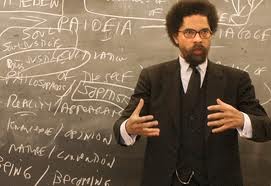
Cornel West
Cornel West

It’s been a great week for gay activists, but Dr. Cornel West is not happy. As the postmodern professor par excellence explained to radio host Tavis Smiley last Sunday, the advances made by gays and lesbians mean that “we black folk are just being pushed to the back of the bus”:

Again this has something to do of course with what history books will say. The irony of the age of Obama in which black folks found themselves pushed to the back, [and] our gay brothers and lesbian sisters more and more pushed to the center.

Perhaps West is right, and identity politics really is a zero-sum game. Then again, the good doctor may simply be suffering from a touch of radical conditionedness. – National Review

US top court green lights gay marriage

gayokThe US Supreme Court on Wednesday struck down a central portion of a federal law that restricted the definition of marriage to opposite-sex couples in a major victory for the gay rights movement.

The ruling, on a 5-4 vote, means that legally married gay men and women are entitled to claim the same federal benefits that are available to opposite-sex married couples.

It sidestepped a broad ruling that would affect the whole country, however, by saying it could not decide a closely watched case on the constitutionality of a California law that restricts marriage to opposite-sex couples.

By finding that supporters of the ban on gay marriage did not have standing to defend the law, the court effectively gave the green light for at least some gay weddings to proceed in California because a federal judge’s original ruling that struck down the law, known as Proposition 8, will remain intact.

Justice Anthony Kennedy wrote in the majority opinion that the Defence of Marriage Act violated the US constitution’s guarantee of equal protection.

“The federal statute is invalid, for no legitimate purpose overcomes the purpose and effect to disparage and to injure those whom the state, by its marriage laws, sought to protect in personhood and dignity,” he wrote.

Justice Kennedy, often the court’s swing vote in close decisions, also said the law imposed “a stigma upon all who enter into same-sex marriages made lawful by the unquestioned authority of the states”.

Chief Justice John Roberts and Justice Antonin Scalia both wrote dissenting opinions.

In his dissent, Justice Roberts wrote that the court in the coming Proposition 8 case would not reach the issue of constitutionality of state laws that limited the definition of marriage.

By striking down section 3 of the law, the court clears the way to more than 1,100 federal benefits, rights and burdens linked to marriage status.

As a result of Wednesday’s ruling, Edith Windsor of New York, who was married to a woman and sued the government to get the federal estate tax deduction available to heterosexuals when their spouses die, will be able to claim a $363,000 tax refund. – Reuters

Americans warm to French anti-gay protests

Although France officially legalized gay marriage last month, organizers of an anti-gay marriage — or “pro-family” — parade decided to go forward with a planned demonstration Sunday — and hundreds of thousands turned out.

Sandy Glass from Naperville, Illinois, was in Paris and witnessed the parade unexpectedly, telling TheBlaze she and her husband estimated more than 250,000 people were present.

“It brought tears to our eyes,” Glass, a conservative, said in a phone interview.

“We go to France a lot and thought it was another left wing protest,” she said later, recalling that last year they found themselves in the middle of a Socialist rally.

When they followed the noise and witnessed what she described as “pro-family” signs, Glass said she realized “oh, we’re not the only ‘crazy’ ones,” explaining that it is “sometimes very difficult to be on the right in America.”

The Associated Press reported there being about 5,000 police present for the demonstration, due to clashes that have occurred in other anti-gay marriage protests.

But Glass said the event was very well organized and even seemed to have its own security detail.

“Nobody bothered these people,” she said, noting that people on the street were giving thumbs up and people in balconies were cheering. “

Here are some photos from the event:

“It was such a show of force that was pro something, not against something,” she said. “I think it was awesome.”

The plan of French protesters, according to Glass, is to vote out lawmakers with whom they hold opposition in 2014. – The Blaze

Couple facing court action over refusing gay marriage on their farm

Gareth O’Brien (Left) and Emile Butler (Right)

Farm owners in Paarl, who allegedly refused a gay couple permission to get married on their land, could face legal action.

The Saturday Star reported gay couple Emile Butler and Gareth O’Brien were considering taking the matter to the Equality Court.

The couple had planned to get married at the Diemerskraal wine estate outside Cape Town but were turned down by owners Daan and Jeanette Morkel.

It was alleged the owners could not “find it in their hearts” to allow a gay couple to get married on their property, the newspaper reported today.

Constitutional law expert Pierre de Vos said the owners’ right to reserve admission was not an absolute right.

The Equality Act requires that “no person may unfairly discriminate directly or indirectly against anyone on one or more grounds.”

These include grounds of “race, gender, sex, pregnancy, marital status, ethnic or social origin, colour, sexual orientation, age, disability, religion, conscience, belief, culture, language and birth”.

The Human Rights Commission had notified the Morkel’s about the complaint. Daan Morkel confirmed to the newspaper that they were contacted by the commission. – Sapa

Gay marriage wins final legislative approval in Washington state

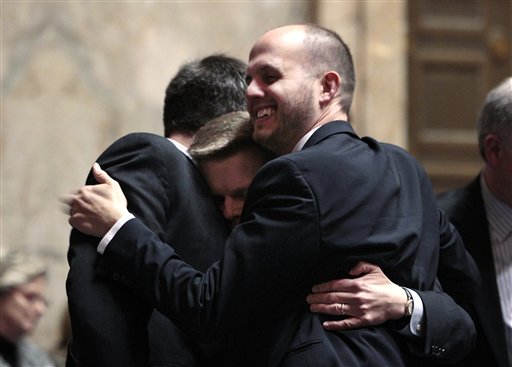
(Reuters) – A bill to legalize gay marriage in Washington state won final legislative approval on Wednesday in a largely party-line vote that moved the state to the cusp of becoming the seventh in the nation to recognize same-sex nuptials.

Washington’s Democratic Governor Christine Gregoire said she looked forward to signing the measure and “putting into law an end to an era of discrimination” even as opponents, led by religious conservatives, vowed to seek its repeal at the polls in November.

The approval in the state House of Representatives came a day after gay marriage advocates won a key legal victory in California when a federal appeals court declared a voter-approved gay marriage ban in that state unconstitutional.

The Washington legislation cleared the state House of Representatives by a vote of 55-43, a week after the state Senate passed it by a 28-21 vote. Democrats, accounting for the lion’s share of support for the bill, control both legislative bodies in Olympia.

Several prominent Washington-based companies employing tens of thousands of workers in the state also endorsed the bill, including Microsoft, Amazon and Starbucks.

Supporters of same-sex marriage are pushing similar statutes in Maryland and New Jersey, and a referendum to legalize gay marriage in Maine has qualified for the November ballot there.

Six other states already recognize gay marriage — New York, Massachusetts, Connecticut, Vermont, New Hampshire and Iowa — as does the District of Columbia.

But neither Tuesday’s legal ruling in San Francisco nor the statehouse action in Olympia will immediately alter the status quo for gay couples. The outcome of the court challenge in California is likely to remain stayed until the appeals process finishes running its course, and the Washington state measure cannot go into effect before early June.

HEATED DEBATE

Wednesday’s floor action began with lawmakers quickly rejecting a series of amendments, most of them relatively technical in nature, that would have slowed the bill’s momentum by forcing it back to the Senate for further consideration.

Debate grew emotional at times, with the bill’s chief House sponsor, Representative Jamie Pedersen, a Democrat who has four young children with his gay companion of 10 years, arguing that the state’s domestic-partnership law falls short.

“I would like our four children to understand … that their daddy and their papa have made that lifelong commitment to each other,” he said. “Thousands of same-sex couples in our state deserve the respect and protection from our government that only marriage can convey.”

Representative Jay Rodne, a Republican who said he was guided by his Roman Catholic faith to oppose gay marriage, decried the bill as tantamount to “progressive reengineering in its most extreme and damaging form.”

“This bill is about validation. This bill is about acceptance … Marriage is not about self-actualization, validation or acceptance,” he said. “Marriage is about life.”

In the end, two Republicans joined 53 Democrats in voting for the bill in the House, while two Democrats sided with 41 Republicans in opposition. It passed unchanged from its Senate version.

Gregoire, in a statement issued after the vote, said Washington state would “no longer deny our citizens the opportunity to marry the person they love.”

“We tell every child of same-sex couples that their family is every bit as equal and important as all other families in our state,” she said.

VALENTINE’S DAY

The bill is to be formally delivered to the governor’s desk by week’s end, and Gregoire will then have five days to sign it, not including Sunday. Aides said enactment was expected to come on or before next Tuesday, Valentine’s Day. Still, the measure would not take effect before June 7, three months after the conclusion of the legislative session.

In the meantime, opponents of same-sex matrimony said they would seek to overturn the legislation via one of two ballot measures — a referendum for repeal or an initiative defining marriage as the exclusive domain of heterosexual couples.

The initiative would need 241,153 signatures of registered voters by July 6 to secure a place on the November ballot. A repeal would need just half the number of signatures by June 6.

If a repeal referendum qualifies for the November ballot, the gay marriage law would be suspended until the election and certification of returns, meaning December 6, before it is either repealed or goes into effect.

One amendment rejected in both the Senate and House would have submitted the issue directly to voters in a referendum, bypassing the need for a petition.

Also left unchanged were provisions allowing gay couples from out of state to get married in Washington and permitting religious organizations to refuse to rent out their chapels or other facilities as venues for same-sex weddings.

Should gay marriage opponents pursue an initiative to define matrimony as being restricted to one man and one woman, gay marriages under the newly passed statute could proceed on June 7, regardless of ballot-qualification efforts.

But it was unclear whether gay weddings performed in the interim would be nullified if an initiative restricting marriage to male-female unions were to pass in November.

There is precedent in California for handling such a situation. California’s Supreme Court legalized gay marriage in 2008, only to see voters approve a state constitutional amendment banning same-sex matrimony six months later.

The state’s high court later upheld the gay marriage ban, known as Proposition 8, but ruled that 18,000 same-sex weddings officiated between May and November 2008 were still legal.

A federal judge later ruled Prop 8 unconstitutional, a decision upheld on Tuesday by the 9th U.S. Circuit Court of Appeals.

Legal experts said that ruling, while narrowly tailored to California, could ease the way for a successful court challenge in Washington state should voters ban gay marriage at the polls.