Scottish nationalists were on course for a landslide win north of the border in Britain’s national election, obliterating their opponents and setting the stage for a new battle over independence.
Early wins for the Scottish National Party (SNP) included the ousting of the leader of the Labour party in Scotland, the defeat of a senior Labour figure in Paisley and taking former Prime Minister Gordon Brown’s onetime stronghold in Kirkcaldy.
“There’s a lion is roaring in Scotland tonight; a Scottish Lion. I don’t think any government of any political complexion is going to be able to ignore it,” former SNP leader Alex Salmond said as he awaited results in the Gordon constituency he is tipped to win.
But the SNP could still be shut out of any role in the British government, a scenario likely to bring a new confrontation over Scottish aspirations for independence.
An exit poll showed Prime Minister David Cameron’s Conservatives were on course to win the most seats in parliament with 316, just shy of an outright majority, with Ed Miliband’s Labour Party trailing on 239.
If confirmed, such an outcome would deny the SNP the kingmaker role it had sought in the House of Commons and kill off the prospect of a leftist alliance with Labour to force Cameron out of office.
But it would dramatically highlight the political divide between England and Scotland.
In a stunning victory for the SNP, Labour’s Douglas Alexander — the shadow foreign secretary and campaign co-ordinator — lost to a 20-year-old politics student, Mhairi Black by nearly 6,000 votes.
Black becomes the youngest British Member of Parliament since the 19th Century.
The leader of the Labour Party in Scotland, Jim Murphy, also lost his seat to the SNP.
Other early results from Scotland gave victory to the SNP in 26 seats, heralding a huge sweep of Scottish seats for the SNP, which won just 6 seats in 2010.
“This is history written as we watch and speak. We have never seen swings of this magnitude in any British election,” said Murray Stewart Leith, senior lecturer in politics at the University of West Scotland.
“It has serious implications for the United Kingdom as a political union. Whatever government is formed after this election will need to seriously consider its constitutional structure.”
SNP leader Nicola Sturgeon said in Glasgow the results showed a historic shift in opinion in Scotland.
“We said during the campaign that the SNP MPs would be elected to make Scotland’s voice heard, and that’s exactly what we intend to do,” she said.
The results could bolster Scots to push for a new referendum on independence after separatists lost one last September.
As the eurozone crisis continues, anti-establishment insurgencies like the Scottish National Party, SNP’s, are surfacing all over Europe: nationalist, populist, separatist, left or right.
As the British empire was gradually dissolved after the second world war and its industrial base attacked by younger, nimbler economies, the cohesion of the British state weakened.
There was an impulse towards supra-nationalism in the shape of membership in the European Union, but Britain joined late, in 1973.
English people – steeped in Britain’s maritime, imperial traditions – felt hostile towards the EU.
At the same time, long-smothered regional nationalism was reviving on Britain’s Celtic fringes. In divided Ireland, it was violent; in Scotland, political, emboldened by newly discovered North Sea oil; in Wales, initially, cultural, based around the preservation of the Welsh language.
That was in the 70s. Forty years on, these rival strands are much stronger, and testing the concept of “Britishness” to destruction.
The Scottish national party has barely paused for breath since losing last September’s referendum on independence for Scotland – immediately declaring itself the moral victor and demanding greater powers for Edinburgh.
Since the referendum result – 55% no, 45% yes – disaffected working-class Labour voters have flocked to the SNP. Polls suggest the Scottish nationalists, now led by Scotland’s new first minister, the formidable Nicola Sturgeon, will slaughter Labour north of the border, winning dozens of Scotland’s 59 seats and perhaps holding the balance of power in London. If she finds herself in that position, Sturgeon promises to block Cameron and prop up a minority Miliband administration.
Britain’s Tory newspapers are busy denouncing Sturgeon as “the most dangerous woman” in the country. Cameron – whose Tories have only one seat in Scotland – warns of a Scottish veto from the people who want to break up Britain. Miliband is embarrassed.
Meanwhile, in England, the populist anti-European right, in the form of the UK independence party (Ukip), has evolved under the skilful leadership of Nigel Farage.
Ukip’s proven ability to win protest votes at four-yearly elections to the 28-nation European parliament is now threatening the status quo at Westminster. It has two MPs (both defectors from the Tories) and hopes to win more on 7 May.
If that sounds familiar, it should. Though Ukip portrays itself as free market and libertarian, it is also deeply nostalgic, socially conservative, and suspicious of immigrants and big-government bureaucracy, especially from the EU’s Brussels headquarters.
Racist, homophobic and authoritarian? Certainly not, says Farage. We just want to be a self-governing sovereign state again. But Ukip’s “little guy” rank-and-file is not always quite so on-message. This is disruptive Tea Party Republicanism with added potency.
Ukip’s threat to the status quo is twofold. It may take enough votes away from Cameron’s Tories to deny the prime minister his slim hopes of a Commons majority on May 7, or even to stop him being the largest party, which would make it hard for him to form another coalition.
In a tight race, with both main parties polling at around 34%, Ukip’s rise may also hurt Miliband’s prospects by peeling off Labour’s equivalent of blue-collar Democrats, working-class voters fed up with stagnant wages and gay marriage, underfunded public services and “unpatriotic” liberals.
It is important to understand that US interests are fundamentally different from those of Europeans, Lena Lio, a former Swiss politician and diplomat, expert on Russian studies, told the newspaper 24 Heures.
The instability in Eastern Europe is beneficial for Washington, as the ongoing conflict in Ukraine will lead to a weak Europe, implying also that mostly white nations will suffer the consequences.
The weak Europe, in turn, cannot pose an economic threat or political competition to the United States. That is one reason why Washington passionately hates “nationalists”, the real backbone of the EU.
If Europe manages to solve its internal problems, it will be a dangerous challenger for the US hegemony, Lio said.
Unable to remain the top dog in international politics, the United States deliberately destabilizes its potential competitors by creating conflicts and fueling existing disputes.
The United States is losing its dominance in the international arena and that is why Washington deliberately tries to destabilize and crush any potential competition.
Most Americans now see Russia – ahead of North Korea, China and Iran – as the US’s public enemy number one and the greatest threat to the US due to a relentless demonization campaign. Americans regard Europeans as “appeasers”.
But the EU has no energy security in the Middle East and North Africa, and without their reliable partner Russia, will have no energy security at all.
The United States can thus no longer remain the only hegemon in the world, the position it has become so used to since the fall of the Berlin Wall and the end of Cold War.
Therefore, unable to stay on the top, the United States uses aggressive style of conducting politics by deliberately damaging relations between other countries, such as fueling disputes between China and Japan, destabilizing Eastern Europe by supporting the conflict in Ukraine, artificially driving down global oil prices and damaging the Russian economy by imposing economic sanctions, said the former Swiss diplomat.
NATO in Europe embodies the ultimate geopolitical existential paradox; an alliance that exists to manage the chaos it perpetuates.
Comedian John Oliver’s efforts to take down India’s newly elected prime minister, Narendra Modi, has come to naught.
Time magazine in its annual TIME’s Person of the Year 2014 survey has just come up with Narendra Modi as the winner.
Oliver, much tweeted and adored by Cultural Marxists and Boerhaters in South Africa after his efforts to smear Afrikaners as all being white racists and thus deserving of ethnic cleansing, did not hesitate to indulge in a racist diatribe against Indians.
The rising tide of farm killings targeting white Afrikaners, and noted by organisations such as Genocide Watch, must have worried British-born Oliver enough to warrant a whole show justifying the killing spree.
The Prime Minister of India is currently toppling the 2013’s top contestant, Abdel Fattah al-Sisi, the Egyptian President, despite Oliver’s best try to make Modi and all Indians look ridiculous.
After Modi quoted the famous Star Wars line, “May the force be with you,” in his speech in Central Park, with Wolverine (aka Hugh Jackman) by his side, Americans were smitten.
Modi had been banned from entering the US in 2005, for purportedly failing to intervene as chief minister of Gujarat state during 2002 riots in which Hindu mobs attacked minority Muslims.
According to the International Religious Freedom Act, which the US Congress passed in 1998, “foreign officials responsible for “severe violations of religious freedom” aren’t eligible for visas. Indian courts have since cleared Hindu-nationalist Modi of wrongdoing.
A recent survey by the National Council of Applied Economic Research and the University of Maryland, United States, spanning 42,000 households has found that 25% of Indians practiced caste untouchability in some form. This, despite the Constitution having banned the practice 64 years ago.
By caste-groups, Brahmins topped the list with 27% admitting to it, followed by non-Brahmin forward castes (25%) followed by other backward classes (33%).
By religions, Hindus were the biggest believers in the system (30%). The findings also found that the practice was most common in the Hindi heartland of the country, with more than 45% of the respondents from Madhya Pradesh, Himachal Pradesh, Chhattisgarh, Rajasthan and Bihar owning up to the practice.
Leaders of the Flemish nationalists in Belgium, the Catalans in Spain and Italy’s Venetians said they still have momentum on their side, despite the ‘No’ vote in Scotland.
“Whether it was a ‘no’ or a ’yes’ vote, the main thing is that the process has started,” Gerolf Annemans, leader of the Vlaams Belang, or Flemish Interest party, said in an a phone interview. “You can’t say this is a clear vote for unity. The process of autonomy and national identity can’t be stopped.”
Separatists across Europe that had been energized by the Scottish nationalists’ push for independence were drawing breath today after voters opted to remain with the U.K. by about 10 percentage points. That leaves the Catalans as the most likely candidate to test EU leaders’ insistence that newly independent states will have to reapply for membership and face a period in the wilderness before reclaiming its full rights.
European Commission President Jose Manuel Barroso, Spanish Prime Minister Mariano Rajoy and German Foreign Minister Frank-Walter Steinmeier all welcomed the vote, which shores up the constitutional status quo in the 28-member bloc.
“I think this is a good decision for Scotland, Great Britain and Europe,” Steinmeier said in a statement.
Roger Albinyana, head of the foreign affairs department of the Catalan regional government, said in an interview with Bloomberg Television today that his movement is still determined to hold a referendum, despite the opposition of the national government in Madrid.
“There is a strong determination from the Catalan people,” Albinyana said. “We’ll do our best to hold that vote.”
Rajoy — who today said Scotland had avoided “grave social, economic, institutional, political consequences” of a split — has pledged to prevent Catalans voting on independence from Spain in a ballot Regional President Artur Mas has penciled in for November. The Catalan Parliament is set to approve the legal framework for the referendum today and Mas’s allies are urging him to defy the legal threats from the central government.
Mas today told reporters in Barcelona that Catalonia will push on with its independence referendum, and that a vote is the only way to resolve conflicts between Catalonia and the rest of Spain.
Gianluca Busato, who organized an unofficial referendum in March that called for independence of the Veneto region in northeast Italy, said economic arguments appeared to have won out in Scotland, the exact same reason why he said his region will eventually choose independence.
What the Catalans do regarding independence will likely have an impact on Spain’s Basques, who already have some autonomy.
The Basque region on the border between Spain and France has long sought independence. Around 150,000 Basques formed a 123km-long human chain on June 8 in a “Right to Decide” event.
The organizers of the Veneto vote said 2.36 million people voted in March, with 89 percent approving independence. Busato said Scotland’s experience shows the need for a more professionally prepared referendum next time.
“The oppressive fiscal transfers from Veneto to the rest of Italy are apparent for all to see,” Busato said in a phone interview. “For the Scottish, independence may have appeared more of a gamble.’
Twm Morys was boiling carrots for his children when he momentarily stopped to recite a 15th-century battle chant in Welsh. Beating out the guttural consonants with a stave on his kitchen floor until they rang in every last corner of his farmhouse, Mr. Morys, a well-known poet, said it was time to put “fire in the belly” of his people.
He is not the only one. In the ancient mountains towering above this coastal town in northern Wales, where eight in 10 people speak the native Celtic tongue, and many carry names their fellow Britons would not dare pronounce, Welsh nationalists have their eyes firmly set on independence — Scottish independence.
Less than a month before Scotland holds a referendum on whether to leave Britain, Wales is watching with a mix of envy, excitement and trepidation.
Leanne Wood, leader of Wales’s nationalist party Plaid Cymru, in Penygraig, Wales. “The tectonic plates of the United Kingdom are shifting,” she said.
“If Scotland votes yes, the genie is out of the bottle,” said Leanne Wood, leader of Wales’s nationalist party Plaid Cymru. Only one in 10 Welsh voters supports independence, compared with about four in 10 in Scotland, but Ms. Wood thinks that could change. “The tectonic plates of the United Kingdom are shifting,” she said.
Tremors from the Scottish debate can already be felt across Britain. Whatever happens on Sept. 18, growing demands for more regional autonomy will reshape the country. In Northern Ireland, nationalists spy an opportunity to revive dreams of a united Ireland. Cornwall recently won minority status for its Celtic inhabitants. Even the long-neglected north of England has turned up the volume, questioning an ever greater concentration of wealth in London and the southeast.
But in Wales, perhaps more than anywhere else, nationalists have made the Scottish independence bid their own in the hope that it will stir passions at home — if not for full independence, at least for more self-government.
Ms. Wood, who was once expelled from a legislative debate for referring to Queen Elizabeth II as “Mrs. Windsor,” has been to Scotland twice in support of the Yes campaign and plans to go again. The Welsh Hollywood actor Rhys Ifans has joined the #goforitScotland campaign. And Adam Price, an entrepreneur and prominent pro-independence thinker, has been campaigning in Scotland from a caravan, Welsh-style. “Caravaning for independence,” he calls it.
Others, like Mr. Morys, will gather in the Welsh capital, Cardiff, the week before the referendum for a series of performances to “whip up some Welsh enthusiasm,” stave in hand.
Wales and Scotland have much in common — not least an unfailing loyalty to any sporting side that plays against England, their once mighty and still dominant neighbor.
Ever since Margaret Thatcher, the conservative prime minister, shut their heavy industries, Scottish and Welsh voters have cast their ballot to the left of the English. There is, said Peter Florence, director of Wales’s Hay literary festival, a shared sense of not being represented in Westminster.
But Wales is smaller and poorer than Scotland. It has no oil to make up for the subsidies from London currently sustaining its public services. “We’re a hundred years too late,” Mr. Florence lamented, referring to the Welsh coal riches that once fired Britain’s industrial revolution. If he were Scottish, he would vote for independence, he said. “But we simply cannot afford it.”
Gerald Holtham, one of Wales’s most prominent economists, has done the math: Total government spending for Wales is 30 billion pounds a year, or about $50 billion, and tax receipts come to 17 billion pounds. “We’re talking about a gap a quarter the size of the economy,” he said.
Nationalists retort that Wales can escape poverty only if it takes charge of its own destiny. “No nation has ever ruled another well,” said Mr. Price, a former lawmaker who set up a technology company in Wales. “We are poor because we are not independent, rather than the other way round.”
But even he conceded that the time for Welsh independence has not come. First, he said, “We have to learn to be a nation again.”
Unlike Scotland, whose Parliament voted to join England three centuries ago, Wales was conquered in 1282. The Scots kept their own legal system, schools, universities, church and, with it all, a strong civic identity distinct from England’s. Welsh institutions were swallowed whole; the Welsh dragon, which flutters proudly and ubiquitously on the high street in Caernarfon, is nowhere to be seen in the Union Jack.
“We were England’s first colony,” said Eirian James, owner of Palas Print, a local bookstore with mainly Welsh-language fare. Every time she visits relatives in southern Wales, she has to take a train through England. To this day, most transport links run from west to east, toward England, rather than along Wales’s north-south axis.
The Welsh tourism board proudly promotes the fact that there are more castles per square mile in Wales than anywhere else. For locals, those castles are another reminder of early occupation.
Caernarfon Castle, up the street from Palas Print, was built by Edward I of England who killed Llewellyn, the last native prince of Wales, and declared his own firstborn son the Prince of Wales. That tradition still grates with some Welsh people. When Prince Charles was invested in Caernarfon Castle in 1969, militants tried to blow up his train. The local poet Gerallt Lloyd Owen recorded both events in popular poems. He died this summer, and donations made in his memory are going to Scotland’s Yes campaign.
Poetry may not be the political weapon of choice elsewhere, but in Wales, home to the Eisteddfod, a sort of cultural Olympiad whose history can be traced to 1176, national grievances often find their way into verse.
As Jerry Hunter, a professor at Bangor University, said, “Where else have you got thousands of people crowding into a pavilion watching the results of a poetry contest?”
When the Welsh-speaking village Capel Celyn was flooded in 1965 to create a water reservoir for Liverpool, England, despite unanimous opposition from Welsh lawmakers, it spawned songs and graffiti art and gave Plaid Cymru its first significant boost.
Stemming the decline in the Welsh language — just under one in five Welsh people speaks Cymraeg — is the greatest triumph of Welsh nationalism, but it is also a handicap: It has divided a country of three million between those, mainly in the rural north and west, who speak it, and those in the more urban south and east who don’t, reducing Plaid Cymru in the eyes of many to a mere language-lobbying group.
Many still grumble about a Welsh-speaking cabal — the Taffia, after the Welsh River Taff — holding the best jobs, the most influence and a greater claim to Welshness. But hostility toward the language has been fading, and the Welsh appetite for more self-government has grown — with a little help from Scotland.
In a 1979 referendum, eight in 10 Welsh voters opposed any kind of autonomy from London.
But in 1997, after Scotland voted to have its own Parliament, the tiniest majority of Welsh voters followed suit and approved the creation of a more modest Welsh assembly. By 2011, two in three of those voters wanted to extend the assembly’s lawmaking powers.
“That’s a bigger swing in public opinion over 30 years than in Scotland,” said Richard Wyn Jones of Cardiff University.
Some bank on a Scottish yes vote to accelerate that process. Others say a narrow no vote would be a better result for the Welsh: Once mocked in Whitehall circles as Scotland’s “smaller, uglier sister,” Wales may have more leverage with a Scottish ally inside the union.
But Mr. Jones says Wales will end up more autonomous irrespective of what happens in Scotland.
“Independence may look unlikely right now,” he said. “But who in 1979 would have dared imagine a devolved Wales looking on as Scotland prepares an independence referendum?” – New York Times
EU, US exploiting nationalism to fend off Russia in Ukraine
Ukraine’s opposition will march on parliament to pressure lawmakers struggling to end a deadly three-month political standoff, jeopardizing compromises that eased tensions over the past week.
Vitali Klitschko, a former boxing champion and EU man, and Arseniy Yatsenyuk, a lawmaker and former central banker, plan to lead thousands of demonstrators today on the first mass action outside their Independence Square compound since Jan. 19, when the last attempt to reach parliament erupted in clashes with police.
“If politicians don’t make a decision, we the people will,” Serhiy, a 23-year-old from the Lviv region near Poland, said inside the encampment, wearing camouflage and a bulletproof vest adorned with a paper “self defense” badge. “We’ve had enough. We’re fighters. We haven’t come here to listen to talks. If we decide to act, we’ll act.”
The standoff began Nov. 21, when Yanukovych pulled out of a free-trade deal with the EU, opting instead for President Vladimir Putin’s offer of $15 billion of aid and cheaper gas.
Russia, which stopped buying bonds from Ukraine’s cash-strapped government after Yanukovych’s Russian-born prime minister, Mykola Azarov, resigned on Jan. 28, said yesterday it will resume purchases, including $2 billion this week. Russian Finance Minister Anton Siluanov made the announcement just as Klitschko and Yatsenyuk were meeting with German Chancellor Angela Merkel in Berlin to seek financial and political backing to form a new government.
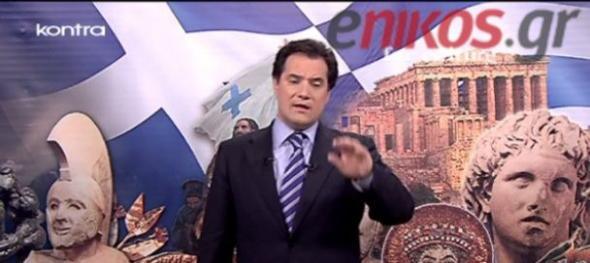
Adonis Georgiadis – Health Minister of Greece – during his TV show ‘Greek Awakening’
Greece’s Health Minister nationalist Adonis Georgiadis has a history of remarks about Jews and has promoted anti-Semitic book.
The Anti-Defamation League expressed concern on Friday over the appointment of Adonis Georgiadis as Greece’s Health Minister, due to a history of troubling remarks about Jews and his public promotion of an anti-Semitic book.
According to reports, Georgiadis has said in the past that “all major banks belong to the Jews” and that “the Jewish lobby” would determine the fate of Greece’s foreign debt. He has also promoted an anti-Semitic diatribe called “The Jews, the whole truth” written by Konstantinos Plevris, a prominent author and self-proclaimed anti-Semite.
“At a time when anti-Semitic speech and Holocaust denial continue to occur regularly in public and political discourse in Greece and as Golden Dawn’s leaders openly espouse anti-Semitism to stoke hatred and fear while their party is rising in popularity, the elevation of a politician who is also known to have promoted anti-Semitism is troubling,” said Abraham H. Foxman, the ADL’s national director. “Our concern is heightened by the ongoing failure to enact a stringent anti-racism bill despite the government’s public commitment to do so.”… – Haaretz
This website uses cookies to improve your experience. We'll assume you're ok with this, but you can opt-out if you wish. Cookie settingsACCEPT
Privacy & Cookies Policy
Privacy Overview
This website uses cookies to improve your experience while you navigate through the website. Out of these cookies, the cookies that are categorized as necessary are stored on your browser as they are essential for the working of basic functionalities of the website. We also use third-party cookies that help us analyze and understand how you use this website. These cookies will be stored in your browser only with your consent. You also have the option to opt-out of these cookies. But opting out of some of these cookies may have an effect on your browsing experience.
Necessary cookies are absolutely essential for the website to function properly. This category only includes cookies that ensures basic functionalities and security features of the website. These cookies do not store any personal information.
Any cookies that may not be particularly necessary for the website to function and is used specifically to collect user personal data via analytics, ads, other embedded contents are termed as non-necessary cookies. It is mandatory to procure user consent prior to running these cookies on your website.