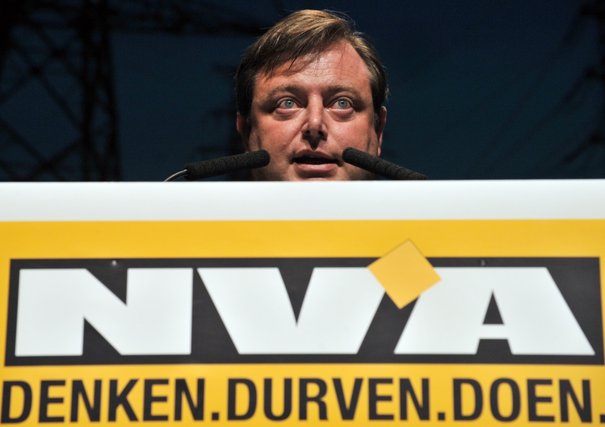
Antwerp mayor receives death threats from Jihadists

Islamic extremists in Belgium have publicly threatened to kill the mayor of the Belgian city of Antwerp, Bart De Wever, if he does not convert to Islam, local media reported Monday.

A sign written in French stating threats against de Wever, who is also the head of the nationalist political party the New Flemish Alliance, was placed on one of the main squares of Antwerp. Experts are currently assessing the seriousness of the action and the message.

“I always warned that we will not get rid of the threat from Islamic extremists in the near future. This was ignored for years. This wound became apparent now with [the current developments in] Syria and will fester for a long time before we will get rid of it,” de Wever said.

Throughout his political career, De Wever has repeatedly received threats. The Belgian government has provided him with security guards at state expense.

In the light of advance of the Islamic State (ISIL) terrorist group in the Middle East and a number of ISIL-inspired terrorist attacks in Europe, the European Union has currently seeing a surge in anti-Islamization sentiment.

According to September 2014 statistics from Belgium’s Ministry of Interior, between 300 and 350 Belgians have gone to fight alongside the ISIL in Iraq and Syria since 2012.

Source: Sputniksnews

Belgians ignore EU sanctions against Moscow

Belgian companies continue expanding their businesses in Russia despite the sanctions imposed by the West against Moscow over its alleged involvement in the Ukrainian conflict, Russian Foreign Ministry spokesman Alexander Lukashevich told RIA Novosti in an interview.

“Despite the unfavorable conjuncture, Belgian companies haven’t frozen their projects in Russia, and even continue to develop their businesses,” Lukashevich said.

Both, Russian and Belgian companies express unflagging interest in future cooperation, Lukashevich said.“Even given the counterproductive European Union policy of maintaining sanctions against Russia, the business circles of the two countries continue expressing unflagging mutual interest in increasing bilateral cooperation,” he stated.

The Foreign Ministry’s representative said that some 35 Belgian companies are currently implementing their projects in Russia.

Lukashevich cited an example when in March 2014, Belgian Fluxys and Russia’s Yamaltrade signed a 20-year agreement to organize the transit of up to 8.8 billion tons of Yamal liquefied natural gas per year through the Port of Zeebruge.

Since 2014, the United States, the European Union, and their allies have imposed several rounds of economic sanctions against Moscow, citing the Kremlin’s alleged involvement in Ukraine’s internal affairs. Russia has repeatedly denied the accusations, adding that the sanctions policy is ineffective and counterproductive.

Several European companies that have been successful in the Russian market have also expressed their disappointment with the anti-Russia sanctions, saying that the measures hinder their businesses.

Battlelines drawn for independence

Leaders of the Flemish nationalists in Belgium, the Catalans in Spain and Italy’s Venetians said they still have momentum on their side, despite the ‘No’ vote in Scotland.

“Whether it was a ‘no’ or a ’yes’ vote, the main thing is that the process has started,” Gerolf Annemans, leader of the Vlaams Belang, or Flemish Interest party, said in an a phone interview. “You can’t say this is a clear vote for unity. The process of autonomy and national identity can’t be stopped.”

Separatists across Europe that had been energized by the Scottish nationalists’ push for independence were drawing breath today after voters opted to remain with the U.K. by about 10 percentage points. That leaves the Catalans as the most likely candidate to test EU leaders’ insistence that newly independent states will have to reapply for membership and face a period in the wilderness before reclaiming its full rights.

European Commission President Jose Manuel Barroso, Spanish Prime Minister Mariano Rajoy and German Foreign Minister Frank-Walter Steinmeier all welcomed the vote, which shores up the constitutional status quo in the 28-member bloc.

“I think this is a good decision for Scotland, Great Britain and Europe,” Steinmeier said in a statement.

Roger Albinyana, head of the foreign affairs department of the Catalan regional government, said in an interview with Bloomberg Television today that his movement is still determined to hold a referendum, despite the opposition of the national government in Madrid.

“There is a strong determination from the Catalan people,” Albinyana said. “We’ll do our best to hold that vote.”

Rajoy — who today said Scotland had avoided “grave social, economic, institutional, political consequences” of a split — has pledged to prevent Catalans voting on independence from Spain in a ballot Regional President Artur Mas has penciled in for November. The Catalan Parliament is set to approve the legal framework for the referendum today and Mas’s allies are urging him to defy the legal threats from the central government.

Mas today told reporters in Barcelona that Catalonia will push on with its independence referendum, and that a vote is the only way to resolve conflicts between Catalonia and the rest of Spain.

Gianluca Busato, who organized an unofficial referendum in March that called for independence of the Veneto region in northeast Italy, said economic arguments appeared to have won out in Scotland, the exact same reason why he said his region will eventually choose independence.

What the Catalans do regarding independence will likely have an impact on Spain’s Basques, who already have some autonomy.

The Basque region on the border between Spain and France has long sought independence. Around 150,000 Basques formed a 123km-long human chain on June 8 in a “Right to Decide” event.

The organizers of the Veneto vote said 2.36 million people voted in March, with 89 percent approving independence. Busato said Scotland’s experience shows the need for a more professionally prepared referendum next time.

“The oppressive fiscal transfers from Veneto to the rest of Italy are apparent for all to see,” Busato said in a phone interview. “For the Scottish, independence may have appeared more of a gamble.’

Source: Bloomberg

Vlaams Belang following in Scotland’s footsteps

An independent Flanders with Brussels as its capital will be best for the Flemish people who represent 60 percent of the Belgium population, and provide 80 percent of its economy, Flemish MP Tom van Grieken told RT.

Following in the footsteps of Scotland, Veneto in Italy and Catalonia in Spain, and Belgium’s Flemish region may become the next to hold a referendum on independence. The Flanders area of northern Belgium has been claiming its own sovereignty for years, and if it succeeds, Belgium may be no more, along with its being the symbol of a united Europe.

The 2008 financial crisis has boosted separatism movements in Europe, with rich and developed regions in a number of countries starting to voice their discontent with policies from the capital, and the necessity to feed economically weak regions. However, for such Scotland, Catalonia and Flanders it is also a question rooted in the history of the formation of the countries they belong to.

Dutch-speaking Flanders and French-speaking Wallonia have always been rich and well-developed regions, connected to each other despite language and cultural differences. The artificial creation of the Belgian state put these nations into a difficult situation, forcing them to coexist with people they don’t feel any connections with. Meanwhile, Scotland’s independence vote has inspired the Flemish people with hope to finally create their own state.

RT: Why does your party Vlaams Belang (“Flemish Interest”) support independence of Flanders?

Tom van Grieken: We are the only party in Belgium who are for Flemish independence. We think Belgium is dead, it is from the beginning in 1830 an artificial state, where two different people are forced to live together. Although we are only 60 percent of the population of Belgium, we produce 80 percent of our economy. Independent Flanders with Brussels as its capital will be the best for the Flemish people.

RT: The world’s attention is now chained to the Scottish referendum. After this vote we expect Catalonia to follow the same path. If Flanders was to hold a referendum, what results do you foresee?

TG: The importance of holding a referendum – it’s not the result which is important. The public debate concerning becoming independent is also important. In my country there is almost no debate on public television about independence, although the population really wants it. For example, in Scotland whether it is “yes” or “no” vote when the referendum results are made public, they already have their victory simply by having a public debate about independence of the people.

RT: Is it mostly for political reasons that the Flemish people seek independence? Does Flanders want to take decisions on its own?

TG: Of course it’s not our main purpose. The economic part is also very important. Like I have already said, 60 percent of the population of Belgium is Dutch-speaking, Flemish-speaking and they produce 80 percent. Also there are differences between cultures – the Flemish culture is completely different [from] the French culture in the south. We also have different political views: [in] the south [people] are all socialists, social-democrats and the North Flemish part votes for the right and center-right. It would be the best democratic solution to split up Belgium.

RT: Do you think in case of “yes” vote Flanders, Catalonia and Veneto will be able to survive?

TG: Of course. Small nation-states can produce easier answers to the difficult questions we all face in Europe. Flanders will not be smaller than independent Ireland or Denmark, or Estonia, or Lithuania. We would be a full-grown nation-state in the heart of Europe.

RT: How do you see the development of the situation?

TG: I think it will be like in a marriage. At the moment we are always fighting in every discussion but we should divorce, split up and become good friends, good neighbors. I think it will be our first economic partner to work together with but it’s better to become good friends than stay together in a bad marriage.

RT: What are the reasons for a marriage to become bad? And what makes bad neighbors?

TG: What makes bad neighbors? Of course it’s not something among individuals. As you know, my country, Belgium, where I’m forced to live in, holds the world’s record for days without government because we don’t agree on anything. Every political discussion has an aspect which Flemish and Wallonia people disagree on. So it would be better not only for Flanders but also for my French friends in the south.

RT: Do you think a referendum is needed?

TG: Yes, of course. We are the only independence party in Belgium. I think referendum is a good thing because if you are afraid of the opinion of your people, then you are not ready to be a leader of your people. So I think we need also in Belgium a referendum concerning the Flemish independence.

Source: RT

Landslide victory for Flemish nationalists

Bart de Wever

Flemish nationalists made sweeping gains across northern Belgium in local elections on Sunday, a success that will bolster separatists’ hopes for a break-up of the country.

Bart de Wever, leader of the New Flemish Alliance (NVA), is set to become mayor of the northern city of Antwerp, Belgium’s economic heartland, after his party emerged as the largest one ending about 90 years of socialist rule.

Soon after the ballot results emerged, Mr De Wever, who had turned the tough mayoral race into a referendum on Flander’s independence for Belgium, demanded that the country’s prime minister give greater independence to the Dutch-speaking north.

“De Wever sent a strong signal to Brussels and he has put his party on course to send an even clearer one in 2014 … they will try to go for an even bigger win in the federal elections,” said a veteran political analyst for the Gazet Van Antwerpen.

“We want to give Flemish people the government they want at all levels. That is why I call on Elio Di Rupo and the francophone politicians. Take up your responsibility,” said De Wever.

The strong result recorded by the Flemish nationalists is likely to have an impact across Europe, where the sovereign debt crisis, which has seen rich countries bail out poor ones, has revived separatist sentiment throughout the continent.

Flanders, which is the most economically prosperous region of Belgium, has long resented financing the ailing economy of French-speaking Wallonia, and Sunday’s victory will strengthen their demand for self-rule.

Lieven De Winter, a political scientist at Université Catholique de Louvain, said that Mr De Wever’s victory was a clear step forward for separatist who had long been campaigning for secession from the southern part of the country. However, he warned that the process towards accomplishing a break-up would be wrath of problems.

“There is no doubt that tonight De Wever made a small step towards completing his dream of a break-up but there are many obstacles ahead … at the end of the day you need two to tango,” Mr De Winter said.

NVA won about 38 per cent of votes in Antwerp against about 28 per cent secured by the Socialists, according to provisional Flanders government data. Meanwhile, in the rest of the northern region the Flemish nationalists won more than 30 per cent of support.

NVA is expected to seek the support of the Socialists to run Antwerp – in Belgium it is common for opposing parties to form a coalition after elections as no one party enjoys an outright majority throughout the country.

Belgium consists of Dutch-speaking Flanders, francophone Wallonia and Brussels, its bilingual capital. The Socialists have tried to keep Brussels French through Arab immigration. Political powers have already been devolved to regional governments, Flanders, in more populous with about 6m people compared with 3.5m in Wallonia.

NVA’s victory in Antwerp and strong result across the north of Belgium will give good momentum to the separatists in the run-up to the key federal elections in 2014, said analysts. – FT