Belgian companies continue expanding their businesses in Russia despite the sanctions imposed by the West against Moscow over its alleged involvement in the Ukrainian conflict, Russian Foreign Ministry spokesman Alexander Lukashevich told RIA Novosti in an interview.
“Despite the unfavorable conjuncture, Belgian companies haven’t frozen their projects in Russia, and even continue to develop their businesses,” Lukashevich said.
Both, Russian and Belgian companies express unflagging interest in future cooperation, Lukashevich said.“Even given the counterproductive European Union policy of maintaining sanctions against Russia, the business circles of the two countries continue expressing unflagging mutual interest in increasing bilateral cooperation,” he stated.
The Foreign Ministry’s representative said that some 35 Belgian companies are currently implementing their projects in Russia.
Lukashevich cited an example when in March 2014, Belgian Fluxys and Russia’s Yamaltrade signed a 20-year agreement to organize the transit of up to 8.8 billion tons of Yamal liquefied natural gas per year through the Port of Zeebruge.
Since 2014, the United States, the European Union, and their allies have imposed several rounds of economic sanctions against Moscow, citing the Kremlin’s alleged involvement in Ukraine’s internal affairs. Russia has repeatedly denied the accusations, adding that the sanctions policy is ineffective and counterproductive.
Several European companies that have been successful in the Russian market have also expressed their disappointment with the anti-Russia sanctions, saying that the measures hinder their businesses.
Representatives of about a dozen “far-right” groups from across Europe gathered in Russia Sunday for a pro-Kremlin conference as concern grows over Moscow’s alleged attempts to court “extremists” on the continent.
About 150 members of Russian nationalist and right-wing European parties — including Greece’s Golden Dawn and Germany’s National Democratic Party — met in Russia’s second city Saint Petersburg to berate the West for its stance on the Ukraine conflict and to promote “traditional values”.
Rightwing groups across Europe have become vocal supporters of Russian President Vladimir Putin over his handling of the Ukraine crisis, prompting allegations they have reached a Faustian pact to help burnish the Kremlin’s battered image.
The growing ties come despite Moscow’s claims it is aiming to counter what it sees as “fascism” in Ukraine, where pro-Western protesters swept a Kremlin-backed president from power last year.
“We do not support the sanctions against Russia over the Ukraine conflict,” Udo Voigt, a member of the European Parliament from Germany’s National Democratic Party, told the conference.
“It is incredible what patience Russia and President Putin have shown in the face of NATO’s aggressive policies.”
But the Russian federation of Jewish communities said it was extremely worried about such a meeting in “one of the cities that suffered most from the Nazis”, saying it was “particularly cynical” given Russia would celebrate the 70th anniversary of its victory over Adolf Hitler’s Germany in May.
Organisers said the forum was intended to strengthen links with right-wing groups across Europe and help shape a common agenda.
“This meeting is the first foundation stone towards constructing the new world that we are obliged to build,” said Fyodor Birukov, from the pro-Kremlin Rodina party that organised the event.
“I see this forum as a way pushing the fight back against liberalism and what we call modernism, the destruction of traditional values including Christianity throughout the modern world,” said Nick Griffin, former head of the British National Party.
France’s National Front did not attend the meeting but its leader Marine Le Pen appeared on Russian state television on Saturday to condemn EU sanctions against Moscow and anti-Russian “propaganda”, which she claimed is being done “under orders from the US”.
Police outside Sheremetyevo international airport in Moscow
US intelligence leaker Edward Snowden was set Wednesday to leave the Moscow airport transit zone where he has been holed up for the last month after being provided with a document allowing him to officially enter Russia, reports said.
The state RIA Novosti news agency said the document confirms that his application for asylum in Russia is being considered and allows him to cross into Russia proper so long as border guards do not object, it said.
The news agency added that the document was initially given to the lawyer helping him, Anatoly Kucherena, who was now at Sheremetyevo airport and meeting Snowden in a secure zone.
A large crowd of media was already outside a door marked “staff only” on the lower floor of Terminal E at Sheremetyevo, with police and security guards keeping tight control, an AFP correspondent at the scene said.
The Interfax news agency said Snowden, who is wanted by the US on espionage charges for revealing a vast spying programme, could leave the airport in the “next hours”.
“The American is currently getting ready to leave. He is being provided with new clothes. The document will be given to him by Kucherena,” Interfax said.
RIA Novosti cited a source within the Russian border guards service as saying he would be allowed to leave the airport as soon as he presents the document.
He would not cross the border with regular passengers but through a special channel, the Interfax news agency reported.
The migration service declined to comment and there was no official confirmation that he was preparing to cross into Russian territory.
Snowden earlier this month applied for asylum in Russia, a process that could take up to three months.
Kucherena has said Snowden may even apply for Russian citizenship and is interested in looking for work in Russia.
Hosting Snowden risks further straining relations between Russia and the United States. But Russia has refused to hand Snowden over, saying it has no extradition treaty with Washington.
Snowden arrived in Moscow from Hong Kong on June 23.
The former contractor for the National Security Agency was checked-in to fly on to Cuba the next day but he never boarded the plane to Havana.
He ended up marooned at the Moscow airport after the United States revoked his passport.
With the help of Sarah Harrison, an employee of anti-secrecy group WikiLeaks, the 30-year-old applied for asylum in 27 countries but most of the nations denied him a safe haven under pressure from Washington.
Three countries in Latin America known for their anti-US stance –Nicaragua, Bolivia and Venezuela — have said they would be willing to give refuge to Snowden.
But there are doubts about whether the American will be able to travel on to Latin American after Bolivian President Evo Morales’s plane flying from Moscow earlier this month was forced to land in Vienna and searched amid suspicions Snowden was on board.
Breaking his silence for the first time since arriving from Hong Kong, Snowden on July 12 summoned several rights activists and Kremlin-friendly lawyers for a dramatic, closed-door meeting at Sheremetyevo airport.
He told them he would apply for asylum in Russia and asked them to petition President Vladimir Putin on his behalf.
On July 16, Snowden applied for temporary asylum with the help of Kucherena, a pro-Kremlin lawyer who participated in the airport meeting.
The Kremlin has sought to keep Snowden’s case at arm’s length but observers said the activists’ meeting at the state-controlled airport would have never been possible without government involvement. – AFP
The Kremlin is returning to typewriters in an attempt to avoid damaging leaks from computer hardware, it has been claimed.
A source at Russia’s Federal Guard Service (FSO), which is in charge of safeguarding Kremlin communications and protecting President Vladimir Putin, claimed that the return to typewriters has been prompted by the publication of secret documents by WikiLeaks, the whistle-blowing website, as well as Edward Snowden, the fugitive US intelligence contractor.
The FSO is looking to spend 486,000 roubles – around £10,000 – on a number of electric typewriters, according to the site of state procurement agency, zakupki.gov.ru. The notice included ribbons for German-made Triumph Adlew TWEN 180 typewriters, although it was not clear if the typewriters themselves were this kind.
The service declined to comment on the notice, which was posted last week.
However an FSO source told Izvestiya newspaper: “After scandals with the distribution of secret documents by WikiLeaks, the exposes by Edward Snowden, reports about Dmitry Medvedev being listened in on during his visit to the G20 summit in London, it has been decided to expand the practice of creating paper documents.”
Unlike printers, every typewriter has its own individual pattern of type so it is possible to link every document to a machine used to type it.
“Typewriters are still used to type on paper with an adhesive layer so that the glue doesn’t get too hot,” the source said. “What’s more, a whole series of documents are not created on electronic devices. That practice exists in the defence ministry, the emergencies ministry and the special services.”
Directives to the defence minister and the supreme commander-in-chief, Mr Putin, are still printed on paper, a defency ministry source said.
Documents leaked by Mr Snowden appeared to show that Britain spied on foreign delegates including Dmitry Medvedev, then the president, at the 2009 London G20 meetings.
Russia was outraged by the revelations but said it had the means to protect itself.
Mr Snowden has been stuck in the transit zone of Sheremetyevo Airport in Moscow for three weeks since arriving from Hong Kong in a bid to seek asylum.
Nikolai Kovalev, the former director of Russia’s Federal Security Service, told Izvestiya: “From the point of view of security, any means of electronic communication is vulnerable. You can remove any information from a computer. There are means of defence, of course, but there’s no 100 per cent guarantee they will work. So from the point of view of preserving secrets the most primitive methods are preferable: a person’s hand and a pen, or a typewriter.”
However, another expert said that paper documents were still unreliable because they could be stolen or photographed, or could go up in smoke in case of a fire.- The Telegraph
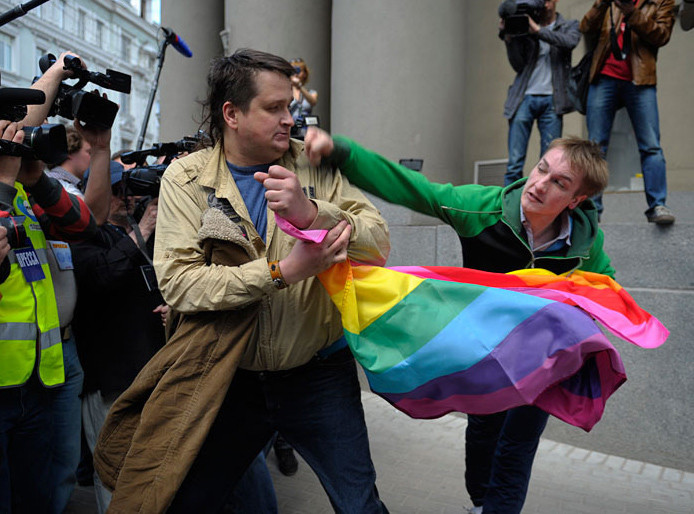
More than two dozen activists were detained in Moscow on Tuesday as they were protesting a bill that stigmatizes the gay community and bans the giving of information about homosexuality to children.
The protesters attempted to rally outside the Russian State Duma before what is expected to be a final vote on the bill banning “propaganda of nontraditional sexual relations.”
Police moved in after supporters of the bill started showering the protesters with eggs and water. Some of the protesters who were not detained were viciously attacked by masked men on a central street a mile away.
The Kremlin-backed legislation imposes hefty fines for providing information about the lesbian, gay, bisexual and transgender community to minors or holding gay pride rallies.
Russia is also considering banning citizens of countries that allow same-sex marriage from adopting Russian children.
Lawmakers changed the wording of “homosexual propaganda” to “propaganda of nontraditional sexual relations,” which backers of the bill define as “relations which are not conducive to procreation.”
Breaching the law carries a fine of up to 5,000 rubles ($156) for an individual and up to 1 million rubles ($31,000) for media.
Earlier Tuesday a dozen anti-gay activists picketed the Duma. One of them held a poster that read: “Lawmakers, protect the people from perverts!”
The bill has been seen as Putin’s attempt to consolidate his support base which includes many conservative Russian Orthodox voters.
Russian and foreign rights activists have decried the bill as violating basic rights. Human Rights Watch on Monday said the bill would “infringe Russian citizens’ freedom of expression and information, and discriminate against Russia’s LGBT community.”
Russian officials have rejected criticism. Foreign Minister Sergey Lavrov defended the bill in February, saying that Russia does not have any international or European commitment to “allow propaganda of homosexuality.”
Russia decriminalized homosexuality in 1993 but anti-gay sentiment is still high. – AP
This website uses cookies to improve your experience. We'll assume you're ok with this, but you can opt-out if you wish. Cookie settingsACCEPT
Privacy & Cookies Policy
Privacy Overview
This website uses cookies to improve your experience while you navigate through the website. Out of these cookies, the cookies that are categorized as necessary are stored on your browser as they are essential for the working of basic functionalities of the website. We also use third-party cookies that help us analyze and understand how you use this website. These cookies will be stored in your browser only with your consent. You also have the option to opt-out of these cookies. But opting out of some of these cookies may have an effect on your browsing experience.
Necessary cookies are absolutely essential for the website to function properly. This category only includes cookies that ensures basic functionalities and security features of the website. These cookies do not store any personal information.
Any cookies that may not be particularly necessary for the website to function and is used specifically to collect user personal data via analytics, ads, other embedded contents are termed as non-necessary cookies. It is mandatory to procure user consent prior to running these cookies on your website.