US military to consider transgender soldiers

The US military will consider opening its doors to transgender people who are currently banned from service and can be booted out if discovered, Pentagon chief Ashton Carter said Monday.

The secretary of defense made the revelation as he unveiled a working group that will be studying the issue during the next six months.

“The Defense Department’s current regulations regarding transgender service members are outdated and are causing uncertainty that distracts commanders from our core missions” he said in a statement.

As a result, the Pentagon “will create a working group to study over the next six months the policy and readiness implications of welcoming transgender persons to serve openly,” he said.

In the United States, despite the 2011 repeal of the divisive “Don’t Ask, Don’t Tell” law, which banned gays from serving openly, transgender people have remained banned.

“At my direction, the working group will start with the presumption that transgender persons can serve openly without adverse impact on military effectiveness and readiness, unless and except where objective, practical impediments are identified,” Carter said.

“We have transgender soldiers, sailors, airmen and Marines — real patriotic Americans — who I know are being hurt by an outdated, confusing, inconsistent approach,” he added.

Source: AFP

Cubans show pride in their rainbow nation

More than 1,000 gay, lesbian and transgender Cubans marched through Havana on Saturday, proudly displaying their truest selves for a day in a society where they still endure discrimination.

The Eighth Annual March against Homophobia and Transphobia took on extra meaning this year for about 20 couples who participated in a “Celebration of Love,” symbolically exchanging vows as same-sex marriage remains illegal in Cuba.

Religious figures from Cuba and abroad huddled with couples in a crowded pavilion in a ceremony inspired by the mass wedding of more than 100 couples at the World Pride event in Toronto last June.

“Our family accepts us but society doesn’t,” said Raul Orta, who “married” his partner of 13 years, Yaimel Medina. “If one us is no longer here tomorrow, the other one loses everything. That’s not right.”

The parade, with the beat of conga drums and the waving of rainbow-colored banners, gave gay Cubans and their supporters a rare opportunity to celebrate without fear.

“For eight years we’ve been living a dream we never thought would have been possible,” Orta said of the parade.
For Cubans from the provinces, the open display in Havana was even more liberating.

“In the interior of the country, you couldn’t even dream about an event like this,” said Raiza Marmol, who moved from Camaguey two years ago and exchanged vows with her partner of two years, Yatiana Garcia. “It’s a unique event and surprising for gays who can show their faces without having to hide from anyone.”

Cuba once sent gays to labor camps in the early years after the 1959 revolution, which retired leader later Fidel Castro admitted was wrong.

Cuban gays have made great strides in recent years with help from Mariela Castro, the daughter of current President Raul Castro and niece of Fidel. She is a member of the National Assembly and head of the National Center for Sex Education.

The National Assembly last year approved a labor law that banned discrimination based on sexual orientation. But Mariela Castro voted against the law in an extremely rare and possibly unprecedented dissenting vote because the law did not also ban discrimination based on gender identity.

Elsewhere in Latin America, Argentina and Uruguay have legalized same-sex marriage, as has Mexico City, but in Cuba marriage remains a distant goal.

“It’s not important for us to be first. It’s important to get there,” Mariela Castro told reporters.

Source: Reuters

US support for gay marriage hits record high

Support for same-sex marriage in the United States has soared to a record 60 percent, a new Washington Post-ABC News poll released Thursday said.

The poll was conducted a week ahead of historic US Supreme Court hearings on whether the Constitution allows state restrictions on recognizing the legality of same-sex marriage. The country’s highest court is expected to debate the issue April 28.

The court will review cases from four states — Michigan, Ohio, Kentucky and Tennessee — where injunctions on same-sex marriage were overturned by federal courts of appeals.

In March, the Obama administration filed a brief with the Supreme Court stating the White House opinion that it is unconstitutional to ban same-sex marriage.

In 2013, the Supreme Court ruled that the Defense of Marriage Act (DOMA) signed in 1996 by former US President Bill Clinton which prevented the federal government from recognizing same-sex marriages legalized by states was unconstitutional.

Source: Sputnik News

Ilana Mercer: Get off your knees, Gov. Pence! (you’re not in a gay bathhouse)

Pretend the U.S. is as free as the Founding Fathers intended it to be. In this authentically (and classically) liberal America, no one can tell free men and women what to do with their property, namely their bodies, their abodes and their businesses.

The individual living in America as it was meant to be is free to run his business as he wishes, associate with those he likes, dissociate from those he dislikes or disapproves; hire, fire, rent to or evict from, invest and disinvest, speak and misspeak at will.

ilana_nuut2This hypothetical free man is at liberty to bruise as many feelings as he likes, so long as his mitts stop at the next man’s face. So long as he harms nobody’s person or property, our mythic man may live as he wishes to live.

Americans have been propagandized for so long; they no longer grasp the basic building blocks of liberty. A crude reductio ad absurdum should help:

A retail store selling Nazi memorabilia opens its doors in my neighborhood. I enter in search of the yellow Star of David Jews were forced to wear during the Third Reich. The proprietor, decked out in Nazi insignia and regalia, says, “I’m sorry, we don’t serve Jews.” “Don’t be like that,” I say. “Where else can I find a pair of clip-on swastika earrings?” The Nazi sympathizer is polite but persistent: “Ma’am, I mean no disrespect, but back in the Old Country, Jews murdered my great grandfather’s cousin and used his blood in the leavening of the Passover matzah.” “Yeah,” I reply. “I’m familiar with that blood libel. I assure you my own mother’s matzo balls were free of the blood of brats, gentile or Jewish. No matter. I can see where you’re coming from. I’m sorry for your loss. Good luck.”

There! Did that hurt?

Did I rush off to rat out my Nazi neighbor to the Civil Rights Division of the Department of Justice? Not on your life. A principled Jewish libertarian (with a sense of humor)—who believes in absolute freedom of association and the rights of private property—would doff his Kippah and walk out.

Similarly, if a restaurant refused to serve a gay family member and her partner; why would we wish to compel its sincere owners to wait on us? Why make them uncomfortable? Why not take our business where it’s wanted?

Ultimately, anti-discrimination law banning the private discrimination just described is inconsistent with freedom of association and the right of private property.

“That right to discriminate is the very essence of freedom,” remarks Roger Pilon of the Cato Institute. “That’s why people came to this country, to escape forced associations—religious, economic, political, or otherwise.”

Not all jurists have a good understanding of liberty.

While poor, hapless Governor Pence has a far better handle on freedom than legal positivist Judge Andrew Napolitano—the Judge condemned the spirit of a law that grants a defendant a legal standing to argue his case in a court of law—Pence lacks the TV persona’s bombast.

Get off your knees Gov. Pence; you’re not in a gay bathhouse (where only gays are, presumably, welcome). Muster a coherent defense of the bedrock of a free republic—and of civilization itself: the rights of private property and freedom of association.

Why do men like Mr. Pence, who understand these principles all too well, buckle before a mob of lobotomized tyrants with the intelligence of a Miley Cyrus?

I’ve read Indiana’s Religious Freedom Restoration Act. I believe the relevant section is a modest thing: “… the court or other tribunal shall allow a defense against any party and shall grant appropriate relief against the governmental entity.”

This small clause came as a surprise, unaware as I was that American courts deny a manifestly religious defendant the right to mount a faith-based defense. The legal defense reclaimed by the Indiana law is thus almost pitiful. How illiberal have U.S. courts become if a defendant has no legal standing to argue his religious convictions?

Canada operates an extra-judiciary Human Rights Tribunal that, likewise, affords its victims none of the traditional defenses Canadian courts usually allows. For example, mens rea, or criminal intention—the absence of the intent to harm—is no defense in this Tribunal. Neither does “truth” qualify as an argument in a “court” that prosecutes thought crimes. If he denies the Holocaust, a defendant in these Canukistan courts cannot assert a sincere belief in this conspiracy.

The absence of due process in Canada’s Human Rights apparatus makes it one of the most oppressive instruments at the state’s disposal. Not for nothing is it referred to as a Kangaroo Court.

And it is a Kangaroo Court that says yes to the Twinkie Defense, and no to the faith-based defense.

© 2015 by Ilana Mercer Like Ilana Mercer’s Facebook page Read Ilana in German on Junge Freiheit.

Daughter of gay parents slams gay marriage

A woman raised by two lesbians has provoked controversy after publicly announcing that she is against gay marriage because she says she missed out on having her father in her life when growing up.

Heather Barwick, a 31-year-old mother-of-four from South Carolina, says her mother left her father when she was 2 or 3 so that she could move in with the woman she loved.

‘Gay community, I am your daughter. My mom raised me with her same-sex partner back in the ’80s and ’90s,’ writes Barwick for the conservative publication The Federalist.

‘I’m writing to you because I’m letting myself out of the closet: I don’t support gay marriage. But it might not be for the reasons that you think. It’s not because you’re gay. I love you, so much. It’s because of the nature of the same-sex relationship itself.’

Barwick recalls growing up in a very liberal and open-minded suburb surrounded by a ‘tight-knit community of gay and lesbian friends’ and says her mother’s partner ‘treated me as if I was her own daughter’.
She also admits that her biological father ‘wasn’t a great guy,’ and ‘didn’t bother coming around anymore.’

Despite being an advocate for gay marriage in her 20s, Barwick now says she’s had a change of heart.

‘Same-sex marriage and parenting withholds either a mother or father from a child while telling him or her that it doesn’t matter. That it’s all the same. But it’s not,’ she writes.

‘A lot of us, a lot of your kids, are hurting. My father’s absence created a huge hole in me, and I ached every day.

Speaking to Christian publication World, Barwick said she only found healing for her ‘father wound’ after she began attending church with her future husband.

Barwick said there had been long-term consequences to going up with two mothers.

‘I’m not gay, but the relationship that was modeled before me was a woman loving a woman. So I’ve struggled as an adult figuring out how to be in a relationship with my husband.’

Barwick is also one of six people raised by gay parents who signed a public letter of support this week for designers Dolce & Gabbana following their controversial statements about gay parents.

Source: Daily Mail

Get ‘diverse’ or else, British govt tells filmmakers

On screen, at least one lead character must be ‘positively reflecting diversity’

Movie companies have been told they must meet new targets for ethnic minority, gay and female characters on screen to be eligible for future funding from the British Film Institute.

The BFI, Britain’s largest public film fund, announced a “Three Ticks” scheme to ensure diversity in films and behind the scenes as it set out new rules for funding.

Under the system, to be implemented in September, films must “tick” at least two of three criteria: on-screen diversity; off-screen diversity and “creating opportunities and social mobility”.

The BFI, which allocates lottery funding and invests more than £27 million in film production, sales and distribution, supports about 30 new projects a year. It backed The King’s Speech and Philomena.

The new rules will compel filmmakers to place “diverse” actors and subjects at the forefront of their projects, as well as ensuring minority workers are represented on set and in the crew.

On screen, at least one lead character must be “positively reflecting diversity”, with the story more likely to receive funding if it “explicitly and predominantly explores issues of identity relating to ethnicity or national origins, a specific focus on women, people with disabilities, sexual identity, age and people from a socially disadvantaged background”.

Among the films the BFI has praised for content include Suffragette, the story of the battle for women to gain the vote, and Pride, about gay activists supporting the miners’ strike. It will ask filmmakers to ensure that at least 30 per cent of supporting and non-speaking characters are also “diverse”.

Off-screen, at least two heads of department must be from diverse backgrounds, as well as a range of “key creatives” including the director, screenwriter, composer and cinematographer.

The third category requires companies to offer paid internships and jobs to “new entrants from diverse backgrounds” and to help them progress.

“Three Ticks” is likely to raise fears about compromising scripts’ authenticity, with period dramas less likely to naturally represent “diverse backgrounds”.

A spokesman for the BFI insisted all films would have the opportunity to meet the criteria, with even those not fulfilling them onscreen able to “tick” the other two sections.

Ed Vaizey, the culture minister, praised the initiative as helping to “raise the bar”, adding that he would like to see all television, film and performing arts companies following the BFI’s example.

Amanda Nevill, the CEO of the BFI, said it was “vital” to reflect British society in order to stay relevant and said the announcement “is just the beginning”.

Last month, the BBC announced it would ensure one in seven actors and presenters will be either black, Asian or ethnic minority in the next three years.

At the time, critics including Philip Davies, the Conservative MP, called it “absolutely ridiculous” political correctness, saying that all recruitment “should be done on ability”. – Daily Telegraph

‘Obama gay, Michelle a tranny’

Joan Rivers calls President Obama “gay” and describes Michelle Obama with a homophobic slur.

Asked by a street reporter whether a gay president or a female president will take office first, Rivers replied, “We already have it with Obama.”

“You know Michelle is a tranny,” she went on. “A transgender. We all know.”

Rivers officiated a gay wedding on Monday.


Gay man gang-raped

rape7A 20-year-old gay man was gang-raped and his mattress burned in Roodepan near Kimberley, Northern Cape police said on Monday.

He was raped in the early hours of Sunday at a house in Lerato Park, Lieutenant Sergio Kock said.

Asked if this had been a homophobic attack, Kock said: “We cannot confirm if it was a homophobic attack or not, that we can’t say really.”

Five men allegedly forced their way into the house where the man was with his boyfriend. The boyfriend managed to escape. The men allegedly took turns raping him.

“It is further alleged that the suspects set alight a mattress inside the house and later fled the scene.”

No one had been arrested.

‘It’s fine to be homophobic’

Museveni has South African supporters
Museveni has many South African supporters

A business journalist has been forced to apologise for contravening his employer’s social media policy after he tweeted “it’s fine to be homophobic”.

Arabile Gumede was responding to the anti-homosexuality bill Uganda President Yoweri Museveni has signed into law.

Gumede tweeted: “I think it’s fine to be homophobic, but to imprison someone for life because of their sexual preference is quite hefty.”

He continued: “Imprisoning a homosexual for life is like killing a squirrel cause it stole your cashews.”

Power FM presenter Eusebius McKaiser tweeted in response : “Why on earth is homophobia OK dude? Is it OK to be racist as long as I don’t beat you to a pulp?”

Gumede replied: “It actually is.”

Head of News at eNCA, Patrick Conroy, said: “We do not condone discrimination in any form.”

Damon Boyd, Social Media Editor at eNCA, said Gumede would be “disciplined in terms of our social media policy” which forbade “any form of racism, sexism, religious bigotry or prejudice on grounds of sexual orientation by eNCA staff”.

Gumede wrote in his apology: “I would like to pass on my sincerest apologies for my tweet. My hope was to relay a message that no one should impose their views on others either through death or any harm no matter what their views are on any social, judicial, economic or environmental issues. I am truly sorry, and take full responsibility for my actions.”

Source: timeslive

Protest at G20 in Russia about ‘gay discrimination’

Russian gays protest

Spaced out along St. Petersburg’s main thoroughfare, about a dozen human rights activists staged individual protests to attract the attention of leaders of the world’s biggest economies to human rights violations in Russia.

Activist Iosiph Skakovsky said they held individual protests because mass protests are often banned or disrupted by police.

Activist Natalya Tsymbalova was protesting “discrimination of sexual minorities, falsification of elections, pressure on NGOs, violation of the freedom of public assembly.”

Her handmade poster said that Russian President Vladimir Putin’s claim that gays are not discriminated against was a lie. “There is discrimination. Speak out for Russia!”

A new Russian law banning gay propaganda aimed at minors has drawn international criticism.

Police checked the documents of individual protesters but did not interfere in their actions. – AP

Russia to vote on bill that bans informing children that gay people exist

More than two dozen activists were detained in Moscow on Tuesday as they were protesting a bill that stigmatizes the gay community and bans the giving of information about homosexuality to children.

The protesters attempted to rally outside the Russian State Duma before what is expected to be a final vote on the bill banning “propaganda of nontraditional sexual relations.”

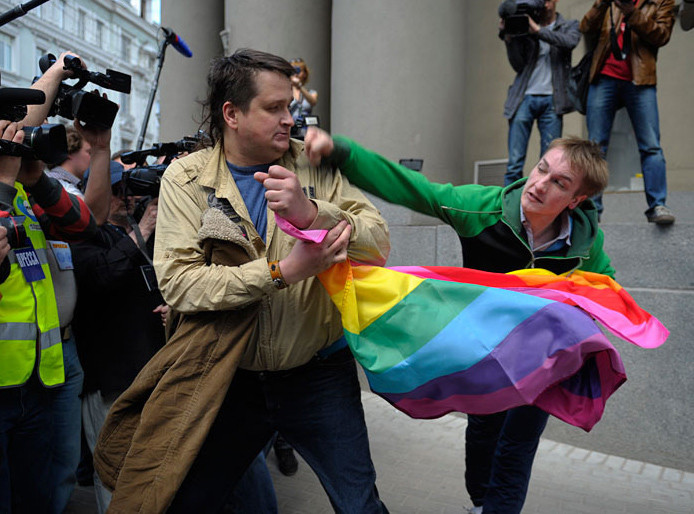
Police moved in after supporters of the bill started showering the protesters with eggs and water. Some of the protesters who were not detained were viciously attacked by masked men on a central street a mile away.

The Kremlin-backed legislation imposes hefty fines for providing information about the lesbian, gay, bisexual and transgender community to minors or holding gay pride rallies.

Russia is also considering banning citizens of countries that allow same-sex marriage from adopting Russian children.

Lawmakers changed the wording of “homosexual propaganda” to “propaganda of nontraditional sexual relations,” which backers of the bill define as “relations which are not conducive to procreation.”

Breaching the law carries a fine of up to 5,000 rubles ($156) for an individual and up to 1 million rubles ($31,000) for media.

Earlier Tuesday a dozen anti-gay activists picketed the Duma. One of them held a poster that read: “Lawmakers, protect the people from perverts!”

The bill has been seen as Putin’s attempt to consolidate his support base which includes many conservative Russian Orthodox voters.

Russian and foreign rights activists have decried the bill as violating basic rights. Human Rights Watch on Monday said the bill would “infringe Russian citizens’ freedom of expression and information, and discriminate against Russia’s LGBT community.”

Russian officials have rejected criticism. Foreign Minister Sergey Lavrov defended the bill in February, saying that Russia does not have any international or European commitment to “allow propaganda of homosexuality.”

Russia decriminalized homosexuality in 1993 but anti-gay sentiment is still high. – AP