The University of the Free State announced yesterday that the historical statue of M.T. Steyn, the last president of the former Boer Republic that came to an end in 1902 is to be “relocated off campus”. In recent years, the university has been prone to antiwhite sentiment, including attacks on statues representing white people.
According to a statement released by the university, “Council furthermore requested that the relocation must be done in complete cooperation
with the family of President MT Steyn. The decision of the Council follows a recommendation made by the ‘Special Task Team’ in a report to the Rector and Vice-Chancellor, Prof Francis Petersen, that the statue should be relocated to a site off campus.”
Prof Francis Petersen (left) making the announcement last night that MT Steyn’s statue will be removed
“The decision was not taken lightly, but I believe that it was in the best interest of the university,” said Prof Petersen. The “Special Task Team” was appointed earlier this year by Prof Petersen “to develop and implement a framework on engaging with a process to review the position of the
statue in front of the Main Building on the Bloemfontein Campus.”
Black students and communist radicals started to object to the MT Steyn statue as far back as 2003, and objections to “the statue of the white man” were again raised during a University Assembly on 28 April 2015. In
January 2018, the university’s Integrated Transformation Plan (ITP) work stream dealing with “Names, Symbols and Spaces” embarked on a process of “reviewing how space and symbolic representation facilitates or hinders social inclusion in a diverse community”. Representations of white people were seen as “hindering diversity”, therefore the MT Steyn statue had to go as “a priority”.
On 8 March 2018, the black-dominated Student Representative Council (SRC), once again asked for the MT Steyn statue “to be removed”. Prof Francis Petersen, a radical coloured academic that used to be with the Cultural-Marxist-infested University of Cape Town, and then nominated to be vice-chancellor and principal of the rural University of the Free State, “acknowledged the urgency of the matter and appointed the Special Task Team to review the position of the statue”.
According to Prof Petersen, the relocation of the statue to a site off campus
will best serve the university’s vision for the future. “This includes ensuring that the UFS is a place where everyone feels welcome, where
diversity is encouraged and celebrated, where concepts such as
decolonialisation are challenged in an academic and realistic
way, and where integration is accomplished in a holistic manner
– as reflected in the ITP,” he said.
The Integrated Transformation Plan (ITP) of the university is meant to “racially transform” the institution in keeping with the overal “transformation” ideology of the ruling ANC-terrorist regime of South Africa. According to the university, “as established in the ‘Names, Symbols and Spaces’ work stream of the Integrated Transformation Plan, the university’s statues, artworks, names, and memorabilia should facilitate social inclusion in a diverse community and reflect a transformed university. The visual and spatial environments should also promote inclusivity and non-racialism. Keeping the statue in its current position – elevated and central, in front of the building that houses the university’s executive management– does not align with the core principles of inclusivity and diversity.”
“In fact, a large proportion of our student body is feeling unwelcome (at least in the specific space in front of the Main Building), as it represents a period in history that they do not feel part of… A comprehensive approach and coherent process will be implemented to reconceptualise the space in front of the Main Building. Members of the Special Task Team will form part of the reconfiguration process,” said Prof Petersen.
A American woman in the US hurls a stream of abuse at a parking attendant for a few minutes over a $15 garage fine – and there are so many swear words it would make even the most hard-boiled men wince.
The woman and her girlfriend arrived at the garage on Broadway in New York seven minutes late to collect their car and were slapped a $15 fine.
Instead of coughing up, one of them went berserk and turned the air blue. In the three-minute clip, the woman keeps humiliating the man who is not shown.
She lashes out at the attendant accusing him of poor English skills, being a looser and mocking his place of birth and job.
“Why don’t you learn to speak English? You f**king idiot! You’re garbage! You’re a piece of s**t!” she keeps on shouting for several minutes.
No one present at the scene tried to bring the woman to reason and curtail her ethnocentric rant.
One of the safest Labour seats in Britain is its most non-white one, East Ham. It has been in Labour hands since it was formed in 1997 and will vote Labour again tomorrow in Britain’s general election. Its MP, Stephen Timms, was once stabbed by one of his constituents, Roshonara Choudhry, a 21-year-old student, who “was inspired by an al-Qaida cleric and wanted to punish Timms for voting in favor of the Iraq War”. The Labour MP downplays the incident and simply wants to represent his “diverse” ward.
Mona Chalabi writes:
There are two mosques on Church Road. I arrive at one of them just after prayers have finished one afternoon in early April, and as I peer my head around the entrance, I see a man hopping on one leg dressed in a black parking inspector’s uniform. He slips his foot into a black regulation shoe that he left on the grid of shelves that line the lobby when he went in to pray.
“Do you have time to talk to me about the election?”
“Nah, sorry,” he replies. “I’m still on my shift.”
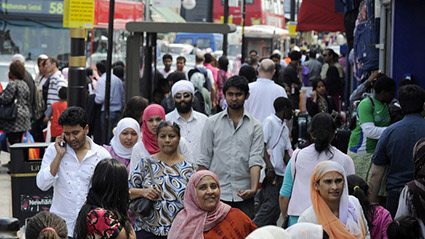
I step back outside so that I’m not in the way of the men silently filing out of the mosque. One tall man with a round stomach slowly passes me in a beige salwar kameez, his sandals flapping behind him as he talks quietly into a cell phone. I don’t recognize the language, but I’m hardly surprised — I am, after all, in East Ham. Only 58.6 percent of people in Newham, the local authority where East Ham is found, reported English as their main language in the 2011 census, the lowest share of anywhere in England and Wales.
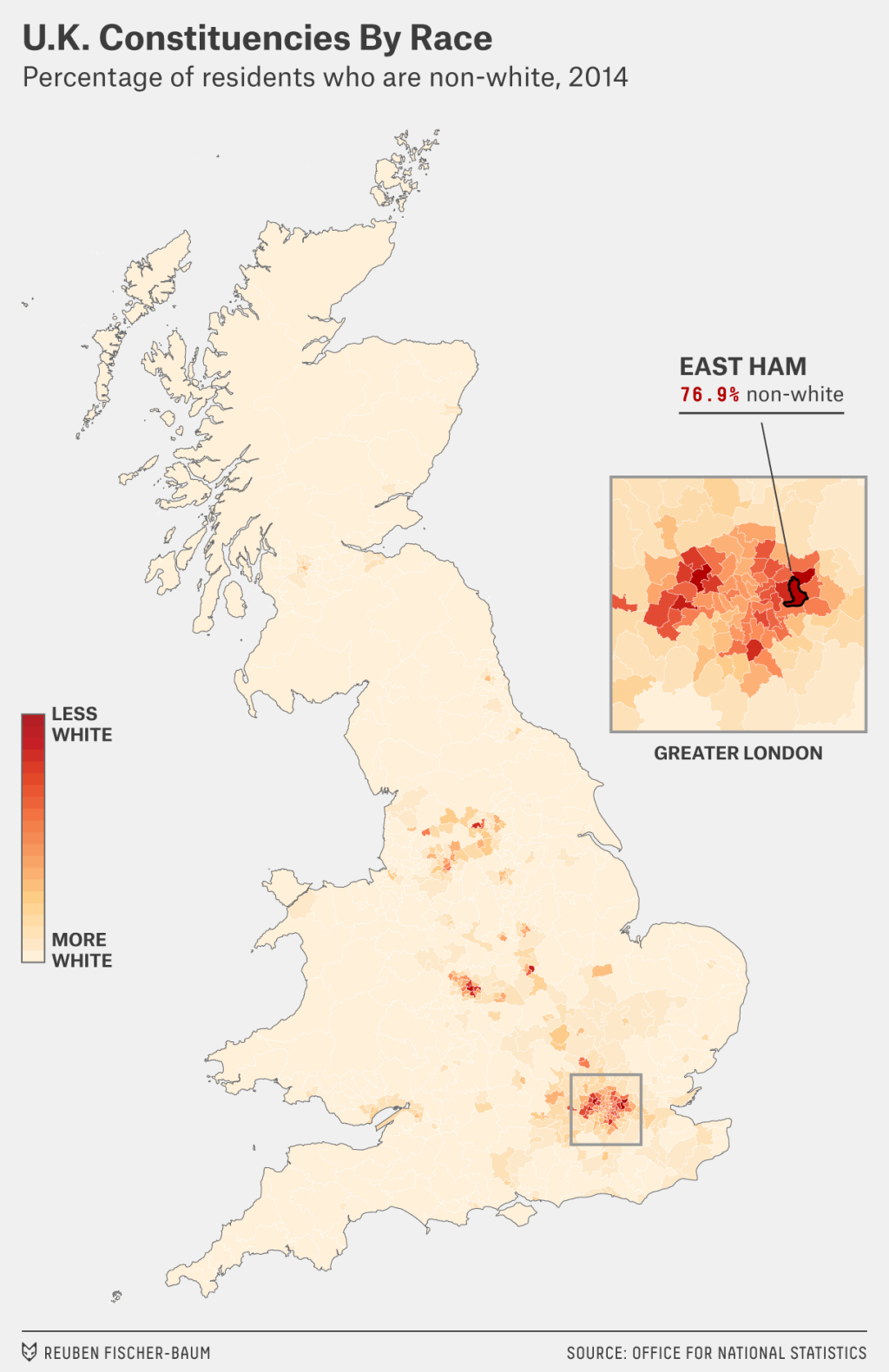
I’m here because the residents of this East London constituency make this place an outlier in a number of ways. This is the U.K.’s most ethnically diverse constituency and one of its most religious areas. It has the highest number of residents who were born abroad — 83,223, according to the 2011 census. And, according to the Office for National Statistics (ONS), 77 percent of the population here is non-white, the highest share of anywhere in the country. The median across the U.K.’s 650 constituencies is just 5.2 percent non-white.
In other words, this place sticks out statistically.
Understanding those numbers is important in explaining why this is one of the safest Labour seats in the country. East Ham has been represented by a Labour member of Parliament (MP) since the seat was formed in 1997. In the 2010 general election, Labour won 70 percent of the vote here and is projected to win 69 percent on May 7.
But while residents here are a key part of this political continuity, they’re also in some ways the focus of calls for political change. Race and religion are rarely explicit talking points in U.K. politics, but they’re often implicit when the topic of immigration comes up — as it now so often does.
That evening, the first of two debates is aired on national television. Leaders of the seven largest political parties take to podiums to present their visions for the country, debate them and take a handful of questions from members of the audience. Race doesn’t come up once, but immigration features heavily. The politicians exchange insults about inaction and make promises about immigration policies. If those policies were different — and most of the party leaders say they should be — maybe East Ham wouldn’t look the way it does now.
In 1999, my mum started working in East Ham as a general practitioner in a National Health Service medical practice that was made up of two small terraced houses with one wall between the two knocked down. Each summer, after a few weeks of holidays had passed and the boredom had become unbearable, my best friend and I would go to the surgery to help out. We would prepare new files for new patients in a waiting area that had once been a living room. There were always new files to make because there were always new patients. Six years ago, the surgery moved to a much larger multi-story, multi-practice building half a mile away to cope with increasing demand.
Between the 1991 and 2011 censuses, the population of Newham grew 42 percent. That growth has been almost exclusively non-white, as the Centre on Dynamics of Ethnicity at the University of Manchester shows below.
Newham’s largest non-white groups reported in the 2011 census were Indian (13.8 percent of people), African (12.3 percent) and Bangladeshi (12.1 percent) — but it’s a long list.3
There’s no data on race and voting patterns at the constituency level, but it’s safe to say that the high share of ethnic minorities here has driven Labour’s success in East Ham. Between May and August 2010, the Ethnic Minority British Election Study asked almost 4,000 voters nationally who they had chosen in the general election that May. Of Brits who were ethnic minorities, 68 percent supported Labour; that compares with 31 percent of whites.
RACE
LABOUR
CONSERVATIVE
LIBERAL DEMOCRAT
African
87%
6%
6%
Caribbean
78
9
12
Bangladeshi
72
18
9
Indian
61
24
13
Pakistani
60
13
25
White
31
37
22
And religiosity in the area has probably played a role, too. Newham is the least irreligious place in the country: Only 9.5 percent of residents say they have no religion, compared with 24.7 percent in England. That’s partly because the share of the population that is Hindu is six times larger in Newham than it is at the national level — the same is true of the Muslim population.
Between February and March of last year, the British Election Study conducted a national survey on the attitudes of religious groups. Among those who said their religion was Islam, 73 percent said they would vote Labour. It’s a strikingly high figure — only 40 percent of those with no religion and 32 percent of Anglicans said they would vote Labour (the largest and second-largest groups of respondents, respectively).
FAITH
LABOUR
CONSERVATIVE
LIBERAL DEMOCRAT
UKIP
Islam
73%
15%
7%
1%
Sikhism
64
15
6
6
Hinduism
58
31
3
6
Roman Catholic
45
30
5
13
None
40
27
11
12
Buddhism
38
25
7
14
Baptist
37
32
10
16
Presbyterian
35
25
5
8
Methodist
35
41
11
10
Anglican
32
39
8
18
Judaism
30
46
5
12
Stephen Timms, who has represented East Ham in Parliament since 1994,4 is well aware that he represents an incredibly diverse constituency. He’s also probably well aware that the racial and religious makeup of his constituency has helped secure his seat as a Labour MP. But it’s not just political demographics — Timms is also well-liked by his constituents. Several people I spoke to gave examples of how he had helped them personally. He votes strongly in favor of raising welfare benefits and against reducing housing benefits, issues that are especially important in this area where 42 percent of children live in poverty.
After a string of high-profile roles, most recently as shadow employment minister, Timms, 59, is now the Labour party’s “Faith Envoy” (he took up Christianity in his teens).
But this long political career, one built on a very solid electoral majority, has not been without incident.
Just a week after re-winning his seat in the last election, Timms was stabbed twice in the stomach by a constituent at an advice surgery — a regular session for MPs to hear the concerns of the people they represent. His attacker, Roshonara Choudhry, a 21-year-old student, said she was inspired by an al-Qaida cleric and wanted to punish Timms for voting in favor of the Iraq War. Aside from giving a few interviews about it, Timms finished his most recent political term without emphasizing the attempted murder.
When I call him, hours before the first leaders debate is due to air, I ask Timms, who is seeking re-election, about race in East Ham. Timms, who is white, speaks about it comfortably.
“You’d think that a very diverse place like this was kind of, by definition, a pretty fragmented community — I actually don’t think that’s the case,” he said. “I think this is actually a quite cohesive community, and I think the reason for that is the great majority of people in this area belong to something. They belong to a church or a mosque or a temple or a gurdwara.”
A thriving religious community and a high vote share for Labour don’t mean there isn’t political debate in East Ham. The U.K. Independence Party (UKIP) has a candidate standing in East Ham who is expected to get 5 percent of the vote in this election (nowhere near enough to unseat Timms, and lower than the 11 percent median vote share that UKIP is projected to get across the U.K.). Britain’s newest political force, UKIP has the strongest stance of any party on immigration — it wants the country to get out of the EU because it believes immigration is unsustainably high.
In 2010, UKIP was politically irrelevant. But the party came in first in the 2014 European Parliament elections, which was followed by two wins in U.K. by-elections. Now, UKIP is shaping the debate on immigration — and by extension, the stakes of this election. Nationally, 27 percent of voters say immigration is the most important issue facing Britain, more than any other single issue. I told Timms that even some of the immigrants I’d spoken to in East Ham were worried that immigration was too high.
“I’m not surprised you came across that,” he said. “It is sometimes a little bit surprising to listen to someone who is clearly an immigrant complaining about immigration, but people do feel quite strongly about that. … Quite a lot of Labour supporters think this is an important issue, and they need to feel that the system is properly managed and fairly.”
The Church in East Ham is now a community centre where they play disco music, unlike in the mosques in the area that are very much used for religious purposes
From the outside, Trinity Community Centre looks like a church so typical that it could be part of a toy train set, made of plastic and placed next to the pretend railway station. I’m greeted in the hallway by a suited Sikh man in a turban holding a clipboard. I tell him that I’m looking for the advice surgery. Only the staff is here today — with the election just five weeks away, Timms is busy with “other commitments.”
Someone somewhere is playing the 1994 disco hit “U Sure Do” by Strike very, very loudly. Over the man’s shoulder, I can see through a glass window — streamers hang from the ceiling, and balloons float between adults and children. I ask if it’s a birthday party, and he tells me that it’s a therapy group for children with disabilities.
A lot of community support groups meet here. If I had arrived at another time or on another day, I might have bumped into Dost, a service for refugee, asylum-seeking, trafficked, undocumented or new migrants between the ages of 11 and 25. Or I might have seen one of the adult education classes or stumbled across Bayaan, a support group that encourages young Asian girls to get into higher education.
The man with the clipboard points above his head: “The advice surgery is upstairs.”
About a dozen constituents sit on pews, waiting to speak to a member of Timms’s staff. I’m keen to hear what they think about UKIP. People here don’t all agree about UKIP; some say the party is racist, some say the party has a point on immigration, but most of these constituents tell me they will vote Labour.
There’s no data on support for UKIP by race either nationally or at the constituency level, but there is evidence that many voters are concerned about the party’s racial politics. In a survey last May, 41 percent of people said they believed UKIP was a racist party and 46 percent said they believed UKIP was “deliberately trying to attract support from racist voters.” The Guardian recently reported that “Are UKIP racist?” was the most common Google search about the party in March.
UKIP’s public policies don’t use xenophobic language, but the party’s general position on immigration and a string of racist incidents involving UKIP members can leave British voters straining for subtext.
Given all that, it seems unlikely that UKIP will be able to win over ethnic minorities in East Ham or elsewhere in Britain. But that doesn’t mean Labour can be complacent about these voters. Britain’s political landscape has changed quite rapidly — established parties now have a smaller share of the vote, and new parties like UKIP are no longer irrelevant players.
If another party emerges that can successfully disentangle race and immigration, presenting itself as neither xenophobic nor lax on border control, Labour could be in real trouble. In 2010, the party won 79 seats with a margin of victory of less than 5 percentage points. In 19 of those seats, over a quarter of the population was non-white.5 Those seats matter; they could make the difference between being in government and being out of it. Parties that want power would do well to not neglect the voters who live in places like East Ham. – Mona Chalabi for fivethirtyeight.com
A former employee of Al Jazeera America is suing the network for $15 million, alleging that a manager with close ties to top executives discriminated against female employees and made disparaging remarks about Jews and Israel.
Matthew Luke, who started with the network in 2013 ahead of its launch as supervisor of media and archive management, filed the lawsuit in New York Supreme Court on Tuesday. In it, he alleges that Osman Mahmud, who rose through the ranks to become Luke’s supervisor as senior vice president of broadcast operations and technology, removed female employees from projects, excluded women from emails and meetings and made discriminatory, anti-Semitic and anti-American remarks such as “whoever supports Israel should die a fiery death in hell.”
Not long after Luke went to human resources to report on the behavior, he alleges he was told he did not fit into the company’s culture and was fired.
In an interview with The Washington Post’s Erik Wemple, Mahmud denied the charges, calling them a “pack of lies” and if he had said such remarks more people would’ve reported them.
The network, the American arm of the popular and widespread Al Jazeera network, was launched with big budgets and great fanfare last year after buying Current TV. But the network has struggled mightily in ratings and, according to the New York Post, is starting to lay off staffers and substitute more programming from Al Jazeera English.
When Jared Milrad and Nate Johnson participated in a video about “big changes,” they had no idea their same-sex wedding plans would feature in Sunday’s campaign launch by Hillary Clinton.
Friends called to say they saw the pair walking hand in hand in what quickly became one of the most widely viewed political clips of the year.
“We were both out shopping, working on wedding invitations,” Milrad told AFP, overjoyed to be part of the Clinton rollout — and part of a large-scale change in US social attitudes.
“It shows how far we’ve come,” said the 31-year-old lawyer, pleased that public support for same-sex marriage rights has grown so far as to appear in a presidential campaign launch.
The gay couple were only one in a diverse series of aspirational Americans featured in the Clinton ad, which casts a broad demographic net as she hunts for a winning coalition of voters.
It features Spanish-speaking brothers preparing to start a business, a mother seeking to return to the work force, an Asian-American college graduate and expectant African-American parents.
“Everyday Americans need a champion, and I want to be that champion,” Clinton says. “So I’m hitting the road to earn your vote.”
Milrad was one of the featured everyday American optimists to get a speaking part, explaining: “I’m getting married this summer, to someone I really care about.”
The vibrant clip, set to snappy music and featuring Clinton for less than half the video’s length, is a dramatic departure from Clinton’s drab announcement of seven years ago.
The video which kicked off her former unsuccessful campaign showed Clinton on a couch, talking about ending the Iraq war, shrinking deficits and expanding affordable health care.
It made no mention of same-sex unions. Barack Obama, the candidate who beat her to the White House, was personally opposed to gay marriage in 2008 and only recently converted to the cause.
Hillary Rodham Clinton is running for president, leaning on a message of middle-class rescue and claims that America’s economy is ‘still stacked in favor of those at the top,’ according to a campaign video that went online Sunday afternoon.
The campaign’s official announcement to reporters, perhaps finished in haste, included an embarrassing mistake in the omission of a key word. Hillary, it said, has ‘fought children and families all her career.’
Her video makes a point of featuring same-sex couples and Hispanic citizens.
‘I’m getting ready to do something,’ Clinton says in the brief ad, following a series of clips of ordinary-looking Americans describing what they’re ‘getting ready’ for.
‘I’m running for president,’ she says.
‘Everyday Americans need a champion, and I want to be that champion.’
That message is a daring one, given Clinton’s wealth. When she left the U.S. State Department in 2013, her financial disclosure report showed that her combined net worth with her husband was between $5.2 and $25.5 million. Millions more rolled in when she published her memoirs.
She famously claimed last year that she and former president Bill Clinton were ‘dead broke’ whenthey left the White House in 2001 – when they moved into a palatial home in a tree-lined New York City suburb.
Clinton’s chief of staff John Podesta pushed a similar ‘middle-class’ message, but stepped on her announcement with his own email to a group of donors.
A race row has erupted at Nelson Mandela Metropolitan University after a project to mark 20 years of democracy in South Africa backfired.
The Port Elizabeth university’s “talking walls” project, aimed at encouraging staff and students to speak about democracy, yielded a range of offensive statements.
According to Herald Online, the white boards that served as the talking walls saw responses ranging from the silly – one student suggested free alcohol in the canteen – to the more serious “F**k whites” which fanned racial tension. Also upsetting to some was a statement that suggested fewer whites should be at the university.
The boards have been pulled off the walls and are currently lying in a passage. The offensive messages have been wiped off.
Management student Tiffany Francis, 21, said: “The past is in the past and we must work together to make the future better. They should have a disciplinary hearing to prevent it happening again”.
Marketing student Sanela Genu, 20, thought the students responsible should be expelled. “They brought the school name into disrepute.”
University spokeswoman Roslyn Baatjies said the university was saddened by the offensive comments, especially as it is presently celebrating Diversity Month.
“This behaviour is not in keeping with our core values. We would like to believe this is an isolated incident and does not reflect the feelings of the majority of staff and students.”
The comments had been written anonymously, so the university did not know who was responsible.
Historically underrepresented racial/ethnic” students be awarded ‘equitable’ grades to their counterparts, regardless
It sounds crazy on its face, but then again one comes to expect that from UW-Madison. But are they crazy enough to do race-based grading.
W. Lee Hansen, a professor emeritus of economics at UW-Madison wrote in an op-ed piece for the John William Hope Pope Center for Higher Education, a North Carolina-based think tank, about the latest “diversity” plan for the UW-System’s flagship school. The plan, completed in May, is your typical left-wing platitudes about commitments to “compositional diversity,” “equity mindedness” “representational equity” and other things for what has become a sacred cow to liberal academia.
But when you dig deeper into the definitions of these platitudes according to Hansen, you suddenly see that “representational equity” is being applied to levels never before seen.
Let us take a closer look at one of these working definitions included, namely “representational equity.”
It calls for “proportional participation of historically underrepresented racial-ethnic groups at all levels of an institution, including high status special programs, high-demand majors, and in the distribution of grades.”
We are not told exactly what adherence to this will entail. It appears to mean that directors of programs and departmental chairs will have to somehow ensure that they have a mix of students with just the right percentages of individuals who embody the various “differences” included in the definition of diversity. I cannot see how that is possible and even if it were, how it improves any student’s education.
Get all that?
UW-Madison’s diversity guidelines state that if a course, major or program is in high demand, special status must be given to ensure the make-up of the class (and thus those taking the major) is racially and ethnically diverse with “just the right percentages.” Meaning, it would be justifiable for a placement in hard-to-get-in classes and prerequisites for specific majors be awarded to students based sole on their race.
But it may be worse than that.
Especially shocking is the language about “equity” in the distribution of grades. Professors, instead of just awarding the grade that each student earns, would apparently have to adjust them so that academically weaker, “historically underrepresented racial/ethnic” students perform at the same level and receive the same grades as academically stronger students.
At the very least, this means even greater expenditures on special tutoring for weaker targeted minority students. It is also likely to trigger a new outbreak of grade inflation, as professors find out that they can avoid trouble over “inequitable” grade distributions by giving every student a high grade.
In short, the new diversity requirements seem to say that campus commitment to diversity is so important that the grading system itself must be sacrificed. This would mean, according to Hansen and others, an environment now exists where academic performance no longer matters. That for the diversity crowd, all that seems to be of value would be that “historically underrepresented racial/ethnic” students be awarded “equitable” grades to their counterparts, regardless.
If what Hansen is saying is true at UW-Madison, then it will be up to officials from the regents, to faculty, to parents and students, to begin questioning the mission statement of the university.
Are they still an institute of higher learning, or an institute of higher diversity?
On screen, at least one lead character must be ‘positively reflecting diversity’
Movie companies have been told they must meet new targets for ethnic minority, gay and female characters on screen to be eligible for future funding from the British Film Institute.
The BFI, Britain’s largest public film fund, announced a “Three Ticks” scheme to ensure diversity in films and behind the scenes as it set out new rules for funding.
Under the system, to be implemented in September, films must “tick” at least two of three criteria: on-screen diversity; off-screen diversity and “creating opportunities and social mobility”.
The BFI, which allocates lottery funding and invests more than £27 million in film production, sales and distribution, supports about 30 new projects a year. It backed The King’s Speech and Philomena.
The new rules will compel filmmakers to place “diverse” actors and subjects at the forefront of their projects, as well as ensuring minority workers are represented on set and in the crew.
On screen, at least one lead character must be “positively reflecting diversity”, with the story more likely to receive funding if it “explicitly and predominantly explores issues of identity relating to ethnicity or national origins, a specific focus on women, people with disabilities, sexual identity, age and people from a socially disadvantaged background”.
Among the films the BFI has praised for content include Suffragette, the story of the battle for women to gain the vote, and Pride, about gay activists supporting the miners’ strike. It will ask filmmakers to ensure that at least 30 per cent of supporting and non-speaking characters are also “diverse”.
Off-screen, at least two heads of department must be from diverse backgrounds, as well as a range of “key creatives” including the director, screenwriter, composer and cinematographer.
The third category requires companies to offer paid internships and jobs to “new entrants from diverse backgrounds” and to help them progress.
“Three Ticks” is likely to raise fears about compromising scripts’ authenticity, with period dramas less likely to naturally represent “diverse backgrounds”.
A spokesman for the BFI insisted all films would have the opportunity to meet the criteria, with even those not fulfilling them onscreen able to “tick” the other two sections.
Ed Vaizey, the culture minister, praised the initiative as helping to “raise the bar”, adding that he would like to see all television, film and performing arts companies following the BFI’s example.
Amanda Nevill, the CEO of the BFI, said it was “vital” to reflect British society in order to stay relevant and said the announcement “is just the beginning”.
Last month, the BBC announced it would ensure one in seven actors and presenters will be either black, Asian or ethnic minority in the next three years.
At the time, critics including Philip Davies, the Conservative MP, called it “absolutely ridiculous” political correctness, saying that all recruitment “should be done on ability”. – Daily Telegraph
Top fashion house Louis Vuitton is being sued over racism claims after a boss at a flagship store allegedly told an African employee: “Black people are slaves who eat dirt off the floor.”
Sales associate Oliver Koffi claims he was in a stock room packing a pair of shoes for a customer when his manager began the shocking race rant in front of stunned staff.
He alleged that the manager called Barack Obama a “muppet” and said America would be better off with “Miss Piggy” as its president because “Muslim people… don’t eat pork”.
Mr Koffi says he was left humiliated by the “black slaves” slur while working at the label’s store in Central London.
Details of the allegations emerged in papers which will be presented to a Central London Employment Tribunal on July 18.
Mr Koffi is suing Louis Vuitton for racist discrimination and harassment.
He claims his manager’s tone of voice was “cold and serious” as he made the comments during a discussion on the origins of the English language with him and three other members of staff in December last year.
Mr Koffi said: “During this discussion, my manager quite randomly stated that ‘black people are slaves and eat dirt off the floor’.
“This comment was grossly offensive and extremely humiliating.
“His reference to slavery in this day and age with regards to black people is quite frankly revolting.”
Mr Koffi was a contract worker at the Louis Vuitton Townhouse at London’s iconic Selfridges department store at the time of the incident.
He says he recorded the offensive comments on tape after concerns over the manager’s alleged “racist conduct”.
He added: “He went on a rant about black people and other races and religions. He jumped from subject to subject, making comments about other races and religions. He made comments about Barack Obama.
“All of his comments were derogatory and a clear illustration of his prejudices towards other races and religions.
“His comments were offensive and degrading. I confronted him about his statement that ‘black people are slaves and eat dirt off the floor’.
“I told him that I was offended by his comment. He did not deny making the comment. He apologised and claimed it was a ‘joke’. It was not a joke at all.”
Mr Koffi says the manager, who left his job following a disciplinary proceeding, had previously questioned him about his nationality, asking, “where are you originally from?” and often referred to customers by their skin colour.
He alleges that the manager’s frequent remarks about Asian people and his comments about some Louis Vuitton products being “s***” because they were “made in China” created a “hostile and intimidating” working environment.
His solicitor Lawrence Davies, of Equal Justice solicitors, said: “The case will set the 21st century bar as to what employers have to do to prevent racism in the workplace.”
Louis Vuitton accepts that the racist comment was made but defends the claim on the basis the company had taken all reasonably practicable steps to prevent the racist comment.
High-end fashion has recently faced a barrage of racism claims, with models Naomi Campbell and Imam supporting worldwide diversity campaigns.
Yesterday a spokeswoman for Louis Vuitton said: “Louis Vuitton has a zero-tolerance policy to harassment of any kind.
“This reported sentiment is in total violation of the Louis Vuitton Ethical charter.
“This issue was investigated, and the manager in question no longer works within the company.” – The Daily Mirror
A public university in Washington state is looking for advice on how to rid itself of white people.
According to Campus Reform,Western Washington University included a survey in its daily newsletter that read: How do we make sure that in future years “we are not as white as we are today?”
Several links offering additional information are listed below the question, including a link to a blog post from Western Washington University President Bruce Shepard, who believes the school will have “failed” if the number of white students remains constant in the years ahead.
Campus Reform included a quote from a 2012 Shepard address:
“Every year, from this stage and at this time, you have heard me say that, if in decades ahead, we are as white as we are today, we will have failed as university.”
The obsession with skin color is on full display in Shepard’s blog post.
“In the decades ahead, should we be as white as we are today, we will be relentlessly driven toward mediocrity; or, become a sad shadow of our current self,” he wrote in explaining his position.
It’s enough to make one wonder if white students walk around campus with their heads hung in shame, apologizing for bringing failure upon the school. How is it possible for a student not be judged by the color of their skin in an environment where their value is directly attributed to their skin pigmentation?
Pointing to the “rapidly decreasing” number of high school graduates the school has “traditionally drawn upon” — code for white people? — Shepard insists ”it’s not about keeping whites out.”
“It is about whether we will have the wisdom, the culture, the commitment, to be able to attract a sufficient number of students from diverse backgrounds,” he stated.
Meanwhile, the marginalization of white people to correct the marginalization of people of color continues unabated on college campuses across America. But then, isn’t that what critical race theory is all about?
Perhaps Western Washington University should just hang a sign it’s door that reads “whites need not apply.”
The two responses to my letter alerting people to the destructive influence of Marxism and liberalism in South Africa do not really respond to the core of my argument. (See Speak for yourself and Move on, Mr Roodt, change is good.)
Mr. Deon Crafford of Pretoria states that “we are not divided by nationalism anymore, only by economic means”. If that were the case, why are the politicians campaigning in this election not arguing over interest rates, tariffs and trade, or the minutiae of macroeconomic policy? Instead, every party has some kind of ethnic platform, whether it is “taking back the land that whites stole from us” (the EFF) or support for racial quotas in the form of so-called broad-based black economic empowerment (DA and ANC).
During the current Oscar Pistorius trial which has been turned into a mass media event, the state could not even supply a trained interpreter from Afrikaans to English in Pretoria, the epicentre of Afrikaans in South Africa and in the world! This is just another indication of the shambles we find ourselves in, with a system founded on some 1940s melting-pot dream that could only have been invented in Sweden, where everybody has blue eyes and drives a Volvo.
How low do we have to go before people acknowledge that the current system is not working and will never work because it is not suited to a multi-ethnic state? Show me one province in South Africa that does not have a premier from the locally dominant tribe and I will eat my hat. Or just appoint a few Pedis to run Kwazulu-Natal and watch what happens. That is real diversity, not the fantasy-world of beer adverts proclaiming “One nation, one beer.”
The Constitutional Court decides whether there should be same-sex marriage or Afrikaans in schools. Is that democratic? Does anyone think that a referendum on same-sex marriage will get a “yes” vote? Most South Africans have probably more in common with Uganda than with Sweden or New York State.
Mr. Vladimir Putin has become the most popular world leader since Ronald Reagan. He opposes globalism and champions national sovereignty. In a recent speech to the Duma he quoted Nikolai Berdyaev, an early Bolshevik who soon turned to a kind of Christian existentialism and conservatism. The quote was:
“‘The point of conservatism is not that it prevents movement forward and upward, but that it prevents movement backward and downward, into chaotic darkness and a return to a primitive state.”
A haunting statement, given South Africa’s descent into anomic violence, as reflected in the media every day.
A slightly shortened version of this column appeared in the Johannesburg daily Business Day.
A recent book called “Against Inclusiveness” by James Kalb suggests that “government interference in our choices is always oppressive”. This applies especially to discrimination where it is stated that “If there were no laws against discrimination, people who want to work or live together would find each other, and everyone would be happier”.
But then there are a host of “laws” for inclusiveness indeed, causing humans to conform to machine-like instructions that everybody is equal. One reference of this is where US Army Chief of Staff George Casey reacted to Nidal Malik Hassan’s Fort Hood massacre: “As horrific as this tragedy was, if our diversity becomes a casualty, I think that’s worse.” Clearly the General (no less) is mistaken when he takes for granted that people (his own troops) should die in defense of “equality” and “diversity” which has nothing to do with defending American blood and treasure.
This tragedy where a soldier shoots a brother-in arms demands further investigation because it reminds one of other cases such as in Denmark. Arabic immigrants were approved (for whatever reason), leading to the bizarre outcome that these immigrants, having literally received everything as well access to everything – refused such extreme generosity and in fact demanded “equal” treatment (as a group) i.e. they refused to assimilate. Thanks, but no thanks. Likewise in Saudi-Arabia, African and Indian immigrants are strangely enough also refused with a no thanks slur.
Australia’s prime minister also clearly repeatedly stated that immigrants to their country must accept the “Australian way”, or, leave. Thanks for considering Australia, but no thanks. Recently the Russian leader Putin confirmed that he supports the self-determination of Crimea from Ukraine (because they are Russian).
The English Monarchy was a bit slow to understand all these “little” issues between “workers”. The story of Enoch Powel, a British parliamentarian in the ‘60’s shows how his arguments came to fruition today, because he predicted the arguments “for” black/Muslim immigration as well as the effect it would have on the general population of Britain, 50 years before it happened. At the time of course, everybody said he was crazy and the Queen would not allow it, but then she did, didn’t she?
Since the black queens of South Africa are in the same league as the British Queen, they will also not understand how badly assimilation with whites (in South Africa) is going to affect them. Cecil John Rhodes was just as wrong as General Casey when he said that sowing English “wild oats” would benefit mankind. Thank you for thinking about it, but no thanks to assimilation all the same.
After more than 60 years, is the end of the road near for affirmative action in college admissions?
The idea of using race to help determine who gets a seat in public colleges has been under fire for decades. Eight states have essentially banned the practice, and a Michigan case pending before the U.S. Supreme Court could prompt others to do the same.
College officials nationwide got a wake-up call last June from the high court, which set a high bar for using race as part of a complex admissions program in Texas. Many observers say the combined weight of the two cases could finally push state universities to find another way to promote diversity.
“All the trends are pointing against the continued use of race in admissions,” says Richard Kahlenberg of the Washington, D.C.-based Century Foundation, a liberal think tank. Kahlenberg has for years advocated using family income,not race, as a way to ensure that public K-12 schools and colleges have a diverse student body.
A year after hearing Fisher, the justices last October heard arguments in a case from Michigan, where a 2006 state constitutional amendment banned racial preferences in public university admissions. Seven other states — California, Florida, Washington, Arizona, Nebraska, Oklahoma and New Hampshire — do the same, and about 29% of students live in states where affirmative action is banned, Kahlenberg estimates.
Michigan Attorney General Bill Schuette says the state’s position was summed up well by Chief Justice John Roberts, who said the best way to stop racial discrimination “is to stop discriminating on the basis of race.”
“Our constitution requires equal treatment in college admissions, which is an expression by 58% of Michigan voters in 2006 that says it is fundamentally wrong to treat people differently based on race or the color of their skin,” Schuette says. “It’s just wrong.”
A July 2013 study by Georgetown University scholars Anthony Carnevale and Jeff Strohl found that in 2009, white students were more “over-represented” among the USA’s 468 most selective colleges than they had been in 1995. From 1995 to 2009, the nationwide share of young people ages 18-24 who were white dropped 6 percentage points, from 68% to 62%. But whites’ share of freshman slots at the USA’s most elite colleges dropped just 2 points during that same period, from 77% to 75%.
Another study, by Orfield’s Civil Rights Project, found that 15 years after California’s ban on racial preferences went into effect, increased competition has dropped the share of black in-state high school graduates admitted to UCLA from 47.6% of applicants to 13.7%; the percentage of Latino students admitted dropped from 54.9% of applicants to 14.8%. The percentage of white students admitted also dropped, but not as sharply.
Kahlenberg says the string of affirmative action cases has pushed universities to find alternative ways to create diverse freshman classes. He notes that Texas’ 10% rule has resulted in higher levels of black and Latino representation. Other state systems have gotten similar results by eliminating preferences for children of alumni and bolstering financial aid, among other measures. These strategies have led to more racially and economically diverse classes “in a way the Supreme Court can’t touch,” he says. “I think that’s the future of affirmative action.”
Recent surveys have found that Americans don’t like using race in admissions, Kahlenberg says, “but on the other hand, Americans don’t want to see universities and American higher education re-segregated.”
A decision in the Michigan case, Schuette v. Coalition to Defend Affirmative Action, is expected this spring. If a majority of eight justices rule in Michigan’s favor (Elena Kagan, a former solicitor general, recused herself), it could prompt opponents of affirmative action in other states to push for similar bans.
But if the ban is overturned, states such as California again could weigh race in college admissions — and not a moment too soon, Orfield says. Admissions pressures there have become “very intense.” He notes that UCLA alone last year received nearly 100,000 applications. “It’s a big state, it’s growing … and we haven’t been growing the higher education system.” – USA Today
Contributing: Richard Wolf
This website uses cookies to improve your experience. We'll assume you're ok with this, but you can opt-out if you wish. Cookie settingsACCEPT
Privacy & Cookies Policy
Privacy Overview
This website uses cookies to improve your experience while you navigate through the website. Out of these cookies, the cookies that are categorized as necessary are stored on your browser as they are essential for the working of basic functionalities of the website. We also use third-party cookies that help us analyze and understand how you use this website. These cookies will be stored in your browser only with your consent. You also have the option to opt-out of these cookies. But opting out of some of these cookies may have an effect on your browsing experience.
Necessary cookies are absolutely essential for the website to function properly. This category only includes cookies that ensures basic functionalities and security features of the website. These cookies do not store any personal information.
Any cookies that may not be particularly necessary for the website to function and is used specifically to collect user personal data via analytics, ads, other embedded contents are termed as non-necessary cookies. It is mandatory to procure user consent prior to running these cookies on your website.